专题03 阅读词汇 (讲义)
目录
01 析·考情精解.....................................................................................................................................2
02 构·知能架构.....................................................................................................................................2
03 破·考点攻坚.....................................................................................................................................3
考点一  考查环境保护类词汇..................................................................................................3
考题动向
关键能力
命题预测
考点二 考查科学探索类词汇...........................................................................................................9
考题动向
关键能力
命题预测
考点三 考查社会体育艺术类词汇.................................................................................................15
考题动向
关键能力
命题预测
考点四 考查人物观点态度类词汇.................................................................................................20
考题动向
关键能力
命题预测
一、阅读理解环保主题考向分析
1. 考查内容拓展
从单一物种保护→全面生态系统保护:早期 (2021) 多关注单一濒危动物 (如黑犀牛),近年 (2023-2025) 扩
展至整个生态系统、气候变化、微塑料等全球性环境问题。
从环境污染→可持续发展与创新解决方案:由单纯描述污染问题 (如塑料污染),转向探讨科技环保创新
(生态机器、微塑料处理) 和可持续生活方式 (绿色出行、食物浪费减少)。
2. 命题特点变化
本土与全球视野结合:既有中国实践 (2025 全国一卷微塑料研究),也有国际案例 (2022 食物浪费、2023 灰
熊保护),引导考生关注全球环境问题的同时,增强本土环保责任感。
科技与人文融合:多篇文章 (2023 生态设计、2024 数字记录、2025 微塑料研究) 将科技创新与环保理念结
合,体现 "绿水青山就是金山银山" 的发展理念。
3. 对考生的能力要求
信息整合与批判性思维:要求考生理解复杂环保议题,分析多方观点,如保护与开发的平衡 (2023 灰熊保
护)、个人行为与全球影响的关系 (2021 塑料污染)。
学生价值观引导:通过阅读材料,引导考生树立尊重自然、保护生态的价值观,培养"生态文明建设,人
人有责"的意识。
二、科技创新与研究探索考向分析
1. 考查内容演变
从单一技术介绍→综合创新生态:早期 (2021) 多聚焦单一技术或产品 (如植物发光、废物处理),近年
(2024-2025) 扩展至创新生态系统,如医疗 + 教育融合、传统工艺 + 数字技术等跨领域整合。
从国外技术→中国创新成果:2023 年前以介绍国际研究为主,2024 年后增加中国科研成果比重,如 2025
年全国一卷的微塑料处理技术、2024 年新高考 I 卷的生物多样性研究,彰显文化自信和科技自立自强。
2. 命题特点变化
科学思维考查增强:从单纯考查信息获取,转向考查 "提出问题→分析问题→解决问题" 的完整科研思维,
如 2025 年全国一卷微塑料研究中对研究方法、数据解读、结论推导的考查。
跨学科融合:科技文章不再局限于单一学科,而是融合生物学、环境科学、医学、工程技术等多领域知识,
如 2023 年生态污水处理技术融合了生物学和环境工程。
3. 对考生能力要求提升
信息整合与批判性思维:要求考生理解复杂科技议题,评价研究方法优劣,推断结论可靠性,如 2024 年
新高考 I 卷对生物多样性数据偏差的分析。
创新意识与应用能力:通过阅读材料,引导考生思考科技如何解决现实问题,培养创新思维和实践能力,
如 2025 年全国二卷将绿植研究应用于生活的考查。
三、社会风俗文化传承考向分析
1. 考查内容演变
从单一文化元素→多元文化融合:早期 (2021-2022) 多聚焦单一文化元素 (如古城墙、茶文化),近期
(2024-2025) 扩展至多元文化融合 (如中医与西医、传统与现代科技)。
从文化介绍→文化理解→文化创新:考查层次不断提升,从简单介绍传统文化知识,到理解文化内涵和价
值,再到探讨文化创新传承方式。
2. 命题特点变化
本土文化与全球视野结合:既有中国传统文化 (如小笼包、围棋),也有跨文化交流 (如中医针灸在西方应
用、丝绸之路文化影响),引导考生树立文化自信和开放包容的世界观。
传统与现代融合:多篇文章 (2023 小笼包、2025 围棋艺术展) 探讨传统文化在现代社会的创新发展,体现
"创造性转化、创新性发展" 理念。
3. 对考生能力要求
文化理解与认同:要求考生理解传统文化内涵,增强文化自信和认同感。
跨文化交际能力:考查对不同文化的理解和尊重,培养国际视野和跨文化交流能力。
创新思维能力:引导考生思考传统文化如何与现代社会结合,在传承中创新发展。
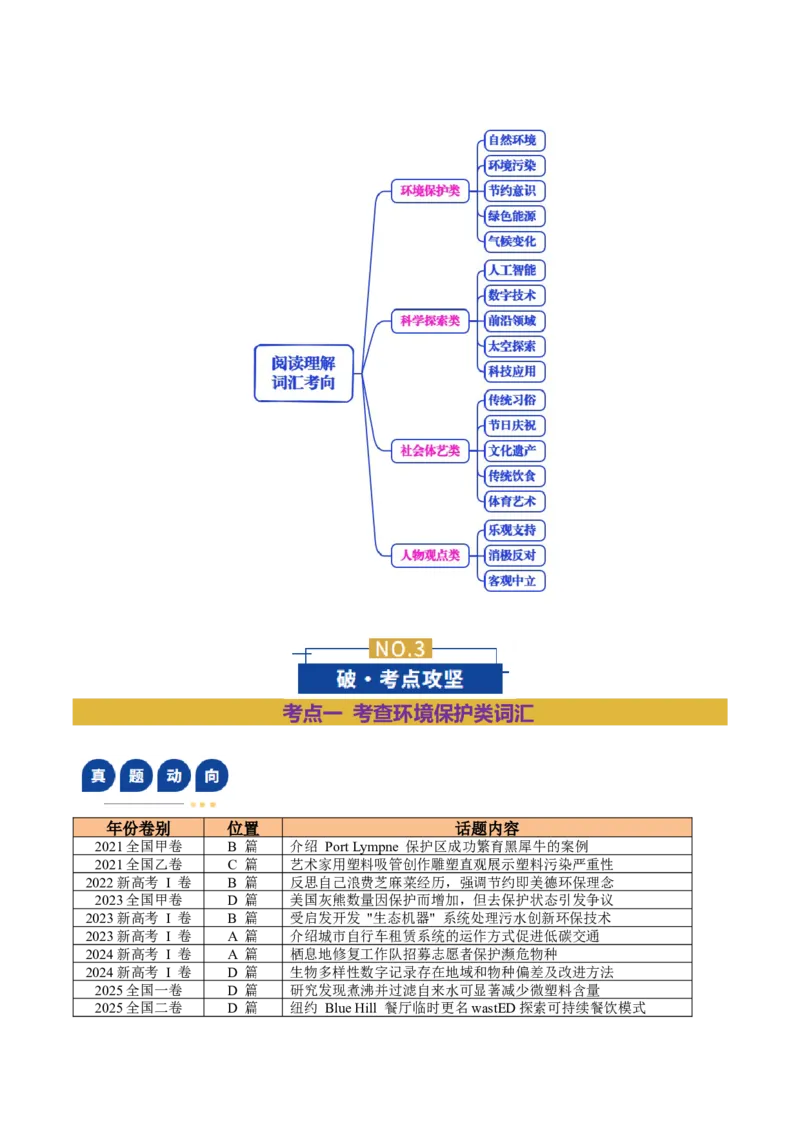
考点一 考查环境保护类词汇
年份卷别
位置
话题内容
2021 全国甲卷
B 篇
介绍 Port Lympne 保护区成功繁育黑犀牛的案例
2021 全国乙卷
C 篇
艺术家用塑料吸管创作雕塑直观展示塑料污染严重性
2022 新高考 I 卷
B 篇
反思自己浪费芝麻菜经历,强调节约即美德环保理念
2023 全国甲卷
D 篇
美国灰熊数量因保护而增加,但去保护状态引发争议
2023 新高考 I 卷
B 篇
受启发开发 "生态机器" 系统处理污水创新环保技术
2023 新高考 I 卷
A 篇
介绍城市自行车租赁系统的运作方式促进低碳交通
2024 新高考 I 卷
A 篇
栖息地修复工作队招募志愿者保护濒危物种
2024 新高考 I 卷
D 篇
生物多样性数字记录存在地域和物种偏差及改进方法
2025 全国一卷
D 篇
研究发现煮沸并过滤自来水可显著减少微塑料含量
2025 全国二卷
D 篇
纽约 Blue Hill 餐厅临时更名wastED 探索可持续餐饮模式
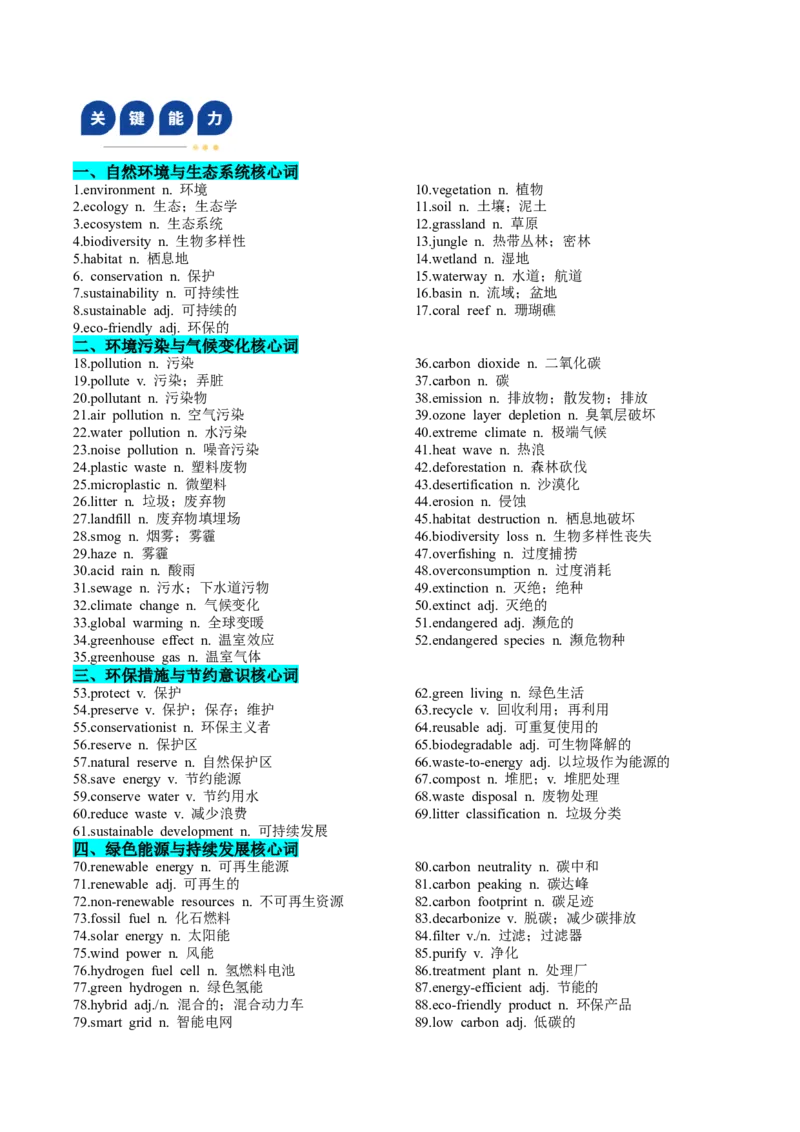
一、自然环境与生态系统核心词
1.environment n. 环境
2.ecology n. 生态;生态学
3.ecosystem n. 生态系统
4.biodiversity n. 生物多样性
5.habitat n. 栖息地
6. conservation n. 保护
7.sustainability n. 可持续性
8.sustainable adj. 可持续的
9.eco-friendly adj. 环保的
10.vegetation n. 植物
11.soil n. 土壤;泥土
12.grassland n. 草原
13.jungle n. 热带丛林;密林
14.wetland n. 湿地
15.waterway n. 水道;航道
16.basin n. 流域;盆地
17.coral reef n. 珊瑚礁
二、环境污染与气候变化核心词
18.pollution n. 污染
19.pollute v. 污染;弄脏
20.pollutant n. 污染物
21.air pollution n. 空气污染
22.water pollution n. 水污染
23.noise pollution n. 噪音污染
24.plastic waste n. 塑料废物
25.microplastic n. 微塑料
26.litter n. 垃圾;废弃物
27.landfill n. 废弃物填埋场
28.smog n. 烟雾;雾霾
29.haze n. 雾霾
30.acid rain n. 酸雨
31.sewage n. 污水;下水道污物
32.climate change n. 气候变化
33.global warming n. 全球变暖
34.greenhouse effect n. 温室效应
35.greenhouse gas n. 温室气体
36.carbon dioxide n. 二氧化碳
37.carbon n. 碳
38.emission n. 排放物;散发物;排放
39.ozone layer depletion n. 臭氧层破坏
40.extreme climate n. 极端气候
41.heat wave n. 热浪
42.deforestation n. 森林砍伐
43.desertification n. 沙漠化
44.erosion n. 侵蚀
45.habitat destruction n. 栖息地破坏
46.biodiversity loss n. 生物多样性丧失
47.overfishing n. 过度捕捞
48.overconsumption n. 过度消耗
49.extinction n. 灭绝;绝种
50.extinct adj. 灭绝的
51.endangered adj. 濒危的
52.endangered species n. 濒危物种
三、环保措施与节约意识核心词
53.protect v. 保护
54.preserve v. 保护;保存;维护
55.conservationist n. 环保主义者
56.reserve n. 保护区
57.natural reserve n. 自然保护区
58.save energy v. 节约能源
59.conserve water v. 节约用水
60.reduce waste v. 减少浪费
61.sustainable development n. 可持续发展
62.green living n. 绿色生活
63.recycle v. 回收利用;再利用
64.reusable adj. 可重复使用的
65.biodegradable adj. 可生物降解的
66.waste-to-energy adj. 以垃圾作为能源的
67.compost n. 堆肥;v. 堆肥处理
68.waste disposal n. 废物处理
69.litter classification n. 垃圾分类
四、绿色能源与持续发展核心词
70.renewable energy n. 可再生能源
71.renewable adj. 可再生的
72.non-renewable resources n. 不可再生资源
73.fossil fuel n. 化石燃料
74.solar energy n. 太阳能
75.wind power n. 风能
76.hydrogen fuel cell n. 氢燃料电池
77.green hydrogen n. 绿色氢能
78.hybrid adj./n. 混合的;混合动力车
79.smart grid n. 智能电网
80.carbon neutrality n. 碳中和
81.carbon peaking n. 碳达峰
82.carbon footprint n. 碳足迹
83.decarbonize v. 脱碳;减少碳排放
84.filter v./n. 过滤;过滤器
85.purify v. 净化
86.treatment plant n. 处理厂
87.energy-efficient adj. 节能的
88.eco-friendly product n. 环保产品
89.low carbon adj. 低碳的
五、生物多样性与保护核心词
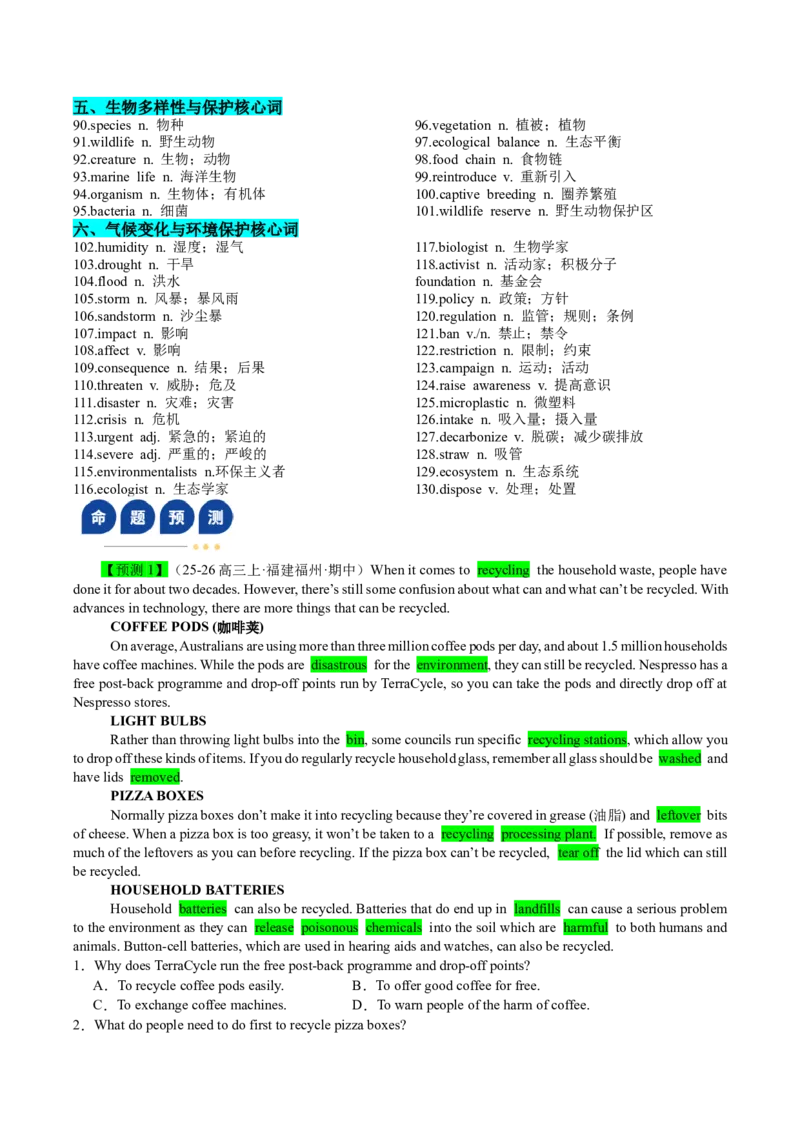
90.species n. 物种
91.wildlife n. 野生动物
92.creature n. 生物;动物
93.marine life n. 海洋生物
94.organism n. 生物体;有机体
95.bacteria n. 细菌
96.vegetation n. 植被;植物
97.ecological balance n. 生态平衡
98.food chain n. 食物链
99.reintroduce v. 重新引入
100.captive breeding n. 圈养繁殖
101.wildlife reserve n. 野生动物保护区
六、气候变化与环境保护核心词
102.humidity n. 湿度;湿气
103.drought n. 干旱
104.flood n. 洪水
105.storm n. 风暴;暴风雨
106.sandstorm n. 沙尘暴
107.impact n. 影响
108.affect v. 影响
109.consequence n. 结果;后果
110.threaten v. 威胁;危及
111.disaster n. 灾难;灾害
112.crisis n. 危机
113.urgent adj. 紧急的;紧迫的
114.severe adj. 严重的;严峻的
115.environmentalists n.环保主义者
116.ecologist n. 生态学家
117.biologist n. 生物学家
118.activist n. 活动家;积极分子
foundation n. 基金会
119.policy n. 政策;方针
120.regulation n. 监管;规则;条例
121.ban v./n. 禁止;禁令
122.restriction n. 限制;约束
123.campaign n. 运动;活动
124.raise awareness v. 提高意识
125.microplastic n. 微塑料
126.intake n. 吸入量;摄入量
127.decarbonize v. 脱碳;减少碳排放
128.straw n. 吸管
129.ecosystem n. 生态系统
130.dispose v. 处理;处置
【预测1】(25-26 高三上·福建福州·期中)When it comes to recycling the household waste, people have
done it for about two decades. However, there’s still some confusion about what can and what can’t be recycled. With
advances in technology, there are more things that can be recycled.
COFFEE PODS (咖啡荚)
On average, Australians are using more than three million coffee pods per day, and about 1.5 million households
have coffee machines. While the pods are disastrous for the environment, they can still be recycled. Nespresso has a
free post-back programme and drop-off points run by TerraCycle, so you can take the pods and directly drop off at
Nespresso stores.
LIGHT BULBS
Rather than throwing light bulbs into the bin, some councils run specific recycling stations, which allow you
to drop off these kinds of items. If you do regularly recycle household glass, remember all glass should be washed and
have lids removed.
PIZZA BOXES
Normally pizza boxes don’t make it into recycling because they’re covered in grease (油脂) and leftover bits
of cheese. When a pizza box is too greasy, it won’t be taken to a recycling processing plant. If possible, remove as
much of the leftovers as you can before recycling. If the pizza box can’t be recycled, tear off the lid which can still
be recycled.
HOUSEHOLD BATTERIES
Household batteries can also be recycled. Batteries that do end up in landfills can cause a serious problem
to the environment as they can release poisonous chemicals into the soil which are harmful to both humans and
animals. Button-cell batteries, which are used in hearing aids and watches, can also be recycled.
1.Why does TerraCycle run the free post-back programme and drop-off points?
A.To recycle coffee pods easily.
B.To offer good coffee for free.
C.To exchange coffee machines.
D.To warn people of the harm of coffee.
2.What do people need to do first to recycle pizza boxes?
A.Wash them many times.
B.Take them to the government.
C.Clear the leftovers as much as possible.
D.Return boxes to the pizza shop quickly.
3.In which section of a magazine can we read the text?
A.Health.
B.Environment.
C.Entertainment.
D.Culture.
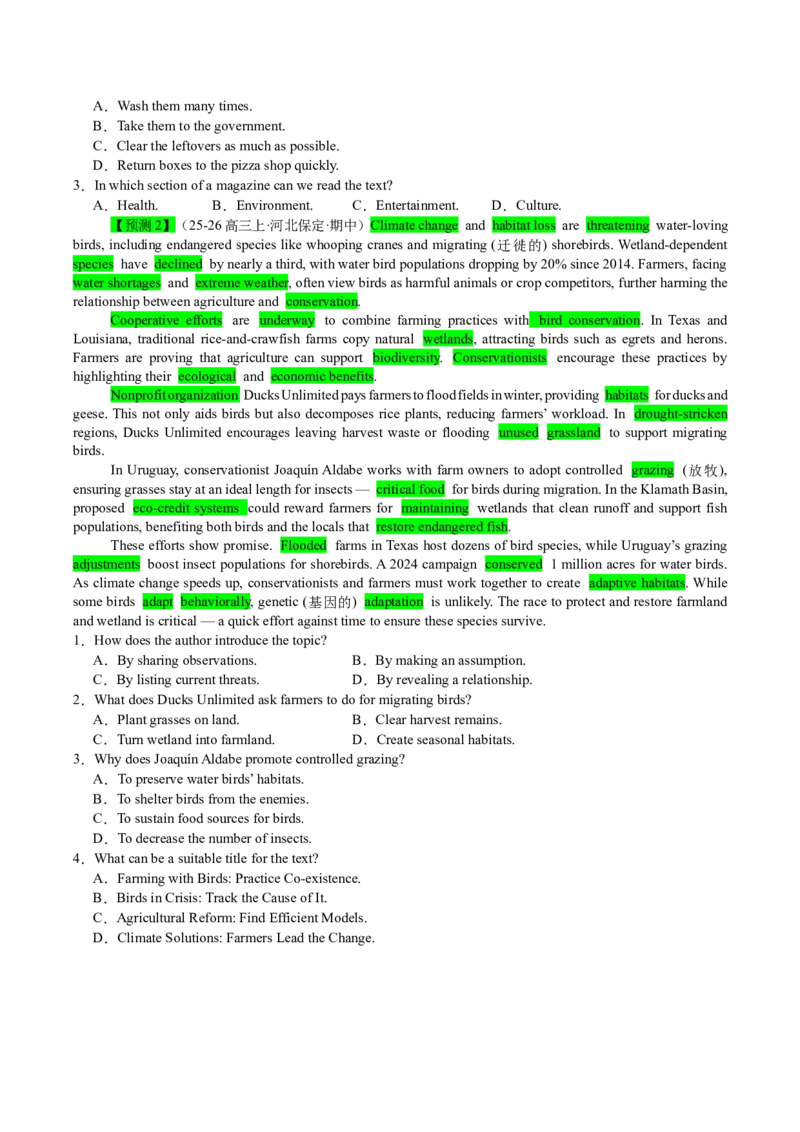
【预测2】(25-26 高三上·河北保定·期中)Climate change and habitat loss are threatening water-loving
birds, including endangered species like whooping cranes and migrating (迁徙的) shorebirds. Wetland-dependent
species have declined by nearly a third, with water bird populations dropping by 20% since 2014. Farmers, facing
water shortages and extreme weather, often view birds as harmful animals or crop competitors, further harming the
relationship between agriculture and conservation.
Cooperative efforts are underway to combine farming practices with bird conservation. In Texas and
Louisiana, traditional rice-and-crawfish farms copy natural wetlands, attracting birds such as egrets and herons.
Farmers are proving that agriculture can support biodiversity. Conservationists encourage these practices by
highlighting their ecological and economic benefits.
Nonprofit organization Ducks Unlimited pays farmers to flood fields in winter, providing habitats for ducks and
geese. This not only aids birds but also decomposes rice plants, reducing farmers’ workload. In drought-stricken
regions, Ducks Unlimited encourages leaving harvest waste or flooding unused grassland to support migrating
birds.
In Uruguay, conservationist Joaquín Aldabe works with farm owners to adopt controlled grazing (放牧),
ensuring grasses stay at an ideal length for insects — critical food for birds during migration. In the Klamath Basin,
proposed eco-credit systems could reward farmers for maintaining wetlands that clean runoff and support fish
populations, benefiting both birds and the locals that restore endangered fish.
These efforts show promise. Flooded farms in Texas host dozens of bird species, while Uruguay’s grazing
adjustments boost insect populations for shorebirds. A 2024 campaign conserved 1 million acres for water birds.
As climate change speeds up, conservationists and farmers must work together to create adaptive habitats. While
some birds adapt behaviorally, genetic (基因的) adaptation is unlikely. The race to protect and restore farmland
and wetland is critical — a quick effort against time to ensure these species survive.
1.How does the author introduce the topic?
A.By sharing observations.
B.By making an assumption.
C.By listing current threats.
D.By revealing a relationship.
2.What does Ducks Unlimited ask farmers to do for migrating birds?
A.Plant grasses on land.
B.Clear harvest remains.
C.Turn wetland into farmland.
D.Create seasonal habitats.
3.Why does Joaquín Aldabe promote controlled grazing?
A.To preserve water birds’ habitats.
B.To shelter birds from the enemies.
C.To sustain food sources for birds.
D.To decrease the number of insects.
4.What can be a suitable title for the text?
A.Farming with Birds: Practice Co-existence.
B.Birds in Crisis: Track the Cause of It.
C.Agricultural Reform: Find Efficient Models.
D.Climate Solutions: Farmers Lead the Change.
考点二 考查科学探索类词汇
年份卷别
位置
话题内容
2021 全国乙卷
D 篇
科学家通过实验使植物能够发光有望在未来替代传统照明
2021 新课标II 卷
D 篇
澳大利亚开发太阳能电力机器人提高畜牧业智能化水平
2022 新高考II 卷
D 篇
追溯香水从天然提取到化学合成的变革化学合成技术创新
2022 全国甲卷
B 篇
鹦鹉具有与人相似形状识别能力为动物智力进化提供新视角
2023 新高考I 卷
D 篇
群体智慧效应在现代社会应用价值,如市场预测、危机决策
2023 全国甲卷
C 篇
介绍3D 扫描、数字建模技术帮助保护和传承非物质文化遗产
2024 全国甲卷
B 篇
俄罗斯医疗专列有效解决了偏远地区医疗资源不足问题
2024 新高考II 卷
C 篇
新型智能键盘安全性高使用便捷为信息安全保护提供新思路
2025 全国一卷
D 篇
水中碳酸钙与微塑料原理为解决全球微塑料污染提供中国方案
2025 全国二卷
C 篇
研究表明室内绿植对人的情绪和思维有积极影响促进身心健康
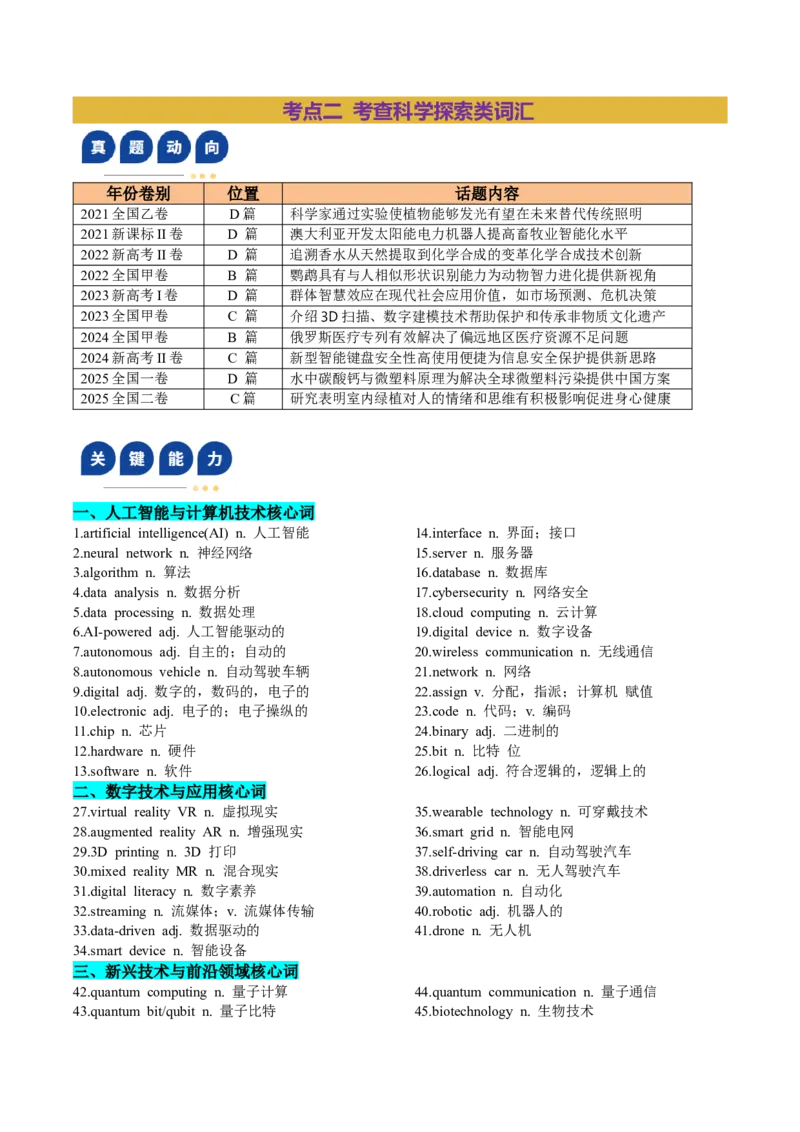
一、人工智能与计算机技术核心词
1.artificial intelligence(AI) n. 人工智能
2.neural network n. 神经网络
3.algorithm n. 算法
4.data analysis n. 数据分析
5.data processing n. 数据处理
6.AI-powered adj. 人工智能驱动的
7.autonomous adj. 自主的;自动的
8.autonomous vehicle n. 自动驾驶车辆
9.digital adj. 数字的,数码的,电子的
10.electronic adj. 电子的;电子操纵的
11.chip n. 芯片
12.hardware n. 硬件
13.software n. 软件
14.interface n. 界面;接口
15.server n. 服务器
16.database n. 数据库
17.cybersecurity n. 网络安全
18.cloud computing n. 云计算
19.digital device n. 数字设备
20.wireless communication n. 无线通信
21.network n. 网络
22.assign v. 分配,指派;计算机 赋值
23.code n. 代码;v. 编码
24.binary adj. 二进制的
25.bit n. 比特 位
26.logical adj. 符合逻辑的,逻辑上的
二、数字技术与应用核心词
27.virtual reality VR n. 虚拟现实
28.augmented reality AR n. 增强现实
29.3D printing n. 3D 打印
30.mixed reality MR n. 混合现实
31.digital literacy n. 数字素养
32.streaming n. 流媒体;v. 流媒体传输
33.data-driven adj. 数据驱动的
34.smart device n. 智能设备
35.wearable technology n. 可穿戴技术
36.smart grid n. 智能电网
37.self-driving car n. 自动驾驶汽车
38.driverless car n. 无人驾驶汽车
39.automation n. 自动化
40.robotic adj. 机器人的
41.drone n. 无人机
三、新兴技术与前沿领域核心词
42.quantum computing n. 量子计算
43.quantum bit/qubit n. 量子比特
44.quantum communication n. 量子通信
45.biotechnology n. 生物技术
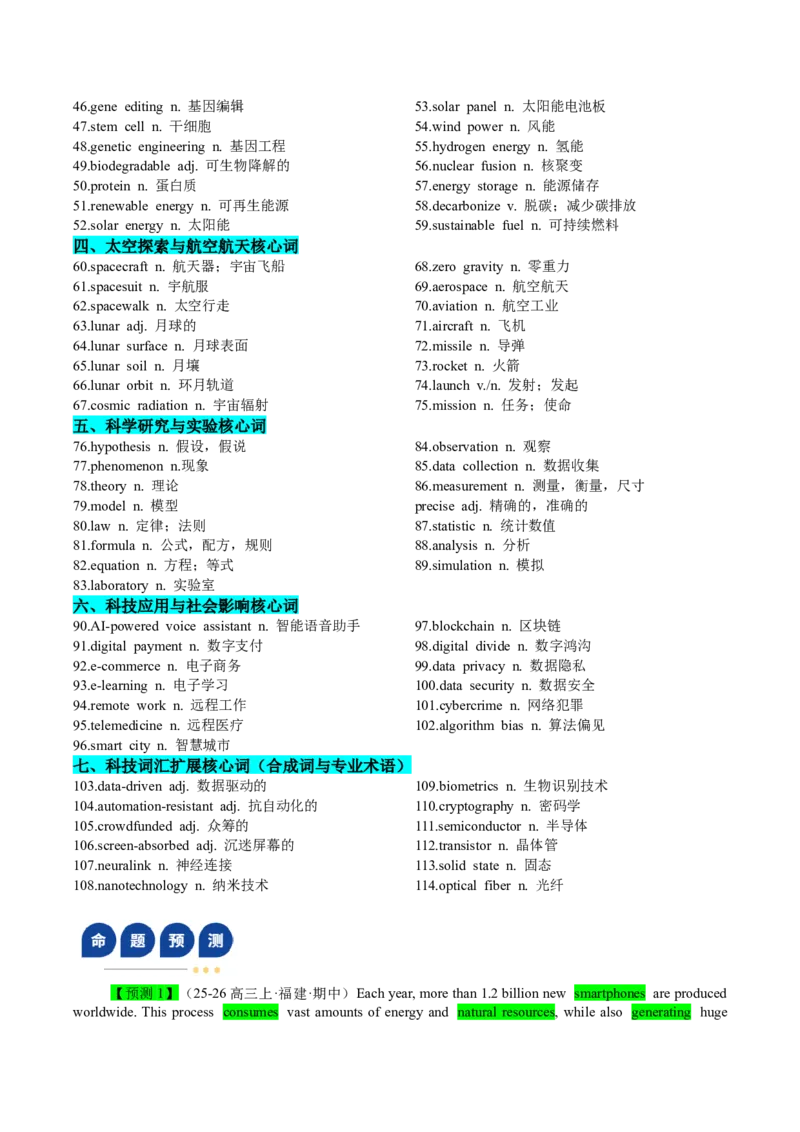
46.gene editing n. 基因编辑
47.stem cell n. 干细胞
48.genetic engineering n. 基因工程
49.biodegradable adj. 可生物降解的
50.protein n. 蛋白质
51.renewable energy n. 可再生能源
52.solar energy n. 太阳能
53.solar panel n. 太阳能电池板
54.wind power n. 风能
55.hydrogen energy n. 氢能
56.nuclear fusion n. 核聚变
57.energy storage n. 能源储存
58.decarbonize v. 脱碳;减少碳排放
59.sustainable fuel n. 可持续燃料
四、太空探索与航空航天核心词
60.spacecraft n. 航天器;宇宙飞船
61.spacesuit n. 宇航服
62.spacewalk n. 太空行走
63.lunar adj. 月球的
64.lunar surface n. 月球表面
65.lunar soil n. 月壤
66.lunar orbit n. 环月轨道
67.cosmic radiation n. 宇宙辐射
68.zero gravity n. 零重力
69.aerospace n. 航空航天
70.aviation n. 航空工业
71.aircraft n. 飞机
72.missile n. 导弹
73.rocket n. 火箭
74.launch v./n. 发射;发起
75.mission n. 任务;使命
五、科学研究与实验核心词
76.hypothesis n. 假设,假说
77.phenomenon n.现象
78.theory n. 理论
79.model n. 模型
80.law n. 定律;法则
81.formula n. 公式,配方,规则
82.equation n. 方程;等式
83.laboratory n. 实验室
84.observation n. 观察
85.data collection n. 数据收集
86.measurement n. 测量,衡量,尺寸
precise adj. 精确的,准确的
87.statistic n. 统计数值
88.analysis n. 分析
89.simulation n. 模拟
六、科技应用与社会影响核心词
90.AI-powered voice assistant n. 智能语音助手
91.digital payment n. 数字支付
92.e-commerce n. 电子商务
93.e-learning n. 电子学习
94.remote work n. 远程工作
95.telemedicine n. 远程医疗
96.smart city n. 智慧城市
97.blockchain n. 区块链
98.digital divide n. 数字鸿沟
99.data privacy n. 数据隐私
100.data security n. 数据安全
101.cybercrime n. 网络犯罪
102.algorithm bias n. 算法偏见
七、科技词汇扩展核心词(合成词与专业术语)
103.data-driven adj. 数据驱动的
104.automation-resistant adj. 抗自动化的
105.crowdfunded adj. 众筹的
106.screen-absorbed adj. 沉迷屏幕的
107.neuralink n. 神经连接
108.nanotechnology n. 纳米技术
109.biometrics n. 生物识别技术
110.cryptography n. 密码学
111.semiconductor n. 半导体
112.transistor n. 晶体管
113.solid state n. 固态
114.optical fiber n. 光纤
【预测1】(25-26 高三上·福建·期中)Each year, more than 1.2 billion new smartphones are produced
worldwide. This process consumes vast amounts of energy and natural resources, while also generating huge
quantities of electronic waste, as people often replace perfectly functional devices every few years. To address this
challenge, researchers have proposed a new approach — repurposing old phones into small-scale data centers for
practical use.
“Innovation often begins not with something new, but with a new way of thinking about the old,” said Huber, an
associate professor at MIT. The research team showed that outdated smartphones can be effectively transformed into
tiny data centers capable of processing and storing data for real-world applications. They also discovered that
building such a system is surprisingly inexpensive — about 8 euros per device — making it a highly affordable
solution.
In their experiment, the scientists carefully removed the batteries to avoid chemical leakage and connected
four old phones using 3D- printed cases. The system was powered externally and tested in practical environments.
One successful trial involved underwater sea life monitoring, where the device automatically recorded and analyzed
marine species — a task that usually requires divers. With this new device, the entire process could be done
automatically underwater.
These repurposed devices hold promise for a wide range of smart city applications. For instance, they could
be installed (安装) at bus stops to monitor passenger flow and help urban planners optimize transportation
schedules and routes, making public transport run more smoothly and reducing waiting time for passengers. This
method not only reduces e-waste but also supports sustainable digital solutions for modern communities.
“This is a smart, green rethink of our throwaway tech culture. Sustainability is not only about protecting the
future — it is about reimagining the present, where yesterday’s devices become tomorrow’s opportunities,” added
Ulrich, an Associate Professor of Software Engineering. With modest investment and creative thinking, outdated
technology can serve new purposes, contributing to a greener digital society while helping to solve the growing
problem of electronic waste.
1.What is a feature of the new approach mentioned?
A.It is cost-effective.
B.It is data-based.
C.It is business-driven.
D.It is skill-intensive.
2.What does the underwater trial show?
A.The risks of underwater tasks.
B.The necessity of innovative tools.
C.The challenges of ocean research.
D.The practicality of the new device.
3.What does the underlined word “optimize” in paragraph 4 mean?
A.Improve.
B.Observe.
C.Cancel.
D.Expand.
4.Which can be a suitable title for the text?
A.Electronic Engineering: An Eco-Digital Guide
B.Repurposing Old Phones: A Green Solution
C.The Problem of Global Smartphone Waste
D.The Sustainability of Smart City Development
【预测2】(25-26 高三上·福建龙岩·期中)Scientists have found a way to use cyanobacteria-usually called
blue-green algae (海藻) — to power a microprocessor nonstop for more than six months. The system uses inexpensive
and mostly recyclable materials, with its key part being a safe photosynthetic ( 光合作用的) algae named
synechocystis. Their study was published in the journal Energy & Environmental Science.
Paolo Bombelli, a researcher from the University of Cambridge and the main writer of the paper, said, “We
were surprised by how steadily the system worked for such a long time. We thought it might stop after a few weeks,
but it just kept running.”
As Matthew Sparkes reported in New Scientist, the team made a container with aluminum and clear plastic,
then put the bacteria inside. The device, about the size of one AA battery, was placed outside a window in Bombelli’s
home from February to August. It successfully powered an Arm Cortex-M0+ processor. The authors explained in
the study that this type of processor is widely used in Internet of Things (IoT) devices — like home appliances
connected to the Internet. The researchers set the processor to work in cycles: 45 minutes of computing followed by
15 minutes of standby.
Even without light, the cyanobacteria can still generate electrical energy. Scientists guess this is because the
algae process some of their stored food in the dark, which creates an electrical current.
Christopher Howe, a professor at the University of Cambridge and co-senior author of the paper, noted, “The
growing IoT needs more and more power. We believe this power should come from systems that generate energy, not
just store it like batteries. Our photosynthetic device doesn’t run down like a battery because it uses light all the
time.”
Right now, the cyanobacteria system isn’t strong enough to run all devices. For example, a desktop
computer would need 333 million such algae devices to work normally. But the team says the system could be made
larger — though more research is needed to find out how much it can be scaled up.
1.What is the key part of the cyanobacteria power system?
A.Synechocystis.
B.A microprocessor.
C.Aluminum container.
D.Cheap recyclable materials.
2.What allows cyanobacteria to produce energy even without light?
A.Using stored light energy.
B.Processing stored food.
C.Absorbing energy from batteries.
D.Getting power from IoT devices.
3.What can we infer about the cyanobacteria system from the text?
A.It will soon replace all batteries.
B.It has no potential to power large devices.
C.Further research is needed to expand its power.
D.It can already power desktop computers normally.
4.Which of the following is the best title for the text?
A.Algae Generates Electrical Energy in Dark
B.Scientists Develop Algae-Powered System
C.Cyanobacteria Powers Microprocessor Long
D.Cyanobacteria Acts as IoT Device Power Source
考点三 考查社会体育艺术类词汇
年份卷别
位置
话题内容
2021 全国甲卷
C 篇
描述与当地爱好者的友谊及长大后故地重游的归属感
2021 新高考I 卷
七选五
巴黎人精致的饮食文化体现法国"美食即生活艺术"文化理念
2022 全国甲卷
七选五
国际通用的餐桌礼仪包括筷子使用规则、餐具摆放、用餐姿势
2022 全国乙卷
A 篇
苏格兰肖像画家艺术展览了解西方艺术史和审美欣赏
2022 全国乙卷
D 篇
征收糖税对解决青少年肥胖问题的作用促进健康饮食
2022 新课标 II 卷
B 篇
研究证实体育锻炼对心脏健康的积极影响养成定期锻炼习惯
2023 全国甲卷
A 篇
推荐曼谷几家特色餐厅展现泰国丰富多元的饮食文化
2023 全国乙卷
C 篇
英国烹饪节目如何改变英国人的烹饪观念及饮食文化变迁
2024 全国甲卷
A 篇
介绍哈佛ARTS FIRST 艺术节,鼓励参与艺术创作培养创新思维
2024 新高考 I 卷
C 篇
比较纸质阅读与数字阅读在理解和记忆方面的差异
2025 全国一卷
A 篇
分析不同交通方式的碳排放数据,探讨未来能源改革方向
2025 全国一卷
C 篇
反思城市规划可持续发展理念,探讨科技进步与文化保护平衡
2025 全国二卷
A 篇
探讨食物浪费问题严重性和解决方案,饮食文化与可持续发展
一、传统习俗与节日核心词
1.ritual n. 仪式;典礼;习惯
2.ancestor n. 祖先;祖宗;先驱
3.heritage n. 遗产;继承物;传统
4.Chinese Seal n. 中国印章
5.Chinese Zodiac n. 中国生肖
6.Chinese Knot n. 中国结
二、社会结构与关系核心词
7.socialize v. 与他人交往;交际;使适应社会
8.social issue n. 社会问题
9.social status n. 社会地位
10.social class n. 社会阶层
11.urbanization n. 城市化
12.rural adj. 农村的;乡村的
13.urban adj. 城市的;都市的
14.interaction n. 相互作用;交流
15.collaboration n. 合作;合作成果
16.conflict n. 冲突;争论;v. 冲突;抵触
17.harmony n. 和谐;协调;融洽
18.equality n. 平等;均等;相等
19.justice n. 公平;公正;正义;司法
20.discrimination n. 歧视;区别对待;辨别力
21.compromise n. 妥协;折中
22.acquaintance n. 相识;熟人
三、社会现象与问题核心词
23.charity n. 慈善;慈善机构;施舍
24.immigration n. 移民;移居
25.epidemic n. 流行病;传染病;泛滥
26.reform n. 改革;改良;改造
27.welfare n. 福利;幸福;福利事业
28.racism n. 种族主义;种族歧视
29.poverty n. 贫困;贫穷;贫乏
30.unemployment n. 失业;失业率
31.corruption n. 腐败;贪污;堕落
32.crime n. 犯罪;罪行;罪恶
33.ethics n. 道德准则;道德学;伦理学
34.morality n. 道德;道德准则;品德;品行
35.religion n. 宗教;宗教信仰;宗教活动
36.integrity n. 正直;诚实;完整;完整性
37.conscience n. 良心;良知;内疚
四、历史与文化遗产核心词
38.medieval adj. 中世纪的
39.era n. 时代;年代;纪元
40.dynasty n. 王朝;朝代
41.heritage n. 遗产;传统;继承物
42.relic n. 遗物;遗迹;纪念品
43.artifact n. 手工艺品;文物;人工制品
44.excavation n. 挖掘;发掘;开凿
45.historian n. 历史学家;史学工作者
46.prehistory n. 史前时期;史前史
47.archaeology n. 考古学
48.gallery n. 画廊;美术馆;走廊
五、饮食与艺术文化核心词
49.cuisine n. 菜肴;风味;烹饪
50.recipe n. 烹饪法;食谱;秘诀
51.ingredient n. 材料;成分;要素
52.sauce n. 调味汁;酱汁
53.feast n. 盛宴;宴会;节日
54.banquet n. 宴会;盛宴;v. 宴请
55.appetite n. 食欲;胃口;欲望
56.painting n. 绘画;油画;画法
57.sculpture n.雕刻;雕塑作品
58.opera n. 歌剧;歌剧院
59.poetry n. 诗歌;诗意
六、社会文化相关短语核心词
60.social gathering n. 社交聚会
61.social network n. 社交网络;社会关系网
62.interpersonal relationship n. 人际关系
63.family reunion n. 家庭团聚
64.public event n. 公共活动;公开活动
七、文化多样性与交流核心词
65.civilization n. 文明;文明社会
66.cultural diversity n. 文化多样性
67.cultural heritage n. 文化遗产
68.cross-cultural communication n.跨文化交际
69.globalization n. 全球化
70.multiculturalism n. 多元文化主义
71.diversity n. 差异性;多样性
72.diverse adj. 多样的;不同的
73.cultural conflict n. 文化冲突
74.cultural identity n. 文化身份
75.stereotype n. 模式化观念;刻板印象
76.prejudice n. 偏见;成见
77.taboo n. 禁忌;忌讳
(25-26 高二上·山东德州·期中)Makaran hated piano lessons she took as a child. It amused her that she
found second-career success as a DJ a decade ago, playing tunes for MTV and other clients. “I was playing music
for people, watching them forget their stress and worries and just be present on the dance floor,” says Makaran. “I
never thought of music for my own healing until I really needed it.”
Ten years ago, Makaran developed cancer. Following drug therapy ( 疗法) and surgery, her best hope of
remaining cancer-free depended largely on Heresquin, an effective anticancer medicine. But after a few rounds,
Makaran proved allergic (过敏物) — and there was no alternative. Makaran asked her doctor, “What should I do?”
He responded simply, “Be happy.” Initially she couldn’t believe it, but then she understood, “If I can manage my
stress and my emotions, I would have the best chance of surviving, even though I was taken off treatment.” Then she
began to explore how music could help her heal.
“Music therapy can help manage cancer-related symptoms and anxieties as effectively as traditional therapies,”
according to a study. The study involved seven weeks of therapy combining talk, music and songwriting. During
sessions, trained therapists might help put a patient’s words or feelings to a song, co-write a tune, or simply listen.
Makaran sometimes wrote songs to express her emotions, or just sang along.
The population of cancer survivors has increased in recent decades to 18.6 million people in America alone.
Dr. Kevin Lion says there is a greater need for varied therapies to improve their quality of life. “We want a wide
range of tools to better personalize treatments,” he says. The next phase of research is to look at the characteristics
of patients likely to benefit from music therapy.
1.How did Makaran initially feel about music?
A.Enthusiastic.
B.Favorable.
C.Negative.
D.Doubtful.
2.What did Makaran realize after her doctor’s advice?
A.Doctors hold all the keys.
B.Mental wellness helps recovery.
C.Music alone holds magic.
D.Medical treatment is needless.
3.What can we infer about music therapy from paragraph 3?
A.It features multiple methods.
B.It requires specific musical skills.
C.It is primarily based on writing songs.
D.It is more effective than traditional ones.
4.Why do the researchers study the characteristics of patients?
A.To train better therapists.
B.To shape their taste in music.
C.To improve the quality of tools.
D.To tailor therapy to specific needs.
(25-26 高三上·湖南·阶段练习)Art can have incredible power over us. Yet even the most timeless and
celebrated pieces can be ruined by the march of the centuries. Turning back the clock can be complicated ——
scientifically and culturally. It requires a set of skills ranging from archaeology to chemistry.
Conservation starts with material analysis, whether the artwork is a cloth, sculpture, or painting. One approach
was to remove a tiny piece of paint from an artwork to analyze layers of paint and see how the artist originally
constructed it. But, increasingly, art conservation scientists have been able to adopt technologies to make the analysis
process less invasive? They often borrow these technologies from other fields, notably the medical field. CT scanning
for instance, can help doctors peer into bodies, but it can also help art conservation experts find tiny details in
artworks, such as fingerprints and tool marks that they couldn’t see with the naked eye —— without damaging the
work itself.
Although more high-tech could be a blessing to the field, what art conservation scientists really long for is
more cooperation between scientists, native experts, affected communities and the general public. They have re-
centered their focus from just what a piece of art is made of and how to keep it an shape to the culture from which
the artwork originated “We’re still very much science-based, but we’ve also come to realize over time that these
objects in our care have values rooted in them,” says Glenn Wharton, chair of the UCLA Program in the Conservation
of Cultural Heritage. “We always try to assess these values, which leads us towards communicating with people
whose cultural heritage it is.”
As with most things art, what gets conserved and what doesn’t usually comes down to time and money. The
number of restoration projects is far more than the availability of qualified scientists in the field. And historically, it
has often been the most valued works owned by the wealthy that were restored. But with the evolving field, this is
changing.
1.What can “turning back the clock” refer to in paragraph 1?
A.Admiring a timeless artwork.
B.Restoring an ancient masterpiece.
C.Creating a copy of a celebrated sculpture.
D.Studying the history of a famous painting.
2.What does the underlined word “invasive” in paragraph 2 mean?
A.Destructive.
B.Defensive.
C.Restrictive.
D.Expensive.
3.What have conservation experts primarily shifted their focus to?
A.Modern technologies for restoration.
B.The composition of artistic materials.
C.Artworks’ cultural origins and values.
D.Artworks’ physical shapes and colors.
4.What is the last paragraph mainly about?
A.Historical achievements.
B.Practical challenges.
C.Valuable heritage
D.Adequate resources.
考点四 考查人物观点态度类词汇
(2024 全国甲卷C 篇) Doctors see up to 150 patients every day. The train’s equipment allows for basic checkups.
“I was very impressed by the doctors and their assistants working and living in such little space but still staying
focused and very concerned,” says Ducke. “They were the best chance for many rural people to get the treatment
they want. ”
31. What is Ducke’s attitude toward the Saint Lukas’ services?
A. Appreciative.
B. Doubtful
C. Ambiguous.
D. Cautious.
能力1 乐观支持类核心词汇:
1.optimistic 乐观的
2.positive 肯定的
3.favorable 支持的,赞同的
4.supportive 支持的
5.approving 赞成的
6.appreciative 赞赏的
能力2 消极反对类核心词汇:
1.negative 否定的
2.opposite 相反的
3.unfair 公正的
4.doubtful 怀疑的
5.indifferent 漠不关心的
6.critical 批评的
7.ironic 讽刺的
8.skeptical 质疑的
9.disappointed 失望的
10.disapproving 不赞同的
11.pessimistic 悲观的
12.dismissive 轻蔑的,不屑一顾的
能力3 客观中立类核心词汇:
1.objective 客观的
2.neutral 中立的
3.cautious 谨慎的
4.reserved 保留的
【预测1】(2022 高三上·全国·专题练习)The problems of excessive energy consumption, climate change and
population growth have been described in a book by the American writer Thomas L. Friedman. He fears the worst,
but hopes for the best.
Friedman points out that the green economy is a chance to keep American strength. “The ability to design,
build and export green technologies for producing clean water, clean air and healthy and abundant food is going to
be the currency of power in the new century.”
1.What is Friedman’s attitude towards America’s future?
A.Ambiguous.
B.Doubtful.
C.Hopeful.
D.Tolerant
【预测2】(2024 高三·全国·专题练习)“As long as our best technology for seeing inside the brain requires
subjects to lie nearly motionless while surrounded by a giant magnet, we’re only going to make limited pro gress on
these questions,” Allen said.
2.What is Allen’s attitude to the current study on the human brain?
A.Cautious.
B.Indifferent.
C.Approving.
D.Pessimistic.
【预测3】(2026 高三·全国·专题练习)People are also worried by language change. If younger people “break”
the rules that older people have learnt, older people often feel disturbed: they are concerned that younger people no
longer know their grammar, and that the language is going downhill. This is a needless worry: change is natural and
inevitable, it cannot be stopped, and it does not generally affect a languages efficiency as a communicative tool. A
great deal of modern English grammar would have been wrong three hundred years ago, and will perhaps be wrong
again three hundred years from now.
3.What is the author's attitude towards the changes of English?
A.Disturbed.
B.Optimistic.
C.Cautious.
D.Doubtful.