词汇清单08 新高考阅读理解障碍词清单及对点训练
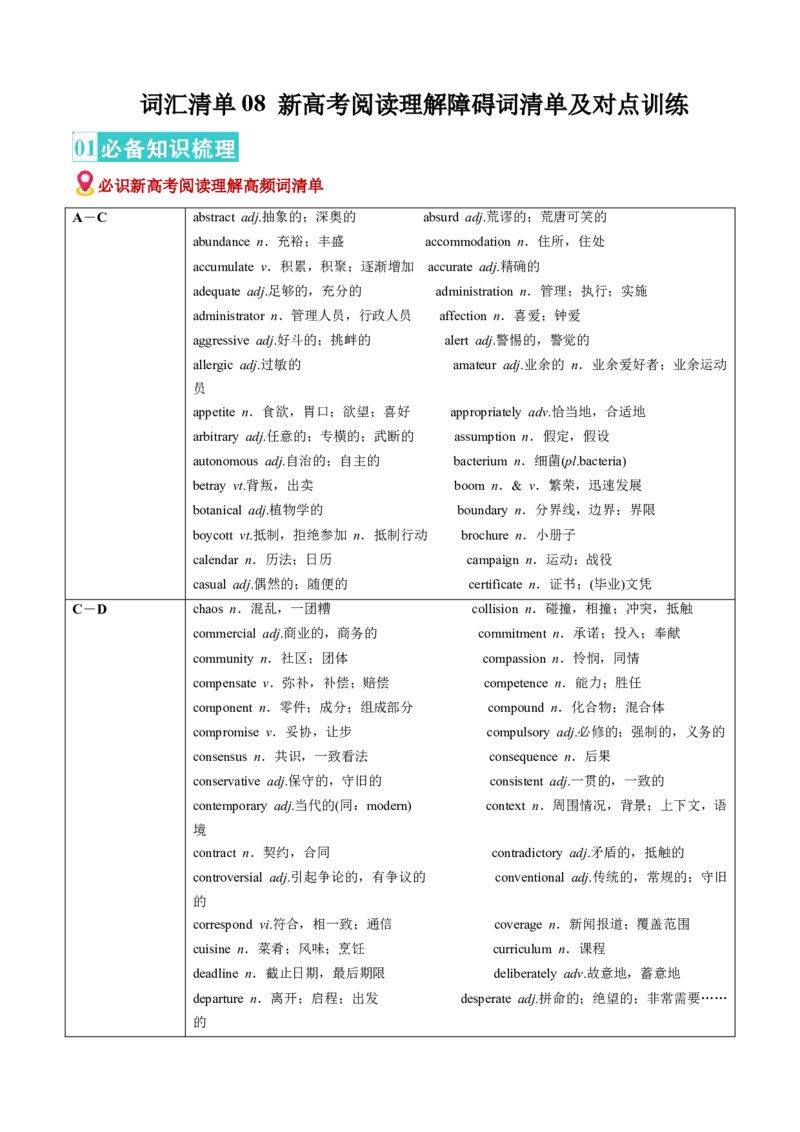
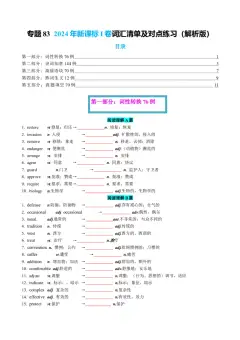
必识新高考阅读理解高频词清单
A-C
abstract adj.抽象的;深奥的          absurd adj.荒谬的;荒唐可笑的
abundance n.充裕;丰盛            accommodation n.住所,住处
accumulate v.积累,积聚;逐渐增加  accurate adj.精确的
adequate adj.足够的,充分的           administration n.管理;执行;实施
administrator n.管理人员,行政人员    affection n.喜爱;钟爱
aggressive adj.好斗的;挑衅的           alert adj.警惕的,警觉的
allergic adj.过敏的                      amateur adj.业余的 n.业余爱好者;业余运动
员
appetite n.食欲,胃口;欲望;喜好      appropriately adv.恰当地,合适地
arbitrary adj.任意的;专横的;武断的      assumption n.假定,假设
autonomous adj.自治的;自主的           bacterium n.细菌(pl.bacteria)
betray vt.背叛,出卖                     boom n.& v.繁荣,迅速发展
botanical adj.植物学的                    boundary n.分界线,边界;界限
boycott vt.抵制,拒绝参加 n.抵制行动     brochure n.小册子
calendar n.历法;日历                    campaign n.运动;战役
casual adj.偶然的;随便的                  certificate n.证书;(毕业)文凭
C-D
chaos n.混乱,一团糟                     collision n.碰撞,相撞;冲突,抵触
commercial adj.商业的,商务的               commitment n.承诺;投入;奉献
community n.社区;团体                    compassion n.怜悯,同情
compensate v.弥补,补偿;赔偿              competence n.能力;胜任
component n.零件;成分;组成部分           compound n.化合物;混合体
compromise v.妥协,让步                    compulsory adj.必修的;强制的,义务的
consensus n.共识,一致看法                  consequence n.后果
conservative adj.保守的,守旧的                consistent adj.一贯的,一致的
contemporary adj.当代的(同:modern)           context n.周围情况,背景;上下文,语
境
contract n.契约,合同                        contradictory adj.矛盾的,抵触的
controversial adj.引起争论的,有争议的          conventional adj.传统的,常规的;守旧
的
correspond vi.符合,相一致;通信               coverage n.新闻报道;覆盖范围
cuisine n.菜肴;风味;烹饪                   curriculum n.课程
deadline n.截止日期,最后期限                deliberately adv.故意地,蓄意地
departure n.离开;启程;出发            desperate adj.拼命的;绝望的;非常需要……
的
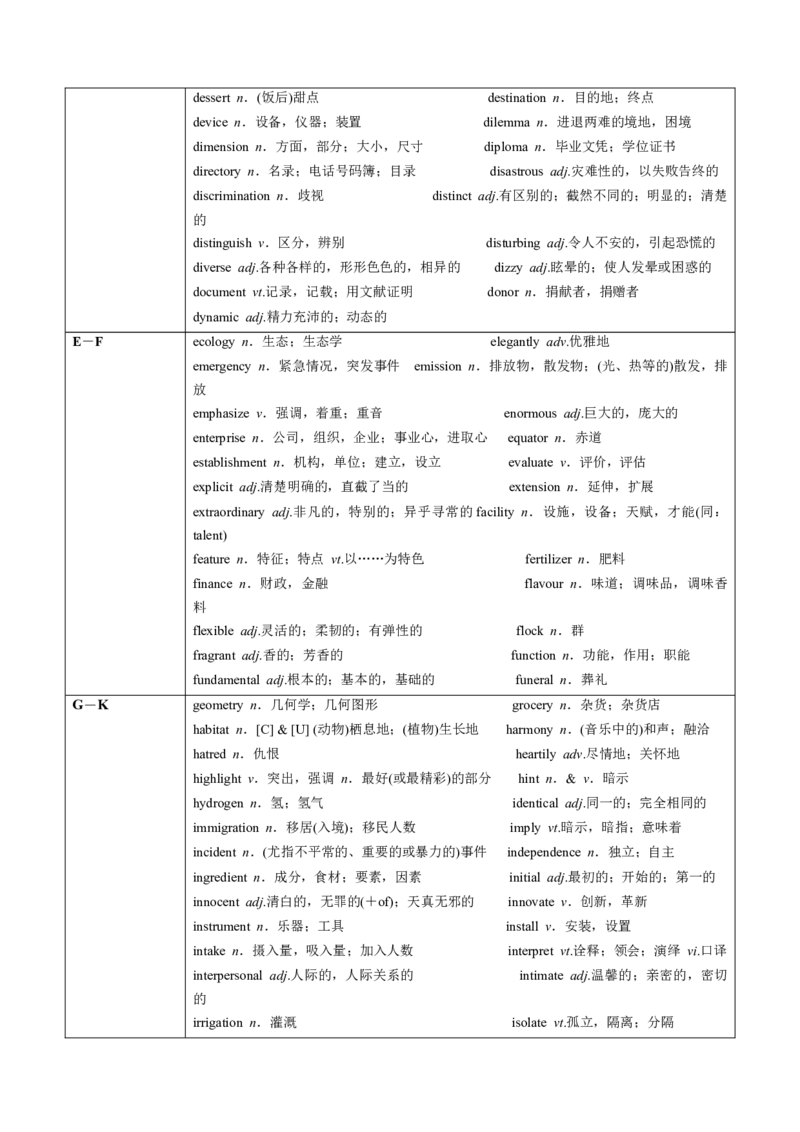
dessert n.(饭后)甜点                         destination n.目的地;终点
device n.设备,仪器;装置                  dilemma n.进退两难的境地,困境
dimension n.方面,部分;大小,尺寸         diploma n.毕业文凭;学位证书
directory n.名录;电话号码簿;目录           disastrous adj.灾难性的,以失败告终的
discrimination n.歧视                distinct adj.有区别的;截然不同的;明显的;清楚
的
distinguish v.区分,辨别                     disturbing adj.令人不安的,引起恐慌的
diverse adj.各种各样的,形形色色的,相异的     dizzy adj.眩晕的;使人发晕或困惑的
document vt.记录,记载;用文献证明           donor n.捐献者,捐赠者
dynamic adj.精力充沛的;动态的
E-F
ecology n.生态;生态学                      elegantly adv.优雅地
emergency n.紧急情况,突发事件  emission n.排放物,散发物;(光、热等的)散发,排
放
emphasize v.强调,着重;重音                  enormous adj.巨大的,庞大的
enterprise n.公司,组织,企业;事业心,进取心   equator n.赤道
establishment n.机构,单位;建立,设立          evaluate v.评价,评估
explicit adj.清楚明确的,直截了当的               extension n.延伸,扩展
extraordinary adj.非凡的,特别的;异乎寻常的facility n.设施,设备;天赋,才能(同:
talent)
feature n.特征;特点 vt.以……为特色               fertilizer n.肥料
finance n.财政,金融                            flavour n.味道;调味品,调味香
料
flexible adj.灵活的;柔韧的;有弹性的              flock n.群
fragrant adj.香的;芳香的                         function n.功能,作用;职能
fundamental adj.根本的;基本的,基础的            funeral n.葬礼
G-K
geometry n.几何学;几何图形                    grocery n.杂货;杂货店
habitat n.[C] & [U] (动物)栖息地;(植物)生长地    harmony n.(音乐中的)和声;融洽
hatred n.仇恨                                   heartily adv.尽情地;关怀地
highlight v.突出,强调 n.最好(或最精彩)的部分    hint n.& v.暗示
hydrogen n.氢;氢气                            identical adj.同一的;完全相同的
immigration n.移居(入境);移民人数              imply vt.暗示,暗指;意味着
incident n.(尤指不平常的、重要的或暴力的)事件   independence n.独立;自主
ingredient n.成分,食材;要素,因素             initial adj.最初的;开始的;第一的
innocent adj.清白的,无罪的(+of);天真无邪的     innovate v.创新,革新
instrument n.乐器;工具                        install v.安装,设置
intake n.摄入量,吸入量;加入人数              interpret vt.诠释;领会;演绎 vi.口译
interpersonal adj.人际的,人际关系的               intimate adj.温馨的;亲密的,密切
的
irrigation n.灌溉                                isolate vt.孤立,隔离;分隔
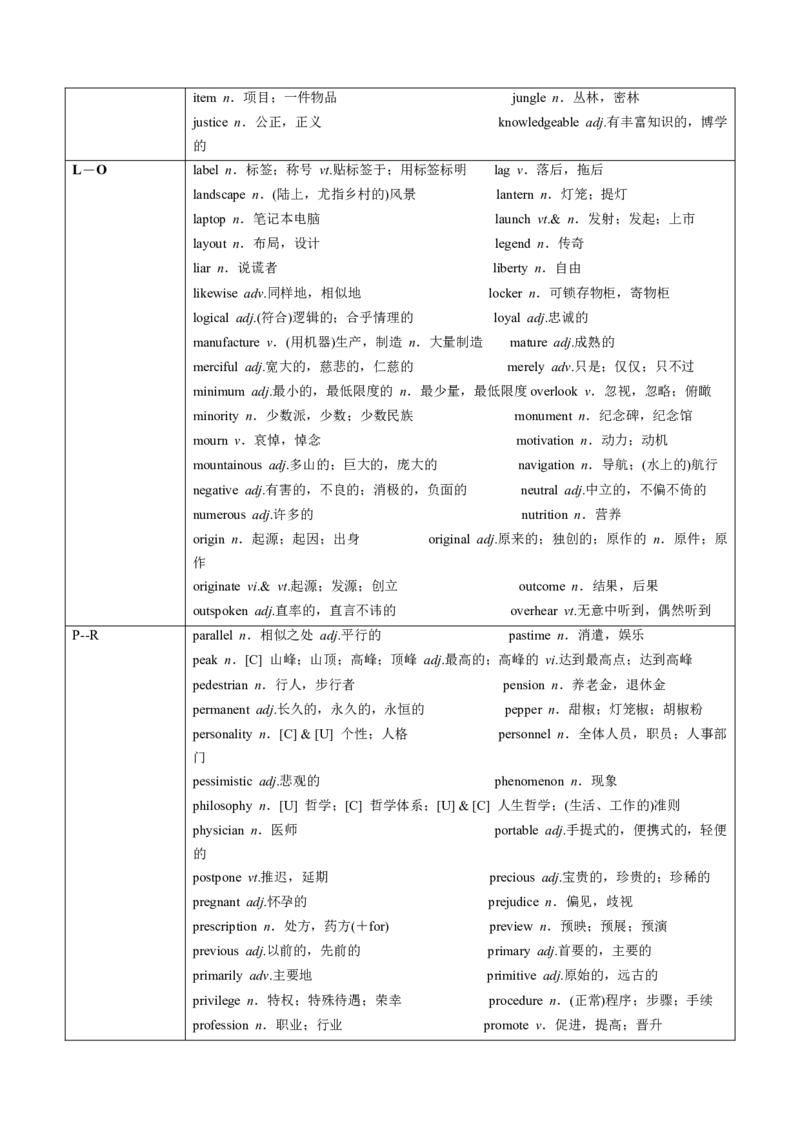
item n.项目;一件物品                          jungle n.丛林,密林
justice n.公正,正义                          knowledgeable adj.有丰富知识的,博学
的
L-O
label n.标签;称号 vt.贴标签于;用标签标明    lag v.落后,拖后
landscape n.(陆上,尤指乡村的)风景            lantern n.灯笼;提灯
laptop n.笔记本电脑                          launch vt.& n.发射;发起;上市
layout n.布局,设计                          legend n.传奇
liar n.说谎者                                liberty n.自由
likewise adv.同样地,相似地                   locker n.可锁存物柜,寄物柜
logical adj.(符合)逻辑的;合乎情理的            loyal adj.忠诚的
manufacture v.(用机器)生产,制造 n.大量制造    mature adj.成熟的
merciful adj.宽大的,慈悲的,仁慈的              merely adv.只是;仅仅;只不过
minimum adj.最小的,最低限度的 n.最少量,最低限度overlook v.忽视,忽略;俯瞰
minority n.少数派,少数;少数民族               monument n.纪念碑,纪念馆
mourn v.哀悼,悼念                             motivation n.动力;动机
mountainous adj.多山的;巨大的,庞大的            navigation n.导航;(水上的)航行
negative adj.有害的,不良的;消极的,负面的        neutral adj.中立的,不偏不倚的
numerous adj.许多的                               nutrition n.营养
origin n.起源;起因;出身          original adj.原来的;独创的;原作的 n.原件;原
作
originate vi.& vt.起源;发源;创立                  outcome n.结果,后果
outspoken adj.直率的,直言不讳的                 overhear vt.无意中听到,偶然听到
P--R
parallel n.相似之处 adj.平行的                   pastime n.消遣,娱乐
peak n.[C] 山峰;山顶;高峰;顶峰 adj.最高的;高峰的 vi.达到最高点;达到高峰
pedestrian n.行人,步行者                      pension n.养老金,退休金
permanent adj.长久的,永久的,永恒的            pepper n.甜椒;灯笼椒;胡椒粉
personality n.[C] & [U] 个性;人格             personnel n.全体人员,职员;人事部
门
pessimistic adj.悲观的                          phenomenon n.现象
philosophy n.[U] 哲学;[C] 哲学体系;[U] & [C] 人生哲学;(生活、工作的)准则
physician n.医师                             portable adj.手提式的,便携式的,轻便
的
postpone vt.推迟,延期                        precious adj.宝贵的,珍贵的;珍稀的
pregnant adj.怀孕的                           prejudice n.偏见,歧视
prescription n.处方,药方(+for)               preview n.预映;预展;预演
previous adj.以前的,先前的                   primary adj.首要的,主要的
primarily adv.主要地                          primitive adj.原始的,远古的
privilege n.特权;特殊待遇;荣幸             procedure n.(正常)程序;步骤;手续
profession n.职业;行业                     promote v.促进,提高;晋升
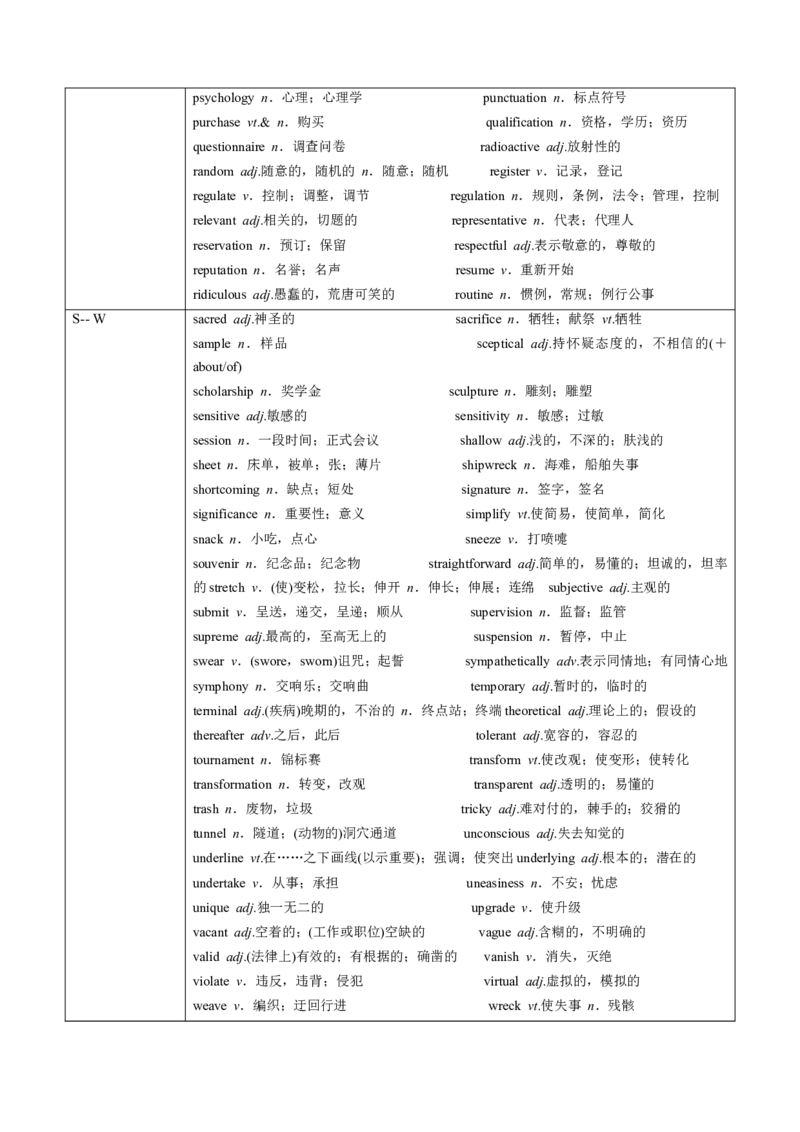
psychology n.心理;心理学                  punctuation n.标点符号
purchase vt.& n.购买                        qualification n.资格,学历;资历
questionnaire n.调查问卷                    radioactive adj.放射性的
random adj.随意的,随机的 n.随意;随机      register v.记录,登记
regulate v.控制;调整,调节            regulation n.规则,条例,法令;管理,控制
relevant adj.相关的,切题的              representative n.代表;代理人
reservation n.预订;保留                respectful adj.表示敬意的,尊敬的
reputation n.名誉;名声                 resume v.重新开始
ridiculous adj.愚蠢的,荒唐可笑的         routine n.惯例,常规;例行公事
S-- W
sacred adj.神圣的                        sacrifice n.牺牲;献祭 vt.牺牲
sample n.样品                         sceptical adj.持怀疑态度的,不相信的(+
about/of)
scholarship n.奖学金                   sculpture n.雕刻;雕塑
sensitive adj.敏感的                      sensitivity n.敏感;过敏
session n.一段时间;正式会议            shallow adj.浅的,不深的;肤浅的
sheet n.床单,被单;张;薄片            shipwreck n.海难,船舶失事
shortcoming n.缺点;短处                signature n.签字,签名
significance n.重要性;意义               simplify vt.使简易,使简单,简化
snack n.小吃,点心                      sneeze v.打喷嚏
souvenir n.纪念品;纪念物          straightforward adj.简单的,易懂的;坦诚的,坦率
的stretch v.(使)变松,拉长;伸开 n.伸长;伸展;连绵  subjective adj.主观的
submit v.呈送,递交,呈递;顺从          supervision n.监督;监管
supreme adj.最高的,至高无上的             suspension n.暂停,中止
swear v.(swore,sworn)诅咒;起誓         sympathetically adv.表示同情地;有同情心地
symphony n.交响乐;交响曲               temporary adj.暂时的,临时的
terminal adj.(疾病)晚期的,不治的 n.终点站;终端theoretical adj.理论上的;假设的
thereafter adv.之后,此后                    tolerant adj.宽容的,容忍的
tournament n.锦标赛                      transform vt.使改观;使变形;使转化
transformation n.转变,改观                transparent adj.透明的;易懂的
trash n.废物,垃圾                      tricky adj.难对付的,棘手的;狡猾的
tunnel n.隧道;(动物的)洞穴通道          unconscious adj.失去知觉的
underline vt.在……之下画线(以示重要);强调;使突出underlying adj.根本的;潜在的
undertake v.从事;承担                   uneasiness n.不安;忧虑
unique adj.独一无二的                      upgrade v.使升级
vacant adj.空着的;(工作或职位)空缺的        vague adj.含糊的,不明确的
valid adj.(法律上)有效的;有根据的;确凿的    vanish v.消失,灭绝
violate v.违反,违背;侵犯                  virtual adj.虚拟的,模拟的
weave v.编织;迂回行进                     wreck vt.使失事 n.残骸
wrinkle n.皱纹 v.起皱纹;皱起
巩固提升
一、选词填空
用方框中的词或词组的正确形式完成下列句子,每个词或词组只能用一次。
benefit    society    relieve   strength    frequency    pay off    deal with
try out for    be fed up with
1.News of their safety came as a great        .
2.I believe that life in the countryside is more         for children.
3.The exercises are designed to         your stomach muscles.
4.All my hard work         in the end, and I finally passed the exam.
5.There are         contacts between the peoples of the two countries.
6.These workers         being at the bottom of the pile when it comes to pay.
7.Paul had a strong desire to play for the team, so he         making the team many times.
8.These stories about struggles also told students how the scientists         these obstacles.
9.Jane was invited to a big         gathering, but because of her quiet nature, she politely refused.
辨析下列单词或短语。根据语境,将单词或短语填入句子中。(其中有一项为多余选项)
despite   postpone   contact   end up   under pressure   intelligent
feature   behavior   challenge   turn out   come across
10.If we get lost on our walk, we’ll            in a completely unfamiliar place.
11.Don’t worry about the party; I’m sure everything will           fine.
12.The on-going mid-term exams put a lot of students          .
13.The dolphin is a highly           animal capable of solving complex problems.
14.The committee decided to           the meeting until next week.
15.The art exhibition will           works from several young local artists.
16.Please           me by email if you have any further questions.
17.If you           any interesting articles please share them with me.
18.The football match went on as scheduled           the heavy rain.
19.The new evidence will           the old theory.
根据语境,选择适当的词语并用其正确形式填空,每词仅用一次。
critical  barely  edge  approve  objective  prospect  instant  call on  appeal to  come to power
20.We intended to visit the theme park, but ended up          Professor Zhang.
21.         does she speak in public, even when asked directly.
22.The old man          along the narrow mountain path, holding the rope tightly to avoid falling down.
23.Traditional folk art rarely          modern audiences, as its rhythm and themes feel outdated to many.
24.To conduct a reliable experiment, researchers must stay          and not let personal opinions affect their
data analysis.
25.         during a period of economic hardship put the new government under great pressure to steady the
market quickly.
26.Despite the challenging situation, the          of discovering a cure for the disease keeps the scientists
motivated to continue their research.
27.Effective communication is          to the success of any team project, as it ensures all members share the
same goals and responsibilities.
28.The          the curtain rose, the audience was surprised by the breathtaking stage design and the
performers’ exquisite acting.
29.With the committee’s plan          by our government, we can finally start the community improvement
project.
选词填空
available, secure, analyze, persuade, gentle, conclusion,
absence, career, accompany, combined, defeated, ban
30.They have successfully          the old with the new in this room.
31.After much discussion, we finally reached a         .
32.The babysitter was very         , with the children, telling them a soft bedtime story.
33.Could you          me to the doctor’s office? I don’t want to go alone.
34.It’s difficult to          him to change his mind once it’s made up.
35.The city council decided to          single-use plastics to reduce pollution.
36.Are you          for a meeting tomorrow morning?
37.Before we make a decision, we need to          the data thoroughly.
38.The          of any clear evidence made the case very difficult to solve.
39.He decided to change his          path from finance to teaching, seeking a more fulfilling life.
冲刺突破
Passage 1
A Tour of Unique Festivals Among China’s Ethnic Minorities (少数民族)
The Mountain Circling Festival
The Mountain Circling Festival, also known as Zhuanshan Festival, is a significant traditional event of the
Mosuo people in Yunnan Province, China. Held annually on the 25th day of the seventh lunar month, it was
included in Yunnan’s Intangible Cultural Heritage (ICH) list in 2005. Originating from nature worship and
matriarchal reverence (母系崇拜), it is one of the earliest traditional festivals of its kind. During the festival, people
gather at the foot of Gemu Mountain, offering grains, hanging prayer flags, and praying for a good harvest and
prosperity (繁荣). It has evolved into a grand cultural event featuring horse racing, wrestling, and singing.
The Jingpo Ethnic Group’s Munao Zongge Festival
The Jingpo Ethnic Group’s Munao Zongge Festival, known as the “heavenly dance,” is the most important
celebration for the Jingpo people and is held annually around the Lantern Festival. Recognized as a National ICH in
2006, it is often called the “carnival dance of ten thousand people” for its spectacular sight of thousands dancing to
the same drumbeat. The dance symbolizes unity and celebrates a rich harvest.
Hani October Festival
Hani October Festival is a major festival for the Hani people in Honghe Prefecture ( 自治州), Yunnan,
typically celebrated in November. Its most symbolic event is the Long Street Banquet ( 宴会), where countless
tables are lined along the streets, forming one of the world’s longest banquet tables. Dressed in traditional Hani
costumes, participants enjoy feasts, watch fireworks, and take part in various folk activities. This festival was listed
as a National ICH in 2006.
Miao Sisters Festival
Miao Sisters Festival is a beloved tradition of the Miao people in Guizhou Province, often regarded as one of
the most romantic festivals. It typically takes place in spring. During this festival, young Miao girls prepare colorful
glutinous rice and gifts, which they offer to young men as a way to show they like them. The event is filled with
singing—especially the antiphonal (对唱) style—and traditional dances, all celebrating youth, love, and the arrival
of spring. It was included in the National ICH list in 2008.
1.Which of the mentioned festivals often takes place in summer?
A.The Mountain Circling Festival.
B.The Munao Zongge Festival.
C.Hani October Festival.
D.Miao Sisters Festival.
2.What can we learn from the passage?
A.The Munao Zongge Festival features people dancing to their own rhythm.
B.Zhuanshan Festival was included in the National ICH list in 2005.
C.Miao Sisters Festival is celebrated to pray for a happy marriage.
D.Hani October Festival is famous for its Long Street Banquet.
3.Where is the passage most likely to be taken from?
A.A news report.
B.A travel blog.
C.A research paper.
D.A cookbook.
Passage 2
Jordan knew he wanted to do something unique with his farmland. He wanted to win the local garden club’s
“Yard of the Month” award. But he didn’t have the money to buy new trees, so he began by using bushes and
shrubs (矮树苗) that a local nursery had thrown away — that looked dead to most people.
Because he worked days at a can factory, Jordan often tended his garden at night. Neighbors got used to
seeing one little headlight as Jordan stood on a ladder, cutting and shaping his steadily growing bushes. Gradually,
the shrubs took on different shapes. Jordan then began planting trees and using zip ties, coat hangers, PVC pipe,
and even his wife’s old stockings to achieve the forms he wanted. “He has a way of manipulating plants to do
things he wants them to do by training, bending, wiring, and clipping,” says a neighbor. “And the plants seem to
bend to his will.”
Many professional gardeners are amazed by what Jordan has been able to achieve. “The garden itself was
created from lack of knowledge,” says Jordan in his booming bass voice, “because I didn’t know you weren’t
supposed to do this with plants. For one time in my life, ignorance paid off.”
Jordan’s attention to detail and his willingness to work hard have made him a local hero. He was the first
African American to win “Yard of the Month” honor from the local garden club. And more recognition followed:
articles in major newspapers and appearances on well-known TV shows.
Jordan’s garden now includes about 400 species of plants and 150 shrubs in different shapes. On his front
yard, four-foot-tall letters filled with bright red begonias (秋海棠) spell Love, Peace, and Goodwill. These are the
values Jordan lives by. Jordan opens his private garden to everyone, including those going through a tough time
financially. A box for donations can be found in his garden, but giving is optional. Jordan welcomes people who
can’t afford to pay. He understands; he’s been there.
4.What does the underlined word “manipulating” in paragraph 2 mean?
A.Controlling.
B.Expecting.
C.Planting.
D.Using.
5.Which of the following words can best describe Jordan?
A.Hard-working and shy.
B.Creative and generous.
C.Helpful and knowledgeable.
D.Positive and humorous.
6.What can be inferred from the last paragraph?
A.Tickets are expensive for visitors.
B.Jordan used to be poor.
C.The garden is only open to plant lovers.
D.Jordan lives on donation from others.
7.What does Jordan’s experience of building the garden mainly tell us?
A.A good beginning is half done.
B.Actions speak louder than words.
C.Where there is a will, there is a way.
D.Hope for the best, but prepare for the worst.
Passage 3
Do you often use the words “tapestry”, “delve” or “testament” in English? Many of us would say no. These
words aren’t among the “Top 500 spoken words” — a list of the most common English words. However, these
words are becoming more common in some written content, as a study in 2024 found that five percent of all articles
published on a research site used the word “delve”. In 2022, it was less than one percent.
Since ChatGPT was released to the public in November 2022, we’ve seen that AI favors certain words. Why
does ChatGPT prefer these words? The answer is actually very human. While ChatGPT seems to think for itself,
what it really does is analyze a very large amount of human-generated (人工生成的) information, and use the data
to spit out answers to our questions. It doesn’t actually understand what it’s telling us.
The process of rating AI responses, as part of training the software, is called “reinforcement(强化)learning
from human feedback,” and this provides the first clue about why ChatGPT favors certain words. The answer lies
in the background of the human trainers themselves. It’s not cheap to employ a lot of testers to rate thousands of
responses from AI. So, big companies hire lower-income countries to do these jobs, often places where English is
not the first language. One such country that offers cheap labor is Nigeria, and in Nigerian English, “delve” is a
common word in professional settings. So, when Nigerian testers tell AI which responses sound natural, their own
language preferences come through.
As AI-generated information becomes more common, will it also affect the way we speak to each other? In
some ways, AI has already left its mark. Of course, language is a living thing that always updates itself, shaped by
current events, technology, and the media we use. As AI-generated media spreads, it is possible, even likely that AI
will affect the development of our own vocabulary.
8.What does the underlined sentence mean?
A.AI’s answers are directly written by humans.
B.AI is specially designed to think like humans.
C.AI depends on humans to develop its language.
D.AI understands human language independently.
9.Why does AI favor certain uncommon words?
A.Spoken English has been used to train AI.
B.AI tries to have impact on human language.
C.Companies develop strange language models.
D.Non-native English speakers work as AI trainers.
10.Which statement does the last paragraph support?
A.AI plays an important role in language development.
B.New technology reduces the number of English words.
C.Language pushes the development of AI-generated media.
D.The use of uncommon words makes communication harder.
11.Which of the following is the best title for the passage?
A.Will ChatGPT Target a New Market?
B.Will AI Change the Way We Speak?
C.Reinforcement Learning: Key to AI’s Power
D.Uncommon English Words: Usage in Daily Life
Passage 4
Holidays are often described as picture-perfect moments: families happily united around a table filled with
seasonal food favorites against a perfect background. For many parents, attempting to meet such unrealistic
expectations can destroy their self-worth gradually. In the real world, parents are juggling ( 同时兼顾) more
activities. It’s all too easy to fall into survival parenting, an approach where the focus is on simply getting through
the day. These holidays can feel like anything but a holiday.
U. S. Surgeon General Dr. Vivek Murthy released a warning in August 2024 calling for a rapid recovery of
parental well-being. Murthy along with scientists and parents sees that the current stress of parenting is seriously
affecting the physical and mental health of caregivers. He states his concern over reports that most days, nearly half
of all parents feel seriously stressed.
Data from a 2022 Household Pulse Survey found that the majority of parents — including 35% with children
under 5 and 54% with children between 5 and 11 — have no formal child care support. This is undoubtedly driven,
at least in part, by the rising costs and increasing lack of day care choices.
The research shows that focusing only on getting through the day with your kids is linked to more stress and
harsher parenting behaviors. When a mom or dad is in survival mode, they tend to be more likely to shout demands
and criticize their children’s behavior, as opposed ( 相反的) to thinking through the impacts of these behaviors.
Stressed-out parents are quicker to criticize little things that get in the way of achieving immediate goals, such as
spilling flour on the floor. And they are slower to notice and acknowledge their child’s strengths, such as their
interest in helping in the kitchen.
However, bringing joy back to parenting this holiday season — and any time of the year — is more
straightforward than most recipes on Pinterest, a social platform. The secret is taking the pressure off surviving the
moment and refocusing on the future you want to create.
12.What is the parents’ real situation during the holidays according to the passage?
A.They battle hard through great stress.
B.They promote parenting with pure delight.
C.They effortlessly reunite with extended family.
D.They balance work-from-home tasks smoothly.
13.What’s the purpose of paragraph 3?
A.To tell readers the fact of rising costs.
B.To showcase the parents’ stress.
C.To analyze causes of parents’ stress.
D.To explain how to get the data.
14.What will be most likely discussed following the last paragraph?
A.Ways to achieve long-term family goals.B.Practical steps to bring back parenting joy.
C.Necessity of reducing holiday expectations.
D.Recipes for Pinterest-worthy holiday activities.
15.Which is the most suitable title for the text?
A.Holiday Daycare Crisis: A Hidden Threat to Parents
B.Strict Holiday Parenting: Stress Shaping Child Behavior
C.Behind Parental Burnout: Holidays Hurting Modern Families
D.Beyond Holiday Survival Mode: Rebuilding Joyful Parenting
Passage 5
Challenging, fun and engaging hobbies have the power to make us happier and healthier.     16     Here
is how you can start and discover things you don’t yet know you’ll like.
Start small. Ease in to figure out if it’s right for you. For instance, sign up for a one-time dance class rather
than a set of eight.     17     Say you enjoy learning to swim, but the next step is competing, and you don’t
want to do that. Just stop there — you have spent enough of the day pushing yourself.
    18     When you were a kid, what did you want to be when you grew up? The answer could lead you
to an appealing hobby. Revisiting activities you loved when you were young is a really helpful place to start. Those
little things that once made you lose track of time often hold clues to what still excites you.
Ask yourself how you want to feel.     19     They can help you clear your mind and relax. Consider
how exactly you want an activity to make you feel. If you long for a break from overthinking, knitting could be a
good choice to relax you. If you want to be socially connected, joining a book club can let you interact with others
and build warm connections.
Keeping an open mind, even if it doesn’t seem your thing. We’re wired as humans to be curious and open,
but in a very burned-out world, we forget that. So next time someone hands you a flier or invites you to tag along to
an event, seize the opportunity.     20
A.Take a trip back in time.
B.Hobbies present an escape.
C.Think about your future career.
D.Plus, they often foster connections with others.
E.Your skills improve as you practise new hobbies.
F.It’s also smart to resist the pressure to overcommit.
G.It could be something you never imagined you’d love.
Passage 6
Three Cups Of Coffee A Day Could Benefit Your Heart
There is nothing quite like that first drink of morning coffee, nor the relief of a short afternoon coffee break in the
middle of a work day. Now, a new study shows that not only is a coffee (or tea) habit a pleasant part of a day’s
routine, it may also help avoid cardiometabolic diseases (心血管代谢疾病).Three cups a day
There has long been evidence that drinking about three cups of coffee a day could be good for your health.
21
Now, the 2024 study suggests that drinking three cups of coffee a day could lower the development of
cardiometabolic multimorbidity (多重病症).     22    . It includes type 2 diabetes, stroke, or heart disease.
The researchers followed 180,000 British people in the UK Biobank.     23     At the start of the study, none
of the subjects had a cardiometabolic disease. The study showed that people who consumed middling amounts of
caffeine: three cups of coffee a day, or 200 to 300 milligrams a day, had reduced risks of developing new onset
cardiometabolic multimorbidity.Promising results
However, despite the promising results of this study, one should still be cautious. There are still questions
about the connection between coffee and heart health. The benefits of coffee still have to be explored.
“    24     And the positive relations are all explained by some unknown factor. For example, perhaps
those more likely to consume coffee also tend to have a healthier diet or to be more physically active,” said Dr
Gregory Marcus, professor of medicine at UC, San Francisco.
Whatever the case, it appears that caffeine can be good for your health.     25     This habit may keep
you healthier.
A.One of its tasks is tracking people’s long-term health.
B.Here are the benefits of drinking three cups of coffee a day.
C.So coffee drinkers can cheer and enjoy their favorite drinks.
D.It is when a person develops several cardiometabolic diseases.
E.Drinking that much coffee could reduce the risk of heart attack.
F.It remains possible that the protective effects do not truly exist at all.
G.People who didn’t drink coffee at all had a reduced risk of 48. 1 percent.