热点时文外刊精读集锦4 DeepSeek(解析版)
第一部分 话题预热
第二部分 热点时文外刊精读
第三部分 时文高考题型精练(阅读理解、语法填空、书面表达)
第一部分 话题预热
What is DeepSeek?
DeepSeek, founded in July 2023, is a Chinese AI startup that develops open-source large language models
(LLMs), according to the company's website.
The company unveiled R1, a specialized model designed for complex problem-solving, on Jan 20, which
"zoomed to the global top 10 in performance," and was built far more rapidly, with fewer, less powerful AI chips,
at a much lower cost than other US models, according to the Wall Street Journal.
The Chinese engineers said they needed only about $6 million in raw computing power to build their new
system. That is about 10 times less than the tech giant Meta spent building its latest AI technology.
Unlike traditional methods that rely heavily on supervised fine-tuning, DeepSeek's models learn by
interacting with their environment and receiving feedback on their actions, similar to how humans learn through
experience. This allows them to develop more sophisticated reasoning abilities and adapt to new situations more
effectively.
DeepSeek是什么?
DeepSeek成立于2023年7月,是一家中国的人工智能初创公司,根据公司官网介绍,其主要致力于
开发开源的大语言模型(LLMs)。
据《华尔街日报》报道,该公司于1月20日发布了R1,这是一款专为解决复杂问题而设计的模型,
其“性能迅速跻身全球前十”,并且相较于其他美国模型,R1的构建速度更快,使用的 AI芯片数量更
少、性能更低,成本也大幅降低。
中国工程师表示,他们构建新系统所需的原始计算能力仅花费了约600万美元。这一数字大约是科技
巨头Meta构建其最新AI技术所花费用的十分之一。
与严重依赖监督微调的传统方法不同,DeepSeek的模型通过与环境的互动并接收对其行为的反馈来
学习,类似于人类通过经验学习的方式。这使得它们能够发展出更复杂的推理能力,并更有效地适应新情
况。
第二部分 外刊热点时文精读
Passage 1【材料来源:BBC】
DeepSeek: The Chinese AI app that has the world talking
DeepSeek, a Chinese artificial intelligence (AI) startup, made headlines worldwide after it topped app
download charts and caused US tech stocks to sink.
In January, it released its latest model, DeepSeek R1, which it said rivalled technology developed by
ChatGPT-maker OpenAI in its capabilities, while costing far less to create.Its popularity and potential
rattled investors, wiping billions of dollars off the market value of chip giant Nvidia - and called into
question whether American firms would dominate the booming artificial intelligence (AI) market, as many
assumed they would.President Donald Trump described it as a "wake-up call" for US companies.
What is artificial intelligence?
To understand why DeepSeek has made such a stir, it helps to start with AI and its capability to
make a computer seem like a person.A machine uses the technology to learn and solve problems,
typically by being trained on massive amounts of information and recognising patterns.The end result is
software that can have conversations like a person or predict people's shopping habits.
In recent years, it has become best known as the tech behind chatbots such as ChatGPT - and
DeepSeek - also known as generative AI.These programs again learn from huge swathes of data, including
online text and images, to be able to make new content.But these tools can also create falsehoods and
often repeat the biases contained within their training data.
Millions of people use tools such as ChatGPT to help them with everyday tasks like writing emails,
summarising text, and answering questions - and others even use them to help with basic coding and
studying.
What is DeepSeek?
DeepSeek is the name of a free AI-powered chatbot, which looks, feels and works very much like
ChatGPT.That means it's used for many of the same tasks, though exactly how well it works compared to
its rivals is up for debate.It is reportedly as powerful as OpenAI's o1 model - released at the end of last
year - in tasks including mathematics and coding.Like o1, R1 is a "reasoning" model. These models
produce responses incrementally, simulating how humans reason through problems or ideas.
Deepseek says it has been able to do this cheaply - researchers behind it claim it cost $6m (£4.8m)
to train, a fraction of the "over $100m" alluded to by OpenAI boss Sam Altman when discussing
GPT-4.It has also seemingly be able to minimise the impact of US restrictions on the most powerful
chips reaching China.
DeepSeek's founder reportedly built up a store of Nvidia A100 chips, which have been banned from
export to China since September 2022. Some experts believe he paired these chips with cheaper, less
sophisticated ones - ending up with a much more efficient process.
DeepSeek also uses less memory than its rivals, ultimately reducing the cost to perform tasks for
users.That combination of performance and lower cost helped DeepSeek's AI assistant become the most-
downloaded free app on Apple's App Store when it was released in the US.The same day, it was hit
with "large-scale malicious attacks", the company said, causing the company to temporary limitregistrations.
DeepSeek was founded in December 2023 by Liang Wenfeng, and released its first AI large language
model the following year.Not much is known about Mr Liang, who graduated from Zhejiang University
with degrees in electronic information engineering and computer science. But he now finds himself in the
international spotlight.
DeepSeek
Several data protection authorities around the world have also asked DeepSeek to clarify how it
handles personal information - which it stores on China-based servers.Italy blocked DeepSeek's app on 30
January and ordered the company to stop processing the personal information of its citizens over data
protection concerns.
"The company's success is seen as a validation of China's Innovation 2.0, a new era of homegrown
technological leadership driven by a younger generation of entrepreneurs."But she also warned that this
sentiment may also lead to "tech isolationism".
【译文欣赏】
DeepSeek:让世界热议的中国AI应用
DeepSeek,一家中国的人工智能(AI)初创公司,在登上应用下载排行榜并导致美国科技股下跌后,
引起了全球的关注,成为各大新闻的头条。
今年1月,该公司发布了其最新模型DeepSeek R1,据称该模型在功能上可与ChatGPT开发商OpenAI
开发的技术相媲美,但研发成本却低得多。其受欢迎程度及潜力令投资者感到不安,导致芯片巨头英伟达
公司的市值蒸发了数十亿美元,同时也让人质疑美国企业是否会像许多人认为的那样,继续主导蓬勃发展
的人工智能(AI)市场。唐纳德·特朗普总统将其称为对美国企业的一次“警钟”。
人工智能是什么?
为了理解DeepSeek为何会引起如此大的轰动,我们先从人工智能(AI)及其让计算机表现得像人一
样的能力说起。机器利用这项技术学习和解决问题,通常是通过大量信息进行训练并识别模式。最终结果
是开发出能够像人一样进行对话或预测人们购物习惯的软件。
近年来,它因成为ChatGPT和DeepSeek等聊天机器人背后的技术而闻名,也被称为生成式人工智能
(Generative AI)。这些程序会再次从包括在线文本和图像在内的海量数据中学习,以生成新的内容。但
这些工具也可能产生虚假信息,并且经常会重复其训练数据中存在的偏见。
数百万人使用ChatGPT等工具来帮助完成撰写电子邮件、文本摘要和回答问题等日常任务,甚至还有
人使用它们来帮助进行基础编程和学习。
DeepSeek是什么?
DeepSeek 是一款免费的 AI 聊天机器人的名称,其外观、使用感受和工作方式在很大程度上与
ChatGPT相似。这意味着它也用于许多相同的任务,尽管与竞争对手相比它的具体表现如何尚存争议。据
报道,在包括数学和编程在内的任务中,它的功能与OpenAI去年年底发布的o1模型一样强大。与o1一样,
R1是一个“推理”模型。这些模型会逐步生成回应,模拟人类如何通过问题或想法进行推理。
Deepseek表示,它已经能够以较低的成本实现这一目标——其背后的研究人员称,训练成本为 600万
美元(480万英镑),远低于OpenAI首席执行官萨姆·奥特曼(Sam Altman)在讨论GPT-4时提到的“超过1亿美元”的一小部分。同时,它似乎还能够最大限度地减少美国对向中国出口最强大芯片的限制所带
来的影响。
据报道,DeepSeek的创始人储备了一批英伟达A100芯片,自2022年9月起,这类芯片已被禁止出口
至中国。一些专家认为,他将这些芯片与更便宜、更不复杂的芯片进行了配对,从而得到了一个效率更高
的处理过程。
与竞争对手相比,DeepSeek使用的内存也更少,这最终降低了为用户执行任务的成本。这种高性能与
低成本的结合,使得DeepSeek的AI助手在美国发布时,成为了苹果应用商店(App Store)上下载量最大
的免费应用。该公司表示,发布当天,它遭受了“大规模恶意攻击”,导致公司暂时限制了用户注册。
由梁文峰于2023年12月创立,并于次年发布了其首个AI大型语言模型。关于梁文峰的信息并不多,
他毕业于浙江大学,获得了电子信息工程和计算机科学的学位。但现在,他已经成为了国际关注的焦点。
全球多个数据保护机构也要求DeepSeek澄清其如何处理个人信息(这些信息存储在中国的服务器
上)。1月30日,意大利屏蔽了DeepSeek的应用,并命令该公司停止处理其公民的个人信息,原因是担
心数据保护问题。
“该公司的成功被视为对中国创新 2.0战略的肯定,这是一个由年轻一代创业者推动的、本土技术领
导的新时代。”但她也警告说,这种情绪也可能导致“技术孤立主义”。
Passage 2
【材料来源:The Economist-20250201期「Leaders」】
Artificial intelligence: DeepSeek, and ye shall find
China's hottest AI model has panicked investors. But it is a cause for optimism for the world at largeAI
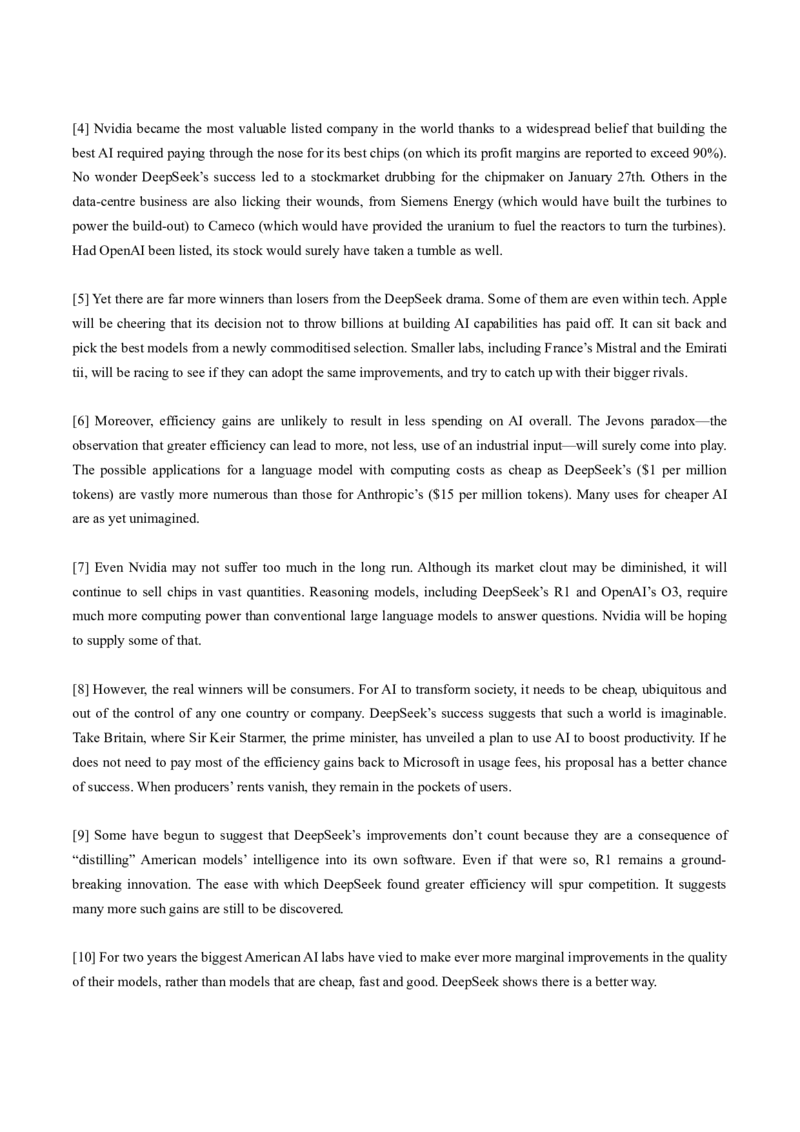
[1] The market reaction, when it came, was brutal. On January 27th, as investors realised just how good
DeepSeek’s “V3” and “R1” models were, they wiped around a trillion dollars off the market capitalisation of
America’s listed tech firms. Nvidia, a chipmaker and the chief shovel-seller of the artificial-intelligence (AI) gold
rush, saw its value fall by $600bn. Yet even if the Chinese model-maker’s new releases rattled investors in a
handful of firms, they should be a cause for optimism for the world at large. DeepSeek shows how competition and
innovation will make AI cheaper and therefore more useful.
[2] DeepSeek’s models are practically as good as those made by Google and OpenAI—and have been produced at a
fraction of the cost. Barred by American export controls from using cutting-edge chips, the Chinese firm undertook
an efficiency drive, even reprogramming the chips it used to train the model to eke out every drop of power. The
cost of building an AI model that can stand toe-to-toe with the best has plummeted. Within days, DeepSeek’s
chatbot was the most downloaded app on the iPhone.
[3] The contrast with America’s approach could not be starker. Sam Altman, the boss of OpenAI, has spent years
telling investors—and America’s new president—that vast sums of money and computing power are needed to stay
at the forefront of AI. Investors have accordingly been betting that a handful of firms stand to reap vast monopoly-
like rents. Yet if fast followers such as DeepSeek can eat away at that lead for a fraction of the cost, then those
profits are at risk.[4] Nvidia became the most valuable listed company in the world thanks to a widespread belief that building the
best AI required paying through the nose for its best chips (on which its profit margins are reported to exceed 90%).
No wonder DeepSeek’s success led to a stockmarket drubbing for the chipmaker on January 27th. Others in the
data-centre business are also licking their wounds, from Siemens Energy (which would have built the turbines to
power the build-out) to Cameco (which would have provided the uranium to fuel the reactors to turn the turbines).
Had OpenAI been listed, its stock would surely have taken a tumble as well.
[5] Yet there are far more winners than losers from the DeepSeek drama. Some of them are even within tech. Apple
will be cheering that its decision not to throw billions at building AI capabilities has paid off. It can sit back and
pick the best models from a newly commoditised selection. Smaller labs, including France’s Mistral and the Emirati
tii, will be racing to see if they can adopt the same improvements, and try to catch up with their bigger rivals.
[6] Moreover, efficiency gains are unlikely to result in less spending on AI overall. The Jevons paradox—the
observation that greater efficiency can lead to more, not less, use of an industrial input—will surely come into play.
The possible applications for a language model with computing costs as cheap as DeepSeek’s ($1 per million
tokens) are vastly more numerous than those for Anthropic’s ($15 per million tokens). Many uses for cheaper AI
are as yet unimagined.
[7] Even Nvidia may not suffer too much in the long run. Although its market clout may be diminished, it will
continue to sell chips in vast quantities. Reasoning models, including DeepSeek’s R1 and OpenAI’s O3, require
much more computing power than conventional large language models to answer questions. Nvidia will be hoping
to supply some of that.
[8] However, the real winners will be consumers. For AI to transform society, it needs to be cheap, ubiquitous and
out of the control of any one country or company. DeepSeek’s success suggests that such a world is imaginable.
Take Britain, where Sir Keir Starmer, the prime minister, has unveiled a plan to use AI to boost productivity. If he
does not need to pay most of the efficiency gains back to Microsoft in usage fees, his proposal has a better chance
of success. When producers’ rents vanish, they remain in the pockets of users.
[9] Some have begun to suggest that DeepSeek’s improvements don’t count because they are a consequence of
“distilling” American models’ intelligence into its own software. Even if that were so, R1 remains a ground-
breaking innovation. The ease with which DeepSeek found greater efficiency will spur competition. It suggests
many more such gains are still to be discovered.
[10] For two years the biggest American AI labs have vied to make ever more marginal improvements in the quality
of their models, rather than models that are cheap, fast and good. DeepSeek shows there is a better way.【译文欣赏】
AI里程碑:寻秘DeepSeek
中国大热AI模型引发投资者恐慌,却给世界带来利好
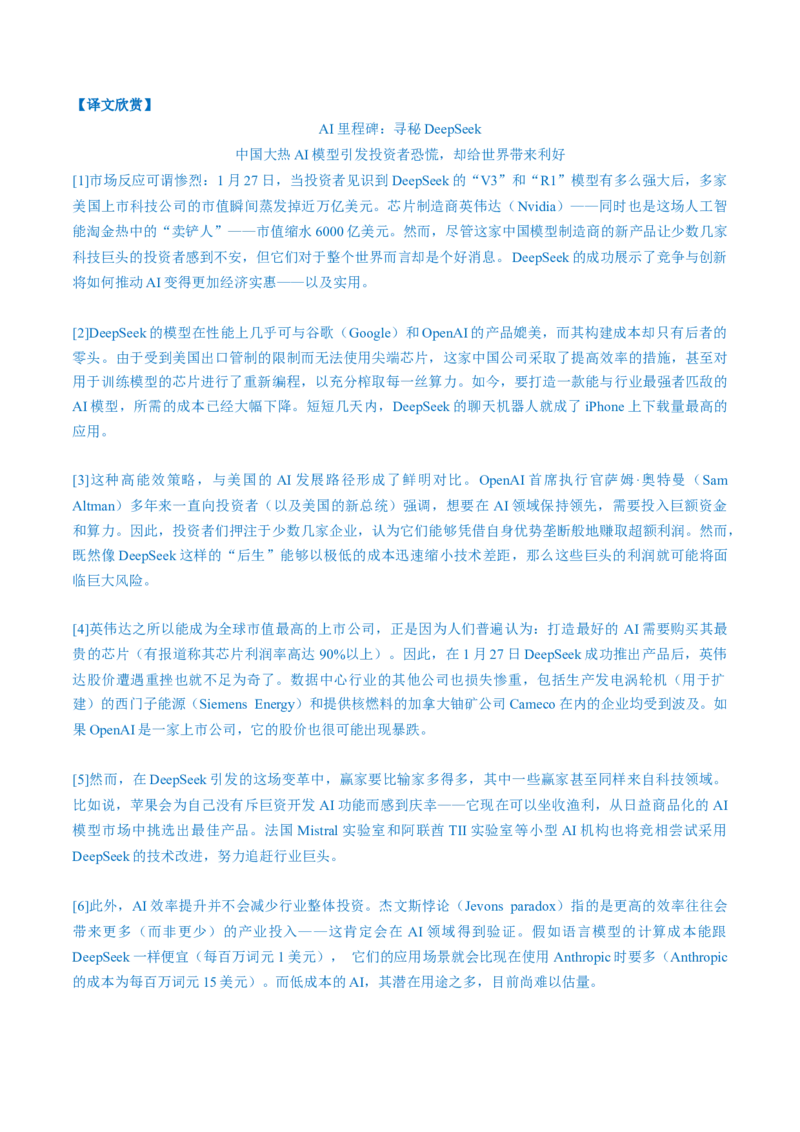
[1]市场反应可谓惨烈:1月27日,当投资者见识到DeepSeek的“V3”和“R1”模型有多么强大后,多家
美国上市科技公司的市值瞬间蒸发掉近万亿美元。芯片制造商英伟达(Nvidia)——同时也是这场人工智
能淘金热中的“卖铲人”——市值缩水6000亿美元。然而,尽管这家中国模型制造商的新产品让少数几家
科技巨头的投资者感到不安,但它们对于整个世界而言却是个好消息。DeepSeek的成功展示了竞争与创新
将如何推动AI变得更加经济实惠——以及实用。
[2]DeepSeek的模型在性能上几乎可与谷歌(Google)和OpenAI的产品媲美,而其构建成本却只有后者的
零头。由于受到美国出口管制的限制而无法使用尖端芯片,这家中国公司采取了提高效率的措施,甚至对
用于训练模型的芯片进行了重新编程,以充分榨取每一丝算力。如今,要打造一款能与行业最强者匹敌的
AI模型,所需的成本已经大幅下降。短短几天内,DeepSeek的聊天机器人就成了iPhone上下载量最高的
应用。
[3]这种高能效策略,与美国的 AI发展路径形成了鲜明对比。OpenAI首席执行官萨姆·奥特曼(Sam
Altman)多年来一直向投资者(以及美国的新总统)强调,想要在 AI领域保持领先,需要投入巨额资金
和算力。因此,投资者们押注于少数几家企业,认为它们能够凭借自身优势垄断般地赚取超额利润。然而,
既然像DeepSeek这样的“后生”能够以极低的成本迅速缩小技术差距,那么这些巨头的利润就可能将面
临巨大风险。
[4]英伟达之所以能成为全球市值最高的上市公司,正是因为人们普遍认为:打造最好的 AI需要购买其最
贵的芯片(有报道称其芯片利润率高达90%以上)。因此,在1月27日DeepSeek成功推出产品后,英伟
达股价遭遇重挫也就不足为奇了。数据中心行业的其他公司也损失惨重,包括生产发电涡轮机(用于扩
建)的西门子能源(Siemens Energy)和提供核燃料的加拿大铀矿公司Cameco在内的企业均受到波及。如
果OpenAI是一家上市公司,它的股价也很可能出现暴跌。
[5]然而,在DeepSeek引发的这场变革中,赢家要比输家多得多,其中一些赢家甚至同样来自科技领域。
比如说,苹果会为自己没有斥巨资开发AI功能而感到庆幸——它现在可以坐收渔利,从日益商品化的AI
模型市场中挑选出最佳产品。法国 Mistral实验室和阿联酋TII实验室等小型AI机构也将竞相尝试采用
DeepSeek的技术改进,努力追赶行业巨头。
[6]此外,AI效率提升并不会减少行业整体投资。杰文斯悖论(Jevons paradox)指的是更高的效率往往会
带来更多(而非更少)的产业投入——这肯定会在 AI领域得到验证。假如语言模型的计算成本能跟
DeepSeek一样便宜(每百万词元1美元), 它们的应用场景就会比现在使用Anthropic时要多(Anthropic
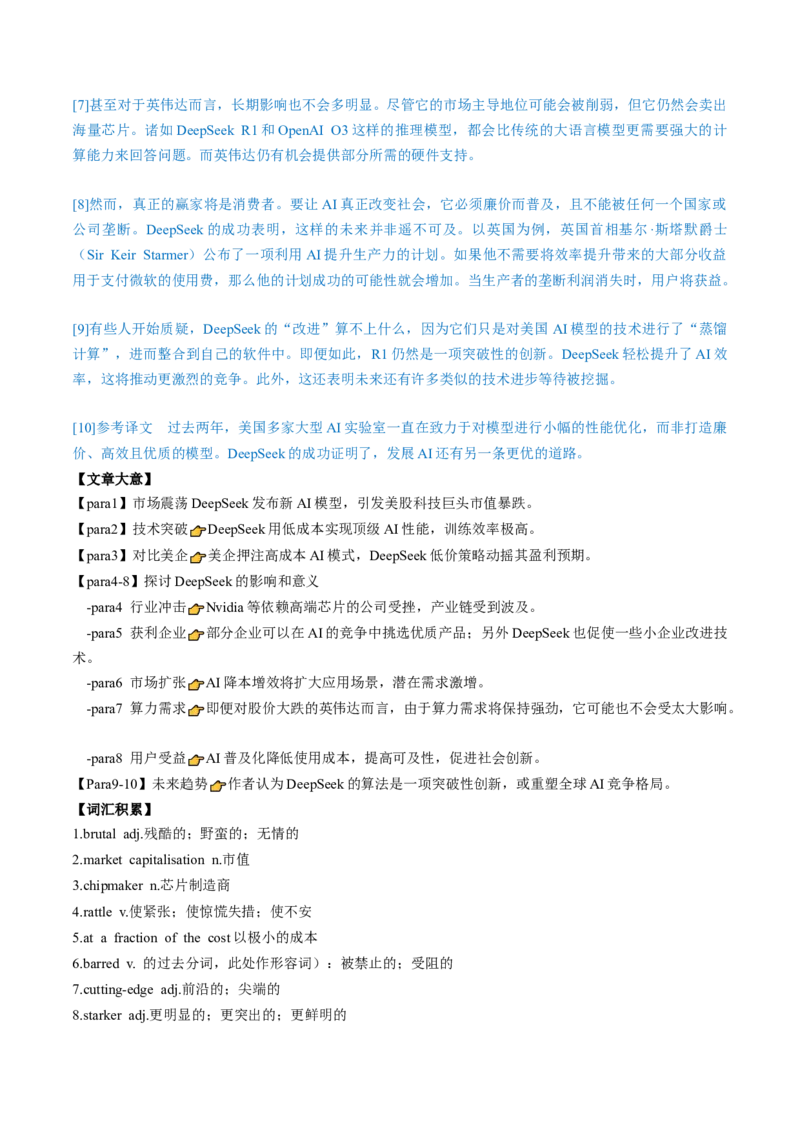
的成本为每百万词元15美元)。而低成本的AI,其潜在用途之多,目前尚难以估量。[7]甚至对于英伟达而言,长期影响也不会多明显。尽管它的市场主导地位可能会被削弱,但它仍然会卖出
海量芯片。诸如DeepSeek R1和OpenAI O3这样的推理模型,都会比传统的大语言模型更需要强大的计
算能力来回答问题。而英伟达仍有机会提供部分所需的硬件支持。
[8]然而,真正的赢家将是消费者。要让 AI真正改变社会,它必须廉价而普及,且不能被任何一个国家或
公司垄断。DeepSeek的成功表明,这样的未来并非遥不可及。以英国为例,英国首相基尔·斯塔默爵士
(Sir Keir Starmer)公布了一项利用AI提升生产力的计划。如果他不需要将效率提升带来的大部分收益
用于支付微软的使用费,那么他的计划成功的可能性就会增加。当生产者的垄断利润消失时,用户将获益。
[9]有些人开始质疑,DeepSeek的“改进”算不上什么,因为它们只是对美国 AI模型的技术进行了“蒸馏
计算”,进而整合到自己的软件中。即便如此,R1仍然是一项突破性的创新。DeepSeek轻松提升了AI效
率,这将推动更激烈的竞争。此外,这还表明未来还有许多类似的技术进步等待被挖掘。
[10]参考译文 过去两年,美国多家大型AI实验室一直在致力于对模型进行小幅的性能优化,而非打造廉
价、高效且优质的模型。DeepSeek的成功证明了,发展AI还有另一条更优的道路。
【文章大意】
【para1】市场震荡DeepSeek发布新AI模型,引发美股科技巨头市值暴跌。
【para2】技术突破👉DeepSeek用低成本实现顶级AI性能,训练效率极高。
【para3】对比美企👉美企押注高成本AI模式,DeepSeek低价策略动摇其盈利预期。
【para4-8】探讨DeepSeek的影响和意义
-para4 行业冲击👉Nvidia等依赖高端芯片的公司受挫,产业链受到波及。
-para5 获利企业👉部分企业可以在AI的竞争中挑选优质产品;另外DeepSeek也促使一些小企业改进技
术。
-para6 市场扩张👉AI降本增效将扩大应用场景,潜在需求激增。
-para7 算力需求👉即便对股价大跌的英伟达而言,由于算力需求将保持强劲,它可能也不会受太大影响。
-para8 用户受益👉AI普及化降低使用成本,提高可及性,促进社会创新。
【Para9-10】未来趋势👉作者认为DeepSeek的算法是一项突破性创新,或重塑全球AI竞争格局。
【词汇积累】
1.brutal adj.残酷的;野蛮的;无情的
2.market capitalisation n.市值
3.chipmaker n.芯片制造商
4.rattle v.使紧张;使惊慌失措;使不安
5.at a fraction of the cost以极小的成本
6.barred v. 的过去分词,此处作形容词):被禁止的;受阻的
7.cutting-edge adj.前沿的;尖端的
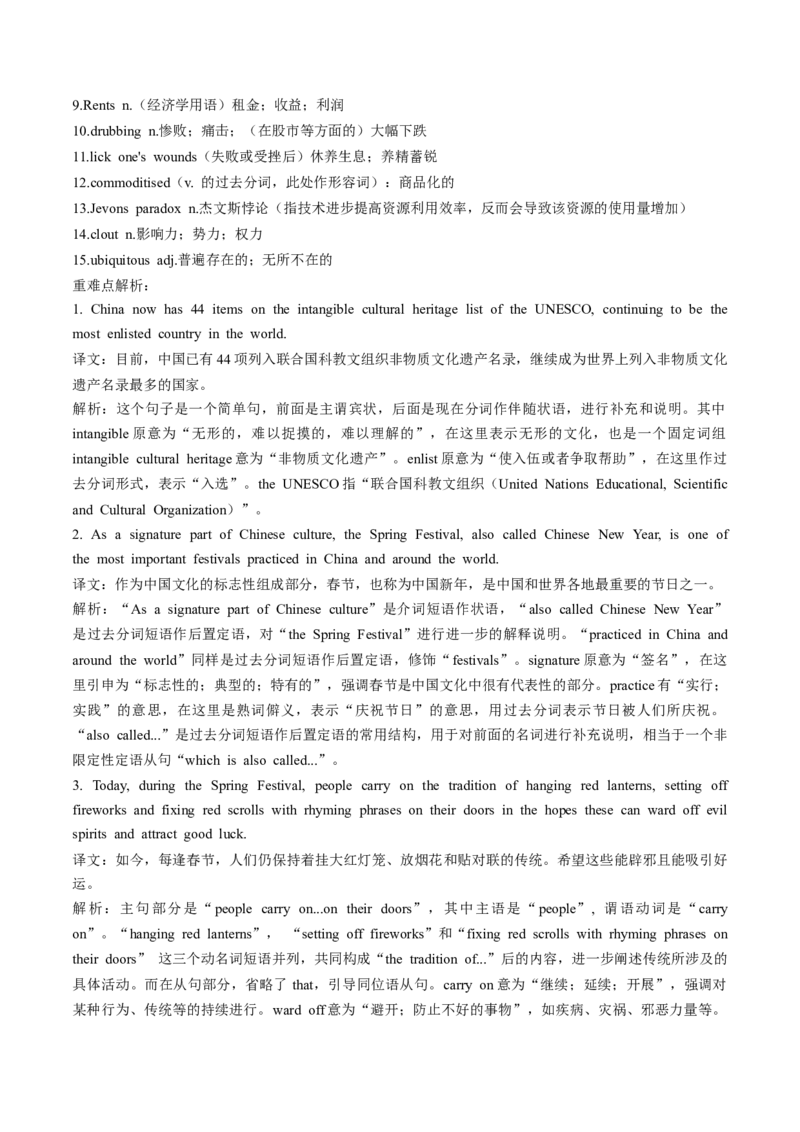
8.starker adj.更明显的;更突出的;更鲜明的9.Rents n.(经济学用语)租金;收益;利润
10.drubbing n.惨败;痛击;(在股市等方面的)大幅下跌
11.lick one's wounds(失败或受挫后)休养生息;养精蓄锐
12.commoditised(v. 的过去分词,此处作形容词):商品化的
13.Jevons paradox n.杰文斯悖论(指技术进步提高资源利用效率,反而会导致该资源的使用量增加)
14.clout n.影响力;势力;权力
15.ubiquitous adj.普遍存在的;无所不在的
重难点解析:
1. China now has 44 items on the intangible cultural heritage list of the UNESCO, continuing to be the
most enlisted country in the world.
译文:目前,中国已有44项列入联合国科教文组织非物质文化遗产名录,继续成为世界上列入非物质文化
遗产名录最多的国家。
解析:这个句子是一个简单句,前面是主谓宾状,后面是现在分词作伴随状语,进行补充和说明。其中
intangible原意为“无形的,难以捉摸的,难以理解的”,在这里表示无形的文化,也是一个固定词组
intangible cultural heritage意为“非物质文化遗产”。enlist原意为“使入伍或者争取帮助”,在这里作过
去分词形式,表示“入选”。the UNESCO指“联合国科教文组织(United Nations Educational, Scientific
and Cultural Organization)”。
2. As a signature part of Chinese culture, the Spring Festival, also called Chinese New Year, is one of
the most important festivals practiced in China and around the world.
译文:作为中国文化的标志性组成部分,春节,也称为中国新年,是中国和世界各地最重要的节日之一。
解析:“As a signature part of Chinese culture”是介词短语作状语,“also called Chinese New Year”
是过去分词短语作后置定语,对“the Spring Festival”进行进一步的解释说明。“practiced in China and
around the world”同样是过去分词短语作后置定语,修饰“festivals”。signature原意为“签名”,在这
里引申为“标志性的;典型的;特有的”,强调春节是中国文化中很有代表性的部分。practice有“实行;
实践”的意思,在这里是熟词僻义,表示“庆祝节日”的意思,用过去分词表示节日被人们所庆祝。
“also called...”是过去分词短语作后置定语的常用结构,用于对前面的名词进行补充说明,相当于一个非
限定性定语从句“which is also called...”。
3. Today, during the Spring Festival, people carry on the tradition of hanging red lanterns, setting off
fireworks and fixing red scrolls with rhyming phrases on their doors in the hopes these can ward off evil
spirits and attract good luck.
译文:如今,每逢春节,人们仍保持着挂大红灯笼、放烟花和贴对联的传统。希望这些能辟邪且能吸引好
运。
解析:主句部分是“people carry on...on their doors”,其中主语是“people”, 谓语动词是“carry
on”。“hanging red lanterns”, “setting off fireworks”和“fixing red scrolls with rhyming phrases on
their doors” 这三个动名词短语并列,共同构成“the tradition of...”后的内容,进一步阐述传统所涉及的
具体活动。而在从句部分,省略了that,引导同位语从句。carry on意为“继续;延续;开展”,强调对
某种行为、传统等的持续进行。ward off意为“避开;防止不好的事物”,如疾病、灾祸、邪恶力量等。set off意为“出发,启程”,这里指“使……爆炸”,表示放烟花。
Passage 3
【材料来源:The Economist】
DeepSeek poses a challenge to Beijing as much as to Silicon Valley
The story of Liang Wenfeng, the model-maker’s mysterious founder
With the release of its latest artificial-intelligence (AI) model, DeepSeek, an obscure Chinese firm,
has laid waste to several years of American policy meant to hold back Chinese innovation—and, in the
process, blown a hole in the valuations of companies from Nvidia, America’s AI chip champion, to
Siemens Energy, a manufacturer of electrical equipment used in data centres. In demonstrating its ability
to innovate around American export restrictions, DeepSeek has raised doubts as to whether access to piles
of cutting-edge semiconductors and related equipment is as important as previously thought when it comes
to training AI models.
The man at the centre of it all is Liang Wenfeng, DeepSeek’s 40-year-old founder. It is unclear
how much he has relished the global market turmoil he has unleashed. A high-school classmate who
recently spoke to local media said Mr Liang is hiding out in his home town for the lunar new year,
which started on January 29th. Playfully mocked on Chinese social media for his skinny, pale appearance,
Mr Liang remains a mystery to most people. Those who have had professional dealings with DeepSeek
say he is obsessed with human-like artificial general intelligence (AGI) and the impact it could have on
the world. In his pursuit of it, DeepSeek’s founder is upending ideas about technological progress both
in the West and China.
Public information on Mr Liang is scant. Born into a family of teachers in an impoverished village
near the southern city of Zhanjiang in 1985, he was a gifted student. A former instructor claimed he
mastered university-level maths in middle school. In 2002 he gained entry into an electronic-information
degree at Zhejiang University, a prestigious school in the eastern Chinese city of Hangzhou. A master’s
degree at the same university, under a well-known machine-vision scientist, exposed him to the field of
AI.
At the time, Hangzhou was a bustling hub for internet technology and home to rising groups such as
Alibaba, an e-commerce firm. Mr Liang and several classmates remained in the city and began
experimenting with quantitative investing models, which do not rely on company fundamentals but on
crunching reams of data. In 2013 Mr Liang and three classmates launched an investment group called
Yakebi in an attempt to monetise the trading models they had built.
Two years later Mr Liang co-founded High-Flyer, a quantitative hedge-fund that grew rapidly
alongside dozens of similar firms during a period of deregulation and market volatility in China. In 2021
it claimed to be managing as much as 100bn yuan ($14bn), though it appears to have rapidly shrunk in
size in the latter half of that year. Quant funds have routinely tussled with Chinese regulators, who view
them as profiting from market routs. Industry insiders say High-Flyer made a name for itself as one of
the most aggressive quant funds, regularly drawing the ire of securities regulators.DeepSeek’s origins lie in an effort to improve High-Flyer’s algorithms. In 2019 the group invested
200m yuan to set up a separate unit to develop its own deep-learning platform, called “Fire-Flyer 1”.
The fund poured 1bn yuan into the effort in 2021 in order to launch a second iteration armed with
10,000 of Nvidia’s A100 graphics processing units. This made High-Flyer an outlier: at the time just
four other firms in China held such large arsenals of powerful chips, all of which were tech giants such
as Alibaba. DeepSeek was made a standalone company in 2023.
It delivered its first jolt to the market in May last year, when it released an ultra-cheap chatbot
based on its V2 model. That kicked off a price war in China’s AI industry, forcing the country’s
biggest tech firms—Alibaba, Baidu, ByteDance and Tencent—to lower their own prices.
By Mr Liang’s own telling, this was not a ploy to capture more users. In July he said costs had
fallen as DeepSeek explored new model structures, something that set it apart from others. Although rival
Chinese AI groups have been conducting research into models, their disadvantage in computing power,
owing to American export restrictions, has led them to focus more on creating clever applications that use
the technology. Many Chinese AI groups have used Llama, the family of large language models developed
by Meta, America’s social-media titan, as a basis for their applications.
Deep thoughts
For Mr Liang, developing models using less computing power is an essential step in pursuit of his
longer-term objective. “Our goal is AGI, which requires us to explore new model structures to achieve
superior capabilities within limited resources,” he has told local media.
DeepSeek’s new R1 model, which has shocked the West, suggests it is making progress. The
company says it cost less than $6m to train, a tiny fraction of comparable models from the likes of
OpenAI, maker of ChatGPT. Sam Altman, OpenAI’s boss, has called R1 “impressive” (though he has
also promised to produce “much better models”, adding that it is “legit invigorating to have a new
competitor”).
DeepSeek certainly has its doubters. Early testing seems to confirm that R1 is as powerful as its
maker says it is. But some have questioned whether the firm has underplayed the number of high-end
chips it used to develop the model, even if others argue its claims are plausible. There is also speculation
that DeepSeek has trained its models by studying the results of American ones, a process known as
“distillation”. OpenAI has said it has evidence that points to DeepSeek distilling its models, in violation
of its terms of service.
If, however, DeepSeek’s is truly efficient, as many believe it is, then it is an affront both to
American tech prowess and China’s state-led innovation model. Chinese state media has been quick to
champion DeepSeek as a national asset in the country’s fight for AI supremacy. Mr Liang was invited
to meet with China’s premier, on January 20th, alongside a handful of other entrepreneurs.
Yet as Zhang Zhiwei of Pinpoint Asset Management, an investment firm, points out, DeepSeek’s
achievements did not emerge from one of China’s myriad government-backed research institutes or state-
controlled companies. Mr Liang appears to control most of the shares in DeepSeek, and has steered clearof China’s state-dominated venture-capital industry.
Mr Liang views China’s role over the past 30 years as that of a technological “follower”,
building on foundations developed in the West. The gap between America and China is between
“originality and imitation”, Mr Liang said in an interview with local media in July. Nvidia’s success,
he argues, has not relied solely on its own performance, but also on technological collaboration among
Western companies. China’s efforts to imitate Western computing power have fallen short, in his view,
because it lacks this type of collaboration, despite a capital-intensive state-led effort to create one.
DeepSeek may not be a wake-up call only for the West, but also for Beijing.
【译文欣赏】
DeepSeek对北京和硅谷都构成了挑战
——模型制造者神秘创始人梁文峰的故事
随着最新人工智能(AI)模型DeepSeek的发布,这家名不见经传的中国公司摧毁了美国多年来旨在
遏制中国创新的政策,并在此过程中对从美国 AI芯片巨头英伟达到数据中心电气设备制造商西门子能源
等公司的估值造成了冲击。DeepSeek展示了其绕过美国出口限制进行创新的能力,这让人们开始怀疑,在
训练AI模型时,获取大量尖端半导体及相关设备是否真的像以前认为的那么重要。
这一切的核心人物是DeepSeek的40岁创始人梁文峰。目前尚不清楚他对自己引发的全球市场动荡有
多大的兴趣。一位最近接受当地媒体采访的高中同学表示,梁文峰正在家乡躲避农历新年(1月29日开
始)的喧嚣。梁文峰因瘦削苍白的外表在中国社交媒体上被戏谑调侃,但对大多数人来说,他仍然是个
谜。那些与DeepSeek有过专业往来的人表示,他痴迷于类人的人工通用智能(AGI)及其可能对世界产生
的影响。在追求这一目标的过程中,DeepSeek的创始人正在颠覆西方和中国对技术进步的认知。
关于梁文峰的公开信息很少。1985年,他出生在湛江市附近一个贫困村庄的教师家庭,是一名天赋异
禀的学生。一位前导师称,他在中学时就掌握了大学水平的数学。2002年,他考入位于杭州的浙江大学,
攻读电子信息学位。在浙江大学攻读硕士学位期间,他师从一位著名的机器视觉科学家,接触到了 AI领
域。
当时,杭州是互联网技术的繁荣中心,也是阿里巴巴等新兴企业的所在地。梁文峰和几位同学留在杭
州,开始尝试量化投资模型。这些模型不依赖公司基本面,而是依赖于海量数据的处理。2013年,梁文峰
和三位同学共同创立了一家名为雅可比的投资集团,试图将他们构建的交易模型商业化。
两年后,梁文峰与他人共同创立了量化对冲基金High-Flyer。在中国放松监管和市场波动的时期,该
公司与数十家类似公司一起迅速发展。2021年,该公司声称管理着高达1000亿元人民币(140亿美元)的
资金,尽管其规模在当年下半年似乎迅速缩水。量化基金经常与中国监管机构发生冲突,监管机构认为它
们从市场崩盘中获利。业内人士表示,High-Flyer以最激进的量化基金之一而闻名,经常引起证券监管机
构的不满。DeepSeek的起源可以追溯到改进High-Flyer算法的努力。2019年,该集团投资2亿元人民币成立了一
个独立部门,开发自己的深度学习平台“Fire-Flyer 1”。2021年,该基金又投入10亿元人民币,推出了
配备1万个英伟达A100图形处理单元的第二代平台。这使得High-Flyer成为一个异类:当时中国只有四家
公司拥有如此大量的强大芯片,且都是阿里巴巴这样的科技巨头。DeepSeek于2023年成为一家独立公
司。
去年5月,该公司发布了基于V2模型的超低价聊天机器人,首次对市场产生了冲击。这引发了中国
AI行业的价格战,迫使阿里巴巴、百度、字节跳动和腾讯等中国最大的科技公司降低自己的价格。
据梁文峰自己说,这并不是为了吸引更多用户。7月,他表示,随着DeepSeek探索新的模型结构,成
本已经下降,这使其与众不同。尽管中国的竞争对手一直在研究模型,但由于美国的出口限制,他们在计
算能力上的劣势使他们更专注于开发使用该技术的智能应用。许多中国 AI集团以Meta开发的大型语言模
型Llama为基础开发应用。
深度思考
对梁文峰来说,使用更少的计算能力开发模型是实现其长期目标的关键一步。他告诉当地媒体:“我
们的目标是AGI,这要求我们在有限的资源内探索新的模型结构,以实现卓越的能力。”
DeepSeek的新R1模型震惊了西方,表明其正在取得进展。该公司表示,训练该模型的成本不到600
万美元,仅为OpenAI等公司同类模型成本的一小部分。OpenAI的老板萨姆·阿尔特曼称R1“令人印象深
刻”(尽管他也承诺将推出“更好的模型”,并补充说“有一个新的竞争对手确实令人振奋”)。
当然,DeepSeek也有质疑者。早期测试似乎证实R1确实如其制造商所说的那样强大。但一些人质疑
该公司是否低估了用于开发该模型的高端芯片数量,尽管其他人认为其说法是可信的。也有人猜测,
DeepSeek通过研究美国模型的结果来训练其模型,这一过程被称为“蒸馏”。OpenAI表示,有证据表明
DeepSeek蒸馏了其模型,违反了其服务条款。
然而,如果DeepSeek确实如许多人认为的那样高效,那么这对美国的技术实力和中国国家主导的创
新模式都是一种冒犯。中国官方媒体迅速将DeepSeek誉为中国争夺AI霸主地位的国家资产。1月20日,
梁文峰与其他几位企业家一起受邀与中国总理会面。
然而,正如投资公司Pinpoint Asset Management的张志伟所指出的,DeepSeek的成就并非来自中国
众多政府支持的研究机构或国有企业。梁文峰似乎控制了DeepSeek的大部分股份,并避开了中国国家主
导的风险投资行业。
梁文峰认为,中国在过去30年的角色是技术“追随者”,建立在西方发展的基础上。梁文峰在 7月接
受当地媒体采访时表示,美国和中国之间的差距在于“原创与模仿”。他认为,英伟达的成功不仅依赖于
其自身的表现,还依赖于西方公司之间的技术合作。在他看来,中国模仿西方计算能力的努力之所以失败,是因为缺乏这种合作,尽管国家主导的资本密集型努力试图创造这种合作。DeepSeek可能不仅是对西
方的警钟,也是对北京的警钟。
第二部分 高考题型精练
一、阅读理解
A
Contemporary information retrieval systems stand at a crossroads, where DeepSeek’s neuro-symbolic
architecture fundamentally subverts decades-old methodologies. Unlike traditional models constrained by the
lexical-semantic dichotomy (词汇语义二分法) — where BM25 excels at term frequency optimization but falters in
contextual inference, or Transformer-based models (BERT, DPR) that capture semantic subtle differences at
prohibitive computational costs —DeepSeek pioneers adaptive sparse-dense fusion (稀疏-稠密结合). This
technique dynamically allocates resources through a gating mechanism, achieving 87.3% precision in MIT’s TREC
Complex Answer Retrieval benchmark while consuming merely 23% of DPR’s energy footprint.
The model’s dynamic sparse activation mechanism, selectively engaging only 12% of parameters per query,
contrasts sharply with DSI’s memory-intensive full-parameter operations. Stanford’s comparative analysis reveals
DeepSeek’s latency-vs-recall Pareto dominance: 11ms response time with 94% recall against DSI’s 37ms/96%
tradeoff, a critical advantage in real-time applications like emergency response systems.
However, epistemological debates persist. While DeepSeek’s multi-hop reasoning capacity (validated by
92% accuracy on HotpotQA’s multi-document inference tasks) surpasses classical models, its gradient-disentangled
representation learning raises philosophical concerns. The 2023 ACL meta-study documents instances where the
model’s compressed knowledge distillation inadvertently erased low-resource language morphological patterns,
prompting UNESCO (联合国教科文组织) to draft ethical guidelines for cognitive bias propagation in AI-mediated
search.
Commercial adoption patterns prove equally transformative. Bloomberg reports that DeepSeek-powered financial
analytics platforms reduced fraudulent transaction identification time from 9.2 to 1.4 seconds, outperforming IBM’s
Watson Discovery by 18.7% in F1 scores. Yet, its black-box query reformulation process remains contentious-the
European AI Office recently mandated transparency protocols after DeepSeek’s explainability metrics scored 0.48
on the LIRE framework(vs. 0.72 for interpretable systems like Elastic Learned Sparse Encoder).Notes: DSI
(Dimension Strategies) is a framework related to dimension strategies in the field of AI by Microsoft.
1.What technological breakthrough enables DeepSeek’s energy efficiency?
A.Full-parameter optimization. B.Gradient-disentangled learning.
C.Adaptive sparse-dense fusion. D.Lexical-semantic dichotomy.
2.Which metric highlights DeepSeek’s real-time application superiority?
A.92% accuracy on HotpotQA B.11ms response time with 94% recall
C.0.48 LIRE explainability score D.87.3% TREC precision rate
3.What ethical concern arises from DeepSeek’s design?
A.Excessive energy consumption. B.Propagation of cognitive biases.
C.Slow fraud detection speeds. D.Overly transparent operations.
4.How does the neuro-symbolic integration address model limitations?A.By prioritizing speed over accuracy.
B.Through compressed knowledge distillation.
C.Using multi-hop reasoning capacity.
D.Via dynamic parameter activation.
B
With the rapid development of artificial intelligence, DeepSeek, a Chinese AI company, has emerged as a
pioneer in educational technology. Its latest model, DeepSeek-R1, combines advanced machine learning methods to
provide personalized learning solutions for students worldwide.
Unlike traditional AI models that rely on pre-programmed answers, DeepSeek-R1 uses reinforcement (强化)
learning to simulate human reasoning. This allows it to guide students through problem-solving step by step, much
like a patient tutor. For example, when a student struggles with a math equation, DeepSeek-R1 doesn’t just give the
answer; it breaks down the logic, identifies errors, and encourages critical thinking.
The model’s applications extend beyond academics. In language learning, it analyzes students’ pronunciation
through AI speech recognition and offers real-time feedback. For teachers, DeepSeek-R1 can generate lesson plans
aligned with curriculum standards and even predict students’ learning difficulties based on historical data. Its
“adaptive testing” feature creates customized quizzes that adjust difficulty according to individual progress.
However, challenges remain. Critics argue that over-reliance on AI might reduce human interaction in
education. DeepSeek’s developers address this by emphasizing its role as a “supplement, not a replacement.” As Dr.
Li, a DeepSeek researcher, stated, “Our goal is to free teachers from repetitive tasks so they can focus on inspiring
creativity.”
Looking ahead, DeepSeek aims to integrate virtual reality (VR) into its platform, allowing students to
explore historical events or scientific concepts in immersive 3D environments. While ethical debates about AI in
education persist, one thing is clear: tools like DeepSeek are reshaping how we learn, blending technology with
human wisdom.
5.What makes DeepSeek-R1 different from traditional AI models?
A.It uses pre-programmed answers.
B.It focuses on memorization techniques.
C.It replaces teachers in classrooms.
D.It employs reinforcement learning for reasoning.
6.The underlined word “adaptive” in Paragraph 3 most likely means ______.
A.fixed B.adjustable
C.complicated D.outdated
7.What can be inferred about DeepSeek’s future plans?
A.VR technology will enhance interactive learning.
B.It will eliminate all classroom activities.
C.It prioritizes profit over educational values.
D.Teachers will lose their jobs to AI.8.What is the main purpose of the passage?
A.To advertise DeepSeek products.
B.To criticize the risks of AI in schools.
C.To discuss AI’s role in transforming education.
D.To compare different AI models.
C
On January 20, 2025, a Chinese tech firm named DeepSeek launched a new AI - DeepSeek - R1. This
intelligent program has the ability to solve math problems, write code, and answer questions, similar to top - tier
models like OpenAI's GPT - 40. However, its development cost is much lower. The team only spent $5.58 million
(1/70 of OpenAI's cost) and used 2,048 computer chips over two months, demonstrating that great ideas can
outperform large amounts of money.
DeepSeek - R1 learns through repeated attempts and self - improvement, much like students practicing math.
While other AIs rely on numerous pre - prepared examples, R1 can enhance itself. For instance, in a global math
test, it achieved a 79.8% accuracy rate, slightly surpassing OpenAI's model. Moreover, a basic version of R1 can
run on low - cost computers, benefiting schools and small enterprises. DeepSeek - R1 is open for free use and
modification. On its first day online, more than 19,000 programmers worldwide initiated projects to study it. A
German scientist stated that experiments with R1 cost only $10, compared to $300 for other AIs. Even a top
scientist from Meta (a well - known US tech company) said, "This kind of free AI could change the world."
US tech companies are concerned. Meta plans to invest an additional $65 billion in AI research. Experts
believe China is catching up rapidly. A report in Nature magazine described R1 as a "big step forward", proving that
smart ideas can defeat expensive tools.
As a DeepSeek engineer put it, "We hope AI will be a friend, not just something for the wealthy to use." With
R1, China shows the world that great achievements come from innovative ideas and hard work, not just money.
9.What is the main advantage of DeepSeek - R1 compared with other top - tier models?
A. It has a wider range of functions.
B. It can run on more types of computers.
C. It has a much lower development cost.
D. It can solve more complex math problems.
10. How does DeepSeek - R1 learn and improve?
A. By relying on a large number of pre - prepared examples.
B. Through repeated attempts and self - enhancement.
C. By comparing with other AI models constantly.
D. With the help of a large number of computer chips.
11. What do we know about the influence of DeepSeek - R1?
A. It has attracted the attention of many programmers around the world.
B. It has made US tech companies give up their AI research plans.
C. It has led to a reduction in the investment of AI research in the US.
D. It has been recognized as the most advanced AI in the world.12. What is the best title for the passage?
A. The Development of AI in China
B. DeepSeek - R1: A New Milestone in AI
C. The Competition between Chinese and US AI
D. The Future of AI: DeepSeek - R1's Vision
二、语法填空
DeepSeek, a remarkable Chinese - made AI, has recently burst into the global spotlight. It 1.______ (develop)
by a group of talented Chinese researchers with the aim of 2.______ (advance) artificial intelligence technology.
What makes DeepSeek stand out is its powerful capabilities. It can handle a wide range of tasks, from natural
language processing 3.______ image recognition. In natural language processing, it can generate high - quality text,
answer complex questions 4.______ (accurate), and even engage in intelligent conversations. When it comes to
image recognition, it can identify various objects and scenes with 5.______ (impress) precision.
The success of DeepSeek is not accidental. It benefits from the continuous investment in AI research in China
and the rich talent pool in this field. The researchers behind DeepSeek have made 6.______ (numerous) efforts to
improve its algorithms and performance. They have also incorporated the latest 7.______ (technology)
breakthroughs into the development process.
Moreover, DeepSeek has found 8.______ (apply) in many industries. In the medical field, it can assist doctors
in diagnosing diseases by analyzing medical images and patient data. In the education sector, it can provide
personalized learning resources for students. In the business world, it can help companies with market analysis and
customer service.
As DeepSeek continues to gain popularity, it is playing an increasingly important role in promoting
international cooperation in the AI field. It shows the world the 9.______ (remark) achievements of Chinese AI
technology and 10.______ (boost) the confidence of the Chinese scientific community.
三、书面表达
假定你是李华,你的英国笔友 Tom 对人工智能很感兴趣,他在邮件中询问你关于最近在全球引发热
议的 DeepSeek 相关情况。请你给他回一封邮件,内容包括:
1.DeepSeek 的基本信息(如它是什么,主要特点等);
2.它在全球引发热议的原因;
3.你对 DeepSeek 未来发展的看法。
注意:
1. 词数 80词左右;
2. 可以适当增加细节,以使行文连贯。
学校英语俱乐部计划举办一场关于人工智能发展的讲座,此次讲座将重点介绍在全球引发热议的 De
epSeek。请你以俱乐部的名义写一则通知,内容包括:
1.讲座的时间、地点;2.讲座的主要内容(对 DeepSeek 的介绍,其影响等);
3.欢迎大家参加并鼓励提问交流。
注意:1.词数 80词左右;
2. 可以适当增加细节,以使行文连贯。