专题 10 情态动词和虚拟语气-2024 年高中英语语法精讲精练
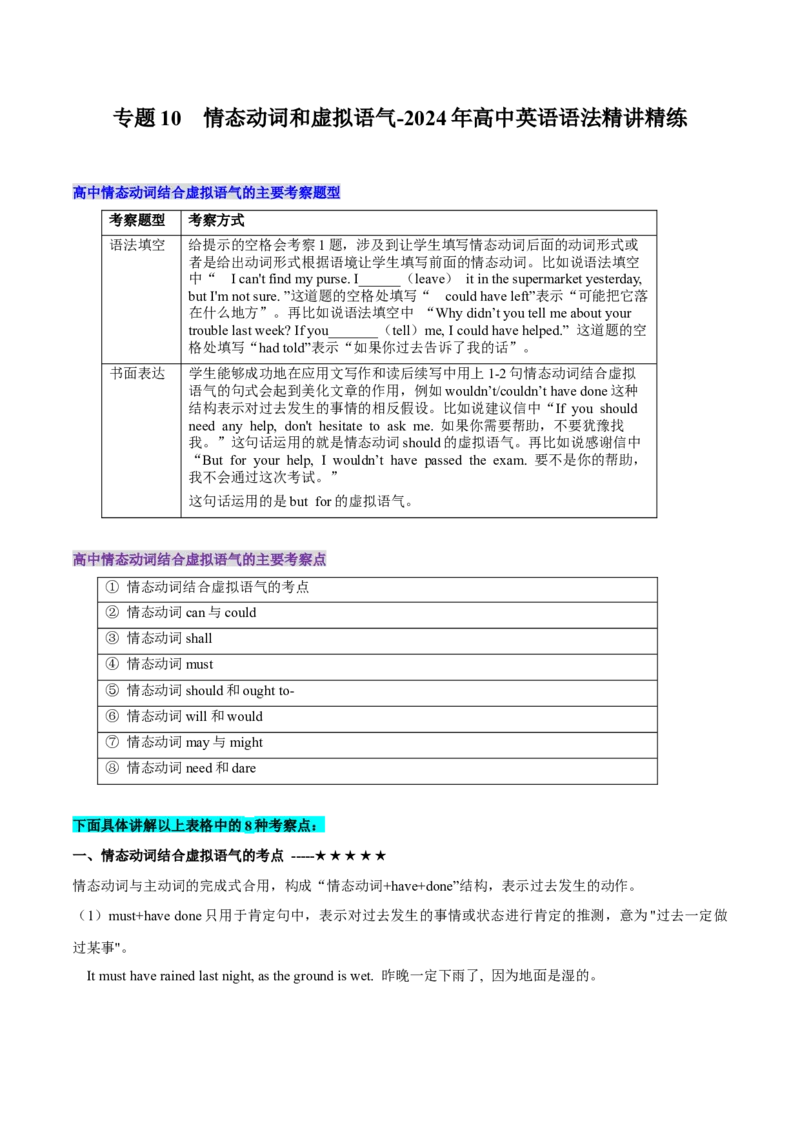
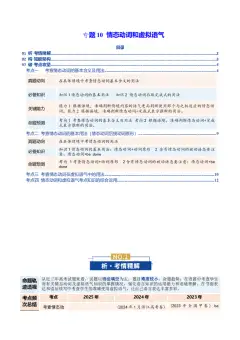
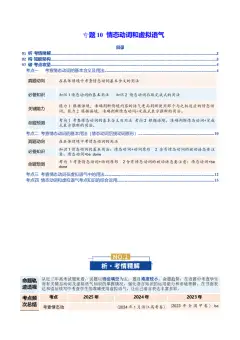
高中情态动词结合虚拟语气的主要考察题型
考察题型 考察方式
语法填空 给提示的空格会考察1题,涉及到让学生填写情态动词后面的动词形式或
者是给出动词形式根据语境让学生填写前面的情态动词。比如说语法填空
中“ I can't find my purse. I______(leave) it in the supermarket yesterday,
but I'm not sure. ”这道题的空格处填写“ could have left”表示“可能把它落
在什么地方”。再比如说语法填空中 “Why didn’t you tell me about your
trouble last week? If you_______(tell)me, I could have helped.” 这道题的空
格处填写“had told”表示“如果你过去告诉了我的话”。
书面表达 学生能够成功地在应用文写作和读后续写中用上1-2句情态动词结合虚拟
语气的句式会起到美化文章的作用,例如wouldn’t/couldn’t have done这种
结构表示对过去发生的事情的相反假设。比如说建议信中“If you should
need any help, don't hesitate to ask me. 如果你需要帮助,不要犹豫找
我。”这句话运用的就是情态动词should的虚拟语气。再比如说感谢信中
“But for your help, I wouldn’t have passed the exam. 要不是你的帮助,
我不会通过这次考试。”
这句话运用的是but for的虚拟语气。
高中情态动词结合虚拟语气的主要考察点
① 情态动词结合虚拟语气的考点
② 情态动词can与could
③ 情态动词shall
④ 情态动词must
⑤ 情态动词should和ought to-
⑥ 情态动词will和would
⑦ 情态动词may与might
⑧ 情态动词need和dare
下面具体讲解以上表格中的8种考察点:
一、情态动词结合虚拟语气的考点 -----★ ★ ★ ★ ★
情态动词与主动词的完成式合用,构成“情态动词+have+done”结构,表示过去发生的动作。
(1)must+have done只用于肯定句中,表示对过去发生的事情或状态进行肯定的推测,意为"过去一定做
过某事"。
It must have rained last night, as the ground is wet. 昨晚一定下雨了, 因为地面是湿的。(2)can't have done/couldn't have done,表示对过去发生的事情或状态的肯定的推测,意为“过去不可能
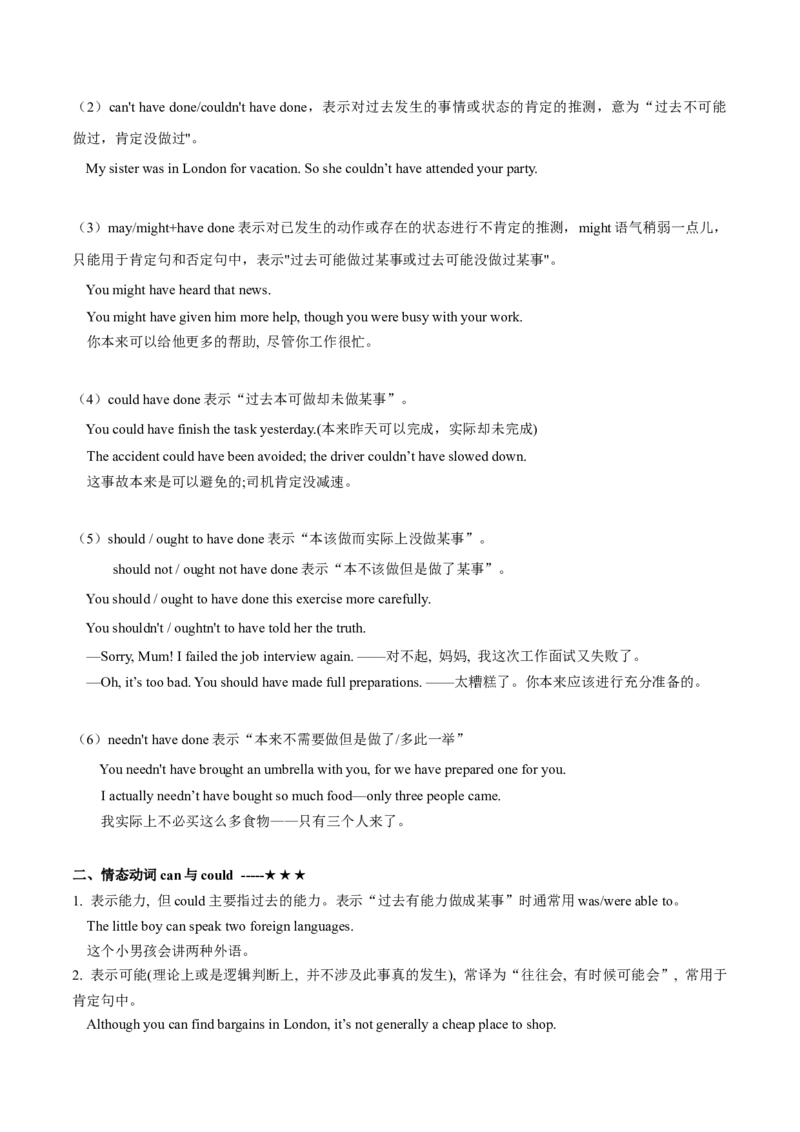
做过,肯定没做过"。
My sister was in London for vacation. So she couldn’t have attended your party.
(3)may/might+have done表示对已发生的动作或存在的状态进行不肯定的推测,might语气稍弱一点儿,
只能用于肯定句和否定句中,表示"过去可能做过某事或过去可能没做过某事"。
You might have heard that news.
You might have given him more help, though you were busy with your work.
你本来可以给他更多的帮助, 尽管你工作很忙。
(4)could have done表示“过去本可做却未做某事”。
You could have finish the task yesterday.(本来昨天可以完成,实际却未完成)
The accident could have been avoided; the driver couldn’t have slowed down.
这事故本来是可以避免的;司机肯定没减速。
(5)should / ought to have done表示“本该做而实际上没做某事”。
should not / ought not have done表示“本不该做但是做了某事”。
You should / ought to have done this exercise more carefully.
You shouldn't / oughtn't to have told her the truth.
—Sorry, Mum! I failed the job interview again. ——对不起, 妈妈, 我这次工作面试又失败了。
—Oh, it’s too bad. You should have made full preparations. ——太糟糕了。你本来应该进行充分准备的。
(6)needn't have done表示“本来不需要做但是做了/多此一举”
You needn't have brought an umbrella with you, for we have prepared one for you.
I actually needn’t have bought so much food—only three people came.
我实际上不必买这么多食物——只有三个人来了。
二、情态动词can与could -----★ ★ ★
1. 表示能力, 但could主要指过去的能力。表示“过去有能力做成某事”时通常用was/were able to。
The little boy can speak two foreign languages.
这个小男孩会讲两种外语。
2. 表示可能(理论上或是逻辑判断上, 并不涉及此事真的发生), 常译为“往往会, 有时候可能会”, 常用于
肯定句中。
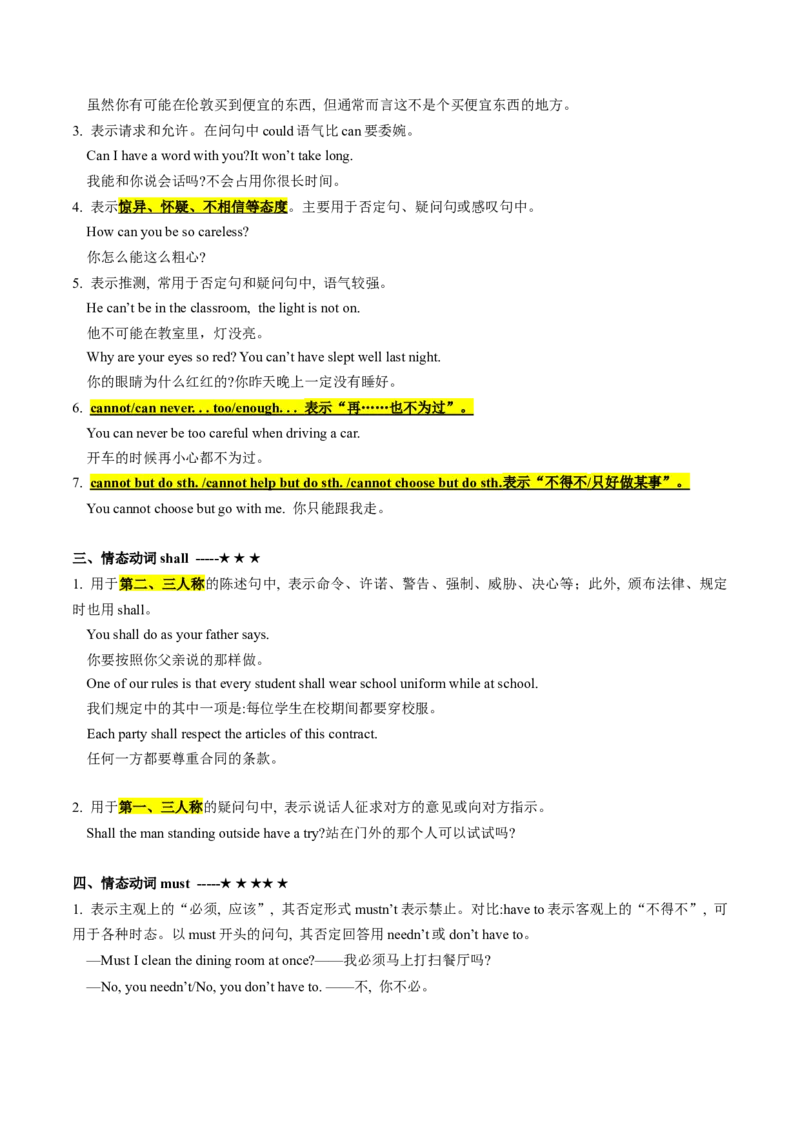
Although you can find bargains in London, it’s not generally a cheap place to shop.虽然你有可能在伦敦买到便宜的东西, 但通常而言这不是个买便宜东西的地方。
3. 表示请求和允许。在问句中could语气比can要委婉。
Can I have a word with you?It won’t take long.
我能和你说会话吗?不会占用你很长时间。
4. 表示惊异、怀疑、不相信等态度。主要用于否定句、疑问句或感叹句中。
How can you be so careless?
你怎么能这么粗心?
5. 表示推测, 常用于否定句和疑问句中, 语气较强。
He can’t be in the classroom, the light is not on.
他不可能在教室里,灯没亮。
Why are your eyes so red? You can’t have slept well last night.
你的眼睛为什么红红的?你昨天晚上一定没有睡好。
6. cannot/can never. . . too/enough. . . 表示“再……也不为过”。
You can never be too careful when driving a car.
开车的时候再小心都不为过。
7. cannot but do sth. /cannot help but do sth. /cannot choose but do sth. 表示“不得不 / 只好做某事”。
You cannot choose but go with me. 你只能跟我走。
三、情态动词shall -----★ ★ ★
1. 用于第二、三人称的陈述句中, 表示命令、许诺、警告、强制、威胁、决心等;此外, 颁布法律、规定
时也用shall。
You shall do as your father says.
你要按照你父亲说的那样做。
One of our rules is that every student shall wear school uniform while at school.
我们规定中的其中一项是:每位学生在校期间都要穿校服。
Each party shall respect the articles of this contract.
任何一方都要尊重合同的条款。
2. 用于第一、三人称的疑问句中, 表示说话人征求对方的意见或向对方指示。
Shall the man standing outside have a try?站在门外的那个人可以试试吗?
四、情态动词must -----★ ★ ★★ ★
1. 表示主观上的“必须, 应该”, 其否定形式mustn’t表示禁止。对比:have to表示客观上的“不得不”, 可
用于各种时态。以must开头的问句, 其否定回答用needn’t或don’t have to。
—Must I clean the dining room at once?——我必须马上打扫餐厅吗?
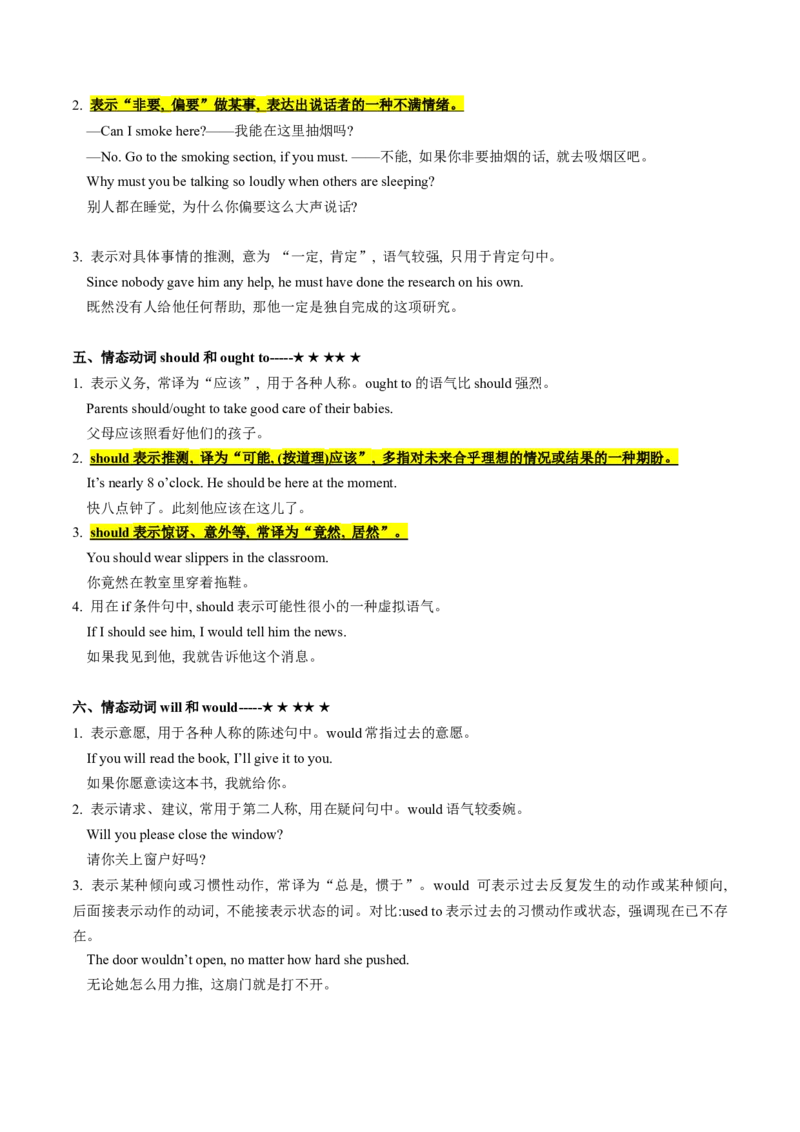
—No, you needn’t/No, you don’t have to. ——不, 你不必。2. 表示“非要 , 偏要”做某事 , 表达出说话者的一种不满情绪。
—Can I smoke here?——我能在这里抽烟吗?
—No. Go to the smoking section, if you must. ——不能, 如果你非要抽烟的话, 就去吸烟区吧。
Why must you be talking so loudly when others are sleeping?
别人都在睡觉, 为什么你偏要这么大声说话?
3. 表示对具体事情的推测, 意为 “一定, 肯定”, 语气较强, 只用于肯定句中。
Since nobody gave him any help, he must have done the research on his own.
既然没有人给他任何帮助, 那他一定是独自完成的这项研究。
五、情态动词should和ought to-----★ ★ ★★ ★
1. 表示义务, 常译为“应该”, 用于各种人称。ought to的语气比should强烈。
Parents should/ought to take good care of their babies.
父母应该照看好他们的孩子。
2. should 表示推测 , 译为“可能 , ( 按道理 ) 应该” , 多指对未来合乎理想的情况或结果的一种期盼。
It’s nearly 8 o’clock. He should be here at the moment.
快八点钟了。此刻他应该在这儿了。
3. should 表示惊讶、意外等 , 常译为“竟然 , 居然”。
You should wear slippers in the classroom.
你竟然在教室里穿着拖鞋。
4. 用在if条件句中, should表示可能性很小的一种虚拟语气。
If I should see him, I would tell him the news.
如果我见到他, 我就告诉他这个消息。
六、情态动词will和would-----★ ★ ★★ ★
1. 表示意愿, 用于各种人称的陈述句中。would常指过去的意愿。
If you will read the book, I’ll give it to you.
如果你愿意读这本书, 我就给你。
2. 表示请求、建议, 常用于第二人称, 用在疑问句中。would语气较委婉。
Will you please close the window?
请你关上窗户好吗?
3. 表示某种倾向或习惯性动作, 常译为“总是, 惯于”。would 可表示过去反复发生的动作或某种倾向,
后面接表示动作的动词, 不能接表示状态的词。对比:used to表示过去的习惯动作或状态, 强调现在已不存
在。
The door wouldn’t open, no matter how hard she pushed.
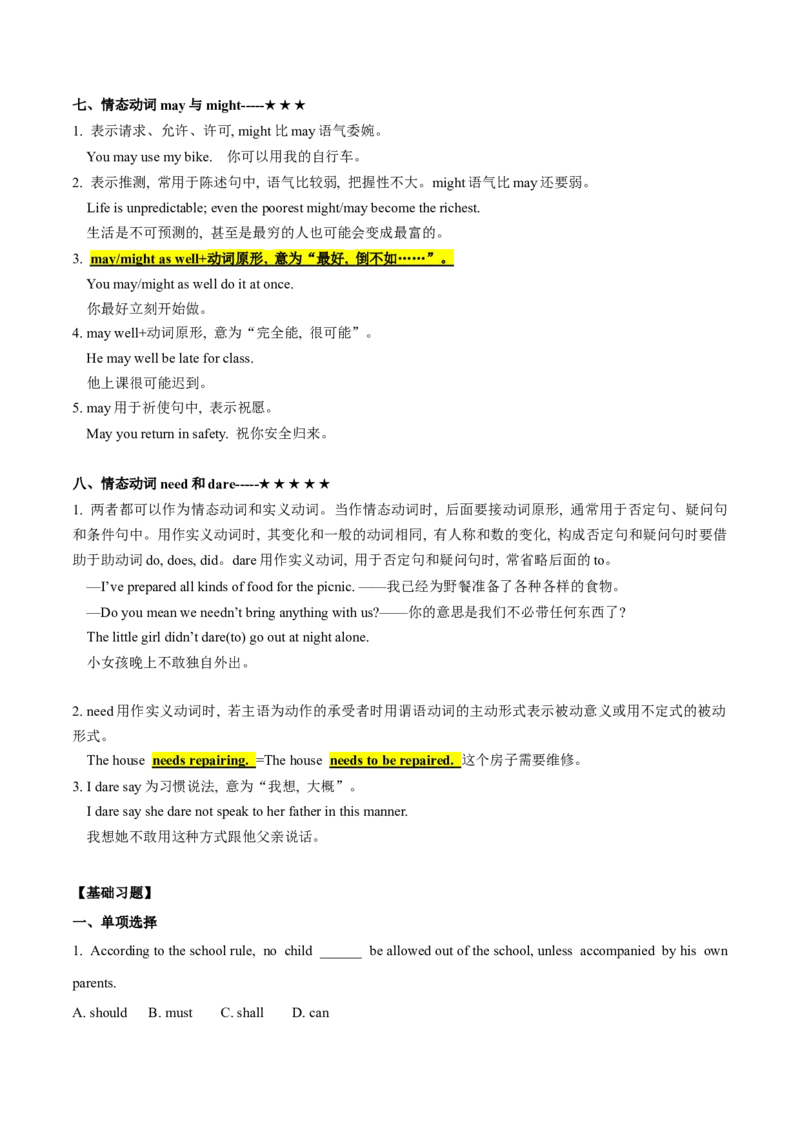
无论她怎么用力推, 这扇门就是打不开。七、情态动词may与might-----★ ★ ★
1. 表示请求、允许、许可, might比may语气委婉。
You may use my bike. 你可以用我的自行车。
2. 表示推测, 常用于陈述句中, 语气比较弱, 把握性不大。might语气比may还要弱。
Life is unpredictable; even the poorest might/may become the richest.
生活是不可预测的, 甚至是最穷的人也可能会变成最富的。
3. may/might as well+ 动词原形 , 意为“最好 , 倒不如……”。
You may/might as well do it at once.
你最好立刻开始做。
4. may well+动词原形, 意为“完全能, 很可能”。
He may well be late for class.
他上课很可能迟到。
5. may用于祈使句中, 表示祝愿。
May you return in safety. 祝你安全归来。
八、情态动词need和dare-----★ ★ ★ ★ ★
1. 两者都可以作为情态动词和实义动词。当作情态动词时, 后面要接动词原形, 通常用于否定句、疑问句
和条件句中。用作实义动词时, 其变化和一般的动词相同, 有人称和数的变化, 构成否定句和疑问句时要借
助于助动词do, does, did。dare用作实义动词, 用于否定句和疑问句时, 常省略后面的to。
—I’ve prepared all kinds of food for the picnic. ——我已经为野餐准备了各种各样的食物。
—Do you mean we needn’t bring anything with us?——你的意思是我们不必带任何东西了?
The little girl didn’t dare(to) go out at night alone.
小女孩晚上不敢独自外出。
2. need用作实义动词时, 若主语为动作的承受者时用谓语动词的主动形式表示被动意义或用不定式的被动
形式。
The house needs repairing. =The house needs to be repaired. 这个房子需要维修。
3. I dare say为习惯说法, 意为“我想, 大概”。
I dare say she dare not speak to her father in this manner.
我想她不敢用这种方式跟他父亲说话。
【基础习题】
一、单项选择
1. According to the school rule, no child ______ be allowed out of the school, unless accompanied by his own
parents.
A. should B. must C. shall D. can2. One of the unanswered questions of the September 11 attacks is whether there was anything U. S. intelligence
______ to stop the attacks .
A. must do B. could do C. must have done D. could have done
3. No wonder some people don't show sympathy for the victim of the accident. She could ______ have observed
A. Must B. Should C. need D. would
4. It's a sad fact of life : lies are lies , and sometimes the truth ______ lie as well.
A. Shall B. should C. Can D.must
5. The expert was greatly shocked at Donald Trump's taking office. Never did he expect that the voters ______
be so unreasonable.
A. should B. could C. would D. might
6. —I have no idea what made the students so excited and crazy.
—______ it have been their team's victory in the finals? must have done canlould .
A. Must B. Could C. Would D. Should
7. —Sherry rang to say she was too busy to come .
—Well , she ______ say that. She is always making excuses.
A. mustn't B. Would C. needn't D. should
8. After making the speech, he went through it in his mind to reflect where he ______ better.
A. could do B. would do C. could have done D. would have done
9. —Penny's baby daughter narrowly escaped drinking the furniture polish on the coffee table.
—Luckily for her. She ______ sick or even died .
A. could have got B. should have got. C. must have got D. will have got
10. “But for the fact that ______ you there for 3 years,______ in this key high school now, facing its endless
homework and exams! ”the poor girl cried to her helpless father .
A. I studied; wouldn't have studied B. studied; wouldn't be studying
C. I had studied; wouldn't have studied D. had studied; wouldn't be studying
11. If my car ________ more reliable, I would have driven to Lhasa instead of flying last summer.
A.was B.had been C.should be D.would be
12. Sorry, I am too busy now . If I ________ time, I would certainly go for an ng with you .
A. had B. have had C. had had D. have
13.If I had enough time, I ________ it better next time .
A. will do B. have done C. did D. would do14.1. Jean have kept his promise. I wonder why he changed his idea.
A. must B. should C. need D. would
15.Jane have come to the party, but she not find the exact time.
A. could; could B. might; could C. should; could D. should; would
16.So many mistakes in your homework! You more careful.
A. may be B. had to C. would be D. should have been
【答案】CDBCA BBCAB BADBA D
二、用适当的情态动词填空
1. --There were already five people in the car but they managed to take me as well.
--It___________ have been comfortable journey.
2. --Jack, you________ play with fire. You________ hurt yourself.
--Okay, mum.
3. --Will you stay for dinner?
--Sorry, I_________. My mother is waiting for me at home.
4. --She looks very sad. You _________ have told her the bad news.
--But I did not mean to hurt her.
5. --________you succeed.
--Thanks a lot.
6. --Shall I tell Mary about it?
--No, you ____________. I have told her already.
【答案】1.couldn’t; 2.mustn’t, may; 3.can’t; 4.shouldn’t; 5.May; 6.don’t have to
【补充习题】
一、阅读下面短文,在空白处填入 1 个适当的单词或括号内单词的正确形式。
The town of Bentonia, in the southern state of Mississippi, has fewer than 500 people. But it is known 36 .
the birthplace of a special style of blues music. One musician is doing 37 . he can to keep the music and
storytelling tradition alive.
Jimmy "Duck" Holmes is 73 years old. He is the last remaining Bentonia blues 38 . (perform).
He was just nominated(提名)for a Grammy Award for Best Traditional Blues Album. He hopes the album, 39 .
(call) Cypress Grove, will help save the Bentonia blues long after he is gone.The world has changed around Holmes and his Blue Front Café, the 40 . (old)surviving juke joint
(小酒馆)of the country. Across the South, these spaces were 41 . (historical)owned and visited by
African Americans. But many juke joints have closed as owners have passed away. Blues experts believe Holmes is
the only American 42 . (run)a juke joint passed down by his parents.
The Grammy Awards take place this year on March 14. Holmes plans to watch the ceremony from the Blue
Front Cafe. He cannot go to 43 . event in person because of the coronavirus pandemic. Instead, he will
44 . (surround)by musicians from across Mississippi 45 . want to perform with him.
【答案】
36.as37.what/whatever38.performer39.called40.Oldest
41.historically42.running43.the44.be surrounded45.who/that
二、根据短文内容,从短文后的选项中选出能填入空白处的最佳选项。选项中有两项为多余选项。
Giacomo Puccini was born in 1858 and was a son of a musical director. 16 . He is remembered as a master
of opera.
17 . Many early forerunners of Impressionistic Music including Rimsky-Korsakov, Strauss, Schoenberg and
Stravinsky, inspired him greatly.
Turandot, an opera based on an Italian drama by the same name, is by far considered to be one of Puccini’s
most popular and most performed works.
It’s a pity that Puccini had no chance to watch his own great opera himself. 18 . In this opera you can hear a
traditional Chinese folk song, which is titled Molihua or Jasmine Flower. 19 . Among them the version sung in
Jiangsu, a province in south China, is the most popular one. By admiring the jasmine flower, the song celebrates the
sweetness and beauty of romantic love. 20 . In 1804 the song was published in a book by British diplomat,
making it the first Chinese folk song that gained popularity outside China.
A.Turandot is performed regularly all over the world
B.At the end of the 18th century. it was first translated into English
C.It’s believed that Puccini’s operas are strong in emotion and conflict.
D.The opera was first performed in 1926, two years after Puccini’s death.
E.During his music career, Puccini was also influenced by other musicians.
F.Though Puccini received training in various areas of music, his true love was in opera
G.There are many different versions of Molihua or Jasmine Flower in different parts of China.
【答案】16.F 17.E 18.D 19.G 20.B三、完形填空
Want to keep your mind healthy and sharp throughout your life? 21 an instrument. A new study found
that musicians might have brains that 22 better than their peers well into old age.
Researchers 23 the mental abilities of senior citizens and discovered that musicians performed better at a
number of skills. In 24 , they excelled at visual (视觉的) memory tasks. While musicians had 25 verbal
(口头的) capabilities to non-musicians, their ability to memorize new words was better. Perhaps most importantly,
the musicians IQ 26 were higher overall than those who spent their lives listening to music 27
performing it.
The experience of musicians also played a role in how 28 their minds were. The younger the musicians
began to play their instruments, the better their minds performed at the mental tasks. 29 , the total number of
years musicians played instruments throughout their life corresponded with (符合) how strong their brains 30
years later.
The study of 70 older participants, with different musical experience over their lifetimes, provides a 31
between musical activity and mental balance in old age. “The results of this study revealed that 32 with at
least 10 years of musical experience had better performance in nonverbal memory, naming, and executive processes
in advanced age 33 non-musicians.”
The study also found that musicians who took the time to 34 in their spare time had even higher-
functioning brain capabilities. This finding supports another recent study that reported people who walk regularly
maintain healthier brains. With that in mind, perhaps joining a marching band now will make you the smartest
person at the 35 home in the future.
21.A.Judge from B.Bring about C.Pick up D.Agree on
22.A.fight B.function C.grow D.hold
23.A.surveyed B.detected C.inspected D.tested
24.A.short B.theory C.person D.particular
25.A.similar B.true C.limited D.common
26.A.points B.degrees C.scores D.grades
27.A.other than B.better than C.less than D.rather than
28.A.sharp B.smart C.wide D.deep
29.A.So B.Additionally C.However D.Inclusively30.A.felt B.rose C.remained D.arrived
31.A.connection B.chance C.stage D.conclusion
32.A.applicants B.interviewers C.researchers D.participants
33.A.devoted to B.relative to C.inferior to D.opposed to
34.A.perform B.exercise C.communicate D.rest
35.A.entertainment B.advertisement C.retirement D.development
【答案】
21.C22.B23.D24.D25.A26.C27.D28.A29.B30.C31.A32.D33.B34.B35.C