ARTICLE · 1236385
2027届模拟试卷速递30:202610山东潍坊阶段检测试卷+答案(word试卷+答案+音频下载)
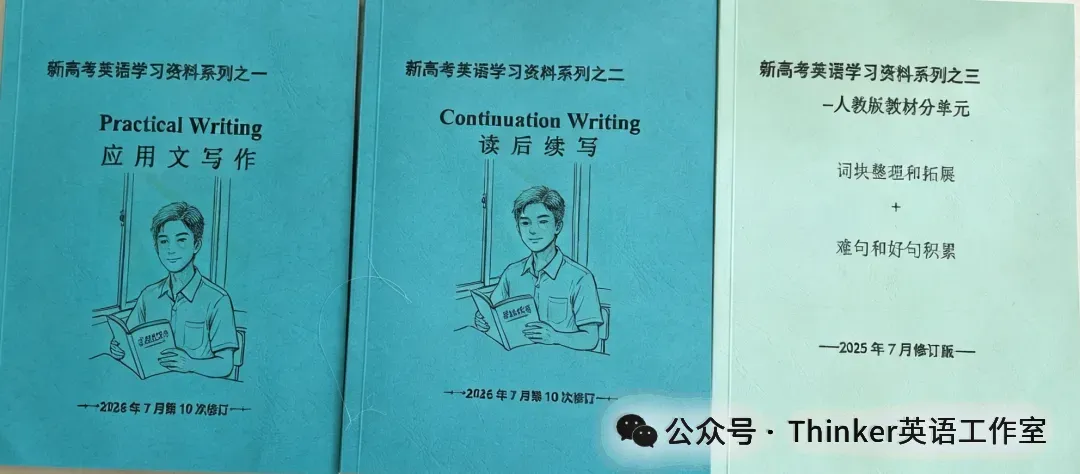
开学了,推荐高中英语学习必备书:最新2026版应用文写作和读后续写:
2026年7月第10版《新高考英语应用文写作+读后续写+人教版单元词块整理三驾马车》来啦!
Word文档下载:
我用夸克网盘给你分享了「202610山东潍坊阶段检测.docx」,点击链接或复制整段内容,打开「夸克APP」即可获取。
链接:https://pan.quark.cn/s/b3865d137a8d
听力音频下载:
我用夸克网盘给你分享了「听力(10).mp3」,点击链接或复制整段内容,打开「夸克APP」即可获取。
链接:https://pan.quark.cn/s/14fdb047c719
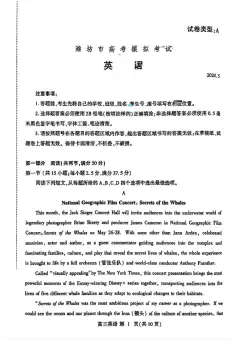
潍坊市部分学校 2026-2027 学年上学期高三 10 月阶段监测
英语试卷
第一部分听力(共两节,满分 30 分)
第一节(共 5 小题;每小题 1.5 分,满分 7.5 分)
听下面 5 段对话。每段对话后有一个小题,从题中所给的 A、B、C 三个选项中选出最佳选项。听完每段对话后,你都有 10 秒钟的时间来回答有关小题和阅读下一小题。每段录音读两遍。
1.What does the man suggest doing?
A. Dining out.B. Ordering a takeaway.C. Cooking at home.
2.What will the speakers do next?
A. Wait for clients.B. Go and find Jim.C. Start a meeting.
3.Where are the speakers?
A. At a bakery.B. On a farm.C. In a fruit shop.
4.What did the woman probably do last night?
A. She enjoyed a match.B. She took care of the kids.C. She watched TV at home.
5.What caused the woman’s poor rest in the afternoon?
A. The loud music.B. The barking of a dog.C. The noise from repairs.
第二节(共 15 小题;每小题 1.5 分,满分 22.5 分)
听下面 5 段对话或独白。每段对话或独白后有几个小题,从题中所给的 A、B、C 三个选项中选出最佳选项。听每段对话或独白前,你将有时间阅读各个小题,每小题 5 秒钟;听完后,各小题将给出 5 秒钟的作答时间。每段录音读两遍。
听第 6 段材料,回答第 6、7 题。
6. Who is Robert Venturi?
A. A businessman.B. A professor.C. An actor.
7. When will the lecture start?
A. At 3:30 p.m.B. At 4:00 p.m.C. At 4:30 p.m.
听第 7 段材料,回答第 8 至 10 题。
8. What is the probable relationship between the speakers?
A. Fellow workers.B. Boss and employee.C. Husband and wife.
9. Why is the man unwilling to run?
A. He eats too much.B. He prefers to watch a game.C. He has some work to finish.
10. Where do the speakers decide to go finally?
A. To a park.B. To the seaside.C. To the football stadium.
听第 8 段材料,回答第 11 至 13 题。
11. What are the speakers mainly talking about?
A. Requirements of a position.
B. Evaluation of job candidates.
C. Arrangement of a business trip.
12. Which aspect of Maria appeals to the woman?
A. Education background.B. Professional certificates.C. Work experience.
13. Who is invited to the next interview?
A. Ms. Couch.B. Mr. Cook.C. Henry.
听第 9 段材料,回答第 14 至 16 题。
14. How did the man perform in today’s competition?
A. He broke a record.B. He won first prize.C. He failed to finish it.
15. Who is Vivian?
A. A judge.B. A competitor.C. A coach.
16. What made the man decide to take up car racing?
A. Mike’s encouragement.B. His childhood dream.C. Desire for honor.
听第 10 段材料,回答第 17 至 20 题。
17. Why did the speaker carry out the study?
A. To pass an examination.B. To explore food culture.C. To write an academic paper.
18. Where does the custom of tipping start?
A. In England.B. In Japan.C. In the US.
19. How much tip can a Brazilian waiter get if the total bill is$200?
A. $10.B.$20.C. $25.
20. What does the speaker think of giving a tip?
A. It is popular.B. It is reasonable.C. It is impolite.
第二部分阅读理解(共两节,满分 50 分)
第一节(共 15 小题;每小题 2.5 分,满分 37.5 分)
阅读下列短文,从每题所给的 A、B、C 和 D 四个选项中,选出最佳答案。
A
JOIN A JOURNEY TOWARD THE NATIONAL DAY OF CONNECTION
We live in one of the most connected times in history. Yet long-term loneliness and lack of social contact touch people of every age, background, and community. According to statistics on loneliness in the US, this is an epidemic (流行病) linked with heart disease, depression, addiction, and more.
◆ 1 in 2 American adults experience measurable loneliness. ◆ $460 Billion The annual cost of long-term loneliness to USemployers from healthcare costs, sick days and turnover. ◆ ~100 People in the world die every hour due to long-term loneliness and lack of social contact. |
WALKING TO THE NATIONAL DAY OF CONNECTION
This fall, Lucy Rose, founder of the Cost of Loneliness Project, which aims to create cultures of connection in every community, will walk from California to New York, listening to how loneliness shows up in daily life and inviting communities along the way to share their own stories of connection. The walk leads to the National Day of Connection on November 12, 2026, a day for everyone to connect authentically and strengthen belonging.
HOW TO PARTICIPATE:
Take 12 Minutes At 12 P. M. On The 12ᵗʰ
You don’t have to wait, or walk across the country, to take part. On November 12, pause at 12 pm. for 12 minutes to connect with someone: call a friend you’ve lost touch with, sit with a coworker at lunch, check in on a neighbor. Intentional moments are how this movement is built.
Bring The Day Into Your Institution
Hospitals, campuses, agencies, and companies can observe the National Day of Connection together as one shared moment, on one date, in a place where people already gather. Visit the site to take part.
21.What do the statistics on loneliness show?
A. Its causes.B. Its treatments.C. Its harm.D. Its nature.
22.What is the goal of the National Day of Connection?
A. To build strong human bonds.B. To collect community stories.
C. To raise money for the project.D. To support Lucy Rose’s walk.
23.What need people do to take part in the movement?
A. Record shared moments.B. Reach out to someone.
C. Volunteer in public places.D. Finish a cross-country walk.
B
When my wife and I heard a strange noise from our laundry (洗衣) room, we knew that our old washing machine had cycled its last load. The washing machine had lasted three decades, long enough to wash my daughter’s baby clothes and her husband’s jeans many years later. We had gotten our money’s worth from an appliance we’d purchased when we were newly married, and I couldn’t complain when it finally gave out.
Waiting for the store to bring a replacement, I glanced at the old washing machine. Before the kids grew up and left home, we probably averaged four loads a week. In the winter of 2000, we sometimes ran the washing machine with nothing in it. Our newborn son, restless at midnight, found the gentle sound of the turning drum (滚筒) a gentle song.
In those cold, dark hours, the laundry room seemed like the gently beating heart of our house. Juice and milk often flew over the family dinner table back then. Our youngsters muddied pants and dresses as they ran quickly around the grass, their knees and arms still marked by the yard’s wild embrace when they came back inside. Our washing machine, always full, greeted us each day warmly.
Now, our daughter and son are grown and living far away. Our washing machine are quieter these days, but when our children return for visits, we once again do their laundry. The simple chore is a reminder that, in washing and folding their clothes, we’ll always be ready with a warm welcome.
As the washing machine works, I realize the circularity of my life, its predictable cycles perhaps seen most ideally as a source of discovery rather than boredom. I told myself so as I opened our new washing machine and put in its first load.
24.What do we know about the old washing machine?
A. It broke down as expected.B. It was good value for money.
C. It was intended for children.D. It witnessed a good marriage.
25.Why did the author run the washing machine with nothing inside?
A. To help a baby sleep.B. To warm the room.
C. To do a self-clean cycle.D. To test the machine.
26.What does the author mean by comparing the laundry room to a beating heart?
A. It was a gathering spot. B. It worked non-stop.
C. It was the busiest place. D. It stored family memories.
27.What does the author realize about the laundry work?
A. It is repetitive. B. It is a sign of growth. C. It is demanding. D. It is a reminder of love.
C
The summer afternoon was hot, but no one in the queue seemed bothered. Dozens were patiently waiting to enter Shakespeare and Company, a storied bookshop located on the left bank of the Seine opposite Notre Dame cathedral.
Launched by George Whitman, 75 years ago, Shakespeare and Company is probably the most famous bookshop in the world, enjoying a reputation for its closeness to some of literature’s masters. Around 2,000-3,000 people visit each day, nearly 1 million a year.
How does a bookshop withstand three-quarters of a century and still get people to queue to enter? One answer is a clever approach to social media. Photos and videos are prohibited inside. This enhances the shop’s mysterious appeal among those who kill time on Instagram and TikTok. “You can’t see what it looks like online, so that’s kind of cool,” says Hannah, a literature student from England who had come to take in “the older, memory-rich atmosphere” for herself.
But probably the biggest explanation for the shop’s success is how it has embraced the myths surrounding it. Shakespeare and Company is like a Russian doll, containing several brands inside. First, its name reminds people of the most famous writer in the English language. Second, there is the shop that preceded it, which had the same name. That one was founded by Sylvia Beach in 1919. She was likeable enough to count superstars, including Ernest Hemingway and T. S. Eliot, as friends. Beach’s bookstore closed afterwards, and legend has it that she later gave Whitman permission to adopt her shop’s name.
Yet Shakespeare and Company’s playbook is impossible to copy. Its history and location in central Paris are unbeatable. In its own way, Shakespeare and Company also deals with the benefit and challenge of tourism. “We’ve always been trying to get a balance between being a popular visit site for people passing through the city and yet trying to keep our connections more local,” says Sylvia Whitman, who runs the English-language bookshop.
28.What is the bookshop well-known for?
A. Its unique location. B. Its diverse storybooks.
C. Its literary connection. D. Its long-standing history.
29.What can we learn from Hannah’s words?
A. She values the shop’s mystery. B. She loves posting photos of the shop.
C. The shop is accessible to Internet users. D. The shop is old-fashioned for young people.
30.Which best explains the underlined word “preceded” in paragraph 4?
A. Competed against. B. Took over. C. Came before. D. Went with.
31.What is the text mainly about?
A. An unforgettable story. B. A success that can’t be copied.
C. A great literature master. D. A wonder that can’t be explained.
D
Overconfidence is common, especially when it comes to what people believe to be true. Yet most of us might benefit from a little less confidence in our beliefs.
Tenelle Porter, an educational psychologist, conducted a series of studies with high-school students. She began by asking 103 of them to rate themselves on statements such as “I am willing to admit it when I don’t know something,” “I acknowledge when someone knows more than me about a subject,” and “I try to reflect on my weaknesses in order to develop my intelligence.” She then measured what education psychologists refer to as “mastery behaviors”—skills that students can use to master what they are learning.
The study found that students who could see that their beliefs might be wrong were much more likely to use strategies to test their knowledge while studying. These students would quiz themselves, check whether they really understood the material, and seek out potential holes in their understanding. In contrast, students who did not see that their knowledge could be flawed (有缺陷的) might simply sail through their studies. Such students, Porter found, can fall into a “knowledge illusion (错觉).”
The good news is that there is a “vaccine” for overconfidence: recognizing that your beliefs could be wrong. Galileo, for instance, dared to question the belief that the Earth was the center of the universe. He suffered for it, but his change of mind opened up a “new” universe for research.
Porter cautions against trying to do this every single time you make a decision. Instead, she recommends practicing it when you are thinking about whether something is correct or making some really important decisions. This might prove most beneficial when you feel really strongly about something. Ask yourself: “Am I certain I am right about this?” If you find it hard to question a belief, try taking “baby steps.”
32.What did Porter ask students to do first in the study?
A. Take intelligence tests.B. Reflect on their learning methods.
C. Find out their weaknesses.D. Assess their own confidence levels.
33.Which students are more likely to have a “knowledge illusion”?
A. Those quizzing themselves.B. Those with poor memories.
C. Those unaware of knowledge holes.D. Those checking study materials.
34.What does the author try to illustrate by mentioning Galileo in Paragraph 4?
A. The value of questioning.B. The courage of great scientists.
C. The danger of overconfidence.D. The hardship of scientific research.
35.What is Porter’s suggestion in the last paragraph?
A. Follow your own steps.B. Hold back your strong feelings.
C. Believe in your thought.D. Examine yourself at proper times.
第二节(共 5 小题;每小题 2.5 分,满分 12.5 分)
阅读下面短文,从短文后的选项中选出能填入空白处的最佳选项。选项中有两项为多余选项。
The thought of summer brings to mind the memorable childhood vacations. The school’s closure for two delicious months was something we eagerly anticipated, which meant putting away the uniforms and bags. 36 The sleep-wake hours and meal timings that were carried out regularly got disturbed.
37 Then we were given some discipline to schedule the vacation in the best way possible. We would write a timetable that would last a maximum period of a week, or till we had visitors, whichever came first! TVs, air coolers, and refrigerators were unheard of. Strict upbringing kept us from staying up late and we couldn’t sleep till late in the morning due to the unbearable heat. Playing outdoors was the only pastime. We would look at the clouds and predict if it would rain. 38
Mango pickles (泡菜) were a must in summer and the entire family contributed. I used to clean and dry the mangoes. 39 Mum’s rule was that the pickle should be tried only after the first monsoon (季风) shower. Mum prepared two varieties: spicy and sweet. Her sweet mango pickle with just the right balance of sweetness, sourness, and spiciness was something to die for!
Earthen pots were used to store drinking water. How refreshing it was to drink the cool water on hot summer days! And the popsicles (冰棍). One shout by the popsicle man would have children in the street rushing to him.40
A. Sometimes a short shower would boost our spirits.
B. I loved the process and couldn’t wait to have a taste.
C. Mum would only allow this for the first week or two.
D. We would select the flavour and enjoy every bit of it.
E. Our daily routine slipped slowly and unconsciously into lazy mode.
F. We wished “Happy Holidays” to our teachers and friends on the last day.
G. The afternoon hours meant staying indoors and attending academic activities.
第三部分语言知识运用(共两节,满分 30 分)
第一节(共 15 小题;每小题 1 分,满分 15 分)
阅读下面短文,从短文后各题所给的 A、B、C、D 四个选项中,选出可以填入空白处的最佳选项。
In her late 50s, Gentile had cancer, losing all her hair and wearing a wig (假发).
“But I only had one wig—that wig was itchy (发痒的), and it was41 ,” Gentile said. “So at some point, my hair grew back short and looked sort of like a crew cut (寸头). Then I decided it was time to42 the wig.”
Her first time driving to work without the wig, Gentile felt43 . As a frequent spokesperson, she worried about how people would44 . “I didn’t want the ‘45 eyes’ people give you when you’re sick,” Gentile said. “I wanted to keep moving.”
She46 at a convenience store to grab some lunch. As she checked the shelves, a woman47 her. “Not everybody could rock a48 like that. You look great,” the woman said. Gentile was49 . She managed a “Thank you” before the woman walked away. Then with lunch in hand she went back to her car, letting the words50 .
“I sat there for a while,51 this wonderful thing she had said to me,” Gentile said. “It really made me feel52 , giving me the courage to get started.” Gentile donated the wig and never looked back. She recovered three years later, having no53 of cancer.
Thinking back to that54 , she credits the woman’s kindness with inspiring her to see others the way that stranger saw her and55 what they might be going through.
41.A. necessary B. annoying C. amusing D. unusual
42.A. change back B. send back C. give up D. clean up
43.A. exposed B. relieved C. lost D. depressed
44.A. complain B. compare C. resist D. respond
45.A. fear B. pity C. doubt D. anger
46.A. wandered B. hesitated C. stopped D. served
47.A. blamed B. joined C. recognized D. approached
48.A. hairstyle B. smile C. dress D. color
49.A. embarrassed B. curious C. shocked D. confused
50.A. escape B. settle C. spread D. shine
51.A. appreciating B. sharing C. explaining D. describing
52.A. beaten B. forgotten C. mistaken D. seen
53.A. impression B. record C. evidence D. case
54.A. suggestion B. encounter C. lesson D. activity
55.A. acknowledge B. tolerate C. avoid D. comment
第二节(共10小题:每小题1.5分,满分15分)
阅读下面短文,在空白处填入 1 个适当的单词或括号内单词的正确形式。
In a sea of rice fields in Yingjiang county, Southwest China’s Yunnan province, harvest season comes with music, dancing and a bowl of green rice.
Dai ethnic performers dance to the rhythm of elephant-foot drums during the fourth Haomao Rice Farming Culture Festival, 56._______(hold) in Nongzhang township in late August.
Haomao, a traditional Dai food whose name means “green grain rice”, 57._______is made from young rice harvested before the grains 58._______(full) mature. Once a seasonal local dish, it is now becoming a symbol of Yingjiang’s efforts 59._______(bring) new value to its rice-growing traditions.
At a Haomao-making competition during the festival, the winning entry could be sold for 1,000 yuan at auction (拍卖). Local 60._______(official) are looking beyond the sale of raw grain, 61._______(explore) ways to add value through specialty foods, cultural products and tourism.
The attraction of the rice fields extends beyond the food. Visitors can taste rice-based dishes, catch fish in the fields 62._______ wander the stands selling Dai clothing, jewelry, bamboo crafts, paper-cutting and other handicrafts alongside 63._______(agriculture) products. Traditional performances and fashion shows turn the fields into 64._______ open-air cultural venue.
For young Haomao maker Ban Guohua, the appeal lies 65._______ keeping the tradition alive. “It is not only a festival, but also an opportunity to learn from the old traditions,” he says.
第四部分写作
第一节(满分 15 分)
你校英文报“Music and Life” 栏目正在举办主题为 “A Song That Touched Me” 的征文活动。请你写一篇短文投稿,推荐一首歌曲。
注意: (1) 写作词数应为 80 左右。 (2) 请按如下格式在答题纸的相应位置作答。
A Song That Touched Me
第二节(满分 25 分)
阅读下面材料,根据其内容和所给段落开头语续写两段,使之构成一篇完整的短文。
This family vacation to Flagstaff made no sense. To start with, I wasn’t even with my family! I’d been second-guessing myself: I’d driven two and a half hours for what? What I was doing here?
I planned to spend the day exploring downtown, with a full bottle of water in my backpack. For one thing, my son had recommended a place which made the best pizza, and I wanted to check it out for lunch. I headed downtown on foot and stopped at the railroad crossing to watch a train thunder through. I was a family man. As much as I liked the outdoors and appreciated its activities alone, I liked a busy household too, with friends and family coming and going. It felt strange to be on my own with no responsibilities to anyone.
As the train roared past, I noticed an old man standing across the way. From his disheveled (衣衫褴褛的) appearance, I could see he was in need. I ought to give him a little money, I thought. Surely, he was hungry.
When I moved to approach him, the man shouted something I couldn’t understand. He wasn’t speaking to me or anyone else I could see. I thought it safer not to engage him and moved on. I continued into town and found the restaurant.
But this place only sold whole pizzas, which would have been fine if my family were with me. Once again, I wondered why I had come to Flagstaff at all.
Someone suggested another restaurant across the street. I walked over and ordered two slices. The pizza was good enough to lift my spirits. As I finished my second slice, a server brought two more. “For free,” she said. “One slice we served you just now was much too small.” I explained I was full, but she packed them neatly in a box that fit my backpack.
注意: (1) 续写词数应为 150 左右。 (2) 请按如下格式在答题卡的相应位置作答。
Paragraph 1: I opened my backpack and put it inside.
Paragraph 2: The old man took the box with both hands.
高三英语参考答案
第一部分听力(共两节,满分 30 分)
1-5 BCABB 6-10 ABCAB 11-15 BCABC 16-20 ACABC
第二部分阅读(共两节,满分 50 分)
21-23 CAB 24-27 BADD 28-31 CACB 32-35 DCAD 36-40 ECABD
第三部分语言运用(共两节,满分 30 分)
第一节(共 15 小题;每小题 1 分,满分 15 分)
41-45 BCADB 46-50 CDACB 51-55 ADCBA
第二节(共 10 小题;每小题 1.5 分,满分 15 分)
56. held 57. is made 58. fully 59. to bring 60. officials 61. exploring 62. and 63. agricultural 64. an 65. in
第四部分写作(共两节,满分 40 分) 第一节(满分 15 分)
One possible version:
A Song That Touched Me
I’d like to recommend Dream It Possible, a song that has touched me deeply.
It is an inspiring pop song whose lyrics encourage people to stick to their dreams through difficulties. I first heard it at a time when I was faced with heavy pressure from my studies and worried about my future progress. Whenever I felt like giving up, the song reminded me to keep trying bravely instead of feeling discouraged. Its gentle tune and powerful words bring me constant strength and lift my spirits.
I truly believe this song is worth listening to. I hope more classmates can draw inspiration from it as I do.
第二节(满分 25 分)
One possible version:
I opened my backpack and put it inside. The man from the railroad crossing popped into my mind. Then I walked out of the restaurant and headed back toward the railroad crossing. The old man was still there, standing alone as if the world had forgotten him. I slowed down, unsure at first, but the box of pizza in my backpack seemed to push me forward. He looked up when I approached, his eyes tired and cautious. I took out the box and held it toward him. “You might need this more than I do,” I said.
The old man took the box with both hands. For a moment, he said nothing. Then he nodded, his lips moving in a quiet “thank you.” I nodded back, turned away, and continued my walk. Strangely, the confusion I had felt all morning began to fade. Whether I was with my family or not, I was never without responsibility to others, strangers though they may be. Perhaps that was why I had come to Flagstaff—not to escape my duties, but to remember that kindness is a duty too, and one I could carry wherever I went.
听力原文
Text 1
M: I have found a very good Thai restaurant on this food delivery app. Shall we order a takeout pizza right now? (1)
W: Putting hot food in a box may change the flavor. It’s hard to guarantee that the quality will match the dishes you order in the restaurant.
Text 2
W: So what shall we do? The clients are waiting for us. Get started without Jim?
M: Yes. (2) The traffic was heavy. We have no idea if he can make it by the end of the meeting. Stay in touch with him.
Text 3
W: The cake baking makes the whole house smell nice.
M: Indeed it does. What would you like?
W: Wow, the cheese roll must go well with the fruit juice, and the strawberries on the cake look very delicious. (3)
Text 4
M: That match last night was a classic, even though my favorite team lost it.
W: I envy you. A good deal of my time was taken up with feeding the little twins, bathing them and sending them to sleep. (4) I wish I could lie on the sofa and watch TV like you.
M: They will grow up one day.
◆ envy 羡慕;忌妒
Text 5
W: I couldn’t get a good rest this afternoon.
M: Was your neighbor fixing his ceiling?
W: He did that in the morning. In the afternoon, I was listening to music to drown out the barks of my neighbor’s dog Lily. (5)
M: You can talk to him about it.
Text 6
M: Maggie, I heard that the speaker of today’s lecture is Robert Venturi. (6) How did you make it? He is the most famous person in our city. It must not be easy for him to make time for a speech at our university.
W: Yes. Ethan had visited him three times before he finally agreed to share his experiences with us.
M: I am so curious about his story of starting his own business. (6) The lecture starts at 3:30 p.m., right? (7)
W: Well, we’ve changed the original plan to some extent. It has been put off. You can come to the school hall half an hour later than the original time. (7)
Text 7
W: Carl, get up and let’s go to the nearest park.
M: Why? It’s already 8:10 p.m. And it seems too hard to leave the sofa. (8)
W: Come on! You don’t get much exercise sitting in the office all day. Let’s go for a run. (9) M: But you asked me to finish up the fish. I can’t run on a full stomach. (9)
W: Hmm, we can go for a walk along the sand instead. I love the sea air. (10)
M: Fine. (10) You are the boss in this house. Could you at least wait until the football game is over?
W: OK. But we must leave at 8:30 p.m.
M: No problem. I’m grateful to have you in my life. The match will end in ten minutes.
Text 8
M: Hi, Mary. What do you think of the candidates?
W: Hi, Henry. Judging from their performances, most of them are excellent and capable. Among them, Maria and Judy impressed me most.
M: Why? They have the right kind of qualifications?
W: I definitely think so. (11) Maria has been in the accounting industry for five years. (12) She is a highly qualified professional woman. Judy graduated from a famous university and she has got multiple certificates. Besides, she is young and energetic.
M: It’s still too early to tell. We need more rounds of interviews. So what’s your plan? What time is suitable for you?
W: Tomorrow afternoon. I intended to let the head of the department assess the candidates. But Mr. Cook is currently on a business trip. So I have invited Ms. Couch. (13)
Text 9(第 14 题为推断题)
W: Well done. How are you feeling?
M: Exhausted. I’m just tired.
W: But you were awarded first place in today’s car race. (14) We all know that you won third prize in the races in Hamburg and Sweden, and second prize in Houston. This is the first time you’ve been on top, right?
M: Yes, I came out here aiming for gold. I finally made it. Vivian must be cheering for me.
W: Congratulations! She must be proud to have you as her student. (15) So who inspired you to be a racing driver?
M: I accidentally watched a car race on TV and became interested in it when I was ten years old. But it was Mike who helped me make the decision to pursue it. (16)
W: Oh, he was a car legend.
M: Yes. Six years ago, I watched one of his races and even got a chance to talk with him. (16) It’s a pity that he couldn’t enter the competition three years ago due to the age limit.
W: Right. Anyway, I think you showed great determination today. And thanks for your time.
Text 10
It’s nice to go out for a meal at a restaurant. But what makes it extra special? Apart from the delicious food, it is the attentive service from the waiters. What can leave a bad taste in your mouth, though, is to be handed the bill and see that a service charge has been added. You’re faced with the dilemma of deciding to pay for it, and whether you should add a tip on top. In order to finish my term paper, I carried out a study on this topic. (17) Tip is said to have originated in 16th century England, (18) when overnight guests would leave money for their hosts’ servants. The practice has since spread all over the world. In the United States, it’s still customary to leave tips because tips often make up a large part of a server’s income. But anyone who has traveled internationally knows that the custom of giving a tip varies from place to place. For example, people usually tip a restaurant waiter or waitress 15%–25% in the US, 10% in Brazil, (19) 5%–10% in Sweden on the basis of total bills. However, I think we should follow the approach in Japan, where tipping under any circumstances may seem rude because good service is standard and expected. (20)
◆ leave a bad taste in one’s mouth 给…… 留下坏印象
◆ customary 习俗的;习惯的