 夜雨聆风
夜雨聆风📚 狂暴英语教案 · 新概念英语第二册
第57课 Can I help you, madam?
您要买什么,夫人?
请关注本公众号,后台回复【26071202】,获得本教案30页完整的打印版本。
📘 本课信息教材:新概念英语第二册 · 第57课核心功能:叙述以貌取人的讽刺故事 · 幽默叙事语法焦点:现在分词/过去分词作状语 · with复合结构 · make+宾语+不定式 · as soon as时间状语从句
🏷️ 热门标签
🎯 一、本课学习目标
(一)词汇目标
掌握以下核心词汇及其用法:jeans(牛仔裤),hesitate(犹豫),scornfully(轻蔑地),punish(惩罚),fur coat(毛皮大衣),handbag(手提包),umbrella(雨伞),rude(粗鲁的),eager(热切的),difficulty(困难)。能够在语境中准确理解和使用这些词汇,并学习其搭配(如 be dressed in,with a handbag in one hand,seek out,enjoy oneself doing something 等)。
(二)语法目标
1. 掌握现在分词短语作状语(Glancing at her scornfully, he told her ...)和过去分词短语作状语(dressed in a fur coat)的用法。2. 掌握 with 复合结构(with a handbag in one hand and a long umbrella in the other)的构成和功能。3. 掌握 as soon as 引导的时间状语从句的用法。4. 掌握动词 make + 宾语 + 省略 to 的不定式(make sb. do sth.)的结构。5. 掌握 enjoy + 反身代词 + doing 的结构。6. 进一步巩固关系代词 that/who 引导的定语从句。
(三)技能目标(段落写作)
1. 能够运用本课所学的时间状语从句和分词结构,按照时间顺序描述一个短篇故事。2. 学会在写作中使用细节描写(衣着、神态、动作)来刻画人物性格和情节转折。3. 掌握简单的讽刺或幽默叙事手法:通过前后对比制造反差效果。
(四)文化目标
1. 了解西方社会中商店服务态度与顾客着装之间的潜在关联,以及“顾客永远是对的”这一服务理念。2. 认识英国等国家商店中“madam/sir”等尊称的使用场景。3. 探讨以貌取人(judging by appearance)的社会现象及其反思。
📖 二、课文完整内容
(一)课文原文
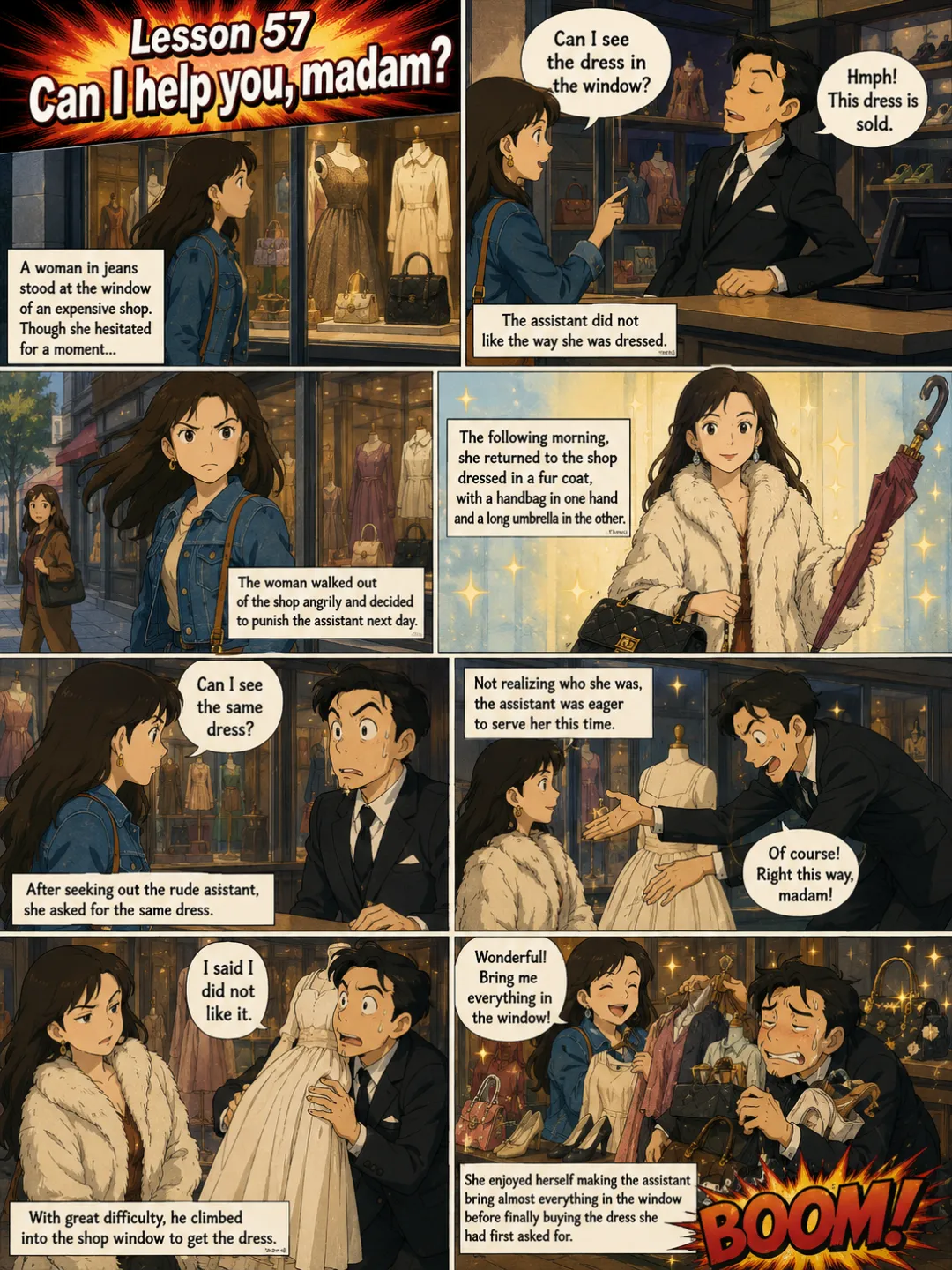
Lesson 57 Can I help you, madam?
您要买什么,夫人?
First listen and then answer the question.
听录音,然后回答以下问题。
Did the woman get what she wanted?
A woman in jeans stood at the window of an expensive shop.Though she hesitated for a moment, she finally went in and asked to see a dress that was in the window.The assistant who served her did not like the way she was dressed.Glancing at her scornfully, he told her that the dress was sold.The woman walked out of the shop angrily and decided to punish the assistant next day.She returned to the shop the following morning dressed in a fur coat, with a handbag in one hand and a long umbrella in the other.After seeking out the rude assistant, she asked for the same dress.Not realizing who she was, the assistant was eager to serve her this time.With great difficulty, he climbed into the shop window to get the dress.As soon as she saw it, the woman said she did not like it.She enjoyed herself making the assistant bring almost everything in the window before finally buying the dress she had first asked for.
语音标注: 本课为故事叙述,注意连读和弱读:glancing at 连读,scornfully 重音在第一个音节;dressed in 连读;with a 弱读;not realizing 连读;eager to serve 中 eager 重音;climbed into 连读;as soon as 连读。
(二)背景简介本课选自《新概念英语》第二册第57课,由 L.G. Alexander 编写,是一篇关于以貌取人并巧妙报复的讽刺故事。故事发生在英国一家高档服装店(expensive shop),通常这类商店的店员经过专业培训,对顾客一视同仁,但在现实中仍可能存在基于顾客外表或社会地位的差别对待。故事中的女顾客利用了这种势利心理,通过改变着装成功“复仇”,情节幽默且富有教育意义。这种叙事模式在英语文学中常见,如欧·亨利的短篇小说,通过对比和反转达到讽刺效果。
(三)参考译文一位穿着牛仔裤的妇女站在一家高档商店的橱窗前。她虽然犹豫了片刻,但终于还是走进了商店,要求看一件陈列在橱窗里的连衣裙。接待她的售货员不喜欢她的那副打扮。他轻蔑地看了她一眼,告诉她那件连衣裙已经卖出去了。这位妇女愤怒地走出了商店,决定第二天来惩罚那个售货员。第二天上午,她又来到了这家商店,穿着一件毛皮大衣,一只手拿着一个手提包,另一只手拿着一把长柄伞。找到那个粗鲁的售货员后,她要求看同一件连衣裙。那个售货员没有认出她是谁,这次非常热心地为她服务。他费了很大劲才爬进橱窗去取那件连衣裙。这位妇女一眼就看见了那件连衣裙,却说不喜欢它。她开心地迫使那个售货员把橱窗里几乎所有的东西都拿了出来,最后才买下了她最初要的那件连衣裙。
🔍 三、逐句精讲与词块总结
句子1
1. 原文: A woman in jeans stood at the window of an expensive shop.
2. 翻译: 一位穿着牛仔裤的妇女站在一家高档商店的橱窗前。
3. 句子结构: 简单句。主语 A woman,后接介词短语 in jeans 作后置定语,谓语 stood,地点状语 at the window of an expensive shop。
4. 重点词汇:
jeans 蓝思值 530 L
英音[dʒiːnz] 美音[dʒiːnz]词性:名词(复数形式)释义:牛仔裤常用语块:a pair of jeans / blue jeans / designer jeans短语搭配:jeans and a T-shirt / in jeans例句一:She was wearing a pair of tight jeans. 她穿着一条紧身牛仔裤。例句二:Jeans are popular among young people. 牛仔裤在年轻人中很受欢迎。拓展:jeans 源自意大利城市热那亚(Genoa)的布料名称,最初是水手的工作服,后成为全球时尚单品。注意jeans常以复数形式出现,不可数时用 a pair of jeans。
expensive 蓝思值 720 L
英音[ɪkˈspensɪv] 美音[ɪkˈspensɪv]词性:形容词释义:昂贵的,高价的常用语块:expensive shop / expensive car / expensive taste短语搭配:too expensive / less expensive / expensive to maintain例句一:That restaurant is too expensive for me. 那家餐馆对我来说太贵了。例句二:She bought an expensive diamond ring. 她买了一枚昂贵的钻戒。拓展:反义词 cheap / inexpensive;名词 expense(花费);副词 expensively。注意区分 expensive(价格高)和 dear(在英式口语中也可表示昂贵,但dear还可表示亲爱的)。
window 蓝思值 210 L
英音[ˈwɪndəʊ] 美音[ˈwɪndoʊ]词性:名词释义:窗户;橱窗(在此处指 shop window)常用语块:shop window / window display / window shopping短语搭配:look out of the window / break a window例句一:She gazed at the beautiful dress in the window. 她凝视着橱窗里那条漂亮的连衣裙。例句二:Can you open the window? 你能开一下窗户吗?拓展:window 源自古诺尔斯语 vindauga,意为“风眼”。复合词 window-shopping(逛橱窗而不买东西)。
5. 语法点睛: 本句是典型的“主语 + 谓语 + 地点状语”简单句结构。介词短语 in jeans 作后置定语修饰主语 A woman,相当于 who was in jeans。这种定语形式比定语从句更简洁,在英语中常见。地点状语 at the window 中的 at 表示“在……旁边/附近”,通常用于较小的具体位置;而 window 这里指 shop window(橱窗),需根据上下文判断。
句子2
1. 原文: Though she hesitated for a moment, she finally went in and asked to see a dress that was in the window.
2. 翻译: 她虽然犹豫了片刻,但终于还是走进了商店,要求看一件陈列在橱窗里的连衣裙。
3. 句子结构: 复合句。Though 引导让步状语从句,主句是 she finally went in and asked to see a dress。a dress 后跟关系代词 that 引导的定语从句(that was in the window)。主句谓语为并列谓语 went in 和 asked to see。
4. 重点词汇:
hesitate 蓝思值 780 L
英音[ˈhezɪteɪt] 美音[ˈhezɪteɪt]词性:动词释义:犹豫,踌躇常用语块:hesitate for a moment / hesitate to do sth.短语搭配:hesitate about / over / without hesitation (名词)例句一:She hesitated before answering the question. 她在回答问题前犹豫了一下。例句二:Don't hesitate to call me if you need help. 需要帮助时请尽管给我打电话。拓展:名词 hesitation(犹豫);形容词 hesitant(犹豫的)。hesitate 后接不定式或介词 about/over。核心含义是因不确定而暂停行动。
finally 蓝思值 440 L
英音[ˈfaɪnəli] 美音[ˈfaɪnəli]词性:副词释义:最后,终于常用语块:finally decide / finally arrive短语搭配:finally and ultimately例句一:After many tries, he finally succeeded. 经过多次尝试,他终于成功了。例句二:Finally, I want to thank my family. 最后,我要感谢我的家人。拓展:形容词 final(最终的);finally 常置于句首或行为动词前,表示在长时间等待或努力之后的结果。
dress 蓝思值 220 L
英音[dres] 美音[dres]词性:名词 / 动词释义:连衣裙(名词);穿衣(动词)常用语块:a dress / dress up / dress in短语搭配:evening dress / wedding dress / dress code例句一:She wore a beautiful red dress. 她穿着一条美丽的红裙子。例句二:I dress my son every morning. 我每天早上给我儿子穿衣服。拓展:作为名词,dress 通常指女性穿的连衣裙;作为动词,可用于男性或女性。be dressed in 表示“穿着……衣服”。
5. 语法点睛:- Though 引导让步状语从句,意为“虽然……但是”,不能与 but 同时使用。从句中 hesitated 是过去时,描述过去的行为。- 定语从句 that was in the window 修饰 a dress,that 在从句中作主语,不能省略。这与现代英语中关系代词作宾语时可省略不同。- 注意动词 ask 后接不定式 to see,表示“要求做某事”。ask to do sth. 是常见搭配,ask sb. to do sth. 则是“要求某人做某事”。
句子3
1. 原文: The assistant who served her did not like the way she was dressed.
2. 翻译: 接待她的售货员不喜欢她的那副打扮。
3. 句子结构: 复合句。主句是 The assistant did not like the way。who served her 是定语从句修饰 assistant;she was dressed 是定语从句修饰 the way,省略了关系副词 that/in which。
4. 重点词汇:
assistant 蓝思值 660 L
英音[əˈsɪstənt] 美音[əˈsɪstənt]词性:名词释义:助手,售货员,店员常用语块:shop assistant / assistant manager / personal assistant短语搭配:sales assistant / office assistant例句一:The assistant helped me choose a gift. 售货员帮我选了一件礼物。例句二:She works as a teaching assistant in a university. 她在大学担任助教。拓展:动词 assist(帮助);名词 assistance(援助)。assistant 既可指人,也可作形容词(assistant professor 副教授)。
serve 蓝思值 580 L
英音[sɜːv] 美音[sɜːrv]词性:动词释义:为……服务;接待(顾客);提供(食物)常用语块:serve customers / serve dinner / serve as短语搭配:serve in the army / serve a purpose例句一:The waiter served us with wine. 服务员给我们倒上了酒。例句二:This restaurant serves Italian food. 这家餐馆供应意大利菜。拓展:名词 service(服务);servant(仆人)。serve 是及物动词,直接跟宾语,不能加 for。
way 蓝思值 220 L
英音[weɪ] 美音[weɪ]词性:名词释义:方式,方法;路常用语块:the way she dressed / in this way / on the way短语搭配:way of life / way out / by the way例句一:I like the way you speak. 我喜欢你说话的方式。例句二:Can you tell me the way to the station? 你能告诉我去车站的路吗?拓展:way 后接定语从句时,关系代词可以用 in which, that 或省略,如 the way (in which/that) she dressed。
5. 语法点睛:- 定语从句 who served her 修饰 assistant,关系代词 who 在从句中作主语。- the way she was dressed 是一个常见的结构:the way + 定语从句(修饰方式)。从句 she was dressed 中,be dressed 表示“穿着……”的状态,was dressed 是被动形式但表状态,不是被动动作。类似:she was dressed in jeans。- 整个句子表达了因果或评价:因为店员不喜欢她的穿着,所以后续态度不好。
句子4
1. 原文: Glancing at her scornfully, he told her that the dress was sold.
2. 翻译: 他轻蔑地看了她一眼,告诉她那件连衣裙已经卖出去了。
3. 句子结构: 复合句。现在分词短语 Glancing at her scornfully 作时间/伴随状语,主句是 he told her that ...,后接 that 引导的宾语从句 (the dress was sold)。
4. 重点词汇:
glance 蓝思值 640 L
英音[glɑːns] 美音[glæns]词性:动词 / 名词释义:瞥一眼,快速看常用语块:glance at / glance over / take a glance短语搭配:glance around / glance through例句一:He glanced at his watch and left. 他瞥了一眼手表然后离开了。例句二:She glanced through the newspaper. 她粗略地翻了翻报纸。拓展:glance 强调快速短暂地看,与 stare(凝视)相对。现在分词 glancing 作状语表示与谓语同时发生的动作。
scornfully 蓝思值 950 L
英音[ˈskɔːnfəli] 美音[ˈskɔːrnfəli]词性:副词释义:轻蔑地,鄙视地常用语块:look scornfully / speak scornfully短语搭配:treat sb. scornfully例句一:She looked at him scornfully. 她轻蔑地看了他一眼。例句二:He laughed scornfully at my idea. 他对我的想法发出了轻蔑的笑声。拓展:形容词 scornful(轻蔑的);名词 scorn(轻蔑)。该词程度较强,表达一种看不起的态度。同义词 contemptuously。
sold 蓝思值 200 L
英音[səʊld] 美音[soʊld]词性:动词 sell 的过去分词释义:被卖出常用语块:sold out / be sold短语搭配:sold at a discount / sold by auction例句一:All tickets have been sold. 所有票都卖光了。例句二:The house was sold yesterday. 这栋房子昨天被卖掉了。拓展:sold 是 sell 的过去分词,常用于被动语态 be sold。在本句中 was sold 表示被卖出的状态。
5. 语法点睛:- 现在分词短语 Glancing at her scornfully 作状语,相当于 When he glanced at her scornfully, he told her ...。分词动作的执行者是主语 he,且是主动关系,所以用现在分词。这种结构多用于书面语,使句子更紧凑。- 宾语从句 that the dress was sold 使用了一般过去时的被动语态,表示那件连衣裙已经被卖出去了(实际上可能是借口,未必真卖出)。
句子5
1. 原文: The woman walked out of the shop angrily and decided to punish the assistant next day.
2. 翻译: 这位妇女愤怒地走出了商店,决定第二天来惩罚那个售货员。
3. 句子结构: 简单句,and 连接两个并列谓语:walked out 和 decided to punish。副词 angrily 修饰 walked out,时间状语 next day 修饰 decided。
4. 重点词汇:
angrily 蓝思值 480 L
英音[ˈæŋɡrɪli] 美音[ˈæŋɡrɪli]词性:副词释义:愤怒地常用语块:speak angrily / shout angrily短语搭配:react angrily / angrily deny例句一:He slammed the door angrily. 他愤怒地关上了门。例句二:She looked at him angrily. 她生气地看着他。拓展:形容词 angry;名词 anger。angrily 的程度比 crossly 稍强。
punish 蓝思值 700 L
英音[ˈpʌnɪʃ] 美音[ˈpʌnɪʃ]词性:动词释义:惩罚,处罚常用语块:punish sb. for sth. / severely punish短语搭配:punish by fine / punish with death例句一:The teacher punished the students for cheating. 老师因作弊惩罚了学生。例句二:How would you punish such a crime? 你会如何惩罚这种罪行?拓展:名词 punishment(惩罚,刑罚);形容词 punishable(可惩罚的)。本课中决定“惩罚”店员是一种幽默的私人报复。
5. 语法点睛:- 并列谓语 walked out 和 decided 共享主语 The woman,由 and 连接。- decide to punish 表示“决定做某事”,decide 后接不定式。注意 next day 没有冠词 the,但也可以说 the next day,通常两人用法都正确,但习惯上过去叙述故事时常用 the next day。此处 next day 相当于 the following day,是标准用法。
句子6
1. 原文: She returned to the shop the following morning dressed in a fur coat, with a handbag in one hand and a long umbrella in the other.
2. 翻译: 第二天上午,她又来到了这家商店,穿着一件毛皮大衣,一只手拿着一个手提包,另一只手拿着一把长柄伞。
3. 句子结构: 简单句。主语 She,谓语 returned,地点状语 to the shop,时间状语 the following morning。后面跟两个伴随状语:过去分词短语 dressed in a fur coat,以及 with 复合结构 with a handbag in one hand and a long umbrella in the other。
4. 重点词汇:
return 蓝思值 540 L
英音[rɪˈtɜːn] 美音[rɪˈtɜːrn]词性:动词 / 名词释义:返回;归还常用语块:return to / return home / in return短语搭配:return a favor / return ticket例句一:She returned to her hometown after ten years. 十年后她回到了家乡。例句二:Please return the books to the library on time. 请按时把书还给图书馆。拓展:return 既是及物动词也是不及物动词。作为“返回”时是不及物,需加介词 to。
fur 蓝思值 710 L
英音[fɜː] 美音[fɜːr]词性:名词释义:毛皮,软毛常用语块:fur coat / fake fur / fur trade短语搭配:fur hat / animal fur例句一:She wore a stylish fur coat. 她穿着一件时髦的毛皮大衣。例句二:The cat has thick black fur. 那只猫有厚厚的黑色软毛。拓展:fur 指动物身上的毛或制成的衣服。注意保护动物权益的背景下,fake fur(人造毛)很常见。
handbag 蓝思值 620 L
英音[ˈhændbæɡ] 美音[ˈhændbæɡ]词性:名词释义:手提包(尤指女式)常用语块:designer handbag / leather handbag / carry a handbag短语搭配:handbag collection / handbag strap例句一:She left her handbag in the taxi. 她把手提包落在了出租车上。例句二:This handbag costs a fortune. 这个手提包价值不菲。拓展:美语中常用 purse,但 handbag 更正式。注意 handbag 通常指女性用于携带个人物品的包。
umbrella 蓝思值 560 L
英音[ʌmˈbrelə] 美音[ʌmˈbrelə]词性:名词释义:伞,雨伞;阳伞常用语块:long umbrella / foldable umbrella / under the umbrella of短语搭配:bring an umbrella / open an umbrella例句一:Take an umbrella; it might rain. 带把伞,可能要下雨了。例句二:She used the umbrella as a walking stick. 她把伞当拐杖用。拓展:umbrella 通常指雨伞,也可指保护伞。复数 umbrellas。
5. 语法点睛:- 过去分词短语 dressed in a fur coat 作伴随状语,表示穿着毛皮大衣的状态。“be dressed in”强调穿着的状态,本句省略了 being,直接用过去分词。- with 复合结构是英语中重要的独立主格形式,其基本结构为“with + 名词/代词 + 介词短语/形容词/分词/副词/不定式”。本句中 with a handbag in one hand and a long umbrella in the other 是“with + 名词 + 介词短语”的形式,表示伴随的状态。这种结构使描述生动形象。
句子7
1. 原文: After seeking out the rude assistant, she asked for the same dress.
2. 翻译: 找到那个粗鲁的售货员后,她要求看同一件连衣裙。
3. 句子结构: 简单句。After seeking out the rude assistant 是介词短语作时间状语,主语 she,谓语 asked for the same dress。
4. 重点词汇:
seek out 蓝思值 820 L
英音[siːk aʊt] 美音[siːk aʊt]词性:动词短语释义:找出,找到(尤指经过努力)常用语块:seek out information / seek out sb.短语搭配:seek out new opportunities例句一:She sought out the manager to complain. 她找到经理投诉。例句二:You need to seek out the truth. 你需要查明真相。拓展:seek(寻找)是比较正式的动词,seek out 强调努力找到目标。
rude 蓝思值 520 L
英音[ruːd] 美音[ruːd]词性:形容词释义:粗鲁的,无礼的常用语块:rude assistant / rude behavior / rude remark短语搭配:be rude to sb. / it is rude to do例句一:It's rude to interrupt. 打断别人是不礼貌的。例句二:He was fired for being rude to customers. 他因对顾客无礼而被解雇。拓展:名词 rudeness(粗鲁);副词 rudely。同义词 impolite,反义词 polite。
5. 语法点睛:- After seeking out 是“after + 动名词”结构,作时间状语,相当于 After she sought out ...。动名词主语与主句主语一致,所以用主动形式。- ask for 是一个动词短语,表示“要求得到”,常用于具体事物。ask for the dress = 要求看那件连衣裙。
句子8
1. 原文: Not realizing who she was, the assistant was eager to serve her this time.
2. 翻译: 那个售货员没有认出她是谁,这次非常热心地为她服务。
3. 句子结构: 复合句。现在分词短语 Not realizing who she was 作原因状语,其中含有一个宾语从句 who she was。主句是 the assistant was eager to serve her this time。
4. 重点词汇:
realize 蓝思值 660 L
英音[ˈrɪəlaɪz] 美音[ˈriːəlaɪz]词性:动词释义:意识到,认识到;实现常用语块:realize one's mistake / realize the importance短语搭配:realize that... / come to realize例句一:I didn't realize how late it was. 我没意识到天已经很晚了。例句二:She realized her dream of becoming an actress. 她实现了当演员的梦想。拓展:名词 realization(实现/认识)。realize 后常接 that 从句或 wh-从句。
eager 蓝思值 730 L
英音[ˈiːɡə] 美音[ˈiːɡər]词性:形容词释义:热切的,渴望的常用语块:eager to serve / eager to learn / eager for success短语搭配:be eager to do / be eager for例句一:The children were eager to open their presents. 孩子们急切地想打开礼物。例句二:He is eager for a chance to prove himself. 他渴望有机会证明自己。拓展:副词 eagerly(热切地);名词 eagerness(渴望)。eager 强调强烈的愿望和热情。
5. 语法点睛:- 分词状语 Not realizing who she was,其逻辑主语是 the assistant,分词 realizing 与主语是主动关系,否定形式在分词前加 not。该部分作原因状语,相当于 Because he did not realize who she was ...- be eager to serve her 表示“急于/热切地服务她”。be eager to do 是常见结构,表达强烈的愿望。this time 与上文的 first time(第一次)形成对比。
句子9
1. 原文: With great difficulty, he climbed into the shop window to get the dress.
2. 翻译: 他费了很大劲才爬进橱窗去取那件连衣裙。
3. 句子结构: 简单句。介词短语 With great difficulty 作方式状语,主语 he,谓语 climbed into the shop window,不定式 to get the dress 作目的状语。
4. 重点词汇:
difficulty 蓝思值 720 L
英音[ˈdɪfɪkəlti] 美音[ˈdɪfɪkəlti]词性:名词释义:困难,艰难常用语块:with great difficulty / have difficulty doing / face difficulties短语搭配:without difficulty / learning difficulties例句一:She solved the problem without difficulty. 她轻松地解决了问题。例句二:He has difficulty in walking after the accident. 事故后他行走困难。拓展:形容词 difficult(困难的)。注意 have difficulty (in) doing sth. 是固定搭配。
climb 蓝思值 440 L
英音[klaɪm] 美音[klaɪm]词性:动词释义:爬,攀登常用语块:climb into / climb up / climb down短语搭配:climb a mountain / climb the stairs例句一:The cat climbed up the tree. 猫爬上了树。例句二:He climbed over the fence. 他翻过了篱笆。拓展:climb 可用于具体攀登,也可抽象(climb the corporate ladder 攀登职场阶梯)。
5. 语法点睛:- With great difficulty 是介词短语作状语,表示“费力地”,修饰谓语 climbed。- 不定式 to get the dress 作目的状语,说明爬进橱窗的目的。- climbed into 中的 into 强调进入内部,体现从外部进入橱窗的动作。
句子10
1. 原文: As soon as she saw it, the woman said she did not like it.
2. 翻译: 这位妇女一看见那件连衣裙,就说不喜欢它。
3. 句子结构: 复合句。As soon as 引导时间状语从句,主句是 the woman said (that) she did not like it,其中 she did not like it 是省略了 that 的宾语从句。
4. 重点词汇:
as soon as 蓝思值 300 L
英音[æz suːn æz] 美音[æz suːn æz]词性:连词结构释义:一……就……常用语块:as soon as possible / as soon as I can短语搭配:as soon as + 从句例句一:As soon as he arrived, he called me. 他一到就给我打了电话。例句二:I'll tell you as soon as I know. 我一知道就告诉你。拓展:as soon as 是常用时间连接词,引导的从句中常用一般现在时表示将来。
5. 语法点睛:- as soon as 引导的时间状语从句表示两个动作几乎是同时发生的,主句动作紧接从句之后。此句中 saw 和 said 都是过去时,体现过去时间点。- said 后省略了 that,引导宾语从句 she did not like it。否定式 did not like 表示“不喜欢”。
句子11
1. 原文: She enjoyed herself making the assistant bring almost everything in the window before finally buying the dress she had first asked for.
2. 翻译: 她开心地迫使那个售货员把橱窗里几乎所有的东西都拿了出来,最后才买下了她最初要的那件连衣裙。
3. 句子结构: 复合句。主句 She enjoyed herself making the assistant bring almost everything。Making 是现在分词作方式状语,补充说明如何享受。the assistant bring 是 make + sb. + do 结构。Premised by before finally buying ... 是介词 before + 动名词 buying,作时间状语。the dress she had first asked for 中 she had first asked for 是定语从句修饰 the dress。
4. 重点词汇:
enjoy 蓝思值 460 L
英音[ɪnˈdʒɔɪ] 美音[ɪnˈdʒɔɪ]词性:动词释义:享受,喜欢常用语块:enjoy oneself / enjoy doing / enjoy the party短语搭配:enjoy life / enjoy the music例句一:Did you enjoy the film? 你喜欢这部电影吗?例句二:I enjoy reading before bed. 我喜欢睡前阅读。拓展:名词 enjoyment(享受)。注意 enjoy 后接动名词(doing),不能接不定式。enjoy oneself 是固定短语,意为“玩得开心,过得很愉快”。
bring 蓝思值 220 L
英音[brɪŋ] 美音[brɪŋ]词性:动词释义:带来,拿来常用语块:bring sth. here / bring sb. with you短语搭配:bring about / bring up / bring down例句一:Bring me that book, please. 请把那本书拿给我。例句二:The waiter brought the food to our table. 服务员把食物端到我们的桌上。拓展:bring 指从远处拿到近处,与 take(拿走)相反。
finally 蓝思值 440 L
英音[ˈfaɪnəli] 美音[ˈfaɪnəli]词性:副词释义:最后,终于常用语块:finally decide / finally arrive短语搭配:finally and ultimately例句一:After many tries, he finally succeeded. 经过多次尝试,他终于成功了。例句二:Finally, I want to thank my family. 最后,我要感谢我的家人。拓展:形容词 final(最终的);finally 常置于句首或行为动词前,表示在长时间等待或努力之后的结果。
ask for 蓝思值 400 L
英音[ɑːsk fɔː] 美音[æsk fɔːr]词性:动词短语释义:要求得到常用语块:ask for help / ask for a drink短语搭配:ask for permission例句一:She asked for a glass of water. 她要了一杯水。例句二:He asked for a raise. 他要求加薪。拓展:ask for 后接事物,ask sb. for sth. 是“向某人索要某物”。
5. 语法点睛:- enjoy oneself making ...:enjoy oneself 后通常不直接跟动词,而是用 enjoy oneself (by) doing,现在分词表示方式。这里 making 是现在分词,表示通过“让售货员拿出几乎所有东西”而享受。- making the assistant bring:make + 宾语 + 省略 to 的不定式,表示“迫使/让某人做某事”。注意主动语态中不定式不带 to,但被动语态要带 to(如 The assistant was made to bring ...)。- before finally buying:介词 before 后接动名词 buying,表示“在最终购买之前”。- 定语从句 she had first asked for 修饰 the dress,关系代词省略(因为作 asked for 的宾语)。注意时态 had asked for 是过去完成时,表示“最初要求”发生在过去的过去(相对于 made 和 bought 而言),体现了时间层次。
📌 核心词块总结
1. be dressed in:穿着……衣服。例句:She was dressed in a beautiful evening gown. 她穿着一件漂亮的晚礼服。
2. with a handbag in one hand and a long umbrella in the other:一只手拿着手提包,另一只手拿着长柄伞。这是 with 复合结构的典型用法,描述伴随状态。
3. seek out:找出(尤指费劲)。例句:He sought out the best coffee in town. 他找到了镇上最好的咖啡。
4. not realize who sb. is:未认出某人是谁。例句:I didn't realize who he was until he spoke. 直到他说话我才认出他是谁。
5. with great difficulty:费了很大劲。例句:With great difficulty, she opened the jar. 她费了好大劲才打开罐子。
6. as soon as:一……就……。例句:As soon as the bell rang, the students ran out. 铃声一响,学生们就跑了出去。
7. enjoy oneself doing:从做某事中感到快乐/享受做某事。例句:The children enjoyed themselves playing in the park. 孩子们在公园里玩得很开心。
8. make sb. bring sth.:迫使/让某人拿来某物。make 后接省略 to 的不定式。
✍️ 四、语篇分析与段落写作技巧
(一)语篇分析(关键术语标注英文)
1. 识别宏观结构 (Identify the macrostructure)本课文可以划分为三个主要段落,分别对应情节的三个发展阶段:- 第一段(句子1-5):设置冲突(Conflict setup)。介绍一位穿牛仔裤的妇女和一位势利的店员之间的初次交锋。店员因妇女的穿着而拒绝服务(假称连衣裙已售出),妇女愤怒离开并决定报复。这是故事的起点和冲突的建立。- 例句佐证:“The assistant who served her did not like the way she was dressed.” 这句话直接点明了冲突的根源——店员以貌取人。“The woman walked out of the shop angrily and decided to punish the assistant next day.” 明确提出了报复的决定,推动情节发展。- 第二段(句子6-9):冲突发展(Conflict development)。妇女第二天穿着华贵服装返回,店员热情服务,甚至费劲爬进橱窗取货。但妇女却开始挑剔。这是报复行动的实施,情节反转。- 例句佐证:“She returned to the shop the following morning dressed in a fur coat, with a handbag in one hand and a long umbrella in the other.” 形象地描绘了妇女的全新装扮,与第一次形成鲜明对比。“Not realizing who she was, the assistant was eager to serve her this time.” 对比店员前后态度的截然不同,突出讽刺效果。- 第三段(句子10-11):结局(Resolution)。妇女最终在店员的极度讨好中,几乎把所有橱窗样品拿出来之后才买了最初想要的那件连衣裙,完成了完美报复。- 例句佐证:“As soon as she saw it, the woman said she did not like it.” 表明妇女并非真正不喜欢,而是在故意刁难。“She enjoyed herself making the assistant bring almost everything in the window before finally buying the dress she had first asked for.” 这句话总结了报复的胜利,点明了故事的高潮和结局。
2. 列举衔接手段 (List cohesive devices)课文使用了多种衔接手段使情节连贯:- 时间连接词:Though(虽然),after(之后),as soon as(一……就……),before(在……之前),the following morning(第二天上午),next day(第二天)。这些词清晰展示了事件的时间顺序和逻辑关系。- 例句:“Though she hesitated for a moment, she finally went in ...”- 例句:“As soon as she saw it, the woman said she did not like it.”- 指代(Reference):代词 she, her, he, it 等回指前文提到的角色或物品,避免重复。- 例句:第一句引入“A woman”,后面全部用 she/her 指代。第一句提到“a dress”,后面用 it 或 the same dress 指代。- 词汇衔接(Lexical cohesion):通过同义词、重复等实现连贯。如“dress”重复出现;“assistant”在第一段出现后,第二段用“rude assistant”复指;“the shop”一直用 the shop。- 对比与反复:第一段的“scornfully”与第二段的“eager”形成强烈对比,通过态度反差推进叙事。
3. 分析作者态度 (Analyze the author's attitude)作者对故事中的人物和事件持讽刺(ironic)和幽默(humorous)的态度。主要体现在:- 对店员的势利加以讽刺:他一开始“Glancing at her scornfully”,后来因未认出而“eager to serve her”。作者通过这种前后的极端反应暗示了店员浅薄、以貌取人的可笑之处。- 例句:“Glancing at her scornfully, he told her that the dress was sold.” 与 “Not realizing who she was, the assistant was eager to serve her this time.” 两相对比,讽刺意味鲜明。- 对女人的报复手段带有同情式的幽默:作者描写女人享受报复过程“She enjoyed herself making the assistant bring almost everything in the window”,用 “enjoyed herself” 这一轻松的措辞来描绘她的报复快感,让读者在微笑中认可其巧妙之处。- 例句:“She enjoyed herself making the assistant bring almost everything in the window before finally buying the dress she had first asked for.” 最后才买下最初要的裙子,这一细节既体现了女人的耐心和智慧,也增添了故事的幽默余味。
(二)写作技巧
1. 提炼写作逻辑本课叙事逻辑为“冲突—装扮/伪装—反转—胜利”。这是一种经典的“复仇”或“身份逆转”故事套路。写作时可采用以下步骤:- 先刻画一个令人生气的场景(冲突 setup)- 主角计划反击(计划)- 主角改变外在条件(装扮)- 对手未认出,态度大变(反转)- 主角利用这种转变,实施刁难(行动)- 最后达到目的时,点出其实是她最初想要的(点题)这种结构可以套用在很多日常主题上,例如:被人小看后通过努力或换种方式证明自己。
2. 提供段落写作范例题目:A Test for the Waiter全文:A man in an old jacket entered a fancy restaurant. Though he looked like a worker, he asked for the best table. The waiter looked at him with a cold face and said all tables were reserved. The man smiled and left, but he knew what to do. The next evening, he came back wearing a suit and a silk tie. Holding a leather briefcase, he walked straight to the same waiter. Not recognizing him, the waiter welcomed him warmly and led him to a window table. The man ordered the most expensive dishes and enjoyed the meal slowly. After finishing, he left a big tip and said, “Thank you. A good waiter does not judge by clothes.” The waiter’s face turned red.全文翻译:一位穿着旧夹克的男士走进了一家高档餐厅。虽然他看起来像个工人,但他要求最好的餐桌。侍者冷着脸看着他说所有的桌子都已经被预订了。男士微笑着离开,但他知道该怎么做。第二天晚上,他穿着西装打着丝绸领带回来了。他拿着一个皮革公文包,径直走向同一个侍者。侍者没有认出他,热情地欢迎他并把他领到一张靠窗的桌子。男士点了最贵的菜,慢慢地享用。吃完后,他给了很多小费并说:“谢谢。好侍者不会以衣着取人。”侍者的脸红了。难词简析:-jacket(蓝思值 430 L) 英音[ˈdʒækɪt] 美音[ˈdʒækɪt] 词性:名词 释义:夹克-restaurant(蓝思值 620 L) 英音[ˈrestərɒnt] 美音[ˈrestərɑːnt] 词性:名词 释义:餐厅-reserved(蓝思值 640 L) 英音[rɪˈzɜːvd] 美音[rɪˈzɜːrvd] 词性:形容词 释义:预订的-briefcase(蓝思值 710 L) 英音[ˈbriːfkeɪs] 美音[ˈbriːfkeɪs] 词性:名词 释义:公文包-warmly(蓝思值 520 L) 英音[ˈwɔːmli] 美音[ˈwɔːrmli] 词性:副词 释义:热情地-judge (蓝思值 540 L) 英音[dʒʌdʒ] 美音[dʒʌdʒ] 词性:动词 释义:判断;评判
3. 布置小练笔并提供例文小练笔题目:模仿课文,写一篇关于“一位顾客在书店因穿着朴素被店员冷落,之后通过打扮返回并让店员尴尬”的故事。要求使用至少三个本课学到的语言点(如 with 结构,分词状语,make sb. do 等),字数100-150词。例文:A student in a plain T-shirt walked into a bookstore and asked for an expensive reference book. The assistant glanced at him and said the book was out of print. Feeling cheated, the student decided to teach him a lesson. The next afternoon, he returned wearing a suit and glasses. With a calculator in his hand, he approached the same assistant. The assistant, not recognizing him, answered enthusiastically this time. After asking many questions and making the assistant search several shelves, the student finally said he would order online instead. The assistant stood frozen, realizing he had been outsmarted.全文翻译:一名穿着普通T恤的学生走进一家书店,要一本昂贵的参考书。店员瞥了他一眼,说那本书已经绝版了。感到被骗的学生决定给他一个教训。第二天下午,他穿着西装戴着眼镜回来了。手里拿着一个计算器,他走向同一个店员。店员没有认出他,这次热情地回答了他的问题。在问了多个问题并让店员翻了几层书架之后,学生最后说他会上网订购。店员呆呆地站着,意识到自己被耍了。分析其结构特点:- 结构上沿用了课文的“冲突-计划-装扮-反转-胜利”五步法。- 使用了两个本课语言点:分词状语(Feeling cheated / Not recognizing him)、with 结构(With a calculator in his hand)、make sb. do(making the assistant search)。- 结尾“stood frozen”模仿课文中店员尴尬的效果,简洁有力。语言点映射:- “The assistant glanced at him” 对应课文 “Glancing at her scornfully”- “with a calculator in his hand” 对应 “with a handbag in one hand”- “The assistant, not recognizing him” 对应 “Not realizing who she was”常见错误预警(必须列举至少3个):1.错误类型:with 复合结构中介词短语顺序错误- 错误示例:With a calculator in his hand, he approached. (正确)- 错误示例:With his hand a calculator in, he approached. (语序混乱)- 修正:应使用“with + 名词/代词 + 介词短语”结构,表示某物在某位置。2.错误类型:make sb. do 中误加 to- 错误示例:He made the assistant to search several shelves. (错误)- 修正:He made the assistant search several shelves. (省略 to)3.错误类型:分词状语不与主语逻辑一致- 错误示例:Feeling cheated, the assistant decided to teach the student a lesson. (逻辑错误:感觉被骗的是学生,不是助理)- 修正:Feeling cheated, the student decided to teach the assistant a lesson. (分词逻辑主语必须与主句主语一致)
📐 五、本课语法精析(加强版)
(一)现在分词短语作状语(Present Participle Phrase as Adverbial)
规则说明现在分词短语(V-ing 短语)可以在句中充当状语,表示时间、原因、条件、方式、伴随或结果等。其逻辑主语必须与主句主语一致。本课中出现两种主要的用法:1. 作时间/伴随状语:如 Glancing at her scornfully, he told her ... 此时分词动作与谓语动作同时发生或几乎同时发生。2. 作原因状语:如 Not realizing who she was, the assistant was eager to serve her. 此时分词状态是谓语动作的原因。现在分词的否定形式是在分词前加 not。
课文例句对照- 例句1:Glancing at her scornfully, he told her that the dress was sold. (伴随/时间状语:他看她一眼然后告诉她……)- 例句2:Not realizing who she was, the assistant was eager to serve her this time. (原因状语:因为没认出她,所以热情。)
记忆口诀“分词作状语,主语要一致;主动用现在,被动用过去;位置可句首,也可句末歇。”口诀解析:分词作状语时,其逻辑主语必须与主句主语一致。如果分词表示主动关系,用现在分词(V-ing);如果是被动关系,用过去分词(V-ed)。分词短语可以放在句首或句末。结合课文:主句主语he(主动发出 glancing 动作),所以用 Glancing。
补充例句1. Hearing the news, she burst into tears. 听到消息,她大哭起来。(时间状语)2. Walking along the street, I met an old friend. 沿街走着,我遇到了一位老朋友。(伴随状语)3. Not knowing what to do, she called her mother. 不知道该做什么,她给妈妈打了电话。(原因状语)
(二)过去分词短语作状语(Past Participle Phrase as Adverbial)
规则说明过去分词短语(V-ed 短语)作状语,表示被动或已完成的状态。本课中 dressed in a fur coat 是过去分词短语作伴随状语,相当于 She was dressed in a fur coat。过去分词作状语通常表示主语所处的状态或被动结果。
课文例句对照- 例句:She returned to the shop the following morning dressed in a fur coat. (伴随状语:她回来时穿着毛皮大衣,dressed 表状态)
记忆口诀“过去分词表状态,被动完成在身外;伴随时间或原因,主语一致莫分开。”口诀解析:过去分词作状语,强调主语所处的被动或状态。本课 dressed 不是动作而是一种穿着状态,与系表结构一致。
补充例句1. Tired after the long walk, she went to bed early. 长途行走后累了,她早早上床了。(原因)2. Built in 1900, the bridge is still in use. 建于1900年,这座桥仍在使用。(时间/被动)3. Lost in thought, he didn't hear the knock. 陷入沉思,他没听到敲门声。(状态)
(三)with 复合结构(with + noun + prepositional phrase)
规则说明“with + 名词/代词 + 介词短语/形容词/副词/分词/不定式”构成的独立结构,用于描述伴随的动作或状态,在句中常作伴随状语。本课使用的是 with + 名词(handbag)+ 介词短语(in one hand)的形式。
课文例句对照- 例句:She returned ... with a handbag in one hand and a long umbrella in the other. (补充说明她手里拿着什么东西)
记忆口诀“with 后跟复合宾,手拿包包很传神;独立结构作状语,形象生动不虚陈。”口诀解析:with 复合结构可以非常具体地描写人物外貌或动作细节,如本课中 women 的配饰描写,使读者能清晰地想象画面。
补充例句1. He stood there with his hands in his pockets. 他站在那里,双手插在口袋里。2. She came in with a book in her hand. 她走了进来,手里拿着一本书。3. They live in a house with a red roof. 他们住在一个红顶房子里。(这里 with 复合结构作定语,类似用法也可以作状语)
(四)make + 宾语 + 省略 to 的不定式(make sb. do sth.)
规则说明使役动词 make 后跟复合宾语:make + sb. + do sth.,表示“迫使/让某人做某事”。注意不定式前省略 to,但在被动语态中 to 必须恢复(be made to do)。类似用法的感官动词还有 let, have 等;感官动词 see, hear, watch 等也省略 to。
课文例句对照- 例句:She enjoyed herself making the assistant bring almost everything. (making 是现在分词作状语,但核心结构是 make the assistant bring,bring 省略 to)
记忆口诀“make let have,后跟动词原形在;主动无 to 被动加,感官动词也一排。”口诀解析:主动语态下,使役动词 make 和 let, have 以及感官动词 see, watch, hear 等后面接不带 to 的不定式;但变为被动时,不定式前必须加 to。本课中 make 用在主动结构 making the assistant bring,所以 bring 不带 to。
补充例句1. My father made me clean my room. 我爸爸逼我打扫房间。2. The teacher let the students leave early. 老师让学生们早走了。3. I heard him sing a song. 我听到他唱了一首歌。
(五)其他语法要点补充
1. as soon as 引导的时间状语从句表示主句动作紧接从句动作发生。从句用一般现在时表将来,但本课用于过去时。- 课文:“As soon as she saw it, the woman said she did not like it.”- 补充:As soon as I finish, I will call you. 我一完成就给你打电话。- 记忆口诀:“as soon as 连接紧,两个动作连连亲;主将从现别忘记,过去句中皆过去。”
2. 定语从句的省略- 课文:“the way she was dressed” 省略了 in which 或 that;“the dress she had first asked for” 省略了 that/which。- 规则:关系代词在定语从句中作宾语时可以省略;先行词为 the way 时也可省略关系词。- 补充:This is the house (that/which) I bought. 这就是我买的房子。
3. after + 动名词作时间状语- 课文:“After seeking out the rude assistant, she asked ...”- 补充:After finishing his homework, he went out. 完成作业后,他出去了。
练习题(共12道,含答案与解析)
题目部分
1. Choose the best option:Not ____ what to do, she turned to her friend for help.A. knowing B. knew C. known D. being known
2. Fill in the blank:She stood at the corner, ____ (wait) for the bus.
3. Rewrite the sentence using a participle phrase:Because she didn't realize who he was, she ignored him.
4. Complete the sentence with "with" structure:The soldier stood ____ (手拿枪).
5. Choose the correct verb form:The teacher made the students ____ (stay / to stay / staying) after class.
6. Change the following sentence into passive voice:The mother made her son do the dishes.
7. Fill in the blank with a proper conjunction:____ she saw the dress, she fell in love with it.
8. Correct the error in the sentence:After to finish the work, she left the office.
9. Complete the sentence using a past participle phrase:The treasure, ____ (hide) under the tree, was never found.
10. Choose the correct option:The way ____ he explained the problem was confusing.A. which B. in which C. what D. both A and B are possible
11. Translate into English:这个男孩站在这里,手里拿着一只猫。
12. Fill in the blank with the correct tense:She said she ____ (not like) the dress as soon as she saw it.
【参考答案与解析】
1. 答案:A解析:现在分词短语作原因状语,逻辑主语为 she,表示主动且否定,用 not knowing。know 与主语主动关系,故用 knowing。2. 答案:waiting解析:现在分词表示伴随动作,she和wait是主动关系。3. 答案:Not realizing who he was, she ignored him.解析:原因状语从句简化为分词短语,否定加 not,realizing 与主语主动关系。4. 答案:with a gun in his hand解析:with 复合结构典型形式,介词短语作宾语补足语。5. 答案:stay解析:make sb. do sth.,省略 to 的不定式。6. 答案:The son was made to do the dishes by his mother.解析:被动语态中不定式必须带 to。7. 答案:As soon as解析:表示“一……就……”的连词结构。8. 答案:After finishing the work, she left the office. (或 After she finished ...)解析:after 是介词,后接动名词 finishing,不能接不定式。9. 答案:hidden过去分词表示被动和完成,hide藏在……。10. 答案:D (both A and B are possible)解析:先行词 way 后,定语从句可由 in which 或 that 引导,也可省略关系词。11. 答案:The boy stood there with a cat in his hands.解析:用 with 复合结构描述伴随状态。12. 答案:did not like解析:as soon as 从句用过去时,主句也用过去时,表示过去的客观不喜欢。
🎧 六、听力与阅读策略训练
(一)听力技巧
1. 预测关键词听课文录音前,可以依据标题和问题预测关键词。本课标题 “Can I help you, madam?” 是商店常用语,推测可能与购物相关。问题 “Did the woman get what she wanted?” 预测关键词:window, shop, dress, assistant, buy, sold, angry, fur coat, punish 等。策略:在听的时候抓住这些词,尤其是体现态度变化的词汇(scornfully, angrily, eagerly, enjoyed)。
- 可预测关键词1:jeans(牛仔裤)——女性穿牛仔裤进商店,可能与身份或态度有关。- 可预测关键词2:punish(惩罚)——妇女打算惩罚店员,是故事的关键动机。
2. 抓主旨大意题目:What is the main idea of the story?A. A woman bought a dress she didn’t like.B. A woman punished a rude assistant by pretending to be rich.C. A woman argued with an assistant about a dress.D. A woman returned a dress the next day.干扰项分析:- A项:她最终买了最初想要的裙子,并非不喜欢,错误。- C项:她们没有争吵,而是店员找借口不服务,错误。- D项:返回是买了裙子,不是退裙子,错误。- B项:正确概括了核心情节——通过假装富有惩罚粗鲁店员。
3. 笔记方法针对本课课文,笔记提纲示例(录音约1-2分钟):| 时间 | 关键词记录 ||------|------------|| 0:00-0:10 | woman jeans → shop window → hesitated → went in || 0:10-0:20 | assistant → didn't like → scornfully → dress sold || 0:20-0:30 | woman angry → decided punish next day || 0:30-0:40 | returned → fur coat, handbag, umbrella || 0:40-0:50 | sought assistant → asked same dress || 0:50-1:00 | assistant eager → difficulty climbed window || 1:00-1:10 | woman saw → said not like → enjoyed making bring all → finally bought first dress |
(二)阅读理解策略
题目1(扫读主旨): What did the woman want to buy?A. A pair of jeans.B. A fur coat.C. A dress she saw in the window.D. A long umbrella.参考答案:C解题思路:扫读第一段和第二段,她两次要求看“the same dress”,说明她想要橱窗里的连衣裙。
题目2(推断词义): In the sentence “Glancing at her scornfully”, the word “scornfully” probably means ___.A. happilyB. respectfullyC. disdainfullyD. carefully参考答案:C解题思路:根据上下文,店员不喜欢她的穿着,所以应该是轻蔑地看。disdainfully 是 scornfully 的同义词。
题目3(简答——细节与推理): Why did the woman finally buy the dress she had first asked for?参考答案与解题思路: She bought it after making the assistant bring almost everything in the window, because she wanted to punish him for his rude behavior the day before. 答案需结合最后一句推理得出报复动机。
📝 七、习题讲解
(一)关键句型练习(Key Structures Exercises)教材中的关键句型练习通常包含语法操练。以下模拟课后练习类型并给出解答。题目:1. Combine the following pairs of sentences using a present participle:(a) He glanced at her scornfully. He told her the dress was sold.(b) She didn't realize who he was. She asked him the time.2. Complete the sentences with “with” structure:(a) The thief ran away ___ (一只手拿着枪).(b) She came into the room ___ (眼里含着泪水).3. Fill in the blanks with “after” + doing or a clause:(a) ___ (去商店) that dress, she returned home.(b) ___ (找到那个店员) she asked for the same dress.
【参考答案】1. (a) Glancing at her scornfully, he told her the dress was sold. (b) Not realizing who he was, she asked him the time.2. (a) with a gun in one hand (b) with tears in her eyes3. (a) After seeing (going to look at) (b) After finding (seeking out)
(二)难点练习(Special Difficulties Exercises)难点练习侧重词汇辨析和固定搭配。题目:1. Choose the correct word: (glance / stare / glimpse)(a) He ___ at the clock and realized he was late.(b) She caught a ___ of her friend in the crowd.(c) Don't ___ at people; it's rude.2. Fill in the correct preposition: (in / into / at)(a) She stood ___ the window.(b) He climbed ___ the shop window.(c) She looked ___ the dress.
【参考答案】1. (a) glanced (快速瞥一眼) (b) glimpse (名词,瞥见) (c) stare (瞪视)2. (a) at (在……旁边) (b) into (进入内部) (c) at (注视)
(三)多项选择题(Multiple Choice Questions)通常有12道,涵盖词汇、语法、理解和句型。以下模拟12道选择题并附答案。
题目:1. The woman wore ___ to the shop the second day.A. jeans B. a fur coat C. a dress D. a handbag2. The assistant told the woman the dress was sold because ___.A. it was really sold B. he disliked her clothes C. he was busy D. the shop was closing3. The word “scornfully” in paragraph 1 means ___.A. proudly B. angrily C. contemptuously D. happily4. After seeking out the assistant, she ___ the same dress.A. asked for B. asked C. asked about D. asked to5. The woman made the assistant ___ almost everything in the window.A. to bring B. bringing C. bring D. brought6. “With great difficulty” shows that the assistant ___.A. climbed easily B. found it hard to climb C. enjoyed climbing D. was forced to climb7. The woman said she didn’t like the dress when she saw it because ___.A. she wanted another dress B. she was teasing the assistant C. it was ugly D. it was too expensive8. The main purpose of the woman’s second visit was to ___.A. buy the dress B. punish the assistant C. see other dresses D. wear her new coat9. The assistant was eager to serve the woman because ___.A. she looked rich B. he recognized her C. the store was empty D. she paid well10. The phrase “the dress she had first asked for” refers to ___.A. a dress she saw later B. a dress from another shop C. the dress in the window D. the dress she bought elsewhere11. The woman walked out of the shop angrily because ___.A. she couldn’t find the right size B. the assistant was rude C. the dress was ugly D. she forgot her wallet12. The story teaches that ___.A. clothes make the man B. you shouldn't judge a book by its cover C. revenge is always sweet D. shopping is fun
【参考答案】1. B 2. B 3. C 4. A 5. C 6. B 7. B 8. B 9. A 10. C 11. B 12. B
解析(简要):1. 第二天穿着fur coat去,文中有描述。2. 因为他不喜欢她的穿着找借口,而非真卖出。3. scornfully = contemptuously, disdainfully4. ask for 固定表示“要求得到”,后加事物。5. make sb. do,省略to。6. with great difficulty = 费很大劲,说明困难。7. 故意刁难店员以惩罚他。8. 文章说她决定punish the assistant。9. 看到她穿着华贵,以为是大客户。10. 最初在橱窗里看到的那件。11. 被店员用借口拒绝而感到愤怒。12. 寓意:不要以貌取人(Don't judge by appearance)。
🤔 八、英文深度思考与拓展(强化版)
(一)层次化英文问题与答案
Level 1 (Factual): 事实性问题
Q1: What was the woman wearing when she first went to the shop?A1: She was wearing jeans when she first went to the shop.
Q2: What excuse did the assistant give for not selling the dress?A2: He said the dress was sold, but in fact he just didn't like the way she was dressed.
Q3: What did the woman carry when she returned the next morning?A3: She carried a handbag in one hand and a long umbrella in the other.
Level 2 (Inferential): 推理性问题
Q4: Why do you think the assistant changed his attitude so dramatically?A4: Because the woman now appeared wealthy with a fur coat, handbag and umbrella. The assistant judged her by her appearance and assumed she was a valuable customer, so he became eager to serve.
Q5: Did the woman really want to buy the dress or something else? Explain.A5: She did want the dress eventually, but her main purpose was to punish the rude assistant. She made him bring many items before finally buying the original dress, which shows she planned the whole experience to embarrass him.
Q6: How did the woman feel during the second visit? Use evidence from the text.A6: She felt amused and triumphant. The text says "She enjoyed herself making the assistant bring almost everything in the window..." The word "enjoyed" shows she was having fun at his expense.
Level 3 (Evaluative): 评价性问题
Q7: Do you think the woman's method of punishing the assistant was fair? Why or why not?A7: It was arguably fair because the assistant had been rude and unprofessional based on her looks. Her revenge was clever and non-violent, causing only inconvenience to the assistant. However, one could argue that she wasted his time intentionally, which is also a bit unfair to other customers. But overall, her method served as a lesson for him not to judge by appearance.
Q8: Could the assistant have avoided this situation? How?A8: Yes, if he had treated the woman with the same respect regardless of her dress, she would have had no reason to return and punish him. A professional assistant should serve every customer equally. He could have shown her the dress politely, and she would have bought it directly.
Q9: What does this story tell us about social class and appearances?A9: The story highlights that people often associate expensive clothes with status and wealth, leading to preferential treatment. However, appearances can be misleading. The woman in jeans had the money to buy an expensive dress, while the assistant's bias made him look foolish. It suggests that judging by appearance is shallow and can lead to embarrassment.
Q10: Imagine you are the woman. Would you have done the same thing? Give reasons.A10: Personal answers vary. Some might say yes, because it's satisfying to teach a biased person a lesson. Others might say no, because it's better to be the bigger person and just take your business elsewhere. The key is to consider whether revenge is the best way to handle rudeness.
Q11: How would you rewrite the ending if the woman decided not to punish the assistant?A11: One possible rewrite: "The woman smiled and left the shop, deciding not to waste her time on such a shallow person. She bought the dress online that evening and enjoyed a better shopping experience." This ending would promote tolerance and forgiveness instead of revenge.
Q12: In many cultures, shop assistants are trained to be polite. Why might this assistant have acted so poorly?A12: The assistant might have had a bad day, or perhaps the shop had a history of serving wealthy customers only. His behavior reflects a personal flaw rather than a general practice. However, the story serves as a reminder that customer service should always be respectful and unbiased.
(二)多类型拓展阅读
拓展阅读 1(时事新闻拓展)Title: Latest Study Shows First Impressions Based on Clothing Still Strong in Service IndustriesText:A recent survey by the British Retail Association reveals that one in five customers in the UK feel they have been treated differently because of how they were dressed. The study, which interviewed 2,000 shoppers, found that people wearing casual clothes like jeans and T-shirts were often kept waiting longer in high-end stores. Experts say this "unconscious bias" persists despite diversity training. Meanwhile, many stores are now adopting a "service for all" policy to avoid complaints. A spokesperson commented, "Every customer deserves the same respect, regardless of their appearance." The results have sparked debates about class and equality in modern society.全文翻译:英国零售协会最新调查显示,五分之一的英国顾客觉得他们因为穿着而受到区别对待。该研究采访了2000名购物者,发现穿着牛仔裤和T恤等休闲服装的人在高端商店往往被等候更长时间。专家表示,尽管进行了多样性培训,这种“无意识偏见”仍然存在。同时,许多商店正在采用“服务所有人”政策以避免投诉。一位发言人评论说:“每位顾客都值得同样的尊重,无论其外表如何。”这一结果引发了关于现代社会阶层和平等的讨论。难词简析:-survey(蓝思值 620 L) 英音[ˈsɜːveɪ] 美音[ˈsɜːrveɪ] 词性:名词 释义:调查-reveal(蓝思值 720 L) 英音[rɪˈviːl] 美音[rɪˈviːl] 词性:动词 释义:揭示,显示-unconscious(蓝思值 860 L) 英音[ʌnˈkɒnʃəs] 美音[ʌnˈkɑːnʃəs] 词性:形容词 释义:无意识的-bias(蓝思值 840 L) 英音[ˈbaɪəs] 美音[ˈbaɪəs] 词性:名词 释义:偏见-persist(蓝思值 800 L) 英音[pəˈsɪst] 美音[pərˈsɪst] 词性:动词 释义:持续存在-diversity(蓝思值 780 L) 英音[daɪˈvɜːsəti] 美音[daɪˈvɜːrsəti] 词性:名词 释义:多样性语言点映射: 本文中的“because of how they were dressed” 与课文 “the way she was dressed” 相似;“jeans” 与本课核心词关联;“service for all” 呼应课文中的优质服务。
拓展阅读 2(文化背景解析)Title: The Gentleman's Agreement: Dress Codes in British ShopsText:In the early 20th century, many British shops had unwritten dress codes. Customers wearing work clothes or torn garments would sometimes be refused entry. This was linked to the idea of "respectability". Even today, some luxury stores in London still require a certain standard of dress, though this is now rare. However, the tradition of the "well-dressed customer" remains in the minds of older staff. The story in Lesson 57 cleverly plays with this expectation: the woman deliberately dresses down first, then dresses up to expose the assistant's hypocrisy. It reflects a subtle class tension that has long existed in British society. Interestingly, the phrase "Can I help you, madam?" itself carries a tone of formal politeness that can sound either respectful or ironically dismissive, depending on the situation.全文翻译:20世纪初,许多英国商店有不成立着装规范。穿着工作服或破旧衣物的顾客有时会被拒绝进入。这与“体面”理念有关。即使在今天,伦敦的一些奢侈品商店仍然要求一定标准的着装,尽管现在这已经很罕见。然而,“穿着讲究的顾客”这一传统仍然存在于年长员工的意识中。第57课的故事巧妙地利用了这种期望:女性先故意穿得很随意,再着华服归来,以揭露店员的虚伪。这反映了英国社会长期存在的微妙阶层紧张关系。有趣的是,“Can I help you, madam?”这个短语本身带有正式礼貌的语气,根据情境可以听起来尊重或讽刺。难词简析:-unwritten(蓝思值 870 L) 英音[ʌnˈrɪt(ə)n] 美音[ʌnˈrɪt(ə)n] 词性:形容词 释义:不成立的-garment(蓝思值 750 L) 英音[ˈɡɑːmənt] 美音[ˈɡɑːrmənt] 词性:名词 释义:衣服-refuse entry:拒绝进入-respectability(蓝思值 940 L) 英音[rɪˌspektəˈbɪləti] 美音[rɪˌspektəˈbɪləti] 词性:名词 释义:体面-hypocrisy(蓝思值 1000 L) 英音[hɪˈpɒkrəsi] 美音[hɪˈpɑːkrəsi] 词性:名词 释义:虚伪-tension (蓝思值 780 L) 英音[ˈtenʃ(ə)n] 美音[ˈtenʃən] 词性:名词 释义:紧张关系
拓展阅读 3(今昔对比分析)Title: Then and Now: The Way We ShopText:Fifty years ago, shopping was a formal affair. People would dress up even for a trip to the local department store. Assistants wore uniforms and were expected to be polite and helpful. However, this could also mean they were selective about whom they served. Today, online shopping has changed everything. You can buy a dress from your couch in pajamas. But in physical stores, the issue of appearance-based service still exists, as our lesson shows. The woman's revenge is a timeless example of fighting bias. Modern customers now often use social media to expose stores that treat customers unfairly. Yet, some things remain: the phrase "Can I help you?" still sounds the same, but its meaning can differ vastly.全文翻译:五十年前,购物是件正式的事情。人们甚至去当地百货公司也会盛装打扮。店员穿制服且被期待礼貌殷勤。然而,这也意味着他们可能对服务对象有所选择。今天,网上购物改变了一切。你可以穿着睡衣在沙发上买连衣裙。但在实体店,基于外表的服务问题仍然存在,正如我们的课文所示。女人的报复是反抗偏见的永恒范例。现代顾客经常用社交媒体曝光不公平对待顾客的商店。然而,有些事情依然如故:“Can I help you?”这句话听起来仍然一样,但其含义可以差别很大。难词简析:-affair(蓝思值 580 L) 英音[əˈfeə(r)] 美音[əˈfer] 词性:名词 释义:事情-department store:百货公司-selective(蓝思值 760 L) 英音[sɪˈlektɪv] 美音[səˈlektɪv] 词性:形容词 释义:有选择的,挑剔的-timeless(蓝思值 870 L) 英音[ˈtaɪmləs] 美音[ˈtaɪmləs] 词性:形容词 释义:永恒的-vastly (蓝思值 760 L) 英音[ˈvɑːstli] 美音[ˈvæstli] 词性:副词 释义:极大地
拓展阅读 4(幽默故事)Title: The Man Who Used the Same TrickText:John, a young man dressed in an old coat, walked into a famous watch shop. He asked to see a very expensive gold watch. The salesman, seeing his clothes, said the watch was not available. John smiled and left. The next day, he came back wearing a sharp suit and carrying a leather folder. The same salesman ran to greet him. "This one is my favorite," John said, pointing at the same gold watch. The salesman happily took it out. John examined it carefully, then said, "It's too heavy for me." After trying five more watches, he finally bought the cheapest one and said, "I just needed a new battery." The salesman's face turned red. John's trick worked perfectly, just like the woman in the story.全文翻译:约翰是一个穿着旧大衣的年轻人,走进一家著名手表店。他要求看一块非常贵的金表。销售员看到他的穿着,说那块表没货。约翰笑着离开了。第二天,他穿着合身的西装,拿着一个皮制文件夹回来了。同一个销售员跑上来迎接他。“这是我最喜欢的一款,”约翰指着同一块金表说。销售员高兴地拿了出来。约翰仔细端详,然后说:“对我来说太沉了。”又试了五块表之后,他最终买了最便宜的一块,并说:“我只是需要换块电池。”销售员的脸色变得通红。约翰的计策完美奏效,就像故事里的那个女人一样。难词简析:-trick(蓝思值 630 L) 英音[trɪk] 美音[trɪk] 词性:名词 释义:计策,恶作剧-sharp suit:合身的西装(sharp 指时髦)-examine(蓝思值 660 L) 英音[ɪɡˈzæmɪn] 美音[ɪɡˈzæmɪn] 词性:动词 释义:仔细检查-battery (蓝思值 560 L) 英音[ˈbæt(ə)ri] 美音[ˈbætəri] 词性:名词 释义:电池
拓展阅读 5(社会评论)Title: Why We Judge by Clothes: A Psychological ViewText:Psychologists say that humans evolved to make quick judgments based on visual cues, including clothing. In early times, identifying friend or foe quickly was important for survival. Today, this instinct can lead to bias in social interactions, such as shopping. The woman in our lesson exploited this: she understood that her jeans signaled low status to the assistant. By wearing a fur coat, she activated a different set of expectations. This phenomenon is called "enclothed cognition" — the influence clothing has on the wearer's psychological processes and on how others perceive them. The story reminds us to be aware of our own biases and to treat everyone equally, regardless of what they wear.全文翻译:心理学家说,人类进化到基于视觉线索(包括衣着)快速做出判断的能力。在早期,快速识别敌友对生存很重要。今天,这种本能可能导致社会交往中的偏见,比如购物。我们课文中的女人利用了这一点:她明白她的牛仔裤向店员传达了低地位信号。通过穿毛皮大衣,她激活了另一套预期。这种现象称为“着装认知”——衣着对穿着者心理过程以及他人如何看待他们的影响。这个故事提醒我们意识到自己的偏见,并平等对待每个人,无论他们穿什么。难词简析:-evolve(蓝思值 820 L) 英音[ɪˈvɒlv] 美音[ɪˈvɑːlv] 词性:动词 释义:进化-cue(蓝思值 630 L) 英音[kjuː] 美音[kjuː] 词性:名词 释义:线索,信号-instinct(蓝思值 750 L) 英音[ˈɪnstɪŋkt] 美音[ˈɪnstɪŋkt] 词性:名词 释义:本能-exploit(蓝思值 770 L) 英音[ɪkˈsplɔɪt] 美音[ɪkˈsplɔɪt] 词性:动词 释义:利用-enclothed cognition:着装认知(心理学名词)-perceive (蓝思值 750 L) 英音[pəˈsiːv] 美音[pərˈsiːv] 词性:动词 释义:感知,看待
🌍 九、日常应用与文化拓展
(一)文化背景知识- 英国商店的称呼:在英美商店中,店员常用“Sir”或“Madam”来称呼顾客,以示尊敬。这种称呼在服务行业十分普遍,即使对年轻女生也可能使用“Madam”,这与年龄无关,而是礼貌用语。课文中“Can I help you, madam?” 是标准招呼语。- 以貌取人的社会现象:西方社会虽然提倡平等,但高档商店中仍存在一定程度的“门禁”或潜规则。例如在伦敦的哈罗德(Harrods)或塞尔福里奇(Selfridges)等百货商店,虽然不会明确禁止休闲穿着,但穿着过于随意可能得不到最热情的服务。故事中的女人正是抓住了这一点进行反击。- 时尚的讽刺:牛仔裤最初是工人和矿工的服装,后来成为休闲象征;而毛皮大衣则被视为奢华。女人从牛仔裤到毛皮大衣的着装变化,本身就是一种社会地位的改变符号。这种反差增强了故事的讽刺效果。
(二)推荐拓展学习资源1. BBC Learning English – “The English We Speak” 系列:该系列包含许多英式口语短语和地道表达,如 “dress to impress” 等与穿着相关的短语。可在BBC官网或手机应用免费获取。与本课关联:帮助学生理解着装相关习语。2. 书籍《新概念英语文化背景阅读》:该书由外研社出版,详细介绍了每课的文化背景。可在线书店购买。与本课关联:提供更多关于英国商店文化的历史。3. 电影《风月俏佳人》(Pretty Woman):该电影讲述一位身着普通服装的女士在比弗利山高档商店被冷落,后因男主角的影响而获得尊重的故事。与本课主题高度相似,可作为课外欣赏和讨论素材。
(三)附加英美生活小常识- 在英国,如果你去商店打算退货,通常需要保留收据,且大多数商品可在28天内退货。但退换货政策因店而异。- 美国商店店员通常会非常热情,一句“Can I help you?” 几乎会出现在每个顾客身边;但这并不意味着你必须购买,你可以礼貌地回复“Just looking, thanks.”- 在正式场合(如面试、婚礼),英国人衣着非常讲究;但日常生活中,尤其在大学城,牛仔裤和T恤几乎万用。
💡 十、引导性思考
(中英双语问题,各带一句思考提示)
1. 中文:你是否认为故事中的女人行为过分?如果你是那个售货员,你会怎么做来避免这种尴尬?思考提示:Consider the assistant's initial rudeness and the woman's clever but time-consuming revenge. Would a simple complaint to the manager have been more effective?
2. 中文:除了穿着,还有哪些因素可能导致人们被不公正地对待?你是否有类似的经历?思考提示:Think about other forms of bias: age, gender, race, or even accent in service encounters. How can we ensure fair treatment for everyone?
3. English: What message does the story convey about the saying "Don't judge a book by its cover"? How does the woman's action reinforce or challenge this message?Hint: Though the woman proves the assistant wrong by showing she can afford the dress, her own method of revenge still relies on changing her "cover" (appearance). Discuss whether her action actually upholds the saying or ironically undermines it.
4. English: If you were writing a sequel to this story, what might happen if the woman comes back again dressed in jeans? Could the assistant have learned his lesson?Hint: Imagine a third visit where the woman tests the assistant again. Would he treat her with respect this time, or would he fall into the same bias? What does your choice say about human nature and learning from experience?
🗂️ 十一、本课知识图谱(结构化逻辑图)
以下以纵向层级列表呈现核心事件 → 主要支撑点 → 关键细节:
- 核心事件:女人报复势利店员- 第一层冲突- 女人初次进店(穿牛仔裤)→ 店员轻蔑拒绝服务(假称已售出)→ 女人愤怒离开并决定惩罚- 第二层反击- 女人改变着装(毛皮大衣+高级配饰)→ 次日返回 → 店员因未认出而热情服务 → 店员费劲爬橱窗取货- 第三层结局- 女人挑刺说不喜欢 → 强迫店员取几乎所有橱窗样品 → 最后才买下最初要的连衣裙 → 店员尴尬无言- 深层主题- 以貌取人致偏见 → 巧妙地以其人之道还治其人之身 → 讽刺与幽默效果
- 主要支撑点- 人物对比:女人第一次(犹豫)vs 第二次(自信);店员第一次(轻蔑)vs 第二次(热切)- 语言对比:第一段“dress was sold” vs 第二段“eager to serve”- 动作细节:glance scornfully → walk out angrily → return dressed up → seek out → enjoy making bring
- 关键细节- 时间点:next day / the following morning- 物品:jeans → fur coat, handbag, umbrella- 情感:decided to punish / enjoyed herself- 结果:finally buying the dress she had first asked for
(本知识图谱可帮助学生快速把握文章脉络和关键要素。)
📌 补充内容
为了进一步充实教案内容,现增加以下语法深层解析和更多例句。
语法深层解析:现在分词与过去分词作状语的区别再强化现在分词作状语通常表示主动和进行,过去分词表示被动或状态。但在本课中,dressed 虽然是过去分词,却表示主动的穿着状态(be dressed in 是固定搭配),所以作为伴随状语,其逻辑主语是主语 she,且表示状态而非被动动作。类似结构还有 seated(坐着的)、lost(迷失的)等。补充比较:
- Walking along the street, she saw a friend. (主动/进行)- Lost in thought, she didn't hear the phone. (状态)- Followed by a dog, she felt nervous. (被动:被狗跟着)- Following the dog, she entered the house. (主动:跟着狗)
时态呼应强化练习课文最后一句话使用了过去完成时 had first asked for,因为它发生在 made(过去时)之前。这是一种典型的时态层次。补充说明:在时间连词 before 引导的从句中,有时可以用过去时替代过去完成时,但强调先后时仍用过去完成。例如:- She bought the dress (she had asked for / she asked for). 两者皆可,但有细微差别。
补充词汇渗透:本课中 “scornfully” 可以对比 “respectfully”;“enjoy oneself” 可以对比 “have a good time”(后者更口语化)。
© 本文为狂暴英语教案 · 新概念英语第二册第57课
排版设计 · 仅供学习交流使用
相关热门标签:#新概念英语第二册 #CanIHelpYouMadam #分词作状语 #with复合结构 #make+宾语+do #以貌取人 #英式幽默 #讽刺故事 #购物英语 #日常对话