文档文本内容
Coco PolarisのB站课堂配套科三英语真题节选 13集视频
科三英语考试真题(节选)
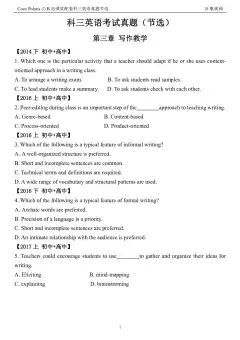
第三章 阅读教学
【2013 下 初中+高中】
1. In which process can students grasp some detailed information?
A. skimming B. scanning C. careful reading D. study reading
【2014 下 初中+高中】
2. Which of the following is NOT a suitable pre-reading activity?
A. demonstrating skimming and scanning techniques.
B. Writing a similar text.
C. Introducing some difficult words of the reading text.
D. Writing questions about the topic and try to answer them.
【2015 上 初中+高中】
3. Which of the following activities can be used to check students’ understanding of difficult
sentences in the text?
A. paraphrasing B. Blank-filling C. story-telling D. summarizing
【2016 下 初中+高中】
4. It is suggested that low-level EFL learners learn to read by reading material.
A. simple and authentic B. original and classical
C. complex and classical D. classical and authentic
【2016 下 初中+高中】
5. Teachers who adopt the model for reading comprehension may start teaching a text
by introducing new vocabulary and structures.
A. parallel B. serial C. top-down D. bottom-up
【2017 上 初中+高中】
6. A teacher may encourage students to when they come across new words in fast
reading.
A. take notes
B. ask for help
C. guess meaning from context
D. look up the words in dictionary
1Coco PolarisのB站课堂配套科三英语真题节选 13集视频
【2018 上 初中+高中】
7. Which of the following practices can encourage students to read an article critically?
A. Evaluating its point of view.
B. Finding out the facts.
C. Finding detailed information.
D. Doing translation exercises.
【2018 下 初中+高中】
8. When the teacher asks students to read a text for the main idea, he/she intends to develop
students’ skill of .
A. retelling B. predicting C. skimming D. scanning
【2020 下 初中+高中】
9. Which of the following is least recommended at the lead-in stage in a reading class?
A. Activating students’ schema of the topic.
B. Giving advice on how to use reading strategies.
C. Sharing background information about the text.
D. Correcting language mistakes students have made.
简答题【2021 下 初中】
31.根据题目要求完整下列任务,用中文作答。
在阅读教学中,有的教师倾向于采用从单词到句子,再到语篇的教学方法。
简述采用此方法的理论基础(8 分),并指出该教学方法存在的两个优点(6
分)和两个缺点(6 分)。
简答题【2019 下 初中】
31.根据题目要求完整下列任务,用中文作答。
老师在为学生选择阅读材料的时候,要注意什么?四点即可。(20 分)。
简答题【2015 上 初中】
31.根据题目要求完整下列任务,用中文作答。
简述 scanning 的含义并举一例说明其基本用途。写出训练该项技能时的三条
注意事项,并用英语写出两句相关的教师指令语。(20 分)。
简答题【2021 上 高中】
31. 请列出四种英语阅读技能(8 分),并分别写出一句课堂教学指令语以培养相应的
技能。(12 分)
2Coco PolarisのB站课堂配套科三英语真题节选 13集视频
教学情境分析题【2018 下 高中】
32.下面是一位实习教师记录的一节阅读课的教学活动。
A. Tell the students the title of the story "An unexpected holiday".
B. Organize a brainstorming activity about holidays.
C. Invite the students to talk about possible contents of the story.
D. Ask the students to read the whole text to see if they are right.
E. Ask the students to figure out the meaning of the underlined parts of the text.
F. Ask the students to read again and underline the sentences they don't understand
G. Check whether the students can recite the story.
根据所给材料从下列三个方面作答:
(1) 上述活动旨在培养学生哪两个阅读技能?(6 分)
(2) 分析 A-F 每个活动的设计意图。(18 分)
(3) 分析活动 G 的缺点,并提出相应的改进建议。(6 分)
3Coco PolarisのB站课堂配套科三英语真题节选 13集视频
【参考答案】
单选题:1-5 B B A A D 6-9 C A C D
简答题【2021 下 初中】
31. 根据题目要求完整下列任务,用中文作答。
在阅读教学中,有的教师倾向于采用从单词到句子,再到语篇的教学方法。
简述采用此方法的理论基础(8 分),并指出该教学方法存在的两个优点(6
分)和两个缺点(6 分)。
(1)这属于自下而上的阅读教学模式。自下而上的模式认为读者对材料的理解是从比
较小的语言文字单位到比较大的单位,从低层到高层一步步进行的;认为学生对材料的
理解是从字母到单词,再到句子,逐个进行解码从而理解全文。
(2)优点:①该模式在阅读教学中比较看重词汇教学,包括读前讲授单词,和阅读过
程中词语用法的分析。有利于学生掌握生词。
②扫除阅读中的生词障碍后,有利于学生对阅读材料内容的理解。
(3)缺点:①一味强调对单词和句子的学习,而没有从篇章角度强调背景知识和上下
文预测的重要性;使学生习惯于解码的分析性阅读,缺乏高层次的理解。
②不利于阅读能力的提升和知识迁移。
简答题【2019 下 初中】
31.根据题目要求完整下列任务,用中文作答。
老师在为学生选择阅读材料的时候,要注意什么?四点即可。(20 分)。
(1)教师在选择阅读材料使要遵循趣味性原则,选择的材料要有一定的趣味性,例如故
事,科普文等,并且可在知道同学阅读前,通过交代背景知识,是同学对所选材料感兴
趣,激发学生的阅读欲望。
(2)在材料的选择上应遵循广泛性原则,既引导同学进行广泛阅读。在日常教学中,教
师不仅需要在课上组织精读活动,也应课下布置阅读任务,鼓励同学利用略读,快读等
方式进行广泛地阅读。
(3)在材料的选择上应遵循真实性原则,尽量选用欧美真实阅读材料,引导同学学习正
4Coco PolarisのB站课堂配套科三英语真题节选 13集视频
确的英语使用方式,培养同学们良好的英语表达习惯。
(4)在选择材料时,教师应当所选材料的难度进行严格把关,选用难度适中的材料。此
外,也可根据学生的实际水平和不同爱好,为不同的学生推荐不同难度、不同话题的阅
读素材。
简答题【2015 上 初中】
31.根据题目要求完整下列任务,用中文作答。
简述 scanning 的含义并举一例说明其基本用途。写出训练该项技能时的三条
注意事项,并用英语写出两句相关的教师指令语。(20 分)。
(1) scanning 的含义:译为"扫读,寻读,查读”是一种快速阅读方式,其目的是从较
长的文字资料中查寻到特定的细节内容。寻读要求既快又准,要在短时间内准确地找到
目标。
基本用途:例如:在教学“Do you want to watch a game show?”时,可以通过设置寻读活
动"Ask students to scan the passage in 5 minutes and fill in the blank according to the line
time",让学生在 5 分钟内阅读文章,然后根据时间顺序填表格。通过寻读,可以帮助
学生了解文章特定信息,提高学生地阅读速度。
(2)注意事项:
①在设计寻读活动时,要有明确的时间规定,以促使学生在较短时间内完成任务。
②在设计寻读活动时,要引导学生借助关键词快速锁定寻读目标,切忌从头逐字地寻
找,导致学生的寻读技巧未得到有效的培养。
③在设计寻读活动时,教师的指令要清楚,不能过于简单,这会造成学生不清楚做什么,
从而影响阅读效果。指令中应包含学生应在多长时间内,通过怎么读,读出什么等信息。
教师指令:
- Please scan the passage in 5 minutes and fill in the table according to the timelines.
- Please scan the Paragraphs 2-4 in 3minutes and answer the following two questions.
简答题【2021 上 高中】
31. 请列出四种英语阅读技能(8 分),并分别写出一句课堂教学指令语以培养相应的
技能。(12 分)
(1)略读:学生有选择地进行快速阅读,可跳过某些细节,以抓住文章的大意。
课堂教学指令语:请在一分钟内读完这篇文章,并简要概括主要内容。(Please read the
passage within one minute and summarize the main idea)
5Coco PolarisのB站课堂配套科三英语真题节选 13集视频
(2)寻读:学生通过有目的性的快速阅读,从较长的文字资料中查寻特定的细节内容。
课堂教学指令语:请阅读第二段和第三段,找出这些数据:$50000,1975,2%,1997,
并弄说明它们指的是什么。(Please read the second and third paragraphs to identify the data-
$50000, 1975, 2%, 1997, and then figure out what they refer to.)
(3)预测:学生借助标题、上下文、背景知识等线索,对文章的主题、体裁、结构及相
关的词汇等进行预测。
课堂教学指令语:看这个标题和图片,试着预测一下这篇文章会讲什么。(Look at the
title and picture, try to predict what the passage will talk about.)
(4)猜测词义:学生通过上下文,分析文中个别单词的语境意义。
课堂教学指令语:读最后一段,并讨论第三行中的"weary"的含义是什么。
(Read the last paragraph, and talk about the meaning of the underlined word "weary".)
教学情境分析题【2018 下 高中】
(1) 上述活动旨在培养学生哪两个阅读技能?(6 分)
上述活动旨在培养学生的略读和猜测词义两个阅读技能。
① C."Invite the students to talk about possible contents of the story"D."Ask the students
to read the whole text to see if they are right"旨在培养学生读前预测文章内容,并能运用
略读技巧,总结文章大意的技能。
② E."Ask the students to figure out the meaning of the underlined parts of the text."旨在
培养学生根据上下文猜测词义的技能。
(2) 分析 A-F 每个活动的设计意图。(18 分)
A. 告知学生文章主题,引入本堂课的话题,吸引学生的注意力,同时激发学生的兴趣。
B. 通过头脑风暴激活学生的背景知识,让学生充分参与到课堂活动中来,为开展阅读
教学做准备。
C. 组织学生根据题目预测课文内容,吸引学生的阅读兴趣,培养学生推测文章大意的
技能。
6Coco PolarisのB站课堂配套科三英语真题节选 13集视频
D. 让学生通读全文,来检验预测内容正确与否,锻炼了学生的略读能力,使学生能够
在较短的时间里了解文章大意。
E. 让学生根据语境猜测词义,锻炼学生的猜词技能,培养学生自主学习的能力。
F. 让学生画出难句,了解学生的知识掌握情况,查漏补缺,同时使学生加深对文章的
理解。
(3) 分析活动 G 的缺点,并提出相应的改进建议。(6 分)
活动 G 属于读后环节。读后环节是阅读内容的拓展阶段,主要任务是根据学生所读内
容开展一些评价或者应用性活动,来巩固学生所学知识,并加深学生对文章的理解。背
诵并不能检验学生对文章的理解情况,更不能使学生学以致用;而且文章刚讲完就要求
背诵,任务难度过大,打击学生的积极性。建议教师在读后环节开展讨论、辩论、角色
扮演、续写故事、根据关键词复述文章大意和书面练习等活动。
7