年 全 国 教 师 资 格
2 0 2 4
理 论 精 讲 -教 学 设 计 3
讲师:李婉君
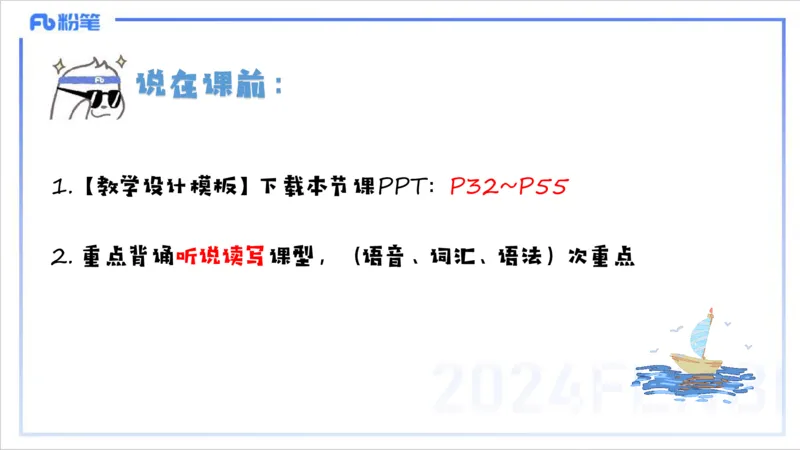
更多干货关注 粉笔教师教育 粉笔教师【教学 设 计 模板】下 载 本 节 课 :
1. PPT P32~P55
重 点 背 诵 听 说 读 写 课型 ,(语 音 、词 汇、语 法 )次 重 点
2.温 故知 新温 故知 新语 法 课语 法 课( )
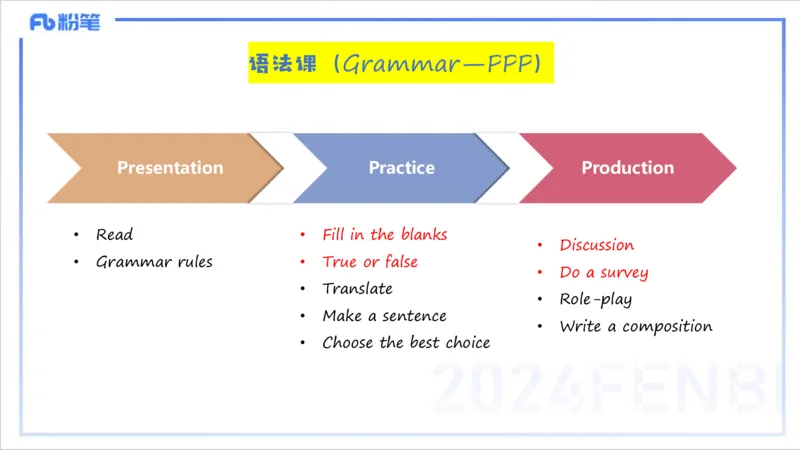
Grammar—PPP
Presentation Practice Production
• •
Read Fill in the blanks
•
Discussion
• •
Grammar rules True or false
•
Do a survey
•
Translate
•
Role-play
•
Make a sentence
•
Write a composition
•
Choose the best choice呈 现模板
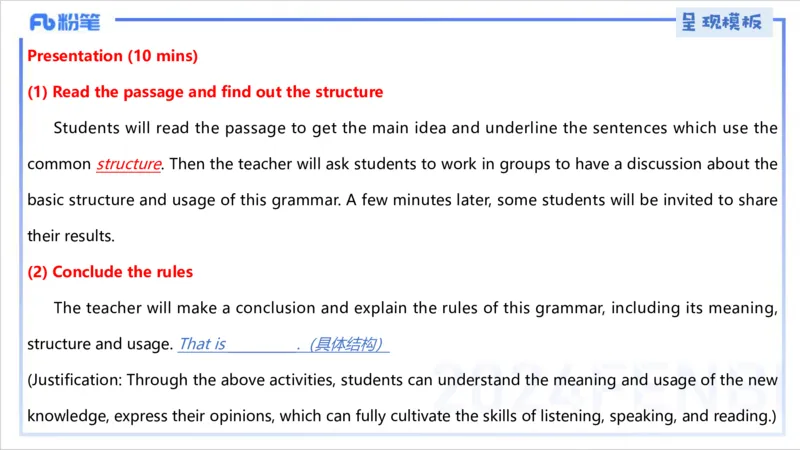
Presentation (10 mins)
(1) Read the passage and find out the structure
Students will read the passage to get the main idea and underline the sentences which use the
common structure. Then the teacher will ask students to work in groups to have a discussion about the
basic structure and usage of this grammar. A few minutes later, some students will be invited to share
their results.
(2) Conclude the rules
The teacher will make a conclusion and explain the rules of this grammar, including its meaning,
structure and usage. That is __________.(具体结构)
(Justification: Through the above activities, students can understand the meaning and usage of the new
knowledge, express their opinions, which can fully cultivate the skills of listening, speaking, and reading.)Step 1 Presentation (10 mins)
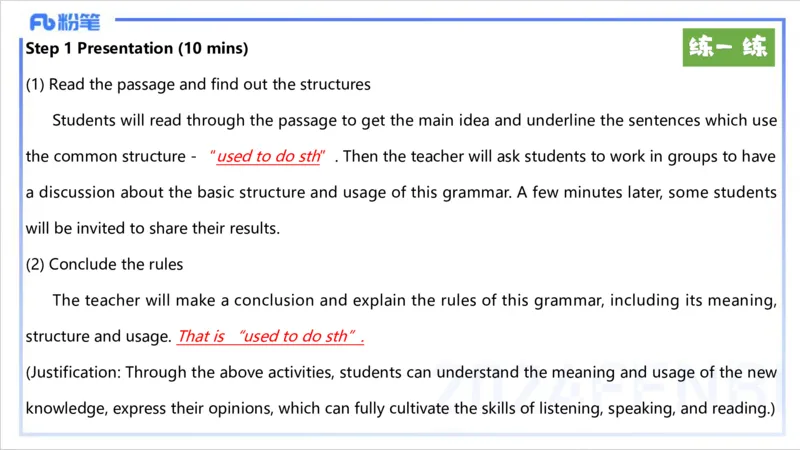
(1) Read the passage and find out the structures
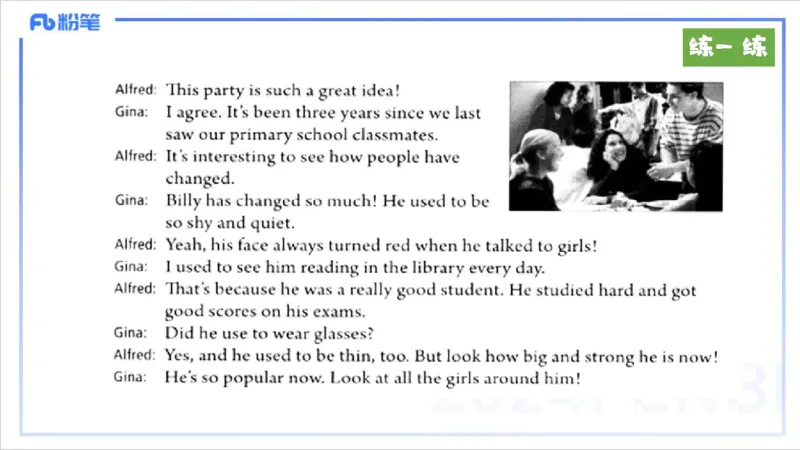
Students will read through the passage to get the main idea and underline the sentences which use
the common structure - “used to do sth”. Then the teacher will ask students to work in groups to have
a discussion about the basic structure and usage of this grammar. A few minutes later, some students
will be invited to share their results.
(2) Conclude the rules
The teacher will make a conclusion and explain the rules of this grammar, including its meaning,
structure and usage. That is “used to do sth”.
(Justification: Through the above activities, students can understand the meaning and usage of the new
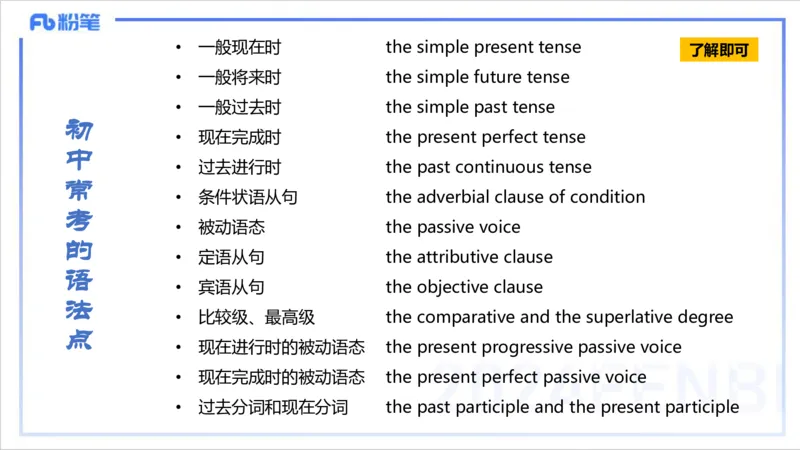
knowledge, express their opinions, which can fully cultivate the skills of listening, speaking, and reading.)• 一般现在时 the simple present tense
了解即可
• 一般将来时 the simple future tense
• 一般过去时 the simple past tense
初
• 现在完成时 the present perfect tense
中
• 过去进行时 the past continuous tense
常
• 条件状语从句 the adverbial clause of condition
考
• 被动语态 the passive voice
的
• 定语从句 the attributive clause
语
• 宾语从句 the objective clause
法
• 比较级、最高级 the comparative and the superlative degree
点
• 现在进行时的被动语态 the present progressive passive voice
• 现在完成时的被动语态 the present perfect passive voice
• 过去分词和现在分词 the past participle and the present participle了解即可
• 过去将来时 the past future tense
• 现在进行时 the present progressive tense
高
• 过去完成时 the past perfect tense
中
• 将来进行时 the future continuous tense
常
• 现在完成进行时态 the present perfect continuous tense
考
• 限定性定语从句 the restrictive attributive clause
的
• 非限制性定语从句 non-restrictive attributive clause
语
• 省略句 elliptical sentence
法
• 非谓语动词 the non-predicate verb
点
• 动词不定式 infinitive
• 过去分词和现在分词 the past participle and the present participlePractice
fill in the
任选其一
blanks
true or false translate
make a
choose the
sentence
best choice练习 模板
Practice (4 mins)
The teacher will ask students to finish the following exercises:
_________________________.(T&F)
_________________________.(T&F)
(Justification: Through these exercises, students can have a better understanding of the new
knowledge. In addition, students can master the meaning and usage of this grammar point.)Step 2 Practice (4 mins)
The teacher will ask students to finish the following exercises:
1. He used to being so shy and quiet.(T&F)
2. I used to see him reading in the library every day.(T&F)
3. Did he used to wear glasses?(T&F)
(Justification: Through these exercises, students can have a better understanding of the new
knowledge. In addition, students can master the meaning and usage of this grammar point.)产 出 模板
Production (6 mins)
Group discussion/Doing a survey
Students need to work in groups to discuss the following question/do a survey about
______ by using this grammar. Several minutes will be given. When time’s up, several students
will be invited to share their results. Then the teacher will comment on students’
performances.
(Justification: Group activities will provide students with the opportunity to apply what
they have learned to practical use, improve their comprehensive language skills, boost their
confidence in learning English and enhance their sense of teamwork.)词 汇 课词 汇课
Vocabulary—PPP
Presentation Practice Production
Group activities
1. New word/phrase teaching 1. New word/phrase practice
2. Key sentence teaching
2. Key sentence practice呈 现模板
Step 1 Presentation (10 mins)
1. New word/phrase teaching
With the help of some pictures/videos/flashcards/objects/actions, the teacher will present the meaning,
usage, pronunciation and spelling of these new words/phrases: __________________.
2. Key sentence teaching
The teacher will show some pictures in the books, then let students describe the pictures firstly. Then the
teacher will introduce the key sentence _______________ and explain the meaning and usage of it.
(Justification:Students can understand the meaning and usage of new knowledge, express their views
correctly and fluently, and cultivate their speaking skills. In addition, students will also be more
interested in activities and more confident in learning English.)A: What are you reading?
B: The Old Man and the Sea.
A: Wow! Are you going to become a writer?
B: Well, I’m going to keep on writing stories, of course. What do you want to be?
A: My parents want me to be a doctor, but I’m not sure about that.
B: Well, don’t worry. Not everyone knows what they want to be. Just make sure you try
your best.
A: Yes, you’re right.Step 1 Presentation (10 mins)
1. New word/phrase teaching
With the help of some pictures, the teacher will present the meaning, usage, pronunciation and spelling
of these new words and phrase: writer, doctor, and keep on.
2. Key sentence teaching
The teacher will show some pictures, then let students describe the pictures firstly. Then the teacher will
introduce the key sentence Are you going to do ...? and explain the meaning and usage of it.
(Justification:Students can understand the meaning and usage of new knowledge, express their views
correctly and fluently, and cultivate their speaking skills. In addition, students will also be more
interested in activities and more confident in learning English.)(单词短语&句型)均任选其一
1. Bomb game
1. True or False
2. Finger show
2. Make sentences
3. High and low voice
3. Fill in the blanks
4. Missing game
5. Make a match
words/phrases sentence练习 模板
Step 2 Practice (6 mins)
1. New word/phrase practice-Make a match
Let students make a match to practice the new knowledge. Students will be given one minute to
match the pictures with correct words. Then some of them will be invited to share thier answers and get
positive feedback.
2. New sentence practice-Make sentences
Students need to make some sentences by using the new sentence pattern. A few minutes later,
some students will be invited to share their answers. Then the teacher will give corresponding feedback.
(Justification: Practicing the new knowledge through these activities can create a good class
atmosphere and consolidate this lesson. In the pair work, students can use these expressions more
flexibly to improve their oral expression ability.产 出 模板
Step 3 Production (4 mins)
Group discussion/Do a survey/Role-play
Students need to work in groups to discuss the following question/do a survey/do a role-play about
_______ by using the key words/phrases and sentences. Several minutes will be given. When time’s up,
several students will be invited to share their results/ dialogue. Then the teacher will comment on
students’ performances.
(Justification: Group activities will provide students with the opportunity to apply what they have
learned to practical use, improve their comprehensive language skills, boost their confidence in learning
English and enhance their sense of teamwork.)语 音 课语 音 课
Phonetics —PPP
1. Discussion
1. Which order 2. Survey
1. Finding phonetic phenomena 2. Same or different 3. Make a conversation
2. Explaining the rules 3. Listen and repeat 3. Dubbing
Presentation
Practice Production语言素材:
Berners Lee, 48, was named in the New Year's Honers list for "services to the
Internet"-- creating the system that has revolutionized computer use across the
world.
He designed the system in his spare time in 1991 while working as a researcher
at the European research laboratory Cen, which is based in Switzerland.
Instead of patenting the system or restricting its use, Bemers Lee gave away his
invention, making it possible for the Web to grow at fast rate.呈 现模板
Step 1 Presentation (10 mins)
① The teacher will read the words/phrases/sentences/passage for the students. Show the words:
__________________ through pictures/a situation/objects/actions.
② Students should listen carefully and work in groups to find out the similarity among them.
③ Pronunciation teaching. The teacher will make a conclusion and introduce the pronunciation rule
of ________.
(Justification: Students can understand the pronunciation rules, express their views correctly and
fluently. In addition, students will also be more interested in activities and more confident in learning
English.)练习 模板
Step 2 Practice (4 mins)
Which order
The teacher reads out a group of words/sentences and students need to arrange them according to
the sounds. After that, the teacher will invite some students to share their answers in front of the whole
class.
(Justification: Practicing the new knowledge through these activities can create a good class
atmosphere and help students consolidate what they have learned in this lesson. Students can also use
the pronunciation rule more flexibly and improve their oral expression ability.)产 出 模板
Step 3 Production (6 mins)
Discussion/Survey/Make a conversation/Dubbing
Students need to work in groups to dub for a short cut of video which contains the pronunciation
rules they've learned. A few minutes will be given for preparation. When time's up, volunteers will be
invited to perform in front of the class, during which they need to imitate the pronounciation and
intonation. Then the teacher will comment on students' performance.
(Justification: Group activities will provide students with more opportunities to express themselves,
and therefore improve their comprehensive language skills, boost their confidence in learning English
and enhance their sense of teamwork.)课型 Presentation Practice Production
1. Read the passage and find out
Fill in the blanks/True or
语法课 the structure Discussion/Survey
False
2. Conclude the rules
1. New word/phrase teaching 1. Make a match
词汇课 Discussion/Survey
2. Key sentence teaching 2. Make sentences
1. Find out the phonetic Discussion/
语音课 phenomena Which order Survey/Role-
2. Conclude the rules play/Dubbing教 学 设 计 模 板
⭐ ⭐1. Teaching contents
版本1:This is a reading lesson. It talks about ___________.
版本2:The given reading material introduces/shows ...
2. Teaching objectives
①Students can learn to use some important words and expressions in the material, such as ______________
②Students will be able to use the target language to talk about ______.
③Students can have good qualities of self-confidence and self-improvement.
④Students can sort out and summarize information in the material.
⑤Students will be willing to take part in the class activities and cooperate with other group members.
3. Teaching key and difficult points
Key point(s)
(1) The teacher will help students to know the meaning and usage of the new words/phrases and sentence
patterns.
(2) The teacher will help students to understand the content of this lesson.Difficult point(s)
(1) The teacher will help students to talk about / describe the new topic correctly and fluently.
(2) The teacher will help students to improve their confidence in speaking English.
4. Major steps
Lead-in (5 mins)
After greeting students, the teacher will show the picture/photo/video of _______ and ask one question:
“_________”, then invite some volunteers to share their answers. After that, the teacher will give
corresponding comments on students' answers and show the topic/task of this lesson.
(Justification: The picture/photo/video is vivid and interesting, which can arouse students' interest in the
teaching activity. Meanwhile, it can also introduce the topic today naturally.)Summary and homework (5 mins)
① Summary:
Students should act as an assistant teacher to conclude what they have learned in this class, and then the
teacher will make a summary together with students.
② Homework:
1.Retell the passage after the class.
2.Search the internet for more information about ______ and share with others next class.
(Justification: Reviewing the important knowledge in this lesson can deepen students’ impression and form
good study habits. Retelling can help students sort out the course content, and the task of collecting information
can help students actively explore more knowledge and information.)阅读课/听力课/听说课
Step 1 Pre-reading (6 mins)
(1) New knowledge teaching
With the help of ______, the teacher will guide students to understand the meaning and usage of the new
words/phrases and sentences, including ______.
(2) Prediction
Before reading, the teacher will organize students to make predictions. Some hints will be provided to help
them.
Hint 1: Words and sentences just referred to.
Hint 2: Title of this material— .
Hint 3: Some pictures/videos in which students can see .
(Justification: The above activities can help students recognize the new words and sentence patterns, remove
the barriers, and lay the foundation for the next step of “reading”.)Step 2 While-reading (10 mins)
(1) Extensive reading
The teacher will ask students to read the text quickly to check their predictions and summarize the main idea of
the text.
(2) Intensive reading
Students should read the text again and do the following tasks.
① True or False ② Matching/Form-filling/Mind mapping
A X
A X X
_________________. (T/F)
B Y A Y
C Z Z
_________________. (T/F)
(Justification: In the process of completing reading tasks at different levels, students can understand the content
and certain details of the text, and improve their reading skills.)Step 3 Post-reading (4 mins)
Group discussion/Do a survey
Students need to work in groups to discuss the following question/do a survey about: ________ by using the
target language. Several minutes will be given. When time’s up, some students will be invited to share their
results. Then the teacher will comment on students’ performance.
(Justification: Group activities provide students with the opportunity to apply what they have learned to practical
use, improve their comprehensive language skills, boost their confidence in learning English, and enhance their
sense of teamwork.)写作课(读写课)——有范文
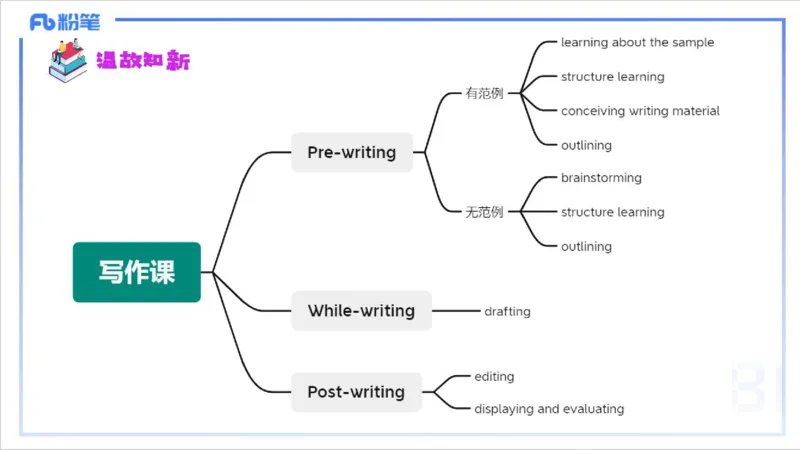
Step 1 Pre-writing (8 mins)
(1) Learning about the material
The teacher will guide students to read the material to summarize the topic of it. Then students will answer
some questions about the material/find the supporting ideas of the material.
① ____________________? / ① _____________________.
② ____________________? / ② _____________________.
(2) Structure learning
Students will read the material again to summarize the basic structure, and they should pay attention to the
topic sentences, transitional words and logical relations.(3) Conceiving writing material
Students will work in groups to talk about ________ and write down some ideas. Representatives from each
group will share their discussion results, including some useful expressions.
(4) Outlining
The teacher will guide students to write an outline and students will put their ideas in order.
(Justification:Through the above activities, students will be prepared to write their own compositions. They
will know what to write and how to write it.)写作课(读写课)——无范文
Step 1 Pre-writing (8 mins)
(1) Do a brainstorming
Let students do a brainstorming. The topic is “When it refers to'_________', I can think of...” Students will be
given several minutes to work in groups to talk about it and write down some ideas. After that, representatives
from each group will share their results, including some useful phrases, sentences and so on. Each answer will
get positive feedback.
(2) Structure learning
The teacher will guide students to define the basic structure of the passage. Students should also pay
attention to the topic sentences, transitional words, logical relations and so on.
(3) Outlining
The teacher will guide students to write an outline and students will put their ideas in order.
(Justification:Through the above activities, students will be prepared to write their own compositions. They
will know what to write and how to write it.)Step 2 While-writing (7 mins)
Drafting
Students will write their own compositions, and the teacher will walk around to offer help and remind
students to pay attention to the spelling, grammar, punctuation and so on.
(Justification: Through the activity, students will finish their writing and their writing ability will be improved.)
Step 3 Post-writing (5 mins)
(1) Editing
① Self-editing
The teacher will give students a short time to go through their compositions to correct the mistakes in spelling
and grammar.
② Peer-editing
Students will exchange their compositions with each other and correct the mistakes in spelling and grammar.
They can also make suggestions about polishing their writings.(2) Displaying and evaluating
The teacher will invite some students to share their compositions with the whole class and guide other students
to evaluate these compositions, and then the teacher will make a conclusion.
(Justification: Through these activities, students will regulate their language and work out better ideas or
expressions, and they will improve their writing skills. Besides, they will be more willing to share their ideas in
public.)口语课
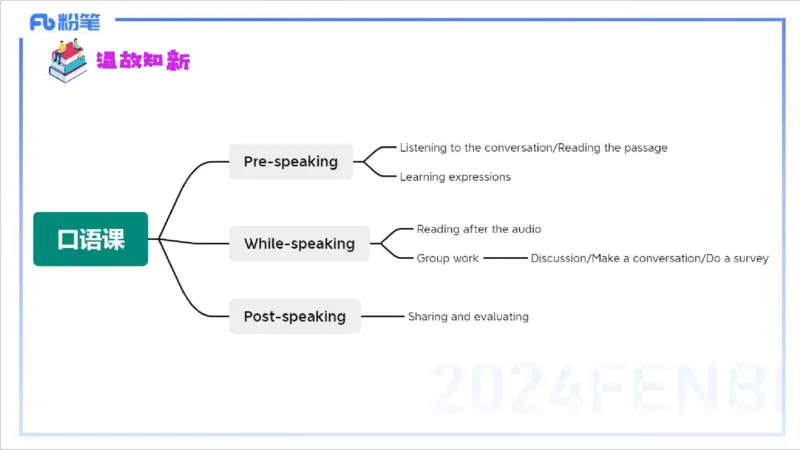
Step 1 Pre-speaking (8 mins)
(1) Listening to the conversation/Reading the passage
Students will listen to the conversation/read the passage to get the main idea, and then answer some
questions/fill in the chart.
XX XX
_____________?
_____________? OR
(2) Learning expressions
The teacher will explain the meaning and usage of the new words and sentences about the situation,
including _________and invite students to do some exercises about the new knowledge.
(Justification: With those activities, students will be familiar with the situation, and accumulate many
expressions which can be used in this situation, making good preparations for the speaking activities.)Step 2 While-speaking (7 mins)
(1) Reading after the audio
The teacher will play the audio and lead students to read after it. Students should pay attention to the
pronunciation and intonation.
(2) Group discussion/Make a conversation/Do a survey
Ask students to work in groups and have a discussion/make a conversation/do a survey about __________.
They should try to use the words and sentence structures they have learned today.
(Justification: Students will have a deeper understanding of the topic and usage of the new knowledge, and
they can also have more opportunities to express themselves.)Step 3 Post-speaking (5 mins)
Sharing and evaluating
The teacher will invite some students to share their dialogues/results with the whole class and guide other
students to evaluate their performance, and then the teacher will make a conclusion.
(Justification: Through these activities, students will improve their speaking skills. Besides, they will be more
willing to share their ideas in public and learn from each other.)语法课
Presentation (10 mins)
(1) Read the passage and find out the structures
Students will read the passage to get the main idea and underline the sentences which use the common
structure. Then the teacher will ask students to work in groups of four to have a discussion about the basic
structure and usage of this grammar. A few minutes later, some students will be invited to share their results.
(2) Conclude the rules
The teacher will make a conclusion and explain the rules of this grammar, including its meaning, structure and
usage. That is __________.(具体结构)
【Justification】Through the above activities, students can understand the meaning and usage of the new
knowledge, express their opinions, which can fully cultivate the skills of listening,speaking, reading.Practice (4 mins)
Let students do the task: true or false. The teacher will ask students to finish the following exercises:
_________________________.(T&F)
_________________________.(T&F)
【Justification】Through these exercises, students can have a better understanding of the new knowledge. In
addition, students can master the meaning and usage of this grammar point.)Production (6 mins)
Group discussion/Doing a survey:
Students need to work in groups to discuss the following question/do a survey about _______ by using this
grammar. Several minutes will be given. When time’s up, several students will be invited to share their results.
Then the teacher will comment on students’ performances.
【Justification】Group activities will provide students with the opportunity to apply what they have learned to
practical use, improve their comprehensive language skills, boost their confidence in learning English and
enhance their sense of teamwork.词汇课
Presentation (10 mins)
1. New word/phrase teaching
With the help of some pictures/videos/flashcards/objects/actions, the teacher will present the meaning, usage,
pronunciation and spelling of these new words/phrases: __________________.
2. Key sentence teaching
The teacher will show some pictures in the books, then let students describe the pictures firstly. Then the
teacher will introduce the key sentence _______________ and explain the meaning and usage of it.
(Justification:Students can understand the meaning and usage of new knowledge, express their views
correctly and fluently, and cultivate their speaking skills. In addition, students will also be more interested in
activities and more confident in learning English.)Practice (6 mins)
1. New word/phrase practice-Make a match
Let students make a match to practice the new knowledge. Students will be given one minute to match the
pictures with correct words. Then some of them will be invited to share thier answers and get positive feedback.
2. New sentence practice-Make sentences
Students need to make some sentences by using the new sentence pattern. A few minutes later, some students
will be invited to share their answers. Then the teacher will give corresponding feedback.
(Justification: Practicing the new knowledge through these activities can create a good class atmosphere and
consolidate this lesson. In the pair work, students can use these expressions more flexibly to improve their oral
expression ability.Production (4 mins)
Group discussion/Do a survey/Make a dialogue
Students need to work in groups to discuss the following question/do a survey/make a dialogue about _______
by using the key words/phrases and sentences. Several minutes will be given. When time’s up, several
students will be invited to share their results/ dialogue. Then the teacher will comment on students’
performances.
(Justification: Group activities will provide students with the opportunity to apply what they have learned to
practical use, improve their comprehensive language skills, boost their confidence in learning English and
enhance their sense of teamwork.)语音课
Presentation (10 mins)
1. Finding phonetic phenomenon
The teacher will read the words/phrases/sentences for the students. Students should listen carefully and find
out the similarity/difference between them. Then the teacher will ask students to work in groups of four to have
a discussion about the rules of the phonetic phenomenon. A few minutes later, some students will be invited to
share their results.
2. Explaining the rules
The teacher will make a conclusion and explain the pronunciation rules of _______ to the students.
(Justification: Students can understand the pronunciation rules, express their views correctly and fluently. In
addition, students will also be more interested in activities and more confident in learning English.)Practice (4 mins)
Which order
The teacher will read out a group of words and the students will arrange them according to the sounds. Several
minutes later, the teacher will invite some students to share their answers in front of the whole class.
(Justification: Practicing the new knowledge through this activity can create a good class atmosphere and help
students consolidate what they have learned in this lesson. Students can also use the pronunciation rules more
flexibly and improve their speaking ability.)Production (6 mins)
Dubbing
Students need to work in groups to dub for a short cut of video which contains the pronunciation rules they've
learned. A few minutes will be given for preparation. When time's up, volunteers will be invited to perform in
front of the class, during which they need to imitate the pronunciation and intonation. Then the teacher will
comment on students' performance.
(Justification: Group activities provide students with more opportunities to express themselves, improve
students' comprehensive language ability, and enhance students' confidence in learning English.)