年 全 国 教 师 资 格
2 0 2 4
理 论 精 讲 -教 学 设 计 1
讲师:李婉君
更多干货关注 粉笔教师教育 粉笔教师【教学 设 计 模板】在 日 教学 设 计 课件后 方 呈 现
1. 2.2 “ 3”PDF
对 教材 进 行 了 调整 和修改,呈 现核心内 容 ,以 为 主
2. PPT
课上 以听 为 主 ,课后 有 模板
3.P179
第 三 部 分
教 学 设 计P179
第 一 章
教 学 设 计 概述P179
了解即可
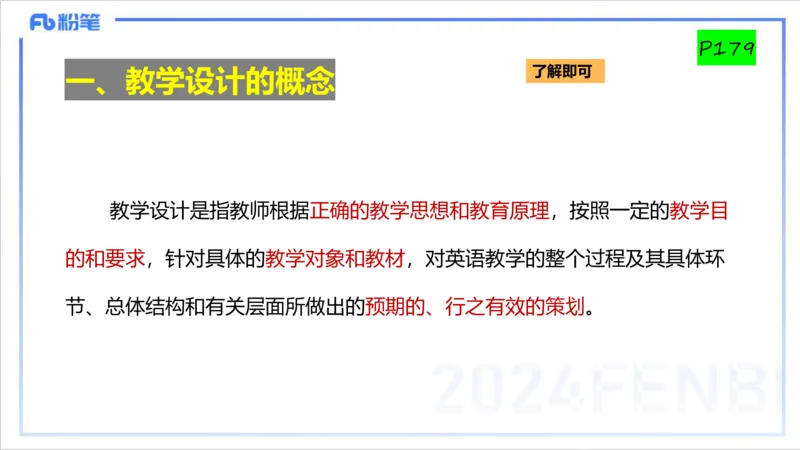
一、教学设计的概念
教学设计是指教师根据正确的教学思想和教育原理,按照一定的教学目
的和要求,针对具体的教学对象和教材,对英语教学的整个过程及其具体环
节、总体结构和有关层面所做出的预期的、行之有效的策划。P179
了解即可
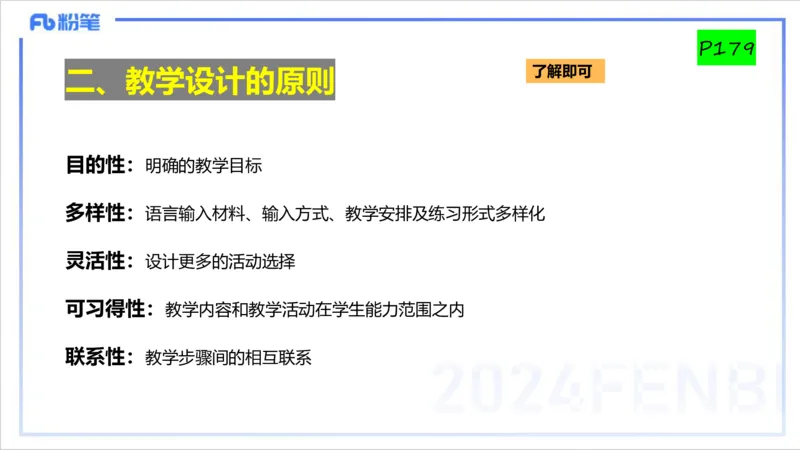
二、教学设计的原则
目的性:明确的教学目标
多样性:语言输入材料、输入方式、教学安排及练习形式多样化
灵活性:设计更多的活动选择
可习得性:教学内容和教学活动在学生能力范围之内
联系性:教学步骤间的相互联系P181
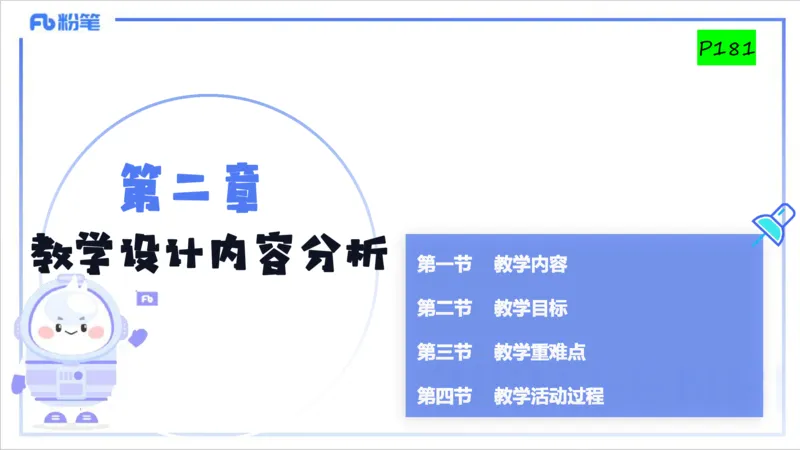
第 二 章
教 学 设 计 内 容 分 析考 情 梳 理真 题 回 顾 下 初 中
-2023
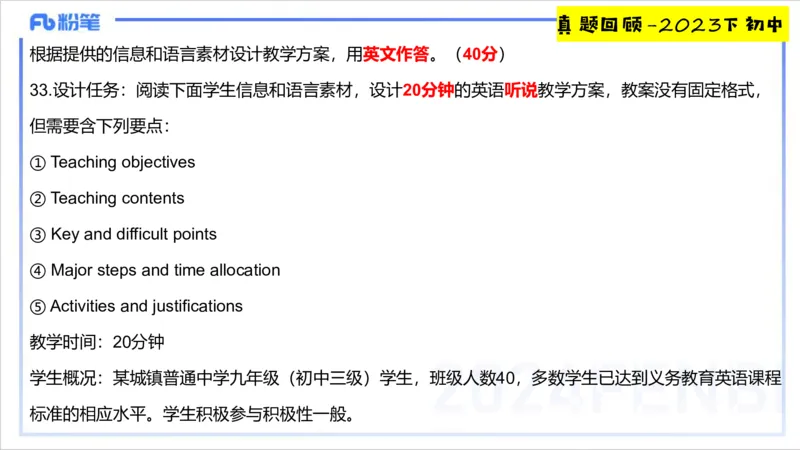
根据提供的信息和语言素材设计教学方案,用英文作答。(40分)
33.设计任务:阅读下面学生信息和语言素材,设计20分钟的英语听说教学方案,教案没有固定格式,
但需要含下列要点:
① Teaching objectives
② Teaching contents
③ Key and difficult points
④ Major steps and time allocation
⑤ Activities and justifications
教学时间:20分钟
学生概况:某城镇普通中学九年级(初中三级)学生,班级人数40,多数学生已达到义务教育英语课程
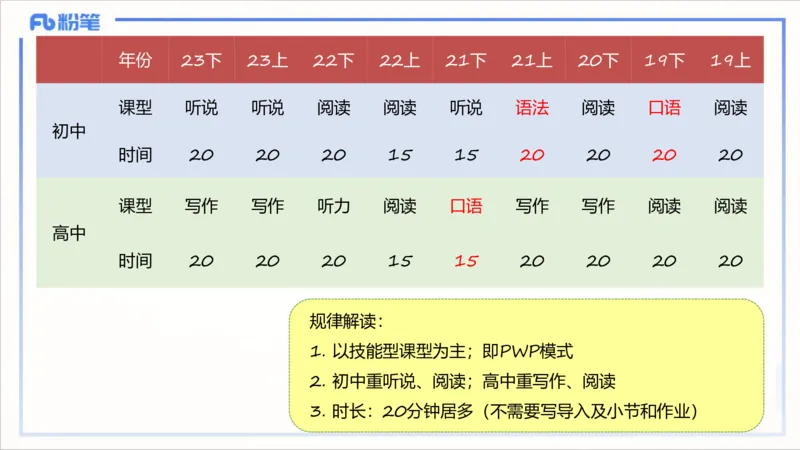
标准的相应水平。学生积极参与积极性一般。年份 下 上 下 上 下 上 下 下 上
23 23 22 22 21 21 20 19 19
课型 听说 听说 阅读 阅读 听说 语法 阅读 口语 阅读
初中
时间
20 20 20 15 15 20 20 20 20
课型 写作 写作 听力 阅读 口语 写作 写作 阅读 阅读
高中
时间
20 20 20 15 15 20 20 20 20
规律解读:
以技能型课型为主;即 模式
1. PWP
初中重听说、阅读;高中重写作、阅读
2.
时长: 分钟居多(不需要写导入及小节和作业)
3. 20教 案 框 架看课件
I. Teaching contents
II. Teaching objectives
(1) Language competence
(2) Cultural awareness
(3) Thinking quality
(4) Learning ability
III. Key and difficult points
Key point(s)
Difficult point(s)
IV. Major steps
×
Step 1 Lead-in ( mins)
×
Step 2 Pre-/Presentation ( mins)
×
Step 3 While-/Practice ( mins)
×
Step 4 Post-/Production ( mins)
×
Step 5 Summary and homework ( mins)答 题 模 板 — 通 用 部 分P181
I. Teaching contents
• 呈 现要 素 :课型+主 题
任选其一
【模板一】This is a reading lesson. It talks about ________.
【模板二】The given listening material introduces / shows ________.小 练习
语言素材:(阅读课)
The Ancient Olympic Games
The original Olympic Games were part of an important religious festival to honour the Greek gods,
especially Zeus. They were held in a valley in Olympia every four years and men from all the Greek city
states attended. Women did not compete in the games or even attend. The first record of the Olympic
Games dates from 778 BC, but they were probably established hundreds of years before that.
At first there was only one competition in the games—a 200 m foot race. The distance was based
on a myth about the hero Hercules who was said to have run this distance in one breath. At later
Olympics other events were introduced, including a 365 meter and a 5 kilometer race, boxing, chariot
races and the pentathlon jumping, running, javelin, discus and wrestling.小 练习
语言素材:(阅读课)
Athletes came to Olympia to train full-time for 10 months. As they were allowed to
compete, they were examined by a committee of 10 men to make sure they were of good
character and physically fit. All wars between cities had to stop for the five days of the games.
The prize for the winners was a crown made from an olive tree branch, but with a gold
handled knife from a sacred tree. The olive branch was believed to give the athlete great
strength and health. The winner gave public thanks to Zeus and to his city or district. Winners
were believed to have gained the favor of the gods.小 练习
【参考答案】
I. Teaching contents
• This is a reading lesson. It mainly talks about the ancient Olympic Games, including its
athletes, events and prize.任选其一或其二
P183
第二节 教学目标
语言能力:【知识】语音、词汇、句型、语法、语篇、语用
【技能】听说读看写
文化意识:【广义】中外文化理解、鉴赏;
【狭义】正确的价值观、必备品格的形成与发展
思维品质:理解、分析、比较、推断、批判、评价、创造
学习能力:学习策略;
乐学与善学、合作与探究II. Teaching objectives——Language competence
看 课件
【词汇课】
1. Students will understand/remember/recite/know/grasp the meaning of the new words,
such as _______, and new sentences _________.
2. Students can use the new words to talk about ________ correctly.
【语音课】
Students will know/grasp the pronunciation of the letter(s) _________ and use it to
communicate with others correctly.
【语法课】
1. Students can understand/remember/know/grasp/get the meaning and usage of the
new grammar _________.
2. Students can use this grammar to talk about __________ correctly/read the material
more easily and quickly.II. Teaching objectives——Language competence
看 课件
【听说课、阅读课】
1. Students can know/understand/grasp/remember the new words and
expressions/sentence patterns, such as ____________.
2. Through listening/reading, students will understand the main idea of the listening/
reading materials/passage and be able to use the target language to talk about ______.
【写作课】
1. Students can know the main idea of the passage and the structure/form of the writing.
2. Students can write a passage with a certain topic ______.
【口语课】
Students will know/understand some new expressions, such as ______ and talk about
______ correctly and fluently.II. Teaching objectives——Cultural awareness
看 课件
任选其一
(1) Students can be interested in learning and exploring Chinese and foreign culture.
(2) Students can compare Chinese and foreign culture and identify with Chinese culture.
(3) Students can respect cultural diversity and differences.
(4) Students can have a sense of national identity, cultural confidence, correct values and
positive emotional attitude.
(5) Students can have good qualities of self-confidence and self-improvement.
(6) Students can be interested in intercultural communication and get along well with others.II. Teaching objectives——Thinking quality
看 课件
任选其一
(1) Students can sort out and summarize the information in the material.
(2) Students can analyze and infer the logical relationship of the passage/material.
(3) Students can use English to think independently and creatively.
(4) Students can correctly understand and judge the thematic meaning and viewpoint of the
passage/material.
(5) Students can infer the author’s attitude and view from the passage/material.II. Teaching objectives——Learning ability
看 课件
任选其一
(1) Students can increase their interest in learning English.
(2) Students will be willing to take part in the class activities and cooperate with other group
members.
(3) Students will be more confident and willing to share their own ideas with others in public.
(4) Students can make clear learning objectives and plans and arrange learning tasks
reasonably.
(5) Students can actively use English to communicate, not afraid of difficulties.模板
首字母大小写保持一致
1.
不用写小标题,只写序号
2.
教学目标 条即可
3. 4~5
Teaching objectives
①Students can learn to use some important words and expressions, such as ______________
②Through reading, students will be able to use the target language to talk about ______.
③Students can have good qualities of self-confidence and self-improvement.
④Students can sort out and summarize information in the passage.
⑤Students will be willing to take part in the class activities and cooperate with other group
members.小 练习
Teaching objectives
①Students can learn to use some important words and expressions, such as pentathlon,
competition, district.
②Through reading, students will be able to use the target language to talk about the Olympic
Games.
③Students can have good qualities of self-confidence and self-improvement.
④Students can sort out and summarize information in the passage.
⑤Students will be willing to take part in the class activities and cooperate with other group
members.任选其一或其二 P187
Teaching key and difficult points
Key point(s)
(1) The teacher will help students to know the meaning and usage of the new words /
phrases and sentence patterns.
(2) The teacher will help students to understand the content of this lesson through listening.
Difficult point(s)
(1) The teacher will help students to talk about / describe the new topic correctly and
fluently.
(2) The teacher will help students to improve their confidence in speaking English.Step1 Lead-in (5 mins)(模板)
P189
After greeting students, the teacher will show a
picture/photo/ video of ______ and ask one question:
Review Situational
“___________________”. Then the teacher will invite some
volunteers to share their answers. After that, the teacher will give
Language
corresponding comments on students’ answers and show the
Course
Media
topic/ task of this lesson.
Homework
(Justification:The picture/photo/video is vivid and
Rhythm
interesting, which can arouse students' interest to the teaching
activity. Meanwhile, it can also introduce the topic today
naturally.)小 练习
Step 1 Lead-in (5 mins)
After greeting students, the teacher will show a video of the Olympic Games and ask one
question: “What do you know about the Olympic Games?” Then the teacher will invite some
volunteers to share their answers. After that, the teacher will give corresponding comments
on students’ answers and show the topic/task of this lesson.
(Justification: The video with vivid and interesting images can draw students’ attention to
the class, and the teacher can naturally introduce the topic of the class.)Step 5 Summary and Homework (5 mins)(模板) P194
(1) Summary
The teacher will invite one student to summarize what he/she has learned in this class.
Then the teacher and students will make a summary together.
(2) Homework
① Listen to and read the new words/phrases/sentences they’ve learned today./Retell
the passage/ conversation.
② Talk about __________ with partners/friends./ Find more information about __________
and share it with partners / friends.
(Justification: Summary can help students develop good habits and deepen the
impression of the new knowledge they have learned. Homework can help students apply
what they have learned to practical use.)小 练习
Step 5 Summary and homework (5 mins)
(1) Summary
The teacher will invite one student to summarize what he/she has learned in this class.
Then the teacher will make a summary together with the students.
(2) Homework
① Retell the passage.
② Find more information about the Olympic Games and share it with partners.
(Justification: Summary can help students develop good habits and deepen the
impression of the new knowledge they have learned. Homework can help students apply
what they have learned to practical use.)答 题 模 板 — 课 型 详 解P192读 前 模板
Step 1 Pre-reading (5 mins)
(1) New knowledge teaching
With the help of , the teacher will guide students to understand the meaning and
usage of the new words/phrases and sentences, including .
(2) Prediction
Before reading, the teacher will organize students to make predictions. Some hints will be
provided to help them.
Hint 1: Words/phrases/sentences just referred to.
Hint 2: Title of this material— .
Hint 3: Some pictures/videos in which students can see .
(Justification: The above activities can help students recognize the new words and
sentence patterns, remove the barriers, and lay the foundation for the next step of
“reading”.)读 中 模板
Step 2 While-reading (10 mins)
(1) Extensive reading
① Skimming
The teacher will ask students to read the text quickly to check their predictions and
summarize the main idea of the text.
② Scanning
Ask students to locate certain information by reading the text quickly and answer the
following questions.
?
?读 中 模板
(2) Intensive reading
Students should read the text again and do the following tasks.
① True or False ② Matching/Form-filling/Mind mapping
. (T/F) A X
A X X
B Y A Y
. (T/F)
C Z Z
(3) Reading after the audio【可写可不写】
Students will listen to the audio and read after it. They should pay attention to the
pronunciation and intonation.
(Justification: In the process of completing reading tasks at different levels, students can
understand the content and certain details of the text, and improve their reading skills.)读 后 模板
Step 3 Post-reading (5 mins)
Group discussion/Do a survey
Students need to work in groups to discuss the following question/do a survey about
______ by using the target language. Several minutes will be given. When time’s up, some
students will be invited to share their results. Then the teacher will comment on students’
performance.
(Justification: Group activities provide students with the opportunity to apply what they
have learned to practical use, improve their comprehensive language skills, boost their
confidence in learning English, and enhance their sense of teamwork.)小 练习
Step 1 Pre-reading (5 mins)
(1) New knowledge teaching
With the help of some pictures, the teacher will guide students to understand the meaning
and usage of the new words, including pentathlon, competition, district.
(2) Predicting
Before reading, the teacher will organize students to make predictions. Some hints will be
provided to help them.
Hint 1: Title of this material—The Ancient Olympic Games.
Hint 2: Some pictures in which students can see the Greek city.
(Justification: The above activities can help students recognize the new words, remove the
barriers, and lay the foundation for the next step of “reading”.)小 练习
Step 2 While-reading (10 mins)
(1) Extensive reading
① Skimming
The teacher will ask students to read the text quickly to check their predictions and
summarize the main idea of the text.
② Scanning
The teacher will ask students to locate certain information by reading the text quickly and
answer the following questions.
What was the prize for the winners of the ancient Olympic Games?
When was the first record of the Olympic Games?小 练习
(2) Intensive reading
Students should read the text again and do the following task.
Form-filling
(3) Reading after the audio【可写可不写】
Students will listen to the audio and read after it. They should pay attention to the
pronunciation and intonation.
(Justification: In the process of completing reading tasks at different levels, students can
understand the content and certain details of the text, and improve their reading skills.)小 练习
Step 3 Post-reading (5 mins)
Group discussion
Students need to work in groups to discuss the following question: What’s the
difference between the ancient Olympic Games and the modern ones? Several minutes will
be given. When time’s up, some students will be invited to share their answers. Then the
teacher will comment on students’ performance.
(Justification: Group activities provide students with the opportunity to apply what they
have learned to practical use, improve their comprehensive language skills, boost their
confidence in learning English, and enhance their sense of teamwork.)P195