文档文本内容
年 全 国 教 师 资 格
2 0 2 4
理 论 精 讲 -教 学 知 识 2
讲师:李婉君
更多干货关注 粉笔教师教育 粉笔教师温 故知 新
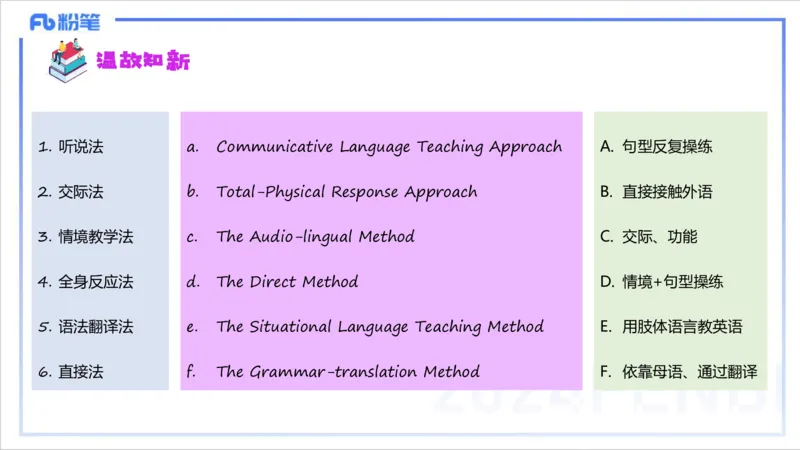
听说法 A. 句型反复操练
1. a. Communicative Language Teaching Approach
交际法 B. 直接接触外语
2. b. Total-Physical Response Approach
情境教学法 C. 交际、功能
3. c. The Audio-lingual Method
全身反应法 D. 情境+句型操练
4. d. The Direct Method
语法翻译法 E. 用肢体语言教英语
5. e. The Situational Language Teaching Method
直接法 F. 依靠母语、通过翻译
6. f. The Grammar-translation Method温 故知 新
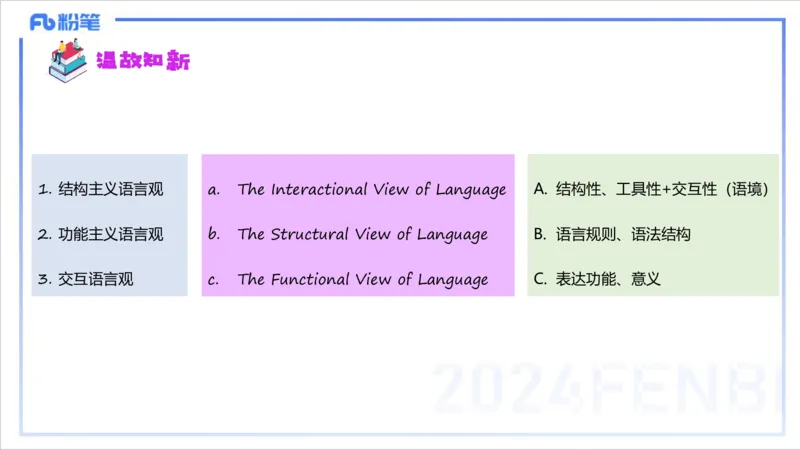
结构主义语言观 A. 结构性、工具性+交互性(语境)
1. a. The Interactional View of Language
功能主义语言观 B. 语言规则、语法结构
2. b. The Structural View of Language
交互语言观 C. 表达功能、意义
3. c. The Functional View of Language温 故知 新
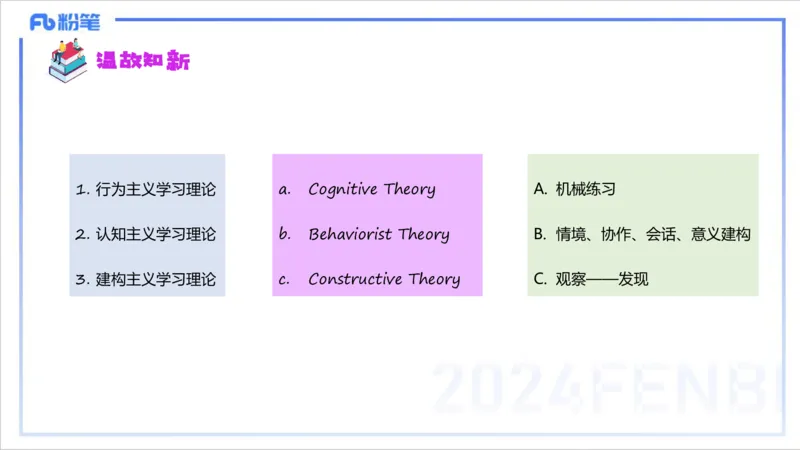
行为主义学习理论 A. 机械练习
1. a. Cognitive Theory
认知主义学习理论 B. 情境、协作、会话、意义建构
2. b. Behaviorist Theory
建构主义学习理论 C. 观察——发现
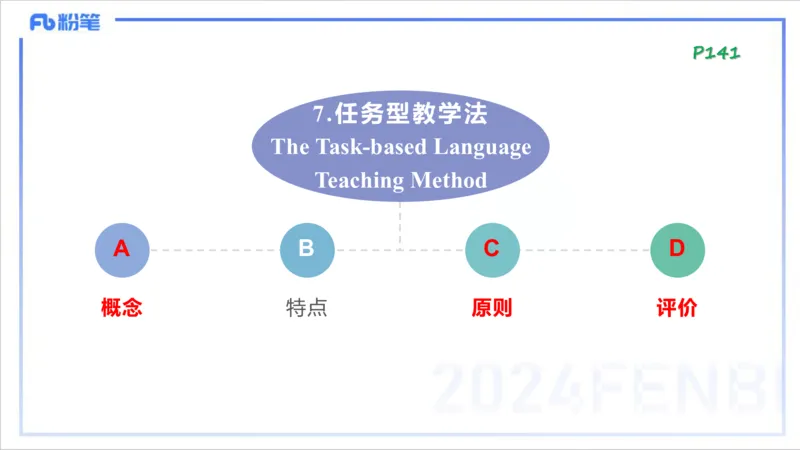
3. c. Constructive Theory7 . 任 务 型 教 学 法
The Task-based Language
Teaching Method
A B C D
概念 特点 原则 评价】
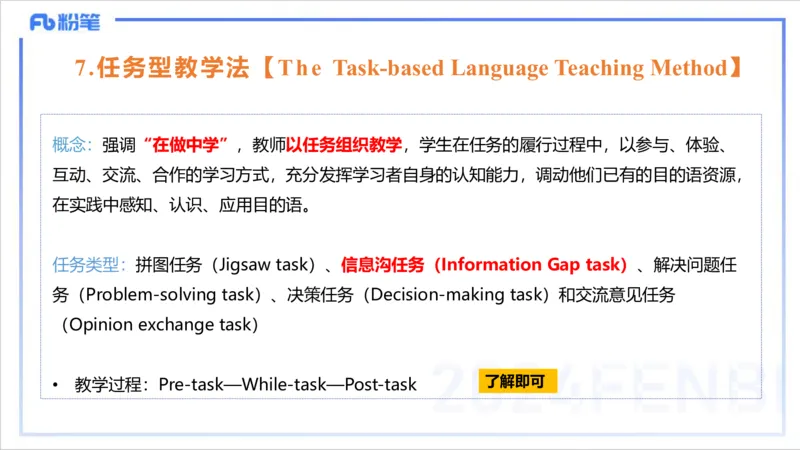
7 . 任 务 型 教 学 法 【 T h e Task-based Language Teaching Method
概念:强调“在做中学”,教师以任务组织教学,学生在任务的履行过程中,以参与、体验、
互动、交流、合作的学习方式,充分发挥学习者自身的认知能力,调动他们已有的目的语资源,
在实践中感知、认识、应用目的语。
任务类型:拼图任务(Jigsaw task)、信息沟任务(Information Gap task)、解决问题任
务(Problem-solving task)、决策任务(Decision-making task)和交流意见任务
(Opinion exchange task)
了解即可
• 教学过程:Pre-task—While-task—Post-task】
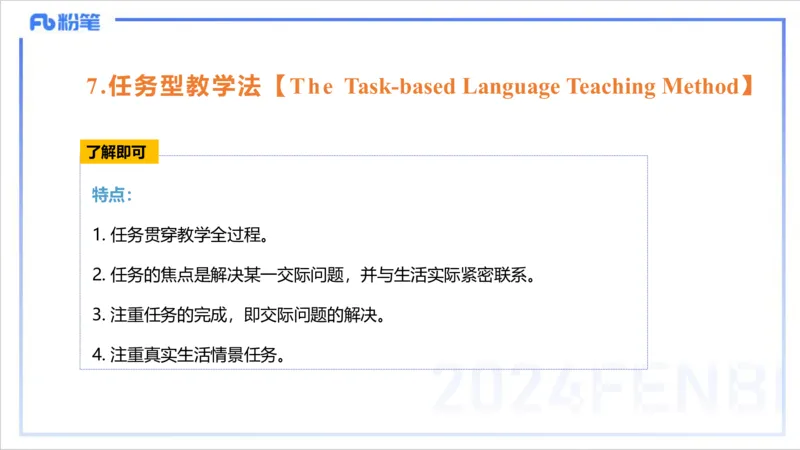
7 . 任 务 型 教 学 法 【 T h e Task-based Language Teaching Method
了解即可
特点:
1. 任务贯穿教学全过程。
2. 任务的焦点是解决某一交际问题,并与生活实际紧密联系。
3. 注重任务的完成,即交际问题的解决。
4. 注重真实生活情景任务。】
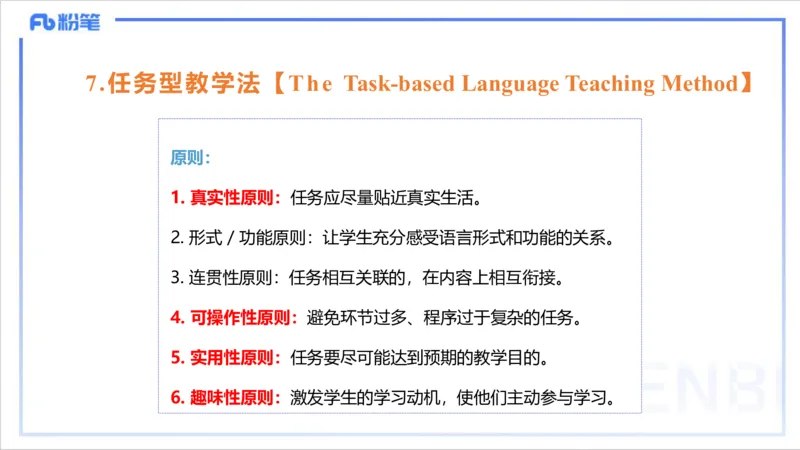
7 . 任 务 型 教 学 法 【 T h e Task-based Language Teaching Method
原则:
1. 真实性原则:任务应尽量贴近真实生活。
2. 形式 / 功能原则:让学生充分感受语言形式和功能的关系。
3. 连贯性原则:任务相互关联的,在内容上相互衔接。
4. 可操作性原则:避免环节过多、程序过于复杂的任务。
5. 实用性原则:任务要尽可能达到预期的教学目的。
6. 趣味性原则:激发学生的学习动机,使他们主动参与学习。】
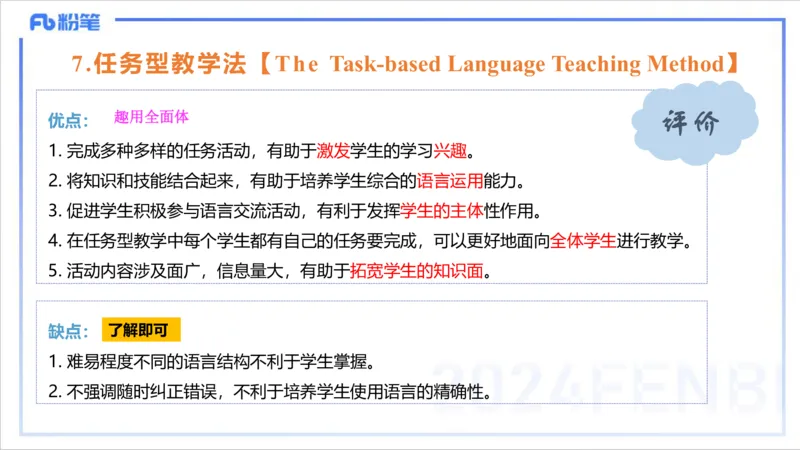
7 . 任 务 型 教 学 法 【 T h e Task-based Language Teaching Method
评价
趣用全面体
优点:
1. 完成多种多样的任务活动,有助于激发学生的学习兴趣。
2. 将知识和技能结合起来,有助于培养学生综合的语言运用能力。
3. 促进学生积极参与语言交流活动,有利于发挥学生的主体性作用。
4. 在任务型教学中每个学生都有自己的任务要完成,可以更好地面向全体学生进行教学。
5. 活动内容涉及面广,信息量大,有助于拓宽学生的知识面。
缺点: 了解即可
1. 难易程度不同的语言结构不利于学生掌握。
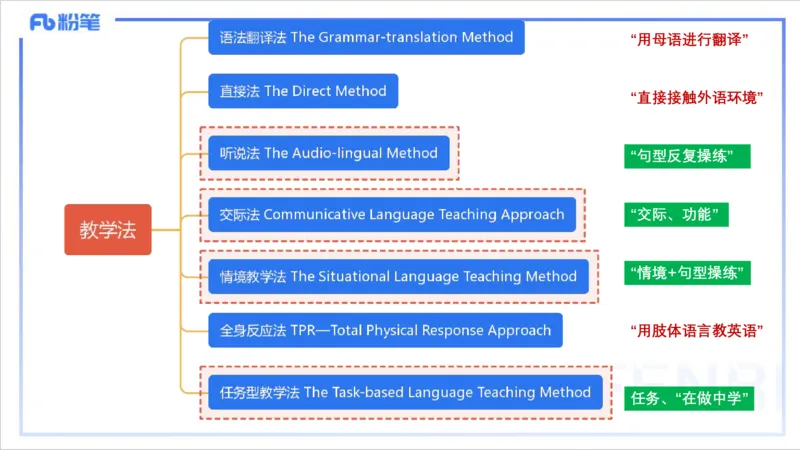
2. 不强调随时纠正错误,不利于培养学生使用语言的精确性。“用母语进行翻译”
“直接接触外语环境”
“句型反复操练”
“交际、功能”
“情境+句型操练”
“用肢体语言教英语”
任务、“在做中学”【2019下高中】Activities such as problem solving, decision making and opinion
exchanging aretypical practices in ______.
A. audio-lingual method B. grammar-translation method
C. situational language teaching method D. task-based language teaching method
【2018下高中】Which of the following is a communicative task?
A. Reading aloud the dialogue on page 24.
B. Writing a party invitation to your friends.
C. Translating the first paragraph into Chinese.
D. Making sentences with the expressions given.【单选、简答、情景分析】
第 二 章
语 言 知 识 教 学【单选、情景分析】
1 . 语 音 教 学
A B C
教学内容 教学原则 练习方法【单选】
1 . 语 音 教 学
教学内容:
• 语音层次:音标、读音规则(phoneme)
• 语流层次:句子重音stress、节奏rhythm、意群和停顿sense-group and
pausing、连读liaison、失去爆破loss of plosion和语调 intonation等。【情景分析】
1 . 语 音 教 学
教学原则:
1. 准确性原则:从发音方式,发音部位入手,保证准确发音。
2. 长期发展原则:语音教学不只是入门阶段的教学任务,而且是贯穿中小学各个阶段的教学任务
3. 综合性原则:将音素、音标、单词、句子及语义、语用等各个层面结合起来。
4. 针对性原则:使用适当的教学方法来解决学生的发音问题。
5. 趣味性原则:游戏、比赛、英语说唱、英语童谣、英语绕口令及 TPR 活动等。
6. 交际性原则: 在语音教学中应将语音置于特定的交际语境之中。
7. 真实性原则:融入有意义、有情景的语音练习中,让学生大量接触真实的、自然的语料和语境。
8. 多样性原则:使用多样化语言教学手段,提供不同形式的教学材料,让学生接触不同口音。【情景分析】
1 . 语 音 教 学
练习方法:
1. 认知练习(培养学生辨认和区分不同语音的能力)
• 使用最小对立对分析音差:will—well, ship—sheep
• 相同还是不同(师读单词,生辩异同):cat, hat
• 排列顺序:big, beg, bag
• 找出不同的发音:bit, bit, bit, pit(补充)
2. 产出练习(培养学生能发出清晰、可理解的语音的能力)
• 听并重复
• 填空:[ei]: Children love to games.
• 使用图片
• 绕口令:There is no need to light a night light on a light night like tonight.
3. 重音和语调练习
• 使用手势、使用声音、使用黑板:【巩固提升】
1. A teacher is teaching students to read a sentence, and using her arm to show which part
should be read strongly and when should stop. What is the teacher teaching in this activity?
A. Stress of words. B. Pronunciations of syllables.
C. Intonations and rhythms. D. Pronunciations of each letter.
2. English teacher Alice stopped Tom’s reading and asked him to follow her and repeat
the word “eat” again and again. What can we conclude from the description above?
A. The teacher concerns the principle of accuracy.
B. The teacher should stop student’s reading to correct their pronunciations.
C. Tom’s pronunciation is poor.
D. Every pronunciation is important in English.Teacher’s instruction:
【2017 年下·初中·教学情境分析题】 Look at the words on the blackboard. Tick the
word you hear in each sentence I read.
根据题目要求完成下列任务,用中文作答。
Teacher reads:
1. I don’t like these sports.
下面是一位初中英语教师在语音教学中使用的练习。
2. These pots are very dirty.
3. Look at that white cord on the water.
根据上面所提供的信息,从下面四个方面作答:
4. Mr. Smith was short.
(3)该教学片段体现了哪两个语音教学原则?(8 分)
Students tick the words they hear:
(4)列出能恰当体现语音教学原则的其他三种方法(9 分)
A B
1. spots sports
2. pots ports
3. cod cord
4. shot short【参考答案】
(3)该教学片段体现了语音教学的原则。
① 综合性原则。语音教学不是孤立的发音教学,教师应该将音素、音标、单词、句子及语义、
语用等各个层面结合起来,把语音教学融入有意义、有情景的语言练习中。
该教学片段中,教师把语音和单词、句子结合起来,体现了综合性教学原则。
② 针对性原则。针对性原则指语音训练的重点应该放在有标记的语音特征上。教师要针对学
生的困难进行有针对性的指导。这个练习主要训练 [ɔː] 和 [ɒ] 这一对长短音的区别,体现了针
对性的教学原则。【参考答案】
(4)能恰当体现语音教学原则的其他三种方法如下。
① 找出一组词中读音不相同的词。教师连续读几个词,有一个词的发音与其他词不同,请学
生挑出发音不同的那个。该练习适用于音素教学和练习,体现了语音教学的针对性原则,例如,
bit,bit,bit,pit(最后一个不同)。
② 绕口令。绕口令可以调节气氛,可以练习熟练程度,可以使学生在理解语句和语篇意义的
基础上及轻松愉快的气氛中感受英语语音的节奏美,体现了语音教学的趣味性。
③ 补充完整。教师读出一串单词,这些单词中只有一个单词的辅音或者元音不同,学生需要
通过老师的读音将单词补充完整,例如,hate,gate,fate,date。该练习适合音素的练习,体
现了语音教学的综合性原则。【单选、情景分析】
2 . 词 汇 教 学
A B C D
教学内容 教学原则 教学方法 教学模式【单选】
2 . 词 汇 教 学
教学内容:
• 词汇意义(Meaning):外延意义(Denotative meaning)和内涵意义(Connotative
meaning)
• 词汇信息(Basic information):词类、词法
• 用法 (Usage):词汇的搭配、短语、习语、语域
• 学习策略 (Strategies):调控策略、资源策略、认知策略、记忆策略和活动策略
语域:正式与非正式、褒义与贬义、抽象与具体之分【情景分析】
2 . 词 汇 教 学
教学原则:
• 词汇选择原则:能用在课堂活动中;高频出现
• 展示原则:直观化、情景化和趣味化
• 系统性原则:展示词汇之间的联系(形义,音形,语义及用法等)
• 运用原则: 创设语境,掌握词汇的用法和功能【情景分析】
2 . 词 汇 教 学
教学方法:
1. 词汇呈现方法
• 呈现意思:实物、动作、手势、定义、词根、词缀、上下文信息等
• 呈现结构和用法:例子、解释、同义词、反义词、问答、结构图等
• 呈现学习策略:分类(Classifying)、推理(Deducing)、类比(Analogy)、猜测
(Guessing)、记笔记(Note-taking)、查词典等
2. 词汇巩固方法
• 词汇搭配、填空、造句、编故事2 . 词 汇 教 学
教学模式:
了解即可
• PPT模式
Presentation(呈现)—Practice(练习)—Test(测试)
了解即可
• TBLT模式
Presentation(呈现)—Task(任务)—Showing(汇报)—Evaluation(评价)TBLT模式
【巩固提升】
Presentation-Task-Showing-Evaluation
1.Which part is NOT included in task-based teaching of vocabulary?
A. Presenting. B. Tasks. C. Showing work. D. Mechanical practice.
2. What skill does he/she use when a student uses language knowledge and contextual
clues to figure out the meaning of a new word? 【2020年下】
A. Contrasting. B. Summarizing. C. Deducing. D. Predicting【巩固提升】
3. A teacher asked students to repeat a word many times to memorize the pronunciation,
meanings and usages. Which of the following conclusions is NOT correct?
A. The teacher is teaching pronunciation.
B. The teacher focuses on accuracy.
C. The teacher is using mechanical practice.
D. The teacher is teaching vocabulary.【单选、简答、情景分析】
3 . 语 法 教 学
A B C D
教学内容 教学原则 教学方法 练习方法【单选】
3 . 语 法 教 学
教学内容:
• 语言形式 / 结构(Language form/ structure)
• 语义(Language meaning)
• 语用(Language use/function)—语境
p She has taught English for 5 years.3 . 语 法 教 学
教学原则:
• 系统性原则:根据教材的内容编排学习节奏
• 交际性原则:创设情境,在交际中使用语法
• 整体性原则:将方法、应用、内容和能力等整合在一起
(1)归纳法与演绎法相结合。
(2)隐性教学与显性教学相结合。
(3)听说读写与语法教学相结合。
• 多样性原则:在活动组织、话题选择、语法展示手段等方面多样化3 . 语 法 教 学
【单选、简答、情景分析】
教学方法:
• 演绎法(The deductive method)(教师:规则—例子)
优点:讲解清楚,易于理解 缺点:依赖性强、易遗忘、被动学习
• 归纳法(The inductive method)(学生:例子—规则)
优点:学生参与、理解语境和功能 缺点:师生要求高、难以巩固【单选】
3 . 语 法 教 学
练习方法:
1. 机械式练习(Mechanical practice):
• 替换操练(Substitution drills),转换操练(Transformation drills),填空
2. 意义性练习(Meaningful practice):看图片编对话、根据提示翻译句子等。
3. 交际性练习(Communicative practice):讲故事、情景对话、小组讨论、角色扮演等【巩固提升】
1. Teacher Taylor taught that attributive clause had two types, one is restrictive one, and the other is
non-restrictive one. What grammar content is the teacher teaching?
A. Language form. B. Language meaning.
C. Language use. D. Language function.
2. If a teacher wants to use “Communicative principle” to teach the grammar of past tense, what will
you suggest?
A. Ask students to repeat a model sentence many times.
B. Ask students to transcribe the text.
C. Ask students “What did you do yesterday?” and let them answer.
D. Show the calendar and ask students to say which dates are past.【2021年下】If a teacher asks the students in class “When do we use passive voice in our
daily life?”, he/she is trying to draw students’ attention to the ______ in grammar teaching.
A. meaning B. function C. form D. sound
【2020年下】What is the focus when a teacher says to the class “Rewrite each of the
following sentences using the passive voice.”?
A. Skill. B. Meaning. C. Structure. D. Function.【2018年下·高中·简答】
简述英语语法教学中归纳法(Inductive Method)的含义(4分),用英语写出两句体现该方法特点
的教师指令语(8分),并从两个方面简述教师在运用该方法时的注意事项(8分)。
教师指令语:【例】Let’s play a game together! Here is the rule. When I say the word in a
high voice, you should say it in a low voice..... Are you clear? Let’s begin!【参 考 答 案 】
(1)归纳法指的是教师让学生首先接触含有语法规则的语境,然后根据上下文的信息归纳出语
法规则。
(2)两句体现该方法特点的教师指令语:
① Now, let’s summarize the grammatical rules.
② Please work in groups to discuss the rules of this grammar according to the
given sentences.【参 考 答 案 】
(3)教师在运用该方法时的两个注意事项:
①要有一定数量的积累。首先,呈现具体的事例;其次,经过观察、分析、思考,对这些具体
的事例进行归纳总结。
②要体现教师的引导作用。在使用归纳法总结语法规则时,教师需要使用恰当的方式引导学生
探究新知,针对较难的知识点或语言基础较薄弱的学生,教师可通过启发提问的方式引起学生
思考。