Unit 2 Stay Healthy
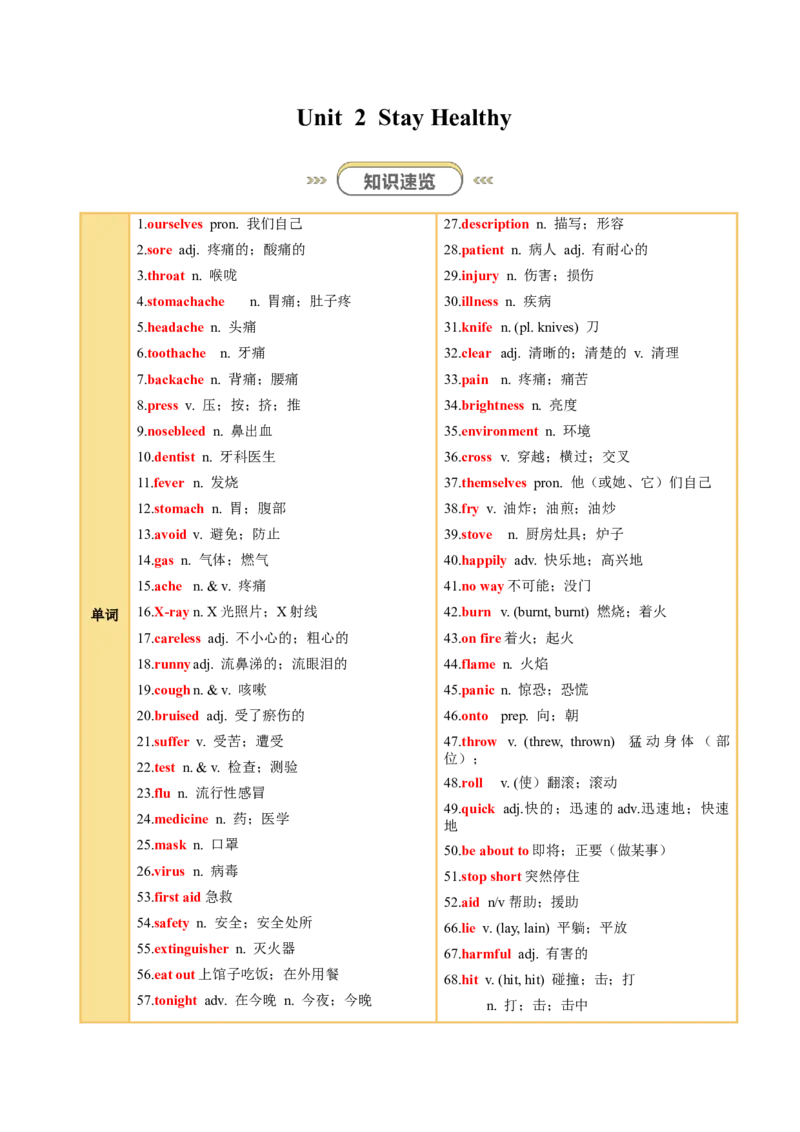
1.ourselves pron. 我们自己 27.description n. 描写;形容
2.sore adj. 疼痛的;酸痛的 28.patient n. 病人 adj. 有耐心的
3.throat n. 喉咙 29.injury n. 伤害;损伤
4.stomachache n. 胃痛;肚子疼 30.illness n. 疾病
5.headache n. 头痛 31.knife n. (pl. knives) 刀
6.toothache n. 牙痛 32.clear adj. 清晰的;清楚的 v. 清理
7.backache n. 背痛;腰痛 33.pain n. 疼痛;痛苦
8.press v. 压;按;挤;推 34.brightness n. 亮度
9.nosebleed n. 鼻出血 35.environment n. 环境
10.dentist n. 牙科医生 36.cross v. 穿越;横过;交叉
11.fever n. 发烧 37.themselves pron. 他(或她、它)们自己
12.stomach n. 胃;腹部 38.fry v. 油炸;油煎;油炒
13.avoid v. 避免;防止 39.stove n. 厨房灶具;炉子
14.gas n. 气体;燃气 40.happily adv. 快乐地;高兴地
15.ache n. & v. 疼痛 41.no way不可能;没门
单词 16.X-rayn. X光照片;X射线 42.burn v. (burnt, burnt) 燃烧;着火
17.careless adj. 不小心的;粗心的 43.on fire着火;起火
18.runnyadj. 流鼻涕的;流眼泪的 44.flame n. 火焰
19.coughn. & v. 咳嗽 45.panic n. 惊恐;恐慌
20.bruised adj. 受了瘀伤的 46.onto prep. 向;朝
21.suffer v. 受苦;遭受 47.throw v. (threw, thrown) 猛动身体(部
位);
22.test n. & v. 检查;测验
48.roll v. (使)翻滚;滚动
23.flu n. 流行性感冒
49.quick adj.快的;迅速的adv.迅速地;快速
24.medicine n. 药;医学
地
25.mask n. 口罩
50.be about to即将;正要(做某事)
26.virus n. 病毒
51.stop short突然停住
53.first aid急救
52.aid n/v帮助;援助
54.safety n. 安全;安全处所
66.lie v. (lay, lain) 平躺;平放
55.extinguisher n. 灭火器
67.harmful adj. 有害的
56.eat out上馆子吃饭;在外用餐
68.hit v. (hit, hit) 碰撞;击;打
57.tonight adv. 在今晚 n. 今夜;今晚
n. 打;击;击中58.sadly adv. 伤心地;令人遗憾 69.shock n. 震惊;令人震惊的事 v. 使震惊
59.smoke n. 烟 v. 吸烟;冒烟 70.bleed v. (bled, bled) 流血;出血
60.unfortunately adv. 不幸地;可惜地 71.check v. 检查;查明 n. 检查;调查
61.luckily adv. 幸运地 72.tight adj. 疼痛的;憋气的;紧的;牢固的
62.badly adv. (worse, worst) 严重地 73.peanut n. 花生
63.harm n. & v. 伤害;损害 74.nervously adv. 紧张不安地
64.pill n. 药丸;药片 75.allergic adj. 过敏的
65.painful adj. (身体部位)疼痛的;令人痛苦 76.from now on从现在起
的
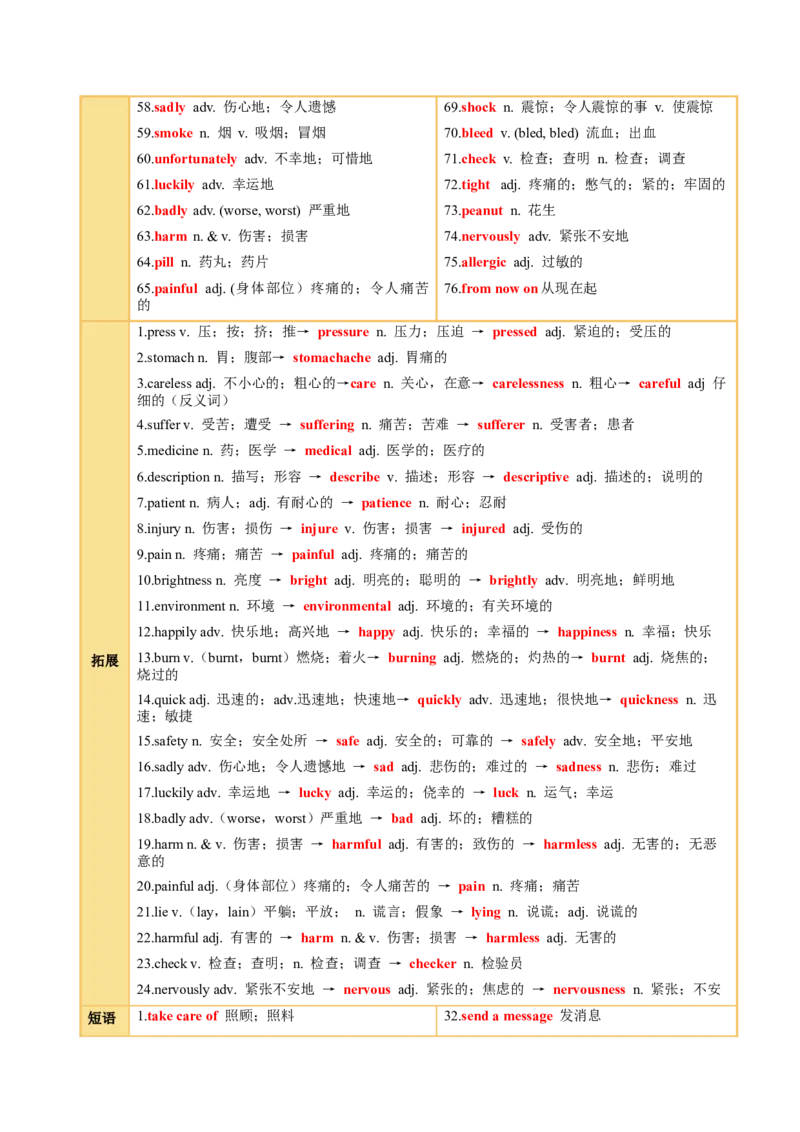
1.press v. 压;按;挤;推→ pressure n. 压力;压迫 → pressed adj. 紧迫的;受压的
2.stomach n. 胃;腹部→ stomachache adj. 胃痛的
3.careless adj. 不小心的;粗心的→care n. 关心,在意→ carelessness n. 粗心→ careful adj 仔
细的(反义词)
4.suffer v. 受苦;遭受 → suffering n. 痛苦;苦难 → sufferer n. 受害者;患者
5.medicine n. 药;医学 → medical adj. 医学的;医疗的
6.description n. 描写;形容 → describe v. 描述;形容 → descriptive adj. 描述的;说明的
7.patient n. 病人;adj. 有耐心的 → patience n. 耐心;忍耐
8.injury n. 伤害;损伤 → injure v. 伤害;损害 → injured adj. 受伤的
9.pain n. 疼痛;痛苦 → painful adj. 疼痛的;痛苦的
10.brightness n. 亮度 → bright adj. 明亮的;聪明的 → brightly adv. 明亮地;鲜明地
11.environment n. 环境 → environmental adj. 环境的;有关环境的
12.happily adv. 快乐地;高兴地 → happy adj. 快乐的;幸福的 → happiness n. 幸福;快乐
拓展 13.burn v.(burnt,burnt)燃烧;着火→ burning adj. 燃烧的;灼热的→ burnt adj. 烧焦的;
烧过的
14.quick adj. 迅速的;adv.迅速地;快速地→ quickly adv. 迅速地;很快地→ quickness n. 迅
速;敏捷
15.safety n. 安全;安全处所 → safe adj. 安全的;可靠的 → safely adv. 安全地;平安地
16.sadly adv. 伤心地;令人遗憾地 → sad adj. 悲伤的;难过的 → sadness n. 悲伤;难过
17.luckily adv. 幸运地 → lucky adj. 幸运的;侥幸的 → luck n. 运气;幸运
18.badly adv.(worse,worst)严重地 → bad adj. 坏的;糟糕的
19.harm n. & v. 伤害;损害 → harmful adj. 有害的;致伤的 → harmless adj. 无害的;无恶
意的
20.painful adj.(身体部位)疼痛的;令人痛苦的 → pain n. 疼痛;痛苦
21.lie v.(lay,lain)平躺;平放; n. 谎言;假象 → lying n. 说谎;adj. 说谎的
22.harmful adj. 有害的 → harm n. & v. 伤害;损害 → harmless adj. 无害的
23.check v. 检查;查明;n. 检查;调查 → checker n. 检验员
24.nervously adv. 紧张不安地 → nervous adj. 紧张的;焦虑的 → nervousness n. 紧张;不安
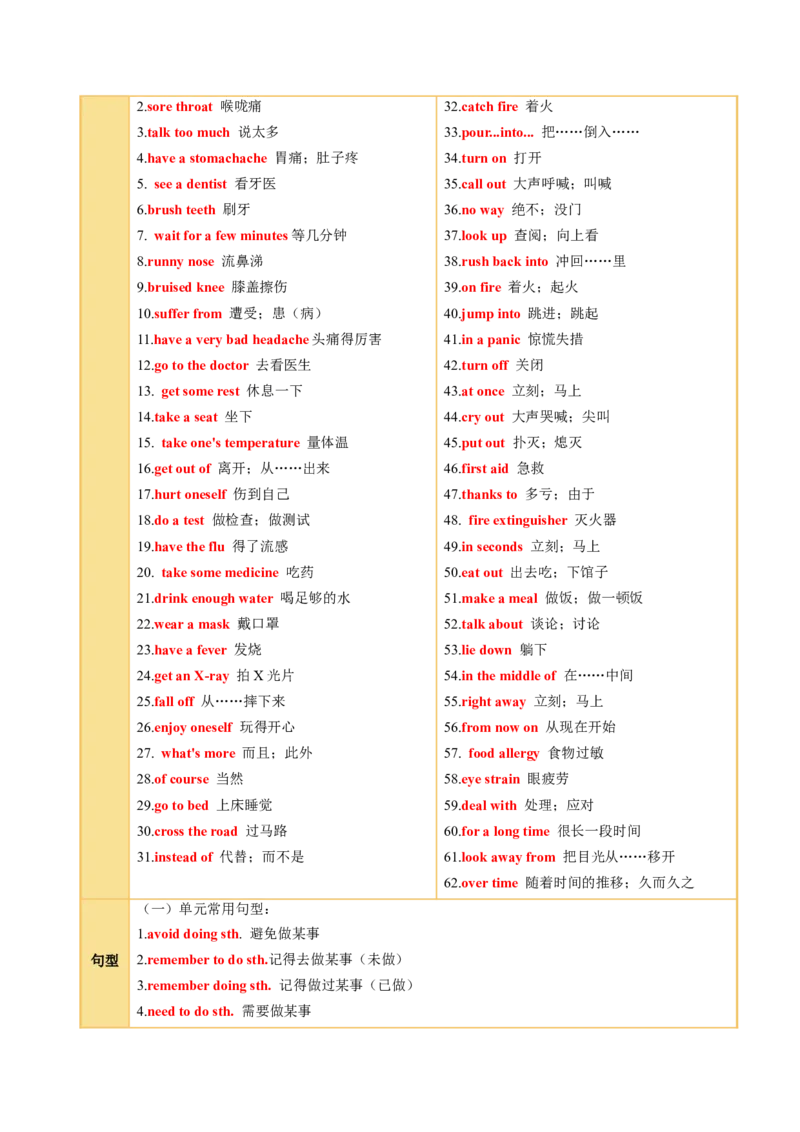
短语 1.take care of 照顾;照料 32.send a message 发消息2.sore throat 喉咙痛 32.catch fire 着火
3.talk too much 说太多 33.pour...into... 把……倒入……
4.have a stomachache 胃痛;肚子疼 34.turn on 打开
5. see a dentist 看牙医 35.call out 大声呼喊;叫喊
6.brush teeth 刷牙 36.no way 绝不;没门
7. wait for a few minutes等几分钟 37.look up 查阅;向上看
8.runny nose 流鼻涕 38.rush back into 冲回……里
9.bruised knee 膝盖擦伤 39.on fire 着火;起火
10.suffer from 遭受;患(病) 40.jump into 跳进;跳起
11.have a very bad headache头痛得厉害 41.in a panic 惊慌失措
12.go to the doctor 去看医生 42.turn off 关闭
13. get some rest 休息一下 43.at once 立刻;马上
14.take a seat 坐下 44.cry out 大声哭喊;尖叫
15. take one's temperature 量体温 45.put out 扑灭;熄灭
16.get out of 离开;从……出来 46.first aid 急救
17.hurt oneself 伤到自己 47.thanks to 多亏;由于
18.do a test 做检查;做测试 48. fire extinguisher 灭火器
19.have the flu 得了流感 49.in seconds 立刻;马上
20. take some medicine 吃药 50.eat out 出去吃;下馆子
21.drink enough water 喝足够的水 51.make a meal 做饭;做一顿饭
22.wear a mask 戴口罩 52.talk about 谈论;讨论
23.have a fever 发烧 53.lie down 躺下
24.get an X-ray 拍X光片 54.in the middle of 在……中间
25.fall off 从……摔下来 55.right away 立刻;马上
26.enjoy oneself 玩得开心 56.from now on 从现在开始
27. what's more 而且;此外 57. food allergy 食物过敏
28.of course 当然 58.eye strain 眼疲劳
29.go to bed 上床睡觉 59.deal with 处理;应对
30.cross the road 过马路 60.for a long time 很长一段时间
31.instead of 代替;而不是 61.look away from 把目光从……移开
62.over time 随着时间的推移;久而久之
(一)单元常用句型:
1.avoid doing sth. 避免做某事
句型 2.remember to do sth.记得去做某事(未做)
3.remember doing sth. 记得做过某事(已做)
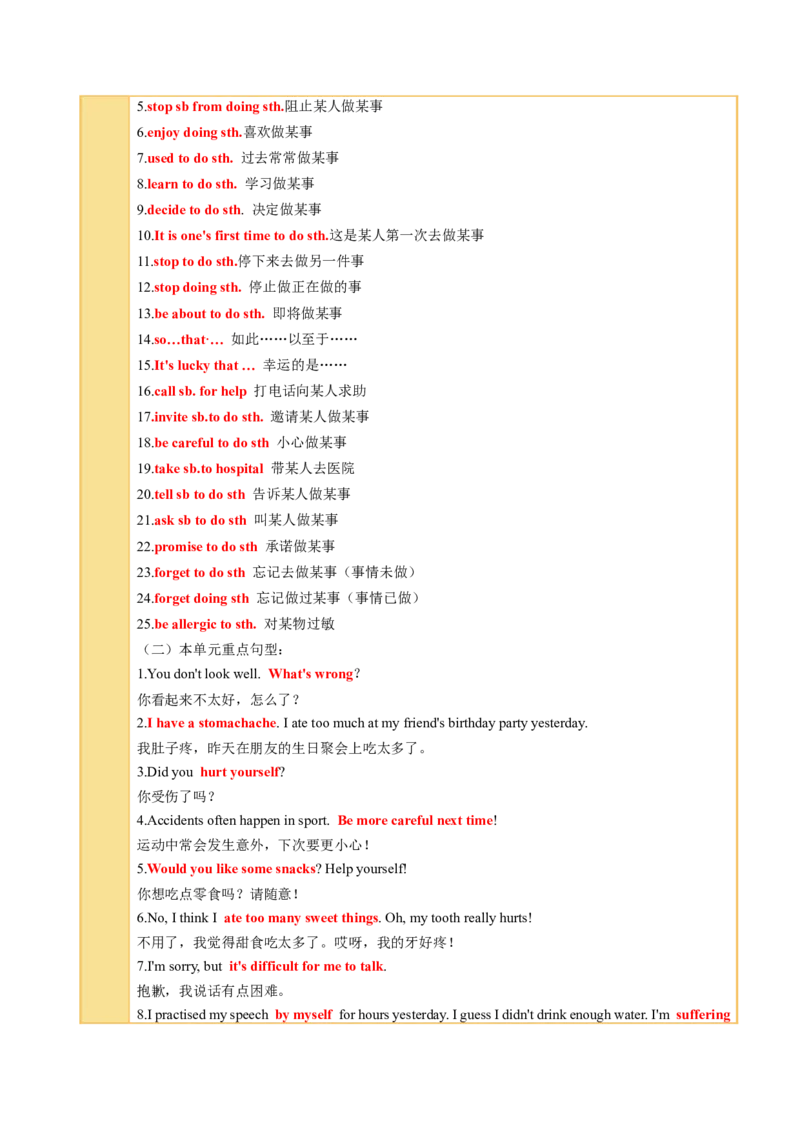
4.need to do sth. 需要做某事5.stop sb from doing sth.阻止某人做某事
6.enjoy doing sth.喜欢做某事
7.used to do sth. 过去常常做某事
8.learn to do sth. 学习做某事
9.decide to do sth. 决定做某事
10.It is one's first time to do sth.这是某人第一次去做某事
11.stop to do sth.停下来去做另一件事
12.stop doing sth. 停止做正在做的事
13.be about to do sth. 即将做某事
14.so…that·… 如此……以至于……
15.It's lucky that … 幸运的是……
16.call sb. for help 打电话向某人求助
17.invite sb.to do sth. 邀请某人做某事
18.be careful to do sth 小心做某事
19.take sb.to hospital 带某人去医院
20.tell sb to do sth 告诉某人做某事
21.ask sb to do sth 叫某人做某事
22.promise to do sth 承诺做某事
23.forget to do sth 忘记去做某事(事情未做)
24.forget doing sth 忘记做过某事(事情已做)
25.be allergic to sth. 对某物过敏
(二)本单元重点句型:
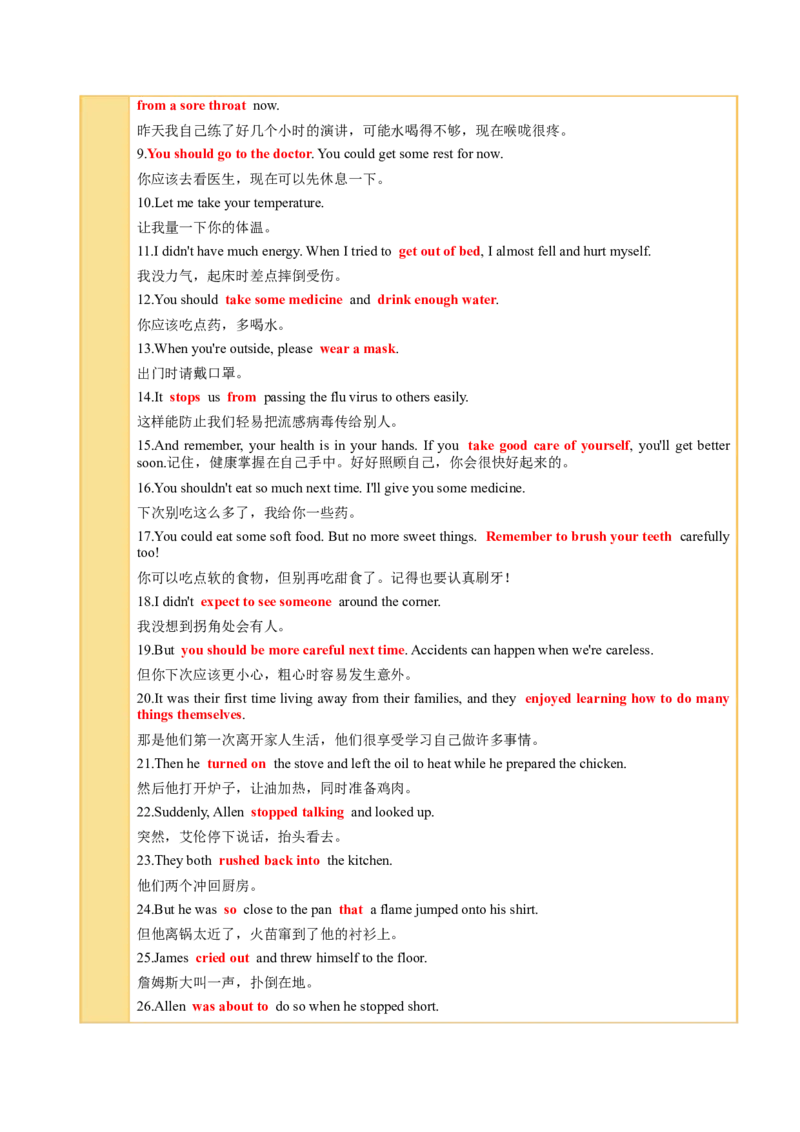
1.You don't look well. What's wrong?
你看起来不太好,怎么了?
2.I have a stomachache. I ate too much at my friend's birthday party yesterday.
我肚子疼,昨天在朋友的生日聚会上吃太多了。
3.Did you hurt yourself?
你受伤了吗?
4.Accidents often happen in sport. Be more careful next time!
运动中常会发生意外,下次要更小心!
5.Would you like some snacks? Help yourself!
你想吃点零食吗?请随意!
6.No, I think I ate too many sweet things. Oh, my tooth really hurts!
不用了,我觉得甜食吃太多了。哎呀,我的牙好疼!
7.I'm sorry, but it's difficult for me to talk.
抱歉,我说话有点困难。
8.I practised my speech by myself for hours yesterday. I guess I didn't drink enough water. I'm sufferingfrom a sore throat now.
昨天我自己练了好几个小时的演讲,可能水喝得不够,现在喉咙很疼。
9.You should go to the doctor. You could get some rest for now.
你应该去看医生,现在可以先休息一下。
10.Let me take your temperature.
让我量一下你的体温。
11.I didn't have much energy. When I tried to get out of bed, I almost fell and hurt myself.
我没力气,起床时差点摔倒受伤。
12.You should take some medicine and drink enough water.
你应该吃点药,多喝水。
13.When you're outside, please wear a mask.
出门时请戴口罩。
14.It stops us from passing the flu virus to others easily.
这样能防止我们轻易把流感病毒传给别人。
15.And remember, your health is in your hands. If you take good care of yourself, you'll get better
soon.记住,健康掌握在自己手中。好好照顾自己,你会很快好起来的。
16.You shouldn't eat so much next time. I'll give you some medicine.
下次别吃这么多了,我给你一些药。
17.You could eat some soft food. But no more sweet things. Remember to brush your teeth carefully
too!
你可以吃点软的食物,但别再吃甜食了。记得也要认真刷牙!
18.I didn't expect to see someone around the corner.
我没想到拐角处会有人。
19.But you should be more careful next time. Accidents can happen when we're careless.
但你下次应该更小心,粗心时容易发生意外。
20.It was their first time living away from their families, and they enjoyed learning how to do many
things themselves.
那是他们第一次离开家人生活,他们很享受学习自己做许多事情。
21.Then he turned on the stove and left the oil to heat while he prepared the chicken.
然后他打开炉子,让油加热,同时准备鸡肉。
22.Suddenly, Allen stopped talking and looked up.
突然,艾伦停下说话,抬头看去。
23.They both rushed back into the kitchen.
他们两个冲回厨房。
24.But he was so close to the pan that a flame jumped onto his shirt.
但他离锅太近了,火苗窜到了他的衬衫上。
25.James cried out and threw himself to the floor.
詹姆斯大叫一声,扑倒在地。
26.Allen was about to do so when he stopped short.艾伦正要这么做,却突然停住了。
27.One Saturday, Julie invited Mark and Lucy to her house for lunch.
一个星期六,朱莉邀请马克和露西来她家吃午饭。
28.When Mark felt better, the doctor asked him some questions and gave him some advice.
马克感觉好些后,医生问了他一些问题并给了些建议。
语法 情态动词should/could 反身代词
写作 保持健康
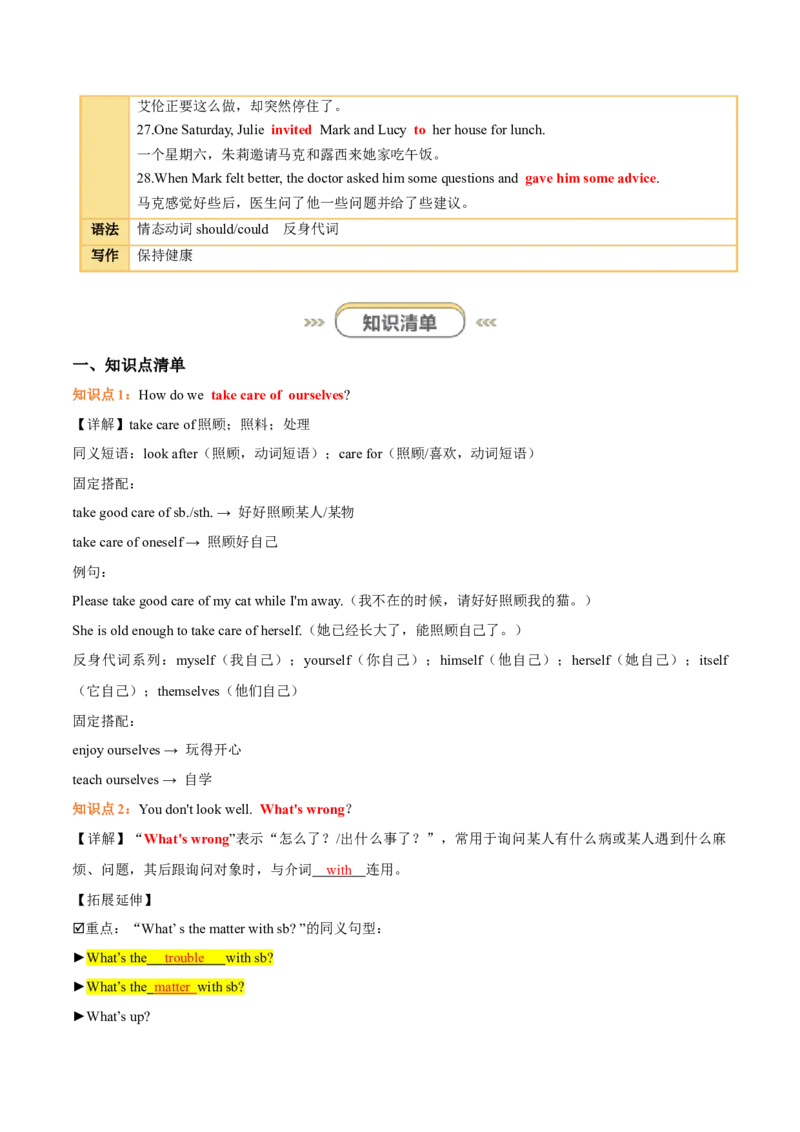
一、知识点清单
知识点1:How do we take care of ourselves?
【详解】take care of照顾;照料;处理
同义短语:look after(照顾,动词短语);care for(照顾/喜欢,动词短语)
固定搭配:
take good care of sb./sth. → 好好照顾某人/某物
take care of oneself → 照顾好自己
例句:
Please take good care of my cat while I'm away.(我不在的时候,请好好照顾我的猫。)
She is old enough to take care of herself.(她已经长大了,能照顾自己了。)
反身代词系列:myself(我自己);yourself(你自己);himself(他自己);herself(她自己);itself
(它自己);themselves(他们自己)
固定搭配:
enjoy ourselves → 玩得开心
teach ourselves → 自学
知识点2:You don't look well. What's wrong?
【详解】“What's wrong”表示“怎么了?/出什么事了?”,常用于询问某人有什么病或某人遇到什么麻
烦、问题,其后跟询问对象时,与介词 with 连用。
【拓展延伸】
重点:“What’ s the matter with sb? ”的同义句型:
►What’s the trouble with sb?
►What’s the matter with sb?
►What’s up?►What happens to sb.?
【注意】matter 和trouble 为名词, 其前可加the 或形容词性物主代词,wrong 是形容词,不能加the。
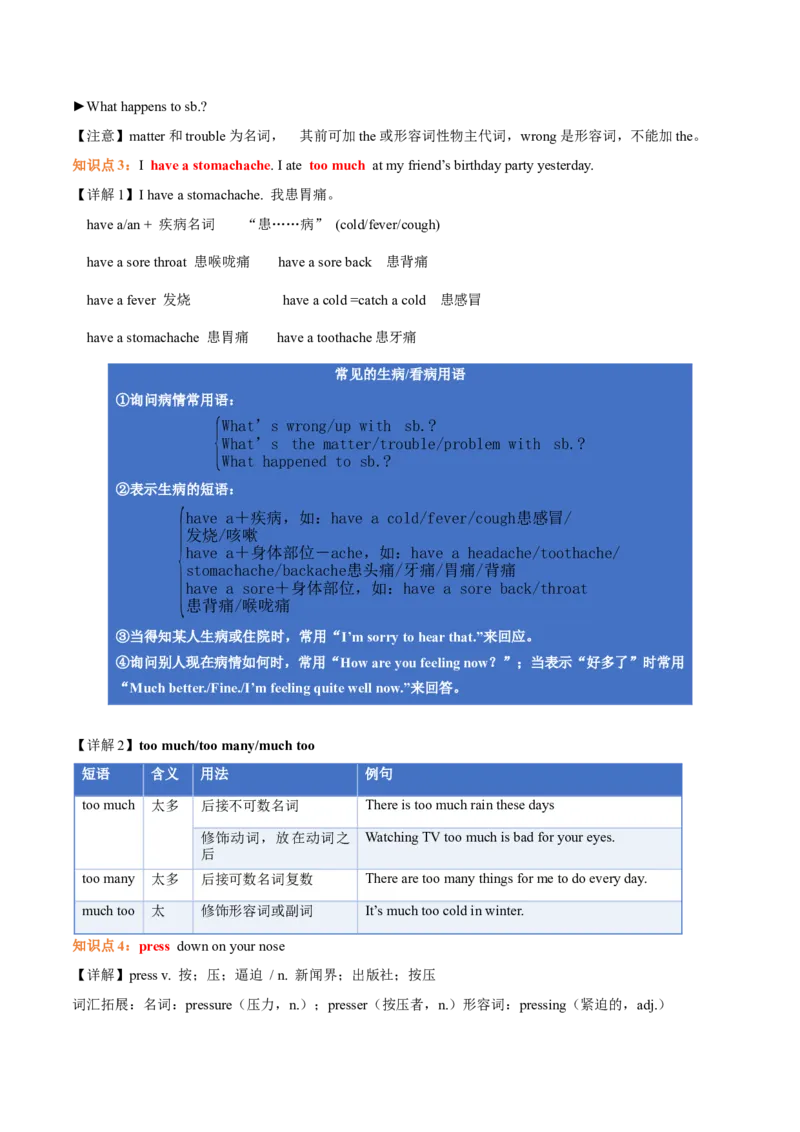
知识点3:I have a stomachache. I ate too much at my friend’s birthday party yesterday.
【详解1】I have a stomachache. 我患胃痛。
have a/an + 疾病名词 “患……病” (cold/fever/cough)
have a sore throat 患喉咙痛 have a sore back 患背痛
have a fever 发烧 have a cold =catch a cold 患感冒
have a stomachache 患胃痛 have a toothache患牙痛
常见的生病/看病用语
①询问病情常用语:
What’s wrong/up with sb.?
{
What’s the matter/trouble/problem with sb.?
What happened to sb.?
②表示生病的短语:
have a+疾病,如:have a cold/fever/cough患感冒/
{
发烧/咳嗽
have a+身体部位-ache,如:have a headache/toothache/
stomachache/backache患头痛/牙痛/胃痛/背痛
have a sore+身体部位,如:have a sore back/throat
患背痛/喉咙痛
③当得知某人生病或住院时,常用“I’m sorry to hear that.”来回应。
④询问别人现在病情如何时,常用“How are you feeling now?”;当表示“好多了”时常用
“Much better./Fine./I’m feeling quite well now.”来回答。
【详解2】too much/too many/much too
短语 含义 用法 例句
too much 太多 后接不可数名词 There is too much rain these days
修饰动词,放在动词之 Watching TV too much is bad for your eyes.
后
too many 太多 后接可数名词复数 There are too many things for me to do every day.
much too 太 修饰形容词或副词 It’s much too cold in winter.
知识点4:press down on your nose
【详解】press v. 按;压;逼迫 / n. 新闻界;出版社;按压
词汇拓展:名词:pressure(压力,n.);presser(按压者,n.)形容词:pressing(紧迫的,adj.)固定搭配+翻译:
press the button → 按按钮
press sb. to do sth. → 催促某人做某事
be pressed for time → 时间紧迫
例句:
Please press the red button to start the machine.(请按红色按钮启动机器。)
He is pressed for time, so he can't go with us.(他时间紧迫,所以不能和我们一起去。)
知识点5:Accidents often happen in sport. Be more careful next time!
【详解】
辨析happen与take place
词(组) 用法
意为“发生;碰巧”,一般用于偶然或者突发的事件
happen sth. happen(s) to sb.某人发生某事
sb. happen(s) to do sth.某人碰巧做某事
take place 意为“发生;出现;举行”,一般指有计划的安排
【注意】
①二者均有“发生”之意,都是不及物动词(词组),不能用于被动语态。
②二者表示的都是“瞬间”的意思,不能与表示时间段的状语连用。
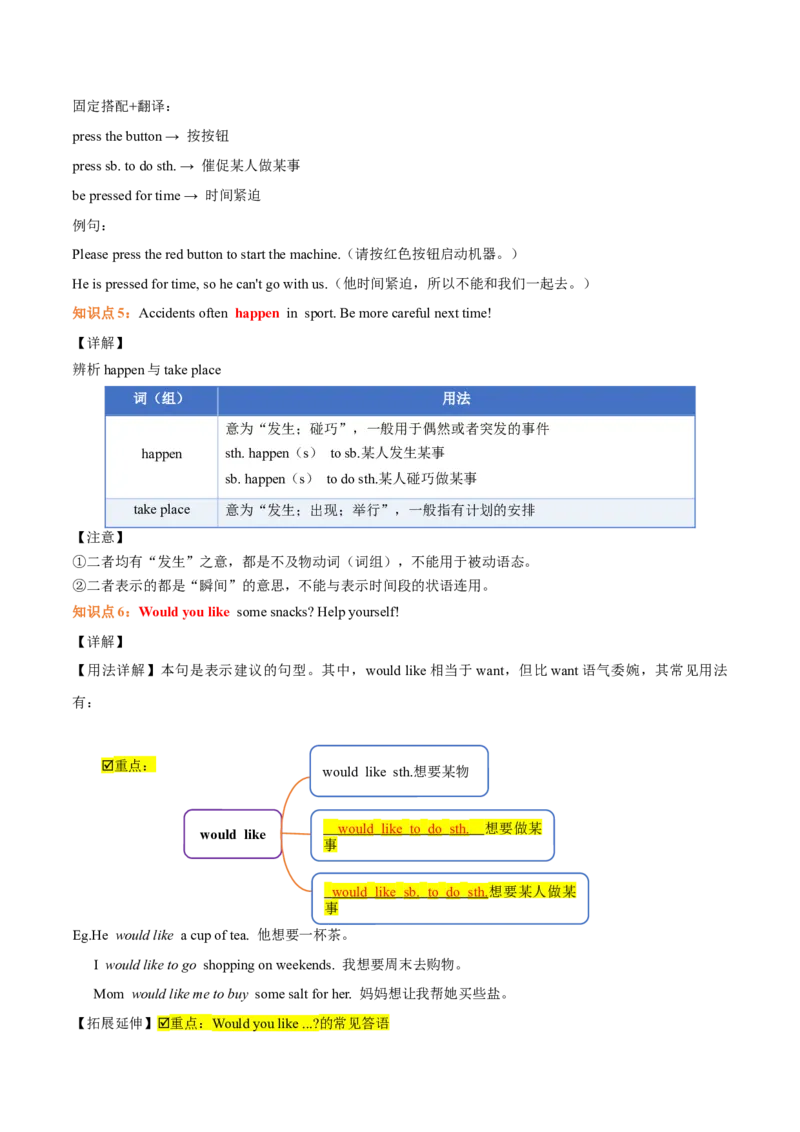
知识点6:Would you like some snacks? Help yourself!
【详解】
【用法详解】本句是表示建议的句型。其中,would like相当于want,但比want语气委婉,其常见用法
有:
重点:
would like sth.想要某物
would lik e to do sth . 想要做某
would like
事
would lik e sb . to do sth .想要某人做某
事
Eg.He would like a cup of tea. 他想要一杯茶。
I would like to go shopping on weekends. 我想要周末去购物。
Mom would like me to buy some salt for her. 妈妈想让我帮她买些盐。
【拓展延伸】重点:Would you like ...?的常见答语句式 肯定回答 否定回答
Would you like sth.? Yes, please. No, thanks.
Would you like to do sth.? Sure/Certainly, I’d love to. Sorry, I can’t./I’m afraid not. I have to...
知识点7:I'm sorry, but it's difficult for me to talk.
【用法详解】It’s + adj. (+for sb.) + to do sth. 表示“(对某人来说)做某事是……的”。其中it是形式主语,
动词不定式是真正的主语。句中的形容词为描述事物特征的形容词,如difficult, easy, hard等。
Eg.It’s easy for me to ride a bike. 对我来说骑自行车很容易。
【注意】若句中的形容词为描述人物品质及性格特征的词,如clever, kind, nice等,句中的介词要用of。
Eg.It’s very kind of you to help me. 你能帮我真是太好了。
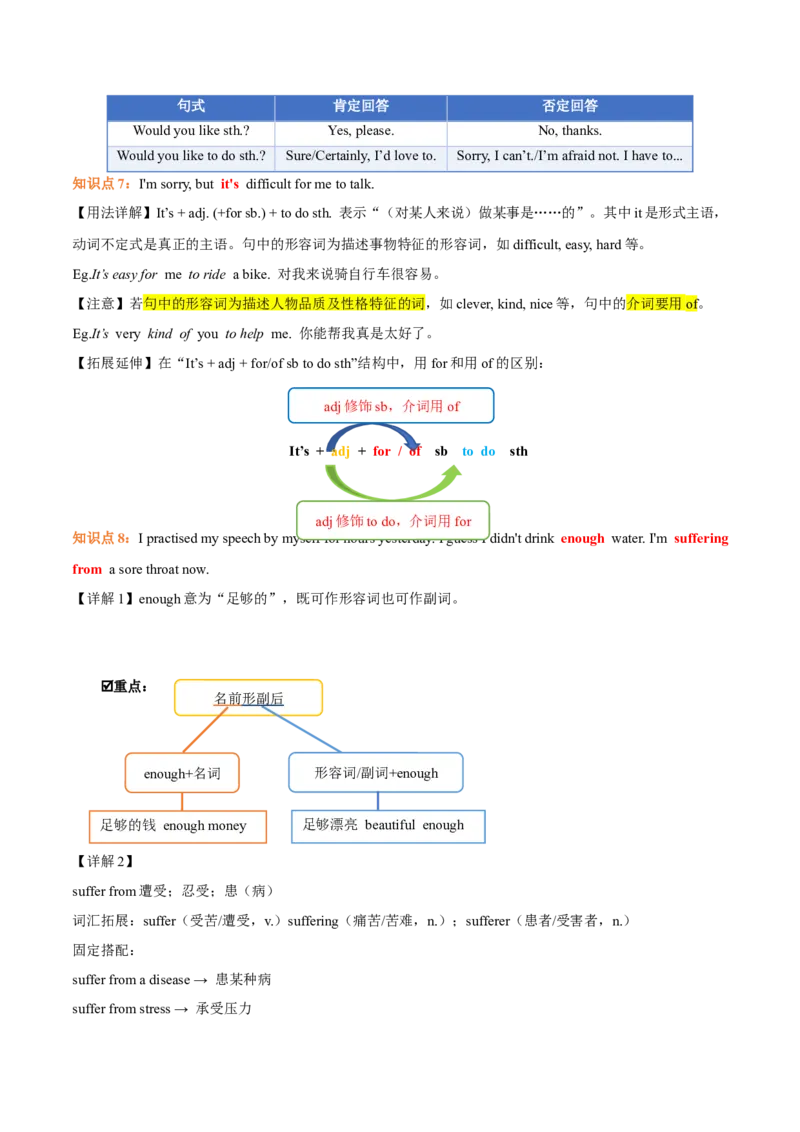
【拓展延伸】在“It’s + adj + for/of sb to do sth”结构中,用for和用of的区别:
adj修饰sb,介词用of
It’s + adj + for / of sb to do sth
adj修饰to do,介词用for
知识点8:I practised my speech by myself for hours yesterday. I guess I didn't drink enough water. I'm suffering
from a sore throat now.
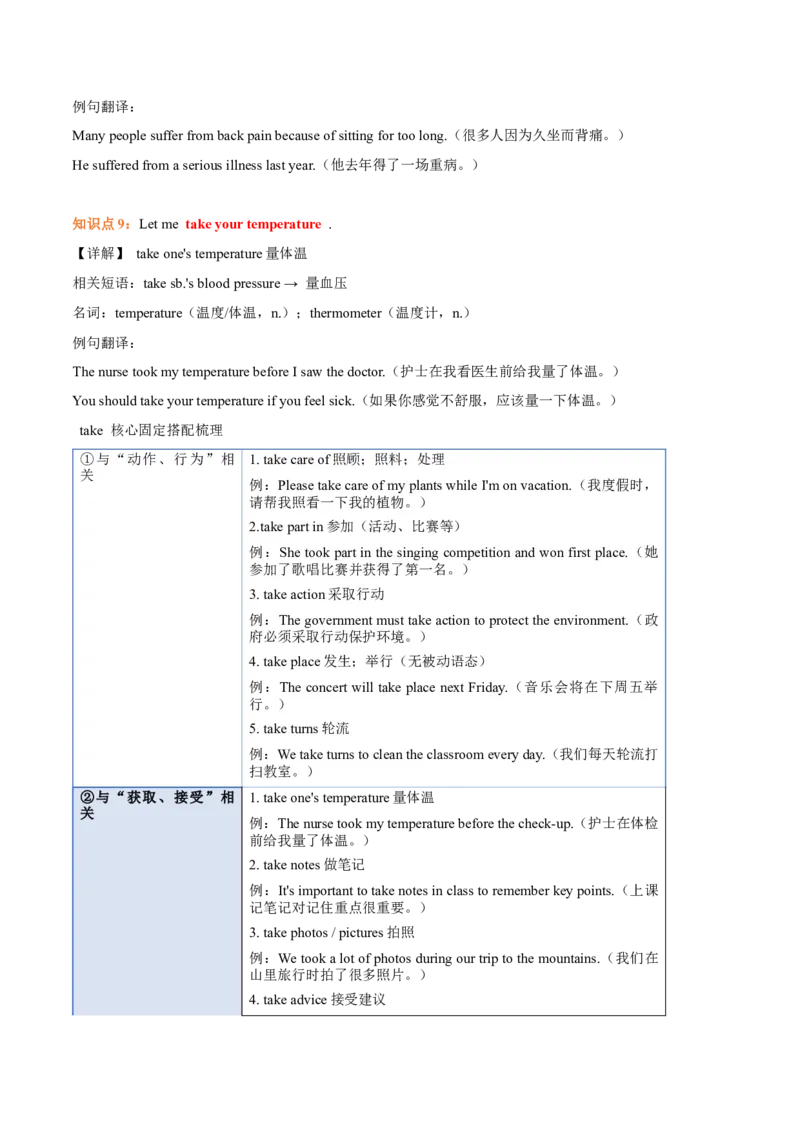
【详解1】enough意为“足够的”,既可作形容词也可作副词。
重点:
名前 形副后
enough+名词 形容词/副词+enough
足够的钱 enough money 足够漂亮 beautiful enough
【详解2】
suffer from遭受;忍受;患(病)
词汇拓展:suffer(受苦/遭受,v.)suffering(痛苦/苦难,n.);sufferer(患者/受害者,n.)
固定搭配:
suffer from a disease → 患某种病
suffer from stress → 承受压力例句翻译:
Many people suffer from back pain because of sitting for too long.(很多人因为久坐而背痛。)
He suffered from a serious illness last year.(他去年得了一场重病。)
知识点9:Let me take your temperature .
【详解】 take one's temperature量体温
相关短语:take sb.'s blood pressure → 量血压
名词:temperature(温度/体温,n.);thermometer(温度计,n.)
例句翻译:
The nurse took my temperature before I saw the doctor.(护士在我看医生前给我量了体温。)
You should take your temperature if you feel sick.(如果你感觉不舒服,应该量一下体温。)
take 核心固定搭配梳理
①与“动作、行为”相 1. take care of照顾;照料;处理
关
例:Please take care of my plants while I'm on vacation.(我度假时,
请帮我照看一下我的植物。)
2.take part in参加(活动、比赛等)
例:She took part in the singing competition and won first place.(她
参加了歌唱比赛并获得了第一名。)
3. take action采取行动
例:The government must take action to protect the environment.(政
府必须采取行动保护环境。)
4. take place发生;举行(无被动语态)
例:The concert will take place next Friday.(音乐会将在下周五举
行。)
5. take turns轮流
例:We take turns to clean the classroom every day.(我们每天轮流打
扫教室。)
②与“获取、接受”相 1. take one's temperature量体温
关
例:The nurse took my temperature before the check-up.(护士在体检
前给我量了体温。)
2. take notes做笔记
例:It's important to take notes in class to remember key points.(上课
记笔记对记住重点很重要。)
3. take photos / pictures拍照
例:We took a lot of photos during our trip to the mountains.(我们在
山里旅行时拍了很多照片。)
4. take advice接受建议例:You should take your parents' advice and think carefully.(你应该
接受父母的建议,仔细考虑。)
③与“时间、花费”相 1. take time花费时间
关
例:Learning a new language takes time and patience.(学习一门新语
言需要时间和耐心。)
2. take sb. some time to do sth.花费某人时间做某事
例:It took me two hours to finish my homework.(我花了两个小时完
成作业。)
④与“方向、移动”相 1. take off(飞机)起飞;脱掉(衣物)
关
例:The plane will take off in 10 minutes.(飞机将在 10分钟后起
飞。)
例:Please take off your shoes before entering the house.(进屋前请脱
鞋。)
2. take up占据(时间/空间);开始从事(爱好/工作)
例:This desk takes up too much space in my room.(这张书桌在我
房间里占了太多空间。)
例:He took up painting after he retired.(他退休后开始画画。)
3. take away带走;拿走;外卖
例:Please take away your trash when you leave.(离开时请把你的垃
圾带走。)
例:I'd like to order a takeaway pizza for dinner.(我想点一份披萨外
卖当晚餐。)
⑤其他常用搭配 1. take it easy别紧张;放松点
例:Take it easy! You'll do well in the exam.(别紧张!你会考好
的。)
2. take out取出;带出(吃饭)
例:She took out her wallet to pay for the coffee.(她拿出钱包付咖啡
钱。)
例:Let's take my mom out for dinner on her birthday.(妈妈生日那
天,我们带她出去吃饭吧。)
3. take down记下;拆除
例:Please take down my phone number so you can call me later.(请
记下我的电话号码,方便你稍后联系我。)
知识点10:I didn't have much energy. When I tried to get out of bed, I almost fell and hurt myself.
【详解】
get out of摆脱;逃避;从……出来
反义短语:get into(陷入/进入,动词短语)
固定搭配:
get out of bed → 起床get out of trouble → 摆脱麻烦
get out of a bad habit → 改掉坏习惯
例句:
It's hard for him to get out of bed early in winter.(冬天他很难早起。)
He tried to get out of doing the housework.(他试图逃避做家务。)
【归纳拓展】 常见get构成的短语:
知识点11:It stops us from passing the flu virus to others easily.
【详解】stop……from 用法详解:阻止/制止某人/某物做某事,from后接动名词
1. stop sb./sth. from doing sth.(最常用,完整结构)
例:We must stop factories from polluting rivers.(我们必须阻止工厂污染河流)
2. stop sb./sth. doing sth.(省略from,英美通用)
例:She stopped the boy running on the road.(她制止男孩在马路上跑)
3. stop from doing sth.(省略sb./sth.,主语是动作承受者)
例:The spread of the disease was stopped from spreading.(疾病传播被遏制了)
易混辨析:
1. stop...from doing = prevent...from doing(通用,prevent更正式)
例:Rain prevented us from going out.(下雨让我们没能出去)
2. stop...from doing = keep...from doing(keep的from不可省,语气更强)
例:Keep children from touching the hot stove.(别让孩子碰滚烫的炉子)
知识点12:You certainly shouldn’t look at it when you cross the road.
【详解】
_across__ adv./prep.过;穿过
cross v.穿过
_crossing_ n.十字路口
固定搭配:
cross the street → 过马路
be cross with sb. → 生某人的气cross out → 划掉
知识点13:I didn't expect to see someone around the corner.
【详解】 expect v. 期待;期望;预料
词汇拓展:expectation(期望/期待,n.);expectancy(预期/期待,n.)
expected(预期的,adj.);unexpected(意外的,adj.)
固定搭配:
expect sb. to do sth.期望某人做某事
expect sth. from sb.从某人那里期待某事
as expected 正如预期
例句:
Parents expect their children to study hard.(父母期望他们的孩子努力学习。)
As expected, he passed the exam easily.(正如预期,他轻松通过了考试。)
【句型剖析】
辨析expect, hope, wish与look forward to
词(组) 常见搭配
①expect (sb.) to do sth. 期望(某人)做某事
expect
②expect+that从句 期望……
①hope to do sth. 希望做某事
hope
②hope+that从句 希望……
①wish (sb.) to do sth. 希望(某人)做某事
wish ②wish+从句(通常用虚拟语气) 希望……(一般表示难以实现的愿望)
③wish sb. sth. 祝愿某人……
look forward to look forward to (doing) sth. 期待(做)某事
知识点14:Then he turned on the stove and left the oil to heat while he prepared the chicken.
【拓展延伸】turn构成的常用短语:
tur n u p 调高 turn down 调低;拒
绝
tur n o n 打开 turn tur n of f 关闭
turn back 折回;往回
turn away 扭头;转
走
身
知识点15:.But he was so close to the pan that a flame jumped onto his shirt.
【详解】"so ... that..."意为"如此……以至于……",that引导结果状语从句。此句型中,so是副词,常
用来修饰形容词或副词。常用句型结构为:主语+谓语+so+adj./adv.+ that从句。☞ The math problem is so difficult that I can’t work it out. 这道数学题是如此难以至于我解不出来。
☞ The boy is so young that he can’t go to school. 这个男孩太小还不能去上学。
【拓展】
such...that...引导结果状语从句,表示“如此……以致于……”,such后面接名词短语,名词前经常跟有形
容词进行修饰。
知识点16:James cried out and threw himself to the floor.
【详解】throw v. 扔;投掷;抛
词汇拓展:过去式/过去分词:threw / thrown
thrower(投掷者,n.);throwaway(一次性的,adj.)
固定搭配:
throw away扔掉;丢弃
throw sth. at sb.向某人扔某物
throw oneself into 投身于
例句:
Don't throw away the plastic bottles; we can recycle them.(不要扔掉塑料瓶,我们可以回收利用。)
He threw a ball to his dog in the park.(他在公园里把球扔给他的狗。)
知识点17:Allen was about to do so when he stopped short.
【详解】
【句型剖析】be about to do sth. 表示"打算做某事"。
I am about to go shopping this weekend. 我这个周末打算去购物。
when表示叙述前面所没有提到过的信息。它总是对所描述的事件予以引人注目的强调,意为"这时,突然
"。
They were about to leave when it began to snow. 他们打算离开,突然开始下雪。
decide to do sth.表示"决定做某事"。
Have you decided to go to Beijing for a vacation? 你决定去北京度假了吗?知识点18:Don’t lie down for too long as it could make your back feel sore.
【详解】lie down躺下
lie v. 躺,平躺
lie的各种含义
You should lie down. 你应该躺下。
lie v. 躺,位于,平放 lay—lain—lying His school lies in the north of the city. 他的学校位于
城北。
lie v. 说谎 lied—lied—lying He often lies. 他经常说谎。
lie n. 谎言 lies(复数) He often tells lies. 他经常说谎。
【巧学妙记】
lie的用法口诀
规则是说谎(lieliedlied),
不规则是躺(lielaylain)。
【拓展】
lay v. 下蛋,放置
☞ The hens lay a lot of eggs every day. 母鸡每天下很多蛋。
☞ Please lay the table before dinner. 饭前请摆好餐具。
知识点19:She was suffering from shock and her arm was bleeding.
【详解】shock v. 使震惊;使惊愕 / n. 震惊;惊愕;休克
词汇拓展:shocked(感到震惊的,adj.);shocking(令人震惊的,adj.)
shockingly(令人震惊地,adv.)
固定搭配:
be shocked at/by sth. 对某事感到震惊
a great shock巨大的震惊
electric shock电击
例句:
I was shocked by the news of his sudden death.(他突然去世的消息让我感到震惊。)
The movie has some shocking scenes.(这部电影有一些令人震惊的场景。)
【易混辨析】shocked与shocking
shocked “感到震惊的”,表示人对事物的感受,主语通常为人shocking “令人震惊的”,表示事物的性质或状态,主语通常为物
Eg.We were all shocked at the shocking news. 我们都对这条惊人的消息感到震惊。
知识点20:One Saturday, Julie invited Mark and Lucy to her house for lunch.
【详解】
【拓展】invitation 为名词,意为“邀请;请柬”。accept/turn down (refuse)
an invitation 接受/拒绝邀请。
知识点21:When Mark felt better, the doctor asked him some questions and gave him some advice.
【详解】
词性及意义 常见搭配
①a piece of advice一条建议
advice 为不可数名 ②ask sb. for advice向某人征求建议
词,意为“劝告; ③give sb. advice (on/about sth.)
建议” (就某事)给某人建议
④take/follow one’s advice采纳某人的建议
①advise doing sth. 建议做某事
②advise sb. (not) to do sth.
advise 为动词,意
建议某人(不要)做某事
为“劝告;建议”
③advise that sb. (should) do sth.
建议某人(应该)做某事
辨析advice与suggestion
advice 为不可数名词,不能直接和数词连用;suggestion 为可数名词。如:four pieces of advice=four
suggestions 四条建议
二、语法点清单
情态动词should的用法
情态动词should意为“应当;应该”,后接动词 原形 ,没有人称和数的变化。
一、should的句式结构
句式 结构 例句
肯定句 主语+ should +动词原形+其他 We should help the people in trouble.
否定句 主语+ shouldn’t +动词原形+其他 They shouldn’t eat too much.特殊疑问句 特殊疑问词+ should +主语+动词原形+其他? Where should we meet?
Should +主语+动词原形+其他? —It’s too cold. Should I close the window?
一般疑问句 肯定回答 Yes, 主语+ should. —Yes, you should.
否定回答 No, 主语+shouldn’t. —No, you shouldn’t.
二、should的基本用法及示例
用法 示例
表示劝告、建议 You should answer the question in English.你应该用英语回答这个问题。
表示义务、责任 Children should do their homework by themselves.孩子们应该独自做作业。
表示推断、判断 They should be at home now, I think.我认为,他们现在应该在家。
表示惊讶、赞叹、不满等 How should I know?我怎么会知道?
情态动词could的用法
could
can 的过去式 礼貌地请求 提出建议 推测
一、提出礼貌的请求
could表示委婉地请求,其句型结构主要有:
1. Could you +动词原形+...?
2. Could you please+动词原形+...?
意为"请你做……好吗? "句型2比句型1语气更加委婉。肯定回答:Yes, sure. / Sure. / Of course. / No
problem. 否定回答:Sorry. / Sorry, I can’t.
☞ Li Lei, could you please help me? 李雷,请你帮我个忙好吗?
☞ —Could you come here soon? 你尽快过来,行吗?
—Sure. 当然可以。
☞ —Could you please close the window? 请你关上窗户好吗?
—I’m afraid not. 恐怕不行。
【注意】其否定结构为:Could you(please)not do...?
【知识拓展】
Would you mind doing sth? 也可表示请求,常用句型:
Would you please + do sth?Would you + do sth?
肯定回答:Sure. / Of course. / No problem. / I’d love to.
否定回答:Sorry. / Sorry, I can’t. / I’d love to, but...
☞ —Would you mind cleaning your room? 你介意去打扫你的房间吗?
—No. I’d like to. 不,我很乐意。
二、表示请求许可
1. could表示请求允许,其句型结构为:
Could I/we +动词原形+...? 意为"请问我(们)能做……吗? "
肯定回答:Sure. / Of course. / No problem.
否定回答:I’m sorry / Sorry, you can’t. 若关系比较亲近,也可以直接说No, you can’t.
【温馨提示】在以上句子结构中情态动词 could不是can的过去式,而是用来表示委婉语气的,后跟动词
原形。
☞ Could I come in? 我可以进来吗?
2. 另外,用Could I ...?时,表示请求对方准许,对方回答时不能用could,而要用can。
☞ —Could I use your bicycle? 我可以用你的自行车吗?
—Yes, you can. 是的,可以。学!科网
3. 对于这种请求的肯定和否定回答的常用语
肯定回答常用语:Certainly. / Of course. / With pleasure. / No problem. / Sure. / Yes, you can.
否定回答常用语:I’m afraid not. / No, I’m afraid I can’t. / No, you can’t.
三、could与can的区别
could与can都是情态动词,could是can的过去式。二者都可用于表示请求,但是用法稍有不同:
1. can表示一般性的请求,语气随便,常用于熟人之间或长辈对晚辈、上级对下级的场合。
☞ Can you tell us your story, Tony? 你能给我们讲讲你的故事吗,托尼?
2. could表示有礼貌地请求,语气委婉,常用于非熟人之间或晚辈对长辈、下级对上级的场合。
☞ —Could you tell us if it snows in winter in Australia? 请告诉我们,澳大利亚冬天下雪吗?
—Sure. 当然可以。
反身代词
一、语法概述
反身代词常表示“某人自己”,在人称代词宾格或形容词性物主代词后加-self(单数)/ -selves(复
数)构成反身代词。
二、八个反身代词第一人称 第二人称 第三人称
单数 myself yourself himself herself itself
我自己 你自己 他自己 她自己 它自己
复数 ourselves yourselves themselves
我们自己 你们自己 他们自己
三、反身代词的用法
1.反身代词多用于动词或介词后作宾语,表示“某人自己”
Eg. He learned to ride a bicycle by himself.他自己学会了骑自行车。
2.反身代词应与它所指代的名词或代词在人称和数上保持一致。
Eg. In 1955, Walt Disney himself opened the first Disney Park.在1955年,沃尔特·迪士尼自己开了第一个迪士
尼公园。
3.反身代词常考短语:
►by oneself 独自
►enjoy oneself玩得开心
►look after oneself 照顾自己
►help oneself to随便吃,随便用
►teach oneself 自学
三、写作清单
此话题通常从饮食、运动、心态及安全意识方面综合考查。常见有以下命题角度:1.健康的重要性及
如何保持健康;2.关注自身健康,浅谈健康的生活方式;3.中学生如何确保自身安全。
1. 描述健康问题与症状
have a fever / headache / stomachache / cold / cough发烧/头痛/胃痛/感冒/咳嗽
feel sick / dizzy / tired / weak感觉不适/头晕/疲劳/虚弱
have trouble sleeping / concentrating睡眠困难/难以集中注意力
It’s hard to...很难……(如:It’s hard to fall asleep.)
My back / neck / eyes hurt.我的背/脖子/眼睛疼。
2. 描述健康好习惯
eat a balanced diet / healthy food均衡饮食/吃健康食物
get enough sleep / rest获得充足睡眠/休息
exercise regularly / do sports经常锻炼/做运动
drink plenty of water多喝水
wash hands often / keep clean勤洗手/保持清洁stay away from junk food / sugar远离垃圾食品/糖分
avoid staying up late避免熬夜
3. 提出建议(可用在写作主体部分)
You should / shouldn’t...你应该/不应该……
It’s important to...……很重要
Try to... / Remember to...尽量…… / 记得……
Why not...? / How about...?为什么不……? / ……怎么样?
I suggest that you...我建议你……
Don’t forget to...不要忘记……
4. 分析原因(可用于写作第二段)
because... / because of...因为……
Too much... is bad for your health.太多……对健康有害。
If you..., you may...如果你……,可能会……
Lack of... leads to...缺乏……会导致……
5. 表达后果与改变
If you don’t..., you might...如果你不……,可能会……
This will help you...这会帮助你……
As a result, ...结果……
I used to..., but now I...我过去常常……,但现在我……
6. 总结与鼓励
In a word, ... / In short, ...总之,……
Keep it up! / Stay healthy!坚持下去!/ 保持健康!
Health is the most important thing.健康是最重要的。
健康安全重要性
1.Nowadays, more and more people realize the importance of having a healthy lifestyle.
现在,越来越多的人意识到健康的生活方式的重要性。
2.As is known to all/As we all know, health is of great importance to us.
众所周知,健康对我们很重要。
3.Health is wealth. Here is some advice on how to keep healthy.
健康就是财富。这里有一些关于如何保持健康的建议。
4.Smoking is dangerous because it leads to many diseases like lung disease and heart disease.
抽烟是危险的,因为它会导致许多疾病,如肺病和心脏病。
5.Accidents often happen around us, so we must pay attention to safety.我们周围经常发生事故,所以我们必须注意安全。
原因建议
1.Washing hands can be a good way to protect us from the disease.
洗手是让我们远离疾病的一个好方法。
2.We’d better eat more fruit and vegetables instead of junk food.
我们最好多吃水果和蔬菜,而不是垃圾食品。
3.We should do more exercise to build up our bodies.
我们应该多做运动来强身健体。
4.Lots of dangers happen because of carelessness.
许多危险是粗心大意导致的。
5.If we are in danger on the way, we should ask the police for help in time.
如果我们在路上遇到危险,我们应该及时向警察求助。
6.You can ask for help if you get into trouble.
如果你遇到麻烦,你可以寻求帮助。
7.It’s better to make sure of at least eight hours’ sleep every day.
最好保证每天至少睡8小时。
8.It’s not right to keep your eyes working for such a long time.
让你的眼睛工作这么长时间是不对的。
9.In a word, health is more valuable than anything else. We should do everything we can to keep healthy.
总之,健康比任何东西都更重要。我们应该尽我们所能保持健康。
10.In my opinion, we all need to learn how to protect ourselves and stay away from dangers.
在我看来,我们都需要学会如何保护自己,远离危险。
>开头中间结尾模板
开头段
1.As they say, all work and no play makes Jack a dull boy. I often play sports in my spare time.
有人说,只工作不玩耍,聪明小孩也变傻。在空余时间,我经常做运动。
2.It is true that health is the first step to success. If you’re in good health, you can overcome the difficulties
and make your dreams come true. Since health is so important, how can we keep healthy?
健康是成功的第一步,这是事实。如果你身体健康,你就能克服困难,实现梦想。既然健康如此重
要,我们怎样才能保持健康呢?
3.As we all know, safety is of great importance to us. We should learn to protect ourselves. Here are some
suggestions about how to keep safe.
众所周知,安全对我们非常重要。我们应该学会保护自己。这里是一些关于如何保证安全的建议。
中间段
1.I like it when everyone on a team is working toward a common goal. Playing basketball also teaches me
important life lessons, such as never giving up.
我喜欢团队中的每个人都朝着一个共同的目标努力。打篮球也教会了我重要的人生经验,如永不言
弃。2.Playing badminton was really difficult for me at first. But it made me realize that I need to be patient and
confident when I decide to learn a new thing.
刚开始的时候,打羽毛球对我来说真的很难。但是它让我意识到当我决定学习一样新的东西时,我
需要耐心和自信。
结尾段
1.After all, life is important to everyone. We should take safety seriously and learn something about self-
protection.
毕竟,生命对每个人都很重要。我们应该认真对待安全,学习一些自我保护的知识。
2.In short, if we pay close attention to our health, we can avoid getting sick. I hope everyone can live a
healthy life.
总之,如果我们密切关注自己的健康,我们就可以避免生病。我希望每个人都能过健康的生活。
>话题俗语谚语
1.The first wealth is health. 健康是人生的第一财富。
2.Old habits die hard. 旧习难改。
3.Safety comes first. 安全第一。
4.An apple a day keeps the doctor away. 一日一苹果,医生远离我。
5.He who has health has hope. 有健康的人才有希望。
6.Good medicine is bitter in the mouth but beneficial to the disease.良药苦口利于病。
7.Early to bed and early to rise makes a man healthy, wealthy and wise.
早睡早起让人健康、富有和明智。
范文:
1.假定你是李明,你得知在英国的朋友Bob得甲流生病了,请你写一封电子邮件叮嘱他生病后的一些注
意事项。
内容包括:
(1) 表达关心 (我很抱歉听说你生病了);
(2) 描述你出现健康问题的一次经历;
(3) 对如何保持健康提出至少两点建议。
作文要求:
(1) 不能照抄原文,不得在作文中出现学校真实的名称和学生的真实姓名。
(2) 语句连贯,词数80左右。作文的开头和结尾已经给出,不计入总词数。
Dear Bob,
I’m sorry to hear that you have H1N1 flu.
____________________________________________________________________________________________
____________________________________________________________________________________________
________________________________________________________________________________________________________________________________________________________________________________________
____________________________________________________________________________________________
____________________________________________________________________________________________
____________________________________________________________________________________________
____________________________________________________________________________________________
____________________________________________________________________________________________
____________________________________________________________________________________________
__________
I hope you will get better soon. Best wishes!
Yours,
Li Ming
【答案】例文
Dear Bob,
I’m sorry to hear that you have H1N1 flu. I also caught a cold last month. I had a high fever and coughed. I
drank a lot of water and took some medicine. I realized the importance of health. So it is necessary for us to know
how to keep healthy.
First, it’s necessary for us to keep a balanced diet. We should eat more vegetables and fruit which contain
lots of vitamins and less fat. We should also try to eat less meat. What’s more, keeping a positive attitude to our life
is good for our health. Last but not least, take proper exercise every day.
I hope you will get better soon. Best wishes!
Yours,
Li Ming
【详解】[总体分析]
①题材:本文是一封电子邮件;
②时态:时态为“一般现在时和一般过去时”;
③提示:写作要点已给出,注意不要遗漏要点,可适当添加细节,并突出写作重点。
[写作步骤]
第一步,根据文章已给出的开头,对朋友表达关心;
第二步,介绍自己出现健康问题的一次经历;
第三步,提出如何保持健康的一些建议。
[亮点词汇]①a lot of很多
②the importance of……的重要性
③keep a balanced diet保持均衡饮食
④what’s more更重要的是
⑤last but not least最后但同样重要的
[高分句型]
①I’m sorry to hear that you have H1N1 flu. (that引导的宾语从句)
②We should eat more vegetables and fruit which contain lots of vitamins and less fat. (which引导的定语从句)
2.健康是幸福生活的基石,尤其是青少年的健康更加受到家庭、学校乃至全社会的关注。假如你是
你们学校的健康达人,应校英语俱乐部的邀请,你将给全成员做一个有关“The importance and secrets of
keeping healthy”的报告。请参考下面的提示,完成报告。
要求:
1.80词左右。开头与结尾已给出,不计入总词数;
2.所给提示仅供参考,需适当发挥;
3.文中不得使用真实的姓名与校名。
Dear Friends,
It’s a great honor to speak here. My topic is “The importance and secrets of keeping healthy.”
____________________________________________________________________________________________
____________________________________________________________________________________________
____________________________________________________________________________________________
____________________________________________________________________________________________
____________________________________________________________________________________________
____________________________________________________________________________________________
____________________________________________________________________________________________
____________________________________________________________________________________________
____________________________________________________________________________________________
____________________________________________________________________________________________
____________________________________________________________________________________________
___________
Thanks for listening.
【答案】例文:Dear Friends,
It’s a great honor to speak here. My topic is “The importance and secrets of keeping healthy”.
It is well known that health is the source of our energy. With a healthy body, we are more likely to lead a
happy life. So it is important for us to keep healthy.
First of all, we should take enough exercise every day to build up our body. What’s more, it is necessary for
us to live a regular life. For example, if we get up early, we can breathe fresh air, which is good for our life. Thirdly,
keeping a balanced diet is also a good way to keep healthy.
In short, health is so important to us that we should try our best to lead a healthy life.
Thanks for listening.
【详解】[总体分析]
①题材:本文是一篇讲稿,主题是“保持健康的重要性和秘诀”;
②时态:时态为“一般现在时”;
③提示:根据题目要求,需要包含健康的重要性、保持健康的秘诀等内容,并适当发挥,确保文章内容丰
富、逻辑清晰。
[写作步骤]
第一步,引入话题,简要说明健康的重要性;
第二步,提出保持健康的建议,如适量运动、规律生活和均衡饮食;
第三步,总结健康的重要性,并鼓励大家尽力过上健康的生活。
[亮点词汇]
①source of energy能量来源
②lead a happy life过上快乐的生活
③build up one’s body强健体魄
④keep a balanced diet保持均衡饮食
[高分句型]
①It is well known that health is the source of our energy.(it作形式主语,that引导的从句作真正的主语)
②In short, health is so important to us that we should try our best to lead a healthy life.(so...that...引导结果状语从
句)
3.假如你是李华,在校园文化节“传统中医进校园”宣讲活动中,你学习到了一些关于中医养生的
方法。请你结合以下图示,向学校广播站“Sound Body, Sound Mind”栏目投稿,向同学们介绍在学习生活
中如何养生的好方法,词数80左右。要求:
1.必须包含所有提示信息,可适当发挥,开头已给出,不计入总词数;
2.意思清楚,表达通顺,行文连贯,书写规范;
3.请勿在文中使用真实的姓名、校名。
Dear friends, it’s important to have a healthy lifestyle. It helps us study and live well. Now, let me introduce
some useful ways according to traditional Chinese medicine.
____________________________________________________________________________________________
____________________________________________________________________________________________
____________________________________________________________________________________________
____________________________________________________________________________________________
____________________________________________________________________________________________
_____
【答案】例文
Dear friends, it’s important to have a healthy lifestyle. It helps us study and live well. Now, let me introduce
some useful ways according to traditional Chinese medicine.
First, eat a balanced diet. For example, have more fruit and vegetables, and drink enough water to stay
healthy. Second, do proper exercise every day. Practicing Wuqinxi not only relaxes your body but also helps you
stay energetic. Third, get enough sleep so that your mind can be clear and focused. Finally, keep a positive attitude.
Smile at yourself and others, and face challenges bravely.
By doing these, we can enjoy a healthier and happier life. Let’s take action now!
【详解】[总体分析]
①题材:本文是一篇材料作文;
②时态:本文应使用“一般现在时”为主;③提示:应注意题干给出的要点并适当补充,使文章内容充实。
[写作步骤]
第一步,借用文章已给开头,引出主题;
第二步,根据题干的要点,从饮食、锻炼、睡眠和心态这几个方面具体展开阐述;
第三步,号召大家都注意养生。
[亮点词汇]
①balanced diet均衡饮食
②for example例如
[高分句型]
①Practicing Wuqinxi not only relaxes your body but also helps you stay energetic.(使用了not only…but also结
构)
②Smile at yourself and others, and face challenges bravely.(祈使句)
4.白岩教育局拟举办八年级学生英语写作比赛。请你以“How to Be a Healthy Student”为题,根据
以下提示,从身体健康、心理健康两方面写一篇不少于70词的英语演讲稿参加比赛。
要求:
1. 文章开头已给出,不计入总词数;
2. 认真审题,意思清楚,可恰当发挥;
3. 表达通顺,行文连贯,书写规范。
How to Be a Healthy Student
Hello, everyone! I’m glad to give a speech here. Health is important for students.
____________________________________________________________________________________________
____________________________________________________________________________________________
____________________________________________________________________________________________
____________________________________________________________________________________________
_________________________________________________________________________________________________
【答案】例文:
How to Be a Healthy Student
Hello, everyone! I’m glad to give a speech here. Health is important for students.
Here is my advice about how to be a healthy student. We need to have healthy eating habits. Fruit and
vegetables are good for our health. So eat the right food to keep healthy. What’s more, having a good sleep also
makes us active. It’s also a good idea to do sports for an hour every day.
We should not only care for our physical health but also our mental health. Try to be happy. If we are not
happy, we can talk with our friends, parents and teachers about our worries or sadness.
In short, health is very important. If we follow the advice, we can keep healthy. Be healthy to live a better
life.
Thanks for listening.
【详解】[总体分析]
①题材:本文是一篇应用文,为演讲稿;
②时态:时态主要为“一般现在时”;
③提示:写作要点已明确给出,即从身体健康和心理健康两方面给出建议,考生应注意不要遗漏这两个方
面的要点,适当添加细节,如具体的健康习惯、应对心理问题的方法等,并突出写作重点。
[写作步骤]
第一步,表明写作意图;
第二步,具体阐述写作内容。首先从身体健康方面提出建议,包括养成健康的饮食习惯、保证良好的睡眠
以及每天进行体育锻炼;接着从心理健康方面提出建议,强调保持快乐的心情,并在不快乐时与朋友、父
母和老师交流;
第三步,书写结语。通过“In short, health is very important. If we follow the advice, we can keep healthy. Be
healthy to live a better life.”总结全文,强调健康的重要性,并表达希望大家保持健康、过上更好生活的愿望。
最后以“Thanks for listening.”结束演讲。
[亮点词汇]
①be good for对……有好处
②what’s more此外,而且
③not only...but also...不仅……而且……
④care for关心,照顾
⑤talk with…与……交谈⑥in short总之,简而言之
[高分句型]
①Here is my advice about how to be a healthy student.(“Here is...”句型)
②If we are not happy, we can talk with our friends, parents and teachers about our worries or sadness.(if引导的
条件状语从句)