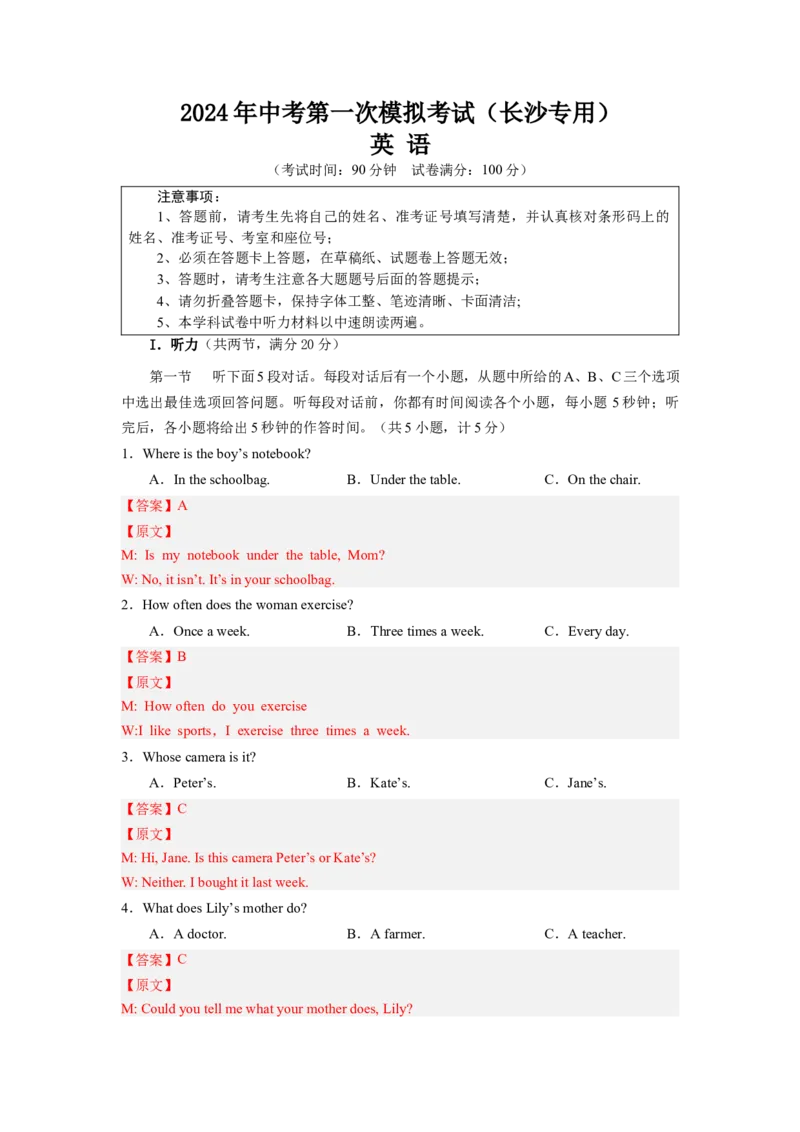
2024 年中考第一次模拟考试(长沙专用)
英 语
(考试时间:90分钟 试卷满分:100分)
注意事项:
1、答题前,请考生先将自己的姓名、准考证号填写清楚,并认真核对条形码上的
姓名、准考证号、考室和座位号;
2、必须在答题卡上答题,在草稿纸、试题卷上答题无效;
3、答题时,请考生注意各大题题号后面的答题提示;
4、请勿折叠答题卡,保持字体工整、笔迹清晰、卡面清洁;
5、本学科试卷中听力材料以中速朗读两遍。
I.听力(共两节,满分20分)
第一节 听下面5段对话。每段对话后有一个小题,从题中所给的A、B、C三个选项
中选出最佳选项回答问题。听每段对话前,你都有时间阅读各个小题,每小题 5秒钟;听
完后,各小题将给出5秒钟的作答时间。(共5小题,计5分)
1.Where is the boy’s notebook?
A.In the schoolbag. B.Under the table. C.On the chair.
【答案】A
【原文】
M: Is my notebook under the table, Mom?
W: No, it isn’t. It’s in your schoolbag.
2.How often does the woman exercise?
A.Once a week. B.Three times a week. C.Every day.
【答案】B
【原文】
M: How often do you exercise
W:I like sports,I exercise three times a week.
3.Whose camera is it?
A.Peter’s. B.Kate’s. C.Jane’s.
【答案】C
【原文】
M: Hi, Jane. Is this camera Peter’s or Kate’s?
W: Neither. I bought it last week.
4.What does Lily’s mother do?
A.A doctor. B.A farmer. C.A teacher.
【答案】C
【原文】
M: Could you tell me what your mother does, Lily?W: Sure, she is a teacher.
5.When did the meeting begin?
A.At 1:40. B.At 2:00. C.At 2:20.
【答案】C
【原文】
W: Sorry, I’m late.
M: Oh, it’s two o’clock now. The meeting has been on for twenty minutes.
第二节(共15小题;每小题1分,满分15分)
听下面6段对话或独白。每段对话或独白后有几个小题,从题中所给的A、B、C三个
选项中选出最佳选项。听每段对话或独白前,你将有时间阅读各个小题,每小题 5秒钟;
听完后,各小题将给出5秒钟的作答时间。每段对话或独白读两遍。
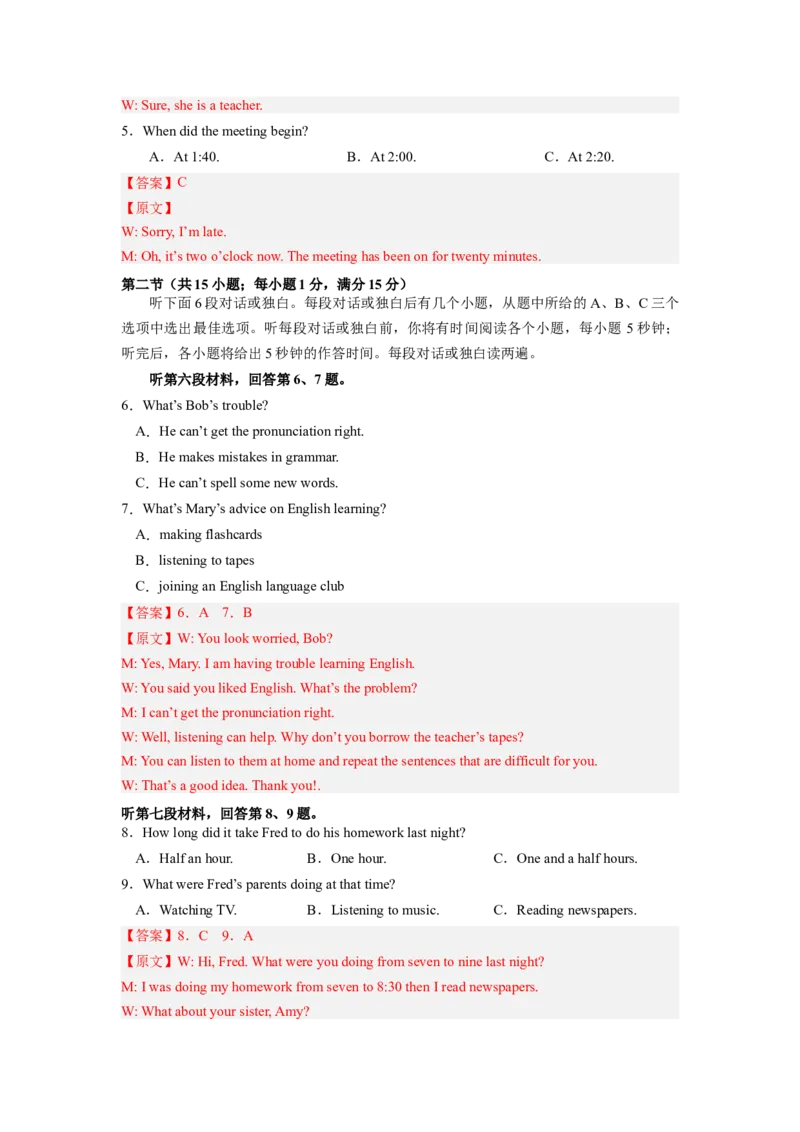
听第六段材料,回答第6、7题。
6.What’s Bob’s trouble?
A.He can’t get the pronunciation right.
B.He makes mistakes in grammar.
C.He can’t spell some new words.
7.What’s Mary’s advice on English learning?
A.making flashcards
B.listening to tapes
C.joining an English language club
【答案】6.A 7.B
【原文】W: You look worried, Bob?
M: Yes, Mary. I am having trouble learning English.
W: You said you liked English. What’s the problem?
M: I can’t get the pronunciation right.
W: Well, listening can help. Why don’t you borrow the teacher’s tapes?
M: You can listen to them at home and repeat the sentences that are difficult for you.
W: That’s a good idea. Thank you!.
听第七段材料,回答第8、9题。
8.How long did it take Fred to do his homework last night?
A.Half an hour. B.One hour. C.One and a half hours.
9.What were Fred’s parents doing at that time?
A.Watching TV. B.Listening to music. C.Reading newspapers.
【答案】8.C 9.A
【原文】W: Hi, Fred. What were you doing from seven to nine last night?
M: I was doing my homework from seven to 8:30 then I read newspapers.
W: What about your sister, Amy?M: She was listening to music.
W: And what were your parents doing?
M: They were watching a talent show on TV.
听第八段材料,回答第10、11题。
10.What’s the relationship between the two speakers?
A.Mother and son. B.Teacher and student. C.Brother and sister.
11.What will Bill do next?
A.Check the soccer score. B.Clean the phone screen. C.Put away the phone.
【答案】10.A 11.C
【原文】W: Bill, could you stop using your phone while having dinner?
M: I’m just checking the soccer score.
W: You’d better not spend so much time on your phone. It’s really bad for your eyes. And it’s very
dirty to touch the screen when you are eating.
M: I’m sorry, Mom.
W: Put away your phone and enjoy your dinner.
М. OK.
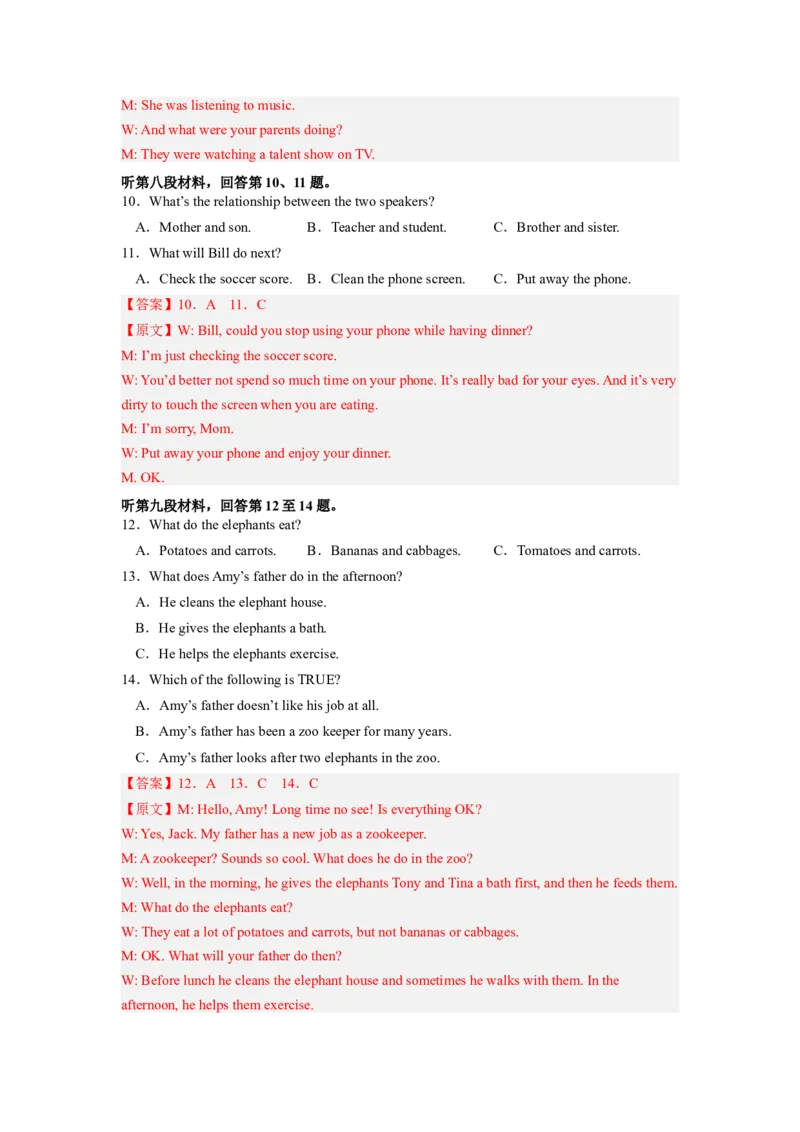
听第九段材料,回答第12至14题。
12.What do the elephants eat?
A.Potatoes and carrots. B.Bananas and cabbages. C.Tomatoes and carrots.
13.What does Amy’s father do in the afternoon?
A.He cleans the elephant house.
B.He gives the elephants a bath.
C.He helps the elephants exercise.
14.Which of the following is TRUE?
A.Amy’s father doesn’t like his job at all.
B.Amy’s father has been a zoo keeper for many years.
C.Amy’s father looks after two elephants in the zoo.
【答案】12.A 13.C 14.C
【原文】M: Hello, Amy! Long time no see! Is everything OK?
W: Yes, Jack. My father has a new job as a zookeeper.
M: A zookeeper? Sounds so cool. What does he do in the zoo?
W: Well, in the morning, he gives the elephants Tony and Tina a bath first, and then he feeds them.
M: What do the elephants eat?
W: They eat a lot of potatoes and carrots, but not bananas or cabbages.
M: OK. What will your father do then?
W: Before lunch he cleans the elephant house and sometimes he walks with them. In the
afternoon, he helps them exercise.M: Sounds interesting. By the way, does your father like his new job?
W: Yes, I think so. Because he loves elephants very much. Maybe we can go to the zoo to see
them this Sunday.
M: Great idea.
听第十段材料,回答第15至17题。
15.Where did Lucy lose her camera?
A.On the bus. B.In the museum. C.At school.
16.What’s the man’s advice?
A.To call the museum. B.To go to the police station. C.To go to the bank.
17.Where will they meet?
A.At the gate of the bank. B.At the gate of the police station. C.At the gate of the park.
【答案】15.B 16.B 17.C
【原文】M: Hi, Lucy! How are you? How was your last weekend?
W: Not so good, John. I went to the museum. When I took the bus home, I realized that I had left
my camera in the museum.
M: Oh, it’s too bad. Did you get it back?
W: No, I didn’t. I called the museum and they said it wasn’t there. I think someone must have
taken it.
M: That’s terrible. You should go to the police station.
W: I think so.
M: If you want, I can go with you.
W: Thanks. I’m free now. How about you?
M: I have to go to the bank now, but I’ll be OK in fifteen minutes.
W: And where shall we meet?
M: I will meet you at the gate of the park.
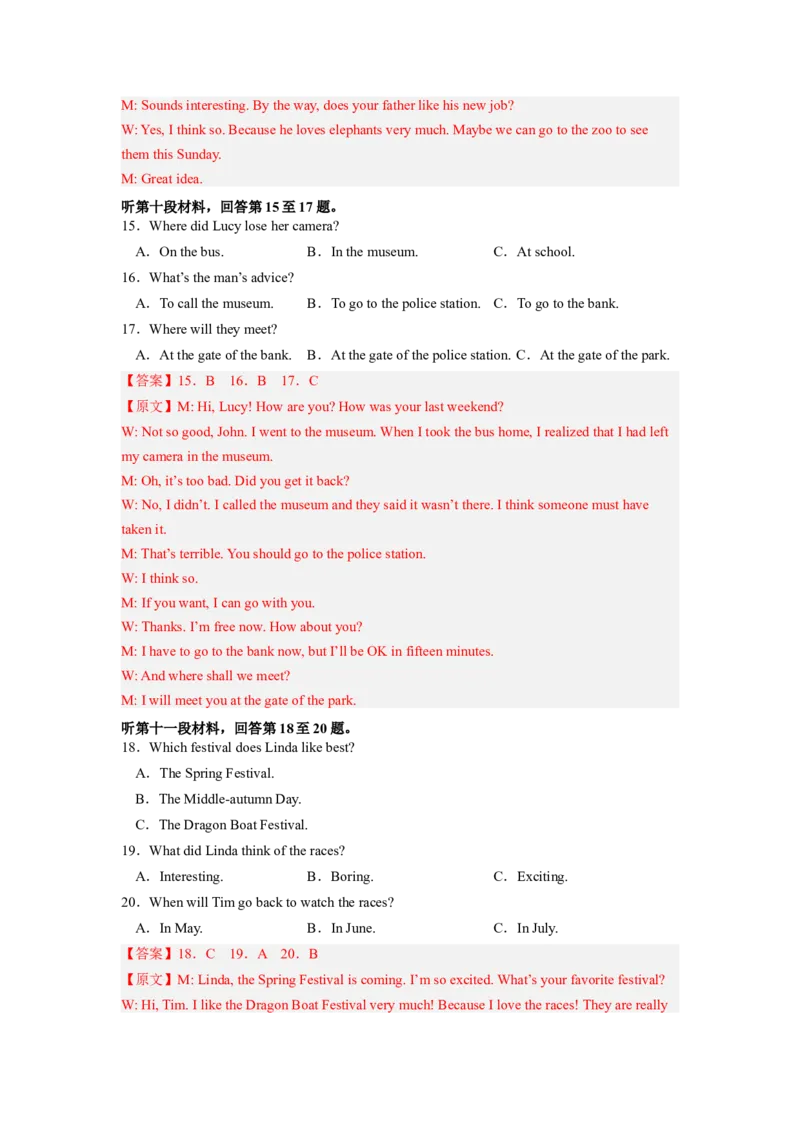
听第十一段材料,回答第18至20题。
18.Which festival does Linda like best?
A.The Spring Festival.
B.The Middle-autumn Day.
C.The Dragon Boat Festival.
19.What did Linda think of the races?
A.Interesting. B.Boring. C.Exciting.
20.When will Tim go back to watch the races?
A.In May. B.In June. C.In July.
【答案】18.C 19.A 20.B
【原文】M: Linda, the Spring Festival is coming. I’m so excited. What’s your favorite festival?
W: Hi, Tim. I like the Dragon Boat Festival very much! Because I love the races! They are reallyinteresting to watch.
M: I agree. Looking at the colorful boats is fun. How pretty they are!
W: I wonder if they will have the races again next year.
M: They have them every year in June. I believe that I’ll be back again next year to watch the
races.
W: Me too. When our family sit together on that day, we communicate with each other and share
delicious food, like Zongzi. The sweet ones are my favorite!
M: Yes! They are great!
II.阅读(共三节,满分40分)
第一节 (共11小题;每小题2分,满分22分)
阅读下列材料,从每题所给的A、B、C三个选项中,选出最佳选项。
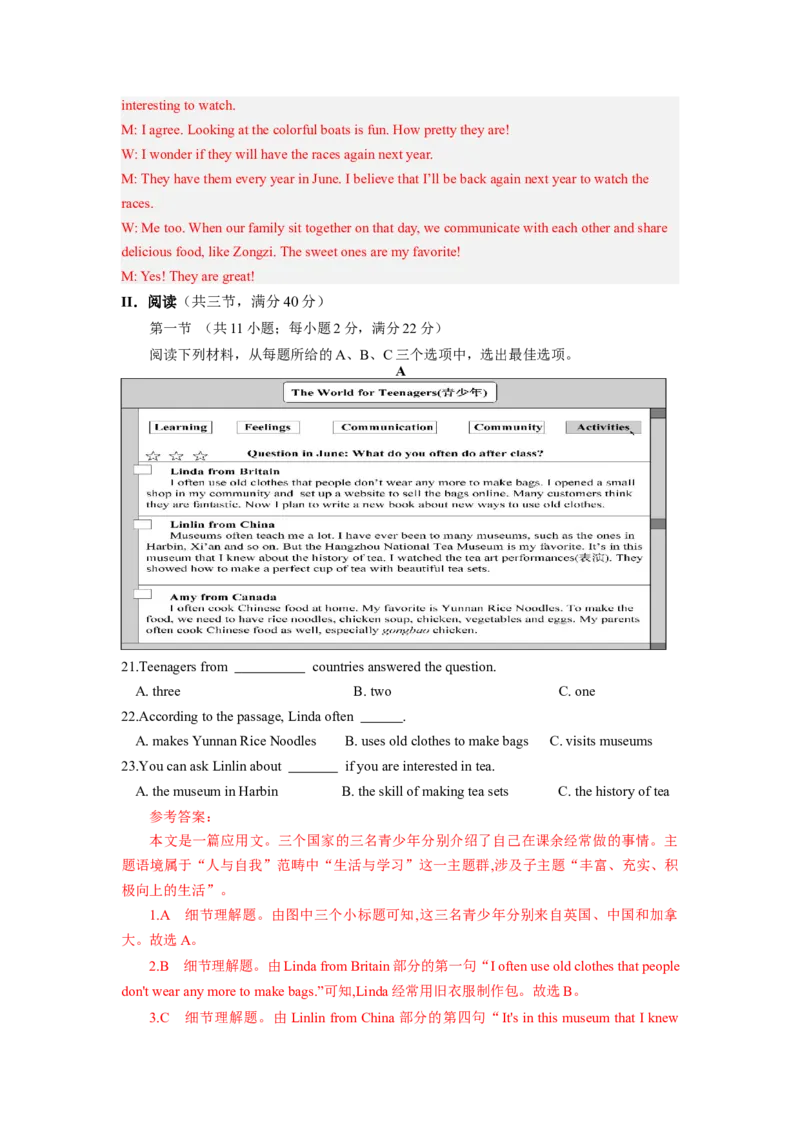
A
21.Teenagers from countries answered the question.
A. three B. two C. one
22.According to the passage, Linda often .
A. makes Yunnan Rice Noodles B. uses old clothes to make bags C. visits museums
23.You can ask Linlin about if you are interested in tea.
A. the museum in Harbin B. the skill of making tea sets C. the history of tea
参考答案:
本文是一篇应用文。三个国家的三名青少年分别介绍了自己在课余经常做的事情。主
题语境属于“人与自我”范畴中“生活与学习”这一主题群,涉及子主题“丰富、充实、积
极向上的生活”。
1.A 细节理解题。由图中三个小标题可知,这三名青少年分别来自英国、中国和加拿
大。故选A。
2.B 细节理解题。由Linda from Britain部分的第一句“I often use old clothes that people
don't wear any more to make bags.”可知,Linda经常用旧衣服制作包。故选B。
3.C 细节理解题。由Linlin from China部分的第四句“It's in this museum that I knewabout the history of tea.”可知,可以问Linlin茶的历史。故选C。
B
Camila lived in Belize City, Belize, a country in Central America. One day, her father said to
her, “I’m going to Glover’s Reef this weekend. Would you like to join me?”
“Of course!” Camila replied excitedly.
While they were flying to the town of Dangriga, Camila’s father explained that Glover’s Reef
was one of the largest coral reef systems (珊瑚礁系统) in the world. Hundreds of fish and coral
species (物种) lived in these reefs. However, many coral reefs were dying from pollution.
After they arrived at the park where Glover’s Reef was, Camila and her father put on their
goggles (游泳镜) and entered the blue waters. The beauty of the underwater world astonished Camila.
She had never seen so many fish swim around her. She also watched the colorful coral. Camila saw
how the plants and animals of the reef lived together perfectly. She took many pictures with her
father’s underwater camera. It was the most exciting experience of her life.
As they left the water, Camila and her father heard a loud noise. Then they saw a large speedboat
filled with tourists racing towards the reef area.
“They’ll scare the fish!” shouted Camila.
“There’s nothing we can do,” said her father. “They’re just outside of the park.”
Hearing that, Camila was angry and upset.
Back in Belize City, Camila spoke to her class about coral reefs. At home, Camila created a
petition (请愿书) online. It read: Governments of the world, please help the ocean’s coral reefs.
Keep our coral reefs safe and healthy for everyone.
In three weeks, 20,000 people in 38 countries signed (签署) Camila’s petition. Within one year,
three countries passed laws to protect their coral reefs.
“You have made a difference, Camila,” said her father. “Thank you! The coral reefs of the
world thank you, too.”
24. The underlined word “astonished” in Paragraph 4 means “_______” in Chinese.
A. 使吃惊 B. 使失望 C. 使害怕
25. Camila felt angry and upset because _______.
A. her father didn’t care about the speedboat
B. she couldn’t spend more time underwater
C. the speedboat might scare the fish but she could do nothing
26. As for Camila’s petition, _______.
A. it was her father’s idea
B. lots of people gave her support
C. she spent three weeks creating it
27. What do we know about Camila?
A. She had been to 38 countries.
B. She cared about the coral reefs.C. She was an expert on ocean species.
参考答案:
Camila去Glover’s Reef游玩,被那儿的美所震惊,但又看到珊瑚礁被破坏,所以写
请愿书保护珊瑚礁。
24. A。本小题考查学生根据上下文猜测词义的能力。由本句后文所用的一些表达:
She had never seen, the colorful coral, perfectly, took many pictures, the most exciting
experience都可看出那个地方的美及Camila被震惊的感受,故划线单词意思为A。
25. C。本小题考查学生查找细节信息的能力。由倒数第四段可知 Camila was angry
and upset,原因是倒数第五、六段所说的内容:快艇吓跑了鱼,Camila和父亲对这一切无
能为力,故答案为C。
26. B。本小题考查学生理解具体信息的能力。由倒数第二段可知人们对Camila请愿书
的反应:时间短,参与人数众多,并有三个国家为此立法,选项B与此内容吻合。
27. B。本小题考查学生推理判断的能力。由Camila对快艇吓跑鱼的反应及写关于保护
珊瑚礁的请愿书的举动,可知Camila很关注珊瑚礁。
C
In Singapore, primary and high school students take outdoor-skills courses as part of their
studies. They are usually three to five days long and include rope and rock climbing, going to sea in
a small boat, sleeping in a tent at night, taking long walks in the forest, and learning to make a fire.
It’s real life. One careless mistake could make someone really get hurt. Are those outdoor skills
really important?
Minister of Education Ng Chee Meng says that the outdoor courses help students
develop skills like critical thinking (批判性思维), teamwork, and good communication —
abilities that are necessary for work and life. He believes that these skills are as important
as traditional subjects. Students need to learn from books, but for some lessons, reading isn’t as
useful as doing.
What do the students think? Angelique, a student from Singapore, went for a boat
trip in the sea. “It helped me to grow stronger,” she says. The trip was stressful
because it was stormy that day. There were moments (片刻) when she felt afraid and
hopeless. But she remembered that “smooth seas never made a skilled sailor (水手)”
and felt brave enough to continue against the storm. “I am thankful for this amazing
chance,” she says.
Right now, students attend the courses with groups from their own school. After 2020, however,
all students will do the course in groups from several different schools. Why does this matter? Good
communication skills are more important now than ever. Working closely with students from other
backgrounds is a great way to learn this useful lesson.
One student said it this way, “There is nothing to be afraid of and nothing’s impossible.” And
that’s a great lesson to learn.
28. What do we know about the outdoor-skills courses from Paragraph 1?A. They are similar to P.E.
B. They are usually one week long.
C. Students may get hurt in the courses.
29. According to Ng Chee Meng, the outdoor courses _______.
A. are less useful than reading
B. teach students necessary work and life skills
C. can help with students’ other subjects
30. The writer uses Angelique’s example to show _______.
A. why the courses are popular
B. what the courses are really like
C. what students think of the courses
31. What can be the best title of the passage?
A. Outdoor classroom
B. Education in Singapore
C. Important outdoor skills
参考答案:
材料介绍了新加坡中小学生的户外技能课程。
28. C。本小题考查学生查找细节信息的能力。由第一段倒数第二句 One careless
mistake could make someone really get hurt. Are those outdoor skills really important?可知答案。
29. B。本小题考查学生查找细节信息的能力。由第二段第一句破折号后边的内容
abilities that are necessary for work and life. He believes that these skills are as important as
traditional subjects可知答案为B。
30. C。本小题考查学生推理判断的能力。第三段用一个问题 What do the students
think? 开头,紧接着用学生Angelique的例子就是为了以实例来回答这个问题,即介绍学生
对户外技能课程的体会,故选C。
31. A。本小题考查学生归纳文章标题的能力。材料首先介绍了户外技能课程的内容,
然后分别从理论和实践上谈了户外技能课程的好处,最后谈了它的发展,主题都是围绕
outdoor-skills courses,故A项作标题最能概括材料大意。
第二节 (共5小题;每小题2分,满分10分)
Are you scared of moving up to senior high school? It can be a worrying experience, but you
shouldn't worry about it. 3 2
You're not alone! 33 They may not realize it, but they're just as nervous as you are.
Moving up to senior high school is an opportunity, not a problem. Things are different. 3 4
Teachers are ready to help! If you are unsure of what to do or worrying about anything, then
ask teachers for help. Teachers are probably the best people to turn to as they're experienced in
helping new students. Some senior high schools also have a “friends system”. If your school has
this, then you will be paired with an older student who will look out for you and help you.Changes. There are many differences between junior high school and senior high school.
35 You'll have a homework diary or a student planner. You will have your lessons with different
teachers in different rooms. You will have homework for different subjects on different days. Make
sure you have a copy of your school timetable so you know which rooms your classes will be in and
on which days you will have your different subjects.
Other points. If you've got an older brother or sister at school, then ask him or her for advice.
Be yourself! 3 6 Also you must go to bed early and get up early to get ready for school.
A. It sounds simple, but people will know you better and get close to you if you act naturally.
B. We've put together a guide on how to get through the first week.
C. All you need to do is be polite and learn the new rules.
D. So make sure you get organized.
E. Remember everybody in your class is in the same boat.
参考答案:
本文是一篇说明文,主要介绍了新生到高中后应如何迅速适应高中生活。主题语境属于
“人与自我”范畴中“生活与学习”这一主题群,涉及子主题“多彩、安全、有意义的学校
生活”。
32.B 前文说“升入高中可能是一次令人担忧的经历,不过你不要担心”,下文应该给出
建议,B项“We've put together a guide on how to get through the first week.”符合语境。
故选B。
33.E 小标题“You're not alone!”说“你不是一个人”,E选项说“记住,你们班上的每
个人都在同一条船上(处境相同)”,与小标题呼应。故选E。
34.C 前文说“升入高中是机会,不是困难,事情有所不同”。C项意为“你所要做的就
是有礼貌以及学习新的规则”。其中learn the new rules与空前的“Things are different.”
对应。故选C。
35.D 根据空后的内容可知,到了高中,课会在不同的教室上,每天的作业也不尽相同,学
生需要搞清楚学校的各项安排,让自己的学习有条理。因此D项符合此处的语境。故选D。
36.A 空前的“Be yourself!”与A项中的“if you act naturally”相呼应,此处指如果你
表现自然,人们会更了解你,更亲近你。故选A。
第三节 (共4小题;每小题2分,满分8分)
Can you cook by yourself? Do you like the homework of making a meal? These
days, primary and middle school students are required to take the Practical Activity Class
(实践活动课) at least one class hour every week. The topic of cooking was discussed
mostly by parents and students. Learning practical skills plays an important role in shaping a
person’s character for sure.
Some schools and students have already practiced their practical activities. Gu Quan, 13 years
old, from No.18 Middle School, used to be a lazy boy. In his own words, he hardly ever did any
housework. But things have changed since No.18 Middle School made housework part of itsstudents’ homework. Doing the dishes, cooking and making the bed... All of these tasks have become
part of Gu Quan’s daily life.
At the beginning of each month, every student gets a list of housework to do every weekend.
Their parents help them keep a record of their performance. The tasks are common and simple in
daily life, such as sweeping the floor, washing cups and cooking food. On holidays like Mother’s
Day, students should prepare presents for their mothers. Huang Yixi, 14, has learned several life
kills, including cooking. “I used to be afraid of fire.” she said. But she managed to overcome ear
and complete her cooking tasks. At the same time, she also learned how tired her mother gets after
doing housework every day. On Mother’s Day, she made a cake for her mother to show her thanks.
“I’ve begun to better understand my parents and want to help them more.” she said.
37. Who is required to take the Practical Activity Class?
___________________________________________________________________________
38. Do the students’ parents help them keep a record of their performance?
___________________________________________________________________________
39. What did Huang Yixi use to be afraid of?
_______________________________________________________________________
40. What do you think of the Practical Activity Class?
_______________________________________________________________________
参考答案:
37.根据"These days, primary and middle school students are required to take the
Practical Activity Class (实践活动课) at least one class hour every week"可知,中小学生
被要求参加实践活动课,故填Primary and middle school students.
38.根据"At the beginning of each month, every student gets a list of housework to
do every weekend. Their parents help them keep a record of their performance”可知,他
们的父母帮助他们记录他们的表现,故填 Yes, they do.
39.根据"Huang Yixi,14, has learned several life kills, including cooking. “I used to
be afraid of fire."可知,以前害怕火,故填Fire.
40.开放性题,答案合理即可。参考答案为Good./Wonderful./Useful...
III.语言运用(共三节,满分30分)
第一节 (共10小题;每小题1分,满分10分)
阅读下面短文,从短文后各题所给的A、B、C三个选项中,选出可以填入空白处的最佳选
项。
One day, Mr. Arnold was teaching a lesson. He was explaining the 41 of humans
to his pupils. He told them that, in the beginning, humans were nomads (游牧部落的人). They
42 stayed in the same place for very long. Instead, they would travel about, here and there, in
search of food.He then taught 43 about farming and keeping animals. By learning to cultivate (耕
作) the land and care for animals, humans could always have food. Then they could remain 44
in one place. All the children were listening quietly. 45 , Lucy stood up and asked, “If
that improved everything so much, why are we nomads again?”
Mr. Arnold didn’ t know what to say. He knew that her family were not nomads. So what did
she 46 ?
“We have become nomads again,” continued Lucy. “When there’ s no more forest left in one
place, the foresters go to another place. That’ s 47 the nomads did, isn’ t it?”
The teacher 48 . Really, Lucy was right. The class spent the rest of the class talking
about what they should do.
The next day, everyone wore a green T-shirt 49 a message that said “I am not a
nomad!” to school. From then on, when they needed paper, they would 50 that they got
the recycled kind. They didn’ t want to become nomads again.
41.A. goal B. communication C. development
42. A. never B. still C. even
43. A. him B. her C. them
44. A. playing B. living C. studying 45.
A. Suddenly B. Luckily C. Especially 46. A. miss
B. want C. mean 47. A. what
B. where C. when 48. A. dreamed
B. nodded C. celebrated
49. A. above B. from C. with
50. A. leave out B. make sure C. take down
参考答案:
文章讲述了Mr. Arnold和他的学生从自我做起,保护环境的故事。
41. C。由下一句起初,人类是游牧部落可知Mr. Arnold在给学生讲解人类的“发展”
42. A。他们“从不”在一个地方待很长时间。
43. C。them在这里指代Mr. Arnold的学生。
44. B。由上一句可知,通过学习农耕和饲养动物,人类能一直有食物了。所以人类能
“住”在一个地方了。
45. A。同学们都在安静听课的时候,Lucy“突然”站起来发问。
46. C。Mr. Arnold知道Lucy的家人不是游牧民,所以她的问题到底是“什么意思”
呢?
47. A。前一句Lucy说的是游牧民的“所作所为”。
48. B。由下一句Lucy是对的,可知Mr. Arnold同意Lucy的观点,因此他“点了点
头”。
49. C。第二天,每个人上学都穿着一件绿T恤,上面写着“我不是游牧民”。
50. B。每当学生们需要纸的时候,他们都要“确保”他们拿到的是可回收利用的环保纸。
第二节 (共10小题;每小题1分,满分10分)
阅读下面短文,在空白处填入1个适当的单词或括号内单词的正确形式。
Sitting in my classroom I was watching my teacher. As she called the 51
(student)names, they went to receive their report cards. I watched their faces with envy (羡慕),
remembering my poor result last year. Since then I had 52 (work)hard but I was not
sure if I had made any progress.
I was so 53 (worry)that I didn’t hear my teacher call my name, and a nudge
(轻推) from my friend startled (使吓一跳) me. I tried my best to keep 54 (I)cool
and walked towards the teacher’s desk. The desk was only two meters away, but it seemed much
55 (far)to me.
Time seemed to stop. My heart was beating fast and my hands were 56
(shake) badly when I received my report card. My teacher was saying something, 57
I was so nervous that I couldn’t hear her.
Soon, thunderous applause (雷鸣般的掌声) brought me out of the darkness of my fears, and I
heard my teacher say, “ 58 (wonder) job!”
When I opened my report card, I discovered an A+ on it. I couldn’t believe my eyes until I
gave it a(n) 59 (two)look. Then all my fears disappeared. I felt like I was flying in
the air. I heard birds singing. Perhaps, they were also 60 (congratulate)me on my
success. I was so glad that my hard work paid off.
参考答案:
材料描述了作者在等待老师发成绩单时的忐忑心情以及看到自己成绩单上的好成绩时
的激动之情。
51. students’。老师叫“学生们的”名字,他们去拿自己的成绩单。“学生”和“成
绩单”之间为所属关系,并且report cards为复数,所以此处首先将student变为复数,然后
再填其名词所有格形式。
52. worked。从那时起,“我”就努力“学习”,但是“我”并不确定自己有没有取得
进步。空前有had,说明此处时态为过去完成时,该空应填work的过去分词形式。
53. worried。 “我”特别“担心”,连老师叫“我”名字都没有听到。根据空前的be
动词was及副词so可知,该空应填worry的形容词形式。
54. my。 “我”尽力保持冷静,朝老师的桌子走去。keep one’s cool为固定搭配,
意为“保持冷静”。
55. farther / further。老师的桌子只有两米远,但对“我”来说,似乎“远得多”。由
于该空前有副词much,much被用来修饰比较级,所以此处填far的比较级形式。
56. shaking。当“我”拿到自己的成绩单时,“我”的心跳得很快,手也“抖”得厉
害。“手”和“颤抖”是主动关系,并且根据 My heart was beating以及空前的were可知,
该处时态为过去进行时,故该空填shaking。57. but。老师正在说着什么,“但是”“我”太紧张了,根本听不到她说什么。
58. wonderful。Wonderful job! 常常用来表达对某人的表扬和赞赏。Wonder变形容词
wonderful修饰job
59. second。 “我”不敢相信自己的眼睛,又看了成绩单一眼。give sth. a second
look意为“再看某物一眼”。
60. congratulating。或许它们也在“祝贺”“我”的成功。they指代的是上文中提到的
birds,和“祝贺”是主动关系,由空前的were可知,此处应填congratulate的-ing形式。
第三节 (共5小题;每小题2分,满分10分)
阅读下面的短文,将划线部分译成英文或中文。
When the day of a big test at school comes, some students feel nervous.61. 他们可能会有胃
痛或头痛。If you are one of them, you need to take steps to lessen (减轻) your test anxiety (忧虑).
Here are some ways to do that.
Ask for help.
Talk to your parents, your teachers, or your friends. 62.Talking to someone about test anxiety
can make you feel better. Describe what happens to you when you’re taking a test and these people
may help you out.
Stop bad thoughts.
Don’t send yourself any bad messages about the test such as “I’m not good at taking tests” or
“I will be sad if I get a bad grade”. 63.These thoughts can make anxiety worse and make it harder
for you to do well in the test.
Breathe better.
Do you know that breathing exercises can help make you less nervous? Here’s how to do it:
breathe in slowly and deeply through your nose, and then breathe out slowly through your mouth.
64. 参加考试时这样做两到四次 , and you might feel better.
Accept mistakes.
Everyone makes mistakes. If you have prepared for the test and done your best, that’s
enough.
参考答案:
61. They may have a stomachache or a headache.
62. 与某人谈论考试焦虑可以让你感觉更好
63. 这些想法会使焦虑变得更糟,并使你更难在考试中取得好成绩。
64. Do this two to four times when you’re taking a test,
65. 如果你已经为考试做好了准备并尽了最大努力,那就足够了。
IV.写作(满分10分)
66. 假如你是李华,刚刚收到加拿大笔友Mike给你发来的电子邮件。请你根据邮件内
容给他回复。
Dear Li Hua,How’s everything going? Something is worrying me these days.
You know, it’s not right to tell a lie (说谎), but there are times when a lie is better than the
truth. Sometimes I have to make a choice between telling a lie and telling the truth, but I can’t
make a decision. I need your advice. Besides, have you ever told a lie? If you have, please tell me
something about it.
Looking forward to your reply. Best wishes!
Yours,
Mike
要求:
1. 内容要全面,语言表达要准确,语意要通顺、连贯;
2. 词数不少于100,电子邮件的格式、开头及结尾已给出,但不计入总词数。
Dear Mike,
I’m very happy to receive your e-mail. From it, I have learned that you are having trouble
with
_______________________________________________________________________________
_______________________________________________________________________________
_____________________________________________________________________________
_______________________________________________________________________________
_______________________________________________________________________________
_______________________________________________________________________________
_______________________________________________________________________________
_______________________________________________________________________________
I hope my advice helps you. Best wishes!
Yours,
Li Hua
参考答案:
Dear Mike,
I’m very happy to receive your e-mail. From it, I have learned that you are having trouble
with deciding if you should tell a lie or tell the truth.
Yes, it’s not always bad to tell a lie. Sometimes it’s necessary for us to do so. For example,
if you don’t want to hurt someone’s feelings by telling the truth, you can lie.
I have lied to my best friend before. Once, during an English test when she wanted to copy
my paper, I told a lie. I said I hadn’t finished it. She got very angry and didn’t talk to me after the
test. A few days later when I was going to have a talk with her, she said she had realized what she
did wrong. She said sorry to me. We became friends again.
I hope my advice helps you. Best wishes!Yours,
Li Hua