试题 第1 页(共8 页)                                                                                            试题 第2 页(共8 页)
………………○………………内………………○………………装………………○………………订………………○……………… 线………………○………………
………………○………………外………………○………………装………………○………………订………………○……………… 线………………○………………
…             学校:______________姓名:_____________班级:_______________考号:______________________


2026 年高考第一次模拟考试
高三英语
(考试时间:90 分钟  试卷满分:100 分)
注意事项:
1.答卷前,考生务必将自己的姓名、准考证号等填写在答题卡和试卷指定位置上。
2.回答选择题时,选出每小题答案后,用铅笔把答题卡上对应题目的答案标号涂黑。如需改动,用橡
皮擦干净后,再选涂其他答案标号。回答非选择题时,将答案写在答题卡上。写在本试卷上无效。
3.考试结束后,将本试卷和答题卡一并交回
第一部分:知识运用(共两节,30 分)
第一节 (共10 小题;每小题1.5 分,共15 分)
阅读下面短文,掌握其大意,从每题所给的A、B、C、D 四个选项中,选出最佳选项,并在答题卡上将
该项涂黑。
(新题材)I lost my job right before Christmas. I was the only parent of a daughter, Kristil, 12. My paycheck
was ___1___.
While we were searching for Christmas tree, I struggled to be ___2___ as I eyed each price tag.
Monday morning, I set off to ___3___ money. I sold some Precious Moments figurines in an antiques store. And
I desperately ___4___ jobs as my bank account grew smaller. I felt as if the world was closing in on me.
One afternoon, I dropped Kristil in a wealthy gated community for a birthday party. I watched as she went in,
surrounded by all the nice things we couldn’t afford. I drove home ___5___.
Back at home, I glanced out of the window. I noticed a woman with short white hair struggling to ___6___ her
car door against the wind. It was my old professor, Esther Heffernan.
I first met Esther 10 years earlier when I was her student at Edgewood College. Kristil was 3 at the time, and I
sometimes took her to class. Esther was understanding and would bring coloring books to ___7___ Kristil.
I rushed out. “What are you doing out in this weather?” I asked as we hugged.
“Well, I called your job and they said you weren’t working there anymore, so I thought I would come by,” she
said. “I have gifts for you and Kristil.”
Esther’s ___8___ gave me hope that things would be all right.
After a short talk, she got up and left a Christmas card. When I opened it, hundred-dollar bills fell onto the table.
Tears of ___9___ welled in my eyes as I counted. Esther had given me $1,000.
It’s been 14 years since that Christmas, but I’ve never forgotten what Esther did for us. In 2020, at age 91, she
died, but the love she gave lives on in the hearts of many. _____10_____, I am one.
1 A. reward
B. survival

C. salary

D. focus
2. A. cheerful
B. sad


C. worried

D. pleased
3. A. pursue

B. change

C. raise

D. borrow
4. A. took up
B. held down
C. land on

D. applied for
5. A. surprised
B. troubled

C. defeated

D. motivated
6. A. open

B. clean

C. repair

D. strike
7. A. teach

B. occupy

C. welcome

D. entertain
8. A. gift

B. teaching

C. assistance
D. presence
9. A. affection
B. overjoy

C. gratitude

D. excitement
10. A. Generally
B. Luckily

C. Honorably
D. Proudly
第二节 (共10 小题;每小题1.5 分,共15 分)
阅读下列短文,根据短文内容填空。在未给提示词的空白处仅填写1 个恰当的单词,在给出提示词的空
白处用括号内所给词的正确形式填空。请在答题卡指定区域作答。
A
(原创题)Last weekend, I visited a local craft show    11    (display) traditional Chinese arts like paper-
cutting and jade carving. When I walked into the hall, I saw an elderly master sitting by a table. The clay figurines
12    (make) by him looked so vivid that I stopped to watch carefully. He noticed me and smiled, explaining that the
figurines,    13    take at least three months to finish, each carry unique stories of old China. This trip deepened
my love for our cultural heritage.
B
(原创题)Every autumn, thousands of migratory birds fly to the city’s wetland    14    winter. But recently,
the wetland    15    (pollute) by plastic waste left by visitors. To save this habitat, local volunteers    16
(organize) weekly clean-ups now. They wear gloves, bags in hand, to pick up trash. Their goal is to protect the wetland
and keep these lovely    17    (creature) safe.
C
(原创题)During the Mid-Autumn Festival, making homemade mooncakes is a cherished tradition in many
Chinese households. Following time-honored recipes, people combine flour, oil and fillings such as red bean paste,
taking care to balance ingredients precisely. The process requires patience and attention, and completing one’s first
mooncake often brings a strong sense of   8    (achieve). In recent years, sharing such homemade treats with
foreign friends has become a popular way  __9   (make) them know more about Chinese festivals. When hosts tell
stories behind the festival during these exchanges, it  10   (help) listeners understand Chinese culture more deeply.
第二部分:阅读理解(共两节,共38 分)
第一节 (共14 小题;每小题2 分,共28 分)
阅读下列短文,从每题所给的A、B、C、D 四个选项中,选出最佳选项,并在答题卡上将该项涂黑。
A
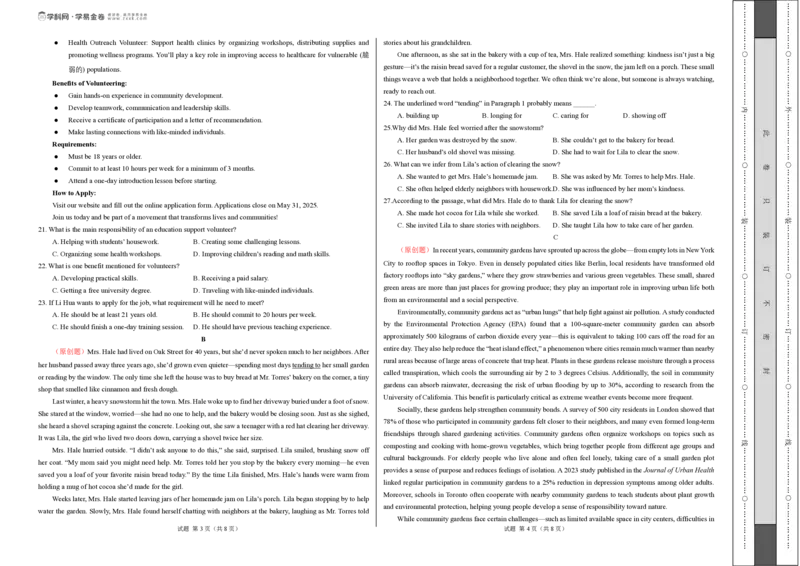
(新题材)Are you passionate about community development and eager to make a positive impact? Join our
volunteer program and contribute to meaningful projects that benefit local communities. Whether you’re interested in
education, environmental conservation, or public health, we have a role for you!
Positions Available:
⚫
Education Support Volunteer: Assist in teaching foundational reading and math to children in underserved
areas. No prior teaching experience is required—just enthusiasm and a willingness to learn. You’ll work
closely with local teachers to create interesting lessons and support students’ learning journeys.
⚫
Environmental Conservation Volunteer: Help with tree planting, clean-up drives and awareness campaigns
to protect natural resources. This role is perfect for those who care about sustainability and want to make a
great difference in their community.
{#{QQABaYaEggCgQJJAAAgCEwUACgOYkAECCKgGwBAYoAABARFABAA=}#}

试题 第3 页(共8 页)                                                                                       试题 第4 页(共8 页)

………………○………………内………………○………………装………………○………………订………………○……………… 线………………○………………
             此
卷
只
装
订
不
密
封

………………○………………外………………○………………装………………○………………订………………○……………… 线………………○………………

⚫
Health Outreach Volunteer: Support health clinics by organizing workshops, distributing supplies and
promoting wellness programs. You’ll play a key role in improving access to healthcare for vulnerable (脆
弱的) populations.
Benefits of Volunteering:
⚫
Gain hands-on experience in community development.
⚫
Develop teamwork, communication and leadership skills.
⚫
Receive a certificate of participation and a letter of recommendation.
⚫
Make lasting connections with like-minded individuals.
Requirements:
⚫
Must be 18 years or older.
⚫
Commit to at least 10 hours per week for a minimum of 3 months.
⚫
Attend a one-day introduction lesson before starting.
How to Apply:
Visit our website and fill out the online application form. Applications close on May 31, 2025.
Join us today and be part of a movement that transforms lives and communities!
21. What is the main responsibility of an education support volunteer?
A. Helping with students’ housework.

B. Creating some challenging lessons.
C. Organizing some health workshops.

D. Improving children’s reading and math skills.
22. What is one benefit mentioned for volunteers?
A. Developing practical skills.


B. Receiving a paid salary.
C. Getting a free university degree.


D. Traveling with like-minded individuals.
23. If Li Hua wants to apply for the job, what requirement will he need to meet?
A. He should be at least 21 years old.


B. He should commit to 20 hours per week.
C. He should finish a one-day training session.
D. He should have previous teaching experience.
B
(原创题)Mrs. Hale had lived on Oak Street for 40 years, but she’d never spoken much to her neighbors. After
her husband passed away three years ago, she’d grown even quieter—spending most days tending to her small garden
or reading by the window. The only time she left the house was to buy bread at Mr. Torres’ bakery on the corner, a tiny
shop that smelled like cinnamon and fresh dough.
Last winter, a heavy snowstorm hit the town. Mrs. Hale woke up to find her driveway buried under a foot of snow.
She stared at the window, worried—she had no one to help, and the bakery would be closing soon. Just as she sighed,
she heard a shovel scraping against the concrete. Looking out, she saw a teenager with a red hat clearing her driveway.
It was Lila, the girl who lived two doors down, carrying a shovel twice her size.
Mrs. Hale hurried outside. “I didn’t ask anyone to do this,” she said, surprised. Lila smiled, brushing snow off
her coat. “My mom said you might need help. Mr. Torres told her you stop by the bakery every morning—he even
saved you a loaf of your favorite raisin bread today.” By the time Lila finished, Mrs. Hale’s hands were warm from
holding a mug of hot cocoa she’d made for the girl.
Weeks later, Mrs. Hale started leaving jars of her homemade jam on Lila’s porch. Lila began stopping by to help
water the garden. Slowly, Mrs. Hale found herself chatting with neighbors at the bakery, laughing as Mr. Torres told
stories about his grandchildren.
One afternoon, as she sat in the bakery with a cup of tea, Mrs. Hale realized something: kindness isn’t just a big
gesture—it’s the raisin bread saved for a regular customer, the shovel in the snow, the jam left on a porch. These small
things weave a web that holds a neighborhood together. We often think we’re alone, but someone is always watching,
ready to reach out.
24. The underlined word “tending” in Paragraph 1 probably means ______.
A. building up


B. longing for

C. caring for

D. showing off
25.Why did Mrs. Hale feel worried after the snowstorm?
A. Her garden was destroyed by the snow.


B. She couldn’t get to the bakery for bread.
C. Her husband’s old shovel was missing.


D. She had to wait for Lila to clear the snow.
26. What can we infer from Lila’s action of clearing the snow?
A. She wanted to get Mrs. Hale’s homemade jam.
B. She was asked by Mr. Torres to help Mrs. Hale.
C. She often helped elderly neighbors with housework.D. She was influenced by her mom’s kindness.
27.According to the passage, what did Mrs. Hale do to thank Lila for clearing the snow?
A. She made hot cocoa for Lila while she worked.
B. She saved Lila a loaf of raisin bread at the bakery.
C. She invited Lila to share stories with neighbors.
D. She taught Lila how to take care of her garden.
C
(原创题)In recent years, community gardens have sprouted up across the globe—from empty lots in New York
City to rooftop spaces in Tokyo. Even in densely populated cities like Berlin, local residents have transformed old
factory rooftops into “sky gardens,” where they grow strawberries and various green vegetables. These small, shared
green areas are more than just places for growing produce; they play an important role in improving urban life both
from an environmental and a social perspective.
Environmentally, community gardens act as “urban lungs” that help fight against air pollution. A study conducted
by the Environmental Protection Agency (EPA) found that a 100-square-meter community garden can absorb
approximately 500 kilograms of carbon dioxide every year—this is equivalent to taking 100 cars off the road for an
entire day. They also help reduce the “heat island effect,” a phenomenon where cities remain much warmer than nearby
rural areas because of large areas of concrete that trap heat. Plants in these gardens release moisture through a process
called transpiration, which cools the surrounding air by 2 to 3 degrees Celsius. Additionally, the soil in community
gardens can absorb rainwater, decreasing the risk of urban flooding by up to 30%, according to research from the
University of California. This benefit is particularly critical as extreme weather events become more frequent.
Socially, these gardens help strengthen community bonds. A survey of 500 city residents in London showed that
78% of those who participated in community gardens felt closer to their neighbors, and many even formed long-term
friendships through shared gardening activities. Community gardens often organize workshops on topics such as
composting and cooking with home-grown vegetables, which bring together people from different age groups and
cultural backgrounds. For elderly people who live alone and often feel lonely, taking care of a small garden plot
provides a sense of purpose and reduces feelings of isolation. A 2023 study published in the Journal of Urban Health
linked regular participation in community gardens to a 25% reduction in depression symptoms among older adults.
Moreover, schools in Toronto often cooperate with nearby community gardens to teach students about plant growth
and environmental protection, helping young people develop a sense of responsibility toward nature.
While community gardens face certain challenges—such as limited available space in city centers, difficulties in
{#{QQABaYaEggCgQJJAAAgCEwUACgOYkAECCKgGwBAYoAABARFABAA=}#}

试题 第5 页(共8 页)                                                                                            试题 第6 页(共8 页)
………………○………………内………………○………………装………………○………………订………………○……………… 线………………○………………
………………○………………外………………○………………装………………○………………订………………○……………… 线………………○………………
…             学校:______________姓名:_____________班级:_______________考号:______________________


securing long-term access to land, and varying levels of commitment from participants—their benefits clearly
outweigh these problems. They prove that even small changes to urban environments can create healthier and more
connected cities. As urban populations continue to grow, community gardens may soon become essential for building
livable communities around the world, showing that green spaces are not luxury items but necessary parts of urban
life.
28. What can we infer about the “heat island effect” from the passage?
A. It can be alleviated by the moisture from garden plants.  B. It increases the amount of carbon dioxide in cities.
C. It is caused by the overgrowth of community gardens.   D. It makes cities cooler than rural areas in summer.
29. Which of the following can be inferred from the studies mentioned in the passage?
A. A 100-square-meter garden can completely solve urban flooding problems.
B. Elderly people who join community gardens are less likely to feel depressed.
C. Community gardens have a greater impact on the environment than on society.
D. All London residents have become more connected to neighbors through gardens.
30.According to the passage, what do schools in Toronto do to help students develop environmental responsibility?
A. They organize students to clean up community gardens regularly.
B. They ask students to grow vegetables in community gardens for their families.
C. They invite experts from the University of California to give lectures on the environment.
D. They cooperate with nearby community gardens to teach plant growth and environmental protection.
31. What can we infer about the author’s attitude toward the future of urban green spaces?
A. The author doubts whether community gardens can solve urban population problems.
B. The author worries that the challenges of community gardens will stop their development.
C. The author believes green spaces will become a basic need rather than a luxury in cities.
D. The author suggests urban governments should focus more on reducing population growth.
D
(新题材)For millennia, we have expected dogs to guard our property and protect our family at night. Now they
are also asked to be friendly around strangers, rest quietly through the night and keep their feet off sofas. “It’s an
evolutionary mismatch”, says Hare, an anthropologist at Duke University. The good news is that this problem is
solvable. Recent studies indicate that selective breeding (繁殖) and careful training can help dogs adapt to indoor life.
 A “puppy kindergarten” research was set up by Hare’s team to illustrate the heritability of behavioural traits (特
征) in dogs by observing what service dogs’ behaviour looks like before intensive training begins. Service dogs were
selected as the subject for they can always naturally adapt well to the mismatch compared to other kinds. They can
pull wheelchairs, operate light switches and interact gently with children.
By collecting data from 1,500 dog owners on the behaviour of their pets, which belonged to 36 breeds, Hare’s
team discovered that genetics (遗传特征) explained 45 percent of the variation in dogs’ self-control, 16 percent of the
variation in reasoning about the physical world and a mere 0.01 percent of the variation in short-term memory, which
manifests that some desirable behaviours are heritable to certain degree, and selective breeding for temperament is
worthwhile.
“Genetics is important, but its relative importance is different for different behavioural traits,” says Gitanjali from
Emory University. Besides, Hare’s work also illustrates selective breeding can’t guarantee some highly desirable traits,
such as a good memory. So they have devised techniques that owners can use to help train their pets and build better
relationships with them.
One habit that is especially important in training is making eye contact. “The dog’s gaze may be a causal factor
in inducing good feelings in the owner”, says Kikusui at Azabu University in Japan, “and the longer a dog gazes at its
owner, the stronger those good feelings become.” Hare also found that pups could solve some “impossible tasks” by
appealing to human for help, and the appeal was made through eye contact. So he suggested puppy owners finish
“impossible tasks” with their pets every two weeks to strengthen the emotional connection with them. “Doing so can
help you learn where your dog’s cognitive strengths lie”, he says. And as the puppy kindergarten project has made
clear, dog training as well as selective breeding is crucial to foster those behaviours we would like our pets to exhibit
in our homes.
32. What can we learn from Hare’s research?
A. Service dogs were observed while accepting training.
B. Genetics may explain differences in dogs’ self-control.
C. Service dogs were chosen for they were trained earlier.
D. Selective breeding develops dogs’ most desirable traits.
33. What’s the author’s aim of quoting Gitanjali’s words?
A. To suggest that other factors also need discussing.
B. To prove the necessity of selective breeding.
C. To confirm the value on reforming dogs’ genes.

D. To reveal that Hare’s research is suspicious.
34. What’s the best title for the passage?
A. Service Dogs: Acquiring Desirable Traits through Breeding
B. Smart Dogs: Adapting Well to Indoor Life through Training
C. Modern Dogs: Training Desirable Dogs through Eye Contact
D. Good Dogs: Evolving through Selective Breeding and Training
第二节 (共5 小题;每小题2 分,共10 分)
根据短文内容,从短文后的七个选项中选出能填入空白处的最佳选项,并在答题卡上将该项涂黑。选项
中有两项为多余选项。
(原创题)Taking good notes in class is key to understanding lessons and preparing for exams. However, many
students struggle with capturing important information without missing parts of the lecture. Follow these practical
steps to make your notes more useful.
First, come prepared with the right tools.    35    A notebook with divided sections (for main ideas and details)
or a digital note-taking app that lets you organize content easily works best. Avoid using messy loose papers—they’re
easy to lose and hard to review later.
Next, focus on key information, not every word.    36    Teachers often emphasize important points with
phrases like “Remember this” or “This is crucial.” Write down main ideas, key terms, and examples, but skip
unnecessary descriptions or repeated explanations.
Then, use a clear note-taking structure.    37    For example, the “Cornell Method” divides your notebook
page into three parts: a section for questions, one for notes, and a small area at the bottom for a summary. This structure
makes it easier to review and connect ideas later.
   38   If you miss a point, leave a blank space and keep listening—don’t stop to fill it in during the lecture.
{#{QQABaYaEggCgQJJAAAgCEwUACgOYkAECCKgGwBAYoAABARFABAA=}#}

试题 第7 页(共8 页)                                                                                       试题 第8 页(共8 页)

………………○………………内………………○………………装………………○………………订………………○……………… 线………………○………………
             此
卷
只
装
订
不
密
封

………………○………………外………………○………………装………………○………………订………………○……………… 线………………○………………

After class, ask a classmate or your teacher to help you fill in the gaps. Also, review your notes within 24 hours: this
helps reinforce what you’ve learned before you forget it.
Finally, personalize your notes.   39    Use symbols (like “!” for important points) or highlight key terms in
different colors. You can also add your own comments or questions in the margins—this makes the notes more
meaningful to you and helps with active learning.
A. Fix gaps and review promptly after class.
B. Not all note-taking tools are equally effective.
C. Different structures work for different subjects.
D. Personal touches help you engage with the material.
E. Having the right tools can save you time and reduce stress.
F. Write down only what the teacher emphasizes as important.
G. Reviewing notes regularly is more important than taking them.
第三部分 书面表达(共两节,32 分)
第一节(共4 小题;第40、41 题各2 分,第42 题3 分,第43 题5 分,共12 分)
阅读下面短文,根据题目要求用英文回答问题。请在答题卡指定区域作答。
(新题材)When I began my Ph. D. in science four years ago, I started feeling like a fish out of water. Everyone
around me seemed to be driven by their burning love of science. I felt out of place, uninspired, and incompetent. “Mary,
don’t worry. It’s just self-doubt,” everyone told me. For years, I believed them, thinking that with more experience and
confidence, things would change.
But as time went on, the feelings only got stronger. The idea of quitting made me feel relieved. But I knew I had
too much fight in me to leave my program. So I decided to get my degree and then pursue something else entirely.
Partly in search of this “something else,” I began writing. At first, I mainly used it as a creative outlet. But
eventually, it led me to explore science communication. In writing about newly published scientific papers, I felt
curious, enlightened, and empowered. I began to entertain the idea that my problem wasn’t self-doubt — maybe I truly
was a fish out of water, and all I needed to do was leave my life on land.
I decided to tell my academic teachers about my new passion. However, they could not understand why I would
want to pursue anything other than research. Truthfully, I did worry about what my life would look like if I left the
world of scientific research. I expressed my concerns to a writing teacher. “Follow your heart, and the rest will follow,”
she told me. I knew in my heart that I wanted to pursue science communication after graduation. And once I chose to
trust that feeling, I found that I no longer struggled to breathe. I still felt out of place in academic research. But I now
knew where I belonged and how to get there.
40. How did the author feel when she began Ph. D. in science?
___________________________________________________________________________________________
41. What did the author use as a creative outlet?
___________________________________________________________________________________________
42. Please decide which part is false in the following statement, then underline it and explain why.
After learning about the author’s concerns, the writing teacher encouraged her to quit scientific research
immediately.
___________________________________________________________________________________________
43. Use an example to show how you would apply the inspiration from the story in your life. (In about 40 words)
_____________________________________________________________________________________________
第二节(20 分)
假设你是红星中学高三学生李华。你所在的学校近期将举办 “绿色校园行动周Green Campus Action Week”
活动,旨在提高同学们的环保意识并鼓励大家践行低碳生活。校学生会正在征集活动倡议书,并计划在校园
网和宣传栏刊登。请你用英文给校学生会写一封倡议信,内容应包括:
1. 介绍你对“绿色校园”的理解;
2. 列举两项可以在校园推行的环保措施并说明理由;
注意:1. 词数100 左右;
2. 开头和结尾已给出,不计入总词数。
Dear Students’ Union,
I am Li Hua, a Senior 3 student from Hongxing High School. I am writing to share my ideas for the upcoming
“Green Campus Action Week”.
——————————————————————————————————————————————
——————————————————————————————————————————————
——————————————————————————————————————————————
Let’s take action now and make our campus greener and more beautiful.
Yours sincerely,
Li Hua
(请务必将作文写在答题卡指定区域内)

{#{QQABaYaEggCgQJJAAAgCEwUACgOYkAECCKgGwBAYoAABARFABAA=}#}