2026 年高考第一次模拟考试
高三英语·全解全析
(考试时间:120 分钟  试卷满分:150 分)
注意事项:
1.答卷前,考生务必将自己的姓名、准考证号等填写在答题卡和试卷指定位置上。
2.回答选择题时,选出每小题答案后,用铅笔把答题卡上对应题目的答案标号涂黑。如需改动,用
橡皮擦干净后,再选涂其他答案标号。回答非选择题时,将答案写在答题卡上。写在本试卷上无效。
3.考试结束后,将本试卷和答题卡一并交回。
第一部分  听力(共两节,满分 30 分)
做题时,先将答案标在试卷上。录音内容结束后,你将有两分钟的时间将试卷上的答案转涂到答题卡
上。
第一节(共5 小题;每小题1.5 分,满分7.5 分)
听下面5 段对话。每段对话后有一个小题,从题中所给的A、B、C 三个选项中选出最佳选项。听完每
段对话后,你都有10 秒钟的时间来回答有关小题和阅读下一小题。每段对话仅读一遍。
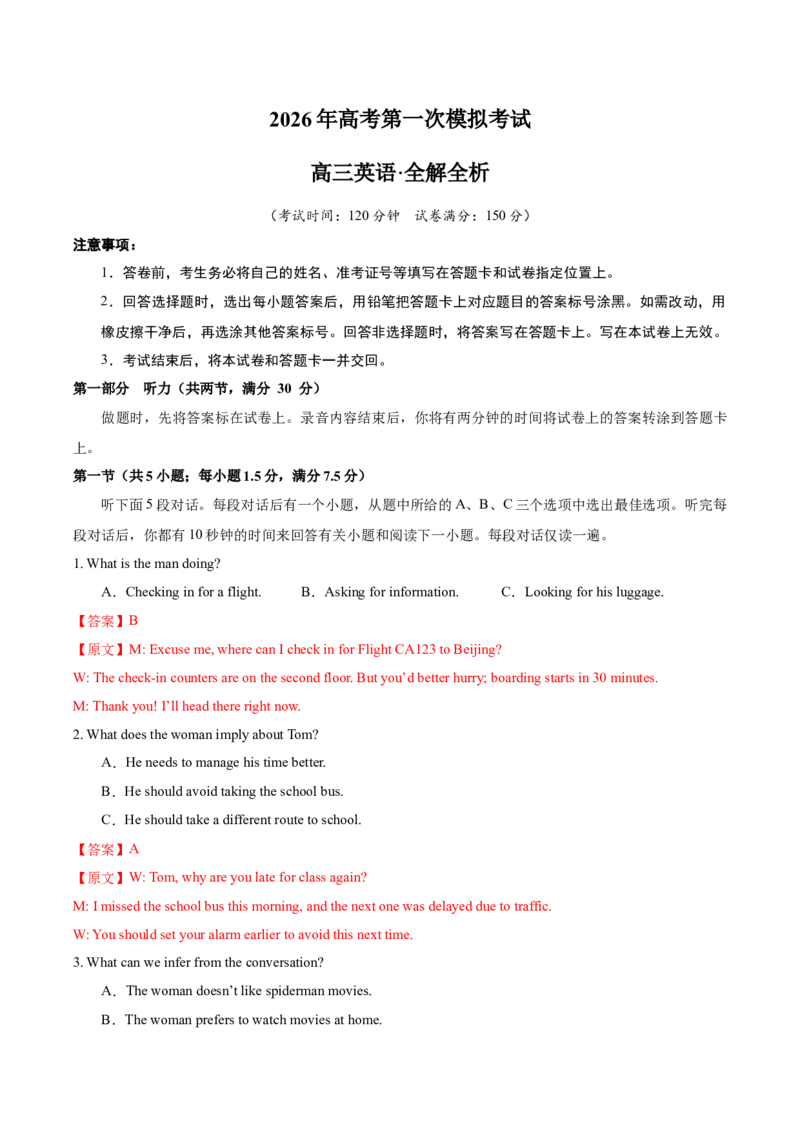
1. What is the man doing?
A.Checking in for a flight.
B.Asking for information.
C.Looking for his luggage.
【答案】B
【原文】M: Excuse me, where can I check in for Flight CA123 to Beijing?
W: The check-in counters are on the second floor. But you’d better hurry; boarding starts in 30 minutes.
M: Thank you! I’ll head there right now.
2. What does the woman imply about Tom?
A.He needs to manage his time better.
B.He should avoid taking the school bus.
C.He should take a different route to school.
【答案】A
【原文】W: Tom, why are you late for class again?
M: I missed the school bus this morning, and the next one was delayed due to traffic.
W: You should set your alarm earlier to avoid this next time.
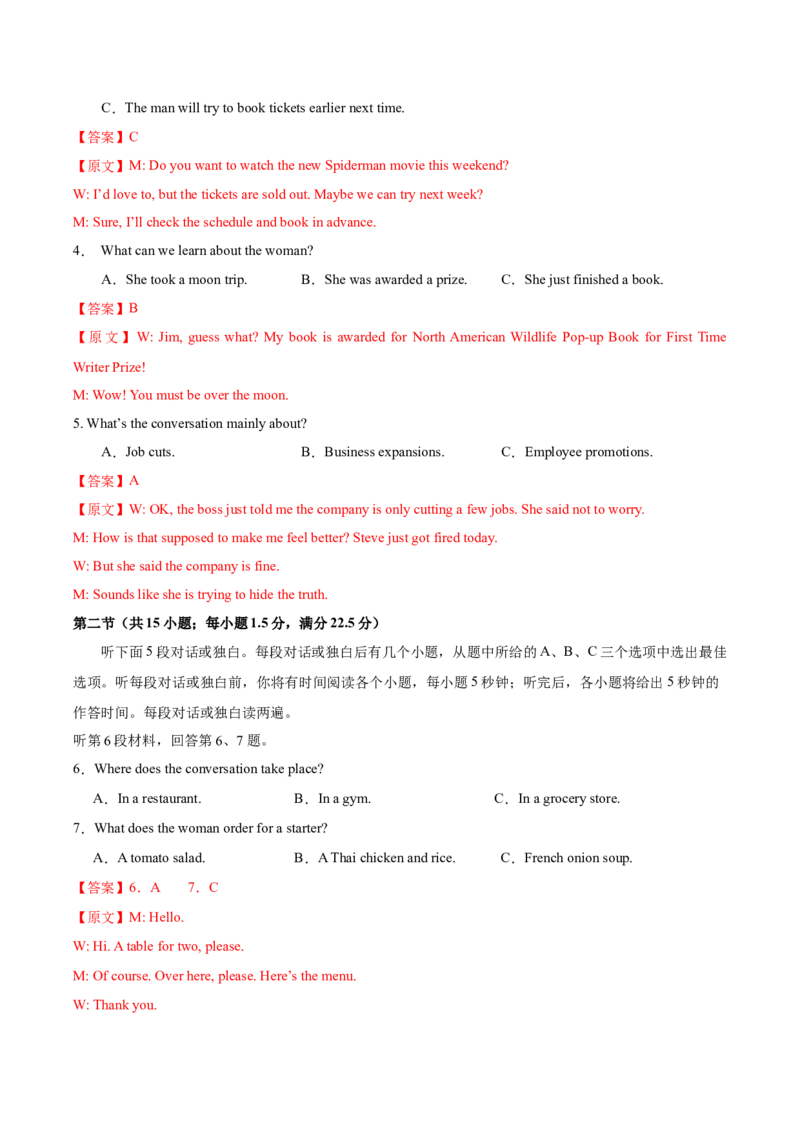
3. What can we infer from the conversation?
A.The woman doesn’t like spiderman movies.
B.The woman prefers to watch movies at home.
C.The man will try to book tickets earlier next time.
【答案】C
【原文】M: Do you want to watch the new Spiderman movie this weekend?
W: I’d love to, but the tickets are sold out. Maybe we can try next week?
M: Sure, I’ll check the schedule and book in advance.
4. What can we learn about the woman?
A.She took a moon trip.
B.She was awarded a prize.
C.She just finished a book.
【答案】B
【原文】W: Jim, guess what? My book is awarded for North American Wildlife Pop-up Book for First Time
Writer Prize!
M: Wow! You must be over the moon.
5. What’s the conversation mainly about?
A.Job cuts.
B.Business expansions.
C.Employee promotions.
【答案】A
【原文】W: OK, the boss just told me the company is only cutting a few jobs. She said not to worry.
M: How is that supposed to make me feel better? Steve just got fired today.
W: But she said the company is fine.
M: Sounds like she is trying to hide the truth.
第二节(共15 小题;每小题1.5 分,满分22.5 分)
听下面5 段对话或独白。每段对话或独白后有几个小题,从题中所给的A、B、C 三个选项中选出最佳
选项。听每段对话或独白前,你将有时间阅读各个小题,每小题5 秒钟;听完后,各小题将给出5 秒钟的
作答时间。每段对话或独白读两遍。
听第6 段材料,回答第6、7 题。
6.Where does the conversation take place?
A.In a restaurant.
     B.In a gym.
       C.In a grocery store.
7.What does the woman order for a starter?
A.A tomato salad.
     B.A Thai chicken and rice.
    C.French onion soup.
【答案】6.A    7.C
【原文】M: Hello.
W: Hi. A table for two, please.
M: Of course. Over here, please. Here’s the menu.
W: Thank you.
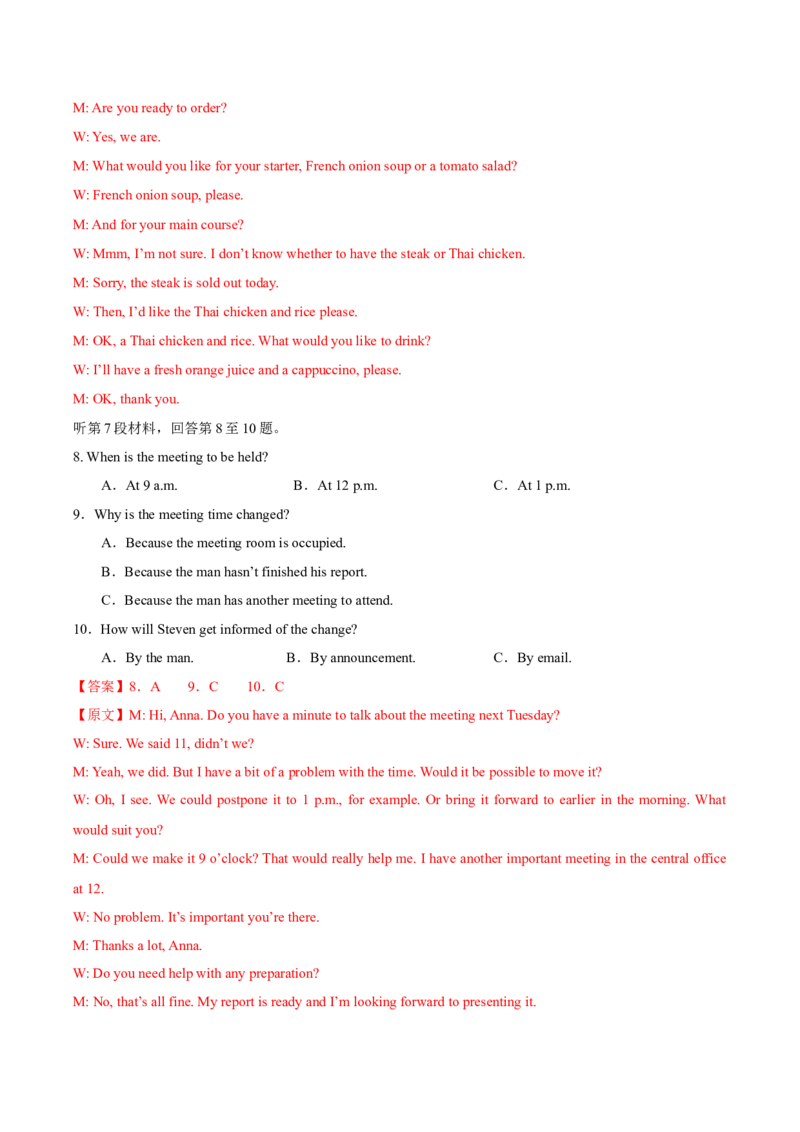
M: Are you ready to order?
W: Yes, we are.
M: What would you like for your starter, French onion soup or a tomato salad?
W: French onion soup, please.
M: And for your main course?
W: Mmm, I’m not sure. I don’t know whether to have the steak or Thai chicken.
M: Sorry, the steak is sold out today.
W: Then, I’d like the Thai chicken and rice please.
M: OK, a Thai chicken and rice. What would you like to drink?
W: I’ll have a fresh orange juice and a cappuccino, please.
M: OK, thank you.
听第7 段材料,回答第8 至10 题。
8. When is the meeting to be held?
A.At 9 a.m.
   B.At 12 p.m.
   C.At 1 p.m.
9.Why is the meeting time changed?
A.Because the meeting room is occupied.
B.Because the man hasn’t finished his report.
C.Because the man has another meeting to attend.
10.How will Steven get informed of the change?
A.By the man.
  B.By announcement.
   C.By email.
【答案】8.A    9.C    10.C
【原文】M: Hi, Anna. Do you have a minute to talk about the meeting next Tuesday?
W: Sure. We said 11, didn’t we?
M: Yeah, we did. But I have a bit of a problem with the time. Would it be possible to move it?
W: Oh, I see. We could postpone it to 1 p.m., for example. Or bring it forward to earlier in the morning. What
would suit you?
M: Could we make it 9 o’clock? That would really help me. I have another important meeting in the central office
at 12.
W: No problem. It’s important you’re there.
M: Thanks a lot, Anna.
W: Do you need help with any preparation?
M: No, that’s all fine. My report is ready and I’m looking forward to presenting it.
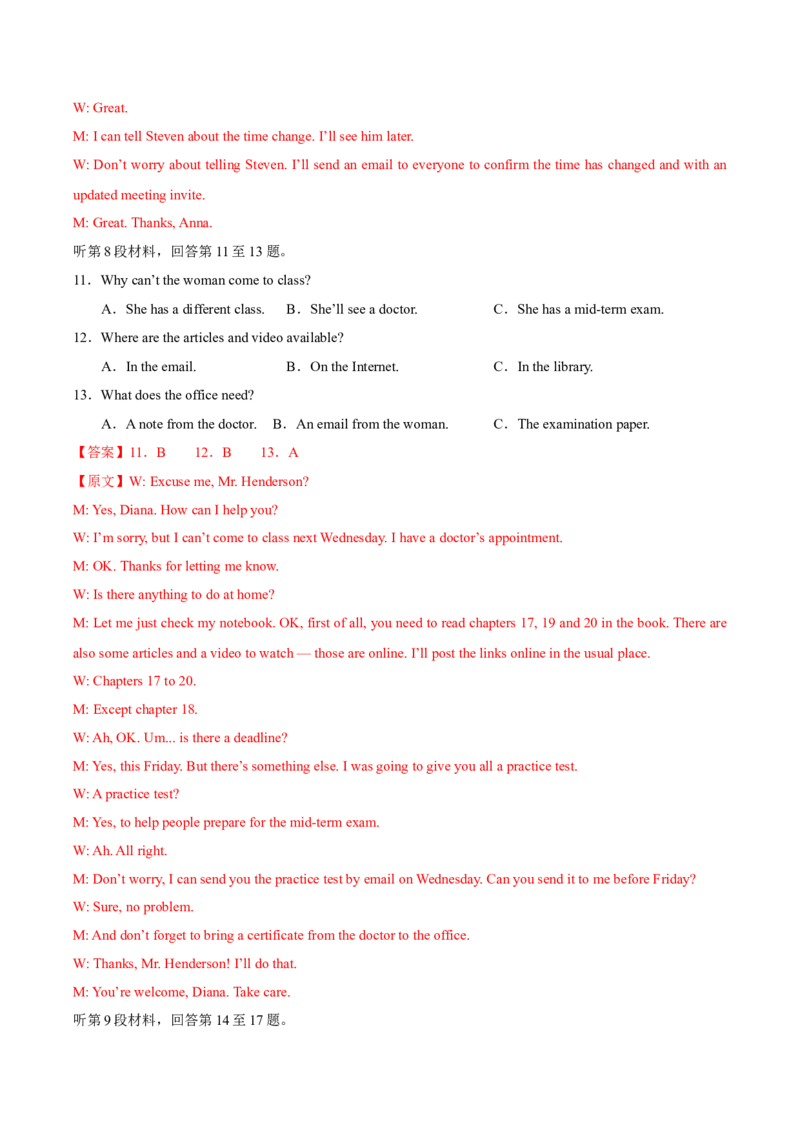
W: Great.
M: I can tell Steven about the time change. I’ll see him later.
W: Don’t worry about telling Steven. I’ll send an email to everyone to confirm the time has changed and with an
updated meeting invite.
M: Great. Thanks, Anna.
听第8 段材料,回答第11 至13 题。
11.Why can’t the woman come to class?
A.She has a different class.  B.She’ll see a doctor.
   C.She has a mid-term exam.
12.Where are the articles and video available?
A.In the email.
  B.On the Internet.

   C.In the library.
13.What does the office need?
A.A note from the doctor.
B.An email from the woman.
   C.The examination paper.
【答案】11.B    12.B    13.A
【原文】W: Excuse me, Mr. Henderson?
M: Yes, Diana. How can I help you?
W: I’m sorry, but I can’t come to class next Wednesday. I have a doctor’s appointment.
M: OK. Thanks for letting me know.
W: Is there anything to do at home?
M: Let me just check my notebook. OK, first of all, you need to read chapters 17, 19 and 20 in the book. There are
also some articles and a video to watch — those are online. I’ll post the links online in the usual place.
W: Chapters 17 to 20.
M: Except chapter 18.
W: Ah, OK. Um... is there a deadline?
M: Yes, this Friday. But there’s something else. I was going to give you all a practice test.
W: A practice test?
M: Yes, to help people prepare for the mid-term exam.
W: Ah. All right.
M: Don’t worry, I can send you the practice test by email on Wednesday. Can you send it to me before Friday?
W: Sure, no problem.
M: And don’t forget to bring a certificate from the doctor to the office.
W: Thanks, Mr. Henderson! I’ll do that.
M: You’re welcome, Diana. Take care.
听第9 段材料,回答第14 至17 题。
14.What does the man decide to do first?
A.Sign up for a yearly membership.
B.Book a personal training session.
C.Choose the monthly membership plan.
15.What is the cost of a single personal training session?
A.25.
B.30.
   C.250.
16.What is included in the gym membership?
A.Access to group classes. B.A discount on yearly plans.
   C.Free personal training sessions.
17.What can we infer about the man?
A.He is new to fitness training.
B.He is only interested in group classes.
C.He prefers flexibility in his membership.
【答案】14. C    15.B    16.A    17.C
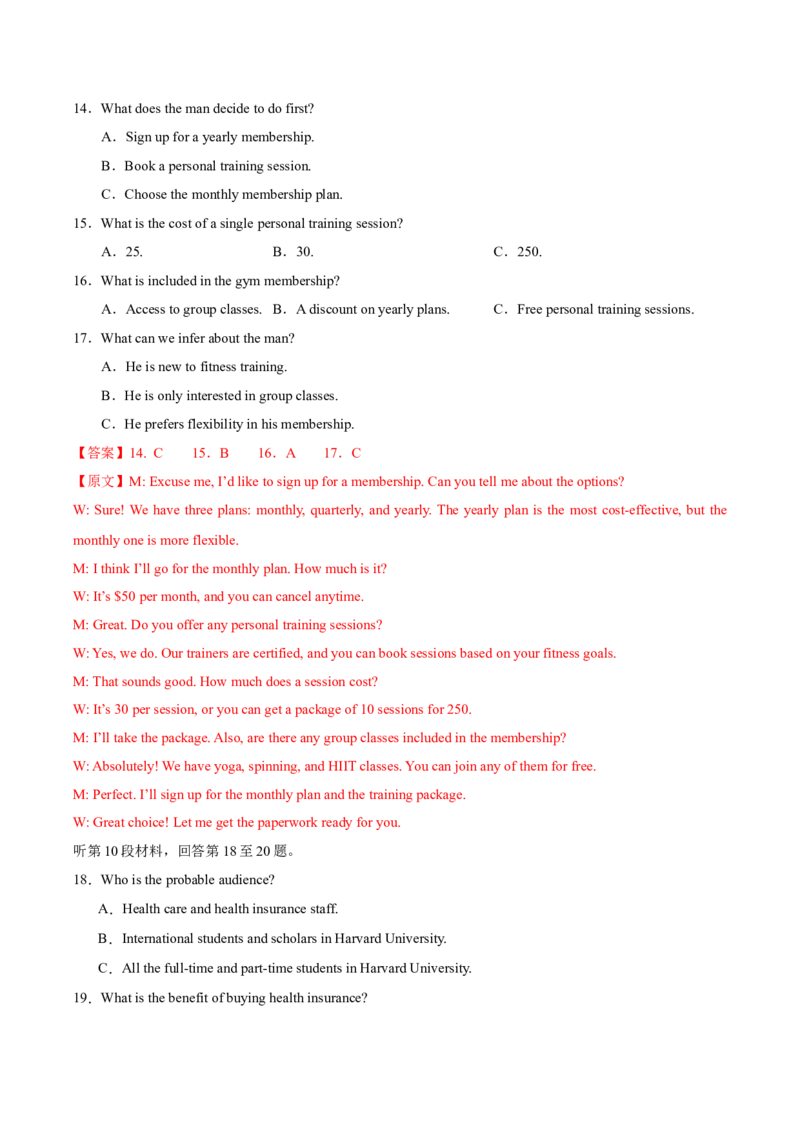
【原文】M: Excuse me, I’d like to sign up for a membership. Can you tell me about the options?
W: Sure! We have three plans: monthly, quarterly, and yearly. The yearly plan is the most cost-effective, but the
monthly one is more flexible.
M: I think I’ll go for the monthly plan. How much is it?
W: It’s $50 per month, and you can cancel anytime.
M: Great. Do you offer any personal training sessions?
W: Yes, we do. Our trainers are certified, and you can book sessions based on your fitness goals.
M: That sounds good. How much does a session cost?
W: It’s 30 per session, or you can get a package of 10 sessions for 250.
M: I’ll take the package. Also, are there any group classes included in the membership?
W: Absolutely! We have yoga, spinning, and HIIT classes. You can join any of them for free.
M: Perfect. I’ll sign up for the monthly plan and the training package.
W: Great choice! Let me get the paperwork ready for you.
听第10 段材料,回答第18 至20 题。
18.Who is the probable audience?
A.Health care and health insurance staff.
B.International students and scholars in Harvard University.
C.All the full-time and part-time students in Harvard University.
19.What is the benefit of buying health insurance?
A.To meet the responsibility.
B.To get all medical cost covered.
C.To get protected against the high medical cost.
20.Who needn’t buy Harvard health plan?
A.International scholars.
B.Visiting professors.
   C.International students.
【答案】18.B    19.C    20.A
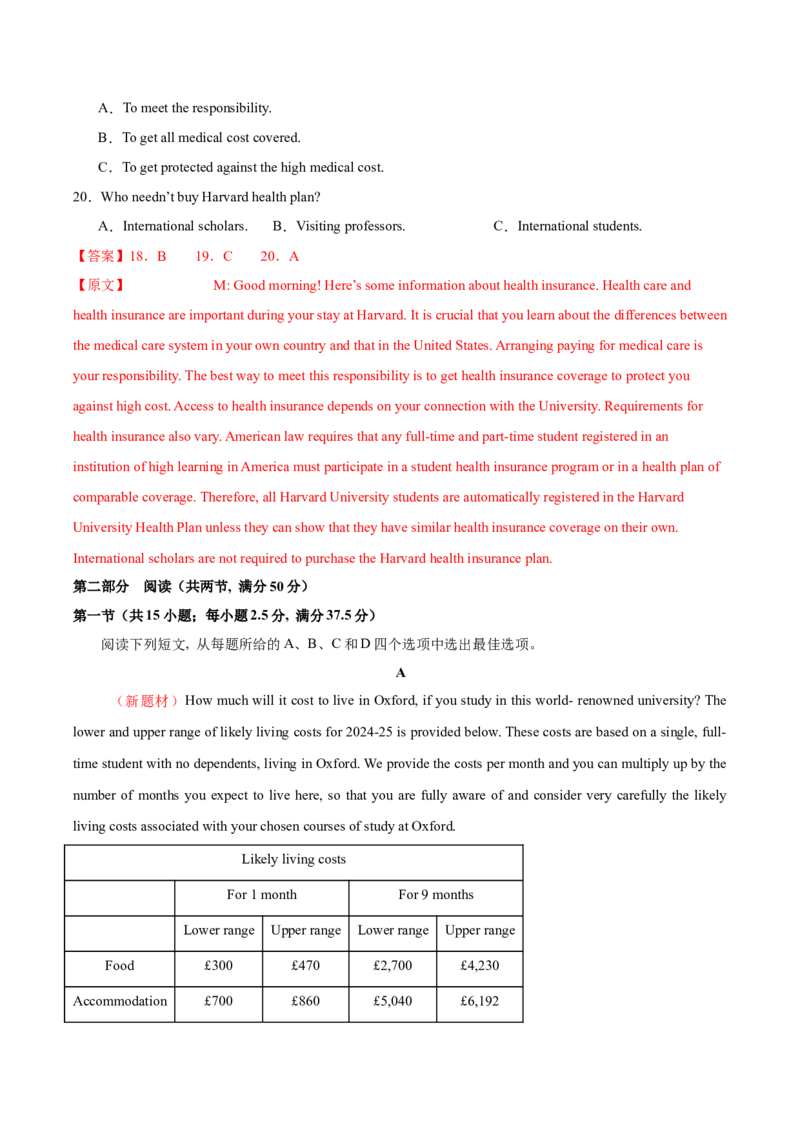
【原文】      M: Good morning! Here’s some information about health insurance. Health care and
health insurance are important during your stay at Harvard. It is crucial that you learn about the differences between
the medical care system in your own country and that in the United States. Arranging paying for medical care is
your responsibility. The best way to meet this responsibility is to get health insurance coverage to protect you
against high cost. Access to health insurance depends on your connection with the University. Requirements for
health insurance also vary. American law requires that any full-time and part-time student registered in an
institution of high learning in America must participate in a student health insurance program or in a health plan of
comparable coverage. Therefore, all Harvard University students are automatically registered in the Harvard
University Health Plan unless they can show that they have similar health insurance coverage on their own.
International scholars are not required to purchase the Harvard health insurance plan.
第二部分  阅读(共两节, 满分50 分)
第一节(共15 小题;每小题2.5 分, 满分37.5 分)
阅读下列短文, 从每题所给的A、B、C 和D 四个选项中选出最佳选项。
A
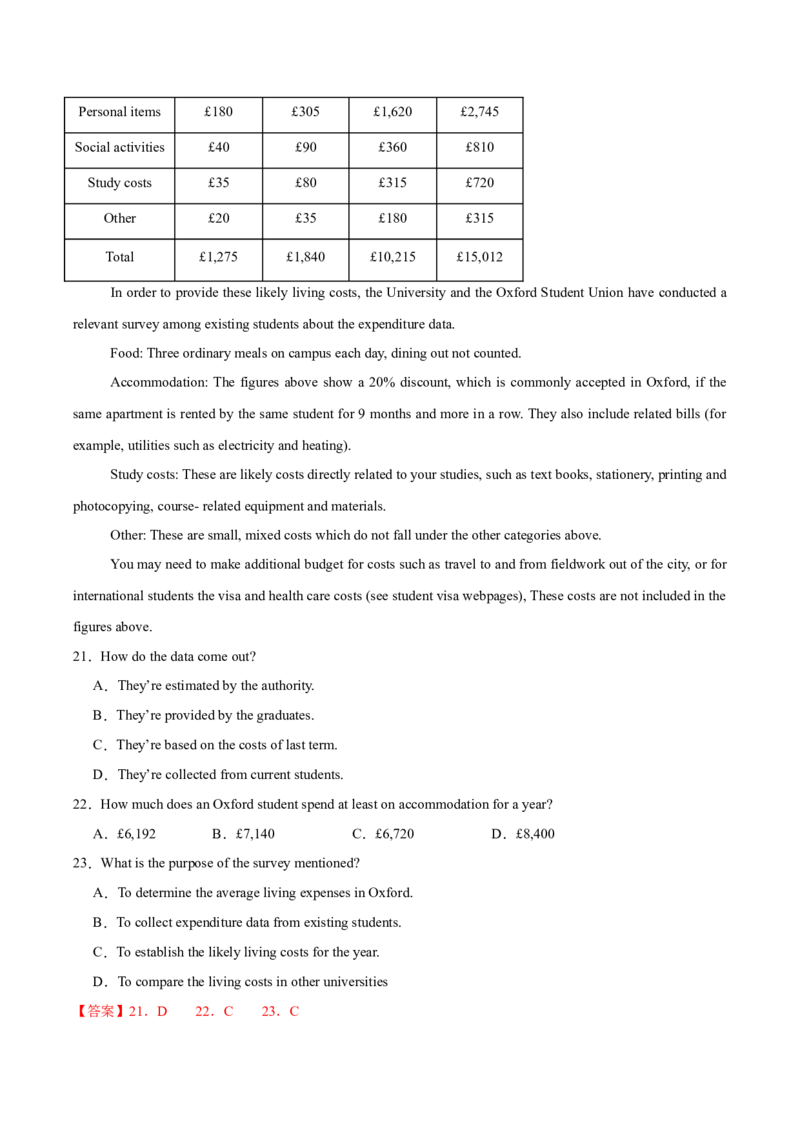
(新题材)How much will it cost to live in Oxford, if you study in this world- renowned university? The
lower and upper range of likely living costs for 2024-25 is provided below. These costs are based on a single, full-
time student with no dependents, living in Oxford. We provide the costs per month and you can multiply up by the
number of months you expect to live here, so that you are fully aware of and consider very carefully the likely
living costs associated with your chosen courses of study at Oxford.
Likely living costs
For 1 month
For 9 months
Lower range
Upper range
Lower range
Upper range
Food
£300
£470
£2,700
£4,230
Accommodation
£700
£860
£5,040
£6,192
Personal items
£180
£305
£1,620
£2,745
Social activities
£40
£90
£360
£810
Study costs
£35
£80
£315
£720
Other
£20
£35
£180
£315
Total
£1,275
£1,840
£10,215
£15,012
In order to provide these likely living costs, the University and the Oxford Student Union have conducted a
relevant survey among existing students about the expenditure data.
Food: Three ordinary meals on campus each day, dining out not counted.
Accommodation: The figures above show a 20% discount, which is commonly accepted in Oxford, if the
same apartment is rented by the same student for 9 months and more in a row. They also include related bills (for
example, utilities such as electricity and heating).
Study costs: These are likely costs directly related to your studies, such as text books, stationery, printing and
photocopying, course- related equipment and materials.
Other: These are small, mixed costs which do not fall under the other categories above.
You may need to make additional budget for costs such as travel to and from fieldwork out of the city, or for
international students the visa and health care costs (see student visa webpages), These costs are not included in the
figures above.
21.How do the data come out?
A.They’re estimated by the authority.
B.They’re provided by the graduates.
C.They’re based on the costs of last term.
D.They’re collected from current students.
22.How much does an Oxford student spend at least on accommodation for a year?
A.£6,192
B.£7,140
C.£6,720
D.£8,400
23.What is the purpose of the survey mentioned?
A.To determine the average living expenses in Oxford.
B.To collect expenditure data from existing students.
C.To establish the likely living costs for the year.
D.To compare the living costs in other universities
【答案】21.D    22.C    23.C
【解析】本文是一篇应用文,主要介绍了在牛津大学学习的生活成本,包括食物、住宿、个人物品、社交
活动、学习成本和其他费用,并提供了一些可能的额外费用。
21.细节理解题。根据表格下文第一段“In order to provide these likely living costs, the University and
the Oxford Student Union have conducted a relevant survey among existing students about the expenditure
data.(为了提供这些可能的生活成本,牛津大学和牛津大学学生会在现有学生中进行了一项有关支出数据的
相关调查。)”可知,这些数据是从当前在校生那里收集的。
22.细节理解题。根据文章表格中的“Accommodation”一行以及“For 1 month”中的“Lower range”
一列所呈现的费用数字可知,一个月中最少得住宿费用是£700;根据文章倒数第四段“Accommodation:
The figures above show a 20% discount, which is commonly accepted in Oxford, if the same apartment
is rented by the same student for 9 months and more in a row. They also include related bills (for
example, utilities such as electricity and heating).).(住宿:上面的数字显示了20%的折扣,这在牛津是普遍
接受的,如果同一套公寓被同一个学生连续租用9 个月或更长时间。它们还包括相关的账单,例如,电费
和暖气等公用事业费用)。”可知,如果同一学生连续9 个月或更长时间租用同一公寓可以获得20%的折扣;
由此可知,牛津大学学生一年的住宿费至少要花6,720 英镑(£700*12-£700*12*20%=£6720)。
23.推理判断题。根据文章第一段“How much will it cost to live in Oxford, if you study in this world-
renowned university? The lower and upper range of likely living costs for 2024-25 is provided below.
These costs are based on a single, full- time student with no dependents, living in Oxford. We provide
the costs per month and you can multiply up by the number of months you expect to live here, so that
you are fully aware of and consider very carefully the likely living costs associated with your chosen
courses of study at Oxford.( 如果你在牛津这所世界著名的大学学习,住在这里要花多少钱?下面列出了
2024-2025 年可能生活费用的上下限。这些费用是根据住在牛津的单身全日制学生计算的,没有家属。我
们提供每月的费用,你可以乘以你预计在这里生活的月数,这样你就能充分了解并仔细考虑你在牛津大学
选择的课程可能带来的生活费用。)”可知,调查的目的是确定这一年可能的生活费用。
B
(新情境)When Liang Wei first joined the Beijing Symphony Orchestra in 1998 as a backup violinist, no
one anticipated the quiet revolution he would bring. The conservatory graduate, often overlooked for his plain
appearance and soft-spoken manner, spent years studying every musician’s part. While others competed for solo
opportunities and public recognition, Liang devoted himself to understanding the orchestra as a complete organism.
Night after night, long after rehearsals ended, he could be found in the dimly lit practice room, diligently studying
each instrumental part and experimenting with different conducting techniques using only a pencil as his baton.
The turning point of Liang’s career came unexpectedly during the orchestra’s 2003 European tour. Minutes
before a scheduled performance of Beethoven’s Fifth Symphony in Vienna’s distinguished Konzerthaus, the
principal conductor fell ill with severe vertigo (眩晕). As panic spread backstage, Liang calmly stepped forward.
What followed was nothing short of mysterious — his economical, almost thoughtful gestures drew from the
orchestra a performance of such depth and clarity that many in the audience wept openly. The normally reserved
Viennese critics credited it as “a revelation of Beethoven’s true intention,” and the twenty-minute standing applause
broke the hall’s records. Yet when journalists rushed to interview this unknown substitute, Liang had already
slipped away, later insisting the credit belonged entirely to the musicians.
In the years that followed, he established the “Listening First” initiative, traveling to remote provinces to
teach underprivileged students his philosophy that “the most important music happens in the silence between
notes.” Liang transformed an abandoned Beijing textile factory into a perfect training center, where he developed
innovative techniques emphasizing collective unity over individual mastery.
Now nearing retirement, Liang remains a mystery in classical music circles. His former students, many now
leading orchestras worldwide, continue to pass on his simple idea: sometimes the quietest voices create the most
enduring echoes.
24.What does the underlined word “baton” mean?
A.A ruler to measure distance.
B.A stick to strike people.
C.A pencil to write something.
D.A tool to instruct people.
25.Why did the audience react to Liang’s performance that way?
A.They were applauding out of politeness.
B.They preferred traditional performances.
C.They acknowledged his artful expression.D
.They were disappointed by the substitute.
26.What did Liang Wei do to practise his thought in Paragraph 3?
A.Train in the real environment.
B.Reject traditional music schools.
C.Commit himself to silent notes.
D.Transform deserted things into use.
27.Which of the following words can best describe Liang Wei?
A.Silent and positive.
B.Confident and humble.
C.Patient and generous.
D.Tolerant and humorous.
【答案】24.D    25.C    26.A    27.B
【解析】本文是一篇记叙文。文章主要讲述了梁伟从一个不起眼的候补小提琴手,通过默默努力和深刻理
解音乐,最终在关键时刻展现出卓越才华,并坚持推广“倾听为先”的音乐理念的故事。
24.词句猜测题。根据第一段中“Night after night, long after rehearsals ended, he could be found in the
dimly lit practice room, diligently studying each instrumental part and experimenting with different
conducting techniques using only a pencil as his baton. (夜复一夜,排练结束很久之后,人们发现他在昏
暗的练习室里,认真地研究每件乐器的分谱,只用一支铅笔作为他的baton,尝试不同的指挥技巧。)”可
知,梁伟用铅笔来尝试练习指挥技巧,说明他没有指挥棒,只能用铅笔代替。由此可知,baton 在这里指
的是指挥乐队用的工具,即指挥棒。
25.推理判断题。根据第二段中“ What followed was nothing short of mysterious — his economical,
almost thoughtful gestures drew from the orchestra a performance of such depth and clarity that many in
the audience wept openly. The normally reserved Viennese critics credited it as “ a revelation of
Beethoven’s true intention,” and the twenty-minute standing applause broke the hall’s records. (随后发
生的堪称奇迹——他那简洁克制、近乎凝思的指挥姿态,竟引导乐团奏出如此深邃清澈的乐章,引得在场
观众纷纷潸然泪下。素来矜持的维也纳乐评人盛赞此为“贝多芬真实创作意图的展现”,长达二十分钟的
起立掌声更创下音乐厅历史纪录。)”可知,观众对梁伟的表演反应如此强烈是因为他们认可他精妙的艺术
表达。
26.推理判断题。根据第三段中“ In the years that followed, he established the “Listening First”
initiative, traveling to remote provinces to teach underprivileged students his philosophy that “the most
important music happens in the silence between notes.” (此后数年间,他创立了“倾听为先”计划,深入
偏远省份向贫困学子传授“最重要的音乐存在于音符间的寂静”这一艺术哲学。)”可知,梁伟践行其理念
的方式是亲身前往实地进行教学。A 选项“在真实环境中进行培训”准确地概括了这种深入现实场景、面
对真实学生进行实践的行为,是其践行音乐哲学核心理念的主要方式。
27 .推理判断题。根据第二段中“ As panic spread backstage, Liang calmly stepped forward. What
followed was nothing short of mysterious — his economical, almost thoughtful gestures drew from the
orchestra a performance of such depth and clarity that many in the audience wept openly. (当恐慌在后台
蔓延时,梁伟从容地走上前台。随后发生的堪称奇迹——他那简洁克制、近乎凝思的指挥姿态,竟引导乐
团奏出如此深邃清澈的乐章,引得在场观众纷纷潸然泪下。)”和“Yet when journalists rushed to
interview this unknown substitute, Liang had already slipped away, later insisting the credit belonged
entirely to the musicians. (然而,当记者们冲去采访这位不知名的替补时,梁已经悄悄离开了,后来他坚
持认为功劳完全属于音乐家们。)”可知,在危急时刻,梁伟从容地走上前台,冷静地站出来指挥,并且取
得了非常出色的成绩,这体现了他的自信;在成功后,面对赞扬和采访,他又悄悄离开,坚持认为功劳属
于音乐家们,这体现了他的谦逊。由此可知,梁伟是一个自信且谦逊的人。
C
(社会热点)As artificial intelligence (AI) takes off, how do we efficiently integrate it into our lives and our
work? Bridging the gap between promise and practice, Jann Spiess, an associate professor at Stanford Graduate
School of Business, is exploring how algorithms (算法) can be designed to most effectively support — rather than
replace — human decision-makers.
“We don’t have much work — yet — that takes design of the human-AI interface really seriously,” says
Spiess. “Our debate about AI and the capabilities of AI is really misplaced, because it’s all about ‘Is AI better than
the human?’”, he continues. “I think instead we should be asking, ‘What are the complementary (互补的) uses of
AI?’”
If users rely too heavily on an algorithm, they may ignore relevant context or information the algorithm may
not know. On the other hand, if users view recommendations as overly complex or irrelevant, they may dismiss
them altogether, forgoing any advantages algorithmic recommendations may provide.
“Therefore, the best algorithm should take into account how a human will interact with the information it
provides,” Spiess says. In a recent paper, Spiess outlines a conceptual (概念的) design framework modeling how
humans respond to algorithmic recommendations — and presents a different approach to building AI tools. This
approach is known as complementarity.
The researchers tested different recommendation strategies in an experiment, where participants made 25
hiring decisions with different levels of algorithmic assistance. People using a complementary algorithm — which
offered selective recommendations in cases where a human was likely to be uncertain or incorrect — made the
most accurate decisions, outperforming those using a purely predictive algorithm and those using no algorithmic
support.
It’s an encouraging result. “There’s much promise around AI improving decisions,” says Spiess, who’s
particularly interested in applications that affect how services are allocated ( 分配) in resource-limited
environments, such as placing teachers in underserved school districts with limited budgets. “If you could use
algorithms to improve resource allocation, there are many high-value use cases in areas where we don’t have ready
or clear solutions,” he says.
28. What is the main issue with current AI debates according to Spiess?
A. Ignoring the potential of AI.
B. Overemphasis on AI’s superiority.
C. Misunderstanding AI’s purpose.
D. Lack of focus on AI’s efficiency.
29. What does the underlined word “forgoing” in paragraph 3 mean?
A. Abandoning.     B. Stressing.     C. Admitting.     D. Assessing.
30. What does Spiess think is the key to effective AI design?
A. Enhancing algorithm complexity.
B. Reducing human dependence on AI.
C. Considering human-AI interaction.
D. Improving AI’s independent capability.
31. What does the experiment on hiring decisions show?
A. Predictive algorithms were the most helpful.
B. Human judgment alone was the most accurate.
C. No algorithmic support was completely the best.
D. Complementary algorithms were highly effective.
【答案】28. B    29. A    30. C    31. D
【解析】这是一篇议论文。文章主要探讨了如何将人工智能(AI)有效地融入我们的生活和工作。斯坦福
大学商学院的副教授Jann Spiess 认为当前关于AI 的讨论过于关注AI 是否优于人类,而应关注AI 与人类
的互补性。他提出了互补性设计框架,并通过实验证明互补性算法在招聘决策中效果最佳,展示了AI 在
资源有限环境中的应用潜力。
28. 细节理解题。根据第二段中““Our debate about AI and the capabilities of AI is really misplaced,
because it’s all about ‘Is AI better than the human?’”, he continues. “I think instead we should be
asking, ‘What are the complementary (互补的) uses of AI?’(“我们对人工智能及其能力的讨论真的是
错位的,因为讨论的都是‘人工智能是否比人类更好’”,他继续说道。“我认为我们应该问的是,‘人
工智能有哪些互补性的用途?’”)”可知,Spiess 认为当前关于AI 的辩论主要问题在于过于强调AI 的优
越性,而没有关注其互补性用途。
29. 词句猜测题。根据第三段中“ If users rely too heavily on an algorithm, they may ignore relevant
context or information the algorithm may not know. On the other hand, if users view recommendations as
overly complex or irrelevant, they may dismiss them altogether, forgoing any advantages algorithmic
recommendations may provide(如果用户过于依赖算法,他们可能会忽略算法可能不知道的相关背景或信息。
另一方面,如果用户认为建议过于复杂或不相关,他们可能会完全忽略这些建议,forgoing 算法建议可能
提供的任何优势)”可知,前后句是对比关系,前半句说用户过于依赖算法会忽略相关信息,后半句说用户
认为建议复杂或不相关就会完全忽略这些建议,也就是不再考虑算法建议可能带来的优势,所以
“forgoing”意思是“放弃”,与A 项“Abandoning”意思一致。
30. 细节理解题。根据第四段中““Therefore, the best algorithm should take into account how a human
will interact with the information it provides,” Spiess says. In a recent paper, Spiess outlines a
conceptual (概念的) design framework modeling how humans respond to algorithmic recommendations—
and presents a different approach to building AI tools. This approach is known as complementarity(“因此,
最佳的算法应当考虑到人类将如何与其所提供的信息进行交互,”施皮斯说道。在最近的一篇论文中,施
皮斯概述了一个概念性的设计框架模型,用于模拟人类对算法推荐的响应方式——并提出了一种构建人工
智能工具的不同方法。这种方法被称为“互补性”)”可知,Spiess 认为有效的人工智能设计的关键在于考
虑人类与人工智能的交互。细节理解题。根据第五段中“People using a complementary algorithm —
which offered selective recommendations in cases where a human was likely to be uncertain or incorrect
— made the most accurate decisions, outperforming those using a purely predictive algorithm and those
using no algorithmic support(使用互补性算法的人——在人类可能不确定或错误的情况下提供选择性建议
——做出了最准确的决策,优于使用纯粹预测性算法的人和不使用算法支持的人)”可知,关于招聘决策的
实验表明,互补性算法非常有效。
D
(社会热点)What makes a genius? We might say it’s a combination of extraordinary talent and drive,
often accompanied by madness. Thomas Edison, Albert Einstein and Pablo Picasso all made pioneering
breakthroughs in their respective fields while living legendary lives. Helen Lewis’s The Genius Myth, however,
argues that society wrongly admires figures like them. She claims the “genius” label excuses immoral behaviours
— alcoholism, abandonment, drug abuse. But does her criticism really make sense?
In her book, Lewis links the idea of innate (天生的) genius to the harmful history of intelligence testing.
This field, started by figures like Francis Galton, is connected to racism. She criticises his later following thinkers,
like Hans Eysenck and William Shockley, for their ignoring social factors affecting success for supporting racial
rankings. For them, she suggests, “genius” becomes a cover on extreme or even evil thinking, a characteristic
increasingly seen in some online fans.
Her solution? Stop admiring individuals. Call specific works genius, not people. But I question whether the
public really believes this “genius myth” as desperately as Lewis insists. Her sweeping statements about “our”
blind love for “troublesome individuals” feel forced — like she’s projecting her own views on everyone else.
The book has significant drawbacks. Lewis essentially invents a term “weak model of genius” to dress up a
long-known obvious point — imperfect people can be talented — as new insight. It feels like she’s selling a cure
for a disease she invented. Besides, her attempts at a friendly, TED-Talk-inspired style feel awkward rather than
genuine. The heavy use of italics ( 斜体字) makes the writing feel struggled, as if she is trying too hard to
convince both readers and herself.
More troubling is the disrespectful attitude towards complex art that surfaces in Lewis’s writing. Her rude
view on Joyce’s literature (“what-if novels, but harder to read”), her dislike for pioneering films, and her confession
of finding the Beatles music “boring” imply that her problem with “genius” might partly be a personal hate for
difficult art and its creators. Worse still, these dislikes go without strong proof. Her unjust claim that Picasso is
admired because of his imperfection, not despite them, reads more like an angry opinion than reasoned argument.
While some online fans might admire some superstars uncritically, true faith in innate genius has been
weaker since the 1960s. Lewis jumps on a train that is already slowing.
32.According to The Genius Myth, Helen Lewis would most likely agree that ______.
A.people like Picasso have never made any real achievements
B.some figures’ evil behaviors are excused by the word “genius”
C.many so-called geniuses cannot pass intelligence testing
D.nothing in this world is worth the genius label
33.What does the writer think of the Genius Myth?
A.Its writing style is engaging, sincere and humble.
B.“The weak model of genius” is an innovative term.
C.Its criticism of the “genius myth” lacks evidence.
D.It fails to explain the root cause of people’s passion for genius.
34.What does the underlined sentence in the last paragraph imply?
A.Lewis is criticizing an idea that is no longer influential.
B.Lewis’s book is thoughtful despite some drawbacks.
C.Lewis’s criticism is fresh but faces the public’s resistance.
D.Lewis is aware that the public’s faith in genius is declining.
35.What is the main idea of the passage?
A.Society’s admiration for geniuses is dangerous.
B.Lewis criticism of “the genius myth” is unconvincing.
C.The public should hold a critical view on geniuses.
D.Specific works instead of people should be admired.
【答案】32.B    33.C    34.A    35.B
【解析】这是一篇说明文。本文介绍《天才神话》对“天才”标签的批判,却指出该书观点主观、缺依
据、文风生硬,其批判的观念已无强影响力,整体论证缺乏说服力。
32 .细节理解题。根据第一段“ Thomas Edison, Albert Einstein and Pablo Picasso all made pioneering
breakthroughs in their respective fields while living legendary lives. Helen Lewis’s The Genius Myth, however,
argues that society wrongly admires figures like them. She claims the “genius” label excuses immoral behaviours
— alcoholism, abandonment, drug abuse.(托马斯·爱迪生、阿尔伯特·爱因斯坦和巴勃罗·毕加索在各自的领域
都取得了开创性的突破,同时他们的人生也充满了传奇色彩。然而,海伦·刘易斯所著的《天才的神话》却
认为,社会错误地推崇了像他们这样的人物。她声称,“天才”这一称号会为不道德的行为开脱——比如
酗酒、遗弃、吸毒)”可知,根据《天才神话》一书,海伦·刘易斯很可能会认同这样的观点:某些人物的恶
劣行为之所以会被原谅,是因为他们具有“天才”这一特质。
33.细节理解题。根据最后一段“Worse still, these dislikes go without strong proof. Her unjust claim that
Picasso is admired because of his imperfection, not despite them, reads more like an angry opinion than reasoned
argument.(更糟糕的是,这些不满并没有充分的证据支持。她那种毫无根据地声称毕加索之所以受到喜爱是
因为他的不完美之处,而非尽管有这些不完美之处才受到喜爱的观点,更像是愤怒的言论而非理性的论
证)”可知,作者认为这本书对“天才神话”的批判缺乏依据。
34.句意猜测题。根据划线词上文“While some online fans might admire some superstars uncritically, true
faith in innate genius has been weaker since the 1960s.(虽然一些网络粉丝会不加批判地追捧某些巨星,但自
20 世纪 60 年代以来,人们对 “天赋型天才” 的盲目崇拜已经有所减弱。)”可知,自20 世纪60 年代
起,人们对‘天赋型天才’的笃信已大幅减弱”,即说明刘易斯是在批评一种已不再具有影响力的观念。
故划线意思是“刘易斯是在批评一种已不再具有影响力的观念”。
35.主旨大意题。根据最后一段“Worse still, these dislikes go without strong proof. Her unjust claim that
Picasso is admired because of his imperfection, not despite them, reads more like an angry opinion than reasoned
argument.以及文章先引出 Lewis《天才神话》的核心观点(批判“天才”标签、否定对天才个体的崇
拜),再从观点主观性(将自身看法强加于人)、术语无创新性(包装旧观点)、文风生硬(刻意说服读
者)、批判无依据(对艺术和天才的评价缺乏论证)、批判对象过时(所批判的观念已无强影响力)等多
维度,论证其观点缺乏说服力。故这篇文章的主要观点是刘易斯关于“天才神话”的批评缺乏说服力。
第二节(共5 小题;每小题2. 5 分, 满分12. 5 分)
阅读下面短文, 从短文后的选项中选出可以填入空白处的最佳选项。选项中有两项为多余选项。
Some of the oldest living things on our remarkable planet are trees. The record holders are bristlecone pines
(狐尾松) of the western United States, quite a few of which are known to be more than 3,000 years old. One
individual, discovered in 2012, is estimated to be more than 5,060 years old, making it the oldest known non-clonal
tree in the world!

 36


 : individuals across a number of other tree species have also been around for
thousands of years.
So, how do trees survive for thousands of years?

 37


 . Undoubtedly, part of the answer lies in luck.
Ancient trees have obviously not submitted to deadly diseases, pests, fires, droughts, windstorms, landslides, or the
human axe in the centuries and centuries that they have quietly endured.
The other part of the answer has to do with how trees age. In fact, there is quite a debate about whether
ancient trees can be considered “immortal (永生的)”. That is, will such trees ever die if they are not killed by an
outside force? We may never know the answer to that, but, at the very least,

 38


 . While cell death is an
important factor in the aging of humans and other animals, one study found little evidence of cell death in the
ginkgo tree vascular cambium (银杏树维管形成层). In addition, a study of bristlecone pine pollen (花粉) found no
significant increase in mutation (变异) rates with age, which is another factor associated with animal aging.
39


 .
Older trees benefit greatly from having bodies made mostly of dead woody tissue. In fact, an old tree might
be as much as 95 percent dead tissue! Given that it isn’t alive, wood does not require metabolic ( 新陈代谢的)
activity to maintain it,

 40


 .
A.so an old tree doesn’t really need to do much to keep living
B.This is a question that has something to do with the good luck of trees
C.However, bristlecones are certainly not alone in terms of the oldest creatures
D.This is a fascinating question for biologists that does not yet have a settled answer
E.What’s more, some ancient trees have superior chemical defenses against pests and diseases
F.which means that trees can survive everywhere without being limited by external and internal conditions
G.we know that ancient trees age in ways that are dramatically different from the ways that most animals
and even other plants age
【答案】36.C    37.D    38.G    39.E    40.A
【解析】这是一篇说明文。文章主要说明了古树寿命长的原因。
36.由上文“The record holders are bristlecone pines (狐尾松) of the western United States, quite a few of which
are known to be more than 3,000 years old. One individual, discovered in 2012, is estimated to be more than 5,060
years old, making it the oldest known non-clonal tree in the world! (在我们这个非凡的星球上,一些最古老的生
物是树木。纪录保持者是美国西部的狐尾松,其中相当一部分的树龄已经超过3000 年。2012 年发现的一
棵树估计有5060 多岁,是世界上已知最古老的非克隆树!)”和后文“but also about being a good listener (许
多其他树种的个体也已经存在了数千年)”可知,此处表示不是只有狐尾松古老。故C 选项“However,
bristlecones are certainly not alone in terms of the oldest creatures (然而,就最古老的生物而言,狐尾松肯定不
是唯一的)”能承上启下,符合题意。
37.由上文“So, how do trees survive for thousands of years?(那么,树木是如何存活数千年的呢?)”及下文
“Undoubtedly, part of the answer lies in luck. Ancient trees have obviously not submitted to deadly diseases,
pests, fires, droughts, windstorms, landslides, or the human axe in the centuries and centuries that they have quietly
endured. (毫无疑问,部分原因在于运气。古树显然没有屈服于致命的疾病,害虫,火灾,干旱,风暴,山
体滑坡,或人类的斧头在他们默默地忍受了一个又一个世纪)”可知,树木是如何存活数千年,目前还没有
确定的答案。故D 选项“This is a fascinating question for biologists that does not yet have a settled answer(对于
生物学家来说,这是一个令人着迷的问题,目前还没有一个确定的答案)”能承上启下,符合题意。
38.由上文“The other part of the answer has to do with how trees age. (答案的另一部分与树木如何老化有
关)”可知,本空要说跟“如何老化”有关的话题,和上文“We may never know the answer to that, but, at the
very least(我们可能永远不会知道答案,但至少)”可知,前文说不知道的事情,本空说至少知道的一件事,
且与“如何老化”有关,故G 选项“we know that ancient trees age in ways that are dramatically different from
the ways that most animals and even other plants age (我们知道,古树的衰老方式与大多数动物甚至其他植物
的衰老方式截然不同)”能承上启下,符合题意。
39.由上文“In addition, a study of bristlecone pine pollen (花粉) found no significant increase in mutation (变
异) rates with age, which is another factor associated with animal aging. (此外,一项对狐尾松花粉的研究发
现,突变率没有随着年龄的增长而显著增加,这是与动物衰老有关的另一个因素)”可知,此处在讲述古树
自身所具有的特性,故E 选项“What’s more, some ancient trees have superior chemical defenses against pests
and diseases (此外,一些古树对病虫害有很好的化学防御能力)”能承接上文,符合题意。
40.由上文“Older trees benefit greatly from having bodies made mostly of dead woody tissue. In fact, an old tree
might be as much as 95 percent dead tissue! Given that it isn’t alive, wood does not require metabolic ( 新陈代谢
的) activity to maintain it, (老树的身体主要由死亡的木质组织构成,这对它们大有好处。事实上,一棵老树
的坏死组织可能高达95% !鉴于它不是活的,木材不需要代谢活动来维持它)”可知,老树不需要新陈代
谢,故A 选项“so an old tree doesn’t really need to do much to keep living (所以一棵老树其实不需要做什么来
维持生命)”能承接上文,符合题意。
第三部分 语言运用(共两节,满分30 分)
第一节(共15 小题,每小题1 分,满分15 分)
阅读下面短文, 从每题所给的A、B、C 和D 四个选项中选出可以填入空白处的最佳选项。
The leather jacket is age-worn and soft. I found it

 41


  in the window of a shop in Brighton, England.
I was there to deliver a talk at an international conference, a PhD student eager to

 42


  a name for herself
and waiting for her career life to

 43


 .
The jacket became my

 44


  one — I wore it everywhere I went. I was always quite determined then.
I had a five-year plan and was sticking to it! I was a woman who couldn’t

 45


  time to visit her grandmother,
who

 46
       missed her nieces’ and nephews’ birthday parties, and who left and didn’t look back.
There was a(n)

 47
       that happened a few years into the five-year plan, when things were going well, and
items were successfully being ticked off the list. Each time one goal post was

 48


 , another took its place.
One day I started to

 48


  whether it would result in any real

 50


  other than an unshakable ability to
give up everything else along the way. I realized I didn’t want the same things anymore. The jacket moved to the
back of the

 51


 .
Seven years later, as I stand in front of my wardrobe filled with

 52


  clothes I couldn’t part with, I
don’t know what to do with the jacket. I take it out and let it fall heavily on the bed. Yet, despite its uselessness and
how much space it

 53


 , at the last moment I

 54


  the leather jacket to the wardrobe. I think it will
always stand for a part of myself that I’m not quite willing to give up forever- that

 55


 , motivated woman.
41.A.fading
B.reflecting
C.hanging
D.hiding
42.A.take
B.make
C.share
D.pick
43.A.proceed
B.protect
C.start
D.value
44.A.popular
B.common
C.favourite
D.lucky
45.A.keep
B.give
C.save
D.spare
46.A.regularly
B.rarely
C.desperately
D.occasionally
47.A.accident
B.change
C.challenge
D.action
48.A.scored
B.set
C.reached
D.touched
49.A.doubt
B.distrust
C.imagine
D.hesitate
50.A.influence
B.success
C.experience
D.consequence
51.A.dresser
B.closet
C.wardrobe
D.house
52.A.new
B.torn
C.useless
D.plain
53.A.takes up
B.fills in
C.fights for
D.locks up
54.A.refund
B.return
C.hold
D.back
55.A.ambitious
B.daring
C.imaginative
D.engaging
【答案】
41.C    42.B    43.C    44.C    45.D    46.A    47.B    48.C    49.A    50.B
51.C    52.C    53.A    54.B    55.A
【解析】本文是一篇记叙文。主要讲述了作者在英国布莱顿购入一件皮夹克,它见证了作者曾追求事业的
雄心,后来作者转变心态不再执着过往目标,但仍留着皮夹克纪念那个有抱负的自己。
41.考查动词词义辨析。句意:我在英国布莱顿一家商店的橱窗里发现它正挂在那里。A. fading 褪色;B.
reflecting 反射;C. hanging 悬挂;D. hiding 隐藏。根据下文以及常识可知,皮夹克是挂在商店橱窗里的。
42.考查动词词义辨析。句意:我去那里是在一个国际会议上发表演讲,作为一名渴望成名的博士生,等
待着自己的职业生涯开始。A. take 拿;B. make 制造;C. share 分享;D. pick 挑选。根据上文以及语境可知,
此处表示作者去发表演讲,渴望成名,make a name for oneself 是固定短语,意为“成名,出名”。
43.考查动词词义辨析。句意:我去那里是在一个国际会议上发表演讲,作为一名渴望成名的博士生,等
待着自己的职业生涯开始。A. proceed 继续;B. protect 保护;C. start 开始;D. value 重视。根据上文可知,
此处表示作者去发表演讲,渴望成名,等待职业生涯开始。
44.考查形容词词义辨析。句意:这件夹克成了我最喜欢的一件——我走到哪儿都穿着它。A. popular 受
欢迎的;B. common 常见的;C. favourite 最喜欢的;D. lucky 幸运的。根据下文可知,作者走到哪儿都穿
这件夹克,说明它是作者最喜欢的。
45.考查动词词义辨析。句意:我是一个不能抽出时间去看望祖母的、经常错过侄女和侄子的生日聚会的、
离开了就没有回头的女人。A. keep 保持;B. give 给;C. save 拯救;D. spare 抽出。根据下文可知,此处表
示作者很忙碌,不能抽出时间去看望祖母,spare time to do sth.是固定短语,意为“抽出时间做某事”。
46.考查副词词义辨析。句意:我是一个不能抽出时间去看望祖母的、经常错过侄女和侄子的生日聚会的、
离开了就没有回头的女人。A. regularly 定期地;B. rarely 很少地;C. desperately 绝望地;D. occasionally 偶
尔地。根据上文“I was a woman who couldn’t   time to visit her grandmother,”可推知,作者很忙,所以此处
表示作者会经常错过侄子侄女们的生日聚会。
47.考查名词词义辨析。句意:在五年计划的头几年里,当事情进展顺利,清单上的项目都成功完成时,
发生了一个变化。A. accident 事故;B. change 变化;C. challenge 挑战;D. action 行动。根据下文可知,作
者的想法改变了,所以此处表示发生了一个变化。故选B。
48.考查动词词义辨析。句意:每次达到一个目标,另一个就会取代它的位置。A. scored 得分;B. set 设
置;C. reached 到达,达到;D. touched 触摸。根据下文可知,此处表示达到目标后另一个目标又出现,
reach one goal post 表示达到一个目标。
49.考查动词词义辨析。句意:有一天,我开始怀疑,除了在过程中放弃其他一切的不屈不挠的能力之外,
这是否会带来任何真正的成功。A. doubt 怀疑;B. distrust 不信任;C. imagine 想象;D. hesitate 犹豫。根据
下文可知,作者开始对自己的做法产生怀疑。
50.考查名词词义辨析。句意:有一天,我开始怀疑,除了在过程中放弃其他一切的不屈不挠的能力之外,
这是否会带来任何真正的成功。A. influence 影响;B. success 成功;C. experience 经历;D. consequence 结
果。根据上文“I had a five-year plan and was sticking to it”以及语境可知,作者原本制定了计划并一直坚持,
但是现在作者产生了怀疑,这样是否能带来真正的成功。故选B。
51.考查名词词义辨析。句意:这件夹克被放到了衣柜的后面。A. dresser 梳妆台;B. closet 壁橱;C.
wardrobe 衣柜;D. house 房子。根据下文可知,作者将夹克放到了衣柜后面。
52.考查形容词词义辨析。句意:七年后,当我站在衣柜前,满是我舍不得的无用衣服时,我不知道该怎
么处理这件夹克。A. new 新的;B. torn 撕破的;C. useless 无用的;D. plain 朴素的。根据下文可知,此处
表示作者的无用的衣服。
53.考查动词短语辨析。句意:然而,尽管它没用,还占了很多空间,但在最后一刻,我还是把皮夹克放
回了衣柜。A. takes up 占据;B. fills in 填写;C. fights for 为……而战;D. locks up 锁上。根据上文可知,
此处表示夹克占据了很多空间。
54.考查动词词义辨析。句意:然而,尽管它没用,还占了很多空间,但在最后一刻,我还是把皮夹克放
回了衣柜。A. refund 退款;B. return 返回;C. hold 握住;D. back 后退。根据下文可知,作者把皮夹克放回
衣柜。
55.考查形容词词义辨析。句意:我想它永远代表着我内心不愿永远放弃的一部分——那个有抱负的、积
极进取的女人。A. ambitious 有抱负的;B. daring 大胆的;C. imaginative 富有想象力的;D. engaging 迷人
的。根据上文“I was there to deliver a talk at an international conference, a PhD student eager to  a name for
herself and waiting for her career life to .”以及“I had a five-year plan and was sticking to it!”可知,作者曾经渴
望成名,制定计划并一直坚持,所以此处表示作者是有抱负的。
第二节(共10 小题;每小题1.5 分 ,满分15 分)
阅读下面短文,在空白处填入1 个适当的单词或括号内单词的正确形式。
(新题材)It’s not yet 6 a.m., but the lights aboard a fishing boat in the port of Huangsha, a village in Zhejiang
Province on China’s eastern coast,

 5  6

 (be) already on. Huang Zhongjiao, 61, is up early to make breakfast for
5  7

 (he) and his shipmate, Lin Taidao, 64. The boat,

 5  8
  (former) used for commercial fishing, has been
renamed

 5  9      (reflect) its new function: to provide “recreational fishing” trips for tourists.
There are six of these boats in the port at Huangsha, all

 60
      (own) by Fishingland. Tour groups book a boat
for a day. They then sail to a site five kilometres offshore,

 61
       they watch two crew members catch fish while
another operates the boat. The tourists get a close-up fishing experience and a few fish to take home at the end.
“Our busy period is from May to October. That’s when we get

 62
       most clients. So far, we’ve taken 2,000
people out this year,” says Huang.
Huangsha is a typical fishing village. At its peak it was home

 63
       more than 20 fishing boats. But many
64


 (fisherman) are back on dry land doing different jobs. Huang is positive about the change. “In the past, it was
normal to be away from home for months. Now, I leave home each morning with a

 65

  (certain) that I’ll get
home each night.”
【答案】
56. are
57. himself     58. formerly    59. to reflect     60. owned
61. where    62. the
  63. to
64. fishermen    65. certainty
【解析】本文是一篇记叙文,介绍了中国东部沿海浙江省黄沙村的渔业转型故事。
56. 考查动词时态和主谓一致。句意:还不到早上6 点,但中国东部沿海浙江省黄沙村港口的一艘渔船上,
灯光已经亮了。此处描述当前的状态(灯光已开启),应用一般现在时;主语the lights 为复数,谓语动词
用复数形式are。
57. 考查反身代词。句意:61 岁的王忠脚早早起床,为自己和64 岁的船员林台岛做早餐。此处主语为
Huang Zhongjiao,宾语与主语指代同一人,应用反身代词himself,意为“他自己”。
58. 考查副词。句意:这艘船以前用于商业捕鱼,现已更名以体现其新功能——为游客提供“休闲垂钓”
服务。此处修饰动词used,应用副词形式,former 的副词为formerly,意为“以前,从前”。故填
formerly。
59. 考查非谓语动词。句意:这艘船以前用于商业捕鱼,现已更名以体现其新功能——为游客提供“休闲
垂钓”服务。此处应用不定式作目的状语,说明“更名”的目的是“体现新功能”,故填to reflect。
60. 考查非谓语动词。句意:黄沙港共有六艘这样的船,均为“渔乐天地”(Fishingland)所有。此处为
非谓语动词作后置定语,own(拥有)与逻辑主语all(指代six boats)之间是被动关系(船被拥有),应
用过去分词owned。
61. 考查定语从句。句意:然后他们航行到五公里外的海域,在那里观看两名船员捕鱼,另一名船员操控
船只。此处引导非限制性定语从句,先行词为a site five kilometres offshore(五公里外的海域),关系词
在从句中作地点状语,应用关系副词where。
62. 考查冠词。句意:那是我们客源最多的时候。此处修饰形容词最高级most(最多的),应用定冠词
the,固定搭配“the most + 名词”表示“最多的……”。
63. 考查介词。句意:在鼎盛时期,这里有20 多艘渔船。此处为固定搭配“be home to”,意为“是……
的所在地/家园”,故填to。
64. 考查名词复数。句意:但许多渔民已上岸从事不同的工作。此处由many 修饰,应用名词fisherman 的
复数形式fishermen,意为“渔民们”。故填fishermen。
65. 考查名词。句意:现在,我每天早上出门时都能确定晚上会回家。此处作介词with 的宾语,应用名词
形式,certain 的名词为certainty,意为“确定性”,为不可数名词。故填certainty。荣反映了中国社会的稳
定与昌盛。此处引导限制性定语从句,先行词为drum culture,关系代词作定语。
第四部分 写作(共两节, 满分40 分)
第一节(满分15 分)
假设你是校学生会主席李华。近期调查显示,部分同学因过度依赖社交媒体出现注意力分散及人际关
系疏离等问题。请你代表学生会在校英文报上写一封倡议书,内容包括:
1. 陈述现象;
2. 提出措施;
3. 发出呼吁。
注意:
1. 写作词数应为80 词左右;
2. 请在答题卡的相应位置作答。
Say No to Digital Overload
Dear Fellow Students,
____________________________________________________________________________________________
____________________________________________________________________________________________
【参考范文】
Say No to Digital Overload
Dear Fellow Students,
Recent surveys reveal that excessive social media use has caused distraction in studies and weakened real-
life interactions.
To address this, we propose: Firstly, limit daily screen time to focus on in-person communication. Secondly,
join offline clubs to rebuild genuine friendships. Let’s prioritize face-to-face talks during breaks instead of scrolling
phones.
Remember, real connections thrive beyond screens. Together, we can create a more engaged campus life!
the Students’ Union
【写作解析】本篇书面表达属于应用文。要求考生以学生会主席李华的身份,针对学生过度依赖社交媒体
的问题,在校英文报上撰写一封结构清晰、语言正式的倡议书,包含现象陈述、措施建议和呼吁行动三部
分。
1.词汇积累
解决:address → tackle
提议:propose → suggest
专注于:focus on → concentrate on
真正的:genuine → authentic
2.句式拓展
简单句变复合句
原句:Firstly, limit daily screen time to focus on in-person communication.
拓展句:Firstly, limit daily screen time, so that we can focus on in-person communication.
【点睛】【高分句型1】Recent surveys reveal that excessive social media use has caused distraction in studies
and weakened real-life interactions.(运用了that 引导的宾语从句)
【高分句型2】Firstly, limit daily screen time to focus on in-person communication.(运用了不定式to focus on
作目的状语)
第二节(满分25 分)
阅读下面材料,根据其内容和所给段落开头语续写两段,使之构成一篇完整的短文。
 It was a cold, snowy evening. Tommy was running as fast as he could, focused on nothing but his
destination —the shop on the street corner. Two weeks ago he saw figurines (小塑像) of Marvel superheroes on the
shelves and felt he had to have one. He has been walking the neighbor’s dog ever since then to earn money to fulfil
his little dream. He was so excited and barely noticing the world around him. Maybe that’s why he tripped over the
legs of a homeless woman, who was sitting on the pavement, her back against the wall. He said “sorry” and moved
on to his destination.
Once he entered the shop, he went straight to the shelves with figurines. Hulk, Thor, Captain America, Iron
Man, and many more — all of his admired heroes. With his heart pounding like crazy he reached for Spiderman.
“You like these, true believer?”
Tommy turned around. An old man was standing behind him with a wide smile on his face.
“Y-yes,… Yes, they’re awesome! ”answered Tommy. “They’re strong and fast and help other people a lot ...”
the boy looked at figurines in admiration. “I wish I could be a superhero too.”
“Then become one!” said the old man.
“How?” Tommy asked in surprise “I don’t have any superpowers.”
“And why would you need them?” the old man smiled. Seeing the confusion on the boy’s face, he put his
hands on Tommy’s arms. “Did you know that shopkeeper lady over there has a disabled husband? She has been
working hard and taking care of him for years. I have never heard a word of complaint from her. And this
person...”he pointed at a redhead man, who just entered the shop. “He’s a firefighter; he’s saved countless lives. He
never gives up, no matter how dangerous the situation seems to be.”
The old man looked Tommy in the eyes and smiled. “You don’t need a superpower to be a hero for someone
else. The path of a superhero starts not in the mind, not in the muscles, but in the heart.”
注意:1.续写词数应为 150 左右;
2.请按如下格式在相应位置作答。
Tommy listened intently, his eyes wide with wonder and realization.
____________________________________________________________________________________________
____________________________________________________________________________________________
____________________________________________________________________________________________
Tommy stepped back out into the snowy evening and approached the homeless woman.
____________________________________________________________________________________________
____________________________________________________________________________________________
____________________________________________________________________________________________
【参考范文】
 Tommy listened intently, his eyes wide with wonder and realization. The old man’s words resonated deeply
within him, and for a moment, he felt a surge of warmth that seemed to counteract the coldness of the evening
outside. “But how can I be a hero?” Tommy asked himself, his voice filled with a mix of curiosity and a budding
sense of responsibility. Suddenly, his eyes lit up and he already had an idea of what he should do. He immediately
decided to go back and help the woman, who was in need of more than just an apology.
Tommy stepped back out into the snowy evening and approached the homeless woman. “Excuse me, ma’am,”
Tommy said softly, “It is really cold out here, and I’d like to help you.” Tommy handed the money to the woman,
which he had earned from walking the neighbor’s dog. He hoped that the money should get the woman a warm
meal and maybe a blanket. The woman’s eyes welled up with grateful tears as she took the money. Meanwhile,
Tommy felt a strange sense of fulfillment and happiness. He realized that a small act of kindness could make a big
difference.
【解析】本文以人物为线索展开,讲述了汤米想成为超级英雄,在一个老人的开导下他学会了用自己的行
动去帮助他人的故事。
1.段落续写:①由第一段首句内容“汤米聚精会神地听着,眼睛睁得大大的,充满了惊奇和领悟。”可知,
第一段可描写汤米明白了什么是超级英雄,想到了如何成为超级英雄的办法。
②由第二段首句内容“汤米走回外面,走进雪夜,走近那个无家可归的女人。”可知,第二段可描写汤米
帮助了那个女人以及感悟。
2.续写线索:领悟——想要帮助他人——帮助无家可归的人——感悟
3.词汇激活
行为类
①充满:be filled with/be full of
②决定:decide/determine
③帮助:help/assist/aid
情绪类
.
①感谢:grateful/thankful /show one’s appreciation/show one’s gratitude
②满足:sense of fulfillment/content/satisfied
【点睛】[高分句型1]. Tommy asked himself, his voice filled with a mix of curiosity and a budding sense of
responsibility.(运用了独立主格)
[高分句型2] Tommy handed the money to the woman, which he had earned from walking the neighbor’s dog.(运
用了which 引导定语从句)