2025 年高考第一次模拟考试(新高考I 卷)02
英语
(考试时间:120 分钟  试卷满分:150 分)
注意事项:
1.答卷前,考生务必将自己的姓名、考生号等填写在答题卡和试卷指定位置上。
2.回答选择题时,选出每小题答案后,用铅笔把答题卡对应题目的答案标号涂黑。如需改动,用橡皮
擦干净后,再选涂其他答案标号。回答非选择题时,将答案写在答题卡上。写在本试卷上无效。
3.考试结束后,将本试卷和答题卡一并交回。
第一部分 听力(共两节,满分 30 分)
第一节(共5 小题;每小题1.5 分,满分7.5 分)
听下面5 段对话。每段对话后有一个小题,从题中所给的A、B、C 三个选项中选出最佳选项。听完每
段对话后,你都有10 秒钟的时间来回答有关小题和阅读下一小题。每段对话仅读一遍。
1.Where does the conversation probably take place?
A.At a bank.
B.At a hospital.
C.At an airport.
2.What is the man probably doing?
A.Driving a car.
B.Riding a bike.
C.Walking.
3.Where does the conversation probably take place?
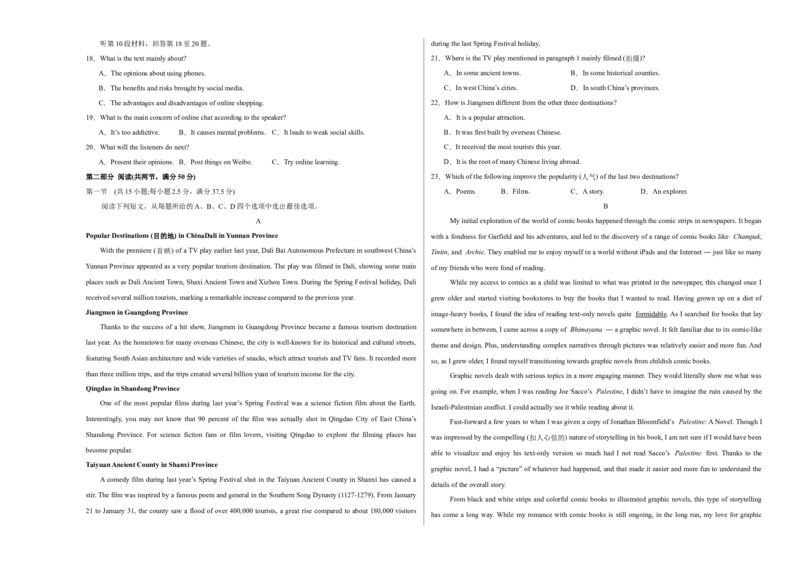
A.At a conference.
B.At a hospital.
C.At an airport.
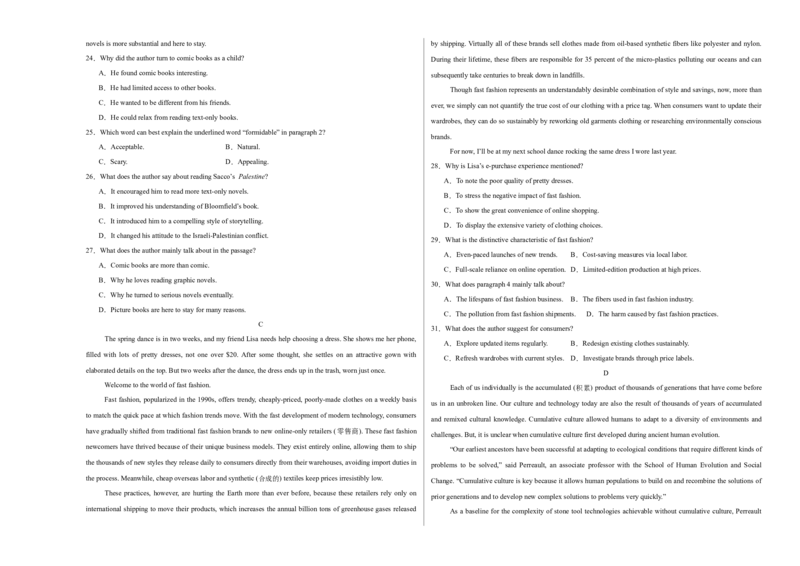
4.How many cups of coffee does the woman drink every week now?
A.One.
B.Three.
C.Seven.
5.What does the woman suggest the man do?
A.Fire at thieves.
B.Get back the ring.
C.Give up the ring.
第二节(共15 小题;每小题1.5 分,满分22.5 分)
听下面 5 段对话或独白。每段对话或独白后有几个小题,从题中所给的A、B、C 三个选项中选出最佳
选项。听每段对话或独白前,你将有时间阅读各个小题,每小题5 秒钟;听完后,各小题将给出5 秒钟的作
答时间,每段对话或独白读两遍。
听第 6 段材料,回答第 6 至7 题。
6.What is the relationship between the speakers?
A.Brother and sister.
B.Father and daughter.
C.Husband and wife.
7.What are the speakers talking about?
A.A wedding.
B.A camera.
C.An old photo.
听第7 段材料,回答第 8 至10 题。
8.Why does the woman choose to use her phone?
A.It’s running well.
B.It’s valuable.
C.It’s advanced.
9.What does the woman usually use her phone for?
A.Texting.
B.Making calls.
C.Taking pictures.
10.How many phones has the man owned?
A.One.
B.Two.
C.Three.
听第8 段材料,回答第11 至14 题。
11.Why does the man feel like he’s in a science fiction film?
A.Shooting stars appear.
B.Spaceships are visible in the sky.
C.Technology has advanced so much.
12.Why is the object easy to see?
A.It reflects the sun’s light.
B.It burns fuel brightly.
C.It has bright lights.
13.How soon would the speakers see the object again?
A.In about one and a half hours.
B.In about five hours.
C.In about nine hours.
14.What are the speakers doing?
A.Having a geography class.
B.Doing a scientific experiment.
C.Talking about an object in space.
听第9 段材料,回答第15 至17 题。
15.What is the probable relationship between the speakers?
A.Brother and sister.
B.Father and daughter.
C.Husband and wife.
16.Where are the man’s glasses?
A.In the bathroom.
B.On his nose.
C.In his pocket.
17.What impressed the man most about his forgetfulness?
A.He went fishing without taking the fishing pole.
B.He went fishing the day he had his wedding.
C.He went out without having pants on.
听第10 段材料,回答第18 至20 题。
18.What is the text mainly about?
A.The opinions about using phones.
B.The benefits and risks brought by social media.
C.The advantages and disadvantages of online shopping.
19.What is the main concern of online chat according to the speaker?
A.It’s too addictive.
B.It causes mental problems.
C.It leads to weak social skills.
20.What will the listeners do next?
A.Present their opinions. B.Post things on Weibo.
C.Try online learning.
第二部分 阅读(共两节,满分50 分)
第一节  (共15 小题;每小题2.5 分,满分37.5 分)
阅读下列短文,从每题所给的A、B、C、D 四个选项中选出最佳选项。
A
Popular Destinations (目的地) in ChinaDali in Yunnan Province
With the premiere (首映) of a TV play earlier last year, Dali Bai Autonomous Prefecture in southwest China’s
Yunnan Province appeared as a very popular tourism destination. The play was filmed in Dali, showing some main
places such as Dali Ancient Town, Shaxi Ancient Town and Xizhou Town. During the Spring Festival holiday, Dali
received several million tourists, marking a remarkable increase compared to the previous year.
Jiangmen in Guangdong Province
Thanks to the success of a hit show, Jiangmen in Guangdong Province became a famous tourism destination
last year. As the hometown for many overseas Chinese, the city is well-known for its historical and cultural streets,
featuring South Asian architecture and wide varieties of snacks, which attract tourists and TV fans. It recorded more
than three million trips, and the trips created several billion yuan of tourism income for the city.
Qingdao in Shandong Province
One of the most popular films during last year’s Spring Festival was a science fiction film about the Earth.
Interestingly, you may not know that 90 percent of the film was actually shot in Qingdao City of East China’s
Shandong Province. For science fiction fans or film lovers, visiting Qingdao to explore the filming places has
become popular.
Taiyuan Ancient County in Shanxi Province
A comedy film during last year’s Spring Festival shot in the Taiyuan Ancient County in Shanxi has caused a
stir. The film was inspired by a famous poem and general in the Southern Song Dynasty (1127-1279). From January
21 to January 31, the county saw a flood of over 400,000 tourists, a great rise compared to about 180,000 visitors
during the last Spring Festival holiday.
21.Where is the TV play mentioned in paragraph 1 mainly filmed (拍摄)?
A.In some ancient towns.
B.In some historical counties.
C.In west China’s cities.
D.In south China’s provinces.
22.How is Jiangmen different from the other three destinations?
A.It is a popular attraction.
B.It was first built by overseas Chinese.
C.It received the most tourists this year.
D.It is the root of many Chinese living abroad.
23.Which of the following improve the popularity (人气) of the last two destinations?
A.Poems.
B.Films.
C.A story.
D.An explorer.
B
My initial exploration of the world of comic books happened through the comic strips in newspapers. It began
with a fondness for Garfield and his adventures, and led to the discovery of a range of comic books like Champak,
Tintin, and Archie. They enabled me to enjoy myself in a world without iPads and the Internet ― just like so many
of my friends who were fond of reading.
While my access to comics as a child was limited to what was printed in the newspaper, this changed once I
grew older and started visiting bookstores to buy the books that I wanted to read. Having grown up on a diet of
image-heavy books, I found the idea of reading text-only novels quite formidable. As I searched for books that lay
somewhere in between, I came across a copy of Bhimayana ― a graphic novel. It felt familiar due to its comic-like
theme and design. Plus, understanding complex narratives through pictures was relatively easier and more fun. And
so, as I grew older, I found myself transitioning towards graphic novels from childish comic books.
Graphic novels dealt with serious topics in a more engaging manner. They would literally show me what was
going on. For example, when I was reading Joe Sacco’s Palestine, I didn’t have to imagine the ruin caused by the
Israeli-Palestinian conflict. I could actually see it while reading about it.
Fast-forward a few years to when I was given a copy of Jonathan Bloomfield’s Palestine: A Novel. Though I
was impressed by the compelling (扣人心弦的) nature of storytelling in his book, I am not sure if I would have been
able to visualize and enjoy his text-only version so much had I not read Sacco’s Palestine first. Thanks to the
graphic novel, I had a “picture” of whatever had happened, and that made it easier and more fun to understand the
details of the overall story.
From black and white strips and colorful comic books to illustrated graphic novels, this type of storytelling
has come a long way. While my romance with comic books is still ongoing, in the long run, my love for graphic
novels is more substantial and here to stay.
24.Why did the author turn to comic books as a child?
A.He found comic books interesting.
B.He had limited access to other books.
C.He wanted to be different from his friends.
D.He could relax from reading text-only books.
25.Which word can best explain the underlined word “formidable” in paragraph 2?
A.Acceptable.
B.Natural.
C.Scary.
D.Appealing.
26.What does the author say about reading Sacco’s Palestine?
A.It encouraged him to read more text-only novels.
B.It improved his understanding of Bloomfield’s book.
C.It introduced him to a compelling style of storytelling.
D.It changed his attitude to the Israeli-Palestinian conflict.
27.What does the author mainly talk about in the passage?
A.Comic books are more than comic.
B.Why he loves reading graphic novels.
C.Why he turned to serious novels eventually.
D.Picture books are here to stay for many reasons.
C
The spring dance is in two weeks, and my friend Lisa needs help choosing a dress. She shows me her phone,
filled with lots of pretty dresses, not one over $20. After some thought, she settles on an attractive gown with
elaborated details on the top. But two weeks after the dance, the dress ends up in the trash, worn just once.
Welcome to the world of fast fashion.
Fast fashion, popularized in the 1990s, offers trendy, cheaply-priced, poorly-made clothes on a weekly basis
to match the quick pace at which fashion trends move. With the fast development of modern technology, consumers
have gradually shifted from traditional fast fashion brands to new online-only retailers (零售商). These fast fashion
newcomers have thrived because of their unique business models. They exist entirely online, allowing them to ship
the thousands of new styles they release daily to consumers directly from their warehouses, avoiding import duties in
the process. Meanwhile, cheap overseas labor and synthetic (合成的) textiles keep prices irresistibly low.
These practices, however, are hurting the Earth more than ever before, because these retailers rely only on
international shipping to move their products, which increases the annual billion tons of greenhouse gases released
by shipping. Virtually all of these brands sell clothes made from oil-based synthetic fibers like polyester and nylon.
During their lifetime, these fibers are responsible for 35 percent of the micro-plastics polluting our oceans and can
subsequently take centuries to break down in landfills.
Though fast fashion represents an understandably desirable combination of style and savings, now, more than
ever, we simply can not quantify the true cost of our clothing with a price tag. When consumers want to update their
wardrobes, they can do so sustainably by reworking old garments clothing or researching environmentally conscious
brands.
For now, I’ll be at my next school dance rocking the same dress I wore last year.
28.Why is Lisa’s e-purchase experience mentioned?
A.To note the poor quality of pretty dresses.
B.To stress the negative impact of fast fashion.
C.To show the great convenience of online shopping.
D.To display the extensive variety of clothing choices.
29.What is the distinctive characteristic of fast fashion?
A.Even-paced launches of new trends.
B.Cost-saving measures via local labor.
C.Full-scale reliance on online operation. D.Limited-edition production at high prices.
30.What does paragraph 4 mainly talk about?
A.The lifespans of fast fashion business.
B.The fibers used in fast fashion industry.
C.The pollution from fast fashion shipments.
D.The harm caused by fast fashion practices.
31.What does the author suggest for consumers?
A.Explore updated items regularly.
B.Redesign existing clothes sustainably.
C.Refresh wardrobes with current styles.
D.Investigate brands through price labels.
D
Each of us individually is the accumulated (积累) product of thousands of generations that have come before
us in an unbroken line. Our culture and technology today are also the result of thousands of years of accumulated
and remixed cultural knowledge. Cumulative culture allowed humans to adapt to a diversity of environments and
challenges. But, it is unclear when cumulative culture first developed during ancient human evolution.
“Our earliest ancestors have been successful at adapting to ecological conditions that require different kinds of
problems to be solved,” said Perreault, an associate professor with the School of Human Evolution and Social
Change. “Cumulative culture is key because it allows human populations to build on and recombine the solutions of
prior generations and to develop new complex solutions to problems very quickly.”
As a baseline for the complexity of stone tool technologies achievable without cumulative culture, Perreault
analyzed technologies used by chimpanzees (黑猩猩). He then analyzed changes in the complexity of stone tool-
making techniques across the past 3.3 million years of the archaeological record to explore the origin of cumulative
culture. He broke down the complexity of the stone tool technologies by the number of steps that each tool-making
sequence (序列) involved.
The results suggested that from around 3.3 to 1.8 million years ago, stone tool-making sequences remained
within the range of the baselines. From around 1.8 million to 600,000 years ago, making sequences began to slightly
top the complexity baseline. But, after around 600,000 years ago, the complexity of making sequences rapidly
increased. “By 600,000 years ago or so, ancient human populations started relying on unusually complex
technologies, and we only see rapid increases in complexity after that time as well,” said Perreault.
Tool-assisted food-hunting may have been the motive for the earliest beginning of the evolution of cumulative
culture. Early ancient humans, 3.4 to 2 million years ago, likely relied on strategies that require tools - like accessing
meat and organs - leading to changes in brain size, lifetime and biology that set the stage for cumulative culture.
32.What does cumulative culture refer to according to the text?
A.Emphasizing individual development.
B.Paying attention to reforming social structure.
C.Adapting to a changing living condition step by step.
D.Building up technological improvements over generations.
33.What’s Paragraph 3 mainly about?
A.How Perreault conducted the research.
B.How important stone tool technologies were.
C.What the baseline of cumulative culture was. D.Why Perreault chose chimpanzees for the study.
34.What happened by 600,000 years ago?
A.Tool-making sequences remained unchanged.
B.The population of the earth increased sharply.
C.The ancestors began to make stone tools.
D.The technology reached a turning point.
35.Why are strategies that require tools mentioned in the last paragraph?
A.To show the result of human brains’ changes.
B.To illustrate the motive of cumulative culture.
C.To indicate the significance of common culture.
D.To stress the eating habits of human ancestors.
第二节  (共5 小题;每小题2.5 分,满分12.5 分)
阅读下面短文,从短文后的选项中选出可以填入空白处的最佳选项。选项中有两项为多余选项。
When people first come across the Law of Attraction (吸引力法则), their hearts and minds often immediately
think of one specific thing that they’d love to achieve in their lives. However, the next thought is often “But I can’t
do that”. You may come up with all kinds of excuses.     36    Here are the reasons why you should believe you
can use the Law of Attraction to obtain whatever you want.
Small steps create big changes. One of the most common reasons for abandoning dreams is that they simply
seem too huge to realize. Usually it’s manageable to think of following your dream as taking a series of significant
but small steps.     37     Then look at each of them. Not so unrealistic now, is it?
    38     When people are interviewed on their deathbeds or write about their lives in autobiographies (自
传), it is often observed that major regrets tend to relate to things that were not done. In older age, it’s likely that you
will be uncomfortable with the idea that you didn’t even try to do the thing that you loved or attempt to obtain what
you truly wanted.    39    But you don’t ever need to feel this way! Make today the first day of your new journey
towards avoiding regret.
Steps towards your dream are never backwards steps. Another common worry is that if you follow your
dreams, you’ll be “taking steps back”.    40     However, what looks like backward steps in your old life can
more productively and accurately be seen as forwarding steps in the brand new life you’re creating.
A.You can avoid regret.
B.It makes sense to move forward confidently.
C.Luckily, the truth is that it’s never too late to follow your dream.
D.It often comes up when people are at the top of careers they hate.
E.It is painful to feel like you haven’t ever found your true purpose.
F.For example, challenge yourself to write down the path to success in ten stages.
G.You have enough life experience and knowledge to make changes to pursue your dream.
第二部分 语言运用(共两节,满分30 分)
第一节  (共15 小题;每小题1 分,满分15 分)
阅读下面短文,从每题所给的A、B、C、D 四个选项中选出可以填入空白处的最佳选项。
It was just a typical morning of an ordinary workday. I was at the    41   , on my way to the lab where I
was a postdoctoral fellow (博士后研究员). But something began to    42    inside me as I watched the people
around me-headphones hanging from their ears, eyes cast down,    43    faces. They looked unhappy. And I
realized that I was one of them. Suddenly, I could no longer    44    my work life and booked a one-way ticket to
fly home.
Over the years, I had grown more competitive due to the    45    of finishing my Ph.D.Those who could
have been partners became competitors I disliked and the effect of this competition was exactly the    46    of
what I had hoped for. I began to feel lonely and lost. I became less and less    47    in my scientific work. I hit
my    48    point that day at the bus station. I had to end this before it is too late. I emailed my professors,
explaining that l had put the    49    first and myself second for too long.
Shortly after I got back home, I started to receive some emails from my workmates — I guessed they
expected me to join them again soon. After a few     50     asking how I was, in the emails many expressed their
stress of academic life. Vulnerable (脆弱的) researchers were sticking their heads out of their shells (壳), seeking
51    . It occurred to me that we all     52     sometimes, and our vulnerability seemed so much alike that I
53     myself from all that had bothered me for days.     54     it can be win-win game, instead of one where
one side gains while the other side loses. Working with others and asking for help doesn’t make my contributions
55    ; it means we can all succeed.
41.A.store
B.office
C.cafe shop
D.station
42.A.settle
B.disappear
C.awaken
D.explode
43.A.uncertain
B.unique
C.unfamiliar
D.unsmiling
44.A.begin with
B.get rid of
C.proceed with
D.get down to
45.A.pressure
B.response
C.commitment
D.obligation
46.A.outcome
B.opposite
C.means
D.alternative
47.A.responsible
B.anxious
C.tough
D.productive
48.A.starting
B.breaking
C.ending
D.boiling
49.A.fame
B.honor
C.partner
D.occupation
50.A.accounts
B.jokes
C.lines
D.greetings
51.A.belief
B.assistance
C.hardship
D.answers
52.A.choked
B.hesitated
C.relaxed
D.suffered
53.A.protected
B.prevented
C.liberated
D.excused
54.A.Actually
B.Generally
C.Eventually
D.Fortunately
55.A.irregular
B.improper
C.illogical
D.insignificant
第二节  (共10 小题;每小题1.5 分,满分15 分)
阅读下面短文,在空白处填入1 个适当的单词或括号内单词的正确形式。
How can you better understand body language to feel more confident and be more effective in a range of
situations? If you are struggling to understand how to interpret body language of colleagues in different cultural
contexts and how to respond, you may find yourself     56     (search) for a checklist of dos and don’ ts. But this
isn’t necessarily the     57     (great) approach. Besides, you can start your interpretation     58

analysing groups, rather than looking at each gesture in isolation.
For example, imagine that you are presenting an idea for a new process in a meeting, and your boss is smiling.
Many experts would advise you that smiling is     59     (cultural) universal, so you might assume that your boss
must be happy with your presentation. However, making this     60     (assume) without deeper investigation
could prove problematic. If you take     61     second look at your boss, you might notice that she is also
laughing slightly, looking down and moving her pen. This could mean a range of different things. How can you
understand your boss’s reaction correctly? The answer is to check that your analysis of their body language matches
with     62     the person says and how they say it.
To understand the cultural influences     63     have led to her behaviour, it is first important to
understand what cultural identity is. Many people use the terms “culture” and “nationality” interchangeably.
However, generalising     64     (base) only on nationality can be risky. To help avoid this, the British Council
65      (develop) a description of culture in the last few years.
第三部分 写作(共两节,满分40 分)
第一节  (满分15 分)
假定你是一所国际学校的学生李华,针对很多同学英语书写较差的情况,你校学生会决定以“规范书
写,从我做起”为主题举办一次英语征文比赛,请你写一篇短文投稿。内容包括:
1. 规范书写的重要性;
2. 提出改进措施;
3. 呼吁同学们重视书写。
注意:
1. 写作词数应为80 个左右;
2. 请在答题卡上相应位置作答。
Beautiful Handwriting in Need
_____________________________________________________________________________________________
_____________________________________________________________________________________________
_____________________________________________________________________________________________
_____________________________________________________________________________________________
_____________________________________________________________________________________________
_____________________________________________________________________________________________
______________________________________________________________________________________
第二节  (满分25 分)
阅读下面材料, 根据其内容和所给段落开头语续写两段, 使之构成一篇完整的短文。
Ian was a young boy who loved spending time with his grandpa. They would go on adventures together,
explore the woods behind their house, and play games. But as Ian’s grandpa grew older, he started to forget things.
At first, it was just little things, like where he left his keys or what he had for breakfast. But soon, it became clear
that something more serious was happening. His grandpa had Alzheimer’s disease (阿尔茨海默症).
Ian didn’t fully understand what that meant, but he could see that his grandpa was changing. He would get
confused and disoriented (迷茫的), and sometimes he didn’t recognize Ian or his parents. It was hard for Ian to
watch his grandpa struggle, but he still loved spending time with him.
One day, Ian’s grandpa didn’t come over for their usual adventure. Ian was worried and asked his parents
where he was. They told him that his grandpa was in the hospital, and that he might not be able to come home.
Ian began to experience a nerve breakdown. He didn’t know what he would do without his grandpa. But then
he had an idea. He decided to make a book about their adventures together, filled with pictures and stories of all the
fun they had had. He worked on it every day, drawing and writing and remembering.
When Ian’s grandpa came home from the hospital, he was confused and disoriented. But then Ian showed him
the book he had made. They looked through it together, and Ian told his grandpa all about the adventures they had
had. Slowly but surely, his grandpa began to remember.
Over the next few weeks and months, Ian and his grandpa looked at the book together every day. They
laughed and talked and remembered. Ian’s grandpa may have forgotten a lot of things, but he never forgot the love
he had for his grandson.
注意:
1. 续写词数应为150 词左右;
2. 请按如下格式在答题卡的相应位置作答。
Eventually, Ian’s grandpa passed away.
_____________________________________________________________________________________________
_____________________________________________________________________________________________
_____________________________________________________________________________________________
_____________________________________________________________________________________________
________________________________________________________________________________________
Years later, when Ian was all grown up, he found the book again.
_____________________________________________________________________________________________
_____________________________________________________________________________________________
_____________________________________________________________________________________________
_____________________________________________________________________________________________
________________________________________________________________________________________