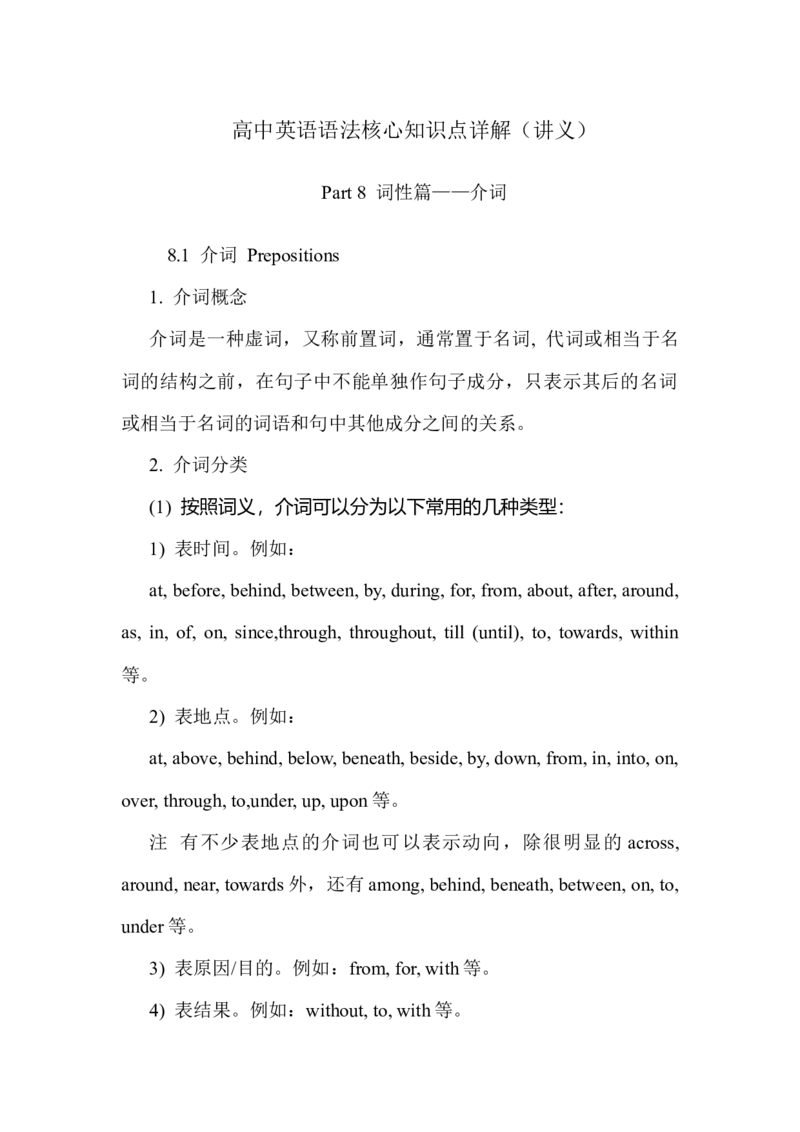
高中英语语法核心知识点详解(讲义)
Part 8 词性篇——介词
8.1 介词 Prepositions
1. 介词概念
介词是一种虚词,又称前置词,通常置于名词, 代词或相当于名
词的结构之前,在句子中不能单独作句子成分,只表示其后的名词
或相当于名词的词语和句中其他成分之间的关系。
2. 介词分类
(1) 按照词义,介词可以分为以下常用的几种类型:
1) 表时间。例如:
at, before, behind, between, by, during, for, from, about, after, around,
as, in, of, on, since,through, throughout, till (until), to, towards, within
等。
2) 表地点。例如:
at, above, behind, below, beneath, beside, by, down, from, in, into, on,
over, through, to,under, up, upon 等。
注 有不少表地点的介词也可以表示动向,除很明显的across,
around, near, towards 外,还有among, behind, beneath, between, on, to,
under 等。
3) 表原因/目的。例如:from, for, with 等。
4) 表结果。例如:without, to, with 等。
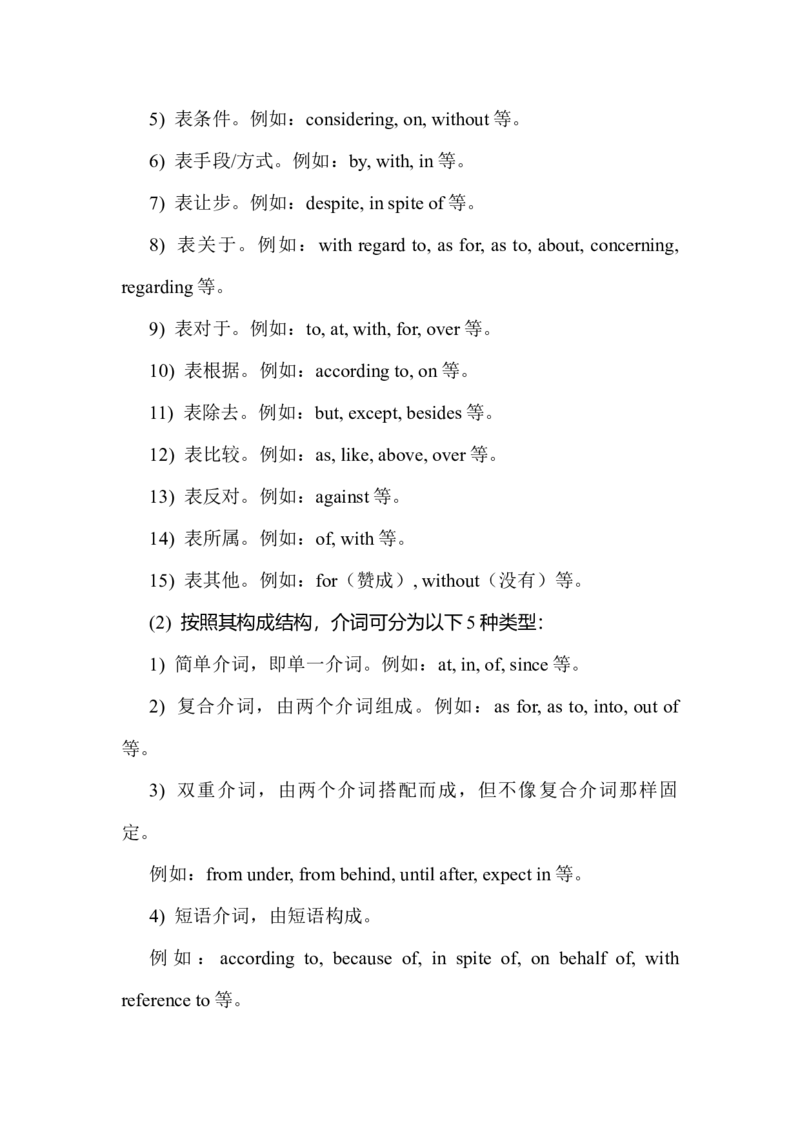
5) 表条件。例如:considering, on, without 等。
6) 表手段/方式。例如:by, with, in 等。
7) 表让步。例如:despite, in spite of 等。
8) 表关于。例如:with regard to, as for, as to, about, concerning,
regarding 等。
9) 表对于。例如:to, at, with, for, over 等。
10) 表根据。例如:according to, on 等。
11) 表除去。例如:but, except, besides 等。
12) 表比较。例如:as, like, above, over 等。
13) 表反对。例如:against 等。
14) 表所属。例如:of, with 等。
15) 表其他。例如:for(赞成), without(没有)等。
(2) 按照其构成结构,介词可分为以下5 种类型:
1) 简单介词,即单一介词。例如:at, in, of, since 等。
2) 复合介词,由两个介词组成。例如:as for, as to, into, out of
等。
3) 双重介词,由两个介词搭配而成,但不像复合介词那样固
定。
例如:from under, from behind, until after, expect in 等。
4) 短语介词,由短语构成。
例如:according to, because of, in spite of, on behalf of, with
reference to 等。
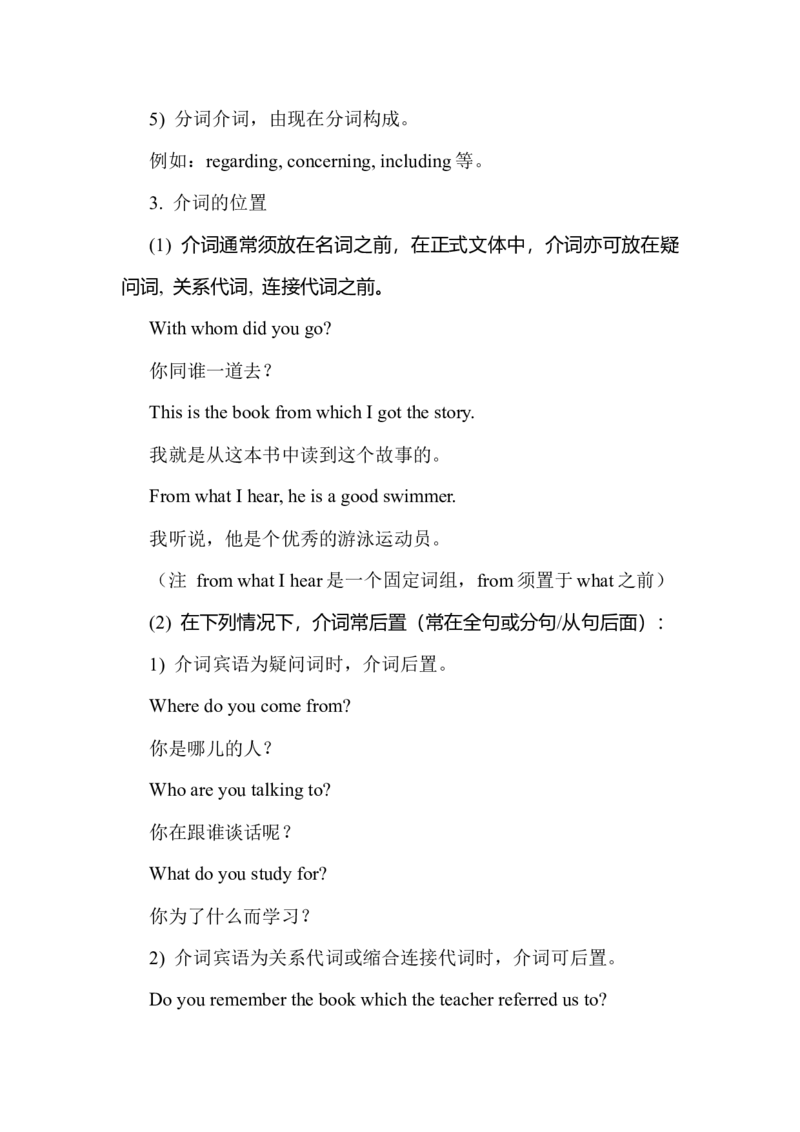
5) 分词介词,由现在分词构成。
例如:regarding, concerning, including 等。
3. 介词的位置
(1) 介词通常须放在名词之前,在正式文体中,介词亦可放在疑
问词, 关系代词, 连接代词之前。
With whom did you go?
你同谁一道去?
This is the book from which I got the story.
我就是从这本书中读到这个故事的。
From what I hear, he is a good swimmer.
我听说,他是个优秀的游泳运动员。
(注 from what I hear 是一个固定词组,from 须置于what 之前)
(2) 在下列情况下,介词常后置(常在全句或分句/从句后面):
1) 介词宾语为疑问词时,介词后置。
Where do you come from?
你是哪儿的人?
Who are you talking to?
你在跟谁谈话呢?
What do you study for?
你为了什么而学习?
2) 介词宾语为关系代词或缩合连接代词时,介词可后置。
Do you remember the book which the teacher referred us to?
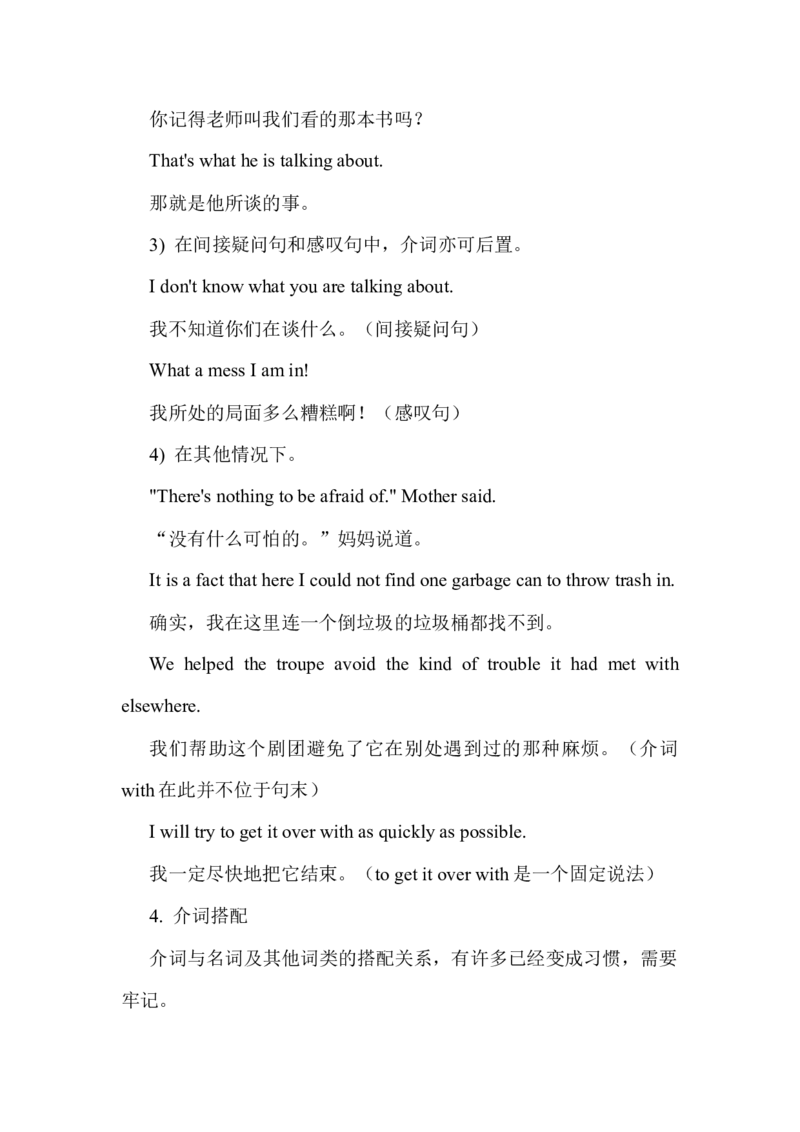
你记得老师叫我们看的那本书吗?
That's what he is talking about.
那就是他所谈的事。
3) 在间接疑问句和感叹句中,介词亦可后置。
I don't know what you are talking about.
我不知道你们在谈什么。(间接疑问句)
What a mess I am in!
我所处的局面多么糟糕啊!(感叹句)
4) 在其他情况下。
"There's nothing to be afraid of." Mother said.
“没有什么可怕的。”妈妈说道。
It is a fact that here I could not find one garbage can to throw trash in.
确实,我在这里连一个倒垃圾的垃圾桶都找不到。
We helped the troupe avoid the kind of trouble it had met with
elsewhere.
我们帮助这个剧团避免了它在别处遇到过的那种麻烦。(介词
with 在此并不位于句末)
I will try to get it over with as quickly as possible.
我一定尽快地把它结束。(to get it over with 是一个固定说法)
4. 介词搭配
介词与名词及其他词类的搭配关系,有许多已经变成习惯,需要
牢记。
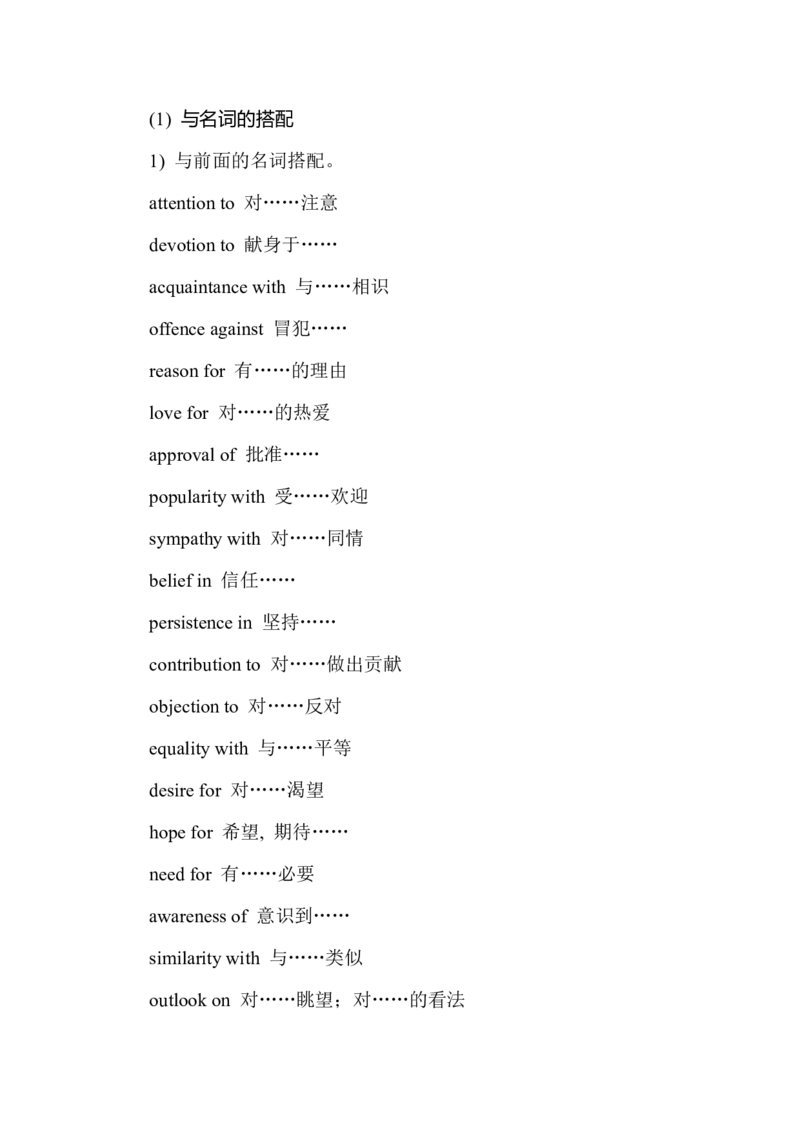
(1) 与名词的搭配
1) 与前面的名词搭配。
attention to 对……注意
devotion to 献身于……
acquaintance with 与……相识
offence against 冒犯……
reason for 有……的理由
love for 对……的热爱
approval of 批准……
popularity with 受……欢迎
sympathy with 对……同情
belief in 信任……
persistence in 坚持……
contribution to 对……做出贡献
objection to 对……反对
equality with 与……平等
desire for 对……渴望
hope for 希望, 期待……
need for 有……必要
awareness of 意识到……
similarity with 与……类似
outlook on 对……眺望;对……的看法
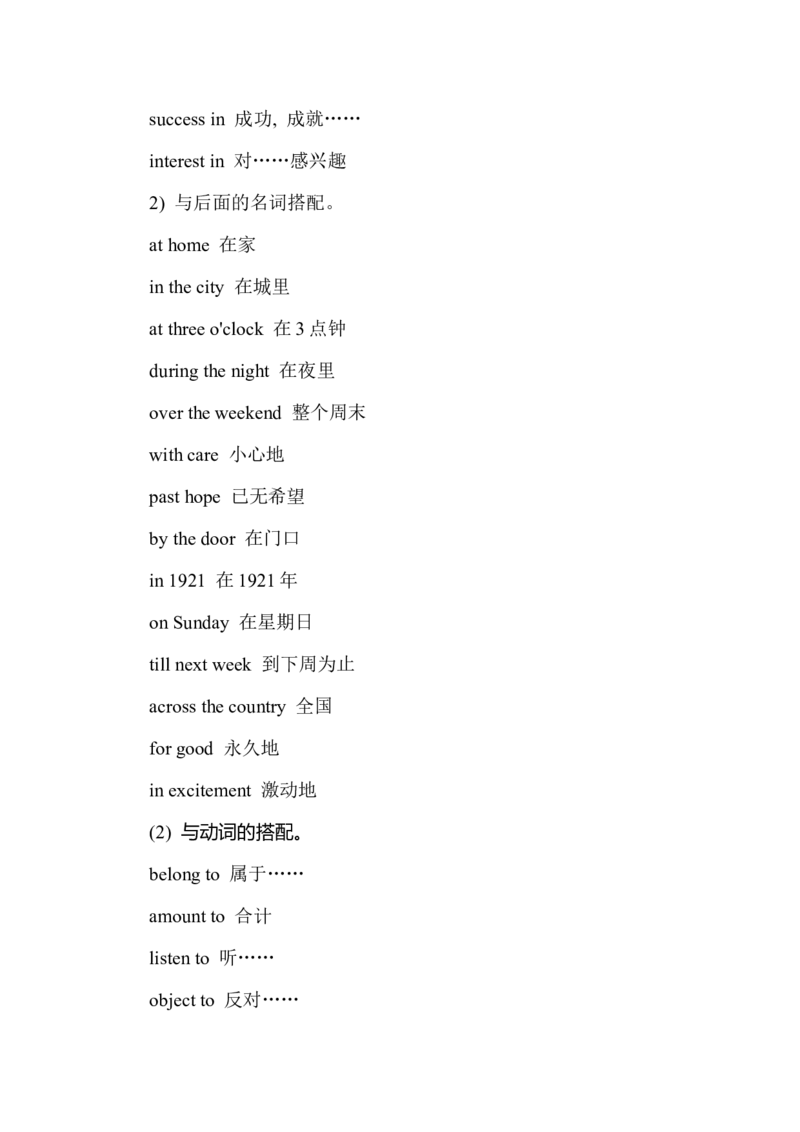
success in 成功, 成就……
interest in 对……感兴趣
2) 与后面的名词搭配。
at home 在家
in the city 在城里
at three o'clock 在3 点钟
during the night 在夜里
over the weekend 整个周末
with care 小心地
past hope 已无希望
by the door 在门口
in 1921 在1921 年
on Sunday 在星期日
till next week 到下周为止
across the country 全国
for good 永久地
in excitement 激动地
(2) 与动词的搭配。
belong to 属于……
amount to 合计
listen to 听……
object to 反对……
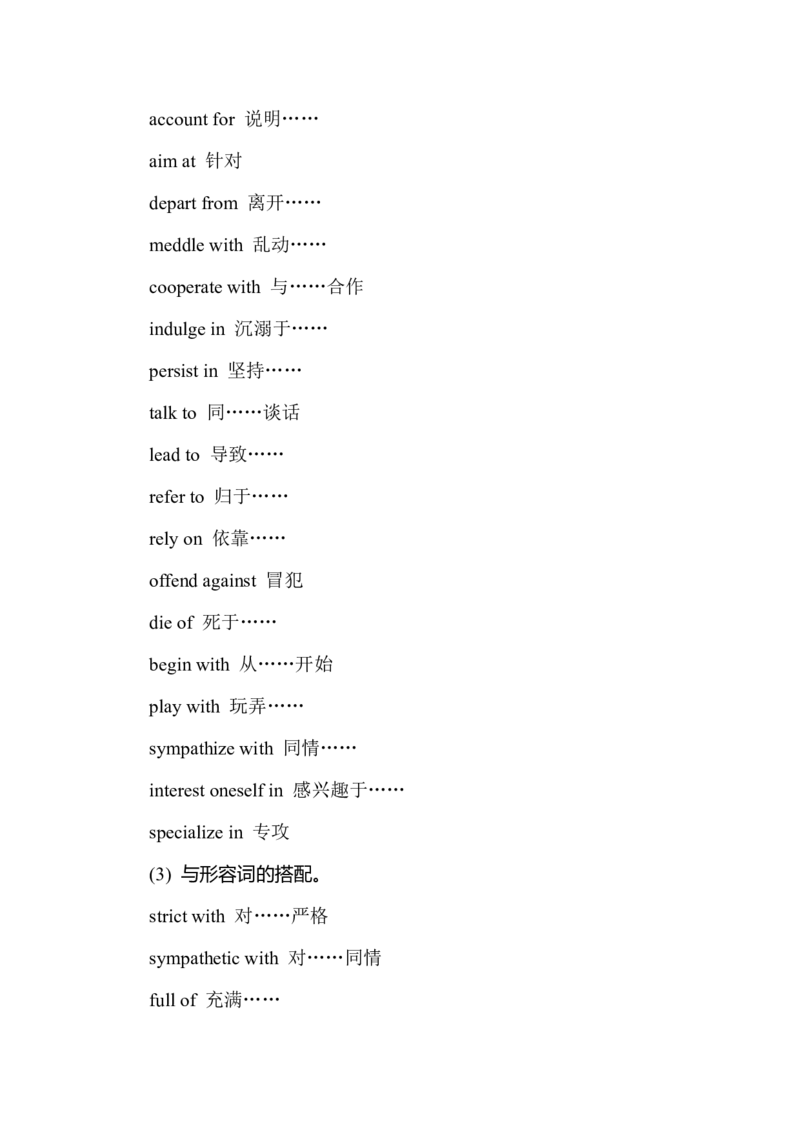
account for 说明……
aim at 针对
depart from 离开……
meddle with 乱动……
cooperate with 与……合作
indulge in 沉溺于……
persist in 坚持……
talk to 同……谈话
lead to 导致……
refer to 归于……
rely on 依靠……
offend against 冒犯
die of 死于……
begin with 从……开始
play with 玩弄……
sympathize with 同情……
interest oneself in 感兴趣于……
specialize in 专攻
(3) 与形容词的搭配。
strict with 对……严格
sympathetic with 对……同情
full of 充满……
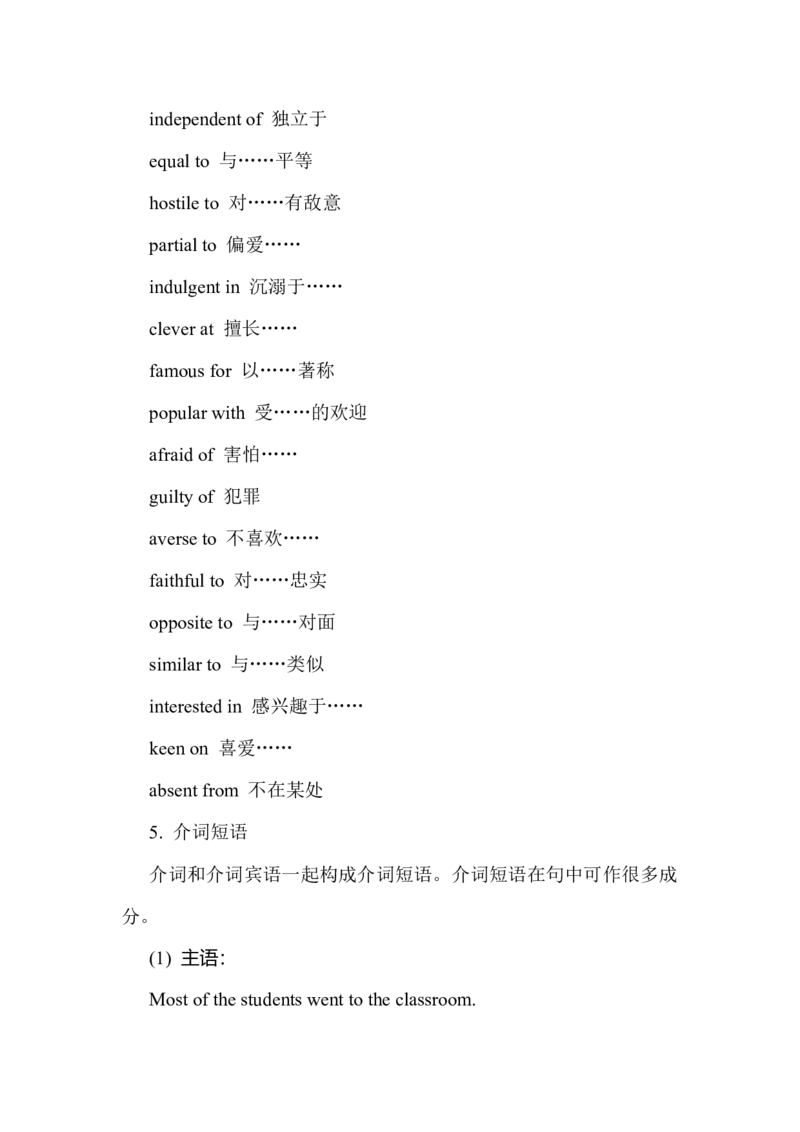
independent of 独立于
equal to 与……平等
hostile to 对……有敌意
partial to 偏爱……
indulgent in 沉溺于……
clever at 擅长……
famous for 以……著称
popular with 受……的欢迎
afraid of 害怕……
guilty of 犯罪
averse to 不喜欢……
faithful to 对……忠实
opposite to 与……对面
similar to 与……类似
interested in 感兴趣于……
keen on 喜爱……
absent from 不在某处
5. 介词短语
介词和介词宾语一起构成介词短语。介词短语在句中可作很多成
分。
(1) 主语:
Most of the students went to the classroom.
大部分学生去了教室。
From my home to office is a twenty minutes' walk.
从我家到办公室要走20 分钟。
(2) 宾语:
I'll give you until tomorrow.
我给你限期到明天。
The eight thieves served a sentence of between 2 and 7 years.
8 个盗窃犯分别服刑2 到7 年。
(3) 补语:
As a scientist, he was dedicated to the truth.
作为一个科学家,他献身于追求真理。(主语补语)
They found themselves in a dark wood.
他们发现自己在一片黑沉沉的树林里。(宾语补语)
(4) 表语:
She looks like a scientist.
她看上去像个科学家。
We are from China.
我们来自中国。
(5) 定语:
The end of colonialism is now a question of time.
殖民主义的结束现在只是时间问题了。
A friend in need is a friend indeed.
患难见真情。
(6) 状语:
We play basketball on the sports ground.
我们在操场上打篮球。
In spite of all my efforts, I failed in the exam.
尽管我很努力,还是没有通过考试。
No living things can live without water.
生物离开水都无法生存。
To a great extent, it is not fair.
在很大程度上,这是不公平的。
Notwithstanding the bad weather, the ship arrived on schedule.
尽管天气很坏,该船仍按时抵达。
6. 介词省略
在现代英语中,介词在某些情况下可省略,呈现出一种省略介词
的趋势。
(1) 省去by。
I sent the letter airmail.
我将此信由航空寄出。(airmail 前省去by)
I want to go economy.
我要节约。(economy 前省去by)
(2) 省去to。
The reception accorded the book has been very gratifying.
这本书受到欢迎是非常可喜的事。(accorded 后省去to)
(3) 省去as。
I consider him an expert.
我认为他是一位专家。(him 之后省去as,现在一般认为不应用
as)
(4) 省去at。
What time did you arrive home?
你什么时候到家的?(what 前省去at)
It is hard work keeping the grass green this time of year.
一年中这个时节保持绿草不枯,要费很大气力。(this time 前省
去at)
(5) 省去of。
The Pacific Ocean is so big that it could hold twenty countries the
size of the United States.
太平洋很大,它可以装得下20 个美国那样大的国家。(the size
前省去of)
What colour is it?
它是什么颜色?(what 前省去of)
He plunged out the doors.
他冲出门口。(美国英语out=out of)
(6) 省去from。
Illness prevented him going to the party.
疾病使他未能参加聚会。(going 前省去from)
Can't you stop the child getting into mischief?
你就不能使孩子不淘气?(getting 前省去from)
(7) 省去on。
The police arrested him on a charge of assault the evening of
November 18.
警察于11 月18 日以殴打罪逮捕了他。(the evening 前省去on)
He meant to go hunting.
他想去打猎。(hunting 前省去on。现今也有语法书认为go 是连
系动词,hunting 是表语)
(8) 省去in。
I had started a schoolboy diary the same year I entered the Latin
School, in 1928.
我是于1928 年进入拉丁学校时,开始记学生日记的。(the same
year 前省去in)
They have recruited few new barbers the past three years.
在过去3 年中,他们很少补充新理发师。(the past three years 前
省去in)
有些动名词前常省去in。
I have been thinking for some time answering this question.
我想了一会儿才回答这个问题。(answering 前省去in)
He showed his appreciation for her assistance helping him practice
English.
他对她帮他练习英语表示感谢。(helping 前省去in)
(9) 在列举一系列名词时,介词可省去,以免重复。
When you're lying without moving, you suddenly get an itch on the
shoulder, the head, and the back.
当你躺着一动不动时,你会突然感到肩上, 头上, 背上一阵搔
痒。
7. 常用介词
(1) at(在/于)用于指明某一特定的时间, 节日, 年龄
at dawn/at night/at noon/at midnight/at daybreak
在黎明/在夜里/在中午/在午夜/在日出时
I go to school at seven in the morning.
我早上7 点钟去上学。
(2) in(在;在……之内;在……期间;在……后,过……后)指:
天, 年, 月, 季节, 周次
in the morning/in the afternoon/in the day time/in the evening
在早上/在下午/在白天/在夜晚
He's to quit in May.
他将会在5 月辞职。
(3) on(在……时;在某日;在某日早/午/晚;当……时候;和……
同时;一……就……)
on the first 在一号(指某月一号,如二号要说second)
on the next morning 隔天早上
on the following evening 在下一个晚上
on the night before 在前一个晚上
(4) by(到……的时候;等到……已经)用在天, 时间
by day 白天(的时候)/by 2 o'clock 到两点钟/by this time 等到
现在(已经)……
miss by a minute 迟一分钟
(5) 介词at, in, on, by 表示地方, 地点, 位置
1) at 把地方, 地点, 位置当做一个“点”:
The beggar is sitting at the corner.
那个乞丐坐在角落里。
at class/at home/at the library/at the office/ at school/at work
在班级中/在家里/在图书馆/在办公室/在学校/在上班
2) in 把地方, 地点, 位置当做一个范围或一个封闭的空间:
in a car/in a taxi/in a boat/in a helicopter/in a lift (elevator)
在汽车里/在的士里/在小船里/在飞机里/在电梯里
in the bedroom/class/library/school
在寝室/教室/图书馆/学校
3) on 把地方, 地点, 位置当做一个平面:
I live on the 7th floor at 21 Oxford Street in London.
我住在伦敦牛津街21 号7 楼。(7th floor 就是7 楼;注意句中的
on, at, in 的用法)
on a bus/on a train/on a plane/on a ship
在巴士上/在火车上/在飞机上/在轮船上
on a bicycle/on a motorbike/on a horse/on an elephant
骑自行车/骑摩托车/骑马/骑象
4) by 用在表示位置(在……旁;贴近;靠近)
by the fire 在炉边
a path by the river 沿河道路
by the nearest road 走最近的路
(6) for, since 用于表示时间
1) 用for 表示计量时间(年, 月, 日, 时, 分, 秒等)
He held his breath for five minutes
他闭息达5 分钟。
She's lived there for ten years.
她住在那里已有10 年了。
2) 用since 表示明确的日期或时间:
He's worked here since 1980.
自从1980 年起他就在此工作了。
She's been sitting in the waiting room since two-thirty.
自两点半起她就坐在等候室了。
(7) 表示动作的介词:to, toward 或不用介词
1) 用to 表示向某处移动
They were driving to work together.
他们一同开车去工作。
She's going to the dentist's office this morning.
今早她去看牙医。
2) toward 表示移向某处
We're moving toward the light.
我们向灯光处移动。
This is a big step towards the project's completion.
对于工程的完成而言,这是前进了一大步。
3) 不需要介词的词:home, downtown, uptown, inside, outside,
downstairs, upstairs 等。
Grandma went upstairs.
奶奶上楼了。
Rama went home.
罗摩回家了。
She came inside.
她进来了。