压轴题 10 完形填空
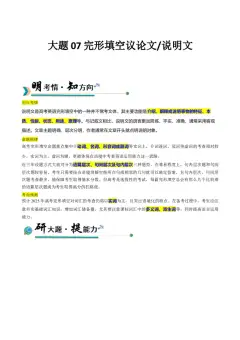
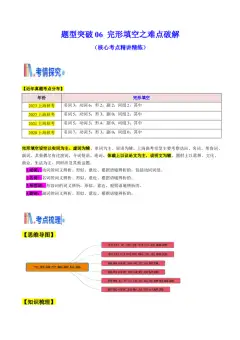
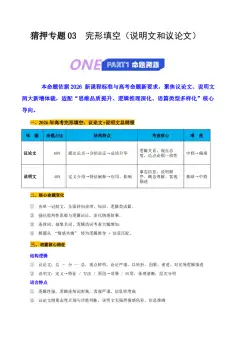
分析近几年新高考完形填空可知,高考完形填空注重考查考生在阅读理解的基础上对词
汇知识的掌握情况,命题遵循“突出语篇,强调应用,注重实际”的思路。内容情节深刻,
常涉及人物心理活动的细致描写,篇章与句子结构变化丰富,文章内容将文化、知识、教
育、趣味等融为一体,时代感突出,生活化明显,寓教于乐,充满正能量。预测2024年高考
命题预测
对于完形填空的考查仍是压轴考题。
1. 句中题
高频考法 2. 句间题
3. 语篇题
一、完形填空基本规律及解题要领
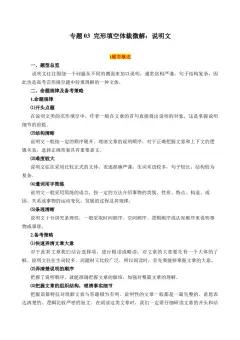
说明文类完形填空题常就某一个问题从不同的角度来加以说明,文章可以是用来说明某一种社会现
象、一个产品的制作过程、一种产品的使用方法、某个科学成就或人类生活中所面临的某个具体的难题。
说明文所呈现的方式较为单一,作者往往一开始就交代说明的对象,然后再从不同的角度进行说明。因
此,这类文章的每一段通常就是其中的一个角度或侧面,所以要注意概括每一个段落的主旨大意,尤其是
文章每一段的开头或结尾,作者往往会对说明的话题进行概括说明。
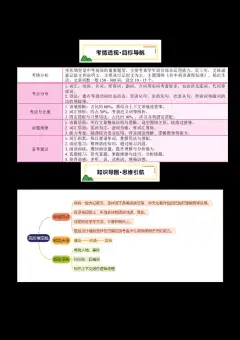
说明文完形填空的结构一般是:提出问题--发现直接原因-分析深层原因-得出结论或提出解决方案。
说明文类的完形填空的特征如下:
1.文章多用现在时态
说明文通常是对客观事物或实例的介绍与说明,与时间的变化关系不大,所以文章常用现在时态。
2.语言简练、平实、准确,常采用客观描述
说明文的目的主要是帮助读者认清事物,明白事理,所以语言简练、平实、易于理解,内容客观真实,很少含有带感情的词汇.
3.文章主题明确,层次分明
说明文类完形填空往往在文章开头就点明说明对象,从而为学生们把握文章主题提供了有利条件。而
且,作者借助合理的说明顺序展开文章,使文章结构清晰,层次分明。
命题规律:
命题以动词和名词等实词为主,完形填空所给的选项一般是同一词类,或属同一范畴。高考完形填空
题考查动词(5-8个)名词(4一6个)、然后是形容词,副词等。而介词、连词、冠词等虚词则相对考得较
少。
句中命题 主要考查考生正确理解句意的能力和词汇的辨析能力。这类题设题较多。
句组命题 从上下文中命题,占比最大,考查考生对上下文的理解能力。
这种题难度较大,考查考生对文章中心脉络、结构层次的把握能力。并具有瞻前顾后,把
情境命题 握全文的全局意识。
情感命题 要求考生理解文章,对作者的思想或心理进行准确的推理判断能力。
考查考生的逻辑推理能力,要求考生根据事情发生、发展的规律,按照作者的思维方式、
逻辑命题 语言风格等对文章的行文逻辑进行分析,做出判断。
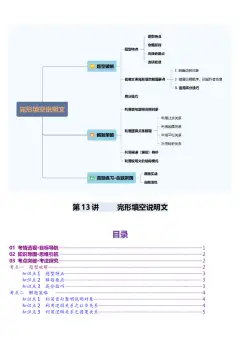
二、完形填空的解题技巧
1 . 利用说明文的首句查找说明 对象
2 . 把握说明文的两种结构模式
(1)总分式。包括*总-分"*分-总"”总-分-总”等具体形式。
(2)递进式。事理说明文多用递进式结构,一层一层地剖析事理。具体包括:空间顺序-从上到下、从外
到内、从左到右、从南到北、从远到近、从中间到四周、从整体到部分;时间顺序-按照时间先后顺序来安
排,事物都有发生、发展、消亡的过程:逻辑顺序-有些说明文主要是剖析事理的,在说明时就按照事理的
逻辑关系进行安排,或者从主到次、从浅到深、从原因到结果,具有严密的条理性。
3 . 关注内在联系,把握说明顺序
常见的说明顺序有时间顺序、空间顺序、逻辑顺序(如因果关系、果因关系、先主后次等)和认识顺序
(如由此及彼、由浅入深、由局部到整体、由现象到本质、由具体到抽象等)。
4 . 瞻前顾后,先易后难
动笔时要瞻前顾后、通篇考虑、先易后难。先做最有把握的,简单直接的题,对于一下子不能确定答案的
题,先跳过,最后再回过头来集中精力根据完形填空的高频考法和命题规律解决难点。此时一定关注语篇
中的线索词。
5 . 巧用信息复现法
语篇复现的信息包括原词复现、同义词和反义词复现、概括词和代词复现等。语篇中如果有词汇和结构复
现与话题相关等情况时,利用上下文寻找解题信息,确定正确答案。6 . 利用逻辑关系法
句子或词组不是孤立存在的,其出现有一定的逻辑关系,可通过句中或句间的逻辑关系,如例证、转折、
让步、递进、因果等逻辑关系词来解题。
7 . 复读再验证
完成各个选项后,把所选的选项代入文中,再把全文通读一遍,看所选的选项是否意思前后关联,顺利成
章,语法结构是否正确,语言表达形式是否符合习惯用法。
03 说明文
1.(2024·全国·模拟预测)
Humans are quick judgment machines. With the seemingly reliable 1 , we form firm and far-reaching
opinions of others. Science is 2 those judgments are also often correct although they can sometimes be 3
.
Actually, it turns out that we’re not 4 to believe so firmly what someone’s gesture or face 5 .
It is found that these clues really can predict our personalities. Take a study, for example. When the scientists 6
data on walking and personality of more than 15,000 7 of all ages, strong patterns appeared: a fast walker is
more likely to be outgoing. 8 .slow walkers are hesitant. Now we know personality indeed has an influence
on walking.
But what about the 9 , you might ask? We all tend to naturally slow down as we get older, but not
everyone slows down at the same 10 .Personality affected not only walking speed, but also how the way
of walking became different overtime. Those who were outgoing had a slower 11 in walking speed.
Your personality can’t be 12 by your speeding up or slowing down, but how you are 13
can. Want to appear brave and outgoing? 14 in. It may be even more useful as a trick that can help you
assess a person’s character and know quickly who you are 15 in a meeting or in a conversation.
1.A.tool B.relationship C.evidence D.value
2.A.arguing B.admitting C.predicting D.noticing
3.A.long-lasting B.ground-breaking C.hard-won D.one-sided4.A.content B.willing C.crazy D.sure
5.A.covers B.records C.rules D.indicates
6.A.looked for B.dug into C.focused on D.ended with
7.A.volunteers B.interviewers C.subjects D.candidates
8.A.In comparison B.In addition C.In fact D.In summary
9.A.personality B.result C.style D.age
10.A.pace B.level C.time D.price
11.A.pause B.process C.rise D.decline
12.A.explained B.changed C.determined D.understood
13.A.seen B.followed C.researched D.motivated
14.A.Drive B.Jump C.Rush D.Walk
15.A.fighting B.handling C.treating D.helping
2.(2024·黑龙江哈尔滨·一模)
Do you sometimes ignore your mom while chatting with friends? If you’re a teen, that’s fairly 16 .
And new researches may explain why so many adolescents 17 their mom’s voices.
Young kids’ brains are very tuned in to their mothers’ voices. But as they grow up, everything 18 .
Teenagers’ brains are more tuned in to strangers’ voices. This obvious 19 usually happens between ages
13 and 14. That’s when teenagers are in the course of puberty (青春期), a roughly decade-long transition into
adulthood.
Researchers scanned the brains of 7 to 16-year-olds as they listened to things said by their mothers or by
unfamiliar women. The words were purely 20 : teebudieshawlt, keebudieshawlt and peebudieshawlt. As
the kids listened, certain parts of their brains became 21 . This was especially true in brain regions that
help us to 22 rewards and pay attention. That’s exactly as it should be. The experiments show that those
parts of their brains react more strongly to the unfamiliar voices than to their mothers’.
These areas in the adolescent brains don’t stop 23 mom. It’s just that unfamiliar voices become
more rewarding and worthy of attention. “As kids 24 , their survival depends less and less on maternal
support. 25 , they rely more and more on their 26 —friends and others closer to their own age.
So the brains need to begin paying more attention to that wider world. The brain seems to 27 new needs
that come with adolescence.”
However, mothers’ voices still have special power, especially in times of 28 . Studies also showedthat levels of stress hormones (荷尔蒙) 29 when stressed-out girls heard their moms’ voices on the
phone.
So while both teens and their parents sometimes feel frustrated by missed messages, that’s okay. “That’s the
way the 30 is wired, and there’s a good reason for it.”
16.A.common B.rare C.strange D.impossible
17.A.put up B.tune out C.listen to D.show off
18.A.changes B.matters C.evolves D.counts
19.A.action B.shift C.ability D.function
20.A.complicated B.meaningful C.nonsense D.nonstop
21.A.numb B.small C.calm D.active
22.A.collapse B.design C.detect D.process
23.A.keeping out B.responding to C.working with D.turning down
24.A.struggle B.advance C.shrink D.mature
25.A.Once B.Otherwise C.Instead D.Besides
26.A.strangers B.competitors C.partners D.peers
27.A.adapt to B.appeal to C.apply to D.attach to
28.A.stress B.relief C.safety D.plenty
29.A.varied B.dropped C.topped D.remained
30.A.head B.mind C.heart D.brain
3.(23-24高三·安徽六安·阶段练习)
The habit of reading is one of the greatest resources of mankind: we enjoy reading books that belong to us
much more than if they are borrowed. Some people regard a borrowed book as a 31 in the house. It must
be treated with care and considerate formality. 32 attitudes are forbidden. Because the book is borrowed,
it tolerates no damage which means it must not 33 while under your roof. While reading the book, you
are not allowed to make any mark or underline the important 34 when a flash of creative idea emerge.
This is huge 35 to one’s imagination.
36 , your own books belong to you and you can treat them with so much closeness that you are not
afraid to mark it up or to place it in a dirty place. Your own books are there for use, not for 37 . You don’t
need to display them in front of others. Private ownership also encourages 38 marking. A good reason for
marking instructive passages in books is that this practice enables you to remember more easily the significantsayings, to 39 them quickly and then review them more frequently in the future.
Given the importance of owned books to a man, everyone should begin collecting a private library, making up
his own 40 property. One should have his own bookshelves, which should not be having doors, glass
windows, or keys. They should be free and 41 to the hand as well as the eye. Like the jewellery to a
woman, the best moral 42 to a man is books. They are more varied in colour and appearance than any
wall-paper. Their variety indicates 43 out of brains of different book writers. The knowledge that
books are in plain view is also stimulating. Your body and mind are both 44 . With books at hand, your
mind is free to land any 45 or even strange possibility, which eventually gives birth to new discoveries
or inventions.
31.A.teacher B.guest C.relative D.servant
32.A.Continual B.Usual C.Casual D.Gradual
33.A.suffer B.store C.destroy D.describe
34.A.trends B.goals C.definitions D.points
35.A.discipline B.discouragement C.relief D.reminder
36.A.Oppositely B.Fortunately C.Immediately D.Definitely
37.A.benefit B.profit C.show D.excuse
38.A.tough B.secondary C.sufficient D.meaningful
39.A.stick to B.refer to C.devote to D.adapt to
40.A.public B.economic C.intellectual D.imaginary
41.A.familiar B.effective C.flexible D.accessible
42.A.truth B.decoration C.training D.expense
43.A.simplicity B.creativity C.experiment D.life
44.A.conscious B.calm C.wild D.excited
45.A.fresh B.resourceful C.purposeful D.memorable
4.(23-24高三·辽宁沈阳·阶段练习)
The psychological aspect of sports is often overlooked. Athletics is 90 percent 46 and 10 percent
physical, and mindsets make a huge 47 in competitions.
“The physical aspect of the sport can only take you 48 ,” said Olympic gold medal-winning gymnast
Shannon Miller. “The mental aspect has to 49 , especially when you’re talking about the best of the best.
In the Olympic Games, everyone is talented. Everyone 50 hard. Everyone does the work. What 51the gold medalists from the silver medalists is simply the mental game.” Many athletes have used the 52
of mental imagery, or visualization, to perform at their best. Research on the brain patterns of 53 found
that the patterns activated by lifting heavy weights were activated 54 when they simply imagined lifting
and some studies have suggested that mental 55 can be almost as effective as physical training.
Mental imagery about the event 56 on many cognitive (认知的) processes in the brain: motor
control, attention, perception, planning, and memory. So the 57 is getting trained for actual
performance during visualisation. And it’s been found that mental practices can prepare your brain for success.
58 visualising is more than just thinking about an upcoming event. “During visualisation, the athlete
incorporates (整合) all of his 59 into the experience.” sports psychologist Dr JoAnn Dahlkoetter wrote
in a blog post on The Huffington Post 60 a speed skater she works with. “She feels her forefoot
pushing off the track, she hears her skating splits, and she sees herself racing ahead of the competitors. She
experiences all of the elements of her race, for example,before executing (完成) her performance.”
46.A.emotional B.intelligent C.mental D.strategic
47.A.difference B.importance C.improvement D.challenge
48.A.so long B.so far C.so much D.so high
49.A.turn on B.show off C.take up D.set off
50.A.approves B.motivates C.disciplines D.trains
51.A.breaks B.pushes C.determines D.distinguishes
52.A.treatment B.technique C.technology D.tradition
53.A.runners B.gymnasts C.weightlifters D.skaters
54.A.regularly B.normally C.finally D.similarly
55.A.connection B.practice C.performances D.directions
56.A.impacts B.comments C.insists D.reflects
57.A.brain B.body C.attention D.memory
58.A.Though B.Otherwise C.But D.Instead
59.A.observations B.spirit C.determination D.senses
60.A.over B.for C.about D.with
5.(2023·江苏·模拟预测)
During my freshman year at Brooklyn College, credit card companies were eager to earn the business of
students. 61 by various rewards programs that only told part of the story, many students signed up for oneor more cards without understanding the 62 of late payment.
63 basic financial literacy (金融素养) meant many college students started off their adult lives with
poor credit. 64 , they faced challenges later in life when they needed to borrow money but couldn’t 65
a low-interest loan.
Poor credit 66 me past college and years into my teaching career. That has fueled my sense of 67
to teach the next generation of students about personal finance. It’s why I helped develop a personal finance course
for teens and young adults.
To make the class as 68 as possible, we asked the students what 69 interested them. They
were curious to know about buying homes and cars. Our course, intended for those aged between 14 and 21, has
them 70 questions: How much do I need to save to make these purchases? Which purchases do I
prioritize?
We, educators, can help young people 71 life after graduation, as there are many great 72
and developing our course was 73 than I had expected, which is why I hope more schools and youth
organizations will offer financial education.
Financial literacy shouldn’t be optional because it puts those without it at a significant 74 . And if
my 75 as a student and an educator have taught me anything, it’s that no one should have to learn
important financial lessons the hard way.
61.A.Attracted B.Sponsored C.Required D.Dominated
62.A.conditions B.benefits C.consequences D.processes
63.A.Displaying B.Maintaining C.Abandoning D.Lacking
64.A.However B.Therefore C.Otherwise D.Instead
65.A.secure B.guarantee C.request D.settle
66.A.turned B.guided C.followed D.tricked
67.A.independence B.responsibility C.achievement D.identity
68.A.touching B.surprising C.engaging D.inspiring
69.A.words B.titles C.courses D.topics
70.A.posing B.considering C.examining D.tackling
71.A.search for B.pay for C.prepare for D.care for
72.A.questions B.paths C.examples D.resources
73.A.easier B.cheaper C.safer D.stricter
74.A.distance B.disadvantage C.point D.corner75.A.duties B.abilities C.ambitions D.experiences