2027 年高考英语一轮复习能力突破(结构化知识+题型提升
练)
专题12 情态动词与虚拟语气
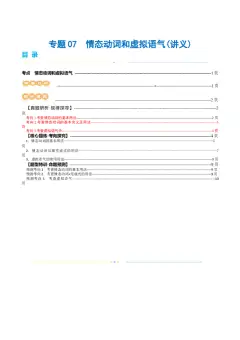
目录
第一部分 必备知识结构化清单
         梳理必备的语言知识点,夯实语言基础能力
第二部分 知识运用题型强化练
         必备知识与能力提升练,提升语言运用能力
◇Part 01  必备知识结构化清单
知|识|清|单
真题分析
【真题再现】
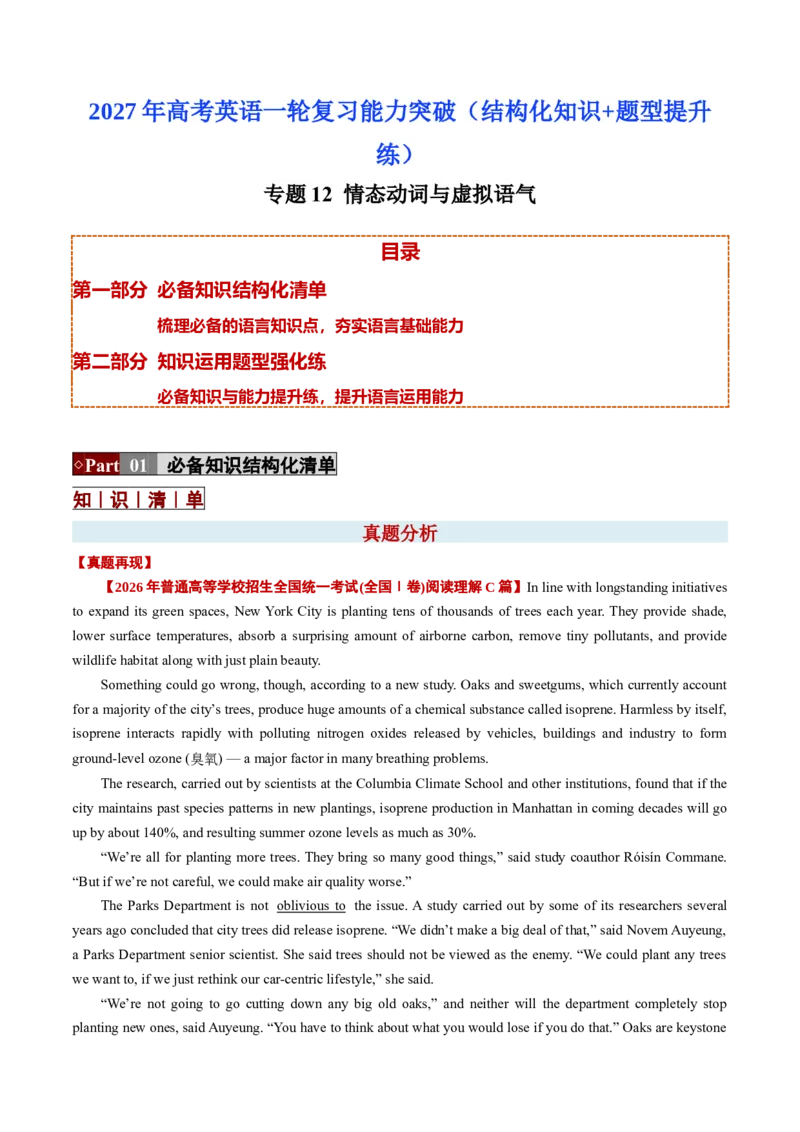
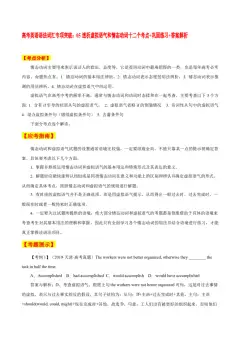
【2026 年普通高等学校招生全国统一考试(全国Ⅰ卷)阅读理解C 篇】In line with longstanding initiatives
to expand its green spaces, New York City is planting tens of thousands of trees each year. They provide shade,
lower surface temperatures, absorb a surprising amount of airborne carbon, remove tiny pollutants, and provide
wildlife habitat along with just plain beauty.
Something could go wrong, though, according to a new study. Oaks and sweetgums, which currently account
for a majority of the city’s trees, produce huge amounts of a chemical substance called isoprene. Harmless by itself,
isoprene interacts rapidly with polluting nitrogen oxides released by vehicles, buildings and industry to form
ground-level ozone (臭氧) — a major factor in many breathing problems.
The research, carried out by scientists at the Columbia Climate School and other institutions, found that if the
city maintains past species patterns in new plantings, isoprene production in Manhattan in coming decades will go
up by about 140%, and resulting summer ozone levels as much as 30%.
“We’re all for planting more trees. They bring so many good things,” said study coauthor Róisín Commane.
“But if we’re not careful, we could make air quality worse.”
The Parks Department is not oblivious to the issue. A study carried out by some of its researchers several
years ago concluded that city trees did release isoprene. “We didn’t make a big deal of that,” said Novem Auyeung,
a Parks Department senior scientist. She said trees should not be viewed as the enemy. “We could plant any trees
we want to, if we just rethink our car-centric lifestyle,” she said.
“We’re not going to go cutting down any big old oaks,” and neither will the department completely stop
planting new ones, said Auyeung. “You have to think about what you would lose if you do that.” Oaks are keystone
species, she pointed out, providing food and habitat for native insects, birds and other animals.
28. What does the new study imply regarding oaks and sweetgums?
A. They affect the growth of other trees.
B. They absorb less carbon than expected.
C. They harm people’s health indirectly.
D. They raise the local temperature slowly.
29. Which of the following may Commane suggest based on their study?
A. Cutting down the isoprene-producing trees.
B. Suspending tree-planting for a few decades.
C. Changing the species of trees in new plantings.
D. Removing isoprene released by existing trees.
30. What does the underlined phrase “oblivious to” in paragraph 5 mean?
A. Honest about.
B. Unaware of.
C. Related to.
D. Optimistic about.
31. What would Auyeung probably advocate?
A. Reducing car use in daily life.
B. Providing animals with new habitats.
C. Controlling population growth.
D. Doing more research on the problem.
(答案:28. C    29. C    30. B    31. A)
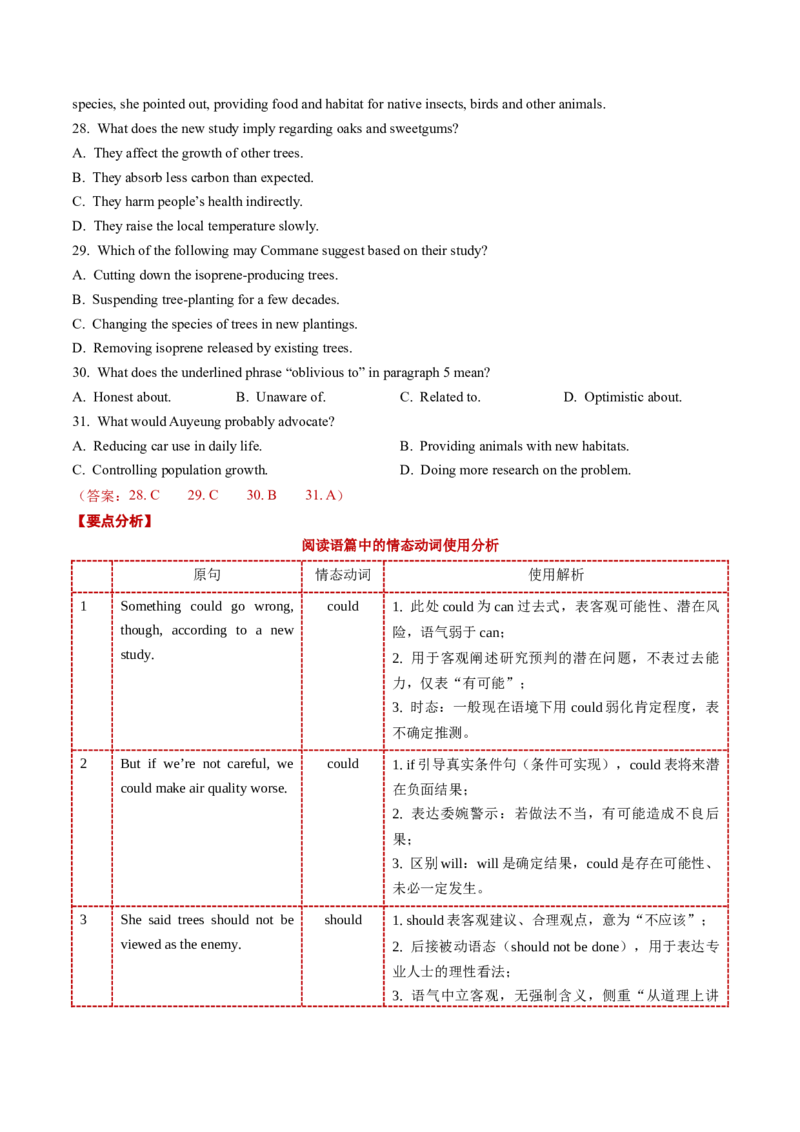
【要点分析】
阅读语篇中的情态动词使用分析
原句
情态动词
使用解析
1
Something could go wrong,
though, according to a new
study.
could
1. 此处could 为can 过去式,表客观可能性、潜在风
险,语气弱于can;
2. 用于客观阐述研究预判的潜在问题,不表过去能
力,仅表“有可能”;
3. 时态:一般现在语境下用could 弱化肯定程度,表
不确定推测。
2
But if we’re not careful, we
could make air quality worse.
could
1. if 引导真实条件句(条件可实现),could 表将来潜
在负面结果;
2. 表达委婉警示:若做法不当,有可能造成不良后
果;
3. 区别will:will 是确定结果,could 是存在可能性、
未必一定发生。
3
She said trees should not be
viewed as the enemy.
should
1. should 表客观建议、合理观点,意为“不应该”;
2. 后接被动语态(should not be done),用于表达专
业人士的理性看法;
3. 语气中立客观,无强制含义,侧重“从道理上讲
不该……”。
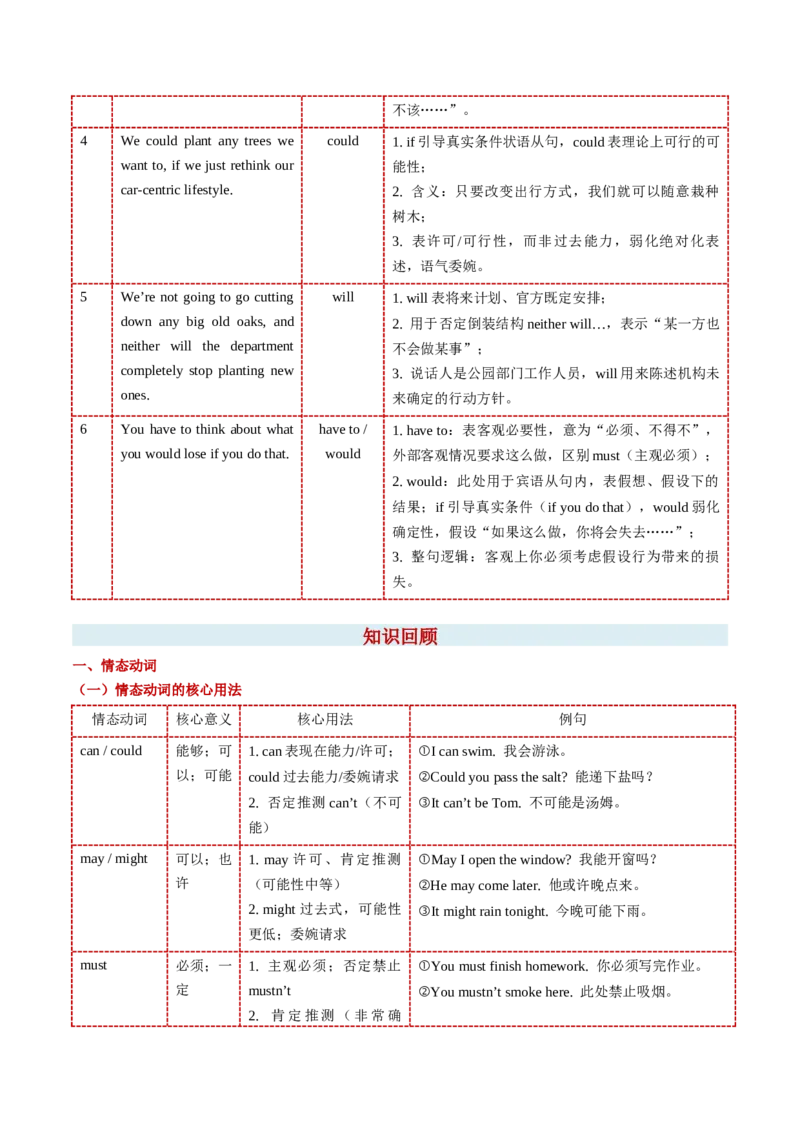
4
We could plant any trees we
want to, if we just rethink our
car-centric lifestyle.
could
1. if 引导真实条件状语从句,could 表理论上可行的可
能性;
2. 含义:只要改变出行方式,我们就可以随意栽种
树木;
3. 表许可/可行性,而非过去能力,弱化绝对化表
述,语气委婉。
5
We’re not going to go cutting
down any big old oaks, and
neither will the department
completely stop planting new
ones.
will
1. will 表将来计划、官方既定安排;
2. 用于否定倒装结构neither will…,表示“某一方也
不会做某事”;
3. 说话人是公园部门工作人员,will 用来陈述机构未
来确定的行动方针。
6
You have to think about what
you would lose if you do that.
have to /
would
1. have to:表客观必要性,意为“必须、不得不”,
外部客观情况要求这么做,区别must(主观必须);
2. would:此处用于宾语从句内,表假想、假设下的
结果;if 引导真实条件(if you do that),would 弱化
确定性,假设“如果这么做,你将会失去……”;
3. 整句逻辑:客观上你必须考虑假设行为带来的损
失。
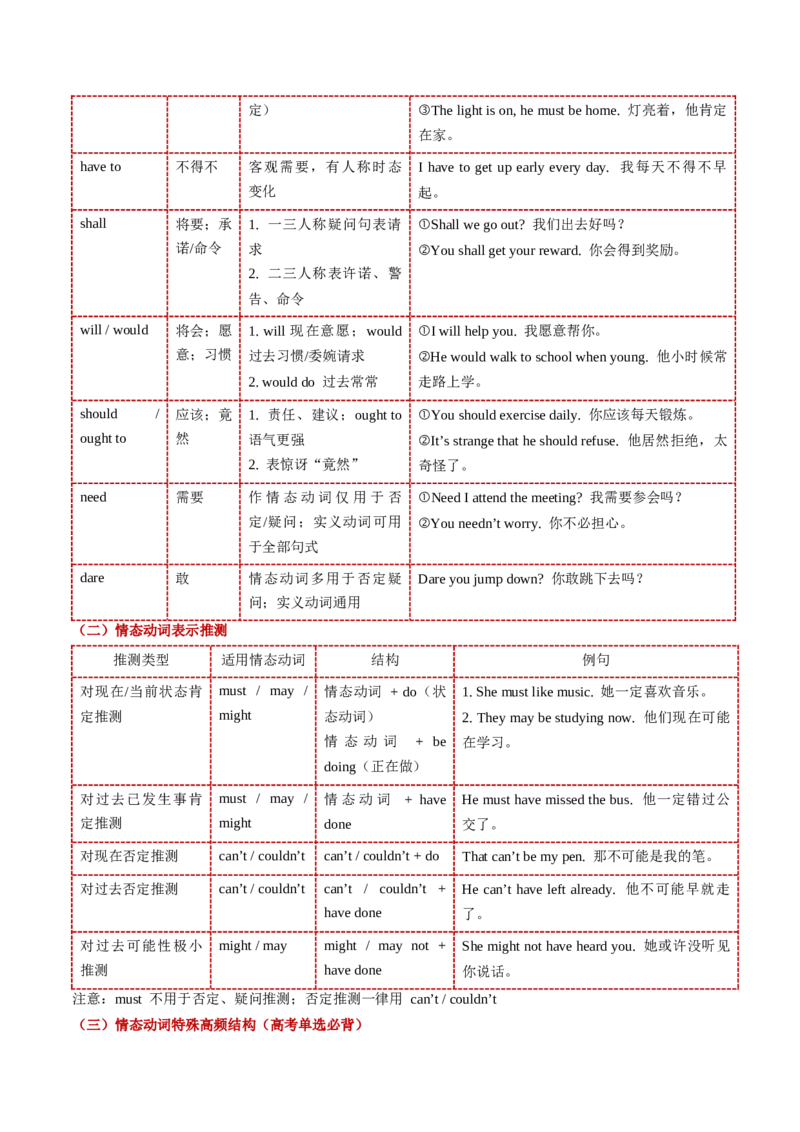
知识回顾
一、情态动词
(一)情态动词的核心用法
情态动词
核心意义
核心用法
例句
can / could
能够;可
以;可能
1. can 表现在能力/许可;
could 过去能力/委婉请求
2. 否定推测can’t(不可
能)
I can swim.
①
我会游泳。
Could you pass the salt?
②
能递下盐吗?
It can’t be Tom.
③
不可能是汤姆。
may / might
可以;也
许
1. may 许可、肯定推测
(可能性中等)
2. might 过去式,可能性
更低;委婉请求
May I open the window?
①
我能开窗吗?
He may come later.
②
他或许晚点来。
It might rain tonight.
③
今晚可能下雨。
must
必须;一
定
1. 主观必须;否定禁止
mustn’t
2. 肯定推测(非常确
You must finish homework.
①
你必须写完作业。
You mustn’t smoke here.
②
此处禁止吸烟。
定)
The light is on, he must be home.
③
灯亮着,他肯定
在家。
have to
不得不
客观需要,有人称时态
变化
I have to get up early every day. 我每天不得不早
起。
shall
将要;承
诺/命令
1. 一三人称疑问句表请
求
2. 二三人称表许诺、警
告、命令
Shall we go out?
①
我们出去好吗?
You shall get your reward.
②
你会得到奖励。
will / would
将会;愿
意;习惯
1. will 现在意愿;would
过去习惯/委婉请求
2. would do 过去常常
I will help you.
①
我愿意帮你。
He would walk to school when young.
②
他小时候常
走路上学。
should

/
ought to
应该;竟
然
1. 责任、建议;ought to
语气更强
2. 表惊讶“竟然”
You should exercise daily.
①
你应该每天锻炼。
It’s strange that he should refuse.
②
他居然拒绝,太
奇怪了。
need
需要
作情态动词仅用于否
定/疑问;实义动词可用
于全部句式
Need I attend the meeting?
①
我需要参会吗?
You needn’t worry.
②
你不必担心。
dare
敢
情态动词多用于否定疑
问;实义动词通用
Dare you jump down? 你敢跳下去吗?
(二)情态动词表示推测
推测类型
适用情态动词
结构
例句
对现在/当前状态肯
定推测
must / may /
might
情态动词 + do(状
态动词)
情态动词 + be
doing(正在做)
1. She must like music. 她一定喜欢音乐。
2. They may be studying now. 他们现在可能
在学习。
对过去已发生事肯
定推测
must / may /
might
情态动词 + have
done
He must have missed the bus. 他一定错过公
交了。
对现在否定推测
can’t / couldn’t
can’t / couldn’t + do
That can’t be my pen. 那不可能是我的笔。
对过去否定推测
can’t / couldn’t
can’t / couldn’t +
have done
He can’t have left already. 他不可能早就走
了。
对过去可能性极小
推测
might / may
might / may not +
have done
She might not have heard you. 她或许没听见
你说话。
注意:must 不用于否定、疑问推测;否定推测一律用 can’t / couldn’t
(三)情态动词特殊高频结构(高考单选必背)
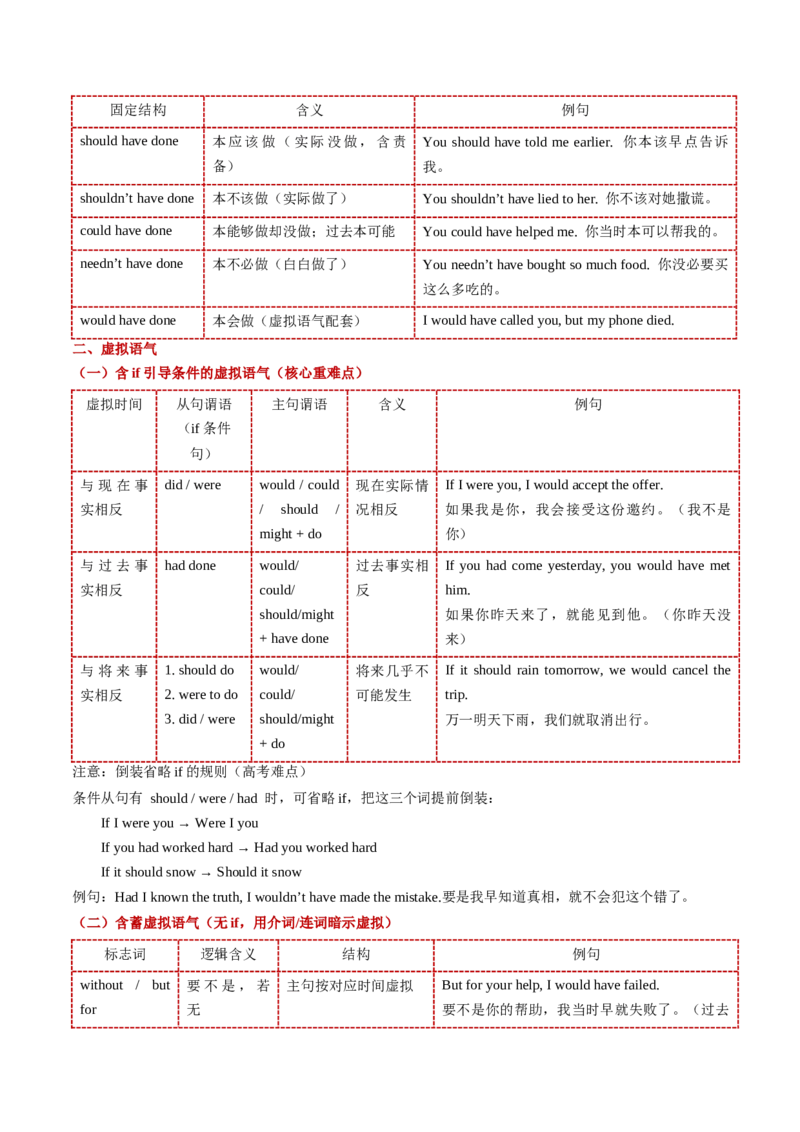
固定结构
含义
例句
should have done
本应该做(实际没做,含责
备)
You should have told me earlier. 你本该早点告诉
我。
shouldn’t have done
本不该做(实际做了)
You shouldn’t have lied to her. 你不该对她撒谎。
could have done
本能够做却没做;过去本可能
You could have helped me. 你当时本可以帮我的。
needn’t have done
本不必做(白白做了)
You needn’t have bought so much food. 你没必要买
这么多吃的。
would have done
本会做(虚拟语气配套)
I would have called you, but my phone died.
二、虚拟语气
(一)含if 引导条件的虚拟语气(核心重难点)
虚拟时间
从句谓语
(if 条件
句)
主句谓语
含义
例句
与现在事
实相反
did / were
would / could
/ should /
might + do
现在实际情
况相反
If I were you, I would accept the offer.
如果我是你,我会接受这份邀约。(我不是
你)
与过去事
实相反
had done
would/
could/
should/might
+ have done
过去事实相
反
If you had come yesterday, you would have met
him.
如果你昨天来了,就能见到他。(你昨天没
来)
与将来事
实相反
1. should do
2. were to do
3. did / were
would/
could/
should/might
+ do
将来几乎不
可能发生
If it should rain tomorrow, we would cancel the
trip.
万一明天下雨,我们就取消出行。
注意:倒装省略if 的规则(高考难点)
条件从句有 should / were / had 时,可省略if,把这三个词提前倒装:
If I were you → Were I you
If you had worked hard → Had you worked hard
If it should snow → Should it snow
例句:Had I known the truth, I wouldn’t have made the mistake.要是我早知道真相,就不会犯这个错了。
(二)含蓄虚拟语气(无if,用介词/连词暗示虚拟)
标志词
逻辑含义
结构
例句
without / but
for
要不是,若
无
主句按对应时间虚拟
But for your help, I would have failed.
要不是你的帮助,我当时早就失败了。(过去
虚拟)
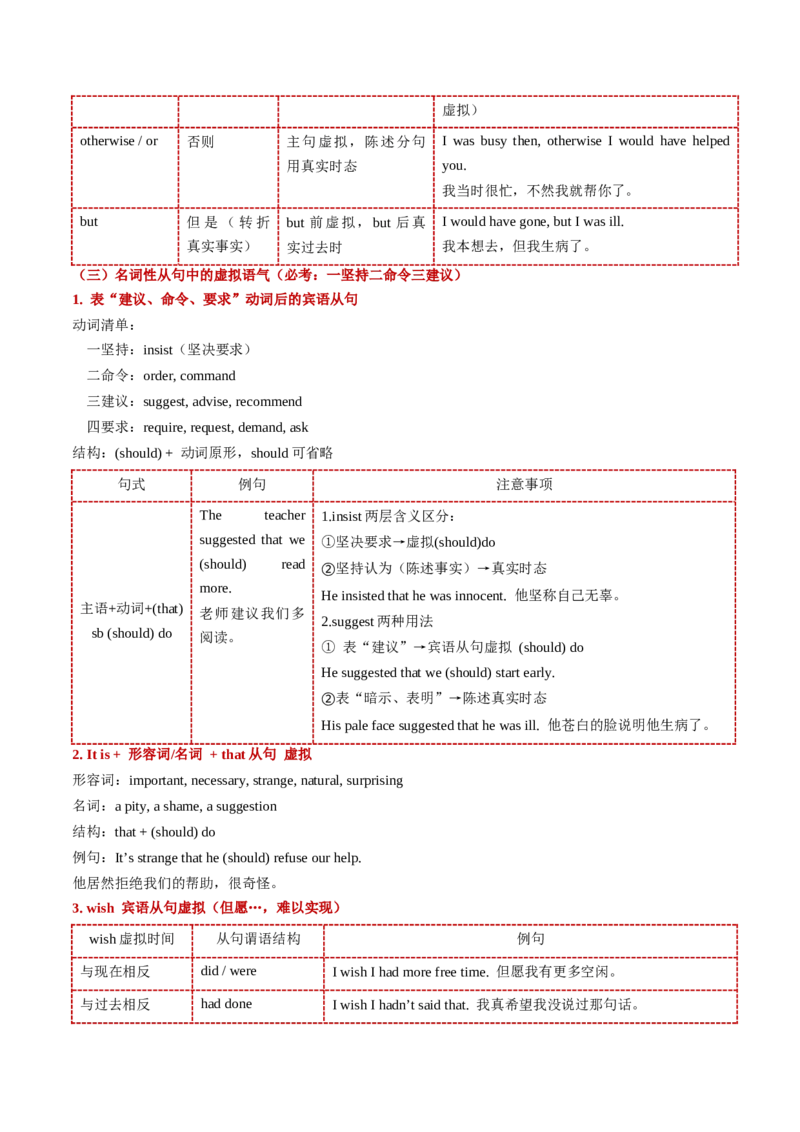
otherwise / or
否则
主句虚拟,陈述分句
用真实时态
I was busy then, otherwise I would have helped
you.
我当时很忙,不然我就帮你了。
but
但是(转折
真实事实)
but 前虚拟,but 后真
实过去时
I would have gone, but I was ill.
我本想去,但我生病了。
(三)名词性从句中的虚拟语气(必考:一坚持二命令三建议)
1. 表“建议、命令、要求”动词后的宾语从句
动词清单:
一坚持:insist(坚决要求)
二命令:order, command
三建议:suggest, advise, recommend
四要求:require, request, demand, ask
结构:(should) + 动词原形,should 可省略
句式
例句
注意事项
主语+动词+(that)
sb (should) do
The

teacher
suggested that we
(should)

read
more.
老师建议我们多
阅读。
1.insist 两层含义区分:
①坚决要求→虚拟(should)do
②坚持认为(陈述事实)→真实时态
He insisted that he was innocent. 他坚称自己无辜。
2.suggest 两种用法
① 表“建议”→宾语从句虚拟 (should) do
He suggested that we (should) start early.
②表“暗示、表明”→陈述真实时态
His pale face suggested that he was ill. 他苍白的脸说明他生病了。
2. It is + 形容词/名词 + that 从句 虚拟
形容词:important, necessary, strange, natural, surprising
名词:a pity, a shame, a suggestion
结构:that + (should) do
例句:It’s strange that he (should) refuse our help.
他居然拒绝我们的帮助,很奇怪。
3. wish 宾语从句虚拟(但愿…,难以实现)
wish 虚拟时间
从句谓语结构
例句
与现在相反
did / were
I wish I had more free time. 但愿我有更多空闲。
与过去相反
had done
I wish I hadn’t said that. 我真希望我没说过那句话。
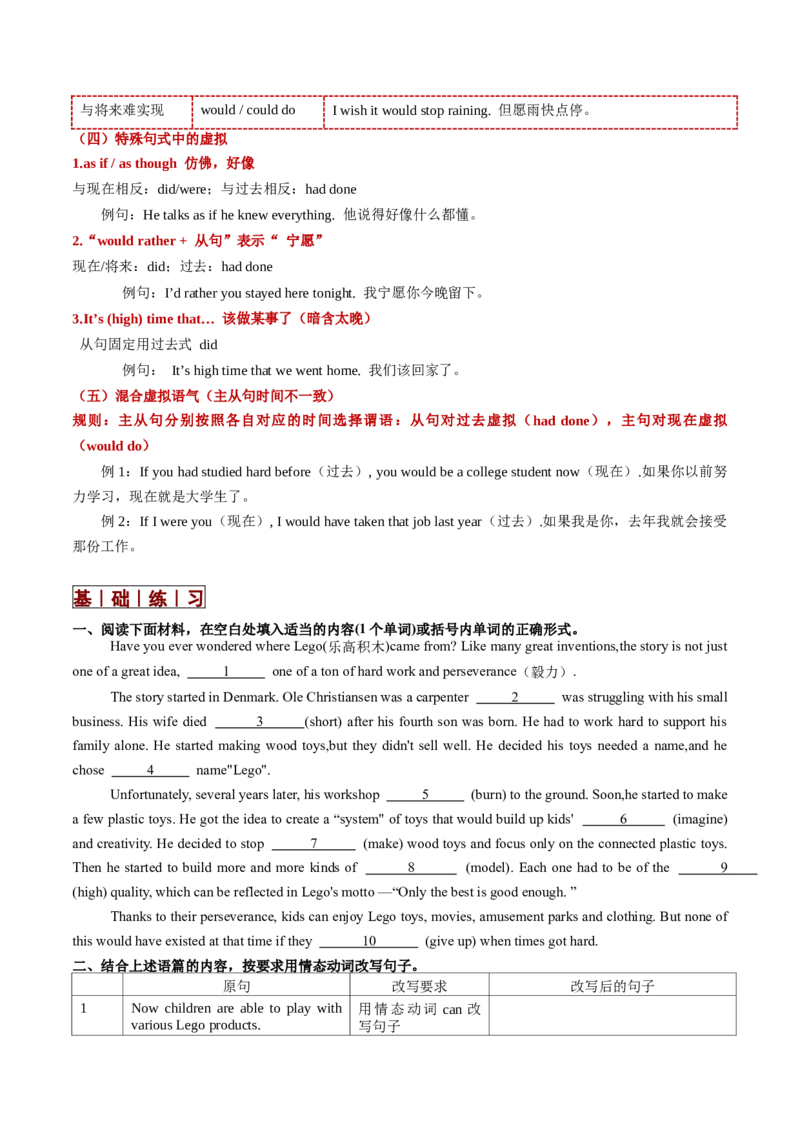
与将来难实现
would / could do
I wish it would stop raining. 但愿雨快点停。
(四)特殊句式中的虚拟
1.as if / as though 仿佛,好像
与现在相反:did/were;与过去相反:had done
例句:He talks as if he knew everything. 他说得好像什么都懂。
2.“would rather + 从句”表示“ 宁愿”
现在/将来:did;过去:had done
       例句:I’d rather you stayed here tonight. 我宁愿你今晚留下。
3.It’s (high) time that… 该做某事了(暗含太晚)
 从句固定用过去式 did
       例句: It’s high time that we went home. 我们该回家了。
(五)混合虚拟语气(主从句时间不一致)
规则:主从句分别按照各自对应的时间选择谓语:从句对过去虚拟(had done),主句对现在虚拟
(would do)
例1:If you had studied hard before(过去), you would be a college student now(现在).如果你以前努
力学习,现在就是大学生了。
例2:If I were you(现在), I would have taken that job last year(过去).如果我是你,去年我就会接受
那份工作。
基|础|练|习
一、阅读下面材料,在空白处填入适当的内容(1 个单词)或括号内单词的正确形式。
Have you ever wondered where Lego(乐高积木)came from? Like many great inventions,the story is not just
one of a great idea,      1      one of a ton of hard work and perseverance(毅力).
The story started in Denmark. Ole Christiansen was a carpenter      2      was struggling with his small
business. His wife died      3     (short) after his fourth son was born. He had to work hard to support his
family alone. He started making wood toys,but they didn't sell well. He decided his toys needed a name,and he
chose      4      name"Lego".
Unfortunately, several years later, his workshop      5      (burn) to the ground. Soon,he started to make
a few plastic toys. He got the idea to create a “system" of toys that would build up kids'      6      (imagine)
and creativity. He decided to stop      7      (make) wood toys and focus only on the connected plastic toys.
Then he started to build more and more kinds of      8      (model). Each one had to be of the      9

(high) quality, which can be reflected in Lego's motto —“Only the best is good enough. ”
Thanks to their perseverance, kids can enjoy Lego toys, movies, amusement parks and clothing. But none of
this would have existed at that time if they       10       (give up) when times got hard.
二、结合上述语篇的内容,按要求用情态动词改写句子。
原句
改写要求
改写后的句子
1
Now children are able to play with
various Lego products.
用情态动词can 改
写句子
2
Ole was forced to make toys day and
night to raise his family.
用had to 改写句子
3
It is certain that Ole experienced
great pain after his wife passed
away.
用must have done 结
构改写
4
Ole’s wooden toys were not popular,
so he didn’t make much money.
用if 引导对现在虚
拟条件句改写
5
They didn’t give up when difficulties
came, so Lego finally came into
being.
用if 引导对过去虚
拟条件句改写
6
It is advisable for toy makers to stick
to high-quality standards.
用should 改写句子
◇Part 02  知识运用题型强化练
一、阅读理解
1
Imagine a robot that could do your laundry, cook your dinner, or stock the dairy section at your local grocery
store. Humans have long been able to teach robots how to do individual tasks, but instructing them on these more
complex (复杂的) jobs has been a challenging goal, despite billions of dollars invested in robotics.
Now, a team of scientists in Switzerland has made progress in the quest to invent helpful robots that can act
on complex instructions from humans. A problem that robotics scientists like Sthithpragya Gupta have long battled
is that robots cannot do tasks beyond those that they are specifically programmed for. Take tennis as an example.
Robots may be able to learn how to hit a backhand shot perfectly. But if conditions change — say, their opponent
moves — it all falls apart. Humans have no problem adjusting to these kinds of changes. Teaching a robot how to
adapt, though, is much more difficult.
Gupta and his colleagues have published a paper showing a new way of teaching robots using machine
learning. The approach relies on kinematic (运动学上的) intelligence — a robot’s built-in awareness of how its
own body can move safely through space. In a video showing their technology, robots with a single arm watch as a
human instructor throws a ball into a small container. The robots then pick up the ball and copy the instructor’s
behavior, adapting their own position. Robots are then capable of transferring these skills and knowledge to other
robots.
“It could be a turning point,” says Robert Platt, who studies robotics at Northeastern University. Platt noted
that the field of robotics is not in widespread agreement about the path forward — but most agree the problem these
researchers are handling is a critical one.
However, this technology poses new questions about ethics (伦理标准). Susan Schneider at Florida Atlantic
University points out that later versions of this technology could potentially be weaponized against humans. Future
development will need rules. “I think really soon we should have regulatory frameworks on who operates a robot
and how,” says Gupta.
1.What problem of robots has long troubled robotics scientists?
A.The high costs of programming robots.
B.The inability to follow complex tasks.
C.The slow response to human orders.
D.The lack of certain physical flexibility.
2.How did the Swiss team’s robots show their learning ability in the experiment?
A.By correcting mistakes made by humans. B.By competing with human instructors.
C.By adapting behavior for their position.
D.By perfectly replaying human actions.
3.What can be inferred about the future of this robotic technology?
A.It will soon replace human workers.
B.Its path forward remains smooth.
C.Its main risk is technical breakdown.
D.It demands rules for its safe application.
4.What is the text mainly about?
A.A breakthrough in adaptable robotics.
B.The tough challenges of machine learning.
C.Various ethical debates around robots.
D.A commercial expectation of service robots.
附加题1:结合阅读理解的内容分析情态动词或虚拟语气的用法
原句
情态动词/虚拟语气的使用分析
1
Imagine a robot that could do your
laundry, cook your dinner, or stock
the dairy section at your local grocery
store.
虚拟语气(含蓄虚拟)+could 用法:
2
Robots may be able to learn how to
hit a backhand shot perfectly.
情态动词may 表推测:
3
I think really soon we should have
regulatory frameworks on who
operates a robot and how.
情态动词should 表建议:
4
later versions of this technology could
potentially be weaponized against
humans.
情态动词could 表委婉推测:
2
Cole Stelter arrived at Virginia Tech with a clear plan. Born in South Dakota, he moved to Virginia in 2012
and discovered his passion for biomedical engineering early on. “I’ve always loved Virginia Tech,” Stelter said.
“Once I toured the department, I was completely impressed. I haven’t had a single regret.”
His journey into engineering began in high school. Through a special program, Stelter became fascinated by
bioprinting. “We worked with a bioprinter and even printed materials using algae (藻类),” he recalled. “That was
my first chance to see that engineering could directly help human health.”
Upon arriving at Virginia Tech, Stelter didn’t wait to dive into practical work. During his freshman year, he
sought research opportunities and joined the Kim Lab led by Assistant Professor Oleg Kim. “Once I met the lab and
the graduate students, I knew it was where I wanted to be,” Stelter said. In the lab, he focused on researching the
effects of saliva ( 唾液) on blood clotting ( 凝块) mechanics in oral wound healing. His findings were great,
discovering that saliva significantly reduces the time required for clot formation.
Stelter’s senior design team is also making progress in medical technology. They are developing a
specialized nerve conduit (神经导管) designed to help the repair of peripheral nerve injuries. This device serves as
a bridge for damaged nerves, effectively promoting natural regrowth. “Instead of relying on nerve grafts ( 移植),
which often only restore about half of motor and sensory function, our goal is to allow the nerve to reconnect,
naturally,” Stelter explained. “That could greatly improve recovery.”
After graduating in just three years, Stelter has found his true interest in tissue engineering and regenerative
medicine. He plans to continue his research at Virginia Tech and in the Kim Lab, eventually working toward a Ph.
D.to continue making an impact on human health through his dedicated scientific efforts.
5.What initially inspired Stelter’s passion for biomedical engineering?
A.His tour of Virginia Tech’s department.
B.A desire to improve environment.
C.His personal experience with diseases.
D.A high school program with bioprinting.
6.What did Stelter discover about saliva in wound healing?
A.It slows down blood clotting.
B.It shortens the time of clot formation.
C.It replaces the need for grafts.
D.It assists natural nerve growth.
7.What is the value of the new device?
A.It replaces traditional motor functions.
B.It simplifies complex graft processes.
C.It improves nerves’natural regrowth.
D.It contributes to a complete recovery.
8.Which best describes Stelter’s educational journey?
A.Physically demanding.
B.Eye-opening.
C.Financially rewarding.
D.Goal-driven.
附加题2:结合阅读理解的内容分析情态动词或虚拟语气的用法
原句
情态动词/虚拟语气的使用分析
1
That could greatly improve recovery.
情态动词could 表潜在能力/预期效果:
2
which often only restore about half of
motor and sensory function.
情态动词隐含用法:
3
Once I toured the department, I knew
it was where I wanted to be.
宾语从句隐含愿望虚拟:
3
Valentia Island, one of Ireland’s most westerly points, receives around 20,000 visitors annually. Most tourists
come to the island to see the picturesque lighthouse. Since Paul O’Neil built the first bee beds on the island in
summer 2023, visitors have been drawn to the island for a unique experience.
“I’ve created a whole experience around the bee beds,” explains Paul. “You start on a bus where we will give
you a natural liquid collected by honey bees, then I will help you into your beekeeping suits.”
Each wooden house has two beds, each with five hives (蜂箱) underneath it. “You’re very close to the bees
but protected by a fine net. There are also observation hives built into the wall of the house where you can observe
all the bees in a way that you can’t even do through traditional beekeeping. You’re then free to just lie down and
experience this unique moment,” says Paul.
Guests usually stay for about half an hour, breathing in the smell of fanning bees. Many fall fast asleep,
supported by advanced red light technology, soft sounds, and nice smells. The hives similarly purify the air, which
Paul says are “very beneficial for cleansing your lungs.” Being so close to honey bees is thought to have beneficial
health effects. While claims haven’t been proven, bee beds have been used for centuries for sleep disorders,
tiredness, and stress.
The bee houses close during the winter months when the queen stops laying, but they reopen in the spring
when the queen is busy again. Due to the year-round demand, Paul is now looking to winter bee experiences for
bee-friendly visitors.
Beekeepers, who barely cover their costs these days, can earn a second income from this unusual travel
trend. That’s why Paul offers a course that teaches other bee enthusiasts how to set up bee beds.
“Bee beds allow normal people to feel the goodness of bees while obviating the risks of being a beekeeper,”
says Paul.
9.What was Paul’s motivation for building bee beds?
A.To protect wild bees.
B.To attract tourists with uniqueness.
C.To sell honey on Valentia Island.
D.To replace traditional beekeeping.
10.What can guests get during their bee bed experience?
A.A course on setting up bee beds.
B.A chance to engage in beekeeping.
C.Peaceful rest and natural comfort.
D.30 minutes of physical exercise and recovery.
11.What is Paul’s plan for the future?
A.Moving bee beds outdoors.
B.Providing winter bee experiences.
C.Improving the living environment of bees.
D.Offering a safe environment for observing bees.
12.What does the underlined word “obviating” in the last paragraph mean?
A.Posing.
B.Assessing.
C.Spreading.
D.Removing.
附加题3:结合阅读理解的内容分析情态动词或虚拟语气的用法
原句
情态动词/虚拟语气的使用分析
1
you can’t even do through traditional
beekeeping.
情态动词can 表客观能力(否定形式):
2
we will give you a natural liquid
collected by honey bees.
情态动词will 表客观将来安排:
3
While claims haven’t been proven, bee
beds have been used for centuries for
sleep disorders, tiredness, and stress.
让步状语从句隐含推测情态:
4
Have you ever dreamed of leaving the noisy city behind and setting off on a journey across a vast, totally
unexplored land? For many travelers, this kind of exciting adventure is the ultimate escape from the routines of
daily life.     13
The journey begins with careful and thorough preparation. First, travelers must choose a suitable and
practical route. Some prefer to follow well-marked paths that pass through famous scenic spots.     14     No
matter which route they take, packing the right and proper supplies is essential. Water, food, a first-aid kit and
durable clothing are among the top priorities.
Once on the road, the vast land unfolds its unique beauty and challenges. The landscape changes
dramatically from one single day to the next.     15     At night, the sky is filled with countless bright stars,
creating a view that city residents rarely get to see. However, travelers also face unexpected difficulties, such as
sudden weather changes and long stretches of empty land with no gas stations or restaurants.
    16     They learn to read the clear signs of nature, such as the direction of the wind and the behavior
of wild animals, to find their way and stay safe. They also develop a deep appreciation for the simple little things in
life, like a clear stream to drink from or a warm campfire to gather around.
At the end of the journey, travelers return home with more than just simple photos and souvenirs.     17
This journey across a vast land is not just a physical experience but a spiritual one that changes their perspective on
life forever.
A.Others choose to take unknown roads to find new places.
B.They also get a refreshing feeling and a deep love for nature.
C.It lets people get close to nature and understand the freedom.
D.Good planning can help travelers avoid trouble and enjoy the trip.
E.On the way travelers encounter diverse wildlife from deer to eagles.
F.People who like challenges can take the trip to test how far they can go.
G.Travelers soon know they have to depend on their own skills and ideas.
附加题4:结合阅读理解的内容分析情态动词或虚拟语气的用法
原句
情态动词/虚拟语气的使用分析
1
Have you ever dreamed of leaving the
noisy city behind and setting off on a
journey across a vast, totally
unexplored land?
wish/dream 类动词引导愿望虚拟语气:
2
travelers must choose a suitable and
practical route.
情态动词must 表客观必须、强制要求:
3
Good planning can help travelers avoid
trouble and enjoy the trip.
情态动词can 表客观功用:
。
二、完形填空
At nineteen, Holly set off to study abroad in Nancy, France, her heart full of excitement. Yet within weeks of
arrival, that excitement     18     into loneliness. Daily life in a foreign land proved much harder than     19
, especially when it came to speaking French. “I could understand the language somewhat, but I was     20

at speaking it. My accent (口音) was bad. People couldn’t understand me,” she said. The continuous     21

to be understood left her tired and sad. The only thing keeping her going was a     22     package from home.
“Mother had sent my favorite food — something I couldn’t find in local shops.”
She went to the post office to     23     it, but the clerk couldn’t understand her broken speech no matter
how hard she tried. “The more I repeated myself, the more discouraged and     24     I felt. I was about to
25     in tears when a stranger came to my     26    .” A local woman asked, in Holly’s own language, “Can I
help you?” And then she spoke to the clerk, and within minutes, the package was in Holly’s hands. But the kindness
didn’t     27     there. The woman invited Holly to her house for dinner. “It soon became our weekly habit. It
was a safe place where I could     28     my French without fear. I     29     felt like I was at home there.”
Decades later, they still keep in touch. “Her act of kindness has     30     my life,” Holly said. “Now I
pay more attention to people who need help, offering the same     31     I once received. I will be forever
32     that someone chose to help me when I needed it most.”
18.A.broke
B.divided
C.gathered
D.faded
19.A.expected
B.requested
C.indicated
D.promised
20.A.excellent
B.amazing
C.terrible
D.patient
21.A.option
B.struggle
C.decision
D.reflection
22.A.familiar
B.neat
C.mysterious
D.commercial
23.A.deliver
B.collect
C.recycle
D.approach
24.A.intelligent
B.energetic
C.disappointed
D.fascinated
25.A.calm down
B.bring up
C.set off
D.break down
26.A.rescue
B.permission
C.defence
D.judgement
27.A.start
B.continue
C.end
D.form
28.A.update
B.practice
C.ignore
D.test
29.A.truly
B.hardly
C.sharply
D.occasionally
30.A.determined
B.signaled
C.impressed
D.influenced
31.A.resource
B.warmth
C.suggestion
D.respect
32.A.careful
B.regretful
C.cheerful
D.grateful
三、语法填空
阅读下面短文,在空白处填入1 个适当的单词或括号内单词的正确形式。
Since November 5, the Inka Museum in Cuzco, Peru, has held the exhibition “Light of the Sun: A Dialogue
Between Ancient Shu and Inca Civilizations”,     33     features numerous cultural treasures. On display are
copies and 3D-printed versions of     34     (object) from China’s ancient Shu kingdom, such as giant bronze
trees and golden masks, alongside Inca relics (文物). Both cultures share a respect for the sun and a love for gold,
35     (make) the exhibition a powerful vehicle for cultural exchange.
This is not the first cross-cultural event. In 2016, to mark     36     45th anniversary of China-Peru
diplomatic (外交的) relations, over 100 Chinese exhibits were shown in Lima, with thousands of visitors eager
37     (see) relics like the Terracotta Warriors.
In recent years, Chinese museums have also hosted Peruvian relic exhibitions. A 2021 joint show     38
(tour) five Chinese cities. After that, a 2024 exhibition featuring 168 relics from 14 Peruvian museums proved
highly popular in Chengdu     39     Shenzhen, attracting over a million visitors in total. The Peruvian
President even visited the Shenzhen show.
These exchanges can     40     (deep) mutual understanding and help people recognize     41

(share) cultural roots. They highlight the vital role cultural interaction plays     42     bridging distant
civilizations and strengthening ties between China and Peru.
四、写作
    假定你是李华,你校英文报将举办榜样人物分享会(Role Model Sharing Session)。请你给学生会写一
封推荐信,推荐一位你敬佩的人(可以是名人,也可以是身边榜样人物)。
内容包括:(1) 你推荐的人物简介;(2) 推荐理由。
注意:(1) 写作词数应为 80 个左右;(2) 可适当加入细节,使行文连贯。
Dear Student Union,
____________________________________________________________________________________________
____________________________________________________________________________________________
____________________________________________________________________________________________
____________________________________________________________________________________________
____________________________________________________________________________________________
____________________________________________________________________________________________
_______________________________________________________________________
Yours
Li Hua