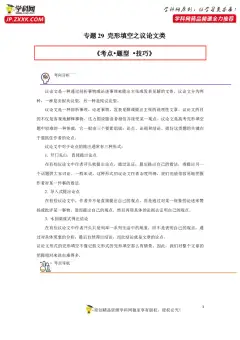
压轴题 11 完形填空
分析近几年新高考完形填空可知,高考完形填空注重考查考生在阅读理解的基础上对词
汇知识的掌握情况,命题遵循“突出语篇,强调应用,注重实际”的思路。内容情节深刻,
常涉及人物心理活动的细致描写,篇章与句子结构变化丰富,文章内容将文化、知识、教
育、趣味等融为一体,时代感突出,生活化明显,寓教于乐,充满正能量。预测2024年高考
命题预测
对于完形填空的考查仍是压轴考题。
1. 句中题
高频考法 2. 句间题
3. 语篇题
一、完形填空基本规律及解题要领
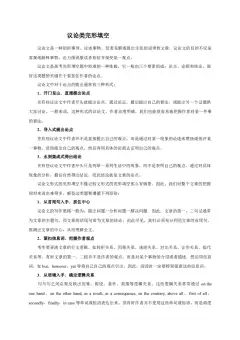
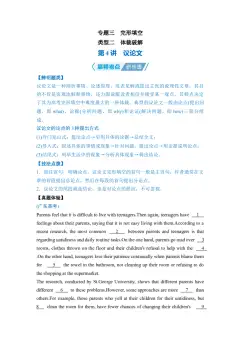
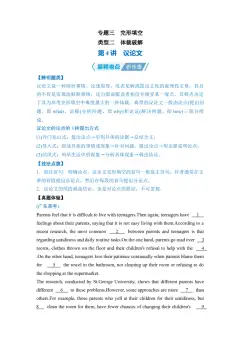
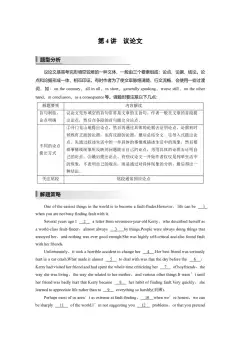
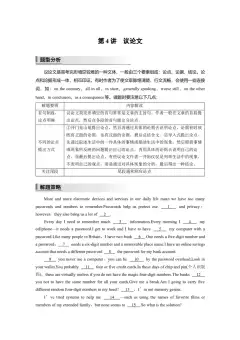
议论文类完形填空是高考完形填空中较难的一种文体,一般由三个要素组成:论点、论据和论证。做好
议论文类的完形填空最重要的是抓住作者的论点。
不同的议论文论点的提出方式往往不同,大体有以下三种情况:
①开门见山地提出论证。大部分议论文在文章的首段就提出论点。然后再通过具体的论据去说明论
点,论据有时候既有正面的,也有反面的。最后总结全文。
②导入式提出论点。有些议论文会先叙述生活中的一件具体的事情或描述生活中的现象,然后根据事情
或现象所反映的问题提出自己的论点,再用具体的论据去说明自己的论点。
③最后提出论证。有些议论文一开始作者仅仅是列举生活中的现象,不表明自己的观点,然后通过对具
体现象的分析,自然地得出一种结论,这种结论往往就是作者的论点。答题时要注意理清论点、论据和论
证。一般来说,能说明论据主要内容的答案可以在论点里得到印证,而能说明论点主要内容的答案也可以与
论据有机地结合起来。抓住了这个特点,部分选项的答案便一目了然。命题规律:
命题以动词和名词等实词为主,完形填空所给的选项一般是同一词类,或属同一范畴。高考完形填空
题考查动词(5-8个)名词(4一6个)、然后是形容词,副词等。而介词、连词、冠词等虚词则相对考得较
少。
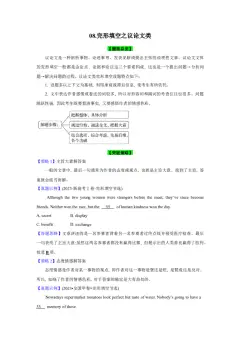
句中命题 主要考查考生正确理解句意的能力和词汇的辨析能力。这类题设题较多。
句组命题 从上下文中命题,占比最大,考查考生对上下文的理解能力。
这种题难度较大,考查考生对文章中心脉络、结构层次的把握能力。并具有瞻前顾后,把
情境命题 握全文的全局意识。
情感命题 要求考生理解文章,对作者的思想或心理进行准确的推理判断能力。
考查考生的逻辑推理能力,要求考生根据事情发生、发展的规律,按照作者的思维方式、
逻辑命题 语言风格等对文章的行文逻辑进行分析,做出判断。
二、完形填空的解题技巧
1 . 通读全文,把握大意
研读首句或首段,跳过空格,弄清文脉,抓住主旨大意,有助于把握短文文意进行初选。
2 . 明确写作要素
弄清记叙文的6要素(5W1H),即时间(when)、地点(where)、人物(who)、事件(what)、原因(why)、结果
(how),抓住这些写作要素,就基本上抓住了文章的主体。
3 . 瞻前顾后,先易后难
动笔时要瞻前顾后、通篇考虑、先易后难。先做最有把握的,简单直接的题,对于一下子不能确定答案的
题,先跳过,最后再回过头来集中精力根据完形填空的高频考法和命题规律解决难点。此时一定关注语篇
中的线索词。
4 . 角色代入法
在做题时考生可采用“角色渗透法”,这样有助于按照作者的思维逻辑、情感色彩,深入理解文章的含义。
5 . 巧用信息复现法
语篇复现的信息包括原词复现、同义词和反义词复现、概括词和代词复现等。语篇中如果有词汇和结构复
现与话题相关等情况时,利用上下文寻找解题信息,确定正确答案。
6 . 利用逻辑关系法
句子或词组不是孤立存在的,其出现有一定的逻辑关系,可通过句中或句间的逻辑关系,如例证、转折、
让步、递进、因果等逻辑关系词来解题。
7 . 复读再验证完成各个选项后,把所选的选项代入文中,再把全文通读一遍,看所选的选项是否意思前后关联,顺利成
章,语法结构是否正确,语言表达形式是否符合习惯用法。
04 议论文
1.(2023·安徽淮南·一模)
“Whenever I am in a group of people, I feel like everyone knows what to say except me. When I try to join in,
I get anxious and have a struggle 1 words. This happens at parties or meetings and I feel 2 — as if
I were being interviewed for a job. People think I am a loner. Maybe I am?”
Individuals experiencing this type of social 3 often avoid eye contact, because it makes them feel 4
and judged. The feelings of awkwardness and not fitting in with others are often frustrating. It prevents these
individuals from defending and 5 for themselves in social environments, though they may be 6 at
holding on to their opinions in environments that are focused on a task rather than 7 .
Fitting into groups of people requires 8 . You need to be interested in the topics that others in the group
are interested in and talk about them the way they do. Becoming a part of these groups requires that you 9
some of your individuality in order to accept others’ 10 and values.
Some individuals are like chameleon (变色龙) in that they 11 pick up the patterns of different
groups and 12 themselves accordingly. For them, this is automatic and they don’t even come to the
13 that they are changing themselves to fit into groups. If you are one of those people who feels 14
in most social group settings, it may be because you 15 changing the way you think in order to feel
part of a group and this shouldn’t be a weakness or a failure.
1.A.reading B.pronouncing C.grasping D.writing
2.A.exposed B.caged C.perceived D.judged
3.A.remoteness B.discomfort C.event D.reality
4.A.transparent B.rigid C.urgent D.disappointed
5.A.insisting on B.breaking with C.sticking up D.talking over
6.A.critical B.effective C.contradictory D.tentative7.A.contribution B.requirement C.assignment D.socialization
8.A.patience B.honesty C.curiosity D.agreement
9.A.sacrifice B.claim C.examine D.present
10.A.hobbies B.approaches C.views D.promises
11.A.naturally B.partly C.vaguely D.merely
12.A.explain B.support C.help D.adapt
13.A.conclusion B.awareness C.decision D.point
14.A.rewarded B.removed C.disconnected D.connected
15.A.resist B.allow C.miss D.undergo
2.(23-24高三·江苏南通·阶段练习)
Although most flyers (传单) have gone the way of tape recordings, there’s still the 16 one that
shows up at our door. 17 , they go straight to the recycling bin — unless there are small children and a
page with toys catches their eyes.
They are 18 by it. They tend to feel forced to read it over and over again. But that’s not 19
. Now there’s a whole list of toys they can’t live without. Before they saw this page, they were 20 . There
was nothing they needed. They had 21 puzzles, books, and games to keep them satisfied for hours. Not
to mention the outdoor 22 . Now, they need this toy. They’ll be miserable 23 they have it. After
calming down the kids and giving some firm nos, it’s time to 24 the experience.
Aren’t we all like those children? We’re mostly fine until we run into a situation where our desires are 25
. This could be a trip to the mall or a view of someone’s vacation pictures on WeChat. There are new things or
experiences we 26 ! We’ll be so miserable without them.
We are all 27 affected. And that’s thought-provoking.
Recognizing our weakness and the source of the temptation (诱惑) is a big first step towards 28
it. We can begin by steeling ourselves against the sources — 29 social media, avoiding the mall… And
even under those circumstances that can’t be avoided, we can repeat to ourselves the wisdom, “Who is the rich
person? The one who is 30 with his life. ”
16.A.original B.occasional C.important D.inspiring
17.A.In order B.In general C.Now and then D.More or less
18.A.ignored B.puzzled C.prohibited D.attracted
19.A.within its reachB.a piece of cake C.the worst of it D.as plain as day20.A.content B.curious C.innocent D.unsettled
21.A.all B.limited C.enough D.extra
22.A.options B.agency C.education D.areas
23.A.if B.because C.until D.though
24.A.meet with B.bring up C.work out D.reflect on
25.A.excited B.admitted C.controlled D.expressed
26.A.need B.obtain C.possess D.share
27.A.secretly B.directly C.barely D.easily
28.A.understanding B.conquering C.investigating D.building
29.A.making time for B.looking forward to C.staying away from D.taking
advantage of
30.A.familiar B.satisfied C.busy D.concerned
3.(2023高三·江苏镇江·开学考试)
In all one’s lifetime it is oneself that one spends the most time being with or dealing with. But it is 31
oneself that one has the least understanding of. When you are going upwards in life you tend to overestimate
yourself. It seems that everything you seek for is within your 32 . When you are going downhill you tend
to underestimate yourself.
To get a thorough understanding of oneself is to gain a correct view of oneself and be a realist-aware of both
one’s 33 and weaknesses. You may 34 hopefully to the future but be sure not to 35
too much, for ideals can never be fully realized. You may be 36 to meet challenges but it should be clear
to you 37 to direct your efforts. That’s to say, so long as you have a perfect 38 of yourself,
there won’t be difficulties you can’t overcome.
To get a thorough understanding of oneself needs self-appreciation. Whether you think you are a towering tree
or a blade of grass, a high mountain or a small stone, you represent a state of nature that has its own reason of 39
. If you earnestly admire yourself you’ll have a real sense of self-appreciation, which will give you confidence.
40 you gain full confidence in yourself, you’ll be enabled to fight and overcome any difficulty.
To get a thorough understanding of oneself also requires doing oneself a favor when it’s needed. In time of
anger, do yourself a favor by giving an outlet to it in a quiet place so that you won’t be hurt by its flames; in time of
sadness, do yourself a favor by 41 it with your friends so as to change a gloomy mood into a cheerful
one; in time of tiredness, do yourself a favor by getting a good sleep or taking some stimulant. Show yourselfloving concern about your health and daily life. 42 you know perfectly well when and how to do yourself
a favor, you won’t be confident and ready enough to 43 the attack of illness. As you are aware, what a
person physically has is but a human body that’s vulnerable when 44 to the elements. So if you fall ill,
it’s up to you to take a good care of yourself.
In a word, to get a thorough understanding of oneself is to get a full 45 of one’s life. Then one will
find one’s life full of color and flavor.
31.A.permanently B.previously C.precisely D.perfectly
32.A.reach B.budget C.development D.brain
33.A.shortages B.disadvantages C.strengths D.limitations
34.A.look up B.look back C.look forward D.look down
35.A.expect B.analyze C.inspect D.dream
36.A.honest B.comprehensive C.courageous D.delicate
37.A.what B.which C.how D.where
38.A.image B.knowledge C.system D.memory
39.A.attack B.criticism C.popularity D.existence
40.A.As much as B.As soon as C.As far as D.As well as
41.A.quarreling B.arguing C.sharing D.blaming
42.A.Unless B.Once C.Since D.If
43.A.recall B.restore C.restart D.resist
44.A.exchanged B.exposed C.experienced D.exported
45.A.mark B.control C.account D.recovery
4.(2023·福建厦门·一模)
Whenever I am in a group of people, I feel like everyone knows what to say and I have no idea. When I do try
to join in, I get anxious. I struggle 46 words. This happens at parties or meetings. I feel judged- 47
I were being interviewed for a job. People think I am a loner. Maybe I am.
Individuals experiencing this type of social 48 often avoid eye contact, because it makes them feel
49 and judged. The feelings of awkwardness and not fitting in with others are often disarming, preventing
these individuals from 50 themselves and sticking up for themselves in social environments, though they
may be 51 at asserting themselves in environments that are focused on a task rather than 52
To 53 into a group, you need to be interested in the topics that others in the group are interested inand talk about them the way they do. Becoming a part of these groups requires that you 54 some of your
individuality in order to accept others’ 55 and values.
Some individuals are chameleon (变色龙)-like in that they 56 pick up the patterns of relating to
different groups and 57 themselves accordingly. For them, this is automatic and they don’t even come
to the 58 that they are changing themselves to fit into groups. If you are one of those people who feel
59 in most social group settings, it may be because you 60 changing the way you think in order
to feel part of a group. Maybe you are better off.
46.A.reading B.pronouncing C.seeing D.writing
47.A.even though B.as C.if D.as if
48.A.status B.discomfort C.event D.response
49.A.transparent B.urgent C.frustrated D.Disappointed
50.A.comforting B.correcting C.asserting D.convincing
51.A.creative B.effective C.attractive D.tentative
52.A.contribution B.requirement C.assignment D.socialization
53.A.dive B.dig C.get D.fit
54.A.sacrifice B.give C.examine D.present
55.A.hobbies B.approaches C.perspectives D.promises
56.A.naturally B.partly C.vaguely D.merely
57.A.explain B.support C.help D.modify
58.A.conclusion B.realization C.decision D.point
59.A.attached B.removed C.disconnected D.connected
60.A.resist B.allow C.miss D.suggest
5.(2023高三·广东广州·阶段练习)
There’s a pattern going like this: it’s late, but instead of going to bed, we stay up. The next day we’re tired and
61 ourselves an early night. Then it 62 again. Why do we insist on an action that’s 63 messing
up our life?
Through childhood, night-time seemed 64 . From our dark room, we saw grown-ups chatting around
the table and 65 some things we weren’t supposed to know. In adolescence (青春期), the night was filled
with 66 . It was when poets drew inspiration, parties got wild, and our friends became most 67 ,
describing their plans to reform the world. Thus, we have a sense that to go to bed early is to 68 joys.In fact, such 69 in our memories were only an accident. These great things aren’t specific to 70
. The deep communication with friends, the determination to 71 the work that wore you out: these aren’t
72 of late night, but tasks of our daytime selves — 73 well-rested minds.
We should be able to let ourselves go to bed early, not when we consider our search for happiness 74
, but when we relocate (迁移) our longing and seek 75 where it can more realistically be found: in the
bright and energetic hours of the new day.
61.A.refuse B.prepare C.promise D.spare
62.A.works B.helps C.responds D.happens
63.A.clearly B.surprisingly C.naturally D.deliberately
64.A.dangerous B.secret C.free D.harmonious
65.A.caught B.discussed C.believed D.recorded
66.A.uncertainties B.impossibilities C.fantasies D.excitements
67.A.curious B.anxious C.sensitive D.talkative
68.A.miss out on B.come up with C.go in for D.break away from
69.A.limitations B.devotions C.associations D.decisions
70.A.darkness B.memory C.youth D.reality
71.A.undertake B.land C.quit D.continue
72.A.features B.demands C.challenges D.bonuses
73.A.training B.requiring C.affecting D.disturbing
74.A.hopeless B.primary C.complex D.urgent
75.A.fortune B.pleasure C.company D.support
6.(2023高三·辽宁鞍山·阶段练习)
We are often told that we should not give up, and that all the most successful people have persistence. Usually,
people who do not 76 persistence are called lazy. But laziness is not the 77 problem. More
often, it is doubt and fear that make you 78 and keep you from trying. These gradually 79
your sense of self-worth, which can lead to depression. That is why it is so 80 to push ahead. Failure is
a(n) 81 for us to discover what goes wrong. After all, no one 82 their goal easily. For
example, it’s constant 83 that makes Stephen Curry one of the greatest basketball players.
Persistence doesn’t mean you should stay in a terrible situation. It’s about 84 . Adversity (逆境) is
unavoidable, but it doesn’t mean you should give up. You just need to 85 how you reach it. Alter yourplans, choose another method, or find a different 86 .
If you’re 87 , persistence comes naturally. I underwent an amazing amount of 88 when I
first started writing. My father opposed it. I received hundreds of rejection letters from publishers. 89 , I
stuck to it. Eventually, my persistence paid off. My articles were 90 by an editor, who hired me to write
articles. I endured over 10 years before seeing any success. Why? It was my love for writing that motivated me
after repeated rejection and failure.
76.A.demonstrate B.enjoy C.control D.admit
77.A.special B.usual C.difficult D.only
78.A.regret B.grow C.delete D.hesitate
79.A.shape B.reduce C.raise D.construct
80.A.rough B.thrilling C.essential D.scary
81.A.excuse B.strategy C.opportunity D.measure
82.A.sets B.abandons C.adjusts D.achieves
83.A.practice B.test C.pressure D.passion
84.A.devotion B.reflection C.flexibility D.attention
85.A.accept B.insist C.plan D.change
86.A.goal B.path C.hobby D.reason
87.A.passionate B.curious C.responsible D.smart
88.A.expectation B.criticism C.hardship D.imagination
89.A.Otherwise B.Nevertheless C.Therefore D.Moreover
90.A.appreciated B.rejected C.considered D.published