选择性必修第三册
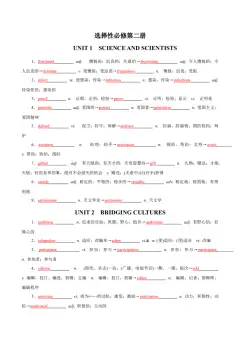
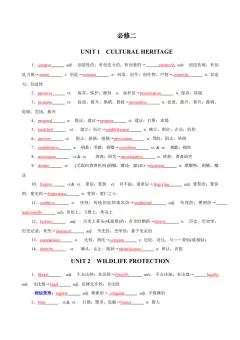
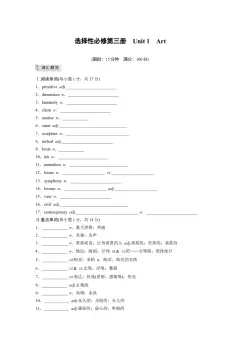
UNIT 1 ART
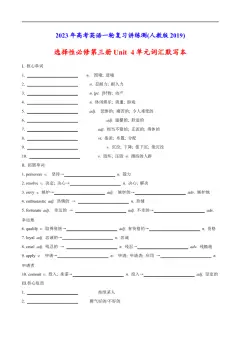
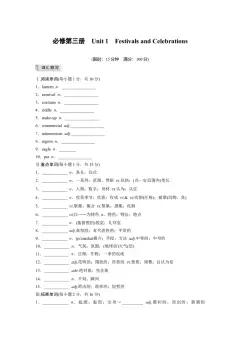
1. adj. 准确的;精确的→ adv. 准确地;精确地;的确如此
2. adj. 现实的;逼真的→ n. 逼真;现实主义;务实作风→ n.
现实主义画家(或作家等);现实主义者
3. n. 人性;人道;(统称)人类→ adj. 人文主义的
4. adj. 有很大影响力的;有支配力的→ n. 影响,作用;势力,影响力;有影响
的人(或事物) v. 影响,对……起作用
5. n. 雕像;雕刻品;雕刻术→ n. 雕刻家;雕塑家
6. vt.& vi. 呈弧形横跨;(使)成弓形 n. 拱;拱形结构;拱门→ adj. 拱形的;弓
形的
7. n. 投资额;投资;(时间、精力的)投入→ v. 投资;投入(时间或精力);赋予
8. vi.& vt. 批评;指责;评价→ n. 批评;指责;评论
9. n. 展览;(技能、感情或行为的)表演→ v. 展览,展出;卖弄,炫耀;提出(证
据等) n. 展品;(法庭上出示的)证物
10. n. 承认;认出;赞誉→ vt. 认出,识别;承认;接受,认可;赞赏 vi. 确
认,承认
11. adj. 值得……的;有价值的→ n. 价值;意义;作用 adj. 有……价值的;
值……钱的
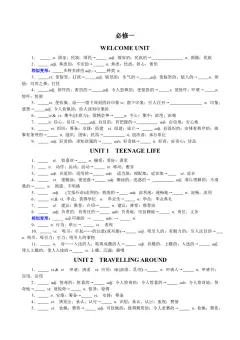
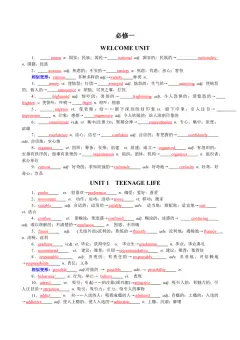
UNIT 2 HEALTHY LIFESTYLE
1. adv. 重复地→ v. 重复说(或写);照着说
2. n. 心理学;心理;心理影响→ n. 心理学家→ adj. 心理的,
精神的;心理学的
3. vi. 依赖;依靠;信赖→ adj. 可靠的,可信赖的
4. adj. 悲观的;悲观主义的→ n. 悲观主义者→ adv. 悲观地
5. v. 删去;删除→ n. 删除,删去的部分
6. n. 解放;摆脱→liberate v. 解放,解救→ n. 解放者;释放者
7. n. 顾问;高级顾问医师→ v. 咨询,请教UNIT 3 ENVIRONMENTAL PROTECTION
1. adj. 适合居住的→ n. (动植物的)生活环境,栖息地
2. vt. 维持;遭受;承受住→ adj. 可持续的;合理利用的
3. adv. 频繁地;经常→ adj. 频繁的,经常性的→ n. 出现次数;
频繁;频率
4. vt. 限制;限定;束缚→ n. 限制规定;限制法规;约束
5. vt. 使生效;贯彻;执行→ n. 实现;执行
6. vi.& vt. 起源;发源;创立→ n. 起源;原点;出身;开端→
adj. 原来的;独创的;原作的 n. 原件;原作→ adv. 最初,起初;本来
7. n. 章程;规章制度→ vt. 调节;规定;控制
8. n. 去掉;清除;处理→ vi.& vt. 排列;布置;安排;使倾向于→ adj.
一次性的;可自由支配的
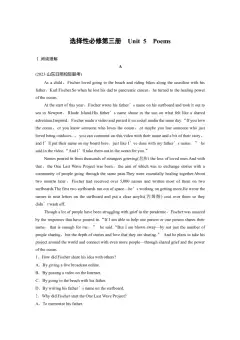
UNIT 4 ADVERSITY AND COURAGE
1. n. 忍耐力;耐久力→ v. 持续存在,持久;忍受,忍耐 vi. 忍耐;持续
2. adj. 符合资格;具备……的知识(或技能、学历等)→ v. 取得资格,合格;使有
权(做某事)→ n. (通过考试或学习课程取得的)资格,学历
3. adj. 热情的;热心的→ n. 热情,热忱→ adv. 热心地;满腔热情地
4. adj. 痛苦的;令人难受的→ adv. 贫困地;可悲地;糟糕地;非常不幸地→
n. 痛苦,苦难;穷困,悲惨境遇
5.vi. 坚持;孜孜以求→n. 毅力;韧性;不屈不挠的精神
6. adj. 残酷的;残忍的;冷酷的→ adv. 残酷地;非常→ n. 残
酷,残忍;不公,虐待
7. vt.& vi. 公布;宣传;做广告→ n. 广告;(某一类事物的)广告→ n. 广
告活动;广告业
8. n. 承诺;保证;奉献→ vt. 犯罪;把……交托给;指派……作战;使……承
担义务;(公开地)表示意见 vi. 忠于(某个人、机构等);承诺
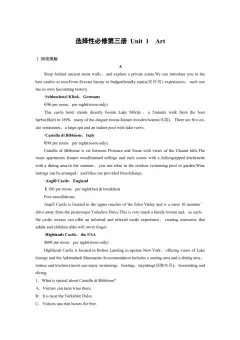
UNIT 5 POEMS
1. n. 悲伤;悲痛;伤心事 vi. 感到悲伤→ adj. 悲伤的,悲痛的,悲哀的;使
人悲伤的2. adj. 分别的;各自的→ adv. 分别;各自;依次为
3. n. 理解力;领悟力;理解练习→ adj. 全部的;所有的;详尽的→ adj.
可理解的;能懂的→ adv. 完全地;彻底地
4. n. 同情;赞同→ adj. 同情的;有同情心的;赞同的
5. adj. 天真无邪的;无辜的;无恶意的→ n. 天真;单纯;无罪
6. vi. 相一致;符合;相当于;通信→ n. 来往信件;通信联系
7. adj. 首要的;占支配地位的;显著的→ vi.& vt. 占据支配地位;控制;影响
8. adj. 复杂的;难懂的→ vt. 使复杂化→ n. 使更复杂化(或更困
难)的事物
基础练习
用单词的适当形式完成句子
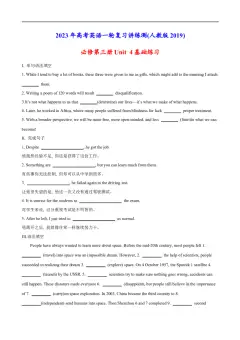
1.I haven’t seen Lily for years, and she has changed beyond (recognize).
2.He explained the journey (visual) by use of pictures.
3.The company intends a slow-down in (expand).
4.She pronounced the word very slowly and (precise).
5.Of all the (consult), only Mr. Wang gave us some proposal in point.
6.We waited three months before going back to see the (special).
7.So far the main thing many large retailers have done in (respond) to all this is to open online stores,
so people will come to them directly.
8.Don’t be such a (pessimistic)——you’re not going to fail.
9.Tony was (repeated) warned by the doctor not to smoke any more.
10.Her parents are very (tolerate), but sometimes she pushes them too far.
11.Try to buy wood that you know has come from a (sustain) source.
12.After an (inspect), the inspectors must publish a report.
13.Only in this way can we live in a more (harmony) society.
14. (fortune), he passed away due to terminal cancer, but he left a deep impression on me and gave me
the inspiration to pick up my pen again.
15.Once he has made a (resolve) to do it, you won’t get her to change his mind.
16.Under his (guide), we finished the work smoothly.
17. ( cruel) to animals really makes me see red (怒不可遏).
18.He is the young scientist name is known all over the country.19.She had no alternative but to quit her job for (vary) reasons.
20.The sample content (respective) was 20, 59 and 57.
综合训练
阅读下面短文,在空白处填入1个适当单词或括号内单词的正确形式。
(一)
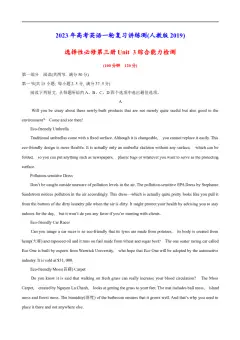
Japan’s decision to discharge nuclear-contaminated water into the sea has reduced the confidence of Chinese
travelers 21 (want) to visit the country, and is expected to deliver a “heavy blow” to Japan’s tourism
industry in the long term, experts and academics said.
Ignoring regional and international concerns about the safety of its decision, Japan began releasing 22
(treat) radioactive water from the Fukushima nuclear plant into the Pacific Ocean on Aug 24.
As one of the major sources of tourists to Japan, China announced on Aug 10 that group tours 23
(start) again to the country, along with 77 other overseas destinations.
Travel portal Trip.com Group said that as of Aug 17 searches for group tours to Japan exceeded 24 for
Thailand and Singapore — the traditional top choices for Chinese travelers. Travel agencies and industry insiders
had also forecast that Japan would see a sharp increase of Chinese travelers for the 25 (nation) Day
holiday.
Trip.com said that as of Aug 17, bookings to Japan for the holiday had seen 26 five-fold month-on-
month increase. 27 , news about the discharge of the nuclear-contaminated water has raised concerns among
Chinese travelers heading to Japan, 28 (especial) regarding their personal health and food safety.
Xu Xiaolei, Chief Brand Officer of CYTS Tours Holding Co in Beijing, said that the company had seen
routine changes in bookings and 29 (cancellation) for travel to Japan. Nevertheless, he warned that travelers
may be taking a “wait and see” approach ahead of the holiday. “Many travelers to Japan want to enjoy the seafood.
Japan’s discharge of nuclear-contaminated water may have a greater influence 30 these young travelers,”
he said. “We will adjust our tour products to cater for our clients’ needs and follow-up the situation in Japan.”
(二)
Last week, students in our school 31 (ask) to share some funny or strange 32 (story)
about using English. 33 our surprise, we received so many posts, and it reminded us that some of the
English we learned in the classroom is rather 34 (differ) from the English in the outside world. When
Yancy heard her teacher Maggie had 35 frog in her throat, she thought Maggie ate a big frog. 36(actual), Maggie had a sore throat. What made Sophie 37 (confuse) is that the first floor she was told was
in fact the ground floor to 38 (she) knowledge. In another post, Julien couldn’t understand why his pen
friend used such a negative word “wicked” 39 (describe) his nice grandfather. Zheng Xu, a hard-working
Chinese, was disappointed at his teacher’s comment “Not Bad!” on his paper, 40 means “fantastic”.
(三)
The Confucian Analects or The Analects (论语) is a collection of the sayings and teachings of Confucius and
his disciples (门徒). It 41 (make) in the early Warring States Period, over 70 years after the death of
Confucius, from the notes that his disciples took according to the answers 42 their questions.
The present-day analects is based on the Lu version compiled during the Han Dynasty and contains 43
Confucian concept of ren or humanity or benevolence. Ren is rich in content, and varied in form. The core of the
concept is “The benevolent love of others” or universal love, 44 is the basic virtue of a gentleman of
noble character. Confucius believes that being benevolent does not mean 45 (be) without principles. One
should be clear about what 46 (love) or hate. Ren comes from learning and self-cultivation: it can be seen
from a person’s appearance. To be sure, li or rites and yue or music are important. 47 , ren is the No.1
principle of being a decent man. It is actually the essence of li and yue. Without ren, li or yue would be 48
(meaning).
Apart from ren, Confucius put forward another concept, which is yi or righteousness. Yi is the codes of
conduct under the 49 (guide) of ren, “The virtuous man cherishes a respect for the law, 50
the vile (邪恶的) man cherishes generous treatment,.”
(四)
Forget about “military-style travel” during which people tend to visit as many places as possible in the least
amount of time. A more 51 (relax) and leisurely alternative, such as “Citywalk”, is becoming the norm
(常态) among urban youngsters.
Unlike military-style travel, Citywalk is about walking around a city on foot, soaking up ( 感受) the
atmosphere and 52 (find) unusual things that even a resident of the city might not 53 (notice)
before. It can be a special event 54 people embark (开始) on a journey led by tour guides or 55
(simple) explore the streets.
Such walks generally avoid famous scenic spots and shopping centers, and take you to places where you can
have real interactions 56 the local people, eat at small but authentic restaurants, and gain 57
deeper understanding of the history and culture of the city.Citywalkers have shared 58 (they) carefully planned routes on social media platforms, generating
thousands of followers. On social media platform Xiaohongshu, there are more than 270,000 posts about Citywalk,
while 59 (video) about Citywalk have attracted millions of views on short video platform Douyin.
Their posts usually include how long the walk is going to take, and interesting places and eateries (小餐馆)
along the way. Some posts are more like a food tour, with walkers carefully planning out routes with certain places
60 (know) for their snack offerings in mind.
(五)
The Chinese painting is one of the oldest artistic traditions in the world. The painting in the traditional style is
known today in Chinese as guohua, 61 (mean) the “national” or “native” painting. It is different from
Western styles of art 62 became popular in China in the 20th century.
One technique of the traditional Chinese painting is ink and wash painting and in Chinese it 63
(call) shuimo. In fact this was an art form practiced 64 gentlemen from the Song Dynasty. This style is
also referred to as xieyi or the freehand style.
65 (traditional), the Chinese painting is done on rice paper or thin silk. There are broadly three
66 (subject) for traditional Chinese paintings — portraits (肖像), landscapes (风景), 67 flowers
& birds—of which the landscape is the most familiar to people. Therefore the Chinese painting is often known
as the landscape painting, or shanshui painting