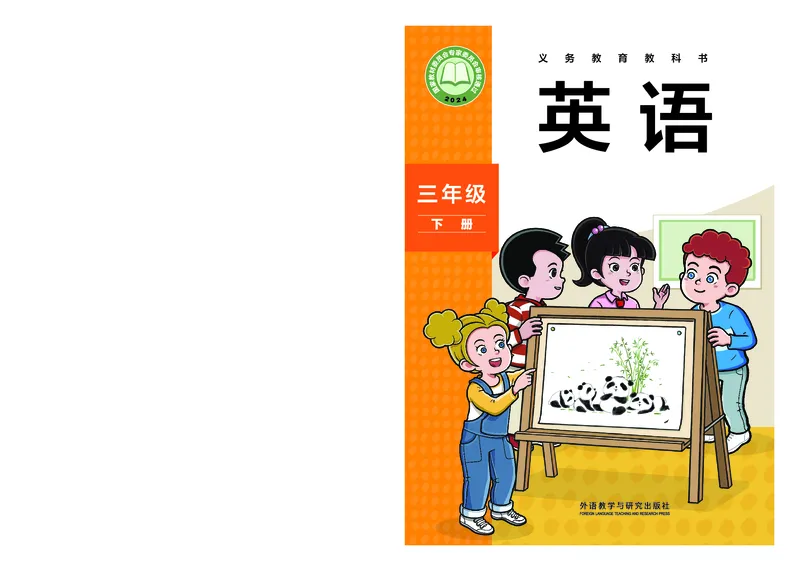
义
义 务 教 育 教 科 书
务
教
育
教
科
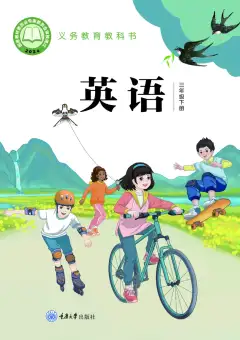
英 语
书
英
语
三 年 级
下 册
三
年
级
下
册义 务 教 育 教 科 书
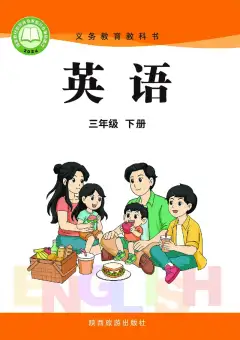
英 语
三 年 级 下 册
主 编:孙有中
副 主 编:鲁子问
分册主编:张宏丽
编 者:于业宏 江 萍 苏朝晖 李立新
杨 璐 张 琦 祝和军 崔秀玲
(按照姓氏笔画排序)致 同 学
各位同学,你们好!欢迎大家继续探索英语学习的世界!
本学期,在大明、玲玲、Sam、Amy和机器人Bobo的陪伴下,你
们将更加深入地了解这些主人公的日常生活和活动,和他们一起画画,
一起堆雪人,一起做彩虹沙拉等。你们将读到更多有趣的绘本故事,如
五官争功、快乐的农场生活、去敬老院看望老人等。大家在感受英语阅
读乐趣的同时,也能够进一步发展思维能力。
你们还将了解更多中外优秀文化,从中华传统文化中的舞狮、虎
头鞋,到法国女孩 Tippi 和她的野生动物朋友们,以及昆虫学家 Fabre
的精彩世界,你们将在学习过程中开阔视野,形成初步的跨文化交际
意识。
你们将学会用英语做更多事情,如制作动物海报、设计机器人、调
查全班同学的兴趣爱好、制订周末计划等。这些活动需要你们充分运用
学到的英语,同时也将考验你们的创造力和团队协作精神。
在英语学习的初始阶段,大家要敢于开口,不怕出错,积极运用并
巩固所学的语言。通过不断的练习和探索,你们很快就会发现,自己在
英语表达上变得更加流畅和自信。
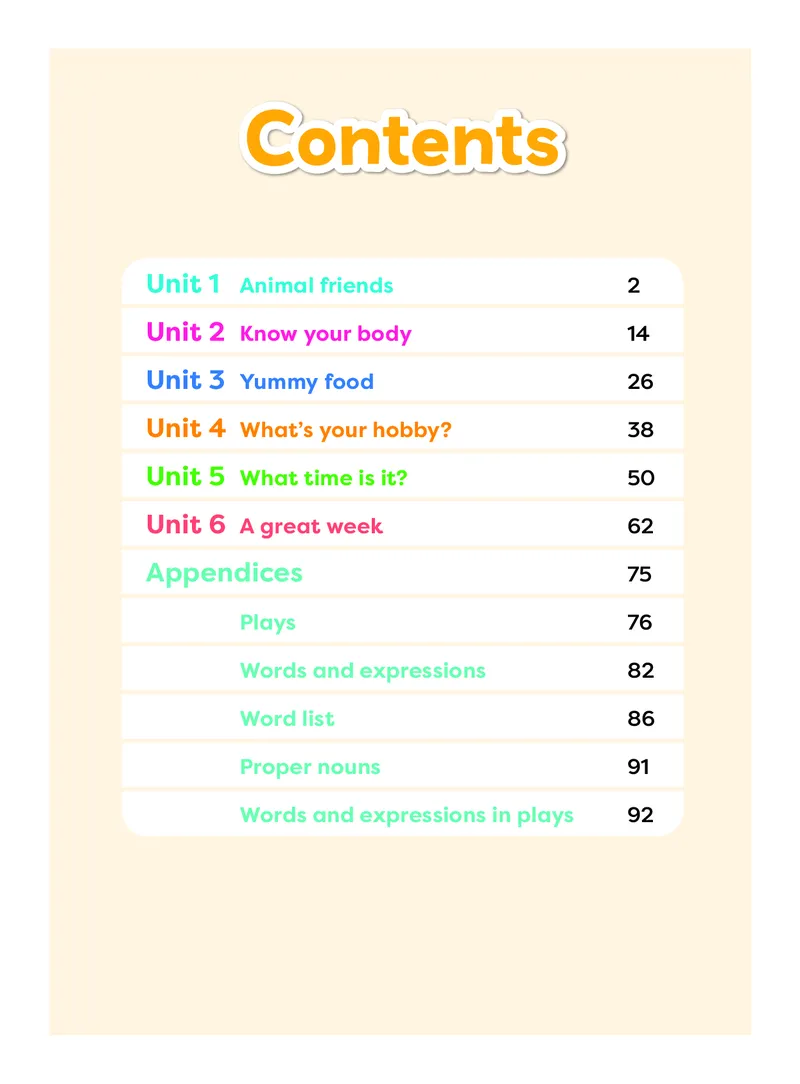
让我们一起享受学习英语的过程,继续加油吧!新标准3B文前-7校pr7-宫.indd 4 2024/3/12 16:33:27Unit 1 Animal friends 2
Unit 2 Know your body 14
Unit 3 Yummy food 26
Unit 4 What’s your hobby? 38
Unit 5 What time is it? 50
Unit 6 A great week 62
Appendices 75
Plays 76
Words and expressions 82
Word list 86
Proper nouns 91
Words and expressions in plays 92Unit
AAnniimmaall ffrriieennddss
1
In this unit, we will learn to...
• name different animals;
• use “What are they?” and “They’re…” to talk
about animals;
• tell a story about animal friends;
• find animals around us.
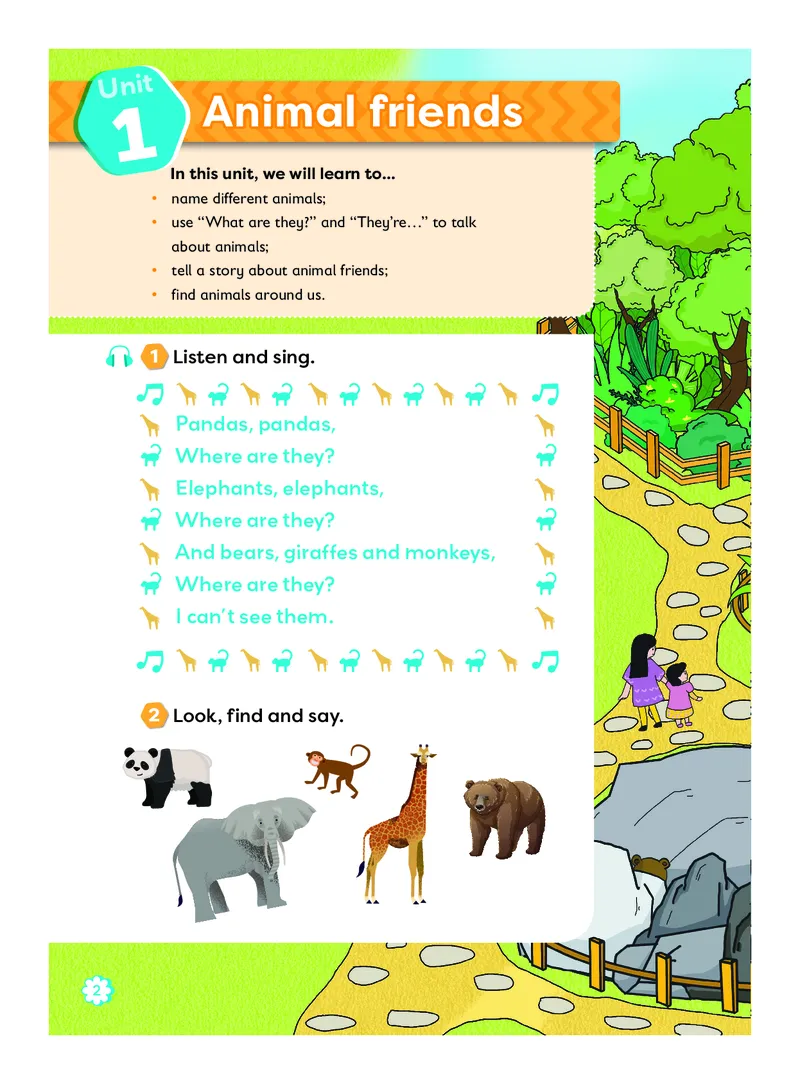
1 Listen and sing.
Pandas, pandas,
Where are they?
Elephants, elephants,
Where are they?
And bears, giraffes and monkeys,
Where are they?
I can’t see them.
2 Look, find and say.
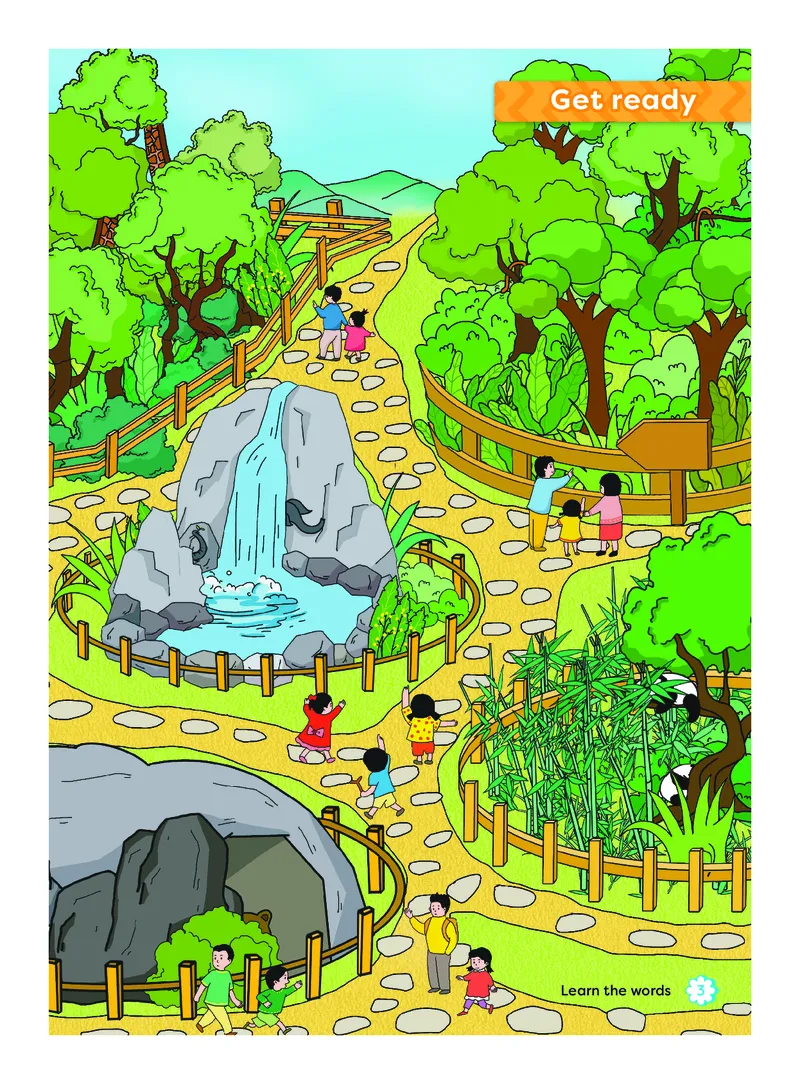
2GGeett rreeaaddyy
Learn the words 3SSttaarrtt uupp
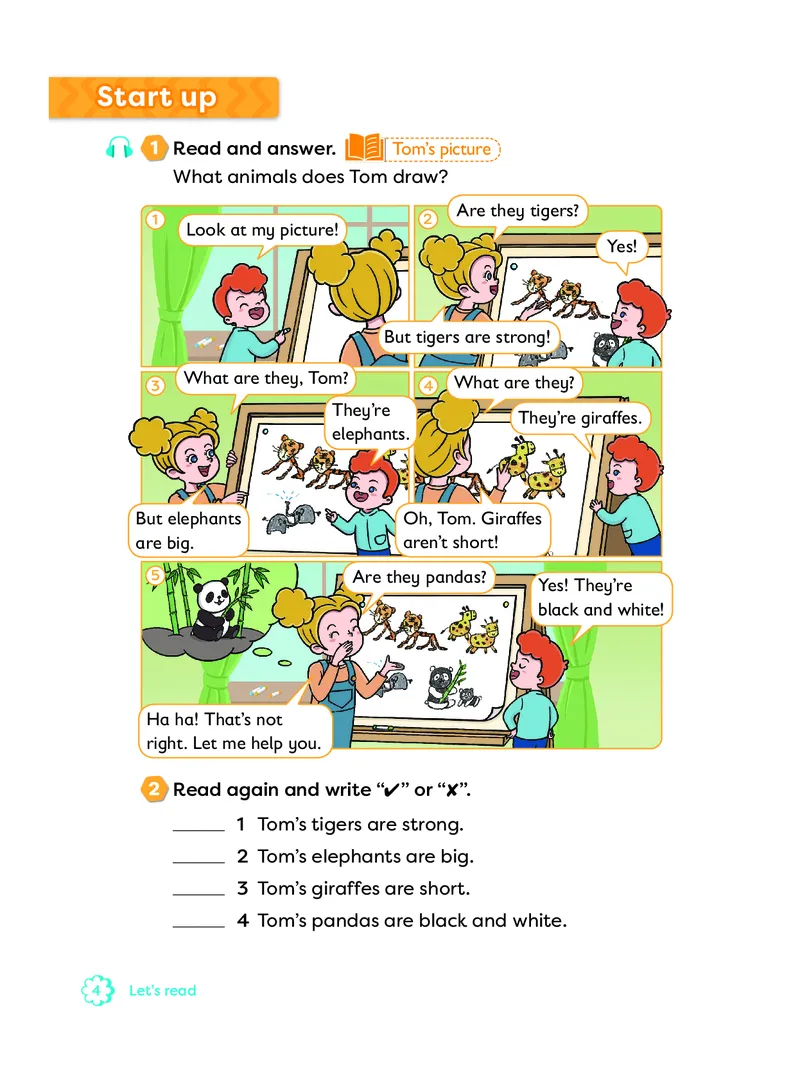
1 Read and answer. Tom’s picture
What animals does Tom draw?
Are they tigers?
1 2
Look at my picture! 1
Yes!
But tigers are strong!
What are they, Tom?
What are they?
3 4
They’re
They’re giraffes.
elephants.
But elephants Oh, Tom. Giraffes
are big. aren’t short!
5 Are they pandas?
Yes! They’re
black and white!
Ha ha! That’s not
right. Let me help you.
2 Read again and write “✔” or “✘”.
__
1 Tom’s tigers are strong.
__
2 Tom’s elephants are big.
__
3 Tom’s giraffes are short.
__
4 Tom’s pandas are black and white.
4 Let’s readIn
focus
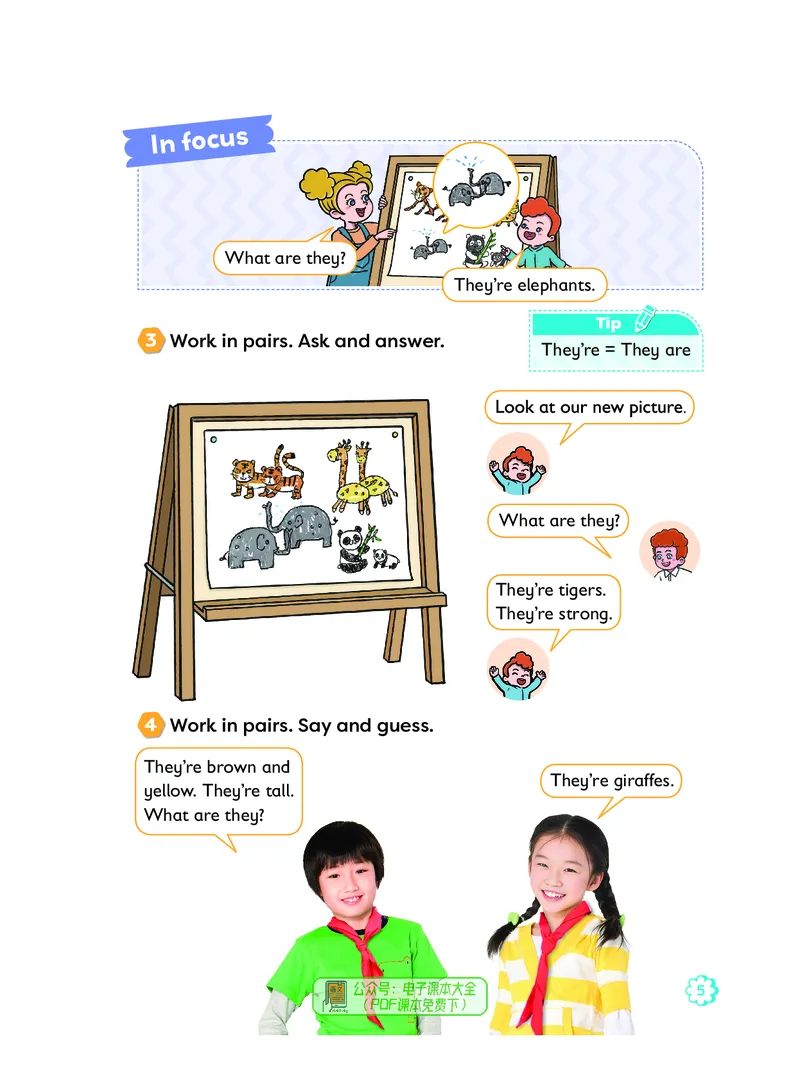
What are they?
They’re elephants.
Tip
3 Work in pairs. Ask and answer.
They’re = They are
What are they?
They’re tigers.
They’re strong.
4 Work in pairs. Say and guess.
They’re brown and
They’re giraffes.
yellow. They’re tall.
What are they?
5SSppeeeedd uupp
1 Read and answer.
Who are Tippi’s friends?
Ti
ppi and her
animal
friends
1 Hi, I’m Tippi. Look!
This is my book.
This is Abu. He is an elephant.
He is big and strong. I love him.
2
This is Leon. He is a
chameleon. He is small.
3
This is Linda. She is
an ostrich. She is fast.
4
6 Story time5
This is Mufasa. He is a little
lion. He is cute.
They are my animal friends. I love them.
6
2 Match and say.
1 Abu the elephant is a small.
2 Linda the ostrich is b cute.
3 Leon the chameleon is c big and strong.
4 Mufasa the lion is d fast.
3 Draw and write about one of Tippi’s animal friends.
1 This is .
2 He / She is a(n) .
3 He / She is .
4 He / She is Tippi’s animal friend.
7FFuueell uupp
1 Listen and chant.
o
d
out of the
zo
n
a
n
I
Zack and Zoe,
Let’s go to the zoo!
Zack and Zoe,
Come and look.
A zebra is here.
A giraffe is there.
But where is the lion?
Let’s move on.
Come and look.
Lions on the road.
Zack and Zoe,
Let’s dance along.
2 Read the chant and circle .
Which words have “z” or “l” sounds?
Zz
zoo
lion
Zack
look
along
Ll
zebra let Zoe
8 Hear it, say it3 Listen and order.
stone lions
a
panda hat
tiger
shoes
4 Find animals around you. Tell the class about them.
What is it?
It’s a lion.
What are they?
They’re tigers.
9HHiitt iitt bbiigg
Make a
poster of
animals
1 Look and guess.
What are they?
2 Make your animal poster.
1 Find or draw pictures of animals.
2 Cut them out.
10 We can do it4 Stick the animals
3 Draw a nice place for
to the paper.
the animals.
3 Talk about your animal poster.
Look! They’re bears.
They’re tigers.
11WWrraapp uupp
ay
to win!
SSTTAARRTT
Pl
Is it a
It’s a li .
giraffe? Is it cute?
Name it.
It’s b .
What are they?
Is it fast?
They’re
.
What are they? It’s st_o_ _.
They’re
.
Name it.
CChheecckk iitt
Now I can
name different animals;
▢▢
use “What are they?” and “They’re…”
▢▢
to talk about animals;
tell a story about animal friends;
▢▢
find animals around me.
▢▢
12LLeett’’ss
eexxpplloorree
1 Read and draw day or night .
1
Name: bat
Colour: black, brown, grey
They sleep in the day.
2
Name: fox
Colour: red, white, black, grey
They sleep in the day.
3
Name: bee
Colour: yellow and black
They sleep at night.
4
Name: rabbit
C olour: white, brown, black, grey
They often sleep in the day.
2 Choose an animal. Complete the card.
Name: Colour:
They
3 Show your animal card to the class and talk about it.
13Unit
2 KKnnooww yyoouurr bbooddyy
In this unit, we will learn to...
• name different body parts;
• use “I / You have(n’t) got…” and “He / She / It has(n’t)
got…” to talk about body parts;
• talk about the use of body parts;
• talk about our friends’ looks.
1 Listen and sing.
Head, eyes, ears, mouth and nose,
Mouth and nose.
Move your head!
Touch your nose!
Hands, arms, legs, feet and toes,
Feet and toes.
Move your legs!
Touch your toes!
2 Look and say.
Nezha has got three heads.
14GGeett rreeaaddyy
Tips
one foot two feet
Learn the words 15SSttaarrtt uupp
1 Read and answer. A snowy day
What do the children make?
Good work, children! Look! He has
1 2
got a red mouth.
Let’s make
a snowman!
3 Now, he has 4 Oh, he hasn’t got eyes.
got a long nose.
I’ve got two rocks!
Now he has got two eyes.
5 He’s got long arms 6 Wow! You’ve got
and big hands! a cool snowman!
2 Read again and write “✔” or “✘”.
1 The snowman has got two ears.
2 The snowman has got a red mouth.
3 The snowman has got a short nose.
4 The snowman has got short arms and
small hands.
16 Let’s readIn
focus
Look! He has got a red mouth.
He’s got long arms and big hands!
Tips
He’s got = He has got
I’ve got = I have got
3 Look, listen and order.
4 Draw a snowman and tell the class about it.
17SSppeeeedd uupp
1 Read and answer.
Which is the best body part?
TTTThhhheeee
bbbbeeeesssstttt
bbbbooooddddyyyy
ppppaaaarrrrtttt
Hello, who is there?
I’m the best!
1
2
No, I’m the best!
3
Sorry, Nana. We are
your body parts. Who You’ve got two ears.
is the best for you? We help you hear.
4
You’ve got two eyes.
We help you see.
Well…
I help you talk and eat.
I help you smell.
5
18 Story time6 And me… And me… 7 Hey! Please stop! You are all
important to me. You are a team.
And me… And me…
You’re right! Let’s work
together for Nana!
2 Read again and complete.
Mum What’s up, Nana?
Nana In my dream, my body parts talk to me.
They are my 1 , 2 , 3 and
4 . They ask, “Who is the 5 ?”
Mum How do you answer?
Nana I say, “You are all important to me.”
3 Work in groups. Act out the story.
19FFuueell uupp
1 Listen and chant.
et’s
be
friends!
L
I have got black hair.
You have got brown hair.
I have got black eyes.
You have got blue eyes.
I have got a small nose.
You have got a big nose.
We have got different faces.
But that’s not important.
Let’s be friends!
2 Read the chant and circle .
Which words have “m” or “n” sounds?
Mm
small important friend
brown
Nn
nose
different
20 Hear it, say it3 Listen and match.
4
2
1 3
Ken Helen Taotao Mia
4 Work in groups. Talk about your friends and guess.
She’s got big eyes
Is it Tangtang?
and black hair.
No. She’s got short hair.
It’s Lulu.
Yes!
5 Work in pairs. Say and draw.
She’s got long
black hair and
black eyes…
21HHiitt iitt bbiigg
Design a
robot
1 Work in groups. Look and say.
This robot This robot This robot
This robot
has got a has got long has got four
hasn’t got
big head, … legs, … legs, …
arms, …
22 We can do it2 Design your robot.
Our robot‘s name is .
3 Tell the class about your robot.
Our robot’s name is Rob.
He’s got long legs.
He hasn’t got hair.
23Write it.
h_a_ Name it.
I’ve got SSttaarrtt
.
She’s got
.
Write it.
mou_ _ PPllaayy ttoo
wwiinn!!
He’s got
.
Write it.
You’ve got
f_ _g_rs .
SSttaarrtt
SSttaarrtt
ttrraattSS
WWrraapp uupp
I’ve got
.
Write it.
n_ _e
I’ve got
.
I’ve got
.
CChheecckk iitt
Now I can
name different body parts;
▢▢
use “I / You have(n’t) got…” and “He / She / It has(n’t)
▢▢
got…” to talk about body parts;
talk about the use of my body parts;
▢▢
talk about my friends’ looks.
▢▢
24Science: The five senses LL
ee
ee
xx
tt
pp
’’ss
ll
oorree
1 Look and say.
I touch with
I see with
my hands.
my eyes.
I taste with
I
smell
with
my tongue.
my
nose.
I hear with my ears.
2 Draw and say.
What can you smell, see, hear, taste and touch?
Smell See Hear Taste Touch
25Unit
3 YYuummmmyy ffoooodd
In this unit, we will learn to...
• name different foods;
MMeeaatt
• use “I (don’t) like...” and “Do you like...?” to talk
about food choices;
• tell a story about breakfast;
• talk about food from different countries.
1 Listen and sing.
FFrruuiitt
I like apples.
I like oranges.
I like strawberries, too.
Mmm! Yummy, yummy food!
I like tomatoes.
I like eggs.
I like noodles, too.
Mmm! Yummy, yummy food!
I like carrots.
I like chicken and fish.
I like rice, too.
Mmm! Yummy, yummy food!
2 Look at the shopping list and find the
food on it.
26GGeett rreeaaddyy
VVeeggeettaabblleess
wberries
3.
stra
ges
2.
ora n
noo
dles
6.
1.
a p
ples
5.
rice Tips
4.
to
m
atoes
8.
carrots
a
to
p
m
pl
a
e
t
→
o →
ap
t
p
o
l
m
es
atoes
strawberry → strawberries
7.
eggs
0.
fis
h
1
n
ke
hic
Learn the words 27
9.
cSSttaarrtt uupp
1 Read and answer. A rainbow salad
Where are Daming and Lingling?
1 2
Let’s make a
Welcome!
salad together!
OK.
Hello!
3 I like tomatoes and oranges.
I like bananas. I like beans.
I don’t like beans.
I like cucumbers.
Then let’s have cucumbers!
Wow! It’s a Do you like it?
4 5
What about Tom?
rainbow salad.
He likes grapes.
Yes, I do. It’s beautiful!
2 Read again and circle .
What’s in the rainbow salad?
28 Let’s readIn
focus
Do you like it?
I don’t like beans.
He likes
I like cucumbers.
grapes.
Yes, I do.
3 Listen and draw or . Then answer the question.
What juice do they make?
Amy
Sam
Tom
4 Work in groups and do a survey.
What food do your friends like and not like?
Hi, Xiaolei. Do you like oranges?
No, I don’t. I like apples.
oranges apples
Xiaolei
29SSppeeeedd uupp
1 Read and answer.
Why do Taotao and Jiajia get up early?
Breakfast
on the
farm
1 Hello, Grandma.
Hello, Grandpa.
Hello, Taotao
and Jiajia.
Time to get up,
2 3
But it’s Do you
children.
still early. like eggs?
Yes, we do.
Let’s get ready
Now we’ve got eggs.
for breakfast.
4
Do you like tomatoes?
Yes, we do. Now we’ve got
tomatoes.
Do you like corn?
5
Yes, I do.
Now we’ve got corn.
30 Story timeDo you like apples?
6
No, I don’t. I like grapes.
OK. Let’s get grapes.
Thank you, Grandma
7
Yummy! Let’s get ready
and Grandpa.
for lunch together, too!
2 Read again and order.
3 Write about Taotao and Jiajia’s breakfast.
Look! This is our breakfast.
We’ve got 1
and 2 noodles,
3 and 4 . We 5 it very much!
31FFuueell uupp
1 Listen and chant.
f
ternoon
tea
A
Every week,
Under the tree,
A nice afternoon tea
For Grandpa and me!
Milk tea is good.
Cupcakes are great.
Yummy sandwiches,
With beef and eggs!
2 Read the chant and circle .
Which words have “k” or “g” sounds?
Kk
week
great
cupcake
good
Gg grandpa
egg milk
32 Hear it, say it3 Listen and match.
2 Mako
Huanhuan Ken
1 3
a dumplings b hot dogs
sushi c
c
4 Think and share.
Find photos of food from your hometown and tell the
class about it.
I like noodles.
I like rice cakes.
33HHiitt iitt bbiigg
Make a
sandwich
1 Look and think.
How can I make a sandwich?
2 Draw and write.
bread
tomato
cucumber
chicken
bread
34 We can do it3 Tell the class about your sandwich.
bread
chicken
tomato
egg
bread
I like my sandwich. It’s good! It’s got
bread, chicken, tomato and egg.
4 Make your sandwich after class. Share it with
your family.
35WWrraapp uupp
SSTTAARRTT
Play to win!
Does
she like
I don’t like…
apples? Name them. I like…
Answer it.
Do you like…?
Do you like
_o_ _l_s
milk?
Name them.
Answer it.
Write it.
b_n_ _a
CChheecckk iitt Write it.
Now I can
name different foods;
▢▢
use “I (don’t) like...” and “Do you like...?” to
I like…
▢▢
talk about food choices;
tell a story about breakfast;
▢▢
talk about food from different countries.
▢▢
36LLeett’’ss
W
Sc
h
i
e
e
r
n
e
c e
is
:
our food
fro m?
eexxpplloorree
1 Look, point and say.
Apples are from a plant. pla
n
t
s
Milk is from an animal.
als
m
i
n
a
2 Work in pairs. Look and answer.
Where is our food from?
37Unit
4 WWhhaatt’’ss yyoouurr hhoobbbbyy??
In this unit, we will learn to...
• name different hobbies;
• use “I / They like…” and “He / She likes…” to talk
about hobbies;
• tell a story about hobbies;
• talk about different hobbies.
1 Listen and sing.
All work and no play?
That is not good.
What do you like doing
In your free time after school?
Painting, reading and singing!
Dancing, running and swimming!
There is so much to do.
We have a lot of fun!
2 Look and write A (Amy) or S (Sam).
singing dancing swimming
running painting reading
38GGeett rreeaaddyy
Learn the words 39SSttaarrtt uupp
1 Read and answer. What do you like doing?
What is Daming’s hobby?
What are these?
1
Photos of
my family.
2 3
Who is this?
Who is this?
That’s my mum.
That’s my dad.
She likes writing.
He likes running.
4 5 What do you like
They are your grandpa
doing, Daming?
and grandma.
Yes, they like doing tai chi. I like taking photos!
2 Read and match.
1 Dad likes doing tai chi.
2 Daming likes taking photos.
3 Mum likes running.
4 Grandpa and Grandma like writing.
40 Let’s readIn
focus
He likes running.
They like doing tai chi.
I like taking photos!
3 Look and write.
1 Daming likes .
2 Amy and Sam like .
3 Lingling .
4 Tom .
4 Work in pairs. Talk about your hobbies.
What is your hobby?
I like writing.
What about you?
I like running.
41SSppeeeedd uupp
1 Read and answer.
What is Fabre’s hobby?
F
abre -
“the insect
man”
1
This is Fabre. He likes learning
about animals and plants.
Why?
2 How many?
When?
How?
What?
Where?
He likes asking questions.
3
He likes watching insects.
4
One day he goes up a tree to study a mantis.
He stays there and watches for a long time.
42 Story timeHey! You! Why are you up there?
5
I’m here to watch
this mantis!
Why?
It’s so interesting!
6
Fabre grows up. He writes many books
about insects. People like reading them!
2 Read again and write “✔” or “✘”.
1 Fabre likes watching insects.
2 Fabre goes up a tree to study a bird.
3 Fabre writes many books about plants.
4 People like reading Fabre’s books.
3 Read again and write.
Fabre likes 1 . He likes 2 .
He likes 3 .
I like 4 .
43FFuueell uupp
1 Listen and chant.
d
Hobb
ies
around
the
worl
From country to country,
We have different hobbies.
Stan likes making robots.
Rena likes cooking food.
Weiwei likes making kites.
Sally likes skating on ice.
It’s so much fun to play.
It makes us happy.
2 Read the chant and circle .
Which words have “s” or “r” sounds?
Ss
Stan different
so
Sally
us Rena
Rr
skating robot
from
44 Hear it, say it3 Listen and match.
1 Charlie likes…
2 Lanlan likes…
3 Kelly likes…
a singing and dancing b skiing
c
gardening
4 Work in groups. Talk about your friends’ hobbies.
My friend Duoduo
My friend Lisa
likes swimming.
likes reading. My friend...
45HHiitt iitt bbiigg
Do a
class
survey
about
hobbies
1 Look, find and write.
12
11
10
9
8
7
6
5
4
3
2
1
1 Nine children like swimming. 5 Six children like
_
.
2
_
children like making robots. 6 Twelve children like
_
.
3
_
children like bird-watching. 7
_
children like cooking.
4
_
children like weiqi.
46 We can do it2 Work in groups. Ask and answer, then draw.
What do you like doing?
I like making robots.
9
8
7
6
5
4
3
2
1
3 Tell the class about your chart.
Six children like making robots.
47WWrraapp uupp
Find a hobby
1 2 3 4
Answer: Say: Go back Answer:
What does I like… one space. What do they
Daming like like doing?
doing?
8 7 6 5
Write: Answer: Write: Ask:
r_ _d What are wr_ti_g Do you
Amy’s hobbies? like…?
9 10 11 12
Answer: Write: Start Say: She
What do they s_i_ming again! likes…
like doing?
16 15 14 13
Say: He Ask: Do you Answer: Say:
likes… like…? What does I like…
she like
doing?
CChheecckk iitt
Now I can
name different hobbies;
▢▢
use “I / They like…” and “He / She likes…” to talk
▢▢
about hobbies;
tell a story about hobbies;
▢▢
talk about different hobbies.
▢▢
48ss
’’
tt ee
ee rr
Social studies: LL oo
ll
pp
xx
ee
1 Read and match.
2
1
3 4
My grandma and her friends like watching and
a
singing Beijing opera. I like it, too. It’s very beautiful.
My friends and I like playing ping-pong together.
b
It’s very interesting.
c People here like flying kites. The kites are colourful.
I like playing weiqi with my mum.
d
I’m good at it.
2 Work in groups. Talk about other hobbies in China.
49Unit
5 WWhhaatt ttiimmee iiss iitt??
In this unit, we will learn to...
• tell the time and name everyday activities;
• use “What time is it?”, “It’s…” and “It’s time to…”
to talk about the time and everyday activities;
• tell a story about people’s everyday activities;
• talk about time differences around the world.
1 Listen and sing.
Tick-tock, tick-tock.
Tell the time on the clock.
Move your arms.
Let’s go.
Tick-tock, it’s one o’clock.
Tick-tock, it’s one fifteen.
Tick-tock, it’s one thirty.
Tick-tock, it’s one forty-five.
2 Listen and draw the times. Then talk
about Daming’s day.
get
up
50GGeett rreeaaddyy
go
to
school
me
go
ho
have
dinner
Tips
7:00 = seven o’clock
7:30 = half past seven /
seven thirty
LLeeaarrnn tthhee wwoorrddss 51SSttaarrtt uupp
1 Read and answer. Not now!
Who has a good day?
1 2
It’s half past six.
Come on, Sam! It’s
It’s time to get up.
time for school!
Not now.
Urgh… Not now.
3 4
It’s time to do your
Time to go
homework, Sam.
to bed, Sam.
Not now!
What time is it? It’s only
six o’clock. Not now.
2 Read again and match.
1 It’s half past six. a Sam does his homework.
2 It’s half past seven. b Amy goes to school.
3 It’s nine o’clock. c Amy gets up.
52 Let’s readIn
focus
It’s half past six.
It’s time to get up.
What time is it?
3 Help Sam plan his time. Then ask and answer.
I need to do things on time.
Time Activity
Get up
7:00 Have breakfast
Go to school
At school
It’s time for breakfast.
5:00 Go home What time is it?
Do homework
It’s seven o’clock.
6:30 Have dinner
Go to bed
4 Plan your time. Ask and answer.
It’s time to go to
school. What time is it? It’s half past seven.
53SSppeeeedd uupp
1 Read and answer.
When does Yuanyuan’s mum go to work?
Yuanyuan and her mum’s day
1 It’s six o’clock in the morning.
Yuanyuan gets up. Her mum is at work.
2 It’s seven o’clock in the morning.
Yuanyuan goes to school. Her mum goes home.
3 It’s half past eight in the morning.
Yuanyuan has classes Her mum goes to bed.
at school.
4 It’s five o’clock in the afternoon.
Yuanyuan goes home. Her mum goes to work.
54 Story timeIt’s nine o’clock in the evening.
5
Yuanyuan goes to bed. Her mum is at work.
2 Read again and write the times.
It’s . It’s . It’s . It’s .
3 Think and write.
Write about the day of a family member.
My gets up at .
He / She at and at .
He / She goes to bed at .
55FFuueell uupp
1 Listen and chant.
T
o b y
Tiger
a nd Danny Do g
Toby Tiger calls Danny Dog.
Why, oh why?
“Good morning.
Toby’s in London and
Good morning.
Danny’s in Sydney.
It’s time to get up.”
It’s only 9 am for Toby.
“Good evening.
But it’s 6 pm for Danny.
Good evening.
It’s time to have dinner.”
9 am 6 pm
Tips
am / AM: in the morning
pm / PM: in the afternoon or evening
2 Read the chant and circle .
Which words have “d” or “t” sounds?
Dd
Danny good get
zebra
London
dinner dog time
Tt
tiger Sydney
Toby
but
56 Hear it, say it3 Listen and write the times.
LLoonnddoonn
1
PM
BBeeiijjiinngg
2
PM
SSyyddnneeyy
NNeeww YYoorrkk
3 4
PM
AM
4 Listen again and match the pictures to the places
in Activity 3.
5 Work in pairs. Act and say.
It’s 5 o’clock.
You’re in Beijing!
Sydney
PM
Beijing
PM
AM London
57HHiitt iitt bbiigg
Plan your
weekend day
1 Think about activities for a weekend day and draw.
58 We can do it2 Write the times of the activities.
Activity
Time
8:00 am Have breakfast
3 Tell the class about your day.
This is my day. It’s 8 o’clock.
It’s time to have breakfast.
I like bread and milk!
8:00 am
10:00 am
12:00 pm
2:00 pm
5:00 pm
6:00 pm
7:00 pm
9:00 pm
59WWrraapp uupp
AArroouunndd tthhee cclloocckk!!
It’s (time). Start
+1 What
It’s time
space Who are time is it?
to…
they?
What 12 It’s time
time is it? to…
0 5 0 0
Ask a
Yuanyuan’s
question.
9 3
mum goes
to work at...
It’s time
Who says it?
to… 6
Not now!
I get up What time It’s time
+2 -1
at... is it? to…
spaces space
CChheecckk iitt
Now I can
tell the time and name everyday activities;
▢▢
use “What time is it?”, “It’s…” and “It’s time
▢▢
to…” to talk about the time and everyday activities;
tell a story about people’s everyday activities;
▢▢
talk about time differences around the world.
▢▢
60LLeett’’ss
H
istory: A
clock from the past
eexxpplloorree
1 Look and read.
How does this clock
tell the time?
WWee s seeee m maannyy k kininddss
ooff cclloocckkss eevveerryy ddaayy.. BBuutt
ddoo yyoouu kknnooww aabboouutt tthheiss oen tew?o ?
ItT ihs eay c alorcek c florocmks tfhroem p athste. past.
HowH odwo dthoeeys tite tlle tlilm thee? tSiumned?i al use
shIatd uoswes a snhda dsaonwdsg. Wlaess d uosne’ ts aunsed .
Wite v deoryn ’mt uusceh tthoedmay t. oBduaty w teh acat n
sundial
mustcihll. fBinudt iyto iun coaunr lsivteills f. iWndh atht em
ino ptahrekrs c, lsohcokps sf raonmd trheest paausrat ndtos .
you know?
2 Make your sundial.
sundial
Sundial
61Unit
6 AA ggrreeaatt wweeeekk
In this unit, we will learn to...
• name days of the week and school subjects;
• use “It’s…” and “We have / do… on…” to talk about
weekly activities;
• act out a story about activities in a week;
• talk about different afterschool clubs.
1 Listen and sing.
Monday, Tuesday,
Wednesday, Thursday,
Friday, Saturday and Sunday.
Seven days are in a week.
Every day is so much fun!
So much to do, so much to see.
Every day is so much fun!
2 Listen and write.
Mon go running
Sun
go to the park
Thu
visit Grandma and Grandpa
62GGeett rreeaaddyy
Tips
Mon = Monday
Tue = Tuesday
Wed = Wednesday
Thu = Thursday
Fri = Friday
Sat = Saturday
Sun = Sunday
Tue Wed
go swimming
play weiqi
Fri
Sat
have a singing
play football
lesson
Learn the words 63SSttaarrtt uupp
We have art on Friday
1 Read and answer.
What subject do Daming and Lingling love?
It’s Thursday!
1 It’s Wednesday. 2
Only one day!
Only two days!
3 You’re happy! Why? 4 Sorry, everyone.
Ms Li is not well today.
It’s Friday! We have art
on Friday. We love art!
Oh… No art today!
5 6
Let’s do something for Ms Li.
T G o e M t s L i w : ell
soon!
Good idea!
2 Read again and write “✔” or “✘”.
1 They have art on Thursday.
2 They have Chinese on Friday.
3 Ms Li teaches English.
4 Daming and Lingling draw a card.
64 Let’s readIn
focus
It’s Friday! We
have art on Friday.
3 Look, listen and write the days.
1 It’s . 2 It’s .
3 It’s . 4 It’s .
_ _
4 Work in pairs. Talk and guess the days.
On this day, we have
It’s Wednesday.
Chinese and art.
65SSppeeeedd uupp
1 Read and answer.
What does Wenwen do on Sunday?
AA Bbuussyy wweeeekk
1
It’s Monday. Let’s go and visit our
Great!
old friends this Sunday!
2
It’s Tuesday.
I want to make some bookmarks
for Grandma Guo. She likes reading.
3 I want to make a
It’s Wednesday.
stick for Grandpa Liu.
4
It’s Thursday. What about a painting
for Grandma Zhang?
66 Story timeDad, I want
some tea. It’s for
5 6
It’s Friday. Grandpa Ma. It’s Saturday.
Mum, I want some flowers
for Grandma Yang.
Sure.
Sure.
7 Thank you so
It’s Sunday.
much, Wenwen!
2 Read again and order. Then write the days.
3 Work in groups. Act out the story.
67FFuueell uupp
1 Listen and chant.
Afters
c
h
o
o s
l clu b
Piano club and painting club!
Book club and basketball club!
From Monday to Friday,
Come, learn and play!
Singing club and dance club!
Computer club and football club!
From Monday to Friday,
Come, learn and play!
2 Read the chant and circle .
Which words have “b” or “p” sounds?
Bb basketball play
club
computer painting
football
Pp
piano book
68 Hear it, say it3 Listen and match.
1
2
aaiinnttiinngg CClluubb
PP Club
On On
_ _
3:30 pm to _ 3:30 pm to
_
4
3
Science
C
lu
b
WWWuuussshhhuuu
CCCllluuubbb
On
_
On
_ _ to 6:00 pm
4:00 pm to
_
4 Listen again and complete the posters in Activity 3.
5 Work in pairs. Talk about your clubs.
What afterschool
clubs do you go to?
69HHiitt iitt bbiigg
Design a
“happy
week”
poster
1 Work in groups. Think and talk about your favourite
activities.
I have science
On Wednesday, I go
I visit my grandpa
class on Monday.
to a painting club.
and grandma on
I love science!
I’m good at painting!
Saturday.
70 We can do it2 Design your poster.
e
ek”
p
M w o
y
p
y s ter
“hap
3 Tell the class about your week.
Look, this is my week.
On Monday, I have
science class…
science
PARK
71WWrraapp uupp
START
aa yy
ttoo wwiinn
!!
ll
PP
When do
you have
Say two English?
Say the day
What class
classes you
before Friday.
is it?
have today.
What do
you do on
Saturday?
What class is it?
Say it:
play basketball Say the day
What days
after Monday.
are at the
weekend?
What day is
it today?
CChheecckk iitt
Now I can
name days of the week and school subjects;
▢▢
use “It’s…” and “We have / do… on…” to talk about
▢▢
weekly activities;
act out a story about activities in a week;
▢▢
talk about different afterschool clubs.
▢▢
72Social
studies:
LLeett’’ss
eexxpplloorree
Claire’s week
1 Read and answer.
1 What classes does Claire have from Monday
to Friday?
2 What does she do at the weekend?
2
I’m Claire. I can’t hear.
1
But like you, I go to
school from Monday to
Friday.
I have many classes, like
maths, English, art and PE.
3
4
m
I a
y
l s
h
o
a
l
n
e
d
a
s
r
.
n to speak
with My weekend is fun! I like
cooking with my family best.
2 Work in pairs. Compare your week with Claire’s week.
We go to school from Monday to Friday.
We don’t learn to speak with our hands.
73Appendices
Plays
Words and expressions
Word list
Proper nouns
Words and expressions in playsAAcctt iitt oouutt
The fox
and
the tiger
I
(The tiger feels hungry and
goes out for food.)
Tiger I’m hungry.
(The tiger sees the fox and jumps at him.)
II
Tiger A fox. Great!
Fox Wait! Don’t eat me!
Tiger Why not?
Fox I am the king of the forest.
Tiger No way. All the animals are
afraid of ME!
Fox Let’s go for a walk…
(They walk in the forest and see a rabbit.
The rabbit runs away.)
III
Rabbit Oh, no! A tiger!
76(Then they see a deer.
The deer runs away, too.)
IV
Deer Oh, no! A tiger! Run!
(Then they see a monkey. The
monkey runs away, too.) V
Monkey Oh, no! A tiger!
VI
Fox See? They are afraid of me.
Tiger OK, you are the king of the forest.
(The tiger runs away, too.)
77AAcctt iitt oouutt
The stone soup
(There’s a small village. The people there don’t
like to share. One day, an old man comes.)
I
Old man Have you got any food?
Woman 1 No, I haven’t.
Old man Have you got any water?
Woman 1 There’s a well.
(The old man puts water in a pot and places it
over a fire. Then he puts stones in it.) II
Woman 1 Are those stones?
Old man Yes. This is stone soup. Have you got
potatoes? It’s good with potatoes.
Girl 1 I’ve got one.
Old man Have you got carrots? It’s good with carrots.
Man 1 I’ve got one.
78(People want to taste the stone soup.
They all bring some food.)
III
Girl 2 I’ve got tomatoes.
Woman 2 I’ve got eggs.
Man 2 I’ve got meat.
IV
Old man The soup is ready! Let’s share!
People We like the soup very much!
79AAcctt iitt oouutt
You’re late!
I
Mr Chen’s friend Mr Chen, what time is our visit to Mr Chen
Mr Meng tomorrow? Yuanfang
Mr Chen One o’clock in the afternoon. Let’s Mr Chen
meet here at 11:45. Yuanfang
Mr Chen’s friend OK. Mr Chen
II
(The next day)
Mr Chen What time is it, Yuanfang? Mr Chen’s friend
Yuanfang It’s half past eleven, Dad.
Mr Chen Is my friend here? Yuanfang
Yuanfang No. Mr Chen’s friend
Mr Chen It’s OK. There’s Yuanfang
still time.
Mr Chen’s friend
80III
Mr Chen What time is it, Yuanfang?
Yuanfang It’s 12 o’clock.
Mr Chen Is my friend here?
Yuanfang No.
Mr Chen Oh… But it’s late. I need to go now.
IV
(Mr Chen’s friend comes.)
Mr Chen’s friend Hi, Yuanfang. Where’s your dad?
We need to go.
Yuanfang He’s gone.
Mr Chen’s friend What? That’s not right!
Yuanfang But you’re late. That’s bad.
Now you say bad things
about my dad in front of me.
That’s bad, too.
Mr Chen’s friend Oh. I’m sorry.
81Words and expressions
Unit 1 zebra 斑马
animal 动物 move 移动
panda 大熊猫 road 路,道路
elephant 象 dance 跳舞
bear 熊 along 一起
giraffe 长颈鹿 which 哪一个;哪些
monkey 猴 word 字,词,单词
them 他们;她们;它们 stone 石头
draw 画,绘画 hat 帽子
tiger 老虎,虎 shoe 鞋
strong 强壮的,力气大的
short 个子矮的 Unit 2
white 白的,白色的 body 身体
brown 棕色的;褐色的 head 头,头部
tall 高的,高大的 eye 眼睛
him 他;它(指雄性动物) ear 耳朵
ostrich 鸵鸟 mouth 嘴,口
fast 快的,快速的 nose 鼻子
chameleon 变色龙 touch 触摸,碰
small 小的 hand 手
lion 狮子 arm 手臂,上肢
cute 可爱的,漂亮的,逗人喜 leg 腿
爱的 foot (复数feet)脚
out 往外,向外,出来 toe 脚趾
zoo 动物园 get 获得,得到
go 走,去 snowy 多雪的,积雪的
注:加粗词汇为义务教育英语课程标准要求掌握的二级词汇
82child (复数children)儿童, strawberry 草莓
小孩 tomato 番茄,西红柿
work 事情,工作 noodles (一般用复数)面条
snowman 雪人 carrot 胡萝卜
long 长的 chicken 鸡肉;鸡
rock 石头,石子 fish 鱼肉;鱼
cool 时髦的,酷的 rice 米;米饭
best 最好的 meat 肉
part 器官;部位;组成部分 fruit 水果
well 嗯,这个;健康的 vegetable 蔬菜
hear 听见 salad 沙拉
smell 闻到,嗅到 banana 香蕉
talk 说话 bean 豆子
eat 吃 cucumber 黄瓜
hey 嘿,喂 then 那么;然后,接下来
stop 停止,终止 about 关于
important 重要的,重大的 what about... ……怎么样
team 队 grape 葡萄
dream 梦 juice 汁
ask 问,提问 why 为什么
answer 回答,答复 early 提早,提前;早的
hair 头发 breakfast 早餐,早饭
different 不同的,不一样的,有 time 时间
差异的 still 还,仍然
face 脸 ready 准备好的
corn 玉米
Unit 3 lunch 午餐
yummy 美味的,很好吃的 very 很,非常
food 食物 much 非常
83very much 非常 learn 学习
afternoon 下午,午后 plant 植物
tea 茶;茶叶 when 什么时候
afternoon tea 下午茶 question 问题,疑问
every 每,每逢,每隔 watch 观察
week 星期,周 study 研究;仔细察看
tree 树 mantis 螳螂
milk 奶,牛奶 stay 停留,逗留,留下
cupcake 杯形蛋糕 interesting 有趣的,吸引人的
sandwich 三明治,夹心面包 grow 成长,长大
beef 牛肉 grow up 长大
dumpling 水饺 country 国家
hot 热的 robot 机器人
hot dog 热狗 kite 风筝
sushi 寿司 skate 滑冰,溜冰
cake 蛋糕 ice 冰
ski 滑雪
Unit 4 garden 做园艺工作;花园
hobby 业余爱好,嗜好
free 空闲的,有空的 Unit 5
after 在……后 tick-tock 嘀嗒声
swim 游泳 tell 告诉,告知
lot 许多 clock 时钟
a lot 大量,许多 o’clock 点钟
these 这些(this的复数形式) fifteen 十五
tai chi 太极 thirty 三十
his 他的 forty-five 四十五
insect 昆虫 dinner 正餐,主餐
man 成年男子,男人 half 一半,半
84past 晚于;在……之后 art 美术,艺术
half past one / two... 1点 subject 学科
半 / 2点半等 maths 数学
urgh 呃,呸 science 科学
homework 家庭作业,功课 something 某物;某事
need 需要 idea 想法,主意
activity 活动 soon 不久,即刻,很快
her 她的 teach 教,教授
class 课;班级 English 英语
evening 傍晚;晚上 card 卡片
call (给……)打电话 busy 忙的,忙碌的
old 年老的;相识很久的
Unit 6 some 一些,若干
Monday 星期一 bookmark 书签
Tuesday 星期二 stick 木棍,拐杖
Wednesday 星期三 sure 当然,好的
Thursday 星期四 flower 花,花朵
Friday 星期五 afterschool 课外的
Saturday 星期六 club 俱乐部
Sunday 星期日 piano 钢琴
park 公园 basketball 篮球
visit 看望,拜访 computer 计算机;电脑
lesson 课,课程 music 音乐
football 足球
85Word list
A C
a lot 大量,许多 cake 蛋糕
about 关于 call (给……)打电话
activity 活动 card 卡片
after 在……后 carrot 胡萝卜
afternoon 下午,午后 chameleon 变色龙
afternoon tea 下午茶 chicken 鸡肉;鸡
afterschool 课外的 child (复数children)儿童,
along 一起 小孩
animal 动物 class 课;班级
answer 回答,答复 clock 时钟
arm 手臂,上肢 club 俱乐部
art 美术,艺术 computer 计算机;电脑
ask 问,提问 cool 时髦的,酷的
corn 玉米
B country 国家
banana 香蕉 cucumber 黄瓜
basketball 篮球 cupcake 杯形蛋糕
bean 豆子 cute 可爱的,漂亮的,逗人喜
bear 熊 爱的
beef 牛肉
best 最好的 D
body 身体 dance 跳舞
bookmark 书签 different 不同的,不一样的,有
breakfast 早餐,早饭 差异的
brown 棕色的;褐色的 dinner 正餐,主餐
busy 忙的,忙碌的 draw 画,绘画
86dream 梦 get 获得,得到
dumpling 水饺 giraffe 长颈鹿
go 走,去
E grape 葡萄
ear 耳朵 grow 成长,长大
early 提早,提前;早的 grow up 长大
eat 吃
elephant 象 H
English 英语 hair 头发
evening 傍晚;晚上 half 一半,半
every 每,每逢,每隔 half past one / two... 1点
eye 眼睛 半 / 2点半等
hand 手
F hat 帽子
face 脸 head 头,头部
fast 快的,快速的 hear 听见
fifteen 十五 her 她的
fish 鱼肉;鱼 hey 嘿,喂
flower 花,花朵 him 他;它(指雄性动物)
food 食物 his 他的
foot (复数feet)脚 hobby 业余爱好,嗜好
football 足球 homework 家庭作业,功课
forty-five 四十五 hot 热的
free 空闲的,有空的 hot dog 热狗
Friday 星期五
fruit 水果 I
ice 冰
G idea 想法,主意
garden 做园艺工作;花园 important 重要的,重大的
87insect 昆虫 music 音乐
interesting 有趣的,吸引人的
N
J need 需要
juice 汁 noodles (一般用复数)面条
nose 鼻子
K
kite 风筝 O
o’clock 点钟
L old 年老的;相识很久的
learn 学习 ostrich 鸵鸟
leg 腿 out 往外,向外,出来
lesson 课,课程
lion 狮子 P
long 长的 panda 大熊猫
lot 许多 park 公园
lunch 午餐 part 器官;部位;组成部分
past 晚于;在……之后
M piano 钢琴
man 成年男子,男人 plant 植物
mantis 螳螂
maths 数学 Q
meat 肉 question 问题,疑问
milk 奶,牛奶
Monday 星期一 R
monkey 猴 ready 准备好的
mouth 嘴,口 rice 米;米饭
move 移动 road 路,道路
much 非常 robot 机器人
88rock 石头,石子 sushi 寿司
swim 游泳
S
salad 沙拉 T
sandwich 三明治,夹心面包 tai chi 太极
Saturday 星期六 talk 说话
science 科学 tall 高的,高大的
shoe 鞋 tea 茶;茶叶
short 个子矮的 teach 教,教授
skate 滑冰,溜冰 team 队
ski 滑雪 tell 告诉,告知
small 小的 them 他们;她们;它们
smell 闻到,嗅到 then 那么;然后,接下来
snowman 雪人 these 这些(this的复数形式)
snowy 多雪的,积雪的 thirty 三十
some 一些,若干 Thursday 星期四
something 某物;某事 tick-tock 嘀嗒声
soon 不久,即刻,很快 tiger 老虎,虎
stay 停留,逗留,留下 time 时间
stick 木棍,拐杖 toe 脚趾
still 还,仍然 tomato 番茄,西红柿
stone 石头 touch 触摸,碰
stop 停止,终止 tree 树
strawberry 草莓 Tuesday 星期二
strong 强壮的,力气大的
study 研究;仔细察看 U
subject 学科 urgh 呃,呸
Sunday 星期日
sure 当然,好的
89V which 哪一个;哪些
vegetable 蔬菜 white 白的,白色的
very 很,非常 why 为什么
very much 非常 word 字,词,单词
visit 看望,拜访 work 事情,工作
W Y
watch 观察 yummy 美味的,很好吃的
Wednesday 星期三
week 星期,周 Z
well 嗯,这个;健康的 zebra 斑马
what about... ……怎么样 zoo 动物园
when 什么时候
90Proper nouns
Names Stan 斯坦
Tippi 蒂皮 Rena 雷娜
Abu 阿布 Sally 萨莉
Linda 琳达 Lisa 莉萨
Leon 利昂 Toby 托比
Mufasa 木法沙 Danny 丹尼
Zack 扎克
Zoe 佐伊 Places
Ken 肯 Africa 非洲
Helen 海伦 London 伦敦
Mako 真子 Sydney 悉尼
Fabre 法布尔 New York 纽约
91Words and expressions in plays
fox 狐狸 pot 锅
jump 跳 fire 火;炉火,灶火
king 国王 those 那些(that的复数形式)
forest 森林 potato 马铃薯,土豆
way 方法 taste 尝,品尝
no way 不可能;不行 bring 带来;拿来
afraid 害怕的,恐惧的 late 晚的,迟的;迟到的
walk 走,行走 tomorrow 明天
away 离开 bad 不好的,糟糕的,坏的
soup 汤 in front of sb / sth 在某人/
village 乡村,村庄 某物的前面
well 井
92后 记
在建设教育强国、推进义务教育优质均衡发展的时代背景下,外语教学与
研究出版社一直致力于用心打造培根铸魂、启智增慧的精品教材,以最高的标
准和最严格的要求推进教材编修工作。
2000年,我社依据国家《义务教育英语课程标准(实验稿)》组织编写了
本套教材。在过去的二十余年间,本套教材在全国范围内广泛使用,赢得了广
大师生的喜爱和认可。2022年,以党的教育方针为指引,根据教育部颁布的
《义务教育英语课程标准(2022年版)》的理念与要求,结合最新的教学理论和
实践经验,我社组织优秀编者团队及设计力量对本套教材进行了全面修订,着
力在小学英语学科教育中全面落实立德树人根本任务。
在本套教材的修订过程中,为积极落实党的教育方针,发展学生核心素养,
编者团队、编辑团队和设计团队付出了巨大的努力。经过他们的系统规划和反
复打磨,修订后的教材呈现出全新的面貌。在此,我们向整个团队表示由衷的
感谢,他们的专业投入和辛勤付出是教材品质的坚实保障。
此次修订也得到了广大教研员和一线教师的持续关心和热情帮助。他们全
面、细致的意见和建议,使教材内容安排和版面设计更加科学合理,更加贴合
一线教学需求。我们向各位可敬的教研员和教师致以诚挚的谢意。
此次修订还得到了众多专家学者、社会各界人士及组织的大力支持。本册
第一单元Speed up板块的配图故事Tippi and her animal friends内容由Tippi
本人及其家人授权使用。他们的无私帮助保证了教材的语言真实地道、内容鲜
活多样。在此,我们一并向他们表示真诚的感谢。
教材是学生学习与教师教学的重要内容和手段,是落实学科课程标准的重
要介质。时代在前进,教材的建设也将持续发展。我们热切期待本套教材能得
到业内专家持续指正,在未来的实践中亦将广泛征求使用者的意见,使之更加
完善,适应我国小学英语教育的不断发展,为学生英语学习和终身发展打下良
好基础,为培养学生适应未来发展的正确价值观、必备品格和关键能力,成长
为德智体美劳全面发展的社会主义建设者和接班人做出应有的贡献。
我们的联系方式是:
电 话:400 898 7008
电子邮箱:beed@fltrp.com
外语教学与研究出版社义
义 务 教 育 教 科 书
务
教
育
教
科
英 语
书
英
语
三 年 级
下 册
三
年
级
下
册