ARTICLE · 1246130
每日跟读|高中英语必修一 Unit5 课文音频与文本
坚持课文跟读,培养语感、熟悉课文、纠正发音。跟着音频磨耳朵练口语,日积月累,你的听力和口语会稳步提升。现在,我们开始本单元的课文跟读。
Unit 5 Languages Around the World
一、Listening and Speaking
🎧Listen to a speech and tick the two languages with the most native speakers.Circle the official the United Nations (UN).
To some students, it seems that the only foreign language to learn is English. There are, however, nearly7.000 languages in the world. After Chinese, the language with the most native language speakers isn't English-it's Spanish! Learning English is very useful, but it is wise to learn at least one other foreign language, if possible.
There are many reasons why people learn a foreign language. Many students choose to study one of the languages that are spoken at the UN. As they think it means better job chances in the future. The UN has six official languages: Arabic, Chinese, English, French, Russian, and Spanish. They are spoken by around 2.8 billion people as their native or second languages.
Some students, though, choose to study a language because of family or friends. One American girl chose to learn Danish because her grandparents were from Denmark. When she was little, her grandpa used to read letters to her in Danish from their relatives in Denmark. Another young lady started learning French because she had several friends from African countries where French is spoken.
What do you think? Which other language would you choose to study and why?
🎧Listen to the speech again and answer the questions.
🎧Listen to the speech again.What do the italicised words refer to in the sentences.
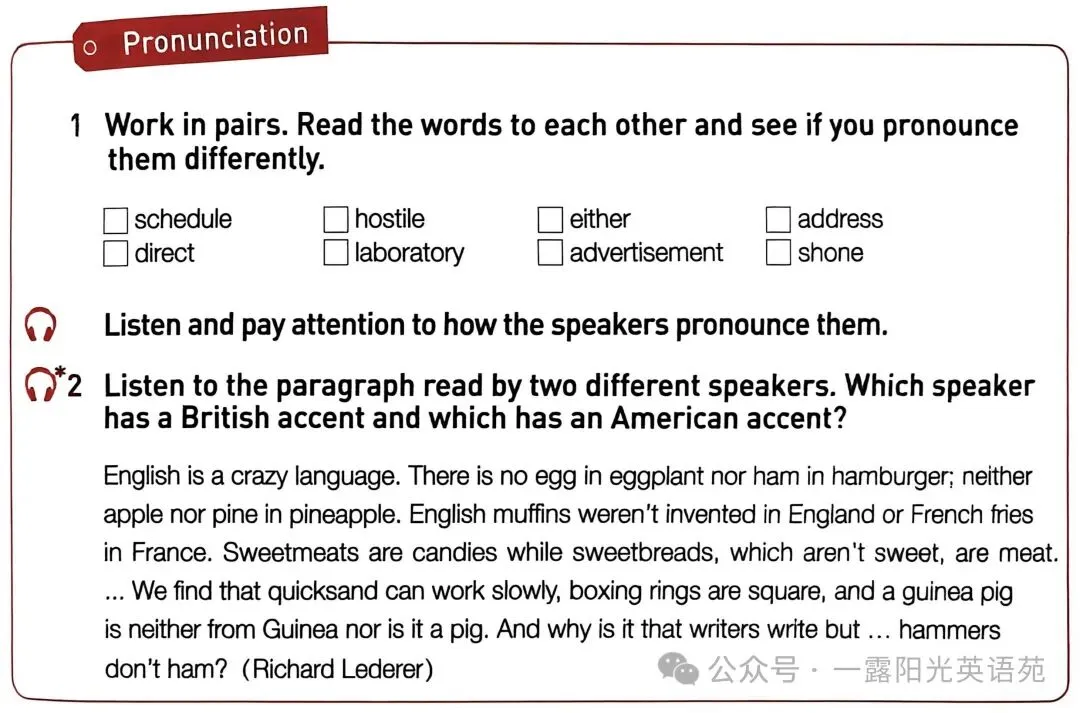
🎧Pronunciation
二、Listening and Talking
🎧Listen to the first part of the talk. What are the different kinds of English mentioned?
LISTENING PART1
As many countries speak English as a first language, there are many different kinds of English around the world: British English, American English, Australian English, and many others. Some English learners might ask, "Can English speakers from different countries all understand each other?" The answer is yes. People in these countries can usually understand each other with very few problems.There are differences in vocabulary, pronunciation, and grammar, but those are usually not big problems.However, those differences can cause confusion for non-native English speakers. For example, a student who has learnt British English might not be familiar with the different vocabulary that an American might use. Listen to this conversation between a foreign language student and her American classmate.
🎧Listen to the second part of the talk. What are the two pairs of words that the student is confused by? Tick them in the boxes.
LISTENING PART 2
Amy: Thank you very much for helping me with my English.
Betty: You're welcome! When are you free to meet? This semester, I'm free on Tuesday and Thursday after lunch.
Amy: I'm sorry? What does "semester" mean?
Betty: You know, semester-half of a school year.
Amy: Oh, you mean like a term?
Betty: Yes, like a term. The British say "term". We usually say "semester" here in America.
Amy: Got it! My first English lesson with you, haha? OK, let's meet on Tuesday. Where shall we meet?
Betty: Let's meet at a coffee shop near my home. It's very convenient to get there by subway.
Amy: Subway? Do you mean the Underground?
Betty: Yes, the train that goes under the ground!
Amy: Ah, got it! Haha, my second English lesson-thank you!
🎧Reading and Thinking🎧

🎧Reading for Writing🎧