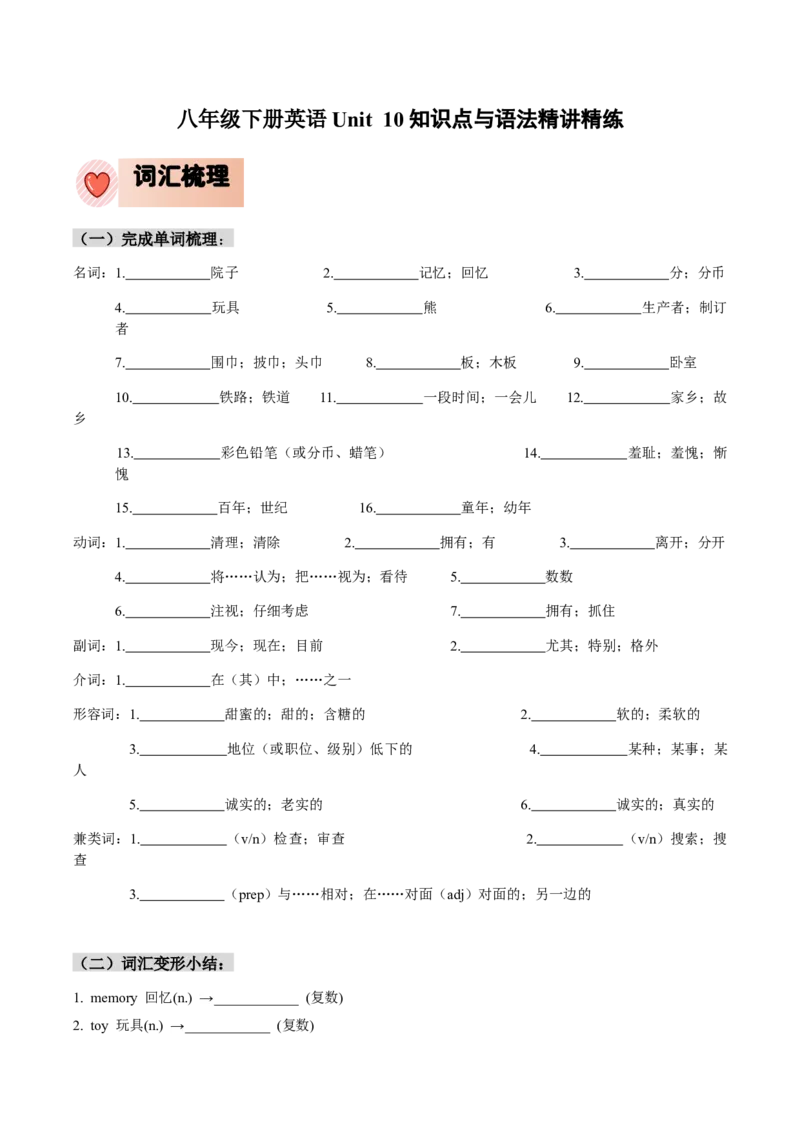
八年级下册英语 Unit 10 知识点与语法精讲精练
词汇梳理
(一)完成单词梳理:
名词:1. 院子 2. 记忆;回忆 3. 分;分币
4. 玩具 5. 熊 6. 生产者;制订
者
7. 围巾;披巾;头巾 8. 板;木板 9. 卧室
10. 铁路;铁道 11. 一段时间;一会儿 12. 家乡;故
乡
13. 彩色铅笔(或分币、蜡笔) 14. 羞耻;羞愧;惭
愧
15. 百年;世纪 16. 童年;幼年
动词:1. 清理;清除 2. 拥有;有 3. 离开;分开
4. 将……认为;把……视为;看待 5. 数数
6. 注视;仔细考虑 7. 拥有;抓住
副词:1. 现今;现在;目前 2. 尤其;特别;格外
介词:1. 在(其)中;……之一
形容词:1. 甜蜜的;甜的;含糖的 2. 软的;柔软的
3. 地位(或职位、级别)低下的 4. 某种;某事;某
人
5. 诚实的;老实的 6. 诚实的;真实的
兼类词:1. (v/n)检查;审查 2. (v/n)搜索;搜
查
3. (prep)与……相对;在……对面(adj)对面的;另一边的
(二)词汇变形小结:
1. memory 回忆(n.) →____________ (复数)
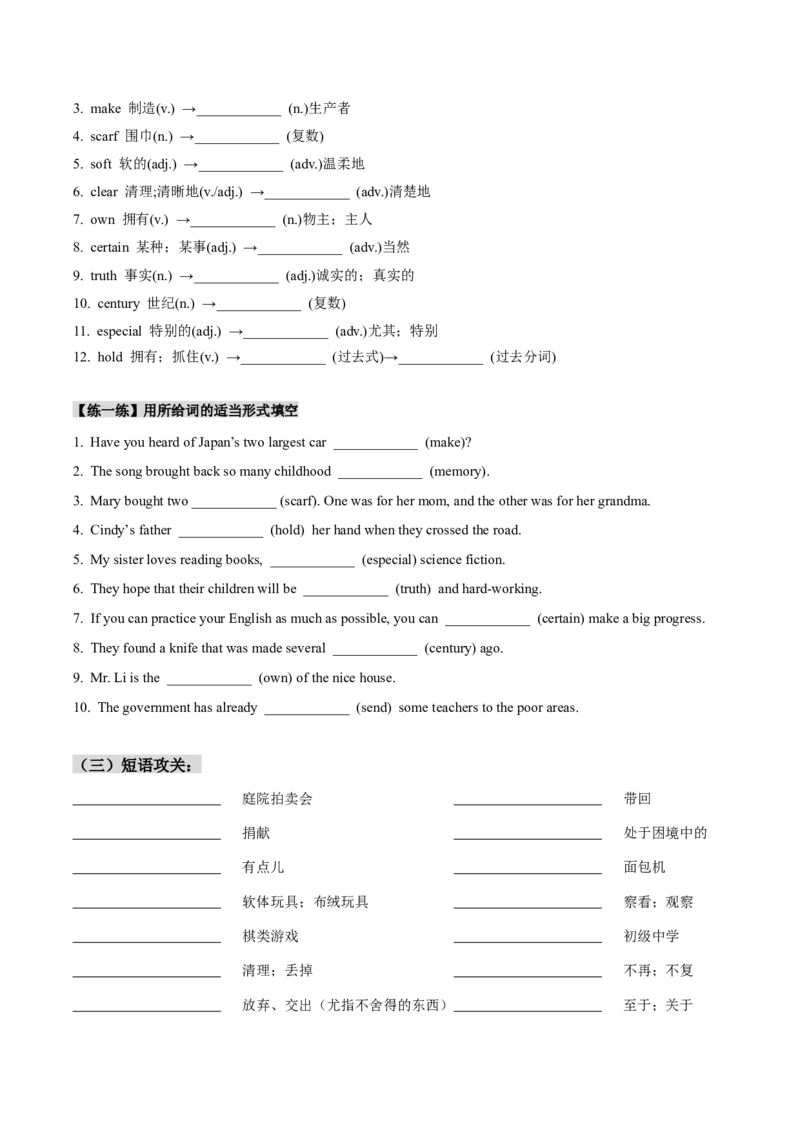
2. toy 玩具(n.) →____________ (复数)3. make 制造(v.) →____________ (n.)生产者
4. scarf 围巾(n.) →____________ (复数)
5. soft 软的(adj.) →____________ (adv.)温柔地
6. clear 清理;清晰地(v./adj.) →____________ (adv.)清楚地
7. own 拥有(v.) →____________ (n.)物主;主人
8. certain 某种;某事(adj.) →____________ (adv.)当然
9. truth 事实(n.) →____________ (adj.)诚实的;真实的
10. century 世纪(n.) →____________ (复数)
11. especial 特别的(adj.) →____________ (adv.)尤其;特别
12. hold 拥有;抓住(v.) →____________ (过去式)→____________ (过去分词)
【练一练】用所给词的适当形式填空
1. Have you heard of Japan’s two largest car ____________ (make)?
2. The song brought back so many childhood ____________ (memory).
3. Mary bought two ____________ (scarf). One was for her mom, and the other was for her grandma.
4. Cindy’s father ____________ (hold) her hand when they crossed the road.
5. My sister loves reading books, ____________ (especial) science fiction.
6. They hope that their children will be ____________ (truth) and hard-working.
7. If you can practice your English as much as possible, you can ____________ (certain) make a big progress.
8. They found a knife that was made several ____________ (century) ago.
9. Mr. Li is the ____________ (own) of the nice house.
10. The government has already ____________ (send) some teachers to the poor areas.
(三)短语攻关:
庭院拍卖会 带回
捐献 处于困境中的
有点儿 面包机
软体玩具;布绒玩具 察看;观察
棋类游戏 初级中学
清理;丢掉 不再;不复
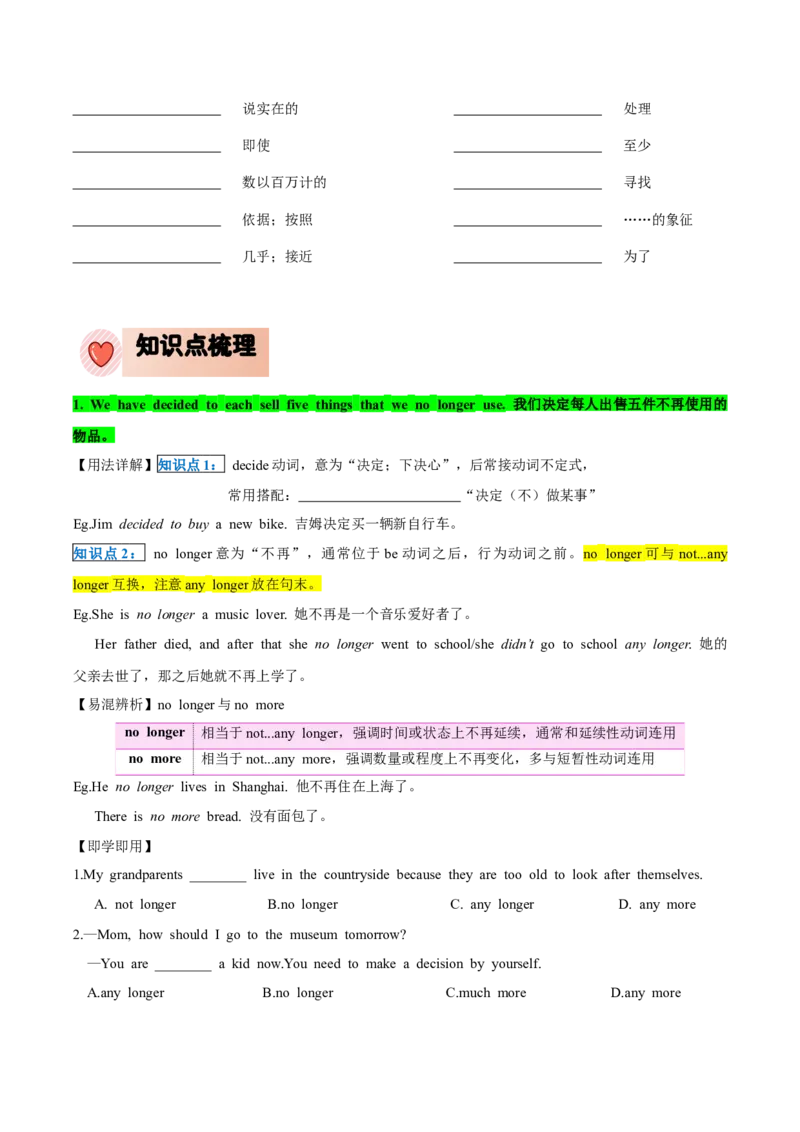
放弃、交出(尤指不舍得的东西) 至于;关于说实在的 处理
即使 至少
数以百万计的 寻找
依据;按照 ……的象征
几乎;接近 为了
知识点梳理
1. We have decided to each sell five things that we no longer use. 我们决定每人出售五件不再使用的
物品。
【用法详解】知识点1: decide动词,意为“决定;下决心”,后常接动词不定式,
常用搭配: “决定(不)做某事”
Eg.Jim decided to buy a new bike. 吉姆决定买一辆新自行车。
知识点2: no longer意为“不再”,通常位于be动词之后,行为动词之前。no longer可与not...any
longer互换,注意any longer放在句末。
Eg.She is no longer a music lover. 她不再是一个音乐爱好者了。
Her father died, and after that she no longer went to school/she didn’t go to school any longer. 她的
父亲去世了,那之后她就不再上学了。
【易混辨析】no longer与no more
no longer 相当于not...any longer,强调时间或状态上不再延续,通常和延续性动词连用
no more 相当于not...any more,强调数量或程度上不再变化,多与短暂性动词连用
Eg.He no longer lives in Shanghai. 他不再住在上海了。
There is no more bread. 没有面包了。
【即学即用】
1.My grandparents ________ live in the countryside because they are too old to look after themselves.
A. not longer B.no longer C. any longer D. any more
2.—Mom, how should I go to the museum tomorrow?
—You are ________ a kid now.You need to make a decision by yourself.
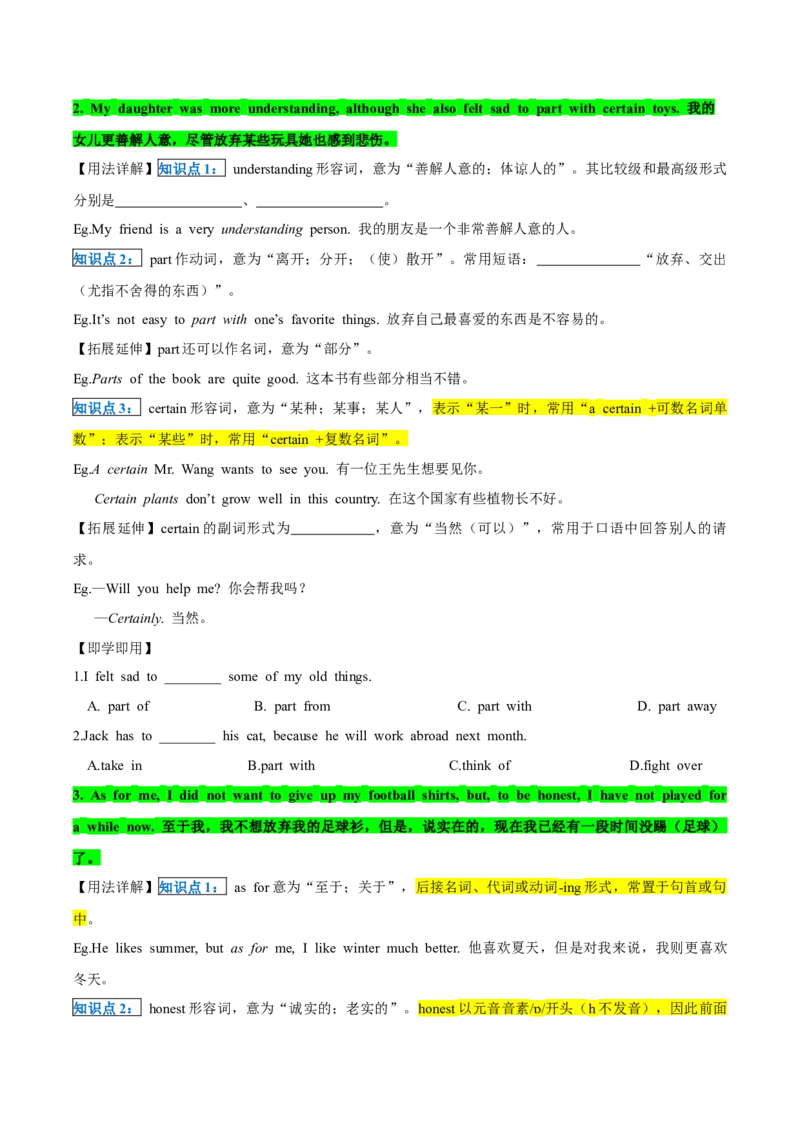
A.any longer B.no longer C.much more D.any more2. My daughter was more understanding, although she also felt sad to part with certain toys. 我的
女儿更善解人意,尽管放弃某些玩具她也感到悲伤。
【用法详解】知识点1: understanding形容词,意为“善解人意的;体谅人的”。其比较级和最高级形式
分别是 、 。
Eg.My friend is a very understanding person. 我的朋友是一个非常善解人意的人。
知识点2: part作动词,意为“离开;分开;(使)散开”。常用短语: “放弃、交出
(尤指不舍得的东西)”。
Eg.It’s not easy to part with one’s favorite things. 放弃自己最喜爱的东西是不容易的。
【拓展延伸】part还可以作名词,意为“部分”。
Eg.Parts of the book are quite good. 这本书有些部分相当不错。
知识点3: certain形容词,意为“某种;某事;某人”,表示“某一”时,常用“a certain +可数名词单
数”;表示“某些”时,常用“certain +复数名词”。
Eg.A certain Mr. Wang wants to see you. 有一位王先生想要见你。
Certain plants don’t grow well in this country. 在这个国家有些植物长不好。
【拓展延伸】certain的副词形式为 ,意为“当然(可以)”,常用于口语中回答别人的请
求。
Eg.—Will you help me? 你会帮我吗?
—Certainly. 当然。
【即学即用】
1.I felt sad to ________ some of my old things.
A. part of B. part from C. part with D. part away
2.Jack has to ________ his cat, because he will work abroad next month.
A.take in B.part with C.think of D.fight over
3. As for me, I did not want to give up my football shirts, but, to be honest, I have not played for
a while now. 至于我,我不想放弃我的足球衫,但是,说实在的,现在我已经有一段时间没踢(足球)
了。
【用法详解】知识点1: as for意为“至于;关于”,后接名词、代词或动词-ing形式,常置于句首或句
中。
Eg.He likes summer, but as for me, I like winter much better. 他喜欢夏天,但是对我来说,我则更喜欢
冬天。
知识点2: honest形容词,意为“诚实的;老实的”。honest以元音音素/ɒ/开头(h不发音),因此前面加不定冠词时要用 。to be honest意为“说实在的”,经常单独使用,作插入语放在句首,用逗号
与句子的其他部分隔开。
Eg.To be honest, she is not an honest girl. 说实话,她不是一个诚实的女孩。
【即学即用】
1.________, volunteering is both a chance to help others and a good way to develop ourselves.So you'd
better make time to volunteer.
A.To my surprise B.To be honest C.To start with D.In the
end
2.My brother likes eating meat. ________ me, I like vegetables and fruit.
A.As for B.According to C.Instead of D.Because
of
3.Miss Lee taught me to be ________ honest person. I will never forget ________ words that she said.
A. a; the B.a; / C. an; the D. an; /
4. Nowadays, millions of Chinese leave the countryside to search for work in the cities. 如今,数百
万中国人离开农村去城市找工作。
【用法详解】search作动词,意为“搜索;搜查”,其后可直接跟宾语。常用短语:search for“搜寻;寻
找”,相当于look for,后面的宾语是寻找的目标。
Eg.They searched the forest. 他们搜查了森林。
You can search for jobs online. 你可以在网上找工作。
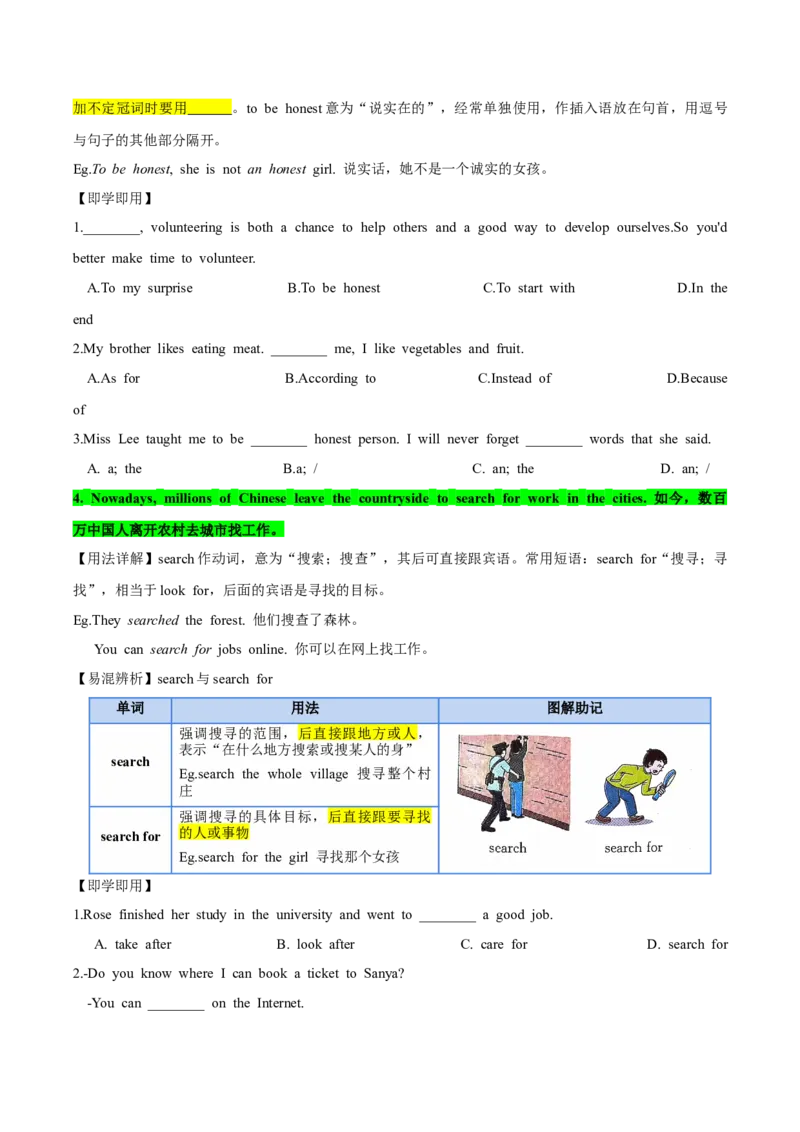
【易混辨析】search与search for
单词 用法 图解助记
强调搜寻的范围,后直接跟地方或人,
表示“在什么地方搜索或搜某人的身”
search
Eg.search the whole village 搜寻整个村
庄
强调搜寻的具体目标,后直接跟要寻找
的人或事物
search for
Eg.search for the girl 寻找那个女孩
【即学即用】
1.Rose finished her study in the university and went to ________ a good job.
A. take after B. look after C. care for D. search for
2.-Do you know where I can book a ticket to Sanya?
-You can ________ on the Internet.A.look B.find C.see D.search
5. Among these is Zhong Wei, a 46-year-old husband and father. 作为一位46岁的丈夫和父亲,钟伟
就是其中之一。
【用法详解】这是一个倒装句。正常语序应当是“Zhong Wei, a 46-year-old husband and father, is among
these.”英语中,表示地点的介词短语作状语置于句首时,主谓须倒装。
Eg.Under the tree stood two tables and four chairs. 树下有两张桌子和四把椅子。
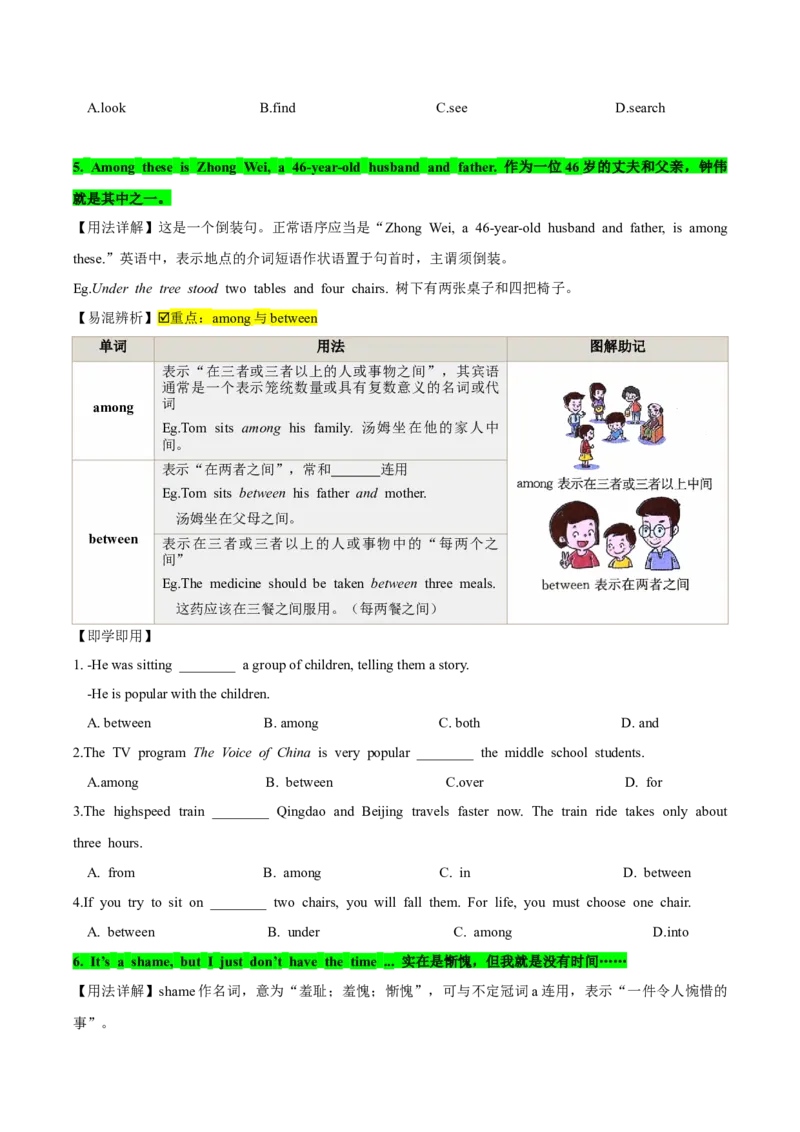
【易混辨析】重点:among与between
单词 用法 图解助记
表示“在三者或三者以上的人或事物之间”,其宾语
通常是一个表示笼统数量或具有复数意义的名词或代
词
among
Eg.Tom sits among his family. 汤姆坐在他的家人中
间。
表示“在两者之间”,常和 连用
Eg.Tom sits between his father and mother.
汤姆坐在父母之间。
between
表示在三者或三者以上的人或事物中的“每两个之
间”
Eg.The medicine should be taken between three meals.
这药应该在三餐之间服用。(每两餐之间)
【即学即用】
1. -He was sitting ________ a group of children, telling them a story.
-He is popular with the children.
A. between B. among C. both D. and
2.The TV program The Voice of China is very popular ________ the middle school students.
A.among B. between C.over D. for
3.The highspeed train ________ Qingdao and Beijing travels faster now. The train ride takes only about
three hours.
A. from B. among C. in D. between
4.If you try to sit on ________ two chairs, you will fall them. For life, you must choose one chair.
A. between B. under C. among D.into
6. It’s a shame, but I just don’t have the time ... 实在是惭愧,但我就是没有时间……
【用法详解】shame作名词,意为“羞耻;羞愧;惭愧”,可与不定冠词a连用,表示“一件令人惋惜的
事”。Eg.It’s a shame that you have to go back to America tomorrow. 真遗憾你明天就得回美国了。
Better die with honor than live with shame. 宁愿光荣就义,不愿苟且偷生。
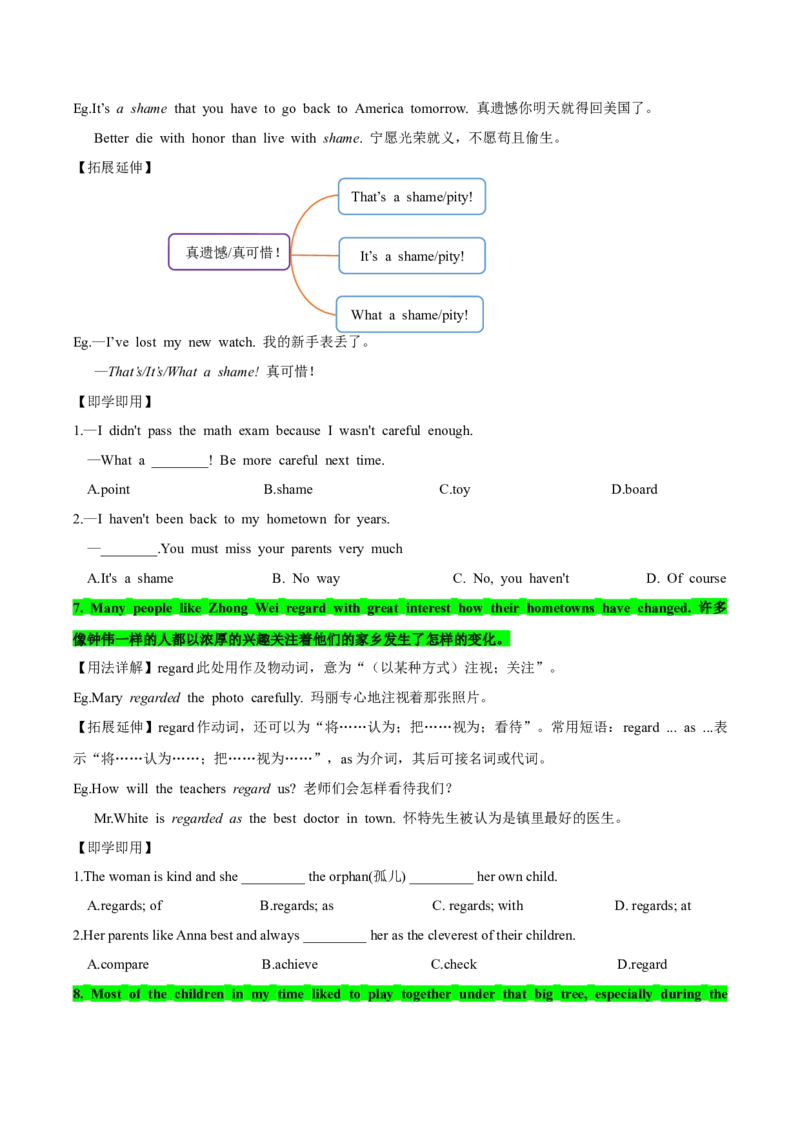
【拓展延伸】
That’s a shame/pity!
真遗憾/真可惜!
It’s a shame/pity!
What a shame/pity!
Eg.—I’ve lost my new watch. 我的新手表丢了。
—That’s/It’s/What a shame! 真可惜!
【即学即用】
1.—I didn't pass the math exam because I wasn't careful enough.
—What a ________! Be more careful next time.
A.point B.shame C.toy D.board
2.—I haven't been back to my hometown for years.
—________.You must miss your parents very much
A.It's a shame B. No way C. No, you haven't D. Of course
7. Many people like Zhong Wei regard with great interest how their hometowns have changed. 许多
像钟伟一样的人都以浓厚的兴趣关注着他们的家乡发生了怎样的变化。
【用法详解】regard此处用作及物动词,意为“(以某种方式)注视;关注”。
Eg.Mary regarded the photo carefully. 玛丽专心地注视着那张照片。
【拓展延伸】regard作动词,还可以为“将……认为;把……视为;看待”。常用短语:regard ... as ...表
示“将……认为……;把……视为……”,as为介词,其后可接名词或代词。
Eg.How will the teachers regard us? 老师们会怎样看待我们?
Mr.White is regarded as the best doctor in town. 怀特先生被认为是镇里最好的医生。
【即学即用】
1.The woman is kind and she _________ the orphan(孤儿) _________ her own child.
A.regards; of B.regards; as C. regards; with D. regards; at
2.Her parents like Anna best and always _________ her as the cleverest of their children.
A.compare B.achieve C.check D.regard
8. Most of the children in my time liked to play together under that big tree, especially during thesummer holiday. 在我那个年代,大多数孩子喜欢在那棵大树底下一起玩,特别是在暑假期间。
【用法详解】especially副词,意为“尤其;特别;格外”。当陈述某一事实,并列举一个具有代表性的例
子做进一步的强调时,常用especially,其后可接名词、介词短语等。
Eg.Aunt Alice loves animals, especially dogs. 艾丽斯阿姨喜爱动物,尤其爱狗。
I love Rome, especially in the spring. 我喜欢罗马,尤其是春天的罗马。
【拓展延伸】especially还可用来修饰动词、形容词或副词,强调程度。
Eg.I especially want to see that film. 我特别想看那部电影。
We are especially busy today. 我们今天特别忙。
【即学即用】
1.-I think to be a teacher is an interesting job, ________ when you stay with students.
-So it is.
A.specially B. especially C.probably D. properly
2.Nowadays, many people prefer to eat out on New Year's Day, ________ kids.
A.specially B.especially C.only D.probably
3.As we all know, smoking is bad for us, ____________ (especial) for children.
9. consider 注视;仔细考虑
【用法详解】(1)consider用作动词,意为“注视”。
Eg.The girl stood there, considering the painting. 那个女孩站在那里,凝视着那幅油画。
(2)consider用作动词,意为“仔细考虑”,后面通常跟名词、代词、动词-ing形式、“疑问词+不定
式”或wh-从句。常考搭配: “考虑做某事”。
Eg.Please consider my suggestion. 请考虑一下我的建议。
I’ m considering changing my job. 我正在考虑换份工作。
【即学即用】
1.You should ________ it carefully before ________ a composition(作文).
A. consider; write B. consider; writing C. considering; writing D. considering;
write
2.My teacher considered ________ the story from the point of view of the teenagers.
A. to tell B.telling C.told D.tells
3.For your next vacation, why not consider ____________ (visit) Shanghai?
4.They're considering ____________ (go) back tomorrow.课堂小测
一、单项选择
1.I like Mr.White because he is ________ honest and funny man.
A.a B.an C.the D./
2.Mike, don't throw your toys away.You can give them to the children ________ need.
A.at B.on C.in D.for
3.—Alice, your room is in a mess. You should ________ some of your junk.
—OK.I will.
A. clear out B. check out C. find out D. cut out
4.—Can you tell me something about your English teacher?
—Sure.All of us ________ her as the best teacher in our school.
A.decide B.regard C.count D.cheer
5.—________, there must be life on other planets though none has been discovered.
—I agree with you.The universe(宇宙)is so large after all.
A.To my surprise B.To be honest C.In my opinion D.Again and
again
6.His grade in the exam put him ________ the top students in his class.
A.between B.over C.among D.above
7.—What do you think of your hometown, Lin Tao?
—Very beautiful, ________ in spring. Lots of visitors come and see flowers every year.
A. especially B. actually C. completely D. probably
8.—I ________ play computer games. I must study hard, or I can’t get better education.
—Yes, computer games are bad for your study.
A. not long B. no long C. no longer D. not
longer
9.—Oh my God!I lost my birthday gift.
—________!
A. What a shame B.Well done C.Good idea D. How
wonderful
10.My brother likes eating meat. ________ me, I like vegetables and fruit.A. Because of B. According to C. Instead of
D.As for
11.—Why are you so quiet?
—I’m considering ________ a new sweater.
A. buy B. bought C. buying D. to buy
12.—You shouldn’t ________ your hobby.
—I know, but I am too busy this term. What should I do?
A. check out B. clear out C. deal with D. part with
13.________ the timetable,the train to London leaves at seven o'clock in the evening.
A.Thanks to B.As for C.Thanks for D.According to
14.My uncle has been teaching in this school ________ he was twenty years old.
A. since B. for C. until D. after
15.—When did you leave home?
—I left home at 18, Neil. I ________ your city for five years.
A. have gone to B. have been to C. have been in D. have
come to
二、用所给词的适当形式填空
1. Elephants have good ___________ (memory). They never forget the places with food and water.
2. Most people would like to relax in the park, ___________ (especial ) in summer.
3. Every year, ___________ (million) of people take part in the sports meeting.
4. I am no ___________ (long) interested in dancing. Now I like singing.
5. Speak ___________ (clear) so that they can understand you.
6. This film came from a ___________ (truth) story happened many years ago.
7.—Why not consider ___________ (go) for a walk after supper?
—That’s a good idea.
8. He has gone to a ___________ (certainly) place in Asia.
9. She has had those ___________ (scarf) for two years.
10. The little kid fell asleep without ___________ (take) a shower.
三、完形填空
In 2022, my mother had a yard sale. During the sale, she had a conversation 1 a young girl
Nancy, for she had a 2 interest in some books she had for sale. They enjoyed their conversation3 much that they exchanged their phone numbers. Later they became friends and got together for a
few times. When my mom moved into her new house, she had a family dinner and invited Nancy and
4 her to my brother. Five months later Nancy married my brother and that was four years ago.
There is 5 yard sale that I'll never forget. One day, after work from school, I found one of
my 6 had a lot of things out in his front yard with cars and people everywhere. I 7 into
the yard at once and wanted to find some good and 8 things before everything good had gone.
But then I found out it wasn’t a yard sale. In fact, 9 were taking the stolen(被偷的) things out of
the house. My neighbor was a thief. Luckily, I didn’t ask 1 0 the TV was.
( )1.A.to B. with C. about D.for
( )2. A. different B. same C. normal D.common
( )3.A.so B. such C.too D.enough
( )4. A.led B. showed C.took D. introduced
( )5.A.other B. the other C. another D.more
( )6. A.classmates B. neighbors C. workmates D. friends
( )7. A.looked B. ran C. turned D. fell
( )8. A. expensive B. strange C. hard D.cheap
( )9. A. policemen B. teachers C. workers D. doctors
( )10.A.what B. how C. how big D. how much
四、阅读理解
A man came home from work late, tired and unhappy, to find his 5yearold son waiting for him at the door.
The boy asked, “Daddy, how much do you make every hour?” The father was furious at his son's question.
When he said $20 an hour, the little boy asked his father to lend $10 to him. The father was even angrier because he
thought the boy just wanted some money to buy a toy. So he didn't give his son money.
The little boy quietly went to his room. After about an hour or so, the man calmed down and started to think:
Maybe there was something he really needed to buy with that $10.
“Maybe I was too hard on you just now,” the man went into the room and said.
“Here's the $10 you asked for.”
“Oh, thank you, Daddy!” the little boy said. Then he reached under his pillow(枕头), pulled out some
crumpled(压皱的) money and said, “Daddy, I have $20 now. Can I buy an hour of your time? Please come home
early tomorrow. I would like to have dinner with you.”
( ) 1. How much does the man make if he works 10 hours?A. $10. B. $200. C. $300. D. $40.
( ) 2. In this passage, the underlined word “furious” means “________”.
A. very angry B. quite happy C. too excited D. a little nervous
( ) 3. At first, the father refused to lend the boy any money because ________.
A. he thought the boy wanted to keep the money for himself
B. he did not have enough money at that moment
C. he thought the boy would buy something of no use
D. the boy always borrowed money from him
( ) 4. The boy wanted to buy ________ with twenty dollars.
A. a new book for himself B. a nice present for his father
C. a toy for himself D. an hour of his father's time
( ) 5. From the passage, we can infer(推断) that the father ________.
A. often played with his son B. spent little time with his son
C. didn't love his son at all D. often came back home early
五、语法填空
I'm Eric. I was born in California. That place has left me many happy childhood
1.__________(memory).
When I 2.__________(be) a little boy, 1 had to get up before sunrise to work on the farm.At sunrise
I could see a house 3.__________ golden windows far away from the farm.Everyday I
4.__________(enjoy) it with interest and wondered what the house looked like inside. To be honest, I
really wanted 5.__________(live) there! I often said to myself, "Some day I will 6.__________(own) a
house like that."
One day I walked to the house with golden windows. I walked for 7.__________ while and then I
stopped in front of the house. To 8.__________ (I) surprise,there were no golden windows. I was very
upset. 9.__________ (late) I learned that the windows were not golden at all. It was the sunrise that 10.
__________(make) them look golden.
六、根据汉语意思完成句子,每空一词
1.老实说,我真不想离开母校。
____________ ____________ ____________ , I don't really want to leave my school.
2.在你扔掉这些废物之前请查看他们。
Please ____________ ____________ these waste things before you throw them away.
3.怀特夫妇正考虑去美国度假。
Mrs.White and Mr.White are ____________ ____________ to the USA for vacation.语法精讲
现在完成时(三)
一、现在完成时的“未完成用法”
现在完成时表示动作或状态从过去某时开始,一直延续至今,还可能继续下去。这种用法称为“未完
成用法”。此时常与for或since引导的时间状语(从句)连用。
表示“未完成”的句式 示例
现在完成时+ for +一段时间 We have known each other for twenty years. 我们认识有二十
年了。
现在完成时+ since +表示过去的时间 Mr. Smith has worked here since 1984. 自从1984年史密斯先
点 生就在这里工作。
现在完成时+ since +从句 I have lived here since I was born. 我从出生就住在这儿。
【拓展延伸】
1.在现在完成时中,for与since引导的时间状语可以进行相互转换,即“for +时间段= since +时间段+
ago”。
Eg.I have kept the book for a month. = I have kept the book since a month ago. 我已经借这本书一个
月了。
2.在现在完成时中,当谓语动词是延续性动词时,可以用how long提问。
Eg.He has been a soldier for three years.他参军三年了。→ How long has he been a soldier?他参军多长
时间了?
二、延续性动词与非延续性动词
1.延续性动词表示经验、经历;非延续性动词表示行为的结果,不能与表示一段时间的状语连用。有些非
延续性动词可以用延续性动词替换并用在现在完成时中。
2.在现在完成时的句子中,若含有for或since引导的时间 状语,则句中谓语动词一定要用延续性动词。非
延续性动词转换为延续性动词的方法有:
(1)将非延续性动词转化为“be+形容词或副词”,这样才能和时间段连用:
begin/start → be on(开始) marry → (结婚)
coma back → be back(回来) come here → be here(来这里)
open → be open(开业) close → be closed(关门)
die → (死) get/arrive/reach → be in/at(到达)
finish → be over(结束) fall ill → be ill(生病)
leave → (离开) join/become → be in/be a member of(参加;加入)
(2)有的非延续性动词可以转化为意思相同的延续性动词
borrow/lend → put on → wear/be on(穿)
(借)
become → (成为) get to know → know(认识)
buy → (买) catch a cold → have a cold(感
冒)
receive → have(收到) go to sleep → sleep(睡觉)
Eg.【译】这家商店已经开业6小时了。
【误】The shop has opened for 6 hours.
【正】The shop has been open for 6 hours.
【注意】在完成时的否定句中,非延续性动词可以与表示一段时间的状语连用。
Eg.I haven’t caught a cold for two hours. 我已经2个月没感冒了。
语法小测
一、单项选择
1.They have been good friends ________ they joined the same basketball team.
A.before B. for C.since D. because
2.—What a nice bike! How long have you ________ it?
—Less than two weeks.
A.had B.received C.bought D. borrowed
3.—Your new watch is so nice! When did you buy it?
—In April. I ________ it for two months.
A.have had B. had C. have bought D.bought
4.Julie’s father ________ to London last month. He ________ there three times.
A.went; has gone B.has gone; has been C. went; has been D.has been; has
gone
5.Lei Feng ________ for many years, but he still lives in the hearts of Chinese people.
A.died B.was died C. has been died D. has been
dead
6.We ________ each other since I came to Beijing, but we send e-mails very often.
A.don't see B.didn't see C.won't see D.haven't seen7.In the last ten years, great changes ________ place in my hometown.
A. took B. had taken C. have taken D. take
8.—Mom, I want to watch the football game tonight.
—Oh, dear, it ________ for a few minutes. Come on.
A. has begun B. will begin C. has been on D. will be on
9.—Do you know her well?
—Sure. We ________ friends since ten years ago.
A. were B. became C. have become D. have been
10.—Are you a basketball player in your school?
—Yes. I ________ the team 3 years ago. I ________ in it for 3 years.
A.joined; was B.was joined; am C.have joined; have been D.joined; have been
11.We ________ to learn English three years ago. We ________ it for three years.
A. began; learned B. begin; have learned
C. have begun; will learn D. began; have learned
12.A China ________ great achievements in science and technology since 1978.
A.makes B.made C.has made D.have made
13.—When will A Bite of China III begin tonight?
—It ________ for ten minutes.
A.will begin B.has begun C.will be on D.has been on
14.—________ have you stayed in this hotel?
—Not long; just ________ this Monday.
A. How soon; from B. How long; since C. How many days; for D. How
often; on
15.—When did you buy this bike?
—I ________ it when I was 11 years old. I have ________ it since three years ago.
A.bought; bought B.bought; had C.had; bought D.bought; have
16.—________ have you been in Beijing?
—For two days.
A.How many B.How often C.How soon D.How long
17.—________ have you been interested in paper cutting, Tom?
—Since I first came to China 10 years ago.
A.How long B.When C.How soon D.How much18.Cathy ________ her mother since she ________ to America. Her mother is worried about her a lot.
A.has called; went B.has called; has gone C. hasn’t called; went D.hasn’t called;
has gone
19.—Where is Mr. Wang?
—He ________ to Beijing. He has ________ for two hours.
A.has gone; been away B.has gone; left C.has been; left D.has been; been
away
20.—Many people have been back to their work ________ March 5th.
—Cities are brought back to life.
A. for B. in C. since D. during
二、用所给词的适当形式填空
1.Bruce ____________ (learn) Chinese for two years. He can speak it well.
2.Stephen Hawking ____________ (die) for over 3 months, but his spirit still lives on.
3.I have ____________ (have) this bread maker since I was 15 years old.
4.In many places, the government has also built new schools and ____________ (send) teachers from the
cities to help.
5.He has worked on the farm since he ____________ (leave) the army.
三、按要求完成句子,每空一词
1.We have known each other for two years.(改为同义句)
We have known each other __________ two years __________.
2.Susan has been a volunteer for protecting animals for three years . (对画线部分提问)
__________ __________ has Susan been a volunteer for protecting animals?
3.Nick has had the bag for two years. (改为一般疑问句)
__________ Nick __________ the bag for two years?
4.The man came here two days ago. (改为同义句)
The man has __________ __________ for two days.
5.I borrowed the book two weeks ago.(改为同义句)
I __________ __________ the book for two weeks.
四、语法填空
These days my children 1. (grow) up fast. My daughter is 16 years old and my boy is already in
junior high school. It seems that our house is becoming smaller and 2. (small). We decided to have 3.yard sale so that we can give the money to a 4. (children) house.Each of us will send five old things
after 5. (clear) out the things from our bedrooms. Of course, my son felt a little sad first 6.
he still wanted to keep the 7. (toy). He ever played with them so much. As you see, he 8.
(have) his train and railway set since he was four years old. And he played with 9. almost every day
until about seven years old. He also wanted to keep his toy monkey. Every night he slept next to the toy monkey as
a child. We could remember that forever. My daughter was sad to part 10. some of her toys, too.
五、书面表达
请以“My Hometown”为题,按以下提示内容写一篇80词左右的短文。
1.家乡的地理位置等基本情况; 2.家乡的巨大变化; 3.对家乡的简要评价。
My Hometown
____________________________________________________________________________________________
____________________________________________________________________________________________
____________________________________________________________________________________________
____________________________________________________________________________________________
____________________________________________________________________________________________
____________________________________________________________________________________________
____________________________________________________________________________________________
____________________________________________________________________________________________
____________________________________________________________________________________________
____________________________________________________________________________________________