八年级下册英语 Unit 4 知识点与语法精讲精练
词汇梳理
(一)完成单词梳理:
名词:1. 协议;交易 2. 关系;联系;交往 3. 交流;沟
通
4. 云;云朵 5. 成员;分子 6. 压力
7. 意见;想法;看法 8. 技艺;技巧 9. (美式)足
球
10. 发展;发育;成长
动词:1. 允许;准许 2. 猜测;估计 3. 争吵;争
论
4. 主动提出;自愿给予 5. 交流;沟通 6. 解释;说
明
7. 抄袭;模仿;复制;复印 8. 归还;回来;返
回
9. 竞争;对抗 10. 持续;继续存在 11. 比
较
12. 鞭策;督促;推动 13. 造成;引起
副词:1. 代替;反而;却 2. 第二;其次
3. 再也(不);(不)再 4. 可能;大概;也
许
代词:1. 任何;每一
形容词:1. 有毛病;错误的 2. 年纪较长的
3. 焦虑的;担忧的 4. 正确的;恰当的
5. 清楚易懂的;晴朗的 6. 典型的
7. 快的;迅速的;时间短暂的 8. 不理智的;疯狂
的
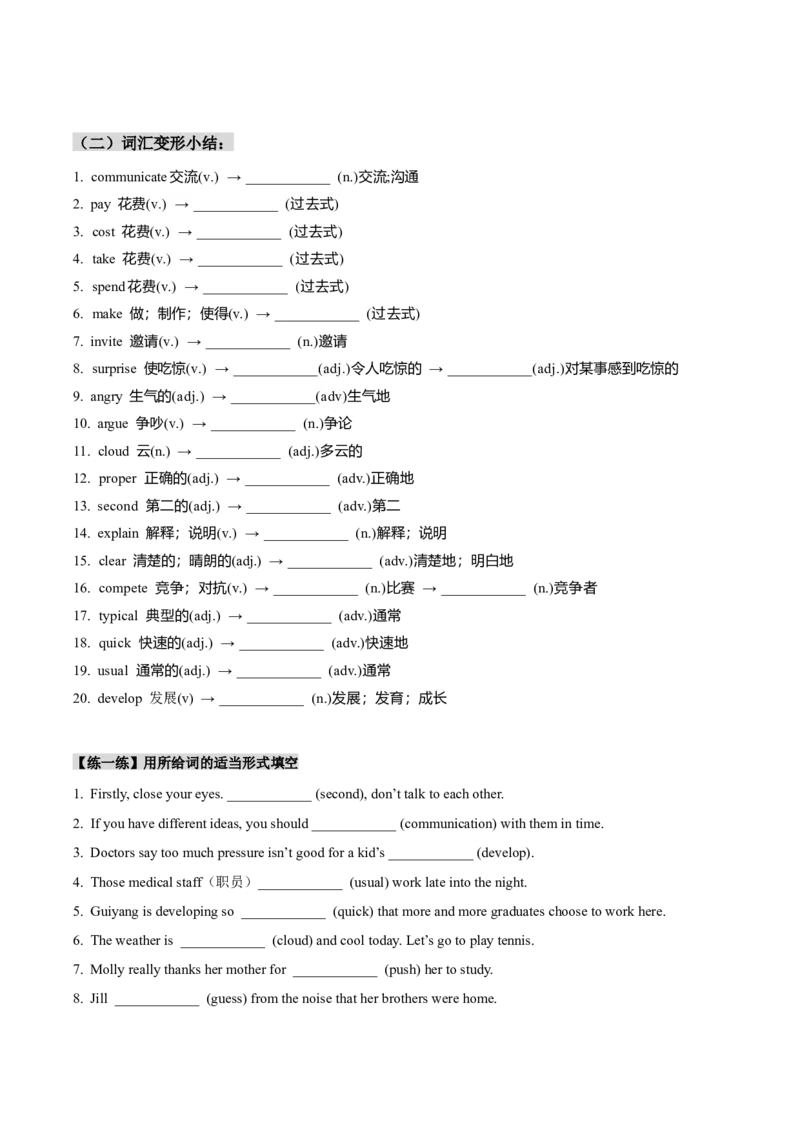
9. 通常的;寻常的(二)词汇变形小结:
1. communicate交流(v.) → ____________ (n.)交流;沟通
2. pay 花费(v.) → ____________ (过去式)
3. cost 花费(v.) → ____________ (过去式)
4. take 花费(v.) → ____________ (过去式)
5. spend花费(v.) → ____________ (过去式)
6. make 做;制作;使得(v.) → ____________ (过去式)
7. invite 邀请(v.) → ____________ (n.)邀请
8. surprise 使吃惊(v.) → ____________(adj.)令人吃惊的 → ____________(adj.)对某事感到吃惊的
9. angry 生气的(adj.) → ____________(adv)生气地
10. argue 争吵(v.) → ____________ (n.)争论
11. cloud 云(n.) → ____________ (adj.)多云的
12. proper 正确的(adj.) → ____________ (adv.)正确地
13. second 第二的(adj.) → ____________ (adv.)第二
14. explain 解释;说明(v.) → ____________ (n.)解释;说明
15. clear 清楚的;晴朗的(adj.) → ____________ (adv.)清楚地;明白地
16. compete 竞争;对抗(v.) → ____________ (n.)比赛 → ____________ (n.)竞争者
17. typical 典型的(adj.) → ____________ (adv.)通常
18. quick 快速的(adj.) → ____________ (adv.)快速地
19. usual 通常的(adj.) → ____________ (adv.)通常
20. develop 发展(v) → ____________ (n.)发展;发育;成长
【练一练】用所给词的适当形式填空
1. Firstly, close your eyes. ____________ (second), don’t talk to each other.
2. If you have different ideas, you should ____________ (communication) with them in time.
3. Doctors say too much pressure isn’t good for a kid’s ____________ (develop).
4. Those medical staff(职员)____________ (usual) work late into the night.
5. Guiyang is developing so ____________ (quick) that more and more graduates choose to work here.
6. The weather is ____________ (cloud) and cool today. Let’s go to play tennis.
7. Molly really thanks her mother for ____________ (push) her to study.
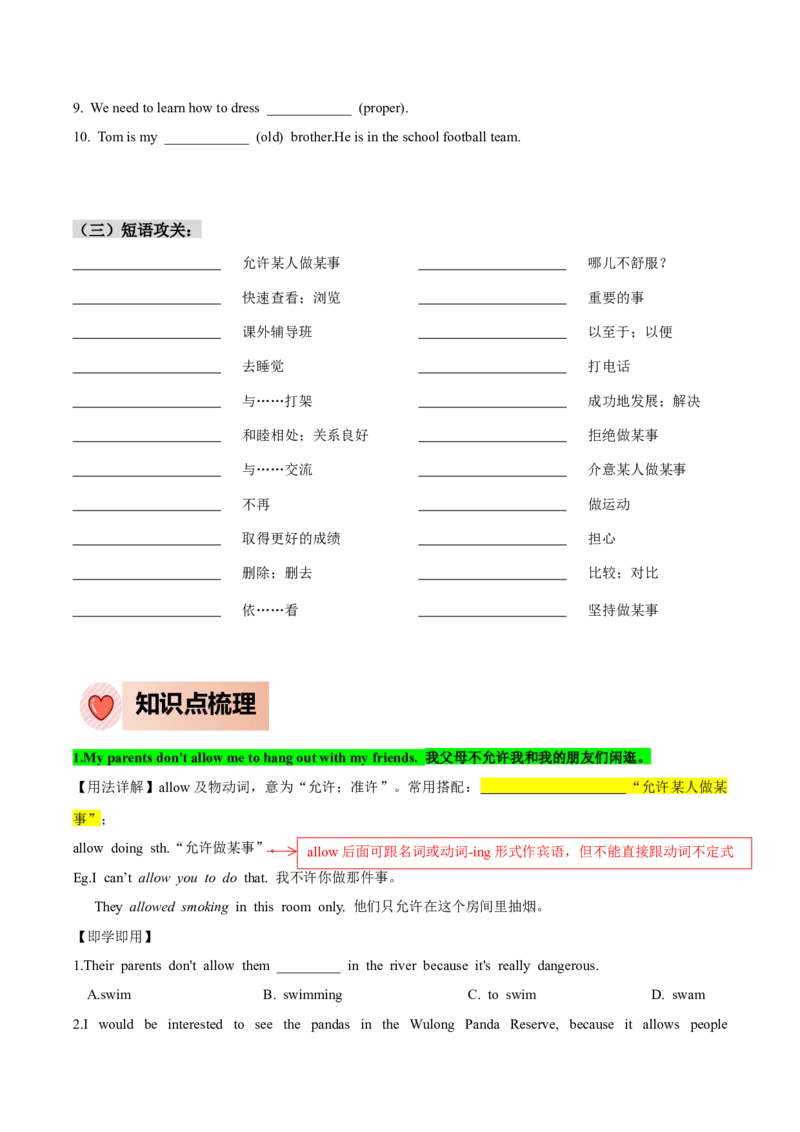
8. Jill ____________ (guess) from the noise that her brothers were home.9. We need to learn how to dress ____________ (proper).
10. Tom is my ____________ (old) brother.He is in the school football team.
(三)短语攻关:
允许某人做某事 哪儿不舒服?
快速查看;浏览 重要的事
课外辅导班 以至于;以便
去睡觉 打电话
与……打架 成功地发展;解决
和睦相处;关系良好 拒绝做某事
与……交流 介意某人做某事
不再 做运动
取得更好的成绩 担心
删除;删去 比较;对比
依……看 坚持做某事
知识点梳理
1.My parents don't allow me to hang out with my friends. 我父母不允许我和我的朋友们闲逛。
【用法详解】allow及物动词,意为“允许;准许”。常用搭配: “允许某人做某
事”;
allow doing sth.“允许做某事”。 allow后面可跟名词或动词-ing形式作宾语,但不能直接跟动词不定式
Eg.I can’t allow you to do that. 我不许你做那件事。
They allowed smoking in this room only. 他们只允许在这个房间里抽烟。
【即学即用】
1.Their parents don't allow them _________ in the river because it's really dangerous.
A.swim B. swimming C. to swim D. swam
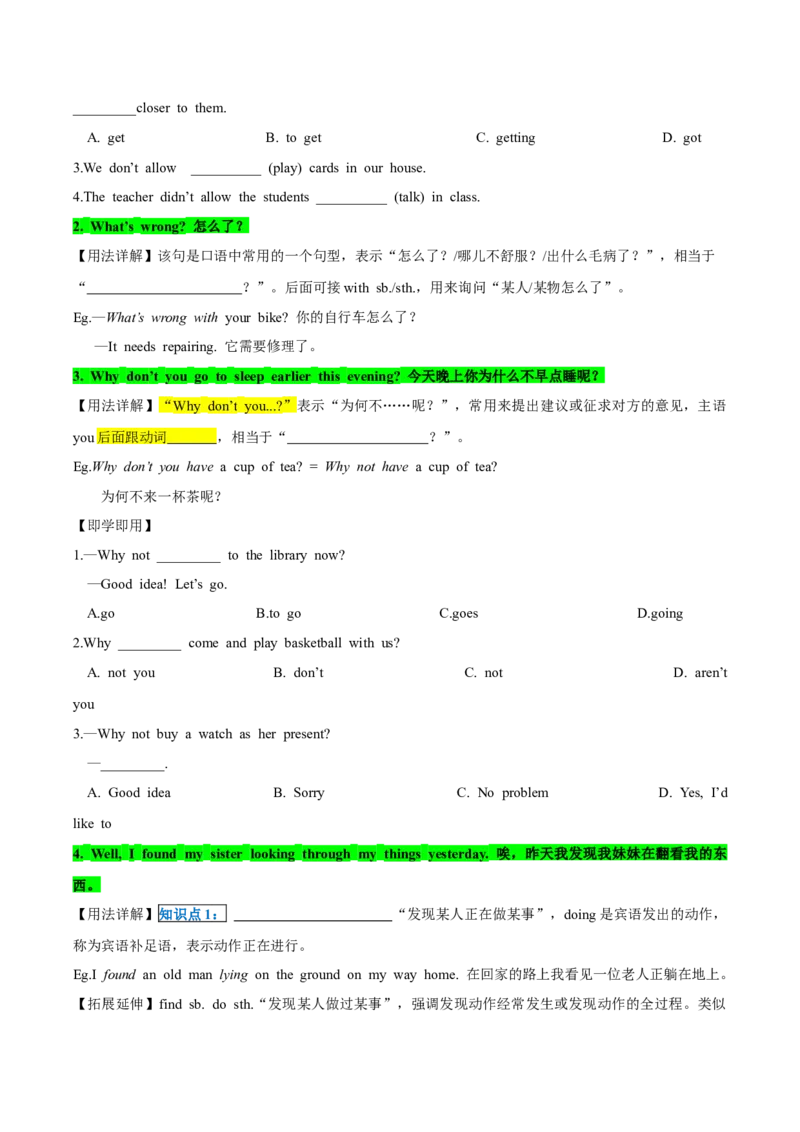
2.I would be interested to see the pandas in the Wulong Panda Reserve, because it allows people_________closer to them.
A. get B. to get C. getting D. got
3.We don’t allow __________ (play) cards in our house.
4.The teacher didn’t allow the students __________ (talk) in class.
2. What’s wrong? 怎么了?
【用法详解】该句是口语中常用的一个句型,表示“怎么了?/哪儿不舒服?/出什么毛病了?”,相当于
“ ?”。后面可接with sb./sth.,用来询问“某人/某物怎么了”。
Eg.—What’s wrong with your bike? 你的自行车怎么了?
—It needs repairing. 它需要修理了。
3. Why don’t you go to sleep earlier this evening? 今天晚上你为什么不早点睡呢?
【用法详解】“Why don’t you...?”表示“为何不……呢?”,常用来提出建议或征求对方的意见,主语
you后面跟动词 ,相当于“ ?”。
Eg.Why don’t you have a cup of tea? = Why not have a cup of tea?
为何不来一杯茶呢?
【即学即用】
1.—Why not _________ to the library now?
—Good idea! Let’s go.
A.go B.to go C.goes D.going
2.Why _________ come and play basketball with us?
A. not you B. don’t C. not D. aren’t
you
3.—Why not buy a watch as her present?
—_________.
A. Good idea B. Sorry C. No problem D. Yes, I’d
like to
4. Well, I found my sister looking through my things yesterday. 唉,昨天我发现我妹妹在翻看我的东
西。
【用法详解】知识点1: “发现某人正在做某事”,doing是宾语发出的动作,
称为宾语补足语,表示动作正在进行。
Eg.I found an old man lying on the ground on my way home. 在回家的路上我看见一位老人正躺在地上。
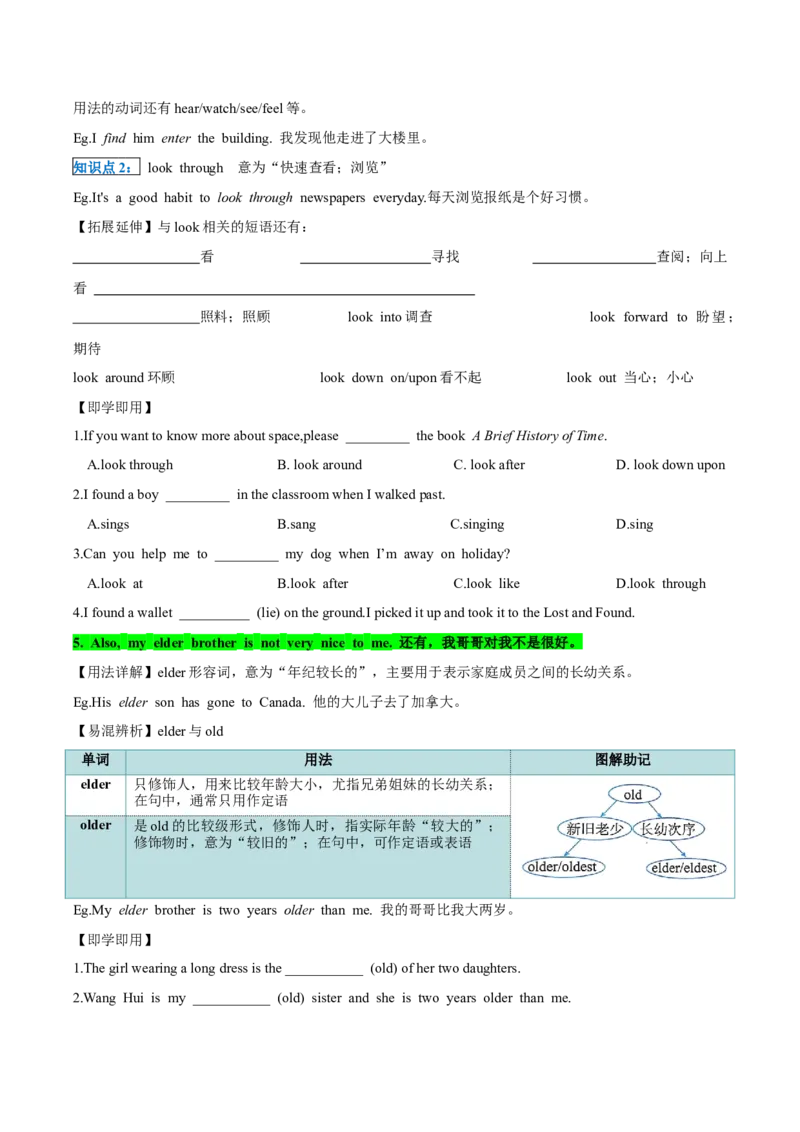
【拓展延伸】find sb. do sth.“发现某人做过某事”,强调发现动作经常发生或发现动作的全过程。类似用法的动词还有hear/watch/see/feel等。
Eg.I find him enter the building. 我发现他走进了大楼里。
知识点2: look through 意为“快速查看;浏览”
Eg.It's a good habit to look through newspapers everyday.每天浏览报纸是个好习惯。
【拓展延伸】与look相关的短语还有:
看 寻找 查阅;向上
看
照料;照顾 look into调查 look forward to 盼望;
期待
look around环顾 look down on/upon看不起 look out 当心;小心
【即学即用】
1.If you want to know more about space,please _________ the book A Brief History of Time.
A.look through B. look around C. look after D. look down upon
2.I found a boy _________ in the classroom when I walked past.
A.sings B.sang C.singing D.sing
3.Can you help me to _________ my dog when I’m away on holiday?
A.look at B.look after C.look like D.look through
4.I found a wallet __________ (lie) on the ground.I picked it up and took it to the Lost and Found.
5. Also, my elder brother is not very nice to me. 还有,我哥哥对我不是很好。
【用法详解】elder形容词,意为“年纪较长的”,主要用于表示家庭成员之间的长幼关系。
Eg.His elder son has gone to Canada. 他的大儿子去了加拿大。
【易混辨析】elder与old
单词 用法 图解助记
elder 只修饰人,用来比较年龄大小,尤指兄弟姐妹的长幼关系;
在句中,通常只用作定语
older 是old的比较级形式,修饰人时,指实际年龄“较大的”;
修饰物时,意为“较旧的”;在句中,可作定语或表语
Eg.My elder brother is two years older than me. 我的哥哥比我大两岁。
【即学即用】
1.The girl wearing a long dress is the ___________ (old) of her two daughters.
2.Wang Hui is my ___________ (old) sister and she is two years older than me.6. Instead he watches whatever he wants until late at night. 相反,他却可以看他想看的任何节目,一
直看到深夜。
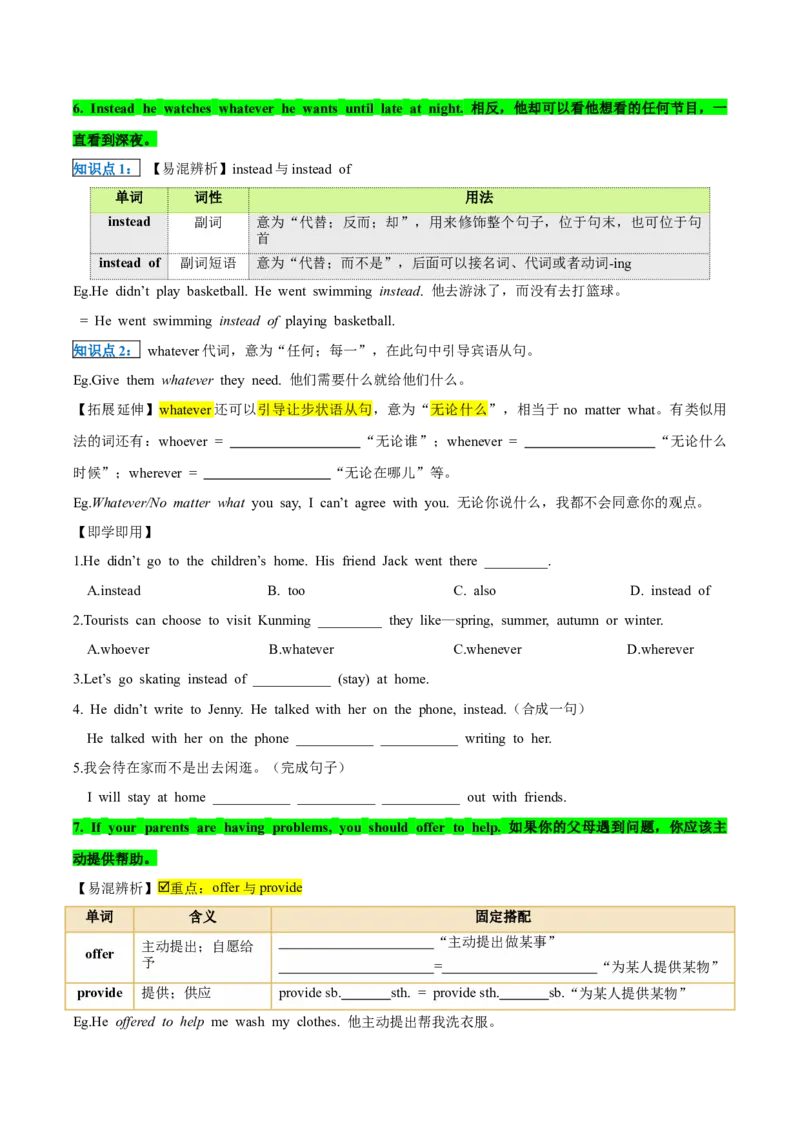
知识点1: 【易混辨析】instead与instead of
单词 词性 用法
instead 副词 意为“代替;反而;却”,用来修饰整个句子,位于句末,也可位于句
首
instead of 副词短语 意为“代替;而不是”,后面可以接名词、代词或者动词-ing
Eg.He didn’t play basketball. He went swimming instead. 他去游泳了,而没有去打篮球。
= He went swimming instead of playing basketball.
知识点2: whatever代词,意为“任何;每一”,在此句中引导宾语从句。
Eg.Give them whatever they need. 他们需要什么就给他们什么。
【拓展延伸】whatever还可以引导让步状语从句,意为“无论什么”,相当于no matter what。有类似用
法的词还有:whoever = “无论谁”;whenever = “无论什么
时候”;wherever = “无论在哪儿”等。
Eg.Whatever/No matter what you say, I can’t agree with you. 无论你说什么,我都不会同意你的观点。
【即学即用】
1.He didn’t go to the children’s home. His friend Jack went there _________.
A.instead B. too C. also D. instead of
2.Tourists can choose to visit Kunming _________ they like—spring, summer, autumn or winter.
A.whoever B.whatever C.whenever D.wherever
3.Let’s go skating instead of ___________ (stay) at home.
4. He didn’t write to Jenny. He talked with her on the phone, instead.(合成一句)
He talked with her on the phone ___________ ___________ writing to her.
5.我会待在家而不是出去闲逛。(完成句子)
I will stay at home ___________ ___________ ___________ out with friends.
7. If your parents are having problems, you should offer to help. 如果你的父母遇到问题,你应该主
动提供帮助。
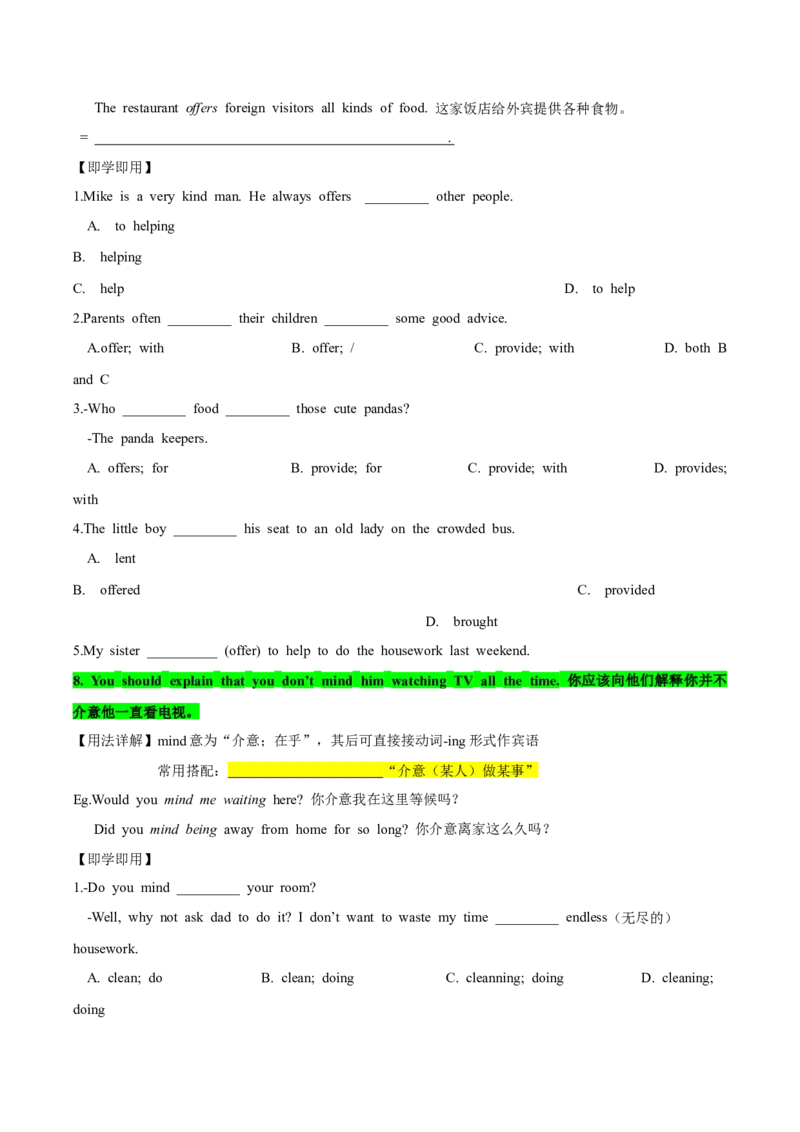
【易混辨析】重点:offer与provide
单词 含义 固定搭配
“主动提出做某事”
主动提出;自愿给
offer
予 = “为某人提供某物”
provide 提供;供应 provide sb. sth. = provide sth. sb.“为某人提供某物”
Eg.He offered to help me wash my clothes. 他主动提出帮我洗衣服。The restaurant offers foreign visitors all kinds of food. 这家饭店给外宾提供各种食物。
= .
【即学即用】
1.Mike is a very kind man. He always offers _________ other people.
A. to helping
B. helping
C. help D. to help
2.Parents often _________ their children _________ some good advice.
A.offer; with B. offer; / C. provide; with D. both B
and C
3.-Who _________ food _________ those cute pandas?
-The panda keepers.
A. offers; for B. provide; for C. provide; with D. provides;
with
4.The little boy _________ his seat to an old lady on the crowded bus.
A. lent
B. offered C. provided
D. brought
5.My sister __________ (offer) to help to do the housework last weekend.
8. You should explain that you don’t mind him watching TV all the time. 你应该向他们解释你并不
介意他一直看电视。
【用法详解】mind意为“介意;在乎”,其后可直接接动词-ing形式作宾语
常用搭配: “介意(某人)做某事”
Eg.Would you mind me waiting here? 你介意我在这里等候吗?
Did you mind being away from home for so long? 你介意离家这么久吗?
【即学即用】
1.-Do you mind _________ your room?
-Well, why not ask dad to do it? I don’t want to waste my time _________ endless(无尽的)
housework.
A. clean; do B. clean; doing C. cleanning; doing D. cleaning;
doing2.Do you mind __________ (open) the windows so that the fresh air can get in?
9. You left your homework at home. 你把作业落在家里了。
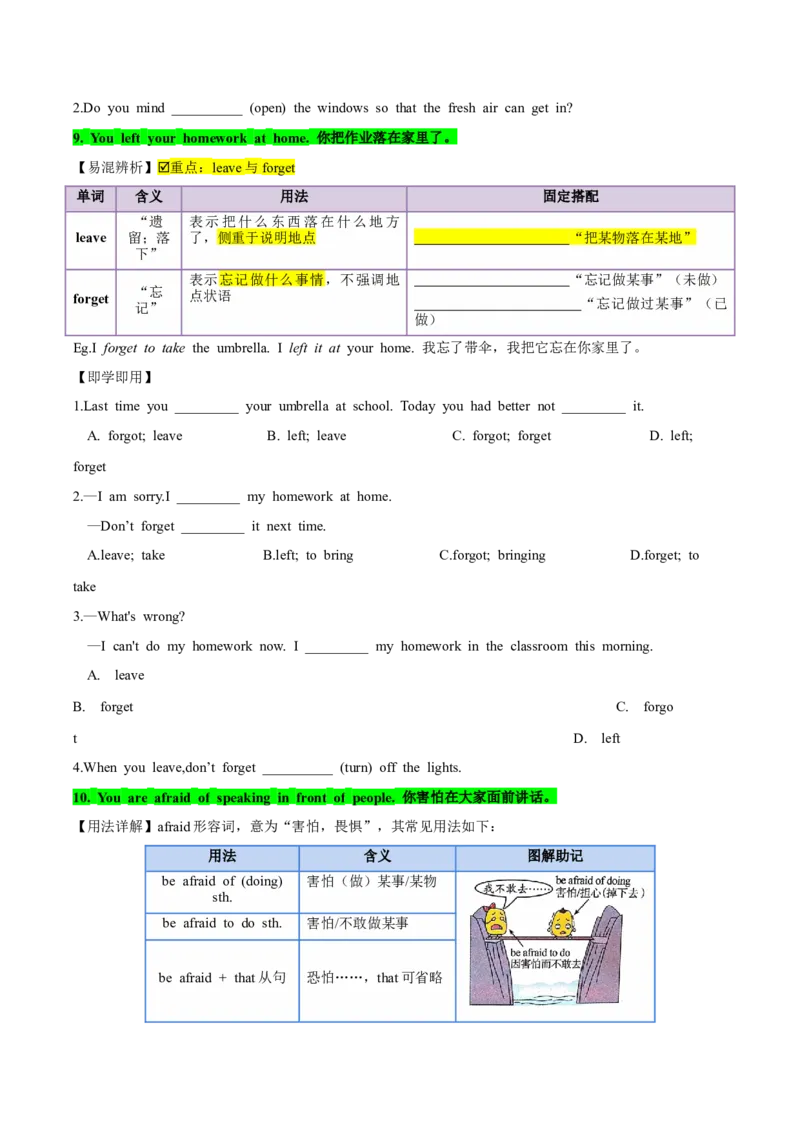
【易混辨析】重点:leave与forget
单词 含义 用法 固定搭配
“遗 表示把什么东西落在什么地方
leave 留;落 了,侧重于说明地点 “把某物落在某地”
下”
表示忘记做什么事情,不强调地 “忘记做某事”(未做)
forget “忘 点状语
记” “忘记做过某事”(已
做)
Eg.I forget to take the umbrella. I left it at your home. 我忘了带伞,我把它忘在你家里了。
【即学即用】
1.Last time you _________ your umbrella at school. Today you had better not _________ it.
A. forgot; leave B. left; leave C. forgot; forget D. left;
forget
2.—I am sorry.I _________ my homework at home.
—Don’t forget _________ it next time.
A.leave; take B.left; to bring C.forgot; bringing D.forget; to
take
3.—What's wrong?
—I can't do my homework now. I _________ my homework in the classroom this morning.
A. leave
B. forget C. forgo
t D. left
4.When you leave,don’t forget __________ (turn) off the lights.
10. You are afraid of speaking in front of people. 你害怕在大家面前讲话。
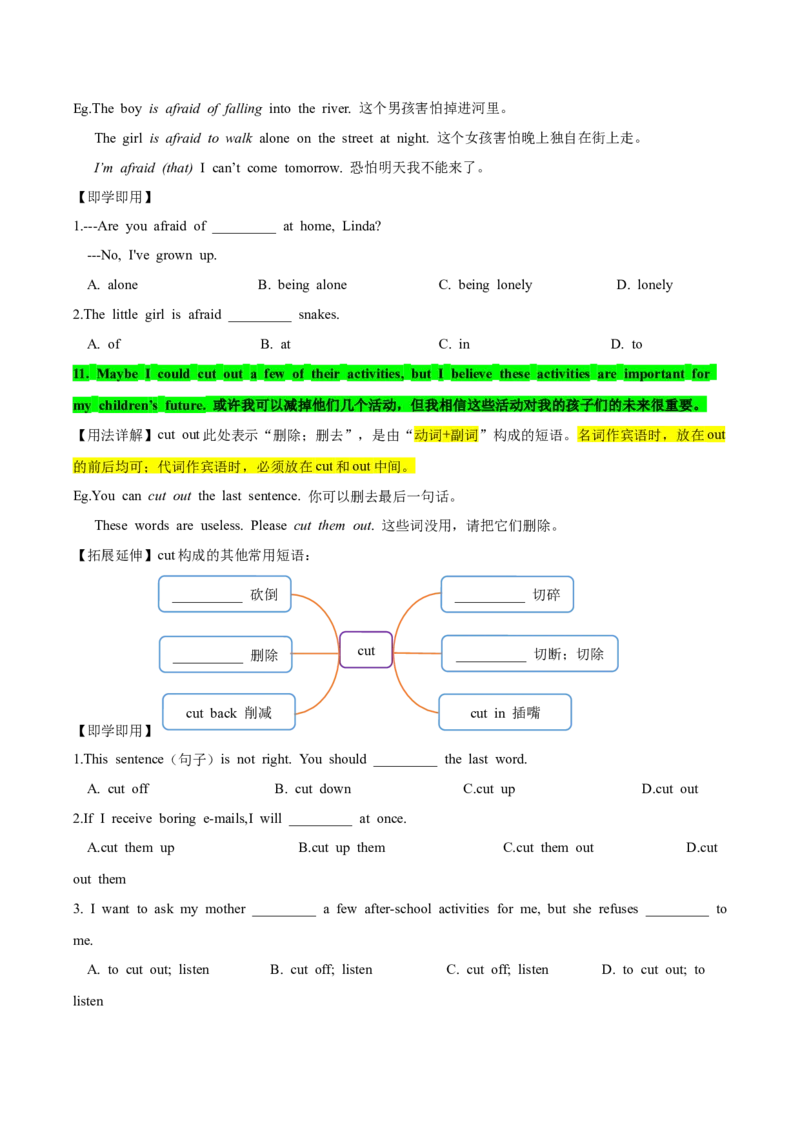
【用法详解】afraid形容词,意为“害怕,畏惧”,其常见用法如下:
用法 含义 图解助记
be afraid of (doing) 害怕(做)某事/某物
sth.
be afraid to do sth. 害怕/不敢做某事
be afraid + that从句 恐怕……,that可省略Eg.The boy is afraid of falling into the river. 这个男孩害怕掉进河里。
The girl is afraid to walk alone on the street at night. 这个女孩害怕晚上独自在街上走。
I’m afraid (that) I can’t come tomorrow. 恐怕明天我不能来了。
【即学即用】
1.---Are you afraid of _________ at home, Linda?
---No, I've grown up.
A. alone B. being alone C. being lonely D. lonely
2.The little girl is afraid _________ snakes.
A. of B. at C. in D. to
11. Maybe I could cut out a few of their activities, but I believe these activities are important for
my children’s future. 或许我可以减掉他们几个活动,但我相信这些活动对我的孩子们的未来很重要。
【用法详解】cut out此处表示“删除;删去”,是由“动词+副词”构成的短语。名词作宾语时,放在out
的前后均可;代词作宾语时,必须放在cut和out中间。
Eg.You can cut out the last sentence. 你可以删去最后一句话。
These words are useless. Please cut them out. 这些词没用,请把它们删除。
【拓展延伸】cut构成的其他常用短语:
__________ 砍倒 __________ 切碎
__________ 删除 cut __________ 切断;切除
cut back 削减 cut in 插嘴
【即学即用】
1.This sentence(句子)is not right. You should _________ the last word.
A. cut off B. cut down C.cut up D.cut out
2.If I receive boring e-mails,I will _________ at once.
A.cut them up B.cut up them C.cut them out D.cut
out them
3. I want to ask my mother _________ a few after-school activities for me, but she refuses _________ to
me.
A. to cut out; listen B. cut off; listen C. cut off; listen D. to cut out; to
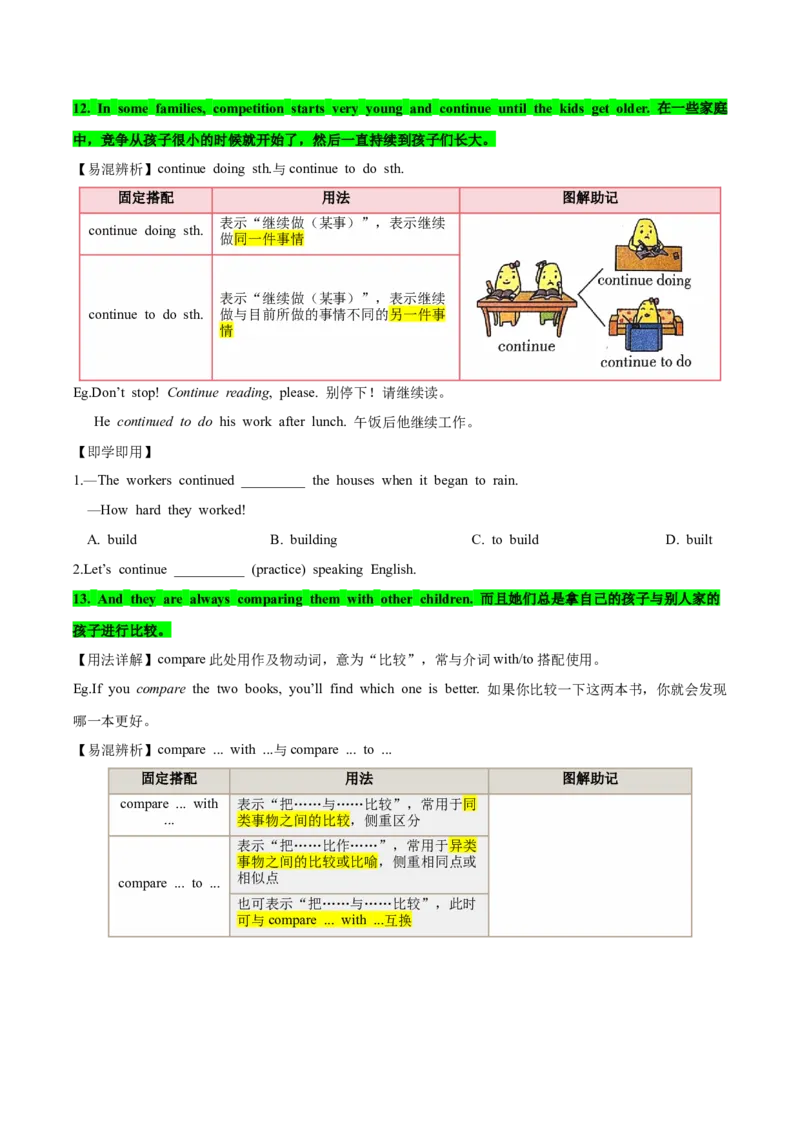
listen12. In some families, competition starts very young and continue until the kids get older. 在一些家庭
中,竞争从孩子很小的时候就开始了,然后一直持续到孩子们长大。
【易混辨析】continue doing sth.与continue to do sth.
固定搭配 用法 图解助记
表示“继续做(某事)”,表示继续
continue doing sth.
做同一件事情
表示“继续做(某事)”,表示继续
continue to do sth. 做与目前所做的事情不同的另一件事
情
Eg.Don’t stop! Continue reading, please. 别停下!请继续读。
He continued to do his work after lunch. 午饭后他继续工作。
【即学即用】
1.—The workers continued _________ the houses when it began to rain.
—How hard they worked!
A. build B. building C. to build D. built
2.Let’s continue __________ (practice) speaking English.
13. And they are always comparing them with other children. 而且她们总是拿自己的孩子与别人家的
孩子进行比较。
【用法详解】compare此处用作及物动词,意为“比较”,常与介词with/to搭配使用。
Eg.If you compare the two books, you’ll find which one is better. 如果你比较一下这两本书,你就会发现
哪一本更好。
【易混辨析】compare ... with ...与compare ... to ...
固定搭配 用法 图解助记
compare ... with 表示“把……与……比较”,常用于同
... 类事物之间的比较,侧重区分
表示“把……比作……”,常用于异类
事物之间的比较或比喻,侧重相同点或
相似点
compare ... to ...
也可表示“把……与……比较”,此时
可与compare ... with ...互换【即学即用】
1.你的新房子和旧房子比起来怎么样?
How does your new house __________ __________ your old house?
2.中国古代的皇帝把他们自己比作龙。
The emperors of ancient China __________ __________ __________ dragons.
3.—If you always compare yourself _________ others, you may have tons of pressure.
—I agree. We should believe in ourselves.
A.of B.with C.for D.in
4.When we study foreign languages , it’s necessary _________ them _________ Chinese in English study.
A. compare; to B. to compare; with C. comparing; to D. to compare;
into
课堂小测
一、单项选择
1.We don’t allow people _______ in our office, but they allow ______ in the smoking rooms.
A. to smoke; to smoke B. smoking; smoking C. to smoke; smoking D.smoking; to
smoke
2.I found the girl _______ for the way to her home when I saw her. I think she isn’t _______ to
remember the way.
A. look; old enough B. look; enough old C. looking; old enough D. looking; enough
old3.Our parents always compare us _______ other children and this _______ us so hard.
A. to; pushes B. with; put C. to; puts D. with; pushes
4.As soon as Mr.Green went into his office, he began to _______ the telephone book on his desk.
A.look up B.look into C.look like D.look through
5.(江苏无锡中考)_______ I do,I do it for you. Do not ever doubt that,my boy.
A.Whatever B.Wherever C.Whenever D.Whoever
6.(江苏扬州中考改编)—Honey,come and help me _______ the picture of balloons from the
magazine.
—OK,Granny.I’m coming.
A.cut off B.cut down C.cut out D.cut up
7.—Do you mind _______ your room?
—No, I’ll do that after finishing _______ this article.
A. clean; write B. clean; writing C. cleaning; write D. cleaning;
writing
8.—I’m going to take a vacation. Could you give me some advice?
—Sure. I can _______ you _______ some information about interesting places to travel.
A. offer; to B. offer; for C. provide; with D. provide; for
9.He has two sons. They are Jim and Tom. Jim is Tom’s _______ brother.
A. old B. older C. elder D. young
10. ---What's wrong _______ your sister? She looks very sad.
---Oh. She argued _______ her mother.
A. with; about B. with; with C. for; about D. for; with
11.Our English teacher,Miss Gao,was ill.So Mr.Li gave us a lesson _______.
A.instead of B.so that C.instead D.rather than
12.Why don’t you _______ an English club to practice _______ English?
A.join; speak B.join; speaking C.to join; speaking D.to join; speak
13.She was ________ that her little baby could do something ________ to make her laugh.
A.surprising; surprising B.surprised; surprised
C.surprised; surprising D.surprising; surprised
14.Don’t ________ to turn off the TV before you go to bed.
A.remember B.want C.forget D.leave15.—My cousin always takes my things without asking.
—________, I think. You shouldn't care too much about that.
A.It's right B.It's not a big deal
C.It's dangerous D.It's not a good idea
二、用所给词的适当形式填空
1. The ___________ (communicate) between them is very successful.
2. The old man can’t see everything ___________ (clear) because he is blind.
3. Would you mind ___________ (close) the door? It’s a little cold.
4. Mike always refuses ___________ (help) others. So no one will help him.
5. Many after-school activities are good for a child’s ___________ (develop).
6. Although he fell ill, he still continued ___________ (write) articles.
7. Firstly, you shouldn’t be angry.___________ (two), you could have a talk with her.
8. Little Lucy was so kind.She offered ___________ (give) out the candies to the children.
9. The TV says that it will be ___________ (cloud) the day after tomorrow.
10. When I came in, I found him ___________ (write) something on his seat.
11.Mr. Jackson goes to work at 7:00 a. m. and ___________ (return) at 5:00 p.m. every day.
12.Reading is one of the most important ___________ (skill) in learning a language.
13.I ___________ (usual) just have a sandwich for lunch.
14.Do you allow me ___________ (compare) with my brother?
15.My parents give me a lot of ___________ ( press ) about school.
三、完形填空
Whenever the exam season comes, stress may come along. Here are some 1 that have helped me and my
friends through this season.
When the stress of exams is really hitting me, I stop and take a walk. I usually borrow my neighbor’s dog and
2 for about fifteen minutes. Many boys would simply choose to run for a while, or play ball games. Having
some 3 drives away your stress easily most of the time.
And 4 you find music helpful, just have a try. Listening to your favorite songs will surely make you 5 .
The best thing about this is that you don’t have to go 6 .
But if you are a book lover just like me, 7 a book you like for half an hour. Reading can take you to places
you 8 get to. Putting yourself into a new world helps you forget your stress in this world for a little bit.
For sure, there’s nothing better than laughing. Laughing is the best medicine. It can really keep 9 off yourmind! I often call my best friend and we 10 our good time or something funny, and I’m feeling better before I
know it.
Remember many others also face the problem of stress just like you, and it is not something that cannot be
dealt with.
( )1. A. ways B. reasons C. habits D. results
( )2. A. walk B. jump C.stand D. sit
( )3. A. jokes B. sports C. tasks D. lessons
( )4. A. before B. until C. since D. if
( )5. A. lovely B. friendly C. happy D. sleepy
( )6. A. somewhere B. everywhere C. anywhere D. nowhere
( )7. A. copy B. write C. print(打印) D. read
( )8. A. ever B. never C. sometimes D. always
( )9. A. worry B. action C. surprise D. peace
( )10. A. think about B. talk about C. care about D. hear about
四、阅读还原七选五
It is necessary to learn how to communicate with people from other cultures to build good
relationships with them. ___1____
Learn about the culture first.___2___ Before meeting with someone from another culture, try to take
time to learn the basic “dos and don’ts”of that culture.
___3___Each culture has its own values, beliefs and prejudices(偏见).You shouldn't judge people
based on these differences. Instead,respect them for what they are. You may even learn something new.
Speak clearly and slowly. Don't shout at others. Raising your voice doesn’t make you easier to
understand.___4___. Communication difficulties lie in cultural differences, not because of intelligence.
Understand rules about touching.Some cultures may expect more physical contact(接触)between
people. For example, some cultures may shake or touch hands more readily than others. ____5____
A. Here are some rules.
B. So don't take it as impolite.
C.Show respect for the culture.
D. A little knowledge can be helpful
E. Do not treat other people as if they are silly.
F.Do you think you can communicate with no words?
G.People can communicate in many ways without words.五、将下列句子中汉语部分译成英语,注意使用适当形式。
1.As students, we should _________________ our parents and teachers.(与......交流)
2._________________, it’s a good way to improve your English.(依我看)
3.Cathy thinks her lovely dog is one of her_________________.(家庭成员)
4.You can _________________ what you dislike in the article.(删除)
5.They _________________ the problem successfully.(解决)
六、按要求完成句子,每空一词。
1.There is something wrong with my computer. (划线提问)
___________ ___________ with your computer?
2.Why don't you talk to your parents? (改为同义句)
___________ ___________ talk to your parents?
3.We don’t go shopping. We watch TV at home instead. (合并为一句)
We watch TV at home ___________ ___________ ___________ shopping.
4.These fans arrived early. They could see their favorite stars. (合并一句)
These fans arrived early ___________ ___________ ___________ see their favorite stars.
5.She does well in singing and dancing. (改为同义句)
She is ___________ ___________ singing and dancing.
语法精讲
一、提建议的句型
一、常用提建议的句型
句型结构 含义 示例
Why don’t you + ? 你 ( 们 ) 为 什 么 Why don’t we write to pen friend?
不……呢?
= Why not sth.? Why not join an English club?
How/What about + ? ……怎么样? What/How about watching English movies?
Let’s + . 让我们……吧. Let’s go swimming this afternoon.
We/You should/could + . 我 们 / 你 ( 们 ) 应 We should get up earlier.该/可以……
Would you mind + ? 你介意……吗? Would you mind speaking in a low voice?
Would/Could you please + ? 请你……好吗? Would you please turn down the radio?
had better(not)do sth. 最好(不要)做某事 We’d better speak English as much as
possible.
Would you like + to do sth.? 你(们)想要……吗? Would you like to go out for a walk?
二、提建议句型的常用答语
肯定回答 否定回答
Good idea./That’s a good idea.好主意。 I’d love/like to, but...我愿意,但是……
OK./All right./Great.好/行/太好了。 Sorry, I can’t./Sorry, but...
No problem.没问题。 对不起,我不能/对不起,可是……
I agree with you.我同意你的看法。 I don’t think so.我不这样认为。
Sure./Of course./Certainly./I’d love to./I’d like I’m afraid not.恐怕不行。
you.当然可以/我愿意。
【即学即用】
1.—You _______ write him a letter to say you are sorry for it.
—I’m not good at writing letters. I want to talk about it _______ the phone.
A. could; on B. should; in C. can; over D. must; by
2.—My English is poor.Could you help me with it?
—_______.
A.Thank you B.Me,too C.No problem D.See you
3.—Why don’t you stop to have a rest?
—_______.
A.That’s a good idea B.That’s all right C.Yes,I do D.That’s for
sure
4.It’s getting dark. You’d better _______ out by yourself. It’s dangerous.
A.not go B.not to go C.to go D.go
5.Why don’t you _______ earlier to catch the early bus?
A.getting up B.get up C.gets up D.got up
二、until、although与so that引导的状语从句一、语法概述
在复合句中,用作状语的从句叫作状语从句。状语从句由从属连词引导,从属连词不充当句子成分,
只起连接作用。根据状语从句表达的意思可分为时间、原因、条件、目的、结果和让步等类型。本单元主
要学习until、although与so that引导的状语从句。
二、until引导的时间状语从句
肯定句中 表示“ ” 主句谓语动词用延续性动词
主句谓语动词用非延续性动词
否定句中 表示“ ”
Eg.I have to stay here until the rain stops. 我不得不待在这儿,直到雨停。
Cathy didn’t go home until the rain stopped. 直到雨停了,凯茜才回家。
三、although引导的让步状语从句
although引导的让步状语从句一般翻译为“ ”,一般情况下,although与though可以互换,
但两者都不能与 同时出现在一个句子中,但可以和yet/still同时出现。
Eg.Although she’s very weak, she works very hard. 她尽管身体很弱,但是工作很努力。
四、so that引导的目的状语从句
so that表示“ ”,从句中的谓语动词常与情态动词can/could/may/might等连用。
Eg.He should talk to his friend so that he can say he’s sorry. 他应该跟他的朋友谈谈,以便能向其道歉。
【拓展延伸】so that +从句 = in order that +从句= in order to + do
语法小测
一、单项选择
1.They went to the playground and practiced running _______ they could win the race.
A. until B. so that C. as
soon as D. unless
2.—Would you like something to eat?
— _______. I'm hungry.
A. Yes, I can B. Yes, please C. No,
thanks D. No, I don't like it
3.—Jim, you shouldn't argue with your friend. You are really best friends.
—_______ Thanks for your advice.
A. Really? B. You're right.C. Why? D. Sounds great.
4.Some people won’t realize the importance of their friendship _______ they lose it.
A.after B.when C.until D.as
5.You should study hard _______ you can make progress in study.
A.in order to B.as soon as C.so that D.such as
6. He didn’t walk slowly _______ he was sure nobody was following him.
A.and B.since C.until D.but
7.This little boy can speak English _______ he is only eight years old.
A.if B.so C.because D.although
8.—I feel stressed from time to time. Could you give me some advice?
—_______ sharing your worries with your parents?
A. Why don't you B. How about C. Why not D. Would you
like
9.—It's nearly lunchtime. How about having some noodles and dumplings?
—_______.
A.You're welcome B.That's all right C. That's nice of you D.That sounds good
10.You could climb the mountains _______ you can keep healthy.
A. until B. so that C. as soon as D. in order to
11.—Jim, let's go out to play basketball.
—Oh, I won't do that _______ I finish my homework.
A. if B. until C. because D.
although
12.—Why not hold a Chinese Poetry Competition to welcome our school's 70th birthday?
—_______ Let's make a plan together in our group.
A. That's all right. B. Yes, please. C. Good idea. D. Never
mind.
13.—Mom,shall we have supper now?
—Oh,we won’t have supper _______ your dad comes back.
A.until B.when C.after D.although
14.—Why not _______ John a toy car for his birthday?
—Good idea! He is crazy about cars.A.buy B. buying C.to buy D. buys
15.(山东滨州中考)—I think I am the shyest in my class.What should I do?
—Be more active in class _______ you can improve your ability to express yourself.
A.so that B.unless C.or D.although
二、语法填空
Working on a team is important. However,if people on your team are not good at 1.
(communicate), you may often feel terrible. To create a successful team, good communication is the most necessary
part for both the leader(领导) and team members. The following are some 2. (help) suggestions.
Listen to other people actively.
When someone is speaking to you, you should listen to him/her actively. 3. you're not sure about
something, you should ask him/her about it. In this way, you can get your answer 4. any question
before moving on.
Think about other people's ideas carefully.
When someone tells you about his/her ideas, you should think about them carefully. This shows you are
5. (interest) in his/her ideas and makes him/her feel good.
Share your ideas with other people.
When you have a new idea, talk about 6. with your team members. This helps to get better ideas.
Besides this, it also helps to improve the relations 7. you and your team members.
8. (not) criticize(批评) other people.
When someone on your team does something wrong, don't criticize him/her. You can help him/her to find out
9. (reason) and then help him/her to deal with the problem. Criticizing your team members too often
makes them 10. (keep) away from you. As a result, you may feel lonely.
三、书面表达
亲爱的同学,你生活中有烦恼,学习有压力吗? 那我们应该如何正确面对烦恼,有效缓解心理压力
呢? 请根据提示以“How to Solve Our Stress”为题写一篇短文。
提示:1. 积极参加体育锻炼,有一个健康的身体。
2. 多与老师、家长和朋友交谈,说出自己的烦恼。
3. 多听音乐,多看书。
4. 尽自己最大努力学习,勇敢面对自己的成绩。
5. 如果经常感觉压力太大,可以去看医生。
要求:80词左右,开头已给出,不计入总词数;语言表述准确规范,语句通顺连贯;提示内容必须用完。How to Solve Our Stress
We all have some problems and stress in our lives. How should we solve them?
____________________________________________________________________________________________
____________________________________________________________________________________________
____________________________________________________________________________________________
____________________________________________________________________________________________
____________________________________________________________________________________________
____________________________________________________________________________________________
____________________________________________________________________________________________
____________________________________________________________________________________________
____________________________________________________________________________________________