八年级下册英语单元作业
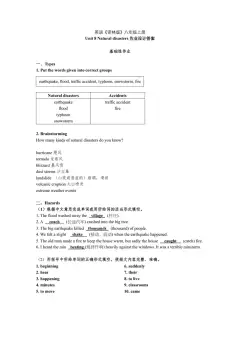
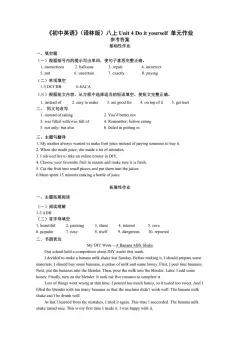
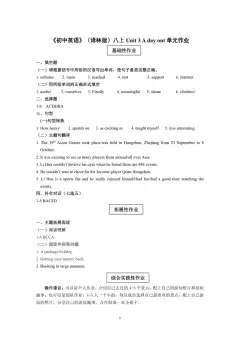
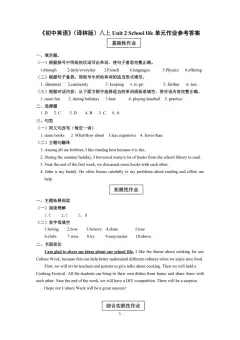
Unit 5 Good manners
【基础性作业】
一、单项选择。
从A、B、C、D四个选项中选出可以填入空白处的最佳选项。
( )1. —Be quiet!The littlebaby is dreaming pleasant dreams.
—Sorry.I will remember tospeak in lower voice.
A. a B. the C. an D. /
( )2. My father is a man who can’t clearly his feelings, but I can feel
lovefrom his eyes.
A. excuse B. explain C. express D. exercise
( )3.Athletes in theAsian Games Village can touch the facilities (设施)
easily,soit’s quiteconvenient.
A. strange B. public C. sudden D. peaceful
( )4. During the eight-day holiday, nearly 100 activities in Beijing,
Shanghai, Nanjing andother majorcities in China.
A. tookplace B. tookover C. tookon D. took off
( )5. When we have trouble in playing the piano well, the most important thing is
tokeep onpractising because .
A. many hands makelight work B. theearly bird catches theworm
C.practice makes perfect D. itnever rains but itpours
( )6. It’s so rude that he keeps on our conversation. We have no choice
butto keep away from him.
A. takingin B. gettinginto C. cuttingin D. bumpinginto
( )7. If you are ,Chinesewon’t touch you orpushpast you.
A. intheirway B. inthis way C. ontheway D. bytheway
( )8. Use your brain, and you will be thetruth.
A. different fromB. similarto C. away from D. closeto
( )9. —Mum,what does thesign mean over there?
—Oh, honey.It says “Don’t !”
A. pick flowers B. drop litterC.leavethe tap running D. make noise
( )10. —Doctor,thank you for giving meanewlife!
— .
A. Certainly not. B. Mypleasure.
C.With pleasure. D. I’m afraid not.
二、从方框中选择适当的单词或短语,填入正确形式,每个单词或短语用一次。
discuss, purpose, express, obey, polite, byaccident
start aconversation, explain, shake hands, excuseme
1. ,would you please tellme thewayto theOriental PearlTower?
2.Thefinal plan isstillunder .Please wait with patience.
3.Thehard-working athletethinks the ofthetraining is to help them win.
4.Theteacher spent hours theproblem to hisstudents during thebreak.
5.If you fail to the trafficrules, you will bein danger.
6.Last night,the farmer thehopethat there would be aharvest nextyear.
7. is hard for us when we meet somepeople for thefirst time.
8.Hejust madethis mistake ,so weshould give him another chance.
9. In last month’s graduation ceremony, the headmaster with each student to
encourage them.
10.Whenever it is,it would be to say bad words about others.
三、句型转换。
1.This young boyisnot tall enough to reach thebasket. (同义句)
This young boyis reach thebasket.
2.If you don’t obey trafficrules, somethingdangerous willhappen to you. (同义句)
, somethingdangerous will happen to you.
3.Japanesehave good manners. Chinese also have good manners. (同义句)
Japanesehave good manners. Chinese have good manners .
4. Thepublicsign over there says “Nophotos!”.(对划线部分提问)
thepublicsign overthere say?5. It’srude topush in before others wherever you are. (同义句)
before others isrude wherever you are.
6. Different kindsof publicsigns keep passengers from danger.(对划线部分提问)
passengers from danger?
7. Hedrove soslowly that hecouldn’t catch the movieUnder theLight.(同义句)
Hedrove catch themovieUnder the Light.
8. Chinesegreet theirfriends witha warm embrace. (改为一般疑问句)
Chinese theirfriends with awarm embrace?
9. LinYuwei, the winner of the Women’s 100m Hurdles Final, made her dream come
trueafter years ofhard work. (同义句)
LinYuwei,thewinner of theWomen’s 100m Hurdles Final,
after years ofhard work.
10. When you are brushing your teeth, please don’tlet the tap run. (同义句)
When you brush your teeth, please don’t thetap .
四、根据汉语意思完成句子,每空一词。
1. 活到老,学到老。我爷爷说他要学习用智能手机。
Oneis never old .My grandpa says hewill learn to use
smart phone.
2. 警告孩子们不要在这里摘花,这对环境是不友好的。
Warn kids here. It’s impoliteto treat the
environment likethat.
3. 英国人只和亲戚或亲密的朋友用亲吻的方式问候。
British people only or witha kiss.
4.为了迎接游客,清洁工尽最大的努力保持街道干净。
Cleaners tried theirbest to thestreets to welcome the tourists.
5.正如谚语所说:患难见真情。
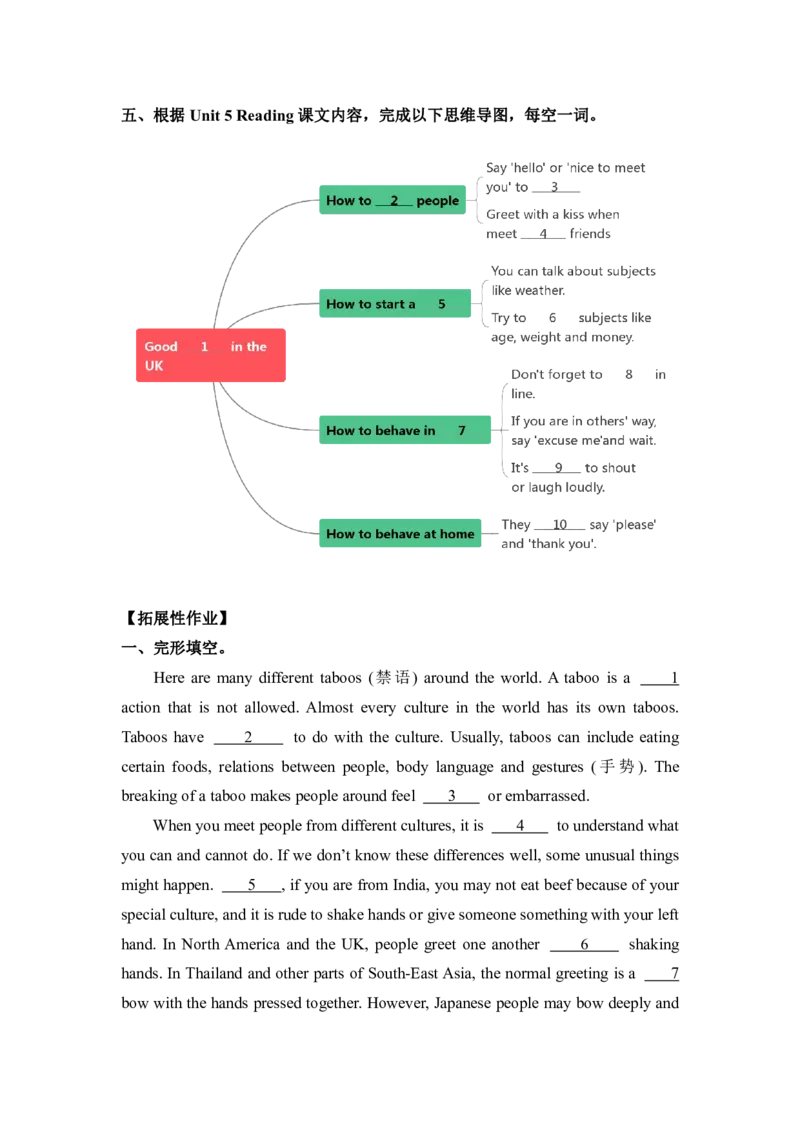
Justas thesaying goes, “afriend is afriend .”五、根据 Unit5Reading 课文内容,完成以下思维导图,每空一词。
【拓展性作业】
一、完形填空。
Here are many different taboos (禁语) around the world. A taboo is a 1
action that is not allowed. Almost every culture in the world has its own taboos.
Taboos have 2 to do with the culture. Usually, taboos can include eating
certain foods, relations between people, body language and gestures (手势). The
breaking ofataboo makes people around feel 3 orembarrassed.
When you meet people from different cultures, itis 4 tounderstand what
you can and cannot do. If we don’t know these differences well, some unusual things
might happen. 5 , if you are from India, you may not eat beef because of your
special culture, and itis rude toshake hands or give someone somethingwith your left
hand. In North America and the UK, people greet one another 6 shaking
hands. In Thailand and other parts of South-EastAsia, the normal greeting is a 7
bow with the hands pressed together. However, Japanese people may bow deeply andeven 8 their business cards togreet others.They dislikeit when peopledo not
look at the cards, 9 remember not to just put the cards in your pocket without
lookingat them.
While these different forms of greetings and customs might seem 10 to
you, remember that what you consider normal probably seems just as unusual to
others.As asaying goes, “Tabooor nottaboo—that isthequestion!”
( )1.A.new B. friendly C. social D. quick
( )2.A.something B. nothing C. anything D. everything
( )3.A.happy B. amazed C. sad D. bored
( )4.A.necessary B. exciting C. common D. hard
( )5.A.For example B.As a result
C.That is tosay D. In a word
( )6.A.from B. by C. into D. after
( )7.A.deep B. slight C. large D. wide
( )8.A.give in B. give away C. give out D. give up
( )9.A.and B. because C. but D. so
( )10.A.important B. kind C. unfair D. strange
二、阅读理解。
(A)
Living in a culture that is different from your own can be both an exciting and
challenging experience. You have to learn different cultural practices. Our bloggers
share the top five cultural differences between China and the US to improve our
different understanding.
Privacy
Chinese people do not have the same idea of privacy asAmericans do.They talk
about topics such as ages, income or jobs in public, which makeAmericans feel angry,
becauseAmericans don’t want others to knowtheirpersonal information.
Family
In China, elders are traditionally treated with a lot of respect while the young are
taken good care of. In America, independence (独立) is encouraged. So unlike theChinese, olderAmericans seldom livewith theirchildren.
Friends
Chinese people have different opinions of friends. Friendship means lifelong
friends who are sure to help each other. There are work friends, playing friends,
school friends anddrinking friends.
Money
As is known, the Chinese like to save. They are always planning to spend money
wisely. It is different in the USA, where fewer families are saving money for
somethingthat might happensuddenly.
Education
Chinese people value education and career more than Americans, who in turn
pay more attention togood charactersand what theybelieve.
Maybe, there are some other cultural differences between China and the US. The
most important thing I think is that we should have the right understanding to accept
these cultural differences. We should open our eyes to see the world and make more
and more peopleknowtheChinese culture.
( )1.Thepassage is mainlyabout .
A. thewayAmerican peoplelive
B. theway Chinesepeople live
C. someexperiences indifferent countries
D. cultural differences between Chinaand theUS
( )2.What does theunderlineword “privacy”mean inChinese?
A. Dream. B. Secret. C. Money. D. Family.
( )3.Which of thefollowingsentences isright according to thepassage?
A.American people usually livewith their children.
B. ChineseandAmerican peoplevalue education andcareer.
C. ChineseandAmerican peoplehave thesame opinionof friendship.
D. Chinesepeople likesaving money forsome emergencies and education.
( )4.Where wecan find the passage?
A.Anadvertisement. B.Astory book.
C.Afood guide. D.An onlinewebsite.(B)
Without making sounds, we can use body language to communicate. Body
language includes eye contact, gestures, and facial expressions and so on.All of them
can send messages.As William Shakespeare (莎士比亚) said in Troilus and Cressida,
“There’s language in her eye, her cheek (脸颊), her lip.” However, there are cultural
differences in how people use body language to communicate. Today, we just take
“hand gestures” and “eye contact”as examples.
Handgestures
Hand gestures can mean very different things in different cultures.
The “OK” sign in Greece, Spain or Brazil may make people feel very angry. In
Turkey,italso has unpleasant meaning.
Athumb (大拇指) up inAmerica and European cultures is a way to say a job is
well done, however inGreece ortheMiddleEast, it isused toshowanger.
Curlingthe index finger (弯曲食指) with thepalm (手掌)facing up isa common
gesture that people in United States and parts of Europe use to ask someone to come
closer. However, it is considered rude in China, East Asia, Malaysia, Singapore and
many otherparts oftheworld. It isused only toask dogs inmanyAsian countries.
Eyecontact
In most western countries, eye contact is a sign of confidence and a way of
attracting attention. We usually believe that if someone looks away while we are
talkingto them, they’renot interested and looking for someoneelseto talk to.
In many Middle Eastern countries, eye contact for a long time between males
and females is considered not proper.
In many Asian, African, and Latin American countries, however, this unbroken
eye contact would be considered not friendly. In these cultures, avoiding eye contact
is asign of respect for bosses and elders.
( )5.Why is Shakespeare’s word used in Paragraph 1?
A.Toexpress thelovefor bodylanguage.
B.Tolistthecauses ofusing bodylanguage.
C.Toexplain theimportance ofbodylanguage.
D.Tocompare different types ofbodylanguage.( )6.What does athumb upmean in theUSA?
A.Ajob is well done. B. Ifeel angry.
C. I’m interested init. D. Irespect you.
( )7.Which country uses theindexfinger with thepalm facing upto askpeople
tocome?
A. China. B. Japan. C.America. D. Singapore.
( )8.What advice willbe helpful ifyou are in theMiddleEast?
A. UseOKsign to showyour anger.
B. If you feel happy,you can thumbup.
C.Avoid makinglong eye contact between sexes.
D.Askpeople to comebycurling theindex finger.
三、阅读表达。
请认真阅读短文,回答以下五个问题,每题答案不超过10个单词。
This report is about how to be polite. It tells us how we can make our language
more polite and how we can make sure we do not make someone feel uncomfortable
from another culture. Learning about the differences is important because it can help
us to broaden the understanding of cultural differences. The information can be found
ontheInternet.
It has been found that words such as “would” and “could” can be used to help us
to be polite. For example, it is much better to say “Would you do this?” rather than
“Do this!” It is also suggested that it is useful to say “please” and “thank you”. People
from the West would like to use these words in case where some people in Asia may
not think it necessary. Saying “sorry” if we want to stop our conversation also helps
us to be polite. For example, when wedisagree, itis much better to say “I’m sorry,but
I think you may be mistaken” rather than “You’re wrong”. We also ought to show
proper respect forpeople olderthan us. Ofcourse, this istrue in mostcountries.
In conclusion, we need to know the customs of a country so that we do not make
others uncomfortable or angry. It seems that if people learn something about other
cultures before they visit a new country, they will be less likely to upset others or be
misunderstood. Nowadays, social customs and ways of behaving changed. Theimportant thing to remember about social customs is not to do anything that makes
other people feel uncomfortable—especially if they are your guests. It has been bad
manners tomake your guests feel foolish oruncomfortable.
1.Whydowe need tolearn about the different cultures?
_______________________________________________________________
2.According to thepassage, when wedisagree withsomebody,what can we say?
_______________________________________________________________
3.What istheattitudetowards theolderpeople in mostcountries?
_______________________________________________________________
4.What isthepurpose ofknowing thecustoms of acountry?
_______________________________________________________________
5.What’s themain idea about this report?
_______________________________________________________________
四、任务型阅读,每空一词。
Food Culturein Malaysia
How much do you know about food culture in Malaysia? When traveling to
Malaysia, besides visiting some famous attractions, you will also eat Malaysian
cuisine. Malaysia’s diverse society (多元社会) is also fully expressed in different
kinds of food. Malaysia is mainly made up of Malays, Chinese and Indians. Each
grouphas their own eating habits, so they have formed theirown cuisines (菜).
Malay Cuisine
Malay food isfamous forits spicy and sweet. It mostlyuses beef, sheep, chicken,
duck, fish, and shrimps as the main ingredients (原料), and uses less or no pork.
Coconut milk is commonly used in their food. Malay cuisine was developed under the
influence ofIndians, Chineseand MiddleEasterners who went to Malaysia.
ChineseCuisine
The Chinese in Malaysia are always caring a lot about what to eat. There are
many kinds of Chinese cuisines. However, most of the Chinese food here is
Cantonese cuisine, because many old Chinese are from Guangdong and Fujian. The
taste is relatively light, tender and smooth, which is closer to the food of Hong Kong,Guangdong and Fujian.
IndianCuisine
The well-known Indian foods include capati, tapai, and tosei. Indian banana rice
is also famous. Teh tarik is a sweet milk tea loved by Indians and Malays. Whether
you’re young, middle-aged or elderly, they all like to drink teh tarik. Many Indian
restaurants marked “Banana Leaf Restaurant” on their signs. In these restaurants,
clean banana leaves are used to serve food to theircustomers.
NyonyaCuisine
Nyonya cuisine not only uses the cooking styles of traditional Chinese cuisine
but also the spices (香料) of Southeast Asia. Nyonya cuisine also uses many local
specialty ingredients. Niangya cuisine has a strong taste. The sauce is made up of at
least ten kinds ofspices, sothe dishis mainly sourandhot.
Food culture in Malaysia
The1.
Malaysia has different types of cuisines because there are
forthe diversified
peoplemoving from different countries.
cuisines
Beef, sheep, chicken, duck, fish, shrimp, coconut
milk are commonly used in their food, while pork is
Malay
3. ornever used.
Cuisine
It is influenced and developed by people from
4. ,ChinaandMiddleEast.
The Chinesein Malaysiaare 5. in
The2.
eating, sothere are many kinds ofChinese cuisines.
main types of
Chinese Chinesefood here is 6. Cantonese
Malaysian
Cuisine cuisine. The taste is relatively light, tender and
cuisines
smooth and quite7. the food of Hong Kong,
Guangdong and Fujian.
Capati, tapai, and tosei are very famous and Teh
Indian tarik is loved byalmost 8. .
Cuisine Clean banana 9. are used to serve food
totheircustomers. Nyonya cuisine is a kind of 10. food. It
Nyonya uses the cooking techniques of traditional Chinese
Cuisine cuisine, the spices of Southeast Asia and many local
specialty ingredients.
五、信息还原。
Manners are like special rules that show respect. But did you know these rules
can bedifferent depending onwhere you are?1.
In China, elders are very important. During meals, the oldest person usually
starts eating first. 2.
When someone gives you praise in China, it’s good to be humble. So, you might
say something like, “Not really!” or “I’m not that good.” In places like America or
Europe, peopleoften just say“thank you.”
Gifts are another interesting difference. Imagine someone gives you a present in
China. 3. . In Western countries, people usually say “thank you” and take the
gift right away.
4. . In China, eating noodles loudly means the food is delicious. But in
Western countries, peopletry to eat more quietly.
Lastly, think about standing in a line or talking with friends. In Western places,
people like a little more space. But in China, especially in crowded places, it’s normal
tostand close.
5. . That is showing respect. Remembering these rules helps us
understand andget along with people from all over theworld.
A. Manners might look different in different places, but they all have one thing in
common.
B. InWestern countries, everyone might start eating together.
C. Chinesepeoplewill thankyou first andthen take it.
D. Let’s look at somedifferences between ChinaandWestern countries.
E. It’spoliteto say “no”once ortwice before taking it.
F. Chinese peopleare more politethanwestern people.
G. Eating sounds are also different!六、短文填空。
根据短文内容及所给提示写出所缺单词,使短文意思完整。
In some countries, how much money a person makes is a private question. But
maybe you still want to find out how much your 1. f friends earn. How can
you askthequestion more 2.w ?
Don’t say: “How much money do you make?” The most likely 3. a will
be: “That’s none of your business.” You may then feel 4. u . In fact, what you
have donehas already hurt theperson’s feeling.
Now you can 5. t again another time.Ask the person cleverly: “What do
you do to make a living?” or “What’s your job title (头衔)?” 6. M people will
be happy to give you an answer. 7. A they tell you their job title, you can
make a guess at how much they make based on the industry average (行业平均值).
Once you 8. k their job title, you could ask: “That’s interesting. I am thinking
a long time about 9. w in this field. Can you tell me what the pay is like?”
Then, you have a much better chance of getting information with a question like this
than with a10.s question. Have you learned that?
【综合性作业】
作业一 FindmoreChinesesayings!
In the Reading part of Unit 4, there is a saying “When in Rome, do as the
Romans do.” Please search the internet and find out if there are some Chinese sayings
with the similar meanings. If you can find them, write down and remember their
Englishversions.
Similarsayingsin China
Chineseversion Englishversion作业二 Record andSharetheChinesemanners!
Find out if there are some manners about using chopsticks/ numbers/ sending
presents etc. in China. Record avideo, showand explain themanners in your video.
作业三 Create slogans orposters aboutManners!
Check how students behave in your school. Try to create some slogans or posters
inEnglish and put them at a suitableplace to help others become more civilized.