夜雨聆风学习资料网 资料列表 开通 VIP 用登录 / 注册 ⌄
DOCX

人教版初三(上)英语第4讲:UNIT2语法篇(教师版)-广渠门于芳_初高中资料库_初中资料库(转存避免链接过期失效)_初中英语

查看资料信息、公开预览和下载状态。

共 9 页DOCX · 776.3KB
下载

文档在线预览

公开展示前 5 页
100%
1
《人教版初三(上)英语第4讲:UNIT2语法篇(教师版)-广渠门于芳_初高中资料库_初中资料库(转存避免链接过期失效)_初中英语》第1页预览
2
《人教版初三(上)英语第4讲:UNIT2语法篇(教师版)-广渠门于芳_初高中资料库_初中资料库(转存避免链接过期失效)_初中英语》第2页预览
3
《人教版初三(上)英语第4讲:UNIT2语法篇(教师版)-广渠门于芳_初高中资料库_初中资料库(转存避免链接过期失效)_初中英语》第3页预览
4
《人教版初三(上)英语第4讲:UNIT2语法篇(教师版)-广渠门于芳_初高中资料库_初中资料库(转存避免链接过期失效)_初中英语》第4页预览
5
《人教版初三(上)英语第4讲:UNIT2语法篇(教师版)-广渠门于芳_初高中资料库_初中资料库(转存避免链接过期失效)_初中英语》第5页预览

本文档共 9 页 剩余 4 页未展示,请下载后查阅

下载

文档文本内容

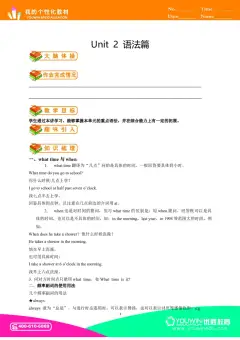
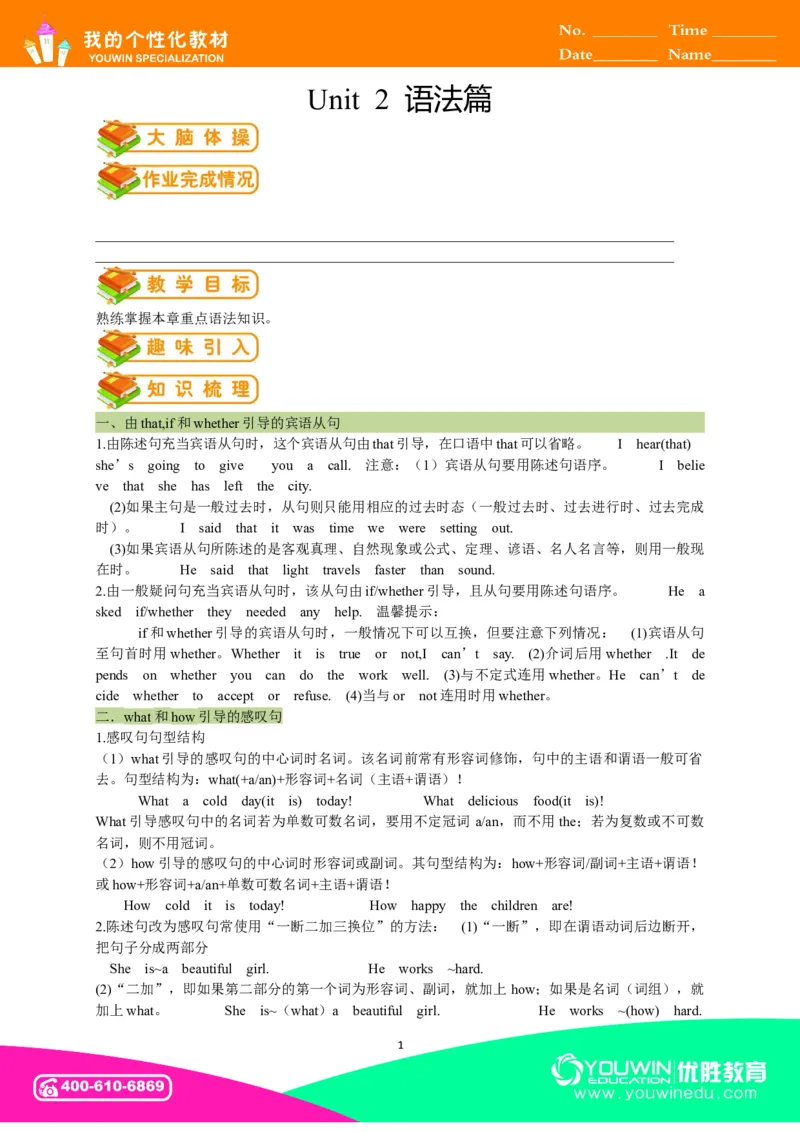
1
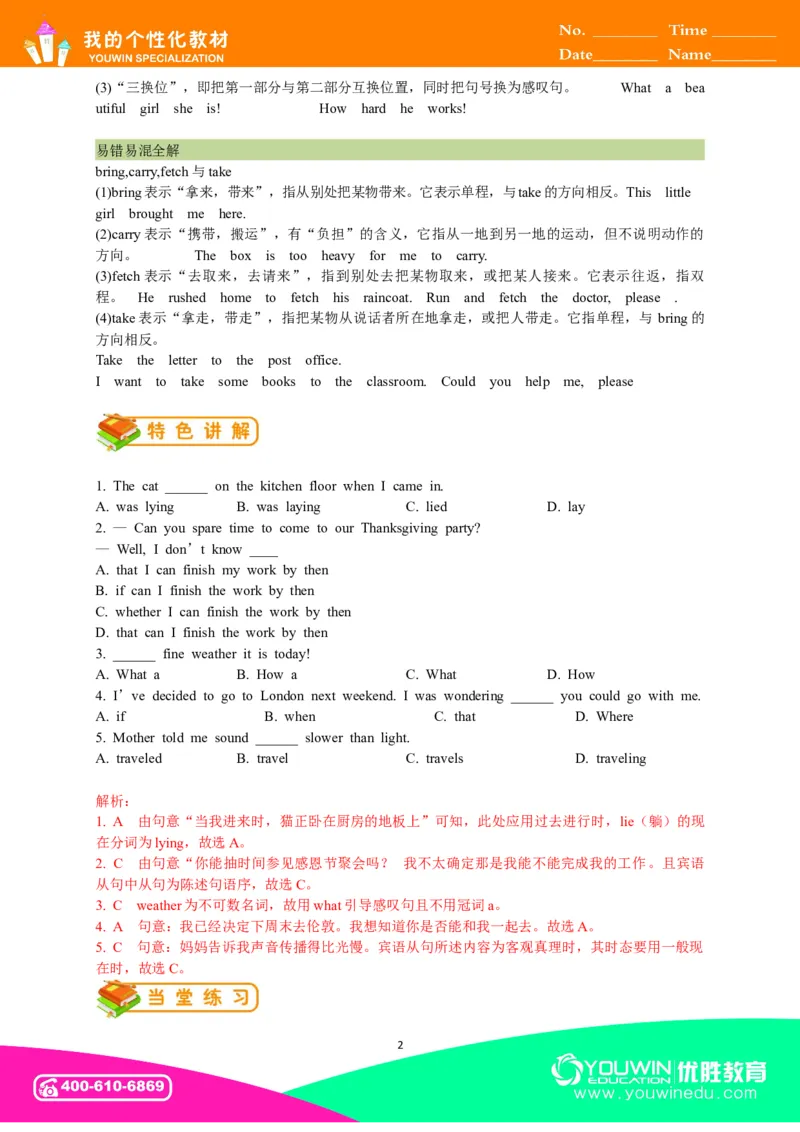
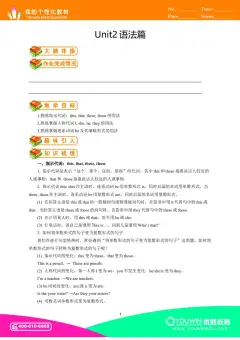
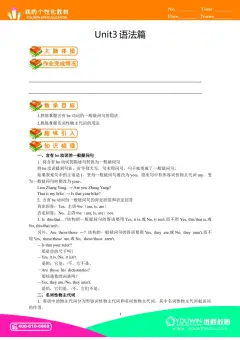
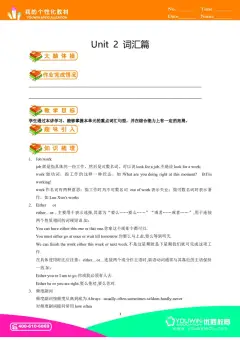
Unit 2 语法篇
__________________________________________________________________________________
__________________________________________________________________________________
熟练掌握本章重点语法知识。
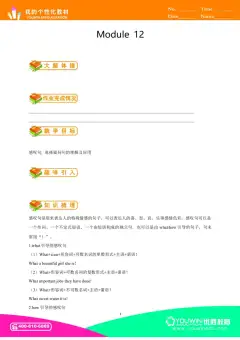
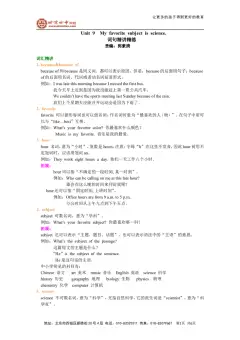
一、由that,if 和whether 引导的宾语从句 
1.由陈述句充当宾语从句时,这个宾语从句由that 引导,在口语中that 可以省略。  I hear(that) 
she’s going to give  you a call. 注意:(1)宾语从句要用陈述句语序。   I belie
ve that she has left the city. 
 (2)如果主句是一般过去时,从句则只能用相应的过去时态(一般过去时、过去进行时、过去完成
时)。   I said that it was time we were setting out. 
 (3)如果宾语从句所陈述的是客观真理、自然现象或公式、定理、谚语、名人名言等,则用一般现
在时。   He said that light travels faster than sound.
2.由一般疑问句充当宾语从句时,该从句由if/whether 引导,且从句要用陈述句语序。   He a
sked if/whether they needed any help. 温馨提示: 
   if 和whether 引导的宾语从句时,一般情况下可以互换,但要注意下列情况: (1)宾语从句
至句首时用whether。Whether it is true or not,I can’t say. (2)介词后用whether .It de
pends on whether you can do the work well. (3)与不定式连用whether。He can’t de
cide whether to accept or refuse. (4)当与or not 连用时用whether。
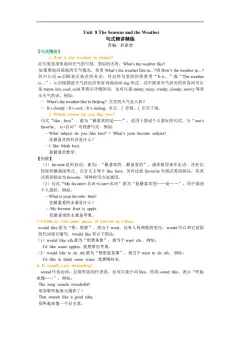
二.what 和how 引导的感叹句 
1.感叹句句型结构 
(1)what 引导的感叹句的中心词时名词。该名词前常有形容词修饰,句中的主语和谓语一般可省
去。句型结构为:what(+a/an)+形容词+名词(主语+谓语)! 
   What a cold day(it is) today!     What delicious food(it is)! 
What 引导感叹句中的名词若为单数可数名词,要用不定冠词a/an,而不用the;若为复数或不可数
名词,则不用冠词。 
(2)how 引导的感叹句的中心词时形容词或副词。其句型结构为:how+形容词/副词+主语+谓语!
或how+形容词+a/an+单数可数名词+主语+谓语! 
  How cold it is today!      How happy the children are! 
2.陈述句改为感叹句常使用“一断二加三换位”的方法: (1)“一断”,即在谓语动词后边断开,
把句子分成两部分
 She is~a beautiful girl.       He works ~hard. 
(2)“二加”,即如果第二部分的第一个词为形容词、副词,就加上how;如果是名词(词组),就
加上what。    She is~(what)a beautiful girl.       He works ~(how) hard. 
2
(3)“三换位”,即把第一部分与第二部分互换位置,同时把句号换为感叹句。   What a bea
utiful girl she is!       How hard he works!
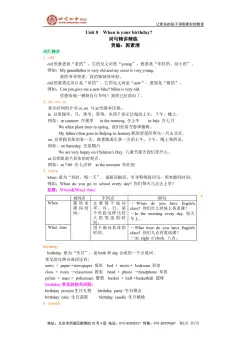
易错易混全解
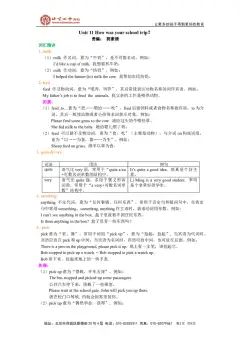
bring,carry,fetch 与take 
(1)bring 表示“拿来,带来”,指从别处把某物带来。它表示单程,与take 的方向相反。This little 
girl brought me here. 
(2)carry 表示“携带,搬运”,有“负担”的含义,它指从一地到另一地的运动,但不说明动作的
方向。    The box is too heavy for me to carry. 
(3)fetch 表示“去取来,去请来”,指到别处去把某物取来,或把某人接来。它表示往返,指双
程。 He rushed home to fetch his raincoat. Run and fetch the doctor, please . 
(4)take 表示“拿走,带走”,指把某物从说话者所在地拿走,或把人带走。它指单程,与bring 的
方向相反。    
Take the letter to the post office. 
I want to take some books to the classroom. Could you help me, please 
1. The cat ______ on the kitchen floor when I came in.
A. was lying
B. was laying          
C. lied
D. lay
2. — Can you spare time to come to our Thanksgiving party?
— Well, I don’t know ____
A. that I can finish my work by then
B. if can I finish the work by then
C. whether I can finish the work by then
D. that can I finish the work by then 
3. ______ fine weather it is today!
A. What a
B. How a              C. What
D. How
4. I’ve decided to go to London next weekend. I was wondering ______ you could go with me.
A. if
B. when               
C. that
D. Where
5. Mother told me sound ______ slower than light.
A. traveled
B. travel              
C. travels
D. traveling
解析:
1. A  由句意“当我进来时,猫正卧在厨房的地板上”可知,此处应用过去进行时,lie(躺)的现
在分词为lying,故选A。
2. C  由句意“你能抽时间参见感恩节聚会吗? 我不太确定那是我能不能完成我的工作。且宾语
从句中从句为陈述句语序,故选C。
3. C  weather 为不可数名词,故用what 引导感叹句且不用冠词a。
4. A  句意:我已经决定下周末去伦敦。我想知道你是否能和我一起去。故选A。
5. C  句意:妈妈告诉我声音传播得比光慢。宾语从句所述内容为客观真理时,其时态要用一般现
在时,故选C。
3
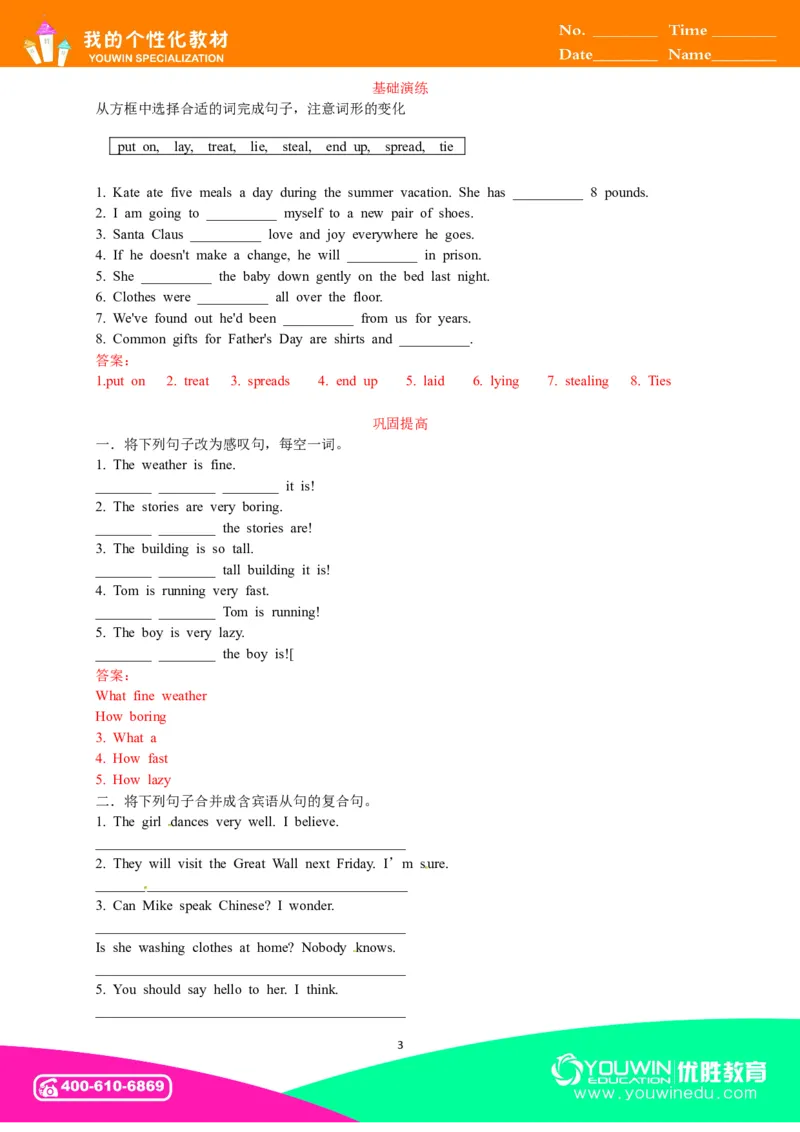
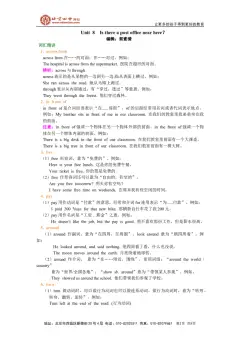
基础演练
从方框中选择合适的词完成句子,注意词形的变化
1. Kate ate five meals a day during the summer vacation. She has __________ 8 pounds.
2. I am going to __________ myself to a new pair of shoes.
3. Santa Claus __________ love and joy everywhere he goes.
4. If he doesn't make a change, he will __________ in prison.
5. She __________ the baby down gently on the bed last night.
6. Clothes were __________ all over the floor.
7. We've found out he'd been __________ from us for years.
8. Common gifts for Father's Day are shirts and __________.
答案: 
1.put on   2. treat   3. spreads    4. end up    5. laid    6. lying    7. stealing   8. Ties
巩固提高
一.将下列句子改为感叹句,每空一词。
1. The weather is fine.
________ ________ ________ it is!
2. The stories are very boring.
________ ________ the stories are!
3. The building is so tall.
________ ________ tall building it is!
4. Tom is running very fast.
________ ________ Tom is running!
5. The boy is very lazy.
________ ________ the boy is![
答案:
What fine weather 
How boring 
3. What a
4. How fast 
5. How lazy
二.将下列句子合并成含宾语从句的复合句。
1. The girl dances very well. I believe.
____________________________________________
2. They will visit the Great Wall next Friday. I’m sure.
____________________________________________
3. Can Mike speak Chinese? I wonder.
____________________________________________
Is she washing clothes at home? Nobody knows.
____________________________________________
5. You should say hello to her. I think.
____________________________________________
put on,  lay,  treat,  lie,  steal,  end up,  spread,  tie
4
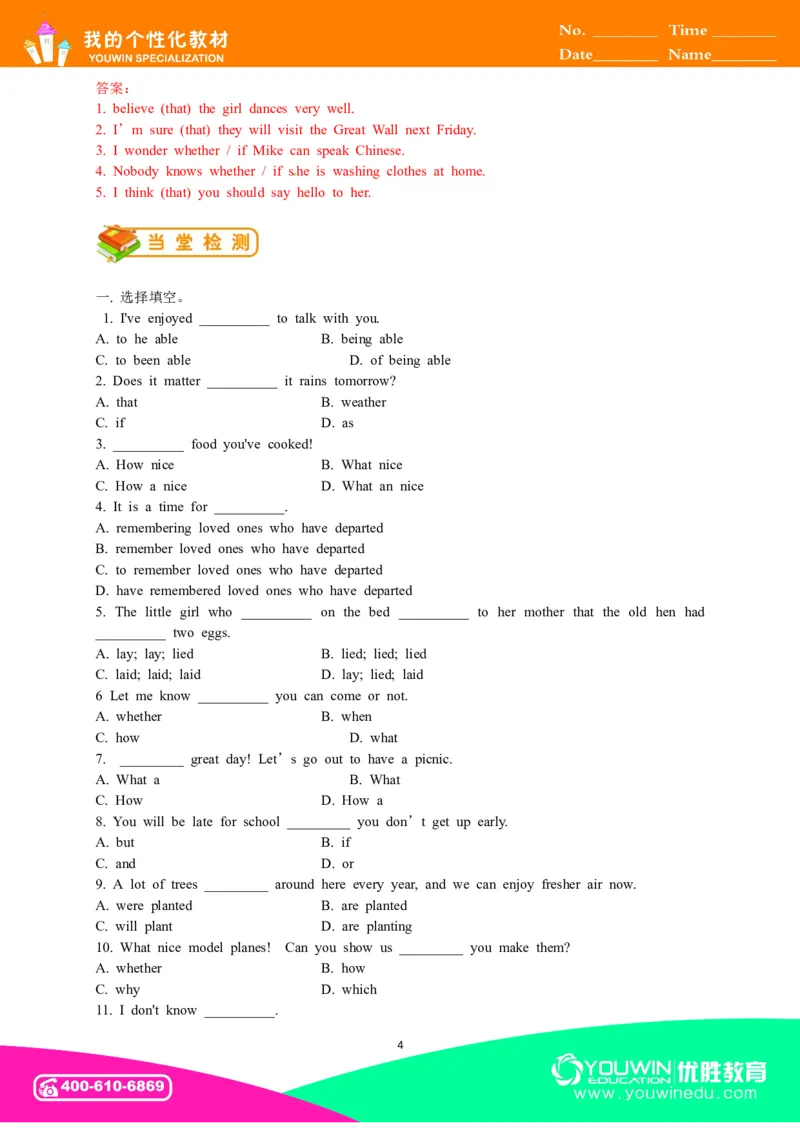
答案: 
1. believe (that) the girl dances very well.
2. I’m sure (that) they will visit the Great Wall next Friday.
3. I wonder whether / if Mike can speak Chinese.
4. Nobody knows whether / if she is washing clothes at home.
5. I think (that) you should say hello to her.
一. 选择填空。
 1. I've enjoyed __________ to talk with you.
A. to he able       
B. being able 
C. to been able       
D. of being able
2. Does it matter __________ it rains tomorrow?
A. that       
B. weather 
C. if         
D. as 
3. __________ food you've cooked!
A. How nice                  
B. What nice
C. How a nice                 
D. What an nice
4. It is a time for __________.
A. remembering loved ones who have departed
B. remember loved ones who have departed
C. to remember loved ones who have departed
D. have remembered loved ones who have departed 
5. The little girl who __________ on the bed __________ to her mother that the old hen had 
__________ two eggs.
A. lay; lay; lied                 B. lied; lied; lied 
C. laid; laid; laid                D. lay; lied; laid
6 Let me know __________ you can come or not.
A. whether          
B. when 
C. how      
D. what 
7.  _________ great day! Let’s go out to have a picnic.
A. What a       
B. What 
C. How         
D. How a
8. You will be late for school _________ you don’t get up early. 
A. but       
B. if 
C. and      
D. or
9. A lot of trees _________ around here every year, and we can enjoy fresher air now.
A. were planted            
B. are planted
C. will plant               
D. are planting
10. What nice model planes!  Can you show us _________ you make them? 
A. whether         
B. how 
C. why     
D. which
11. I don't know __________.
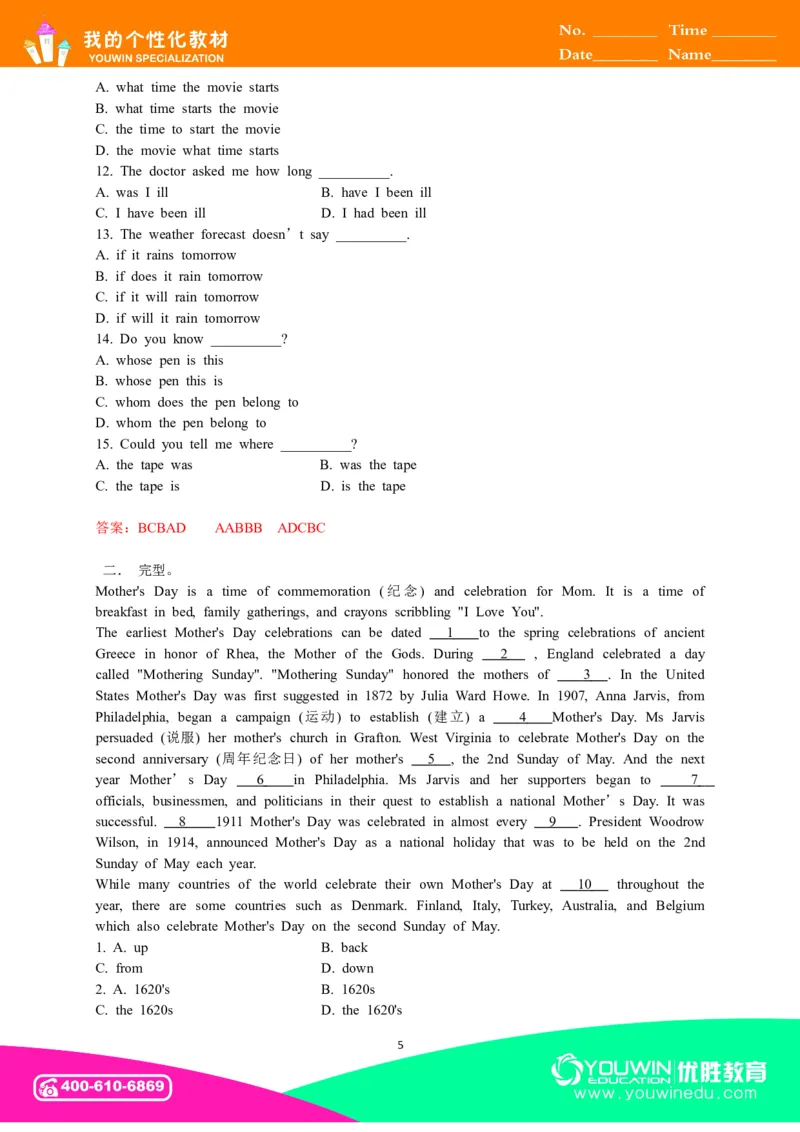
5
A. what time the movie starts
B. what time starts the movie
C. the time to start the movie
D. the movie what time starts
12. The doctor asked me how long __________.
A. was I ill                 
B. have I been ill
C. I have been ill            
D. I had been ill
13. The weather forecast doesn’t say __________.
A. if it rains tomorrow
B. if does it rain tomorrow
C. if it will rain tomorrow
D. if will it rain tomorrow
14. Do you know __________?
A. whose pen is this 
B. whose pen this is
C. whom does the pen belong to
D. whom the pen belong to
15. Could you tell me where __________? 
A. the tape was                  B. was the tape
C. the tape is                    D. is the tape
答案:BCBAD    AABBB  ADCBC
 二. 完型。
Mother's Day is a time of commemoration ( 纪念) and celebration for Mom. It is a time of 
breakfast in bed, family gatherings, and crayons scribbling "I Love You".
The earliest Mother's Day celebrations can be dated   
  1    
  to the spring celebrations of ancient 
Greece in honor of Rhea, the Mother of the Gods. During   
  2    
   , England celebrated a day 
called "Mothering Sunday". "Mothering Sunday" honored the mothers of    
 
 3    
  . In the United 
States Mother's Day was first suggested in 1872 by Julia Ward Howe. In 1907, Anna Jarvis, from 
Philadelphia, began a campaign (运动) to establish (建立) a    
 
 4     
 
 Mother's Day. Ms Jarvis 
persuaded (说服) her mother's church in Grafton. West Virginia to celebrate Mother's Day on the 
second anniversary (周年纪念日) of her mother's   
  5   
  , the 2nd Sunday of May. And the next 
year Mother’ s Day   
  6     
 
 in Philadelphia. Ms Jarvis and her supporters began to    
 
 7     
officials, businessmen, and politicians in their quest to establish a national Mother’s Day. It was 
successful.   
  8     
 
 1911 Mother's Day was celebrated in almost every   
  9    
  . President Woodrow 
Wilson, in 1914, announced Mother's Day as a national holiday that was to be held on the 2nd 
Sunday of May each year.
While many countries of the world celebrate their own Mother's Day at   
  1 0   
   throughout the 
year, there are some countries such as Denmark. Finland, Italy, Turkey, Australia, and Belgium 
which also celebrate Mother's Day on the second Sunday of May.
1. A. up            
B. back 
C. from          
D. down
2. A. 1620's         
B. 1620s 
C. the 1620s      
D. the 1620's 
6
3. A. America       
B. world 
C. England       
D. Greece
4. A. public         
B. common 
C. traditional     
D. national
5. A. die            
B. death 
C. dying         
D. Dead
6. A. was celebrated      
B. celebrated
C. had celebrated             
D. had been celebrated
7. A. calling                    B. write to
 C. telephone                 
D. send e-mails to
8. A. By              
B. In 
C. Before    
D. After
9. A. city             
B. country 
C. state        
D. place
10. A. times                      B. the same time
C. different times               
D. another time
答案: BCCDB    ABACC
_________________________________________________________________________________
_________________________________________________________________________________
一、根据汉语提示完成句子
1. -Helen, do you know if Martin __________ to my party next week?
   -I think he will come if he __________ free.
 A. will come; will be                  B. will come; is
 C. comes; is                         D. comes; will be
2. __________ clever the boy is!
 A. How       B. What          C. What a         D. How a
3. Have you decided __________ for Australia?
A. when will you leave             B. when do you leave
C. you will leave when             D. when you will leave
4. Can you tell me __________?
A. where does Torn live            B. where Tom lived
C. Tom lives where                D. where Tom Lives
5. The old man asked me __________.
A. where was the cinema
B. where is the cinema
C. where the cinema was
D. where was the way to the cinema
6. Do you know __________ he's married?
A. if          B. what         C. when         D. where
7. I didn't know __________ he will come or not.
A. that       B. whether        C. weather        D. how
7
8. I wonder __________.
A. how much cost these shoes
B. how much do these shoes cost
C. how much these shoes cost
D. how much are these shoes cost
9. She asked me __________.
A. who he was              B. who was he
C. who is he                D. who he is
10. Ask him __________.
A. whose cup this is            B. whose cup is this
C. this is whose cup            D. whose is this cup
答案:
BADDC    ABCAA 
(2015 年人教版九年级上期中测试题)
二.完形填空。
 I have a very useful dictionary. It has a lot of words. It gives many meanings 
for 
   
  1  
   
  word. But I always read the first meaning of a word in the dictionary. I never read 
the 
other 
meanings, 
because 
I 
wanted 
to 
read 
my 
book 
   
   
  2  
 
   
   This 
morning,  
   
  3  


  I 
was 
reading 
a 
book, 
I 
met 
a 
strange 
sentence. 
It 
looked  
   
  4  
   
   
  first. The sentence had six words:" Draw a picture of your house" I know 
five words in this sentence, but I didn't understand one word. I   
  5   
   
   
  "draw". I opened 
my dictionary and 
   
   
  6   
   
   
  the first meaning of "draw". It was" pull". I said to myself " 
Now I know all the words, and I think I can understand the sentence."SO I wrote the meaning of 
the sentence" Pull a picture of your house."I read it, and" What is the meaning of it.'? I don't 
understand it." 
     My friend Dick read my new sentence. He laughed. He picked  
   
  7   
   
   my 
dictionary, and said to me. "Look, Jack. The second meaning of' draw' is' make a 
picture 
   
   
  8  
   
   a pen, a pencil  
   
  9  
   
   
  brush'. So the sentence means: Make a picture 
of your house." I understood! I thought Dick was wonderful. And  
  1 0   
   
   
  I knew how to 
use my dictionary.
(   )1. A. some 
(     )2. A. quickly 
(     )3. A. how 
(    )4. A. difficult 
(     )5. A. don't know 
(     )6. A. looked 
for 
(     )7. A. by 
(     )8. A. use 
(     )9. A. or a 
(     )10. A. at last
B. another 
B. quick 
B. who 
B. hardly 
B. didn't know 
B. discovered 
B. out 
B. with 
B. and a 
B. at the beginning
C. each 
C. slow 
C. what 
C. easy 
C. knew 
C. found 
C. up 
C. on 
C. and 
C. at the end
D. the other 
D. slowly 
D. when 
D. easily 
D. know 
D. invented 
D. with 
D. by 
D. or 
D. at first
答案: CADCB    CCBAA 
三. 阅读理解。
8
A
Around the world, people have different traditional foods to celebrate different festivals. Traditional 
foods also show a new year of good luck and good health.
An English Christmas dinner has a meal of turkey, and it also includes pies and plum puddings 
(李子布丁). In Germany, Christmas is celebrated with bread, cookies and cakes, which are made 
like Christmas trees. In France, Christmas dessert is a cake filled with butter cream.
In southern parts of India, there is a three-day festival in mid-January called Pongal. It includes 
rice and a dish of rice cooked with sugar that is shared with families and friends.
Japan celebrates New Year with a seven-day festival. It begins from January 1st. Food is prepared 
before the festival so people don’t need to cook during the festival. On New Year's Day, various 
dishes called Osechi Ryori (御节料理) are served—each dish is a wish for the New Year. 
In most Asian countries, the New Year begins with the first full moon of the first Chinese Lunar 
(阴历的) month. Each place has its special food to welcome the coming year: People in China 
prepare their food ahead of time to avoid the possibility that using a knife during New Year's 
time might "cut luck". Foods with lucky names are popular, such as fish, which sounds like 
"surplus(剩余)". 
1. What do you learn from the passage?
  A. People have different traditional foods to celebrate different festivals.
  B. New Year begins from January 10th in Japan.
  C. In France, Christmas dessert is a cake filled with butter.
  D. Traditional foods only show a new of good luck.
2. What did a three-day festival in mid-January in southern parts of India?
     A. Christmas.                   B. Pongal.
     C. New Year.                    D. Lantern Festival.
3. In Japan, people all like eating _________ on New Year's Day.
   A. turkey                      B. dessert
   C. Osechi Ryori                 D. dumplings
4. The underlined word "various" in Paragraph 4 can best be replaced by "_________".
  A. different      B. same       C. expensive     D. few 
5. The underlined word "possibility" in Paragraph 5 probably means "_________" in Chinese.
  A. 必须性        B. 必然性        C. 可变性       D. 可能性
 
答案:ABCAD
B
The Spring Festival is celebrated not only in China but also in other parts of the world. The 
traditional holiday is the most important to Chinese both home and abroad.
United Kingdom
    Celebrations for Spring Festival in the UK started in 1980, with the first evening party 
held in 2002. Every New Year, people get together and have a lot of activities. They sing songs, 
dance to music, share photos with friends or enjoy films in a cinema.
United States
    Spring Festival has become a key time for Chinese living or working in the US. They 
join in a large evening party to welcome the traditional New Year. It is a good chance for people 
to build a circle of friends and feel that they are not alone because they share the same culture 
9
and values.
Australia
    The Chinese New Year will be welcomed with three weeks of celebrations across 
Australia. Many people come to Sydney’s Chinatown or Little Bourke in Melbourne. They enjoy 
fireworks, lion dances, dragon boat races and many other traditional activities. The celebrations are 
also a bridge towards better understanding between Chinese and non-Chinese.
Singapore
    The family dinner on New Year’s Eve is an important tradition for Chinese whether they 
were born in Singapore or moved there from China. They place traditional food on a table as an 
act of remembering their past. Then the whole family enjoy their dinner together. They usually 
hold it at home because having it in a restaurant takes away the meaning of the tradition.
6. Celebrations for Spring Festival in the UK started in         .
A. 1890                         
B. 1980 
 C. 2000                          
D. 2002
7. At Spring Festival, American Chinese join in a large evening party to         .
A. say hello to the new year  
B. refuse a good chance 
C. tell others they are alone  
D. share different cultures
8. Chinese in Australia enjoy the following activities except        .
A. f ireworks           
B. lion dances 
C. bridges         
D. dragon boat races
9. In Singapore, Chinese families don’t hold the new year dinner in a restaurant but at home 
because         .
A. they were born in Singapore   
B. they moved there from other places
C. the restaurant is far away    
D. they want to keep Chinese tradition
10. After reading the passage above, we might say         .
A. all parts of the world celebrate Spring Festival
B. the Chinese New Year is celebrated only in China
C. celebrations for Spring Festival are just held in four foreign countries
D. Chinese across the world have a strong feeling towards Spring Festival
 
答案:BACDD
课程顾问签字:                        教学主管签字: