试题 第1 页(共10 页)                                                                                            试题 第2 页(共10 页)
………………○………………内………………○………………装………………○………………订………………○……………… 线………………○………………
………………○………………外………………○………………装………………○………………订………………○……………… 线………………○………………
…             学校:______________姓名:_____________班级:_______________考号:______________________


2026 年高考第一次模拟考试
高三英语
(考试时间:90 分钟  试卷满分:100 分)
注意事项:
1.答卷前,考生务必将自己的姓名、准考证号等填写在答题卡和试卷指定位置上。
2.回答选择题时,选出每小题答案后,用铅笔把答题卡上对应题目的答案标号涂黑。如需改动,用橡
皮擦干净后,再选涂其他答案标号。回答非选择题时,将答案写在答题卡上。写在本试卷上无效。
3.考试结束后,将本试卷和答题卡一并交回
第一部分:知识运用(共两节,30 分)
第一节 (共10 小题;每小题1.5 分,共15 分)
阅读下面短文,掌握其大意,从每题所给的A、B、C、D 四个选项中,选出最佳选项,并在答题卡上将
该项涂黑。
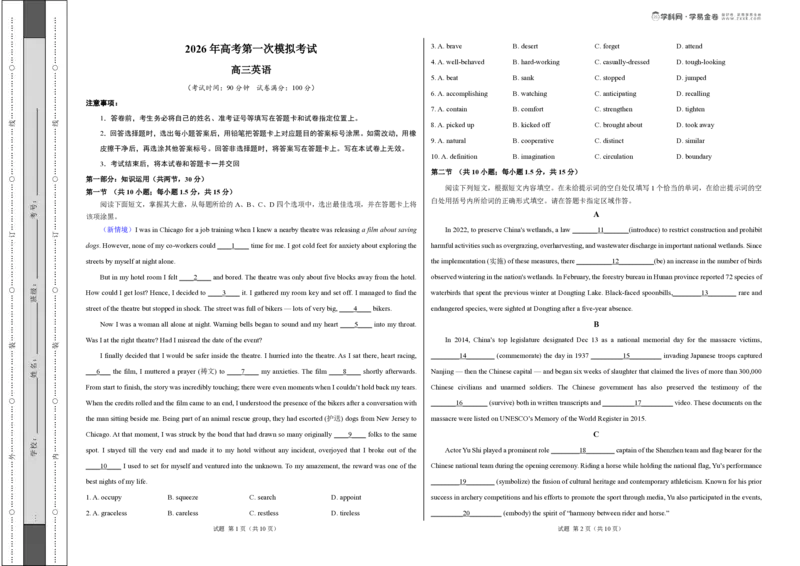
(新情境)I was in Chicago for a job training when I knew a nearby theatre was releasing a film about saving
dogs. However, none of my co-workers could ____1____ time for me. I got cold feet for anxiety about exploring the
streets by myself at night alone.
But in my hotel room I felt ____2____ and bored. The theatre was only about five blocks away from the hotel.
How could I get lost? Hence, I decided to ____3____ it. I gathered my room key and set off. I managed to find the
street of the theatre but stopped in shock. The street was full of bikers — lots of very big, ____4____ bikers.
Now I was a woman all alone at night. Warning bells began to sound and my heart ____5____ into my throat.
Was I at the right theatre? Had I misread the date of the event?
I finally decided that I would be safer inside the theatre. I hurried into the theatre. As I sat there, heart racing,
___6___ the film, I muttered a prayer (祷文) to ____7____ my anxieties. The film ____8____ shortly afterwards.
From start to finish, the story was incredibly touching; there were even moments when I couldn’t hold back my tears.
When the credits rolled and the film came to an end, I understood the presence of the bikers after a conversation with
the man sitting beside me. Being part of an animal rescue group, they had escorted (护送) dogs from New Jersey to
Chicago. At that moment, I was struck by the bond that had drawn so many originally ____9____ folks to the same
spot. I stayed till the very end and made it to my hotel without any incident, overjoyed that I broke out of the
____10____ I used to set for myself and ventured into the unknown. To my amazement, the reward was one of the
best nights of my life.
1. A. occupy
B. squeeze
C. search
D. appoint
2. A. graceless
B. careless
C. restless
D. tireless
3. A. brave
B. desert
C. forget
D. attend
4. A. well-behaved
B. hard-working
C. casually-dressed
D. tough-looking
5. A. beat
B. sank
C. stopped
D. jumped
6. A. accomplishing
B. watching
C. anticipating
D. recalling
7. A. contain
B. comfort
C. strengthen
D. tighten
8. A. picked up
B. kicked off
C. brought about
D. took away
9. A. natural
B. cooperative
C. distinct
D. similar
10. A. definition
B. imagination
C. circulation
D. boundary
第二节 (共10 小题;每小题1.5 分,共15 分)
阅读下列短文,根据短文内容填空。在未给提示词的空白处仅填写1 个恰当的单词,在给出提示词的空
白处用括号内所给词的正确形式填空。请在答题卡指定区域作答。
A
In 2022, to preserve China's wetlands, a law _______11_______(introduce) to restrict construction and prohibit
harmful activities such as overgrazing, overharvesting, and wastewater discharge in important national wetlands. Since
the implementation (实施) of these measures, there __________12__________(be) an increase in the number of birds
observed wintering in the nation's wetlands. In February, the forestry bureau in Hunan province reported 72 species of
waterbirds that spent the previous winter at Dongting Lake. Black-faced spoonbills,________13________ rare and
endangered species, were sighted at Dongting after a five-year absence.
B
In 2014, China’s top legislature designated Dec 13 as a national memorial day for the massacre victims,
________14________ (commemorate) the day in 1937 _________15_________ invading Japanese troops captured
Nanjing — then the Chinese capital — and began six weeks of slaughter that claimed the lives of more than 300,000
Chinese civilians and unarmed soldiers. The Chinese government has also preserved the testimony of the
_______16_______ (survive) both in written transcripts and _________17_________ video. These documents on the
massacre were listed on UNESCO’s Memory of the World Register in 2015.
C
Actor Yu Shi played a prominent role ________18________ captain of the Shenzhen team and flag bearer for the
Chinese national team during the opening ceremony. Riding a horse while holding the national flag, Yu’s performance
________19________ (symbolize) the fusion of cultural heritage and contemporary athleticism. Known for his prior
success in archery competitions and his efforts to promote the sport through media, Yu also participated in the events,
_________20_________ (embody) the spirit of “harmony between rider and horse.”
{#{QQABJQAUggCAQIIAARgCEwEwCgOYkBAAACgOwAAUIAIBQBFABAA=}#}

试题 第3 页(共10 页)                                                                                       试题 第4 页(共10 页)

………………○………………内………………○………………装………………○………………订………………○……………… 线………………○………………
             此
卷
只
装
订
不
密
封

………………○………………外………………○………………装………………○………………订………………○……………… 线………………○………………

第二部分:阅读理解(共两节,共38 分)
第一节 (共14 小题;每小题2 分,共28 分)
阅读下列短文,从每题所给的A、B、C、D 四个选项中,选出最佳选项,并在答题卡上将该项涂黑。
A
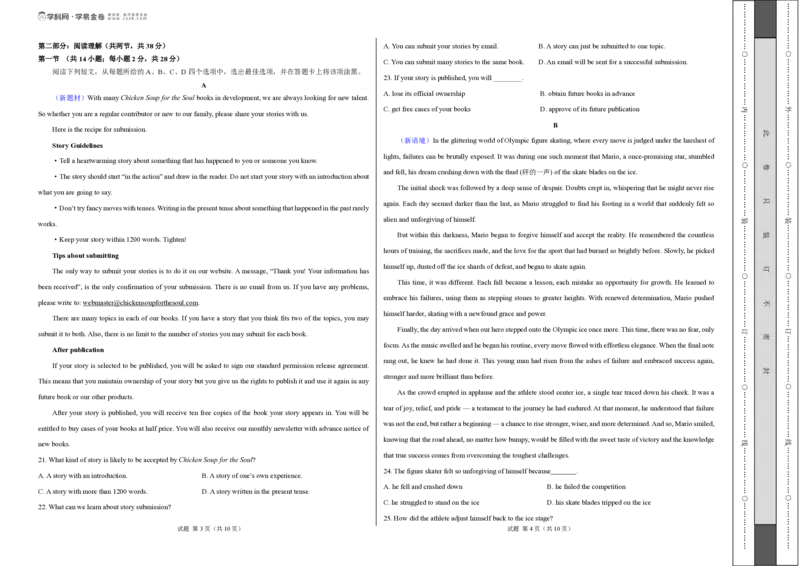
(新题材)With many Chicken Soup for the Soul books in development, we are always looking for new talent.
So whether you are a regular contributor or new to our family, please share your stories with us.
Here is the recipe for submission.
Story Guidelines
·Tell a heartwarming story about something that has happened to you or someone you know.
·The story should start “in the action” and draw in the reader. Do not start your story with an introduction about
what you are going to say.
·Don’t try fancy moves with tenses. Writing in the present tense about something that happened in the past rarely
works.
·Keep your story within 1200 words. Tighten!
Tips about submitting
The only way to submit your stories is to do it on our website. A message, “Thank you! Your information has
been received”, is the only confirmation of your submission. There is no email from us. If you have any problems,
please write to: webmaster@chickensoupforthesoul.com.
There are many topics in each of our books. If you have a story that you think fits two of the topics, you may
submit it to both. Also, there is no limit to the number of stories you may submit for each book.
After publication
If your story is selected to be published, you will be asked to sign our standard permission release agreement.
This means that you maintain ownership of your story but you give us the rights to publish it and use it again in any
future book or our other products.
After your story is published, you will receive ten free copies of the book your story appears in. You will be
entitled to buy cases of your books at half price. You will also receive our monthly newsletter with advance notice of
new books.
21. What kind of story is likely to be accepted by Chicken Soup for the Soul?
A. A story with an introduction.
B. A story of one’s own experience.
C. A story with more than 1200 words.
D. A story written in the present tense.
22. What can we learn about story submission?
A. You can submit your stories by email.


B. A story can just be submitted to one topic.
C. You can submit many stories to the same book.
D. An email will be sent for a successful submission.
23. If your story is published, you will ________.
A. lose its official ownership
B. obtain future books in advance
C. get free cases of your books
D. approve of its future publication
B
(新语境)In the glittering world of Olympic figure skating, where every move is judged under the harshest of
lights, failures can be brutally exposed. It was during one such moment that Mario, a once-promising star, stumbled
and fell, his dream crashing down with the thud (砰的一声) of the skate blades on the ice.
The initial shock was followed by a deep sense of despair. Doubts crept in, whispering that he might never rise
again. Each day seemed darker than the last, as Mario struggled to find his footing in a world that suddenly felt so
alien and unforgiving of himself.
But within this darkness, Mario began to forgive himself and accept the reality. He remembered the countless
hours of training, the sacrifices made, and the love for the sport that had burned so brightly before. Slowly, he picked
himself up, dusted off the ice shards of defeat, and began to skate again.
This time, it was different. Each fall became a lesson, each mistake an opportunity for growth. He learned to
embrace his failures, using them as stepping stones to greater heights. With renewed determination, Mario pushed
himself harder, skating with a newfound grace and power.
Finally, the day arrived when our hero stepped onto the Olympic ice once more. This time, there was no fear, only
focus. As the music swelled and he began his routine, every move flowed with effortless elegance. When the final note
rang out, he knew he had done it. This young man had risen from the ashes of failure and embraced success again,
stronger and more brilliant than before.
As the crowd erupted in applause and the athlete stood center ice, a single tear traced down his cheek. It was a
tear of joy, relief, and pride — a testament to the journey he had endured. At that moment, he understood that failure
was not the end, but rather a beginning — a chance to rise stronger, wiser, and more determined. And so, Mario smiled,
knowing that the road ahead, no matter how bumpy, would be filled with the sweet taste of victory and the knowledge
that true success comes from overcoming the toughest challenges.
24. The figure skater felt so unforgiving of himself because         .
A. he fell and crashed down
B. he failed the competition
C. he struggled to stand on the ice
D. his skate blades tripped on the ice
25. How did the athlete adjust himself back to the ice stage?
{#{QQABJQAUggCAQIIAARgCEwEwCgOYkBAAACgOwAAUIAIBQBFABAA=}#}

试题 第5 页(共10 页)                                                                                            试题 第6 页(共10 页)
………………○………………内………………○………………装………………○………………订………………○……………… 线………………○………………
………………○………………外………………○………………装………………○………………订………………○……………… 线………………○………………
…             学校:______________姓名:_____________班级:_______________考号:______________________


A. He embraced all the tests to the journey.
B. He acknowledged the failure and cheered himself up.
C. He practiced more than before and endured all pains and hurts.
D. He changed himself into a stronger, smarter and more powerful man.
26. Mario is a young man with the merit of         .
A. toughness and sentiments
B. hard work and elegance
C. perseverance and resilience
D. generosity and humility
27. What can we learn from this story?
A. Failure is the mother of success.
B. Chances favor the prepared mind.
C Constant dripping wears away the stone.
D. What doesn’t kill you makes you stronger.
C
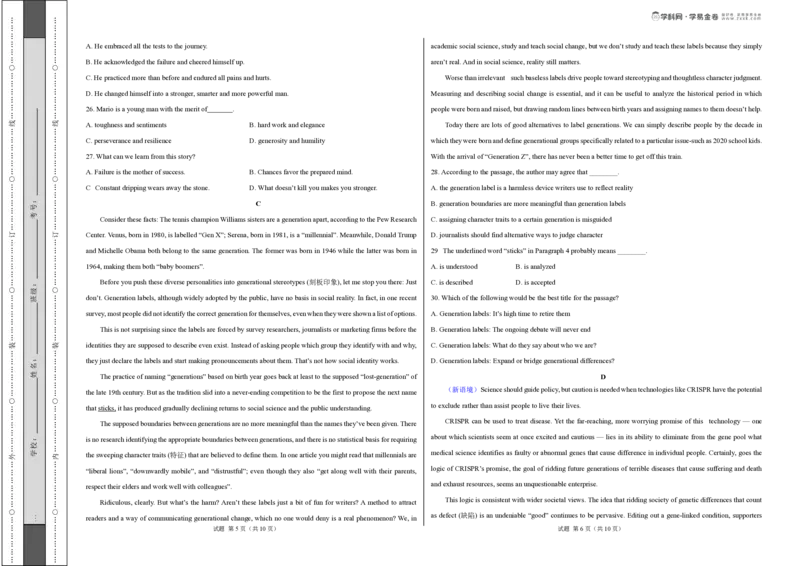
Consider these facts: The tennis champion Williams sisters are a generation apart, according to the Pew Research
Center. Venus, born in 1980, is labelled “Gen X”; Serena, born in 1981, is a “millennial”. Meanwhile, Donald Trump
and Michelle Obama both belong to the same generation. The former was born in 1946 while the latter was born in
1964, making them both “baby boomers”.
Before you push these diverse personalities into generational stereotypes (刻板印象), let me stop you there: Just
don’t. Generation labels, although widely adopted by the public, have no basis in social reality. In fact, in one recent
survey, most people did not identify the correct generation for themselves, even when they were shown a list of options.
This is not surprising since the labels are forced by survey researchers, journalists or marketing firms before the
identities they are supposed to describe even exist. Instead of asking people which group they identify with and why,
they just declare the labels and start making pronouncements about them. That’s not how social identity works.
The practice of naming “generations” based on birth year goes back at least to the supposed “lost-generation” of
the late 19th century. But as the tradition slid into a never-ending competition to be the first to propose the next name
that sticks, it has produced gradually declining returns to social science and the public understanding.
The supposed boundaries between generations are no more meaningful than the names they’ve been given. There
is no research identifying the appropriate boundaries between generations, and there is no statistical basis for requiring
the sweeping character traits (特征) that are believed to define them. In one article you might read that millennials are
“liberal lions”, “downwardly mobile”, and “distrustful”; even though they also “get along well with their parents,
respect their elders and work well with colleagues”.
Ridiculous, clearly. But what’s the harm? Aren’t these labels just a bit of fun for writers? A method to attract
readers and a way of communicating generational change, which no one would deny is a real phenomenon? We, in
academic social science, study and teach social change, but we don’t study and teach these labels because they simply
aren’t real. And in social science, reality still matters.
Worse than irrelevant such baseless labels drive people toward stereotyping and thoughtless character judgment.
Measuring and describing social change is essential, and it can be useful to analyze the historical period in which
people were born and raised, but drawing random lines between birth years and assigning names to them doesn’t help.
Today there are lots of good alternatives to label generations. We can simply describe people by the decade in
which they were born and define generational groups specifically related to a particular issue-such as 2020 school kids.
With the arrival of “Generation Z”, there has never been a better time to get off this train.
28. According to the passage, the author may agree that ________.
A. the generation label is a harmless device writers use to reflect reality
B. generation boundaries are more meaningful than generation labels
C. assigning character traits to a certain generation is misguided
D. journalists should find alternative ways to judge character
29 The underlined word “sticks” in Paragraph 4 probably means ________.
A. is understood


B. is analyzed
C. is described


D. is accepted
30. Which of the following would be the best title for the passage?
A. Generation labels: It’s high time to retire them
B. Generation labels: The ongoing debate will never end
C. Generation labels: What do they say about who we are?
D. Generation labels: Expand or bridge generational differences?
D
(新语境)Science should guide policy, but caution is needed when technologies like CRISPR have the potential
to exclude rather than assist people to live their lives.
CRISPR can be used to treat disease. Yet the far-reaching, more worrying promise of this  technology — one
about which scientists seem at once excited and cautious — lies in its ability to eliminate from the gene pool what
medical science identifies as faulty or abnormal genes that cause difference in individual people. Certainly, goes the
logic of CRISPR’s promise, the goal of ridding future generations of terrible diseases that cause suffering and death
and exhaust resources, seems an unquestionable enterprise.
This logic is consistent with wider societal views. The idea that ridding society of genetic differences that count
as defect (缺陷) is an undeniable “good” continues to be pervasive. Editing out a gene-linked condition, supporters
{#{QQABJQAUggCAQIIAARgCEwEwCgOYkBAAACgOwAAUIAIBQBFABAA=}#}

试题 第7 页(共10 页)                                                                                       试题 第8 页(共10 页)

………………○………………内………………○………………装………………○………………订………………○……………… 线………………○………………
             此
卷
只
装
订
不
密
封

………………○………………外………………○………………装………………○………………订………………○……………… 线………………○………………

may argue, is different from editing out a person, and curing disease is a good thing. But our genetic conditions are
not simply entities that can be clipped away from us and our genetic conditions form a fundamental part of who we
are.
Using genome manipulation tools and performing genetic selection is equal to a new form of eugenic (优生学的)
thinking grounded in what the communications studies scholar James L. Chemey calls “common sense” ableism, a
belief system that allows people to simultaneously deny any commitment to distasteful eugenic principles while also
holding them up. Ultimately, “common sense” ableism embodies a similar goal of cleansing unacceptable human
variations that the campaigns to eliminate the supposedly inferior have held in the past.
People with “bad” genes shouldn’t be edited out of existence in some version of a utopian (乌托邦的) future.
Evaluating the quality of life of another person is morally questionable in a society based on the concept that all people
are of equal value regardless of their individual differences.
Expanding diversity in all its forms, including disability, strengthens the human community ethically and
biologically because it opens the public and private sphere to a variety of perspectives, experiences and ideas to live
together with mutual flourishing.
Genome editing is powerful in reshaping medical treatments, but it can also be harmful by editing out the kinds
of people that medical science, and the society it has shaped, categorize as diseased or genetically contaminated —
people who are understood as having bad genes. We should be reminded that bad genes don’t necessarily lead to bad
lives, just as good genes don’t necessarily lead to good lives. If CRISPR is put to use to eliminate rather than to treat
genetic difference, we as a society would essentially instrumentalize this moralistic and reductionist assumption.
31. According to the author, CRISPR is________.
A. a necessary evil in treating severe diseases

B. a questionable tool for removing faulty genes
C. a promising technology to conserve resources
D. a logical approach to improving human genetics
32. The author discusses “common sense” ableism in Paragraph 4 to________.
A. compare genetic selection to eugenic thinking
B. trace the evolution of genetic selection in history
C. offer an example of campaigns to remove bad genes
D. reveal the root of the societal view on genetic
differences
33. What does the underlined part in the last sentence mean?
A. People need to adopt more simplified solutions.
B. The society should apply CRISPR into other fields.
C. This belief might be widely practiced in the society. D. The technology will be used to create a utopian future.
34. Which would be the best title for this passage?
A. The Dark Side of CRISPR


B. In the Wake of Genetic Selection
C In Defense of Our Bad Genes


D. The Promise and Price of Gene Editing
第二节 (共5 小题;每小题2 分,共10 分)
根据短文内容,从短文后的七个选项中选出能填入空白处的最佳选项,并在答题卡上将该项涂黑。选项
中有两项为多余选项。
In our constant pursuit of productivity and achievement, we often overlook the quality of our daily experiences.
We fill our hours with tasks, yet wonder why we so frequently feel exhausted, distracted, or unsatisfied. What if the
key to a more fulfilling life isn’t about doing more, but about doing differently?
___35___ Activities actually can be divided into different categories. Understanding what each category truly is
helps make better choices.
Pleasing activities are low-effort, high-reward. You don’t need to plan them far in advance or clear out a full
afternoon. It might be a walk in nature, listening to your favorite playlist, or calling a friend just to say hello. ___36___
One of the biggest misconceptions about fun is that it has to be some grand event. In truth, the most restorative
moments often come from these smaller, everyday pleasures.
Living activities are the activities that stretch you. They might feel challenging at first, but they match with your
values and leave you with a real sense of meaning. ___37___ These types of experiences take more effort than Pleasing
activities, but they often help us feel more alive.
Yielding activities are activities that require little effort but offer little satisfaction. ___38___ Or visualize the
repeated check of your inbox without urgency. These activities can be harmless ways to relax. But when overused,
they quietly replace more meaningful experiences.
Once you’ve reflected on how you currently spend your time, try making one small shift each day. Choose a
Pleasing or Living activity you would like to engage in more, even something simple like a short walk or trying
something new that is consistent with your values. ___39___
A. Try to change how you handle these activities.
B. Think of the mindless scanning through social media.
C. This begins by recognizing that not all activities affect us equally.
D. These are simple joys that don’t require much but offer a genuine reward.
E. This could be doing the things that leave you exhausted.
F. The goal is to replace distracted moments with engaged ones.
G. It could be learning a new skill that pushes you out of your comfort zone.
第三部分 书面表达(共两节,32 分)
第一节(共4 小题;第40、41 题各2 分,第42 题3 分,第43 题5 分,共12 分)
{#{QQABJQAUggCAQIIAARgCEwEwCgOYkBAAACgOwAAUIAIBQBFABAA=}#}

试题 第9 页(共10 页)                                                                                            试题 第10 页(共10 页)
………………○………………内………………○………………装………………○………………订………………○……………… 线………………○………………
………………○………………外………………○………………装………………○………………订………………○……………… 线………………○………………
…             学校:______________姓名:_____________班级:_______________考号:______________________


阅读下面短文,根据题目要求用英文回答问题。请在答题卡指定区域作答。
(新题材)My path was long to recognizing my vocation (职业) , much longer than it had to be. My parents
were professors of engineering. Science was the horizon of possibility in my family; nothing else counted or even
existed. No matter how much I loved to read and write, it never occurred to me to major in anything else.
I had been curious about biology and psychology in high school, so when I knew Columbia offered a joint major
in the two fields, I chose it on the spot. The feeling, other than excitement, was one of relief. I couldn’t bear the
uncertainty that college represented. Instead of opening options up, I needed to shut them down. I had locked up three-
quarters of my courses for the next four years, and I hadn’t even gone to a single class.
There was no one there to stop me. I would mope (消沉) in the back of those lectures, reading a novel behind my
notebook, unaware of the fact that I was trying to tell myself something. I don’t know exactly when things went wrong
with my chosen course of study. By the time I realized that I should have been an English major, it was too late to
make the switch. I ended up working in a tiny nonprofit that meant nothing to me, with no idea where I should go next.
And then I happened to be visiting a friend in architecture school. She wasn’t happy, either; her program was way
too pretentious and theoretical. We were walking along and she said, “I have to get out of graduate school. ” And I
immediately thought “I have to go to graduate school. ” Meaning, I’ll never be happy until I give myself the chance
to study English literature after all. Meaning, it’s not too late - I’m not going to let it be too late. Everything was
suddenly clear and calm.
It wasn’t easy getting in at that point. But for the first time in a long while, I performed at the top of my ability.
I’d study for eighty hours a week and I had never been happier.
40. What family factor (s) influenced the author’s choice of major?
___________________________________________________
41. What did the author realize at college?
___________________________________________________
42. Please decide which part is false in the following statement, then underline it and explain why.
 The author was determined to get into graduate school because his friend persuaded him to do so.
___________________________________________________
43. What have you learned from the author’s experience of choosing a major in college? (In about 40 words)
___________________________________________________
第二节(20 分)
假定你是红星中学高三学生李华,英国外教Chris 准备将学生随机分为两人一组课后练习口语,你班同
学认为这样分组存在问题。请你给外教写一封邮件,内容包括:
1. 说明问题;
2. 提出建议。
注意:
1. 词数100 左右;
2. 开头和结尾已给出,不计入总词数。
Dear Chris,
_____________________________________________________________________________________________
_____________________________________________________________________________________________
__________________________________________________________________________________________
_____________________________________________________________________________________________
_____________________________________________________________________________________________
__________________________________________________________________________________________
Yours,
Li Hua
(请务必将作文写在答题卡指定区域内)


{#{QQABJQAUggCAQIIAARgCEwEwCgOYkBAAACgOwAAUIAIBQBFABAA=}#}