文档文本内容
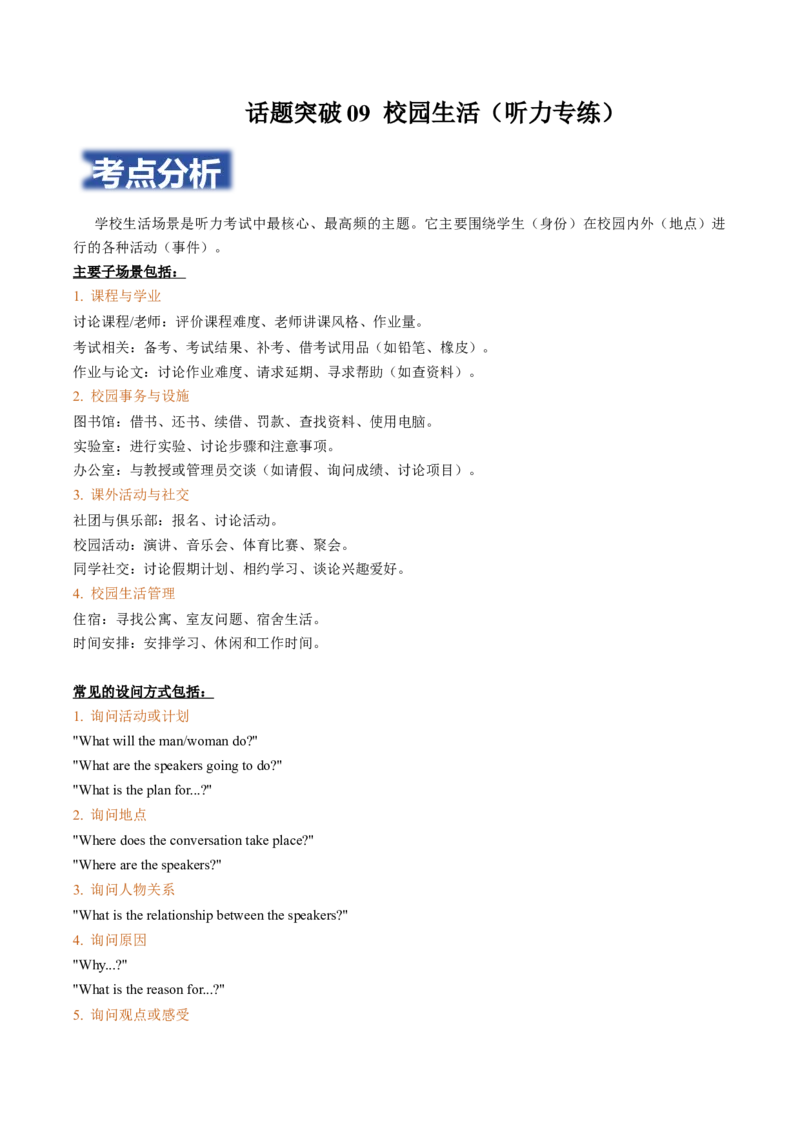
考点分析
话题突破09 校园生活(听力专练)

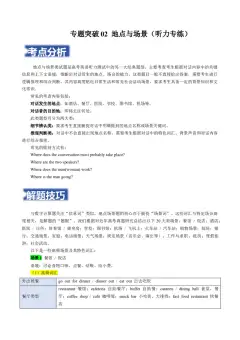
学校生活场景是听力考试中最核心、最高频的主题。它主要围绕学生(身份)在校园内外(地点)进
行的各种活动(事件)。
主要子场景包括:
1. 课程与学业
讨论课程/老师:评价课程难度、老师讲课风格、作业量。
考试相关:备考、考试结果、补考、借考试用品(如铅笔、橡皮)。
作业与论文:讨论作业难度、请求延期、寻求帮助(如查资料)。
2. 校园事务与设施
图书馆:借书、还书、续借、罚款、查找资料、使用电脑。
实验室:进行实验、讨论步骤和注意事项。
办公室:与教授或管理员交谈(如请假、询问成绩、讨论项目)。
3. 课外活动与社交
社团与俱乐部:报名、讨论活动。
校园活动:演讲、音乐会、体育比赛、聚会。
同学社交:讨论假期计划、相约学习、谈论兴趣爱好。
4. 校园生活管理
住宿:寻找公寓、室友问题、宿舍生活。
时间安排:安排学习、休闲和工作时间。
常见

 的设问方式

 包括

 :

1. 询问活动或计划
"What will the man/woman do?"
"What are the speakers going to do?"
"What is the plan for...?"
2. 询问地点
"Where does the conversation take place?"
"Where are the speakers?"
3. 询问人物关系
"What is the relationship between the speakers?"
4. 询问原因
"Why...?"
"What is the reason for...?"
5. 询问观点或感受
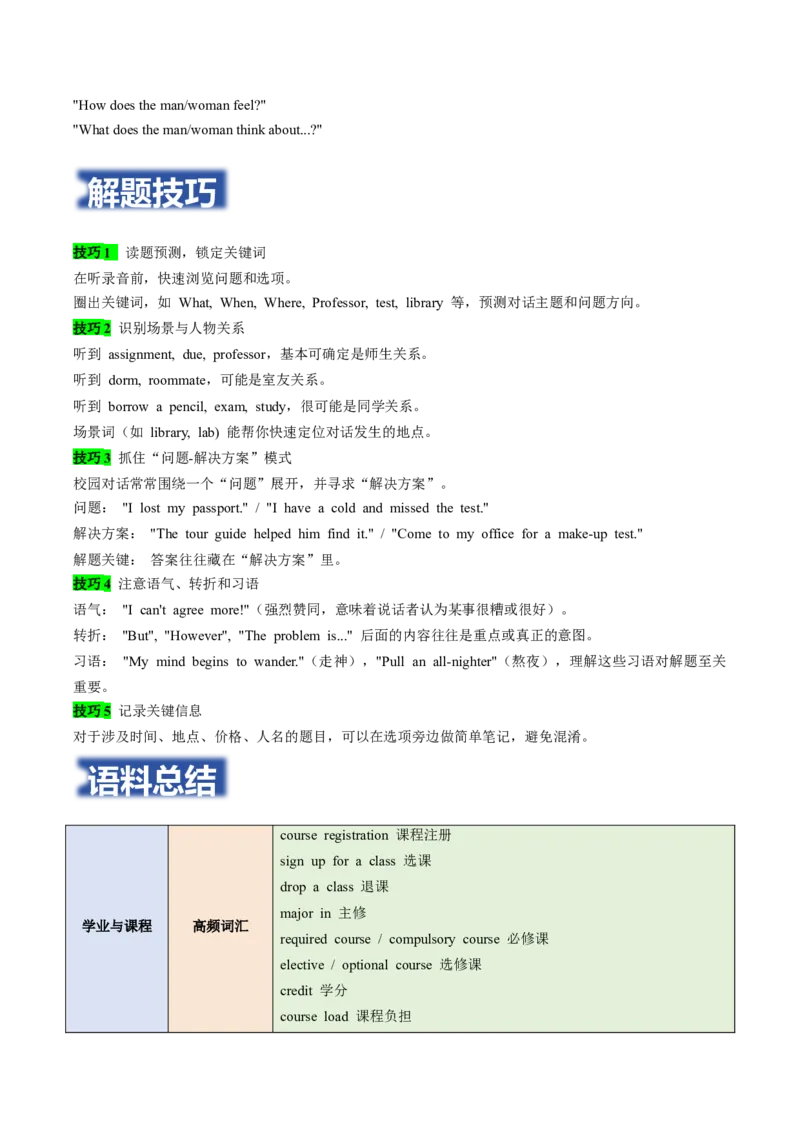
解题技巧
语料总结
"How does the man/woman feel?"
"What does the man/woman think about...?"
技巧1  读题预测,锁定关键词
在听录音前,快速浏览问题和选项。
圈出关键词,如 What, When, Where, Professor, test, library 等,预测对话主题和问题方向。
技巧2 识别场景与人物关系
听到 assignment, due, professor,基本可确定是师生关系。
听到 dorm, roommate,可能是室友关系。
听到 borrow a pencil, exam, study,很可能是同学关系。
场景词(如 library, lab) 能帮你快速定位对话发生的地点。
技巧3 抓住“问题-解决方案”模式
校园对话常常围绕一个“问题”展开,并寻求“解决方案”。
问题: "I lost my passport." / "I have a cold and missed the test."
解决方案: "The tour guide helped him find it." / "Come to my office for a make-up test."
解题关键: 答案往往藏在“解决方案”里。
技巧4 注意语气、转折和习语
语气: "I can't agree more!"(强烈赞同,意味着说话者认为某事很糟或很好)。
转折: "But", "However", "The problem is..." 后面的内容往往是重点或真正的意图。
习语: "My mind begins to wander."(走神),"Pull an all-nighter"(熬夜),理解这些习语对解题至关
重要。
技巧5 记录关键信息
对于涉及时间、地点、价格、人名的题目,可以在选项旁边做简单笔记,避免混淆。
学业与课程
高频词汇
course registration 课程注册
sign up for a class 选课
drop a class 退课
major in 主修
required course / compulsory course 必修课
elective / optional course 选修课
credit 学分
course load 课程负担
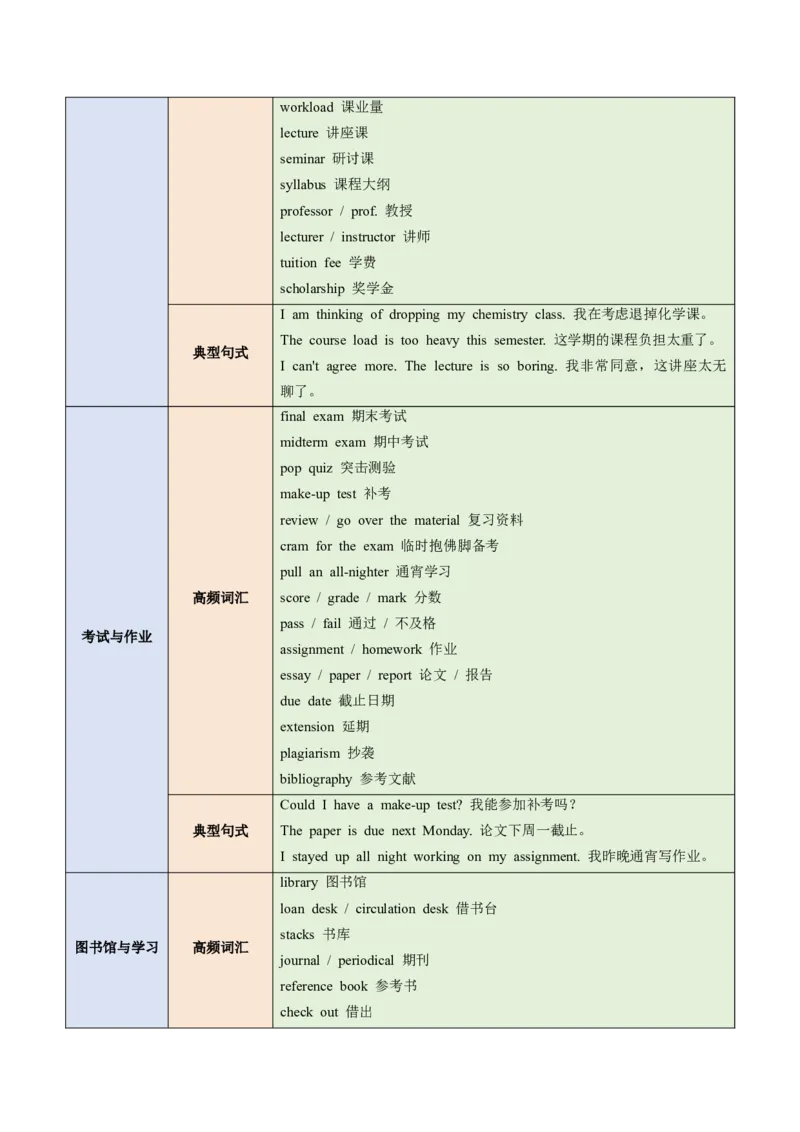
workload 课业量
lecture 讲座课
seminar 研讨课
syllabus 课程大纲
professor / prof. 教授
lecturer / instructor 讲师
tuition fee 学费
scholarship 奖学金
典型句式
I am thinking of dropping my chemistry class. 我在考虑退掉化学课。
The course load is too heavy this semester. 这学期的课程负担太重了。
I can't agree more. The lecture is so boring. 我非常同意,这讲座太无
聊了。
考试与作业
高频词汇
final exam 期末考试
midterm exam 期中考试
pop quiz 突击测验
make-up test 补考
review / go over the material 复习资料
cram for the exam 临时抱佛脚备考
pull an all-nighter 通宵学习
score / grade / mark 分数
pass / fail 通过 / 不及格
assignment / homework 作业
essay / paper / report 论文 / 报告
due date 截止日期
extension 延期
plagiarism 抄袭
bibliography 参考文献
典型句式
Could I have a make-up test? 我能参加补考吗?
The paper is due next Monday. 论文下周一截止。
I stayed up all night working on my assignment. 我昨晚通宵写作业。
图书馆与学习
高频词汇
library 图书馆
loan desk / circulation desk 借书台
stacks 书库
journal / periodical 期刊
reference book 参考书
check out 借出
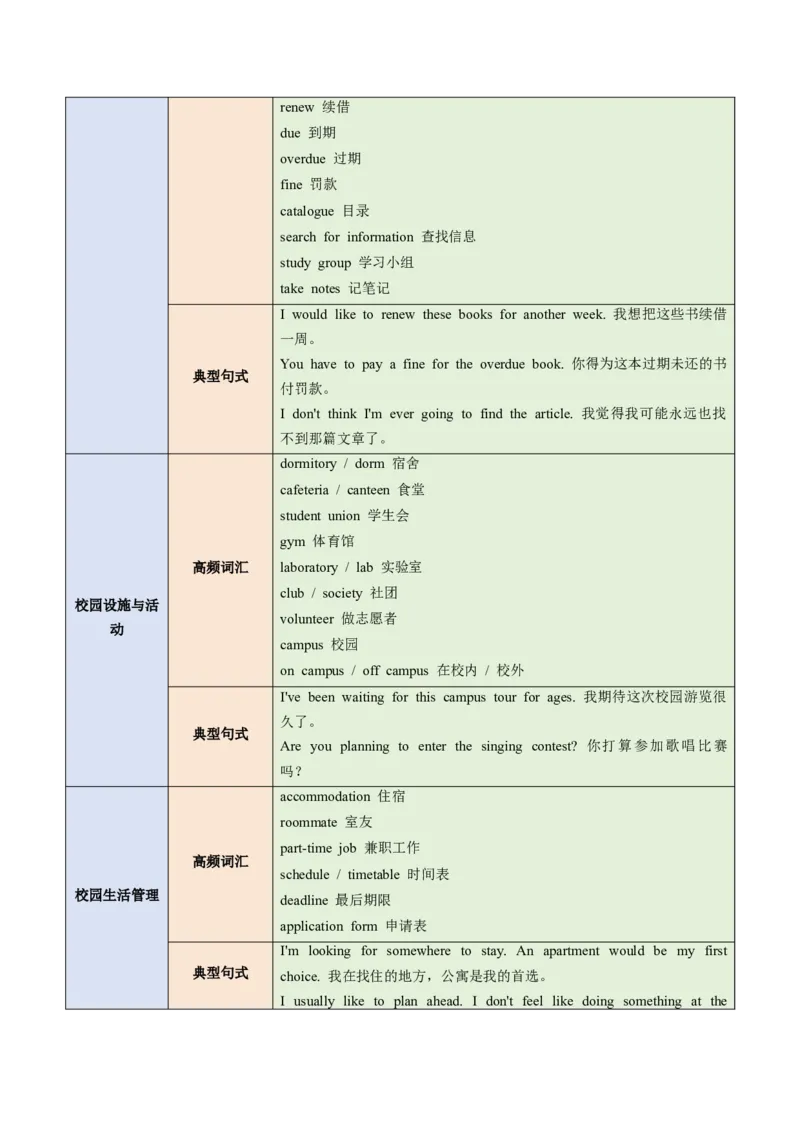
renew 续借
due 到期
overdue 过期
fine 罚款
catalogue 目录
search for information 查找信息
study group 学习小组
take notes 记笔记
典型句式
I would like to renew these books for another week. 我想把这些书续借
一周。
You have to pay a fine for the overdue book. 你得为这本过期未还的书
付罚款。
I don't think I'm ever going to find the article. 我觉得我可能永远也找
不到那篇文章了。
校园设施与活
动
高频词汇
dormitory / dorm 宿舍
cafeteria / canteen 食堂
student union 学生会
gym 体育馆
laboratory / lab 实验室
club / society 社团
volunteer 做志愿者
campus 校园
on campus / off campus 在校内 / 校外
典型句式
I've been waiting for this campus tour for ages. 我期待这次校园游览很
久了。
Are you planning to enter the singing contest? 你打算参加歌唱比赛
吗?
校园生活管理
高频词汇
accommodation 住宿
roommate 室友
part-time job 兼职工作
schedule / timetable 时间表
deadline 最后期限
application form 申请表
典型句式
I'm looking for somewhere to stay. An apartment would be my first
choice. 我在找住的地方,公寓是我的首选。
I usually like to plan ahead. I don't feel like doing something at the
强化训练
last minute. 我通常喜欢提前计划,不喜欢临时做决定。


试题总览
短对话
1
男士在数学学习上遇到困难,女士提议互相辅导(英语)。
2
男士要求女士在周五前完成一篇论文。
3
学生们通过闪烁的灯光而非铃声得知课程结束。
4
女士被告知世界历史课在隔壁的405 教室。
5
男士在书店寻找一本已售罄的书籍。
6
男士会拉小提琴,其妹妹会弹吉他。
7
妹妹提醒哥哥Jason 必须先完成作业才能看电视。
8
Adrew 在学生社团中非常活跃,经常组织活动。
9
男士因每周五有GRE 课程,周六必须在家复习笔记而无法看电影。
10
说话者正在实验室进行实验,并强调要保持针头清洁。
长对话
1
学生寻找教授指定的参考书,并了解“预留阅览”的规定。
2
讨论即将出国留学的行程安排和准备工作。
3
两位新生在午餐时交流对讲座的理解、各自专业及校园生活。
4
两位同学讨论成立读书俱乐部及为首次会议挑选书籍。
5
男生向女生分享关于模拟考试环境、提前了解信息及书写忧虑等多种缓解考试焦
虑的建议。
6
女生向老师寻求生物学习困难的建议,并被鼓励与任课老师沟通。
独白
1
演讲者向家长介绍新校舍的区位、设施、功能和环保设计。
2
艺术系负责人在展览开幕上介绍才华横溢的毕业生及其作品,并引出即将发言的
学生艺术家。
3
校长通过晨间广播向学生说明足球报名、午餐预订新规及手机管理政策。
4
演讲者动员学生为即将排演的戏剧《小美人鱼》参与试镜、舞台 crew 和美术设
计等准备工作。
5
一位幼儿园教师分享了她工作中最具挑战性的环节、最重要的集体活动时间以及
工作带来的幸福感。
练习 1 短对话
听下面10 段对话。每段对话后有一个小题,从题中所给的A、B、C 三个选项中选出最佳选项。听完每段
对话后,你都有10 秒钟的时间来回答有关小题和阅读下一小题。每段对话仅读一遍。
1. What subject does the man have trouble with?
A. Math.
B. Science.
C. English.
2. What does the man ask the woman to finish no later than Friday?
A. A paper.
B. A lecture.
C. An artistic work.
3. How did students know a class has finished today?
A. The bell rang.
B. The lights flashed.
C. The alarm went off.
4. Where is the world history class?
A. In Room 403.
B. In Room 404.
C. In Room 405.
5. Where does the conversation probably take place?
A. In the library.
B. In a bookstore.
C. In the reading room.
6. What instrument can the man play?
A. The piano.
B. The violin.
C. The guitar.
7. What is the most possible relationship between the speakers?
A. Classmates.
B. Brother and sister.
C. Father and daughter.
8. What do we know about Andrew?
A. He’s optimistic.
B. He’s active.
C. He’s shy.
9. What does the man always do on Saturday?
A. See a film.
B. Have a class.
C. Review his notes.
10. Where arc the speakers?
A. At a hospital.
B. At a laboratory.
C. At a classroom.
练习2  中长对话
听下面几段对话。每段对话或独自后有几个小题,从题中所给的A、B、C 三个选项中选出最佳选项,并
标在试卷的相应位置。听每段对话前,你将有时间阅读各个小题,每小题5 秒钟;听完后,各小题将给出
5 秒钟的作答时间。每段对话读两遍。
Dialogue 1
听下面一段较长对话,回答以下小题。
11. Where does the conversation take place?
A. In a classroom.
B. In a bookstore.
C. In a library.
12. What is required if the woman wants to read the book?
A. She must check it out.
B. She must read it in the library.
C. She must reserve it in advance.
13. What will the woman do next?
A. Go to the reserve room.
B. Ask her professor for permission.
C. Find the book in the reading room.
Dialogue 2
听下面一段较长对话,回答以下小题。
14. What did the man do yesterday?
A. He made a flight change.
B. He booked a ticket.
C. He studied.
15. Who will meet the man at the airport?
A. His aunt.
B. His parents.
C. The woman.
16. What does the woman remind the man to do?
A. Phone back.
B. Take photos.
C. Say goodbye.
Dialogue 3
听下面一段较长对话,回答以下小题。
11. What did the man think of Professor Robinson’s speech?
A. It was not difficult at all.
B. It was very interesting.
C. It was a bit confusing.
12. What is the man’s major?
A. Natural Sciences.
B. English.
C. Physics.
13. What is the woman going to do next?
A. Finish her lunch.
B. Buy a map.
C. Attend class.
Dialogue 4
听下面一段较长对话,回答以下小题。
11. What is the probable relationship between the speakers?
A. Writer and fan.
B. Classmates.
C. Teacher and student.
12. What is the woman trying to do?
A. Give a presentation.
B. Finish writing her novel.
C. Organize a reading activity.
13. What does the man mainly learn from the science fiction?
A. The passing nature of time.
B. The development of literature.
C. The reflections on humans and society.
Dialogue 5
听下面一段较长对话,回答以下小题。
13. What is Sean’s first piece of advice for Tara?
A. Adapting to the exam environment in advance.
B. Starting her review with her favorite subject.
C. Making a detailed study plan.
14. What did Tara do yesterday?
A. She reviewed the textbook in the library.
B. She read the exam information.
C. She talked to her teacher.
15. What does Sean always do right before an exam?
A. Write down his worries.
B. Organize exam materials.
C. Breathe deeply for several minutes.
16. How does Sean sound in the end?
A. Nervous.
B. Grateful.
C. Encouraging.
Dialogue 6
听下面一段较长对话,回答以下小题。
14. What is the woman’s problem with biology class?
A. She doesn’t like animals or plants.
B. She can’t understand some concepts.
C. She doesn’t have good learning habits.
15. What is Mr. Anderson’s suggestion?
A. Talking to her biology teacher.
B. Doing more preparation and review.
C. Leaving a good impression on Mrs. Lee.
16. How does Mr. Anderson describe Mrs. Lee?
A. Serious.
B. Kind.
C. Talkative.
练习 3 独白
Passage 1
听下面一段较长独白,回答以下小题。
18. When can students eat in the lunchroom?
A. At 12:30 p.m.
B. At 1:00 p.m.
C. At 1:45 p.m.
19. What can we learn about the building?
A. It is environmentally friendly.
B. It has limited outdoor space.
C. It has a small playground.
20. To whom is the speaker mainly talking?
A. New teachers.
B. Tourists.
C. Parents.
Passage 2
听下面一段独白,回答以下小题。
17. What does the speaker think of the graduating class?
A. They are gifted.
B. They are experienced.
C. They are hard-working.
18. What is the speaker most likely to be good at?
A. Modern painting.
B. Fashion design.
C. Photo taking.
19. Who will probably speak next?
A. James Smith.
B. Jane Goodman.
C. Michael Watts.
20. What is the speaker doing?
A. Giving a class.
B. Awarding prizes.
C. Hosting an exhibition.
Passage 3
听下面一段独白,回答以下小题。
17. Where are the students?
A. On the playground.
B. In the cafeteria.
C. In the school hall.
18. Who is Bill Wyatt?
A. The school director.
B. A football coach.
C. A college student.
19. How can students find out about the lunch menu in advance?
A. From their parents.
B. From the school website.
C. From the posters in the dining hall.
20. What should students do with their cell phones during school?
A. Lock them inside the school gate.
B. Keep them with the school teachers.
C. Leave them inside the teaching buildings.
Passage 4
听下面一段独白,回答以下小题。
17. What is the talk mainly about?
A. A school play.
B. A fantastic festival.
C. A concert on campus.
18. Where should students go to apply for a stage manager?
A. The band room.
B. The video room.
C. The drama room.
19. What is the art students’ main duty?
A. Making posters.
B. Painting furniture.
C. Creating an ocean painting.
20. When will Mrs. Blake’s team have a rehearsal?
A. In March.
B. In April.
C. In May.
Passage 5
听下面一段较长独白,回答以下小题。
18. When is usually the most challenging time for the speaker?
A. Prep time.
B. Circle time (集体活动时间).
C. Greeting time.
19. What activity does circle time usually include?
A. Singing songs.
B. Reading books.
C. Learning math.
20. What does the speaker most probably think of circle play?
A. Boring.
B. Important.
C. Tiring.