综合训练09
第一部分:听力(共两节,满分30 分)
做题时,先将答案标在试卷上,录音内容结束后,有两分钟时间将试卷上的答案转涂到答题卡上。
第一节(共5 小题;每小题1.5 分,满分7.5 分)
听下面5 段对话。每段对话后有一个小题,从题中所给的A、B、C 三个选项中选出最佳选项,并标在
试卷的相应位置。听完每段对话后,你都有 10 秒钟的时间来回答有关小题和阅读下一小题。每段对话仅
读一遍。
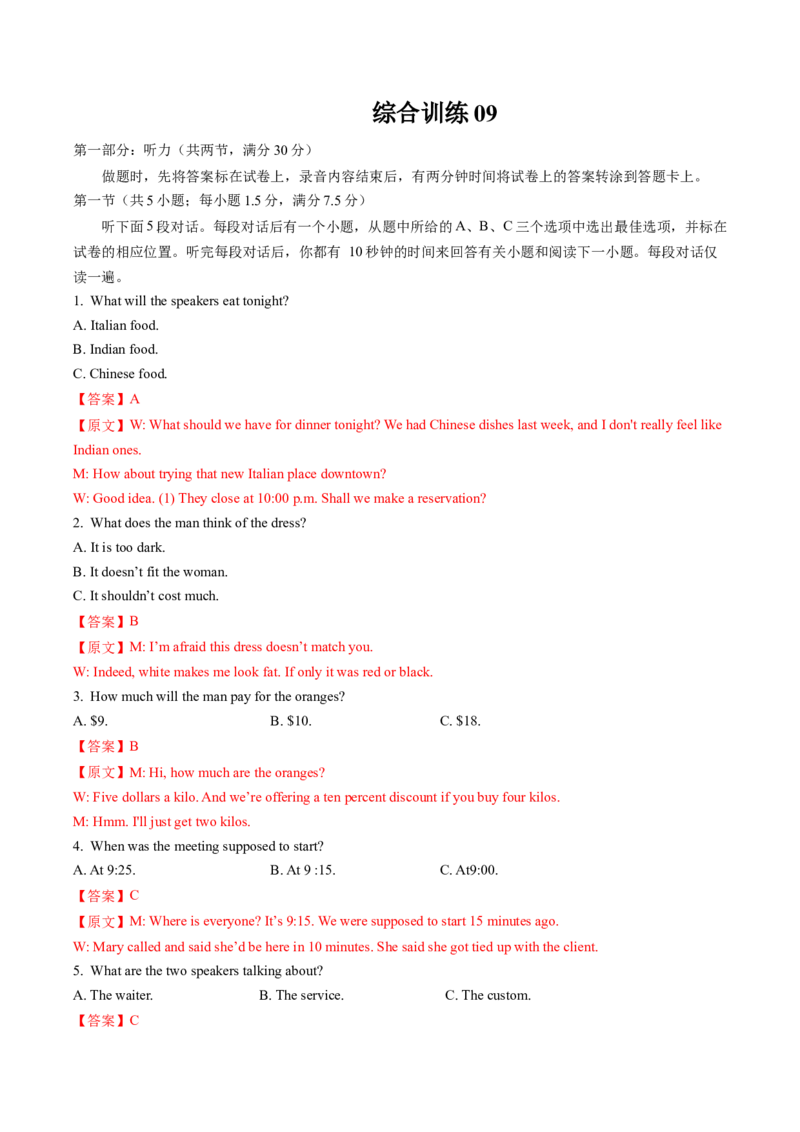
1. What will the speakers eat tonight?
A. Italian food.
B. Indian food.
C. Chinese food.
【答案】A
【原文】W: What should we have for dinner tonight? We had Chinese dishes last week, and I don't really feel like
Indian ones.
M: How about trying that new Italian place downtown?
W: Good idea. (1) They close at 10:00 p.m. Shall we make a reservation?
2. What does the man think of the dress?
A. It is too dark.
B. It doesn’t fit the woman.
C. It shouldn’t cost much.
【答案】B
【原文】M: I’m afraid this dress doesn’t match you.
W: Indeed, white makes me look fat. If only it was red or black.
3. How much will the man pay for the oranges?
A. $9.
B. $10.
C. $18.
【答案】B
【原文】M: Hi, how much are the oranges?
W: Five dollars a kilo. And we’re offering a ten percent discount if you buy four kilos.
M: Hmm. I'll just get two kilos.
4. When was the meeting supposed to start?
A. At 9:25.
B. At 9 :15.
C. At9:00.
【答案】C
【原文】M: Where is everyone? It’s 9:15. We were supposed to start 15 minutes ago.
W: Mary called and said she’d be here in 10 minutes. She said she got tied up with the client.
5. What are the two speakers talking about?
A. The waiter.
B. The service.
C. The custom.
【答案】C
【原文】W: Why’s that waiter so angry?
M: Those people who just left didn’t seem to give him any tip, which made him angry.
W: Is that absolutely necessary here?
M: Kind of. It’s the custom. You can’t really avoid leaving at least a small tip.
第二节(共15 小题;每小题1.5 分,满分22.5 分)
听下面 5 段对话或独白。每段对话或独白后有几个小题,从题中所给的 A、B、C 三个选项中选出最佳
选项,并标在试卷的相应位置。听每段对话或独白前,你将有时间阅读各小题,每小题 5 秒钟;听完后,
各小题将给出 5 秒钟的作答时间。每段对话或独白读两遍。
听第 6 段材料,回答第 6 至 7 题。
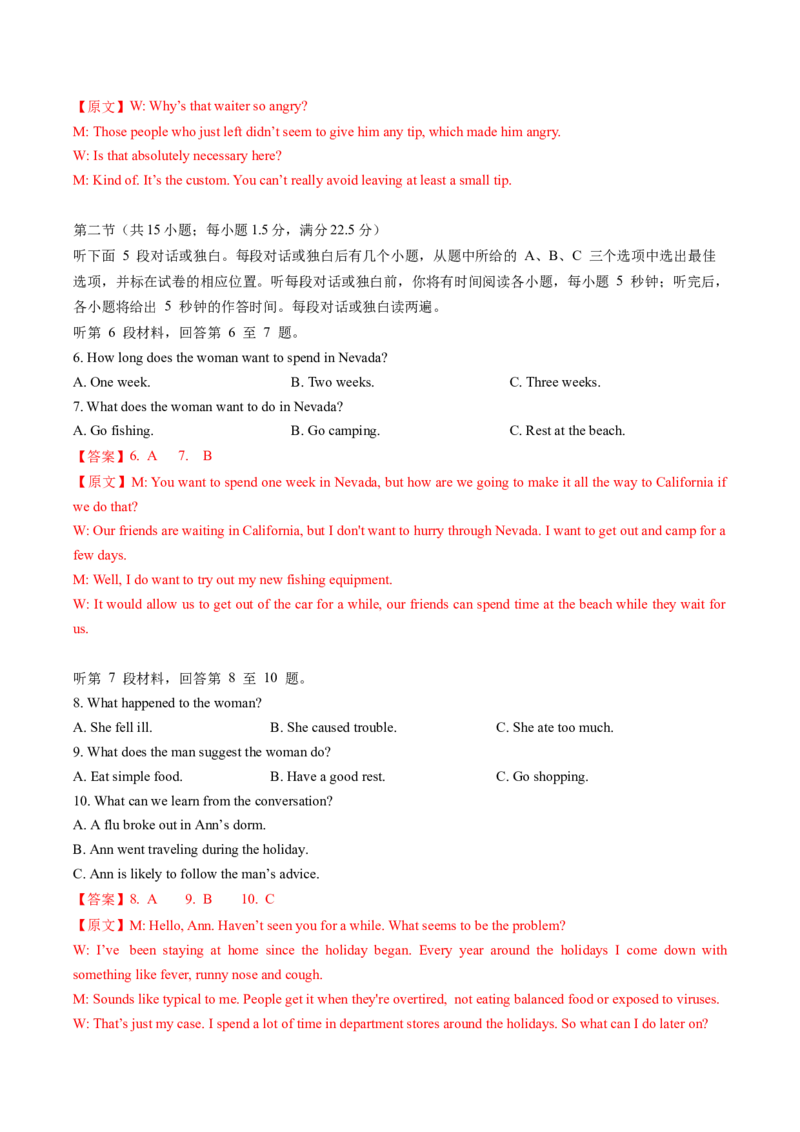
6. How long does the woman want to spend in Nevada?
A. One week.
B. Two weeks.
C. Three weeks.
7. What does the woman want to do in Nevada?
A. Go fishing.
B. Go camping.
C. Rest at the beach.
【答案】6. A   7.  B
【原文】M: You want to spend one week in Nevada, but how are we going to make it all the way to California if
we do that?
W: Our friends are waiting in California, but I don't want to hurry through Nevada. I want to get out and camp for a
few days.
M: Well, I do want to try out my new fishing equipment.
W: It would allow us to get out of the car for a while, our friends can spend time at the beach while they wait for
us.
听第 7 段材料,回答第 8 至 10 题。
8. What happened to the woman?
A. She fell ill.
B. She caused trouble.
C. She ate too much.
9. What does the man suggest the woman do?
A. Eat simple food.
B. Have a good rest.
C. Go shopping.
10. What can we learn from the conversation?
A. A flu broke out in Ann’s dorm.
B. Ann went traveling during the holiday.
C. Ann is likely to follow the man’s advice.
【答案】8. A    9. B    10. C
【原文】M: Hello, Ann. Haven’t seen you for a while. What seems to be the problem?
W: I’ve been staying at home since the holiday began. Every year around the holidays I come down with
something like fever, runny nose and cough.
M: Sounds like typical to me. People get it when they're overtired, not eating balanced food or exposed to viruses.
W: That’s just my case. I spend a lot of time in department stores around the holidays. So what can I do later on?
M: It's simple. Get a lot of rest and eat well.
W: OK. But one more question. What if a flu breaks out in the dorm?
M: Oh, in that case I’d suggest you go have shots in advance...
W: Do you ever see the dogs you trained, like out on the street?
M: Sometimes.
W: Are dogs and cats the only pets people keep?
M: Not really. My dad has spiders. My cousin said he would keep a snake!
W: Wow, that takes courage. By the way, does it cost much to keep a pet?
M: Yeah. Food is probably the biggest cost, but also, if you keep a little dog in your house, they may chew up
everything they can. So we're constantly replacing shoes and cleaning up waste from the carpet and things like
that.
W: I see. Thanks a lot!
听第 8 段材料,回答第 11 至 14 题。
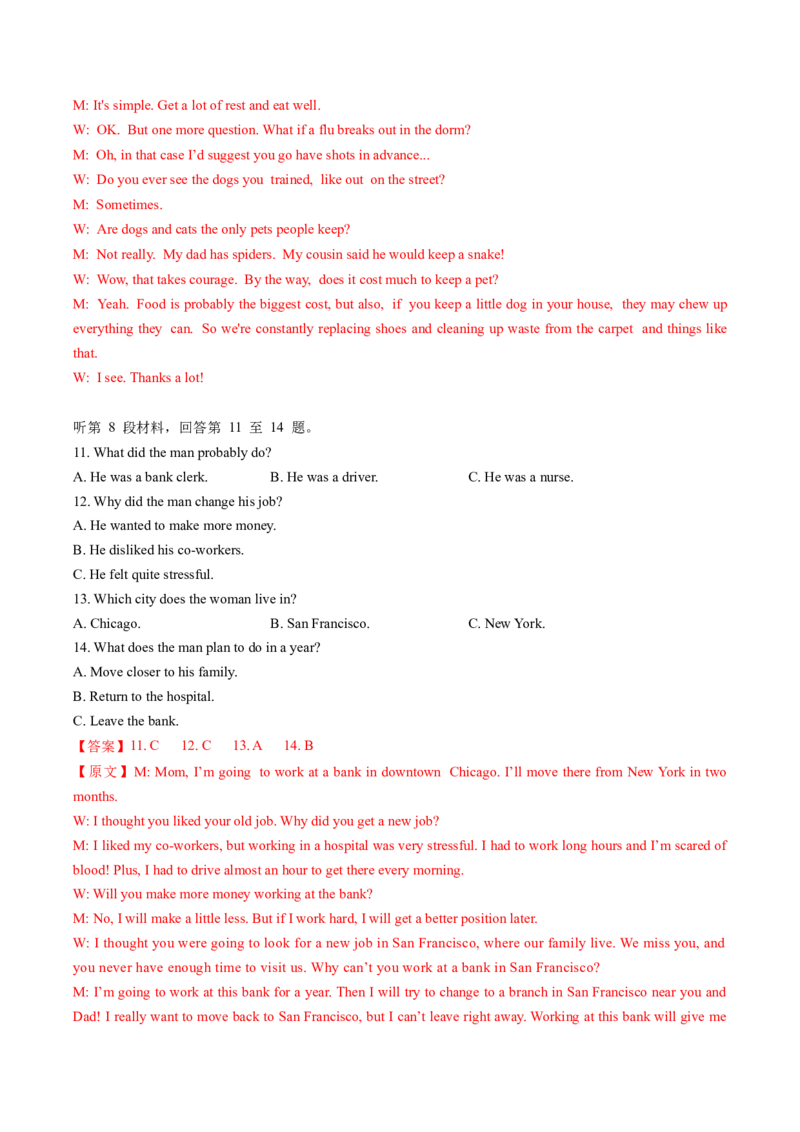
11. What did the man probably do?
A. He was a bank clerk.
B. He was a driver.
C. He was a nurse.
12. Why did the man change his job?
A. He wanted to make more money.
B. He disliked his co-workers.
C. He felt quite stressful.
13. Which city does the woman live in?
A. Chicago.
B. San Francisco.
C. New York.
14. What does the man plan to do in a year?
A. Move closer to his family.
B. Return to the hospital.
C. Leave the bank.
【答案】11. C   12. C   13. A   14. B
【原文】M: Mom, I’m going to work at a bank in downtown Chicago. I’ll move there from New York in two
months.
W: I thought you liked your old job. Why did you get a new job?
M: I liked my co-workers, but working in a hospital was very stressful. I had to work long hours and I’m scared of
blood! Plus, I had to drive almost an hour to get there every morning.
W: Will you make more money working at the bank?
M: No, I will make a little less. But if I work hard, I will get a better position later.
W: I thought you were going to look for a new job in San Francisco, where our family live. We miss you, and
you never have enough time to visit us. Why can’t you work at a bank in San Francisco?
M: I’m going to work at this bank for a year. Then I will try to change to a branch in San Francisco near you and
Dad! I really want to move back to San Francisco, but I can’t leave right away. Working at this bank will give me
some good experience.
听第 9 段材料,回答第 15 至 17 题。
15. What is the relationship between the speakers?
A. Friends.             B. Strangers.               C. Teacher and student.
16. How can James be admitted into the University of Calgary?
A. By achieving 3 As.
B. By passing the 4 courses.
C. By getting A in literature.
17. What major is James planning to study?
A. History.              B. Literature.             C. Economics.
【答案】15. A    16. A    17.   C
【原文】W: [15]① James, what courses did you take?
M: History, literature, law, and language.
W: Do you think you can all pass?
M: I bet I’ve passed, but I’m not sure what grades I will get. I want to study economics at the University of
Calgary, but they won’t give me a chance.
W: You’re not allowed? Why?
M: [16] Unless I get at least three A’s in all my courses.
W: Can you make it?
M: I’m not sure. I’m especially worried about my literature. It’s a bit tough and complicated.
W: Cheer up! You still have chances without literature.
M: [15]② Thanks, buddy!
W: When will you get your results?
M: Not until the day after tomorrow. I’m now on pins and needles.
W: Take it easy. What will you do if you are allowed to?
M: [17] I suppose I’ll take up economics for another year.
W: Good luck to you!
听第 10 段材料,回答第 18 至 20 题。
18. What is Famous Lives?
A. A magazine column.
B. A talk show.
C. A film.
19. How many copies has Nicholas Sparks sold out of the United States?
A. About 97 million.
B. About 65 million.
C. About 32 million.
20. What does the Nicholas Sparks Foundation do?
A. It helps students practice traditional values.
B. It gives scholarships to poor kids.
C. It provides books for rural communities.
【答案】18. B    19. C    20. B
【原文】W: Welcome to Famous Lives, where we meet distinguished writers and discuss who they are and what
makes them successful. Today’s guest is Nicholas Sparks, an American author and storyteller whose books have
consistently been turned into major Hollywood films. He has sold over 97 million copies worldwide, with over 65
million of them in the United States alone. He’s also considered to be very generous with his money. He created the
Nicholas Sparks Foundation, which creates scholarships for children from low-income families in rural
communities. He also founded the Epiphany School in North Carolina. The school’s main goal is to help students
practice the values of respect, responsibility, service, and honesty on a daily basis. In today's interview, we’ll ask
Nicholas Sparks about his favorite books, why his career is so important to him, and what he has in store for the
future. That’s all coming up right after commercials. Don't go away!