考点分析
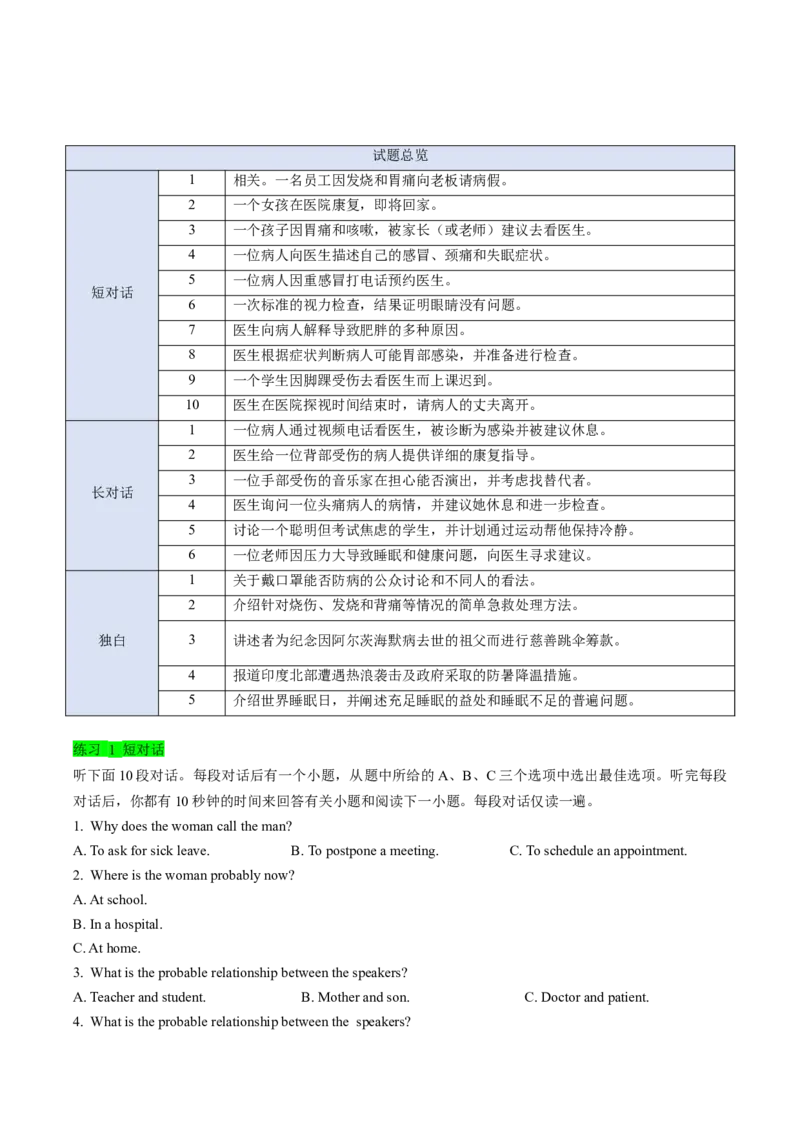
话题突破11 疾病医疗(听力专练)

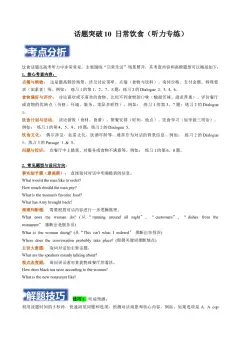
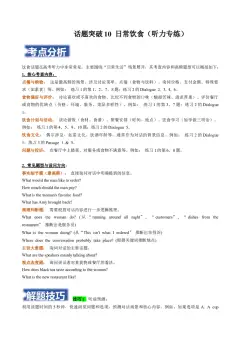
疾病医疗话题是高考听力的核心场景之一,主要围绕“健康与就诊”展开,其考查内容和高频题型可以概
括如下:
1.   核心考查内容:


症状描述与病因询问: 这是最基础的场景。涉及病人描述身体不适(如头痛、发烧、咳嗽、胃痛、失眠
等)以及医生或他人询问病情细节和可能原因。例如: “What is the man’s problem?” “How long
has he been feeling this way?”
诊断与治疗建议: 医生或他人根据症状给出诊断结果和具体的处理建议,如服药、休息、手术或改变生
活习惯。例如: “What does the doctor suggest the woman do?” “Why doesn’-t the man need an
operation?”
医院与诊所场景: 对话直接发生在医患之间,涉及预约、检查、询问医疗费用等。例如: “ Where does
this conversation most probably take place?” “ What is the probable relationship between the
speakers?”
日常健康问题: 非紧急的日常对话,如朋友或家人之间关心对方的健康状况、请假、解释为何缺席活动
等。例如: “Why can’t the man attend the meeting?” “He called in sick.”
意外伤害与处理: 描述因事故(如摔倒、车祸、运动损伤)导致的伤害及其紧急处理过程。例如:
“What happened to the man’s leg?” “He broke it while playing basketball.”
2.   常见题型与设问方向

 :
事实细节题(最高频): 直接询问对话中明确提到的医疗信息。
What is the man's problem? (e.g., a headache, a broken leg)
What caused the man's back injury? (e.g., while on vacation)
What does the doctor advise him to do? (e.g., take some medicine and rest)
When should the man take the pills? (e.g., three times a day after meals)
推理判断题: 需要根据对话内容进行一步逻辑推理。
Where does this conversation probably take place? (根据关键词推断在医院、诊所、牙科医院 hospital,
clinic, dentist's)
What is the probable relationship between the speakers? (从对话内容推断是医患关系 doctor-patient 或护
士与病人 nurse-patient)
How does the woman feel now? (根据描述的病症推断其感受,如 tired, anxious, in pain)
行动计划题: 询问说话者接下来很可能要做什么。
What will the man do next? (e.g., go to see a doctor, pick up his prescription at the pharmacy)
What is the woman going to do this afternoon? (e.g., stay in bed and rest)
主旨大意题: 询问对话的主要话题。
What are the speakers mainly talking about? (选项通常为概括性短语,如 the man's health problem, a
解题技巧
medical treatment)
技巧1 听前预测,锁定场景
利用读题时间的几秒钟,快速浏览问题和选项。如果看到 headache, doctor, medicine, rest 等词,立刻在
脑中构建一个“医疗健康”场景,并预测对话可能会讨论 症状、病因、建议 这三个核心要素。
技巧2 抓住“问题-回应”逻辑链
医疗对话有非常清晰的逻辑结构:
陈述问题:“I have a sore throat and my chest hurts.”
追问细节/原因:“How long have you been like this?”
给出诊断/建议:“I think you've got the flu. Take this medicine and go straight to bed.”
听音时,有意识地去捕捉和串联这三部分信息,答案往往就隐藏在其中。
技巧3 聚焦“转折”与“建议”
听力材料中,转折词和建议句式之后往往是答案的藏身之处。
转折:“I thought it was just a cold, but the doctor said it might be something more serious.” (重点在
but 之后)
建议:“You should drink more water.” / “You ‘d better stay in bed.” / “Why don't you see a
dentist?” (这些句式后的内容通常是行动计划题的答案)
技巧4 识别场景标志词
听到特定词汇,能迅速帮你定位场景和人物关系。
医院/诊所:doctor, dentist, nurse, patient, appointment, check-up, examination, prescription, operation
症状:fever, cough, ache (head/tooth/stomach-), pain, feel dizzy/sick/tired
治疗:medicine, pill, take three times a day, rest, injection, surgery
技巧5 理解“弦外之音”与语气
对于推理题,要结合说话人的语气。一个虚弱、咳嗽的声音很可能表示生病。
当病人说“I'm fine” 但声音颤抖时,可能并非真的没事。
医生的语气通常是安抚的 (Don't worry) 或专业的 (I suggest that...)。
技巧6 注意同义转述
高考听力答案很少使用原文原词,经常进行同义替换。
原文:"I'm running a temperature."
语料总结
选项:He has a fever.
原文:"The doctor told me to stay in bed."
选项:He was advised to have a rest.
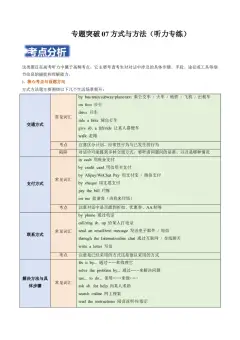
核心场景
与活动
describing symptoms & causes 描述症状与病因
seeing a doctor / dentist 看医生/牙医
getting treatment & advice 接受治疗与建议
at the hospital 在医院 (挂号、检查、手术、探病)
daily health concerns 日常健康关切 (请假、关心他人健康状况)
accidents & injuries 意外与伤害
人物角色
doctor / physician 医生
dentist 牙医
surgeon 外科医生
nurse 护士
patient 病人
friend / family member / colleague 朋友 / 家人 / 同事
食物与饮
料
常见疾病
a cold / the flu 感冒 / 流感
a fever / running a temperature 发烧
a cough / a sore throat 咳嗽 / 喉咙痛
a headache / stomachache / toothache / backache 头/胃/牙/背痛
a broken leg/arm 腿/手臂骨折
a cut / a burn 割伤 / 烧伤
身体感受与症状
feel dizzy / sick / terrible / awful 感到头晕/恶心/糟透了
feel tired / weak / exhausted 感到疲劳/虚弱/精疲力尽
can't sleep / have insomnia 失眠
have a pain in... (my chest/back) ...(胸口/背)痛
It hurts. 很疼。
诊断、治
疗与建议
检查与诊断
examination / check-up 检查 / 体检
test / X-ray 化验 / X 光
diagnosis 诊断
What seems to be the problem? 哪里不舒服?
How long have you been like this? 你这样多久了?
治疗方式
treatment 治疗
强化训练
medicine / pill 药 / 药片
prescription 处方
operation / surgery 手术
injection / shot 注射
take the medicine three times a day 一天服药三次
医嘱与建议
rest / have a rest 休息
stay in bed 卧床休息
drink more water 多喝水
avoid spicy food 避免辛辣食物
get some fresh air 透透气
You should / You'd better... 你应该/你最好……
场所与相
关概念
场所
hospital 医院
clinic 诊所
dentist's (surgery) 牙科诊所
emergency room 急诊室
pharmacy / drugstore 药房
相关概念
appointment 预约
visiting hours 探视时间
bill / fee 账单 / 费用
insurance 保险
recover / recovery 康复
常用表达
与句式
陈述问题
I'm not feeling well. 我感觉不舒服。
I think I'm coming down with something. 我觉得我好像生病了。
I've come to see Dr. Smith. 我来找史密斯医生看病。
表示关心
What's the matter? / What's wrong? 你怎么了?
You look pale. Are you OK? 你脸色苍白,没事吧?
I'm sorry to hear that. 听到这个消息我很难过。
请假与解释
I'm afraid I can't come to work/class today. 恐怕我今天不能来上班/上课
了。
I called in sick. 我打电话请了病假。
He had an accident. 他出了个意外。
医嘱与回应
Take it easy. 放轻松/别紧张。
Get well soon. 祝你早日康复。
I'll follow your advice. 我会听从您的建议。


试题总览
短对话
1
相关。一名员工因发烧和胃痛向老板请病假。
2
一个女孩在医院康复,即将回家。
3
一个孩子因胃痛和咳嗽,被家长(或老师)建议去看医生。
4
一位病人向医生描述自己的感冒、颈痛和失眠症状。
5
一位病人因重感冒打电话预约医生。
6
一次标准的视力检查,结果证明眼睛没有问题。
7
医生向病人解释导致肥胖的多种原因。
8
医生根据症状判断病人可能胃部感染,并准备进行检查。
9
一个学生因脚踝受伤去看医生而上课迟到。
10
医生在医院探视时间结束时,请病人的丈夫离开。
长对话
1
一位病人通过视频电话看医生,被诊断为感染并被建议休息。
2
医生给一位背部受伤的病人提供详细的康复指导。
3
一位手部受伤的音乐家在担心能否演出,并考虑找替代者。
4
医生询问一位头痛病人的病情,并建议她休息和进一步检查。
5
讨论一个聪明但考试焦虑的学生,并计划通过运动帮他保持冷静。
6
一位老师因压力大导致睡眠和健康问题,向医生寻求建议。
独白
1
关于戴口罩能否防病的公众讨论和不同人的看法。
2
介绍针对烧伤、发烧和背痛等情况的简单急救处理方法。
3
讲述者为纪念因阿尔茨海默病去世的祖父而进行慈善跳伞筹款。
4
报道印度北部遭遇热浪袭击及政府采取的防暑降温措施。
5
介绍世界睡眠日,并阐述充足睡眠的益处和睡眠不足的普遍问题。
练习 1 短对话
听下面10 段对话。每段对话后有一个小题,从题中所给的A、B、C 三个选项中选出最佳选项。听完每段
对话后,你都有10 秒钟的时间来回答有关小题和阅读下一小题。每段对话仅读一遍。
1. Why does the woman call the man?
A. To ask for sick leave.
B. To postpone a meeting.
C. To schedule an appointment.
2. Where is the woman probably now?
A. At school.
B. In a hospital.
C. At home.
3. What is the probable relationship between the speakers?
A. Teacher and student.
B. Mother and son.
C. Doctor and patient.
4. What is the probable relationship between the speakers?
A. Doctor and patient.
B. Husband and wife.
C. Parent and child.
5. What’s the probable relationship between the speakers?
A. Nurse and patient.
B. Doctor and nurse.
C. Doctor and patient.
6. What is the man probably doing?
A. Seeing an eye doctor.
B. Learning maths.
C. Playing a game.
7. What does the woman say about the reasons for getting fat?
A. Simple.
B. Unknown.
C. Various.
8. What is the relationship between the speakers?
A. Husband and wife.
B. Doctor and patient.
C. Teacher and student.
9. What is the woman’s reason for being late?
A.She missed the bus.
B.She went to see a doctor.
C.She practiced soccer.
10. Where does this conversation take place?
A. In a classroom.
B. In a hospital.
C. In a museum.
练习2  中长对话
听下面几段对话。每段对话后有几个小题,从题中所给的A、B、C 三个选项中选出最佳选项,并标在试
卷的相应位置。听每段对话前,你将有时间阅读各个小题,每小题5 秒钟;听完后,各小题将给出5 秒钟
的作答时间。每段对话读两遍。
Dialogue 1
听下面一段较长对话,回答以下小题。
6. How did the woman consult her doctor this time?
A. In person.
B. By phone.
C. By video call.
7. What does the man think of going on public transport while ill?
A. It’s better to avoid it.
B. It’s acceptable in certain situations.
C. It’s wise to do so in the early morning.
Dialogue 2
听下面一段较长对话,回答以下小题。
8. How often does the man work out in the gym?
A. Once a week.
B. Twice a week.
C. Three times a week.
9. Where does the conversation probably take place?
A. At a hospital.
B. In a gym.
C. On a football field.
Dialogue 3
听下面一段较长对话,回答以下小题。
11. What concerns Susan most about the concert?
A. The performance.
B. The ticket sale.
C. The audience.
12. How does Susan describe Jim?
A. Unskilled.
B. Unfriendly.
C. Undependable.
13. What does Susan decide to do finally?
A. Practice harder.
B. Communicate with Jim.
C. Cancel the concert.
Dialogue 4
听下面一段较长对话,回答以下小题。
10. What is wrong with the woman?
A. She has a fever.
B. She has a headache.
C. She has a sleeping problem.
11. What did the woman do last night?
A. She prepared for a meeting.
B. She attended a meeting.
C. She went to bed early.
12. What does the man ask the woman to do?
A. Quit the job.
B. Take some medicine.
C. Have a rest.
Dialogue 5
听下面一段较长对话,回答以下小题。
10. What problem does Roger have with exams?
A. He isn’t clever.
B. He isn’t confident.
C. He doesn’t work hard.
11. How does the man decide to help Roger?
A. By helping him to stay calm.
B. By finding an expert for him.
C. By giving him some advice about his future.
12. What do we know about the woman?
A. She is easy to be tired.
B. She often feels nervous.
C. She finds exercise is a good way to relax.
Dialogue 6
听下面一段较长对话,回答以下小题。
14. How long does the woman sleep at night?
A. Six to seven hours.
B. Seven to eight hours.
C. Eight to nine hours.
15. Why does the woman feel sick?
A. She seldom exercises.
B. She gets up early every day.
C. She suffers from much pressure.
16. What is the woman?
A. A student.
B. A teacher.
C. A singer.
17. What is the man’s last advice?
A. Getting more physical exercise.
B. Chatting with close friends.
C. Taking sleeping pills.
练习 3 独白
Passage 1
听下面一段较长独白,回答以下小题。
17. What has created widespread debate?
A. What color masks to choose.
B. Whether to wear a face mask.
C. When the disease will be over.
18. Why was a person in Landon against face masks?
A. Face masks cost too much.
B. There's medicine to handle the disease.
C. Diseases kill people every year.
19. How does Moret like wearing masks?
A. It's a necessity in life.
B. It's not the normal life.
C. It's cheap and effective.
20. What does Laura do every morning?
A. Pick a suitable face mask.
B. Bring some masks for others.
C. listen to the local news events.
Passage 2
听下面一段独白,回答以下小题。
17. How long should people put their burnt hands in cool water?
A. About 20 minutes
B. About 12 minutes
C. About 10 minutes.
18. How should people bring down the temperature?
A. By keeping warm
B. By taking bath
C. By shutting the window.
19. What should people do to deal with backaches?
A. Keep moving gently
B. Lift some heavy boxes
C. Go to bed and rest until it gets
better.
20. What is the speaker mainly discussing?
A. Situations calling for first aid.
B. Mistakes in dealing with injuries.
C. Simple treatment for some situations.
Passage 3
听下面一段独白,回答以下小题。
18. How did the speaker’s grandfather die?
A. Due to a disease.
B. During a charity event.
C. Because of a plane crash.
19. Why did the speaker decide to skydive?
A. To help some patients.
B. To have fun with friends.
C. To overcome a fear of heights.
20. What does the speaker think was the best aspect about the skydive?
A. Falling from 2,000 meters.
B. Hearing stories about Alzheimer’s.
C. Raising a large amount of money.
Passage 4
听下面一段独白,回答以下小题。
17. What are the highest temperatures in Northern India now?
A. About 35℃.
B. Almost 40℃.
C. Over 45℃.
18. How many Indian people died in 2016 due to heat-related illnesses?
A. About 200.
B. About 1,000.
C. About 2,000.
19. What will be done under extremely high temperatures?
A. Government projects will be done at night.
B. Bottles of water will be sold at low prices.
C. School days will be reduced.
20. What will the weather be like late this month in India?
A. Cooler.
B. All the same.
C. Hotter.
Passage 5
听下面一段独白,回答以下小题。
17. On which day is World Sleep Day held?
A. March 21.
B. March 25.
C. March 31.
18. What benefit is mentioned about enough sleep?
A. Being stronger.
B. Being cleverer.
C. Being more active.
19. What percentage of adults have a full eight hours of sleep each day?
A. 21%.
B. 27%.
C. 80%.
20. What can we learn from the passage?
A. World Sleep Day started in 2006.
B. Teenagers need at least 8 hours of sleep a night.
C. 80% of people throughout the world have sleep problems.