综合训练01
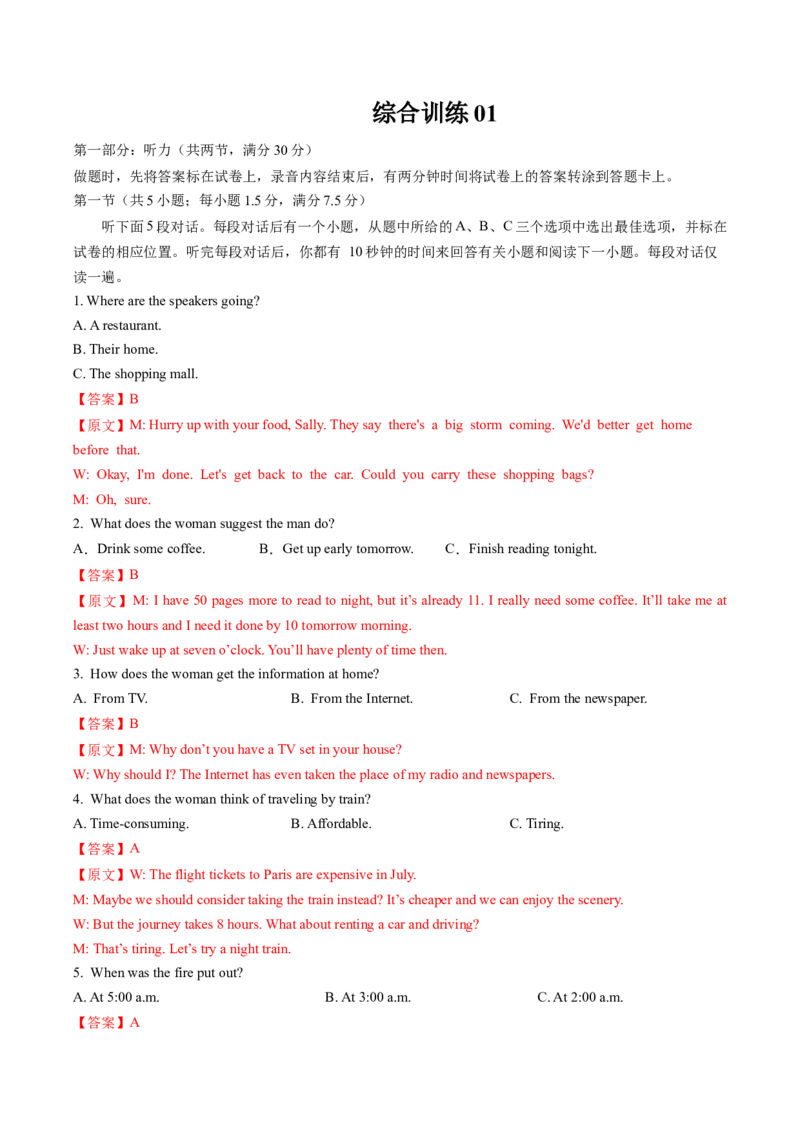
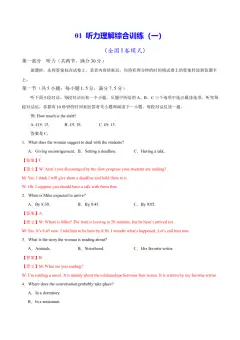
第一部分:听力(共两节,满分30 分)
做题时,先将答案标在试卷上,录音内容结束后,有两分钟时间将试卷上的答案转涂到答题卡上。
第一节(共5 小题;每小题1.5 分,满分7.5 分)
听下面5 段对话。每段对话后有一个小题,从题中所给的A、B、C 三个选项中选出最佳选项,并标在
试卷的相应位置。听完每段对话后,你都有 10 秒钟的时间来回答有关小题和阅读下一小题。每段对话仅
读一遍。
1. Where are the speakers going?
A. A restaurant.
B. Their home.
C. The shopping mall.
【答案】B
【原文】M: Hurry up with your food, Sally. They say there's a big storm coming. We'd better get home
before that.
W: Okay, I'm done. Let's get back to the car. Could you carry these shopping bags?
M: Oh, sure.
2. What does the woman suggest the man do?
A.Drink some coffee.
B.Get up early tomorrow.
C.Finish reading tonight.
【答案】B
【原文】M: I have 50 pages more to read to night, but it’s already 11. I really need some coffee. It’ll take me at
least two hours and I need it done by 10 tomorrow morning.
W: Just wake up at seven o’clock. You’ll have plenty of time then.
3. How does the woman get the information at home?
A. From TV.
B. From the Internet.
C. From the newspaper.
【答案】B
【原文】M: Why don’t you have a TV set in your house?
W: Why should I? The Internet has even taken the place of my radio and newspapers.
4. What does the woman think of traveling by train?
A. Time-consuming.
B. Affordable.
C. Tiring.
【答案】A
【原文】W: The flight tickets to Paris are expensive in July.
M: Maybe we should consider taking the train instead? It’s cheaper and we can enjoy the scenery.
W: But the journey takes 8 hours. What about renting a car and driving?
M: That’s tiring. Let’s try a night train.
5. When was the fire put out?
A. At 5:00 a.m.
                  B. At 3:00 a.m.
   C. At 2:00 a.m.
【答案】A
【原文】M: Do you know a big fire that broke out in the city center at 2:00 a.m.?
W: Yes, luckily,no one was hurt. And it took 3 hours for the firefighters to put it out.
第二节(共15 小题;每小题1.5 分,满分22.5 分)
听下面 5 段对话或独白。每段对话或独白后有几个小题,从题中所给的 A、B、C 三个选项中选出
最佳选项,并标在试卷的相应位置。听每段对话或独白前,你将有时间阅读各小题,每小题 5 秒钟;听
完后,各小题将给出 5 秒钟的作答时间。每段对话或独白读两遍。
听第 6 段材料,回答第 6 至 7 题。
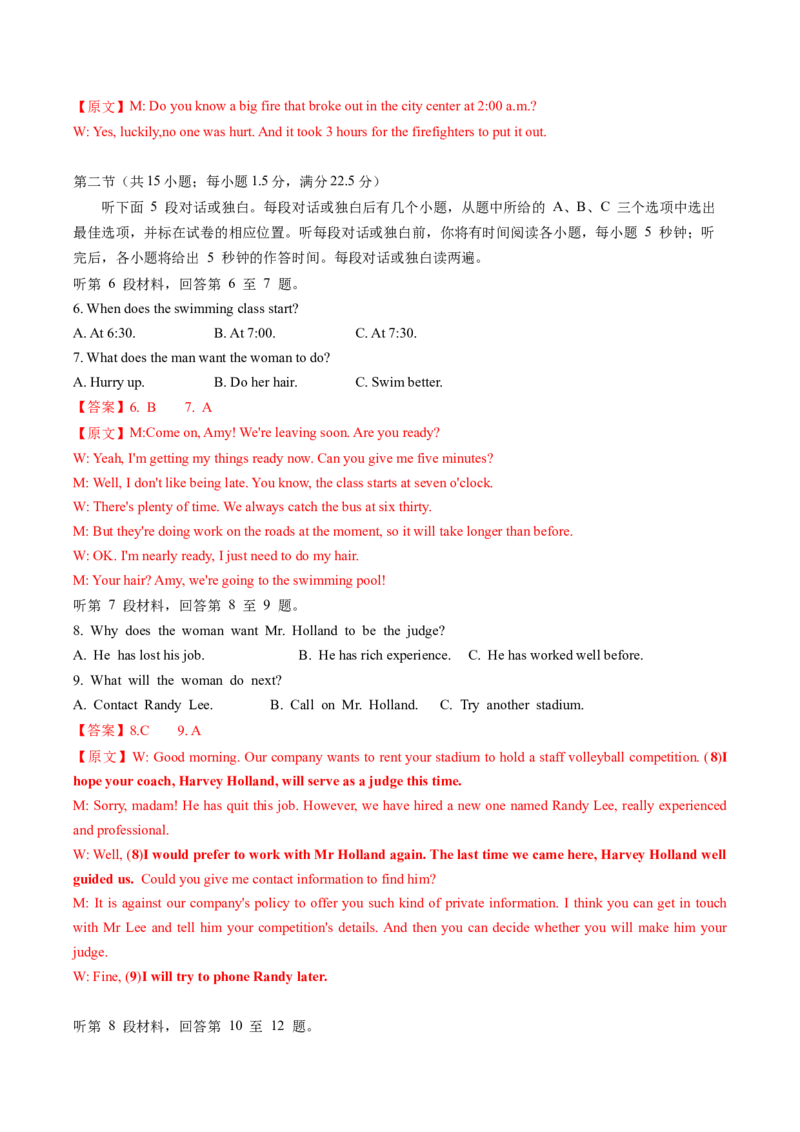
6. When does the swimming class start?
A. At 6:30.
B. At 7:00.
C. At 7:30.
7. What does the man want the woman to do?
A. Hurry up.
B. Do her hair.
C. Swim better.
【答案】6. B    7. A
【原文】M:Come on, Amy! We're leaving soon. Are you ready?
W: Yeah, I'm getting my things ready now. Can you give me five minutes?
M: Well, I don't like being late. You know, the class starts at seven o'clock.
W: There's plenty of time. We always catch the bus at six thirty.
M: But they're doing work on the roads at the moment, so it will take longer than before.
W: OK. I'm nearly ready, I just need to do my hair.
M: Your hair? Amy, we're going to the swimming pool!
听第 7 段材料,回答第 8 至 9 题。
8. Why does the woman want Mr. Holland to be the judge?
A. He has lost his job.
B. He has rich experience.  C. He has worked well before.
9. What will the woman do next?
A. Contact Randy Lee.
B. Call on Mr. Holland.  C. Try another stadium.
【答案】8.C    9. A
【原文】W: Good morning. Our company wants to rent your stadium to hold a staff volleyball competition. (8)I
hope your coach, Harvey Holland, will serve as a judge this time.
M: Sorry, madam! He has quit this job. However, we have hired a new one named Randy Lee, really experienced
and professional.
W: Well, (8)I would prefer to work with Mr Holland again. The last time we came here, Harvey Holland well
guided us. Could you give me contact information to find him?
M: It is against our company's policy to offer you such kind of private information. I think you can get in touch
with Mr Lee and tell him your competition's details. And then you can decide whether you will make him your
judge.
W: Fine, (9)I will try to phone Randy later.
听第 8 段材料,回答第 10 至 12 题。
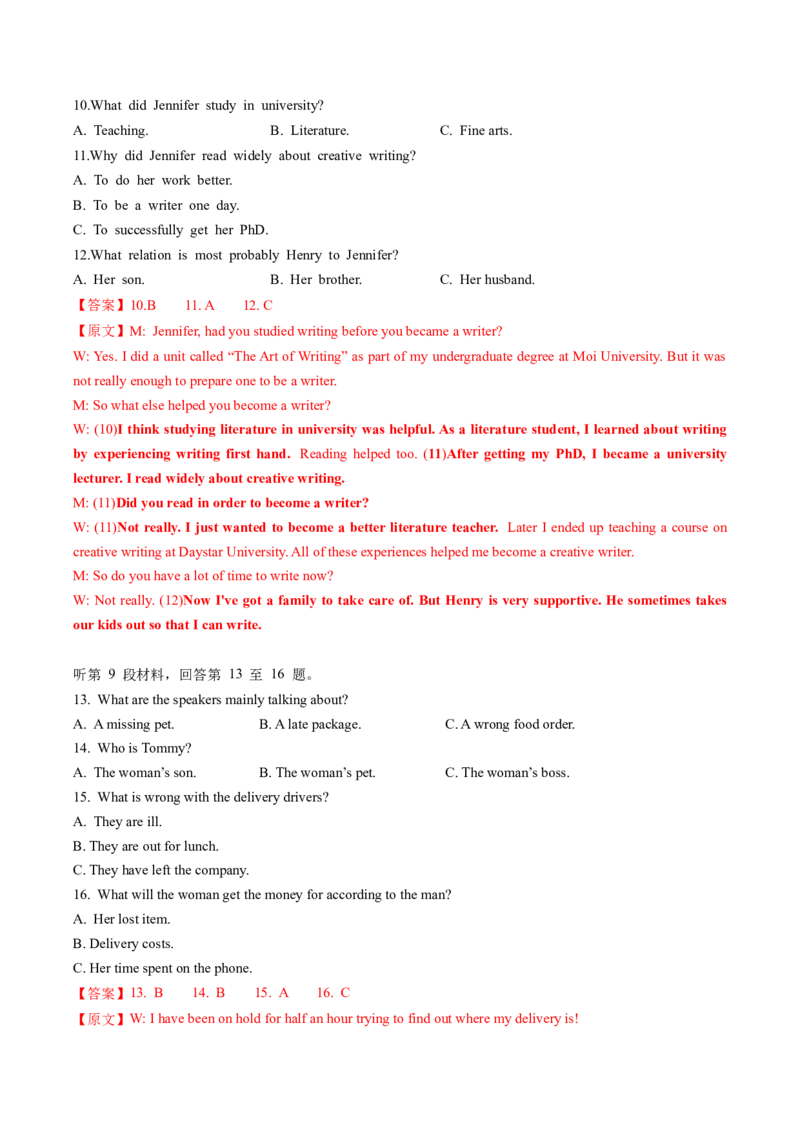
10.What did Jennifer study in university?
A. Teaching.
B. Literature.
C. Fine arts.
11.Why did Jennifer read widely about creative writing?
A. To do her work better.
B. To be a writer one day.
C. To successfully get her PhD.
12.What relation is most probably Henry to Jennifer?
A. Her son.
B. Her brother.
C. Her husband.
【答案】10.B    11. A
12. C
【原文】M: Jennifer, had you studied writing before you became a writer?
W: Yes. I did a unit called “The Art of Writing” as part of my undergraduate degree at Moi University. But it was
not really enough to prepare one to be a writer.
M: So what else helped you become a writer?
W: (10)I think studying literature in university was helpful. As a literature student, I learned about writing
by experiencing writing first hand. Reading helped too. (11)After getting my PhD, I became a university
lecturer. I read widely about creative writing.
M: (11)Did you read in order to become a writer?
W: (11)Not really. I just wanted to become a better literature teacher. Later I ended up teaching a course on
creative writing at Daystar University. All of these experiences helped me become a creative writer.
M: So do you have a lot of time to write now?
W: Not really. (12)Now I've got a family to take care of. But Henry is very supportive. He sometimes takes
our kids out so that I can write.
听第 9 段材料,回答第 13 至 16 题。
13. What are the speakers mainly talking about?
A. A missing pet.
B. A late package.
C. A wrong food order.
14. Who is Tommy?
A. The woman’s son.
B. The woman’s pet.
C. The woman’s boss.
15. What is wrong with the delivery drivers?
A. They are ill.
B. They are out for lunch.
C. They have left the company.
16. What will the woman get the money for according to the man?
A. Her lost item.
B. Delivery costs.
C. Her time spent on the phone.
【答案】13. B    14. B    15. A    16. C
【原文】W: I have been on hold for half an hour trying to find out where my delivery is!
M: I apologize, Mrs. Smith. This is not the level of service we usually offer.
W: Then what is the problem? It’s a present for my little Tommy. It’s his birthday tomorrow. I picked some dog
food for him. Why haven’t I received his present yet?
M: We had to use a delivery service instead of our own drivers.
W: Why?
M: I shouldn’t really say.
W: I demand an explanation, or I want to speak to your boss.
M: Our drivers all eat from the same restaurant at lunch. They have all got food poisoning.
W: Well, I’m sorry to hear that. I hope they are OK.
M: Me, too. Because you are such a loyal customer, I would like to offer you a full refund for the item.
W: I guess that would be acceptable. Hold on, there’s someone at my door.
M: Hello, Mrs. Smith?
W: That was your driver. It arrived! Thank you so much.
M: I’m glad it all worked out fine. We would still like to offer you a refund, for the length of the call.
W: Thank you. That would be lovely.
听第 10 段材料,回答第 17 至 20 题。
17. Where does Lecomte usually take foreigners to?
A. Unknown sites.
B. Camping spots
C. Popular attractions.
18. What does Lecomte enjoy doing with his friends?
A. Riding a motorcycle
B. Helping the locals pick tea
C. Singing and playing the ukulele
19. Which photo astonished the young Chinese netizen?
A. A little girl making a snowman.
B. A man reading a book by the river
C. Children running around with lanterns.
20. What do Lecomte’s childhood and his current life have in common?
A. Living in a house with red walls.
B. Taking photos of ancient villages.
C. Enjoying the stars while camping.
【答案】17.A    18.C    19.A    20.C
【原文】In 2009 Philla Lecomte, who comes from France, travelled to Huangshan in Anhui province. He
lived there for three months. “I don’t want to live here anymore,” Lecomte said. Now Lecomte is a
tour guide. He rarely takes his guests, mostly foreigners, to the most popular attractions. Instead, he searches
for unknown scenery. “I just open the map APP and see if there are any villages around the popular tourist spots.”
Lecomte often rides a motorcycle to find hidden scenery. Besides, Lecomte enjoys camping and hiking with his
Chinese and foreign friends. They sing and play the ukulele by streams and chat with the locals who pick tea. He
shares the beautiful photos online like images of an old man sitting by the river and reading a book against the
sunset, or children running around and waving colorful fish lanterns. One of his favorites is a little girl holding a
cartoon umbrella and building a snowman in the heavy snow. “Golly, the girl was me when I was little,” a young
Chinese medicine commented. Lecomte still has a photo of his childhood home, a house with a red roof,
surrounded by forests.