高中英语语法核心知识点详解(讲义)
Part 9 词性篇——数词和量词
9.1 数词 Numerals
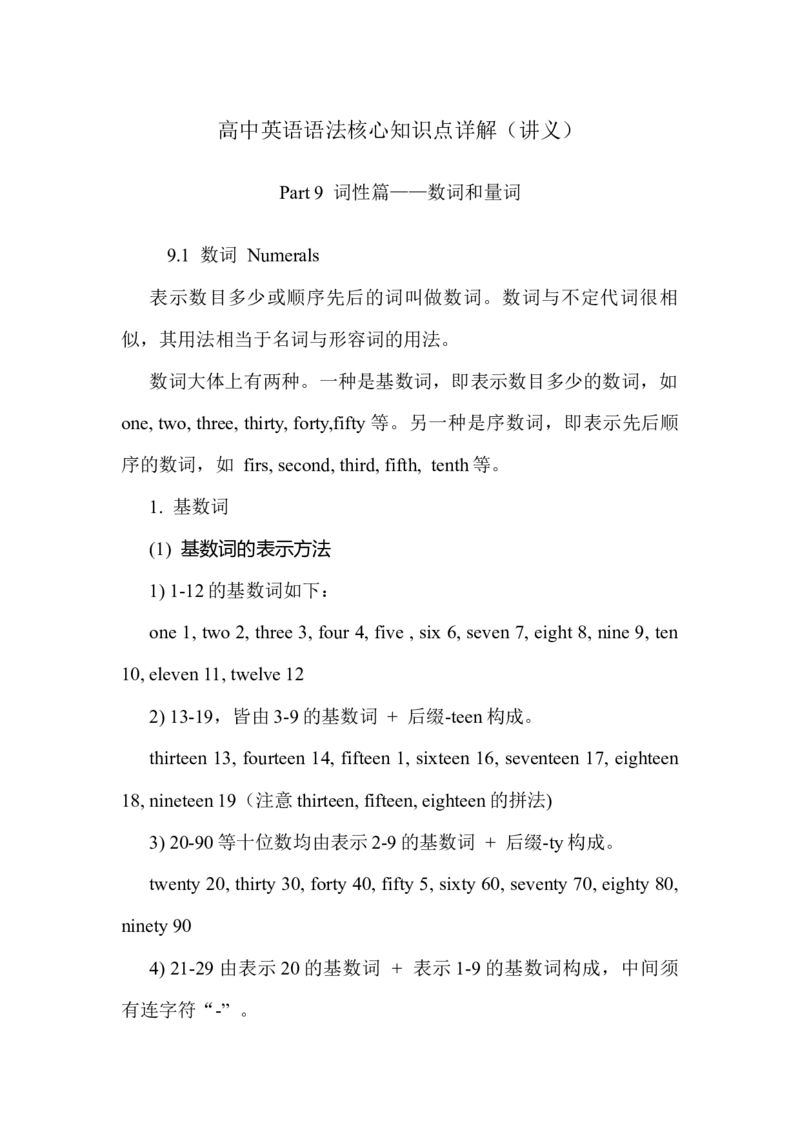
表示数目多少或顺序先后的词叫做数词。数词与不定代词很相
似,其用法相当于名词与形容词的用法。
数词大体上有两种。一种是基数词,即表示数目多少的数词,如
one, two, three, thirty, forty,fifty 等。另一种是序数词,即表示先后顺
序的数词,如 firs, second, third, fifth, tenth 等。
1. 基数词
(1) 基数词的表示方法
1) 1-12 的基数词如下:
one 1, two 2, three 3, four 4, five , six 6, seven 7, eight 8, nine 9, ten
10, eleven 11, twelve 12
2) 13-19,皆由3-9 的基数词 + 后缀-teen 构成。
thirteen 13, fourteen 14, fifteen 1, sixteen 16, seventeen 17, eighteen
18, nineteen 19(注意thirteen, fifteen, eighteen 的拼法)
3) 20-90 等十位数均由表示2-9 的基数词 + 后缀-ty 构成。
twenty 20, thirty 30, forty 40, fifty 5, sixty 60, seventy 70, eighty 80,
ninety 90
4) 21-29 由表示20 的基数词 + 表示1-9 的基数词构成,中间须
有连字符“-” 。
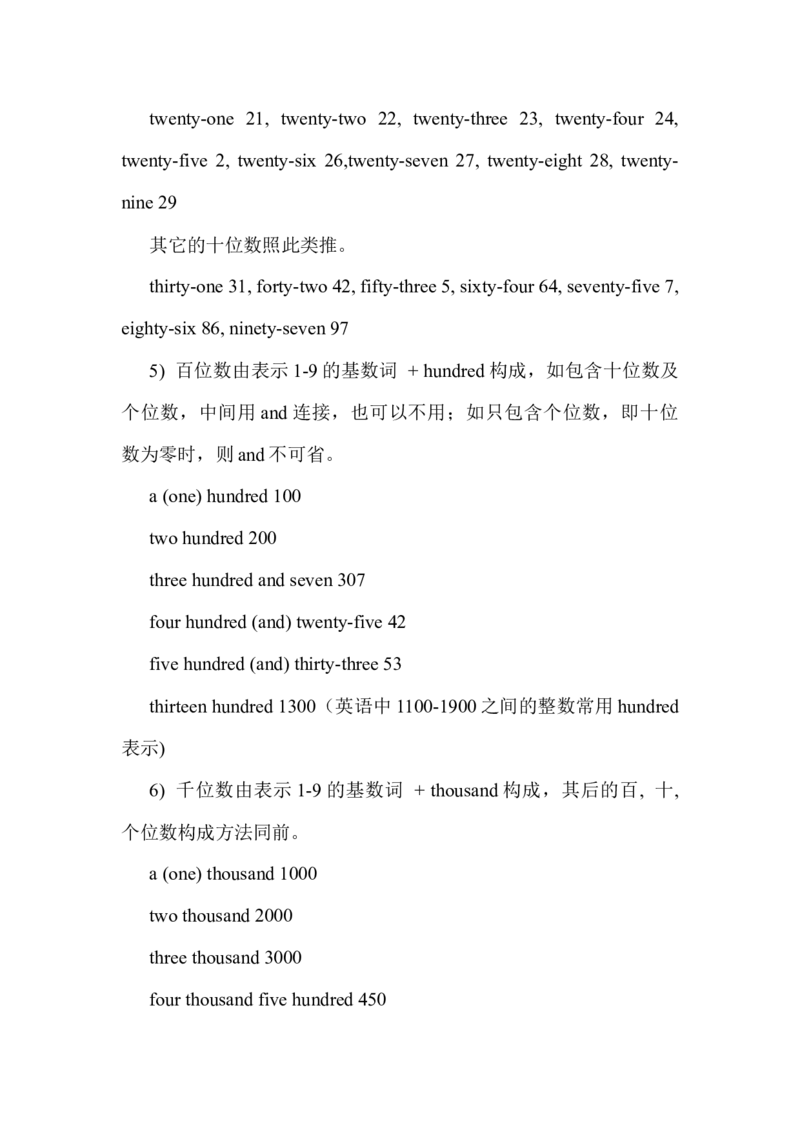
twenty-one 21, twenty-two 22, twenty-three 23, twenty-four 24,
twenty-five 2, twenty-six 26,twenty-seven 27, twenty-eight 28, twenty-
nine 29
其它的十位数照此类推。
thirty-one 31, forty-two 42, fifty-three 5, sixty-four 64, seventy-five 7,
eighty-six 86, ninety-seven 97
5) 百位数由表示1-9 的基数词 + hundred 构成,如包含十位数及
个位数,中间用and 连接,也可以不用;如只包含个位数,即十位
数为零时,则and 不可省。
a (one) hundred 100
two hundred 200
three hundred and seven 307
four hundred (and) twenty-five 42
five hundred (and) thirty-three 53
thirteen hundred 1300(英语中1100-1900 之间的整数常用hundred
表示)
6) 千位数由表示1-9 的基数词 + thousand 构成,其后的百, 十,
个位数构成方法同前。
a (one) thousand 1000
two thousand 2000
three thousand 3000
four thousand five hundred 450
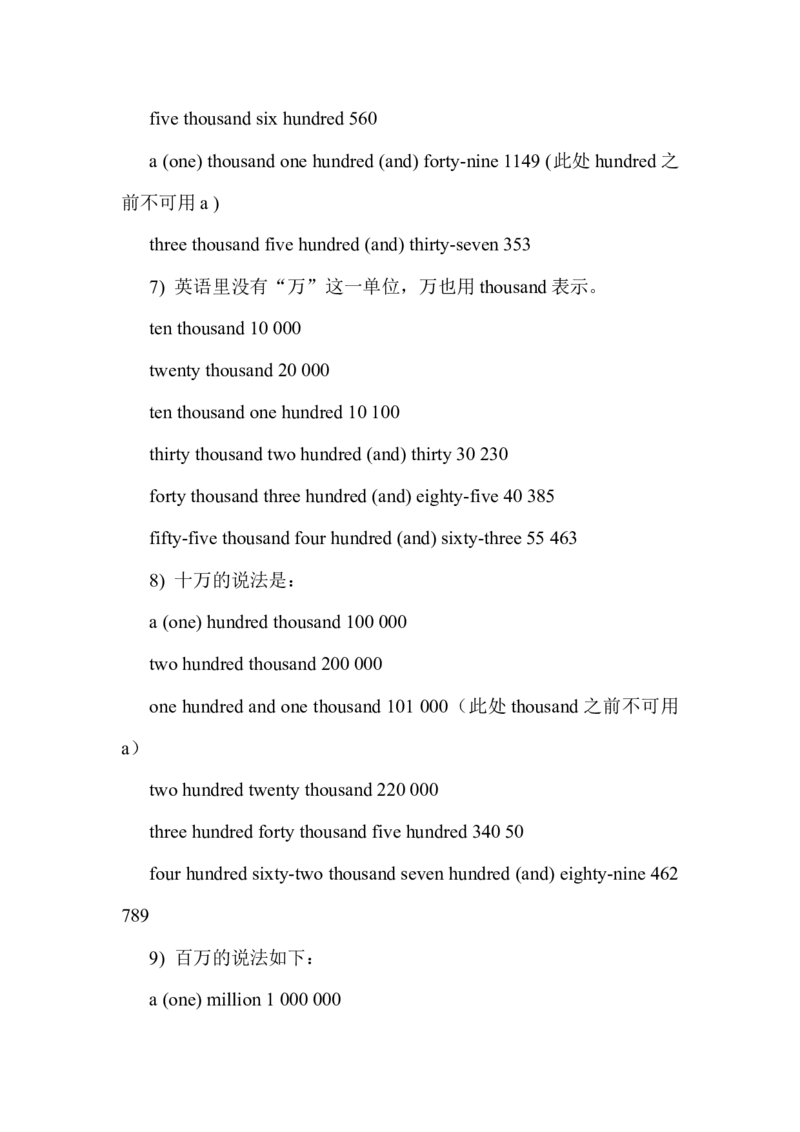
five thousand six hundred 560
a (one) thousand one hundred (and) forty-nine 1149 (此处hundred 之
前不可用a )
three thousand five hundred (and) thirty-seven 353
7) 英语里没有“万”这一单位,万也用thousand 表示。
ten thousand 10 000
twenty thousand 20 000
ten thousand one hundred 10 100
thirty thousand two hundred (and) thirty 30 230
forty thousand three hundred (and) eighty-five 40 385
fifty-five thousand four hundred (and) sixty-three 55 463
8) 十万的说法是:
a (one) hundred thousand 100 000
two hundred thousand 200 000
one hundred and one thousand 101 000(此处thousand 之前不可用
a)
two hundred twenty thousand 220 000
three hundred forty thousand five hundred 340 50
four hundred sixty-two thousand seven hundred (and) eighty-nine 462
789
9) 百万的说法如下:
a (one) million 1 000 000
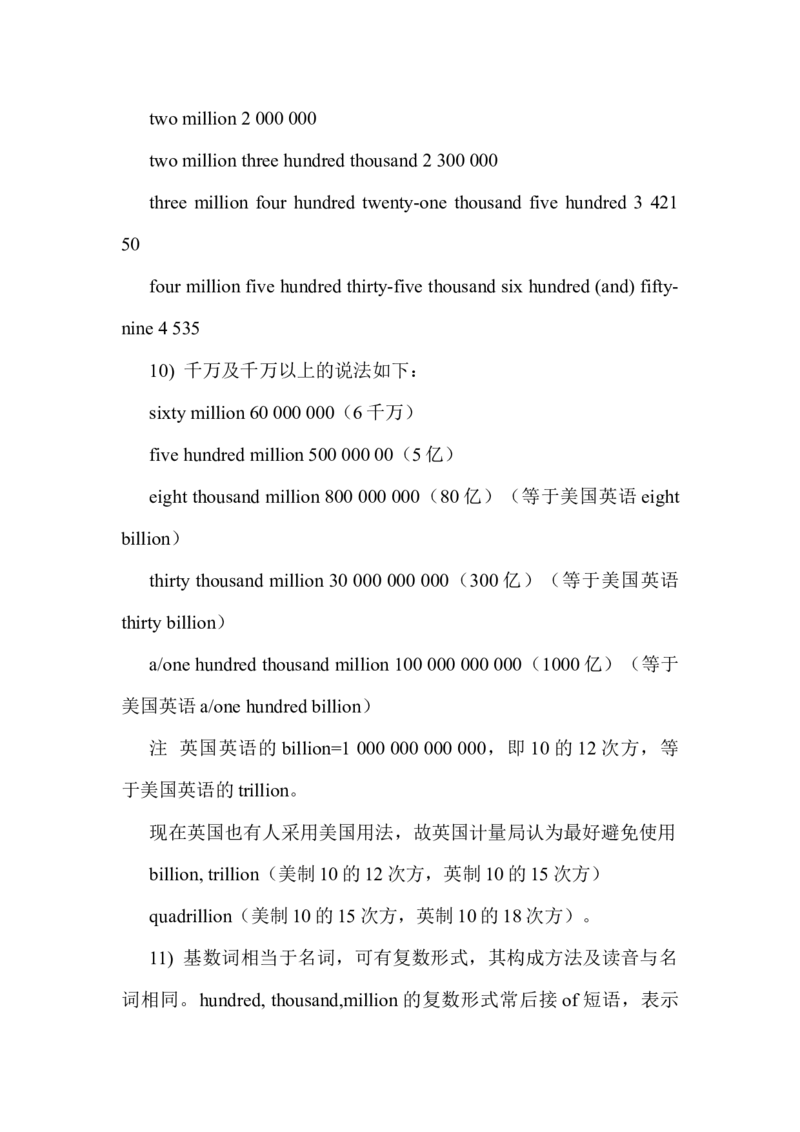
two million 2 000 000
two million three hundred thousand 2 300 000
three million four hundred twenty-one thousand five hundred 3 421
50
four million five hundred thirty-five thousand six hundred (and) fifty-
nine 4 535
10) 千万及千万以上的说法如下:
sixty million 60 000 000(6 千万)
five hundred million 500 000 00(5 亿)
eight thousand million 800 000 000(80 亿)(等于美国英语eight
billion)
thirty thousand million 30 000 000 000(300 亿)(等于美国英语
thirty billion)
a/one hundred thousand million 100 000 000 000(1000 亿)(等于
美国英语a/one hundred billion)
注 英国英语的billion=1 000 000 000 000,即10 的12 次方,等
于美国英语的trillion。
现在英国也有人采用美国用法,故英国计量局认为最好避免使用
billion, trillion(美制10 的12 次方,英制10 的15 次方)
quadrillion(美制10 的15 次方,英制10 的18 次方)。
11) 基数词相当于名词,可有复数形式,其构成方法及读音与名
词相同。hundred, thousand,million 的复数形式常后接of 短语,表示
不确定数目。
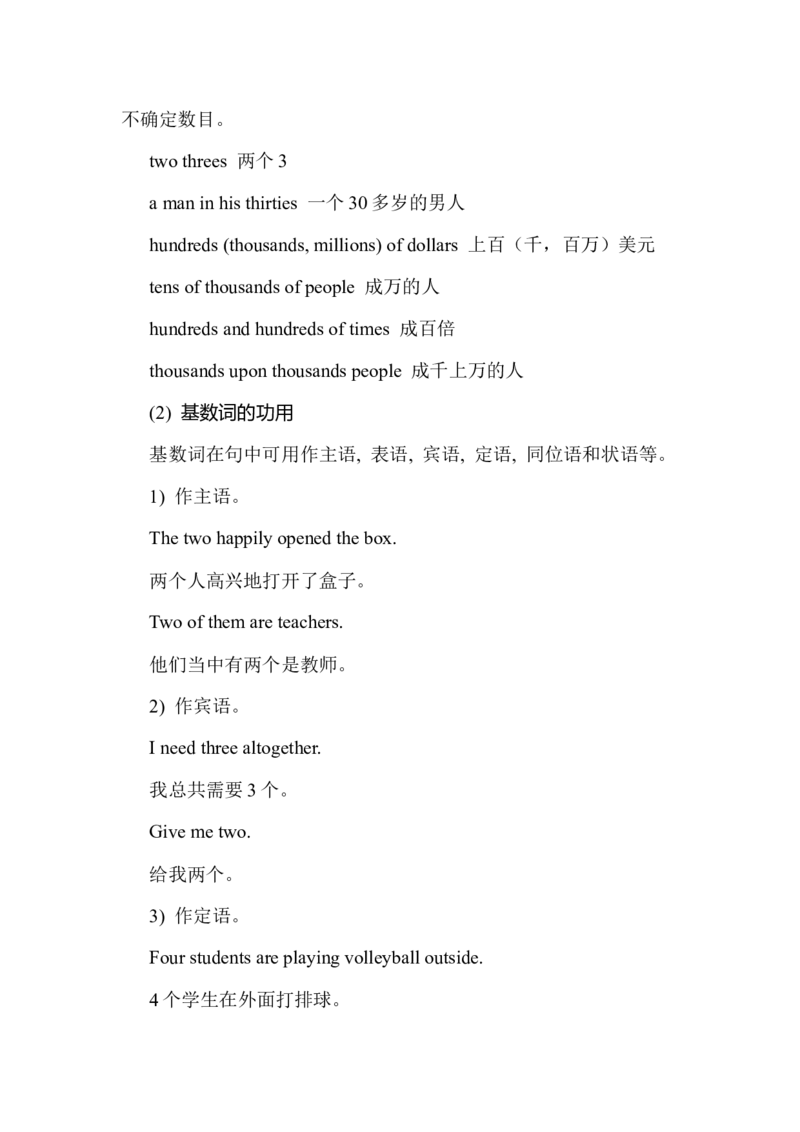
two threes 两个3
a man in his thirties 一个30 多岁的男人
hundreds (thousands, millions) of dollars 上百(千,百万)美元
tens of thousands of people 成万的人
hundreds and hundreds of times 成百倍
thousands upon thousands people 成千上万的人
(2) 基数词的功用
基数词在句中可用作主语, 表语, 宾语, 定语, 同位语和状语等。
1) 作主语。
The two happily opened the box.
两个人高兴地打开了盒子。
Two of them are teachers.
他们当中有两个是教师。
2) 作宾语。
I need three altogether.
我总共需要3 个。
Give me two.
给我两个。
3) 作定语。
Four students are playing volleyball outside.
4 个学生在外面打排球。
There are fifty students in our class.
我们班里有50 个学生。
4) 作表语。
We are sixteen.
我们是16 个人。
I'm eighteen now.
我18 岁了。
5) 作同位语。
They three tried to finish the task before sunset.
他们3 个人尽力想在日落前完成任务。
You may leave it to us two.
你可以把它交给我们两个。
6) 用作状语。
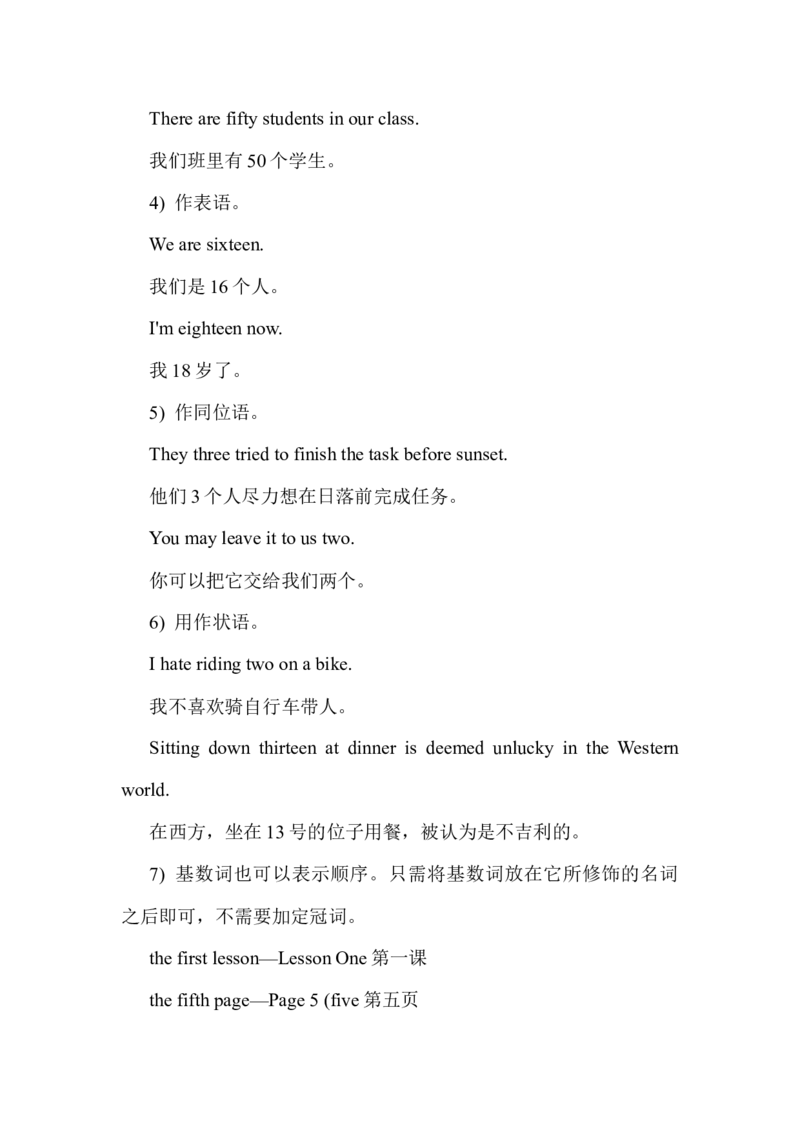
I hate riding two on a bike.
我不喜欢骑自行车带人。
Sitting down thirteen at dinner is deemed unlucky in the Western
world.
在西方,坐在13 号的位子用餐,被认为是不吉利的。
7) 基数词也可以表示顺序。只需将基数词放在它所修饰的名词
之后即可,不需要加定冠词。
the first lesson—Lesson One 第一课
the fifth page—Page 5 (five 第五页
the twenty-first room—Room 21 (twenty-one)第21 号房间
(3) 个别基数词的特殊用法
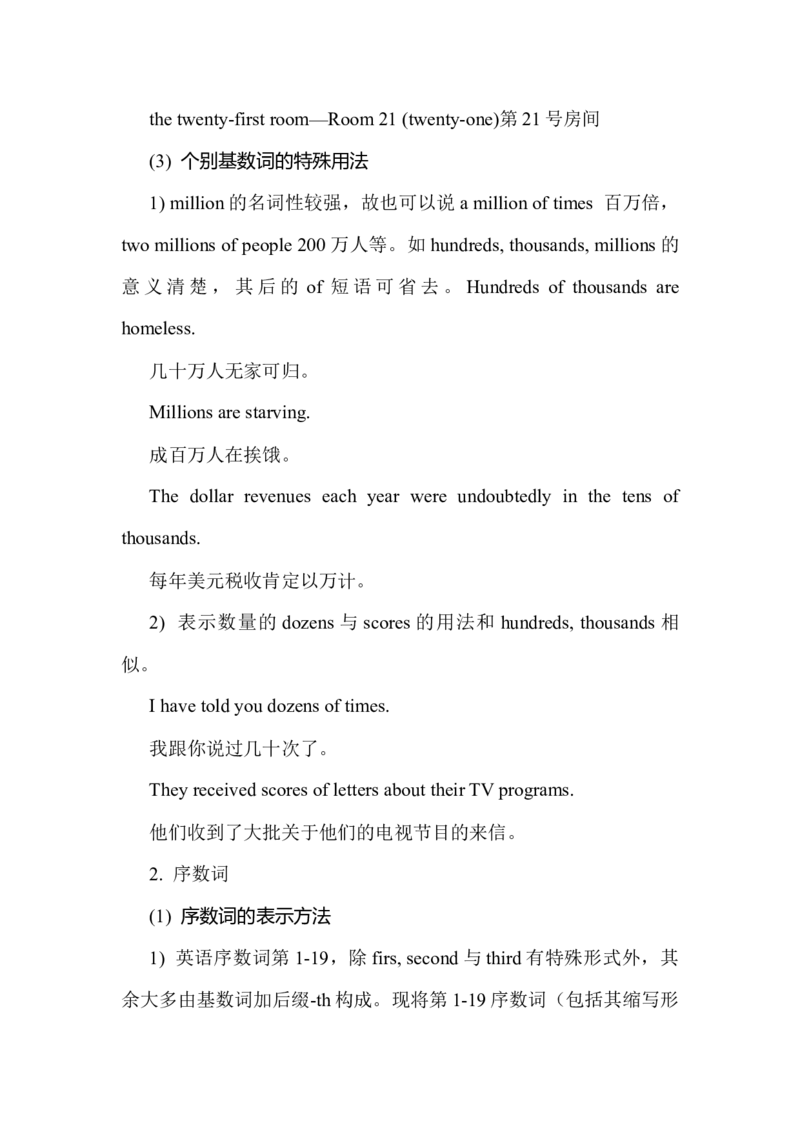
1) million 的名词性较强,故也可以说a million of times 百万倍,
two millions of people 200 万人等。如hundreds, thousands, millions 的
意义清楚,其后的of 短语可省去。Hundreds of thousands are
homeless.
几十万人无家可归。
Millions are starving.
成百万人在挨饿。
The dollar revenues each year were undoubtedly in the tens of
thousands.
每年美元税收肯定以万计。
2) 表示数量的dozens 与scores 的用法和hundreds, thousands 相
似。
I have told you dozens of times.
我跟你说过几十次了。
They received scores of letters about their TV programs.
他们收到了大批关于他们的电视节目的来信。
2. 序数词
(1) 序数词的表示方法
1) 英语序数词第1-19,除firs, second 与third 有特殊形式外,其
余大多由基数词加后缀-th 构成。现将第1-19 序数词(包括其缩写形
式)列出如下:
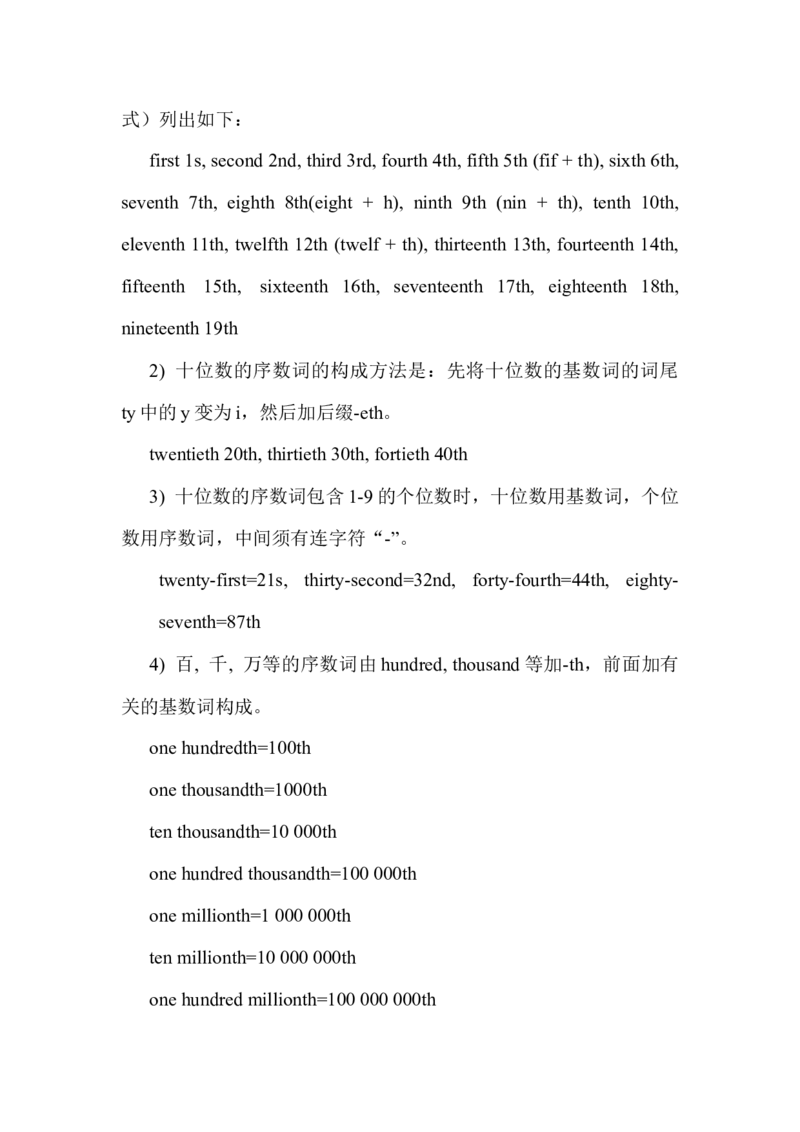
first 1s, second 2nd, third 3rd, fourth 4th, fifth 5th (fif + th), sixth 6th,
seventh 7th, eighth 8th(eight + h), ninth 9th (nin + th), tenth 10th,
eleventh 11th, twelfth 12th (twelf + th), thirteenth 13th, fourteenth 14th,
fifteenth 15th, sixteenth 16th, seventeenth 17th, eighteenth 18th,
nineteenth 19th
2) 十位数的序数词的构成方法是:先将十位数的基数词的词尾
ty 中的y 变为i,然后加后缀-eth。
twentieth 20th, thirtieth 30th, fortieth 40th
3) 十位数的序数词包含1-9 的个位数时,十位数用基数词,个位
数用序数词,中间须有连字符“-”。
twenty-first=21s, thirty-second=32nd, forty-fourth=44th, eighty-
seventh=87th
4) 百, 千, 万等的序数词由hundred, thousand 等加-th,前面加有
关的基数词构成。
one hundredth=100th
one thousandth=1000th
ten thousandth=10 000th
one hundred thousandth=100 000th
one millionth=1 000 000th
ten millionth=10 000 000th
one hundred millionth=100 000 000th
one billionth=1 000 000 000th
注 序数词hundredth, thousandth, millionth, billionth 之前的“一”
只可用one,不可用a。
5) 这些多位数序数词的后位数如包含1-9 时,后位数用序数词,
前位数用基数词,中间出现零时,须用and 连接。
two hundred and first=201s
three thousand two hundred (and) twenty-first=3221s
6) 序数词亦可有复数形式,其构成方法及读音与名词相同。
(2) 序数词的功用
序数词在句中可用作主语, 表语, 宾语, 定语, 同位语或是状语。
1) 作主语。
The second is what I really need.
第二个是我真正需要的。
The third is green.
第三个是绿的。
2) 作宾语。
He chose the second.
他挑选了第二个。
Give me the third.
给我第三个。
3) 作定语。
We are to carry out the first plan.
我们将执行第一个计划。
They live on the third floor.
他们住在3 楼。
4) 作表语。
She is the second in our class.
在我们班她是第二名。
You are the first to speak at the meeting.
你是第一个在会上发言的。
5) 作同位语。
Who is the girl, the third in the first line?
在第一列第三个的那个女孩是谁?
注 序数词作定语,通常前面要加定冠词the;但是如果序数词前
出现不定冠词a 或an 时,则表示“再”,“又”。
I was the third to speak.
我是第三个发言的。
She was among the first to come and settle here.
她是第一批来这儿落户的。
We'll go over it a second time.
我们要再念第二遍。
We've tried it three times. Must we try it a fourth time?
我们已经试过3 遍了,还必须试一次(第四次)吗?
6) 用作状语。
When did you first meet him?
你什么时候和他首次见面的?
He came second in the race.
他赛跑获第二名。
3. 年月日
(1) 世纪的表示,可以用定冠词 + 序数词 + 世纪century,也可
以用定冠词 + 百位数 + 's。
the sixth (6th) century 公元6 世纪
the eighteenth (18th) century 公元18 世纪
the 1900's 20 世纪
the 1600's 17 世纪
注 用序数词表示的世纪,比相应的阿拉伯数字表示的世纪,要
多一个世纪。
(2) 年代的表示,用定冠词及基数词表示的世纪 + 十位整数 + 's
构成。
in the 1930's (in the thirties of the twentieth century 或 in the
nineteen thirties)
在20 世纪30 年代
in the 1860's (in the sixties of the 19th century 或 in the eighteen
sixties)
在19 世纪60 年代
In the 1870's when Marx was already in his fifties, he found it
important to study the situation
in Russia, so he began to learn Russian.
在19 世纪70 年代,当马克思已经50 多岁时,他发现研究俄国
的形势很重要,便开始学习俄语。
(3) 表示某年代的早期, 中期和晚期,可以在定冠词之后, 年代之
前加early, mid-, late。
in the early 1920's 在20 世纪20 年代早期
in the mid-1950's 在20 世纪50 年代中期
(4) 具体的年月日表示法
1) 年份用基数词表示,一般写为阿拉伯数字,读时可以以
hundred 为单位,也可以以世纪, 年代为单位。
1949 读作nineteen hundred and forty-nine 或nineteen forty-nine
1800 读作eighteen hundred
253 读作two hundred and fifty-three 或two fifty-three
1902 读作nineteen hundred and two 或nineteen o two
表示在哪一年,一般在表示年份的阿拉伯数字前加介词in;如果
用year 时,year 放在数词之前。
in 253 B.C.=in the year two fifty-three B.C.在公元前253 年
2) 月份的表示,用介词in + 第一个字母大写的月份名词。例
如:in May 在5 月;in July 在7 月。为了简便起见,月份与日期连
用时,月份常用缩写形式表示。缩写形式除May, June, July 外,其
它的月份都由其前3 个字母表示,但September 除外。
January—Jan. 1 月
February—Feb. 2 月
March—Mar. 3 月
April—Apr. 4 月
August—Aug. 8 月
September—Sept. 9 月
October—Oct. 10 月November—Nov. 11 月
December—Dec. 12 月
注 这里缩写形式后面的点不能省略,因为它是表示缩写形式的
符号。
3) 日期用定冠词the 加序数词表示。在哪一天要添加介词on。
National Day is on Oct. 1.
国庆节是10 月1 日。(读作October firs)
注 此句也可以说 National Day is on the 1st of October.
May 5 5 月5 日(读作May fift)
注 也可以表示为the fifth/5th of May
Mar. 1 (st) 3 月1 日(读作March firs 或 the first of Marc)
(5) 表示不具体, 不确切的时间,例如世纪, 年代, 年份, 月份
时,用介词in;表示具体确切的某一天用介词on。通常情况下,
morning, afternoon, evening 等词前用介词in。但是,当这些词有一修
饰限定的词作为定语,把它们限定为某一天早晨, 下午或晚上时,
介词in 应改为on。这里的修饰限定词可以是介词短语, 名词, 形容
词, 定语从句等。
On a cold morning, the old man died lonely in his house.
在一个寒冷的早晨,这个老人孤独地死在自己的房子里。
I don't want to be disturbed on nights when I have to study.
我不愿意在我必须学习的晚上被打扰。
The accident happened on the afternoon of July 7.
这次事故发生在7 月7 日下午。
We are to have a small test on Monday morning.
星期一早晨我们将进行一次小测验。
4. 其他数词
(1) 币制表示法
1) 关于英国币制的说法如下:
1p 1 便士(读作one penny 或one p)
5p 5 便士(读作five pence 或five p)
£5.86 5 英镑86 便士(读作five pounds eighty-six pence)
2) 关于美国币制的说法如下:
1¢ 1 美分(读作one cent 或one penny)
$1.25 1 美元25 美分(读作one dollar twenty five 或one twenty-
five)
3) 美国硬币除penny 外,还有:
nickel (=five cents 5 分镍币
dime (=ten cents) 10 分铸币
quarter (=twenty-five cents)2 角5 分
half-dollar(=fifty cents 50 美分
(2) 编号表示法
1) 编号既可用序数词表示也可以用基数词表示。用序数词表示
编号,序数词位于名词之前,并加定冠词;用基数词表示编号,基
数词位于名词之后。
the third part=Part Three 第三部分
the seventh lesson=Lesson Seven 第七课
2) 由于基数词简单,所以用基数词的情况较多。
Number 6 第六号(读作number six,缩写式为No.6)
Line 4 第四行(读作 line four,缩写式为L.4)
Page 10 第十页(读作page ten,缩写式为P.10)
Room (No.) 101 第101 房间(读作room /number one o one)
No.10 Downing Street 唐宁街10 号
Platform (No.) 5 第五站台
Bus (No.) 332 第332 路公共汽车
Tel. No. 801-4609 电话号码801-4609(读作telephone number
eight o one four six o nine,在eight, o, one 之后应稍加停顿)。
postcode (或zip code)100081 邮政编码100081
(3) 倍数, 分数, 小数和百分数的表示法
1) 表示倍数的方法有多种。
① 主语 + 谓语 + 倍数(或分数)+ as + adj. + as。
I have three times as many as you.
我有你3 倍那么多。
② 主语 + 谓语 + 倍数(分数)+ the size(amount, length…)
of…。
The earth is 49 times the size of the moon.
地球是月球的49 倍。
③ 主语 + 谓语 + 倍数(分数)+ 形容词(副词)比较级 +
than…。
The grain output is 8 percent higher this year than that of last year.
今年比去年粮食产量增加8%。
This room is two times bigger than that one.
这个房间比那个(房间)大两倍。
The dictionary is four times thicker than that book.
这本词典比那本书厚4 倍。
My age is two times older than his.
我的年龄比他大两倍。
④ 还可以用by + 倍数,表示增加多少倍。
The production of goods has been increased by four times this year.
今年货物产量增加了4 倍。
2) 分数表示法
① 表示分数时,分子须用基数词,分母用序数词。分子如是1
以上,分母须用复数形式。
1/3 读作 a (one) third
2/3 读作 two thirds
1/4 读作a (one) quarter 或fourth
3/4 读作 three quarters 或fourths
2/5 读作 two fifth
但是1/2 须读作a (one) half(不读作one second)。
② 数学中可都用基数词读。
1/2 读作one over two
2/3 读作 two over three
3/4 读作 three over four
11/20 读作 eleven over twenty
尤其是较复杂的分数多用此读法。
27/283 应读作twenty-seven over two hundred (and) eighty-three
③ 整数与分数之间须用and 连接。
读作five and a half
读作 two and three fourths
④ 分数用作前置定语时,注意下列写法与读法:
a one-third mile 1/3 英里(用one,后有连字符)
a three-quarter majority 3/4 的多数(用单形quarter)
a two-thirds majority 2/3 的多数(用复形thirds)
⑤ 分数相当于名词时,用不用连字符皆可。
three-quarters (three quarters) of a mile 3/4 英里
3) 小数的读法:小数点前的基数词与前面所讲的基数词读法相
同,小数点后则须将数字一一读出。
1.25 读作 one point two five
3.728 读作 three point seven two eight
0.56 读作 (naught) (美国用zero)point five six
0.009 读作(naught) point naught naught nine ( 美国用zero 代替
naught)
4) 百分数中的百分号%读作per cent。
5% 读作 five per cent
0.5% 读作 (naught) point five per cent
300% 读作 three hundred per cent
5) 算式表示法
① 关于加, 减, 乘, 除算式的读法:
2+2=4 读作 Two plus two equal(s) four.
10-3=7 读作 Ten minus three is seven.
9×6=54 读作 Nine multiplied by six is fifty-four.
20÷4=5 读作 Twenty divided by four is five.
注 在加, 减, 乘, 除中:
a. 通常表示“加”可用and。
Two and two are four. 2+2=4。
b. 表示“减”可用from。
one from four leaves three. 4-1=3。
c. 表示“乘”可用times。
Four fives are twenty 或Four times five is twenty.4×5=20
d. 表示“除”可用into。
Four into twenty goes five. 20÷4=5。
② 关于比例与乘方, 开方的读法:
3: 2 读作 the ratio of three to two
12: 3=4 读作 The ratio of twelve to three equals four.
3 的2 次方读作 three squared
23=8 读作 Two cubed is eight
X 的4 次方等于Y,读作The fourth power of x is y.
9 的平方根等于3,读作The square root of nine is three.
27 的3 次方根等于3,读作The cubic root of twenty-seven is three.
(17-9 的平方根+65/5)-(4×3)=15 应读作 Seventeen minus the
square root of nine, plus sixty-five over five, minus four times three,
equals fifteen
③ 表示面积常用by
如果说一个房间的面积是3'×6'(3 英尺×6 英尺),应说three feet
by six feet;如房间为6 英尺见方,则可说six feet by six feet,或是
six feet square,也可以说总面积为thirty-six square feet。
9.2 量词 Quantifier
1. 量词概念
用来表示人, 事物或动作的数量单位的词,叫做量词。英语中有
的量词有很多种意思,它们没有像汉语中那样的量词分类。量词的
翻译需要大量积累,以及对中西文化的理解。
2. 英汉量词用法比较
(1) 事实上,在英语中没有量词这一词类,汉语里所说的一头
牛,一匹马,一枝笔,一本书在英语里可以表示为:a cow, a horse, a
pen, a book,都是冠词后面加上可数名词。
(2) 在汉语里有许多简单的物品,在英语里则需要成双成对的表
达。
a pair of glasses (scissors, spectacles, trousers, pants, pliers)
一副眼镜, 一把剪刀, 一副眼镜, 一条裤子, 一条短裤, 一把剪钳
(3) 英语的...of...结构既可以修饰可数名词,也可以修饰不可数名
词。
an article of clothes 一件衣物
a piece of news 一条消息
a piece of newspaper 一张报纸
(4) 汉语里的表示度量衡的量词在英语里可以找到相应的表达结
构,即...of...。
a basket of fruit 一篮子水果
a packet of sweets 一盒糖
a cup of coffee 一杯咖啡
(5) 最有意思的就是英语关于各种动物群体的称呼了,各不相
同。
a brood of chicks 一群小鸡
a pack/throng of wolves 一群狼
a swarm of locusts 一群蝗虫
a hive of bees 一群蜜蜂
a school of fish 一群鱼
an army of elephants 一群大象
a batch of dogs 一群狗
a team/field of horses 一群马
a host of monkeys 一群猴子
a gang of elks 一群驼鹿
(6) 汉语中的形象量词在英语里也能找到对应。
a layer of rock 一层岩石
a blade of grass 一片草叶
a head of garlic 一头蒜
a stack of hay 一堆干草
a flood of moonlight 一片月光
a cloud of smoke 一团烟雾
a block of wood 一块木头
a loaf of bread 一个面包
a cube of sugar 一块方糖
a cone of ice-cream 一个蛋卷冰淇淋
a dash of salt 一撮盐
a coil of wire 一卷电线
a grain of rice 一粒米
a wisp of smoke 一缕烟
a beam of light 一束光线
a pane of glass 一块玻璃
a drop of water 一滴水
a roll of newspaper 一卷报纸
a bar of chocolate 一块巧克力
a ball of wool 一个毛线球
a cake of soap 一块肥皂
a cup of tea 一杯茶
(7) 许多形象量词,不仅说明了数量,还有动态和修辞的含意。
a burst of laughter 一阵笑声
a web of railroad 铁路网
a train of thoughts 一连串的想法
a glimmer of hope 一线希望
a gust of wind 一阵风
(8) 英语和汉语关于表示数量的词的用法还有一点不同:英语中
形容词的位置和汉语中的不同。
汉语说“一杯好茶”,在英语里则是:a nice cup of tea。
类似的例子还有:a thin coat of ice 一层薄冰,a stagnant pool of
water 一潭死水,a beautiful stretch of field 一片美丽的原野等等。
3. 英语中量词的具体用法
(1) 表示“一丝/点/层/片”:
一缕月光 a streak of moonlight
一片草皮 a chunk of turf
一点点工作 a stroke of work
一丝绿意;一片绿色 a tint of green
一丝失望的情绪 a taint/faint of disappointment
一丝失望的眼神 a flicker of disappointment
一层霜/雪/糖霜 a layer of frost/snow/cream
(剩下)一口气/一丝气 a spark/breath of life
一片漆黑 completely dark;dismal night;pitch dark
一丝嫉妒;一阵窘迫 a slight twinge of jealousy/embarrassment
一线未来之光 a glimpse of future
一丝怀疑 a shadow of doubt
一丝睡意 a wink of sleep
一片心意 a small token of our hearts
一片汪洋 a flood of water
一丝恻隐之心 a sign of sympathy for...
一丝懊悔 a slight twinge of remorse
(2) 如何表示“一群”:
一群人 a crowd/group/multitude/throng/army/team/class of people;
a gang/swarm/horde/pack/band of people(含贬义)
troop 通常指聚在一起活动的, 生气勃勃的一群人。
a troop of demonstrators/shoppers/visitors
1) 表示贬义的“一群”有:a mob of angry people/ rioters/ slaves/
liars/ blackguards
2) bevy 特指女性的“一群”,有时指鸟类,尤指鹌鹑或云雀。
a bevy of actresses/young women/ladies/shop girls/quails
3) band 和gang 常指“一帮,一伙儿”:
a band of robbers/gangsters/thieves/outlaws
a gang of criminals/slaves/prisoners
4) horde 原意为游牧部落,通常含有轻蔑色彩:
a horde of lazy-bones/swindlers/locusts/hooligans
5) 表示动物的“一群”:
一群牛/象/马/天鹅 a herd of cattle/elephants/horses/swans
一群星星 a cluster of stars
一群马 a stud/drove of horses
一群小鸡 a gaggle/flock of chicken
一群鸟/鹅/母鸡/山羊/燕子/绵羊/小鸡
a flock of birds/geese/hens/goats/swallows/sheep/chicken
一群猎狗/狼/松鸡 a pack of hounds/wolves/grouses
一群狐狸 a skulk of foxes
一群鱼/虾 a school/shoal of fish/shrimp
一群狮子 a pride of lions
一群蚊子/蝴蝶 a swarm of mosquitoes/butterflies
一群建筑物 a clump/complex of buildings
一群(窝)蚂蚁/蜜蜂 a colony of ants/bees
(3) 表示“一阵”:
1) 少量或稀疏的:
一阵(小)雨/射击 a spatter of rain/bullets
一阵稀疏的掌声/喝彩 a spatter of applause/cheers
2) 突然而猛烈的:
一阵暴雨/狂风/烈火 a gust/blast of rain/wind/flam
3) 声响很大的:
一阵隆隆的炮声/雷声 a peal of artillery/thunder
4) 持续短暂的:
一阵怒气/激情/咳嗽 a fit of anger/passion/coughing
一阵呕吐 a bout of vomiting
5) 持续一段时间的:
一阵厄运/暑热 a spell of bad luck/summer heat
一阵寒潮 a cold spell of weather
一阵昏厥 a fainting spell
6) 突然爆发出的:
一阵哭泣/喝彩/炮击/雷声 a burst of tears/cheers/gunfire/thunder
7) 量如洪水的:
一阵泪雨/瓢泼大雨/夸夸其谈 a flood of tears/rain/boast
8) 针捻刀刺般的:
一阵内疚/牙痛/风湿痛 a twinge of remorse/toothache/rheumatism
一阵尴尬 a twinge of embarrassment
9) 抽搐或颤抖的:
一阵痛苦/ 伤心/ 咳嗽/ 激动 a spasm of pain/ grief/ coughing/
excitement
10) 雹打雨淋般的;
一阵轰炸/打击/咒骂 a hail of bombs/blows/curse
一阵弹雨/批评 a shower of bullets/criticism
(4)“一阵”的译法:
英语中的“一阵”有很多不同的译法,主要在于汉语中“一阵”
这个数量词不含修辞色彩,可用于各类描述;而在英语中,“一
阵”这个概念则是由许多不同的名词来表述,而且这些词一般分别
具有不同的修辞色彩,因此在翻译的时候要仔细推敲。
spatter“少量”,“稀疏”
peal 专指一阵响亮或轰鸣的声音
burst 泛指突然爆发出的一阵,有突如其来之感
twinge 特指肉体或心灵上的一阵剧烈的刺痛
spell 常用于描述天气, 疾病等,表持续一阵子
hail 和shower 比喻色彩也很浓,有雹打雨淋之感
flood 一词比喻色彩浓厚,给人以量如洪水,滔滔不绝之感
fit 常指持续时间短暂的一阵——尤指疾病的短暂发作或感情的短
暂进发
gust 则专指风, 雨, 雹, 火, 烟等的突然而猛烈的一阵。也可用比
喻感情的猛烈进发
spasm 原指痉挛,抽搐,用于动作, 感情的一阵突发时,表抽搐
或浑身颤抖之感
(5) 相关的修辞性量词用法
1) 借代
一片沙滩 a beach of sands
一大群飞机 a cloud of planes
一串珍珠 a rope of pearls
一炉钢 a heat of steel
2) 暗喻
很大的朋友圈 a large circle of friends
一长串汽车 a string of cars
3) 夸张
滔滔不绝的话语 a flood of word
勃然大怒 a wave of anger
小不点 a dot of child
一小撮敌人 a pinch of enemy
一年三熟 three crops a year
林立的烟囱 a forest of chimneys
一串香蕉 a hand of bananas
颗颗汗珠 beads of sweat
多如牛毛的问题 a sea of troubles
开怀大笑 gales of laughter
无数次 heaps of times
一大笔钱 a pile of money