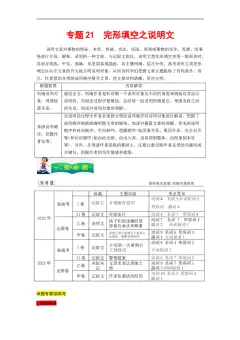
重难点 14 完形填空之说明文
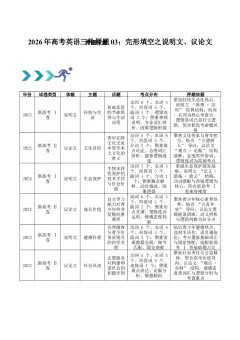
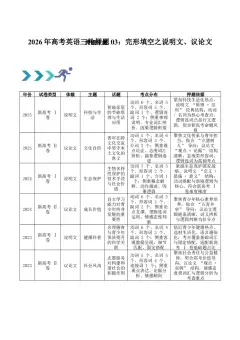
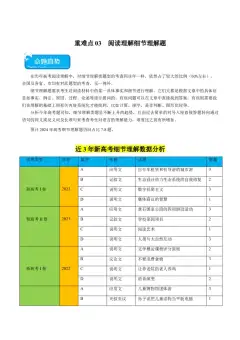
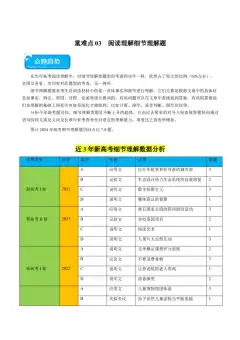
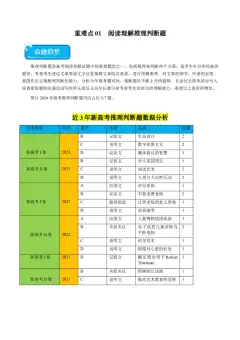
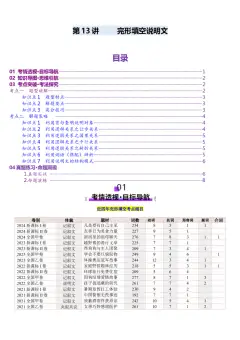
考点 五年考情(2020-2024) 命题趋势
考点1 议论文型
2022浙江6月卷—信任的重要性;
完形填空
2018浙江卷—越忙越能办好事。
(5年1考) 1.说明型完形填空在全国甲卷、
乙卷相对较多,在新高考课表卷
尚未出现过。
2022全国乙卷—孩子捉迷藏的背后;
2.说明型完形填空需要掌握文章
2021天津卷—为小区免费修车;
结构特点和语言特点。
考点2 说明文型 2015广东卷—长寿与老龄化;
3.课外需要广泛阅读,深入积
完形填空 2015安徽卷—减少垃圾,理性消费; 累,尤其是熟词新义和背景知
识。
(5年2考) 2013广东卷—鸟类感受数字能力;
2010安徽卷--钢笔特点;
2009江苏卷--中学生是否应参加社区服务。
【高考考向】
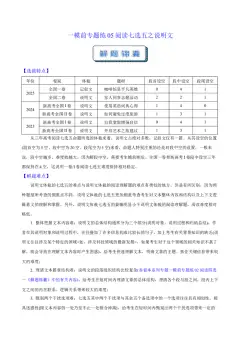
近年高考卷完形填空文章长度250词左右,选材来自英美国家的主流书刊或正规网站,题材多样化,
遵循“文章内容生活化”原则,体现正确的人生观、价值观,传递正能量。
主题语境包含人与社会、人与自我、人与自然,体裁以记叙文为主,说明文和夹叙夹议文为辅。文章
要求考生在正确理解语篇主旨大意的同时,注重揣摩不同词语、句子及篇章结构之间的联系。
【解题策略】
1. 明确说明对象,理清段落关系。
通读全文,明确作者是针对哪一个说明对象从不同的角度和侧面对其加以说明的。在阅读过程中要概
括、总结每一段说明的侧重点,理清各段之间的关系,加深对说明对象的理解。
2. 弄清说明顺序,把握作者态度。
在说明的过程中作者会选择合理的说明顺序对说明对象进行解说。把握了说明顺序就能准确把握文章的脉络,加深对整篇文章的理解。常见的说明顺序有时间顺序、空间顺序、逻辑顺序(如因果关系、果因
关系、先主后次等)和认识顺序(如由此及彼、由浅入深、由局部到整体、由现象到本质等)。另外,在理
清作者思路的基础上,还要注意反映作者态度的关键词或关键句,把握作者的写作情感和意图。
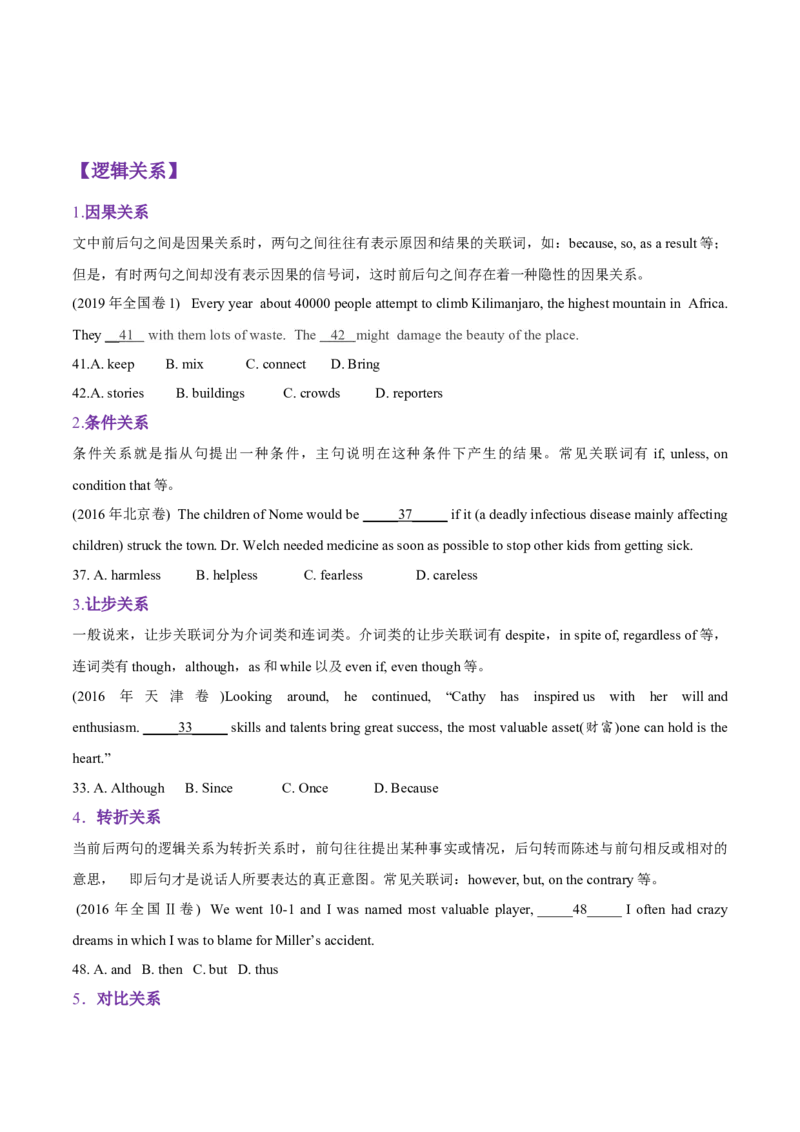
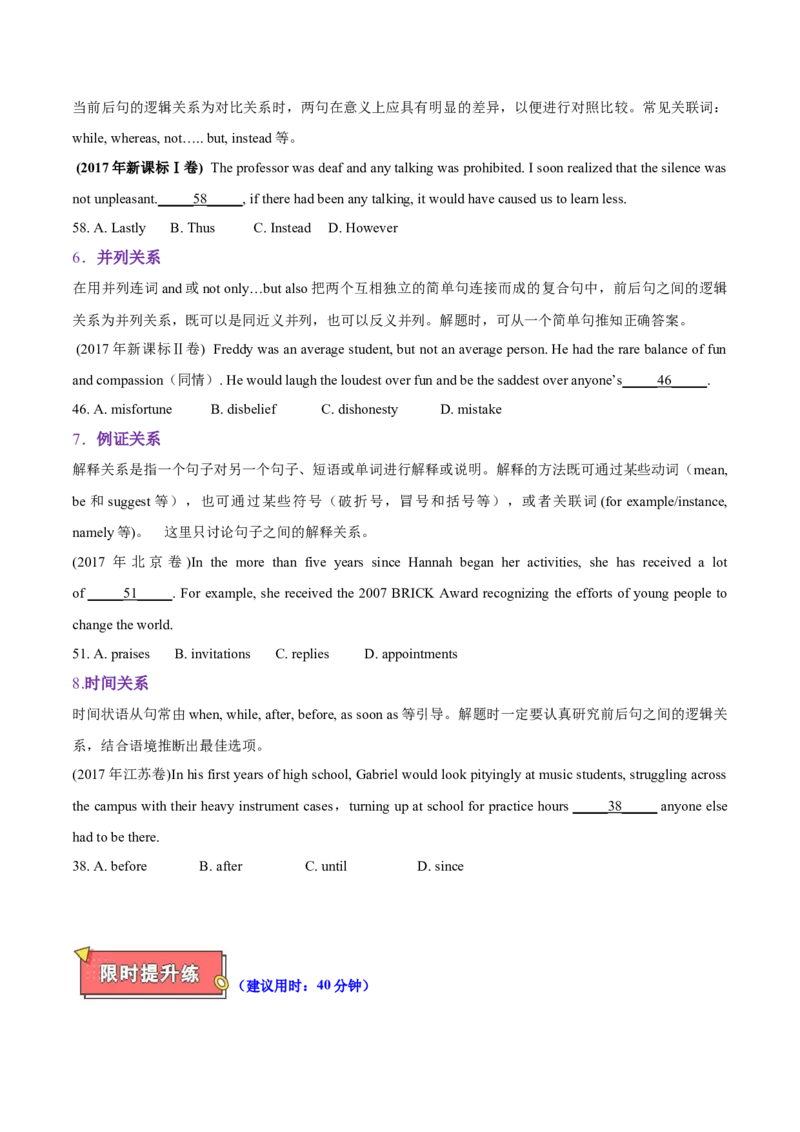
【思维导图】【逻辑关系】
1.因果关系
文中前后句之间是因果关系时,两句之间往往有表示原因和结果的关联词,如:because, so, as a result等;
但是,有时两句之间却没有表示因果的信号词,这时前后句之间存在着一种隐性的因果关系。
(2019年全国卷1) Every year about 40000 people attempt to climb Kilimanjaro, the highest mountain in Africa.
They __41 with them lots of waste. The 42 might damage the beauty of the place.
41.A. keep B. mix C. connect D. Bring
42.A. stories B. buildings C. crowds D. reporters
2.条件关系
条件关系就是指从句提出一种条件,主句说明在这种条件下产生的结果。常见关联词有 if, unless, on
condition that等。
(2016年北京卷) The children of Nome would be _____37_____ if it (a deadly infectious disease mainly affecting
children) struck the town. Dr. Welch needed medicine as soon as possible to stop other kids from getting sick.
37. A. harmless B. helpless C. fearless D. careless
3.让步关系
一般说来,让步关联词分为介词类和连词类。介词类的让步关联词有despite,in spite of, regardless of等,
连词类有though,although,as和while以及even if, even though等。
(2016 年 天 津 卷 )Looking around, he continued, “Cathy has inspired us with her will and
enthusiasm. _____33_____ skills and talents bring great success, the most valuable asset(财富)one can hold is the
heart.”
33. A. Although B. Since C. Once D. Because
4.转折关系
当前后两句的逻辑关系为转折关系时,前句往往提出某种事实或情况,后句转而陈述与前句相反或相对的
意思, 即后句才是说话人所要表达的真正意图。常见关联词:however, but, on the contrary等。
(2016 年全国Ⅱ卷) We went 10-1 and I was named most valuable player, _____48_____ I often had crazy
dreams in which I was to blame for Miller’s accident.
48. A. and B. then C. but D. thus
5.对比关系当前后句的逻辑关系为对比关系时,两句在意义上应具有明显的差异,以便进行对照比较。常见关联词:
while, whereas, not….. but, instead等。
(2017年新课标Ⅰ卷) The professor was deaf and any talking was prohibited. I soon realized that the silence was
not unpleasant._____58_____, if there had been any talking, it would have caused us to learn less.
58. A. Lastly B. Thus C. Instead D. However
6.并列关系
在用并列连词and或not only…but also把两个互相独立的简单句连接而成的复合句中,前后句之间的逻辑
关系为并列关系,既可以是同近义并列,也可以反义并列。解题时,可从一个简单句推知正确答案。
(2017年新课标Ⅱ卷) Freddy was an average student, but not an average person. He had the rare balance of fun
and compassion(同情). He would laugh the loudest over fun and be the saddest over anyone’s_____46_____.
46. A. misfortune B. disbelief C. dishonesty D. mistake
7.例证关系
解释关系是指一个句子对另一个句子、短语或单词进行解释或说明。解释的方法既可通过某些动词(mean,
be和suggest 等),也可通过某些符号(破折号,冒号和括号等),或者关联词(for example/instance,
namely等)。 这里只讨论句子之间的解释关系。
(2017 年 北 京 卷 )In the more than five years since Hannah began her activities, she has received a lot
of _____51_____. For example, she received the 2007 BRICK Award recognizing the efforts of young people to
change the world.
51. A. praises B. invitations C. replies D. appointments
8.时间关系
时间状语从句常由when, while, after, before, as soon as等引导。解题时一定要认真研究前后句之间的逻辑关
系,结合语境推断出最佳选项。
(2017年江苏卷)In his first years of high school, Gabriel would look pityingly at music students, struggling across
the campus with their heavy instrument cases,turning up at school for practice hours _____38_____ anyone else
had to be there.
38. A. before B. after C. until D. since
(建议用时:40分钟)【类型一:历年说明型完形填空】
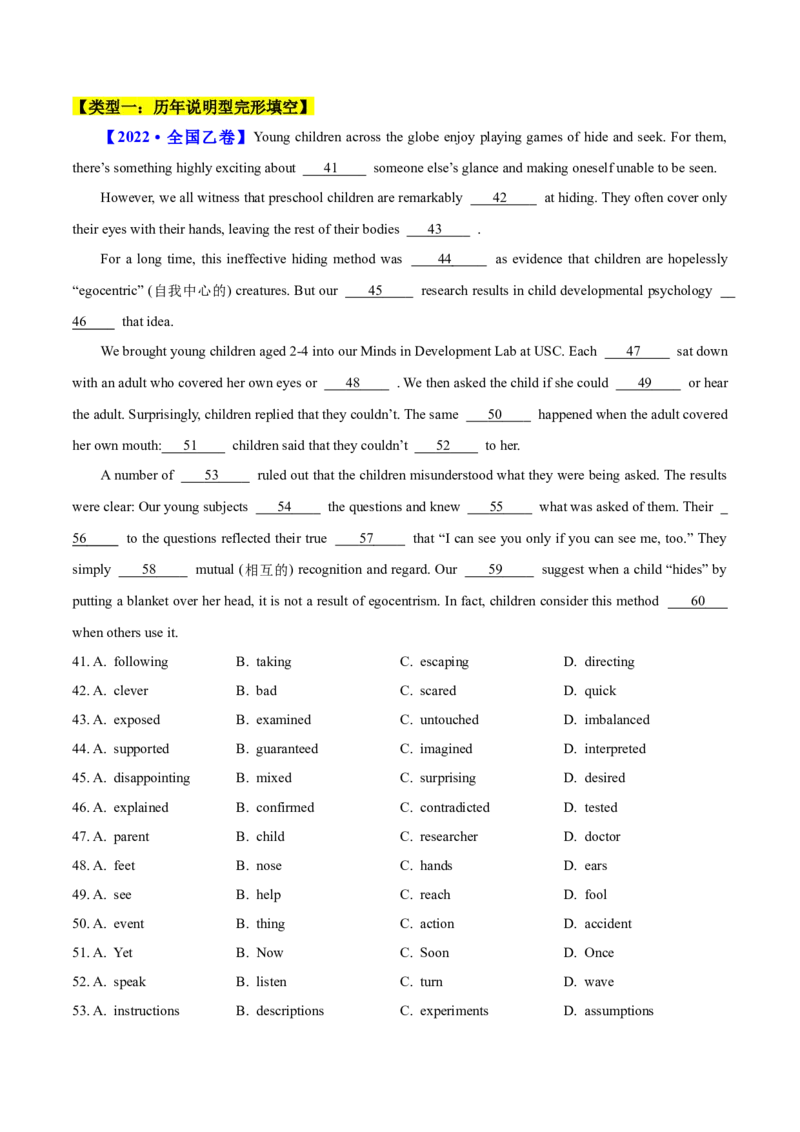
【2022·全国乙卷】Young children across the globe enjoy playing games of hide and seek. For them,
there’s something highly exciting about 4 1 someone else’s glance and making oneself unable to be seen.
However, we all witness that preschool children are remarkably 42 at hiding. They often cover only
their eyes with their hands, leaving the rest of their bodies 4 3 .
For a long time, this ineffective hiding method was 44 as evidence that children are hopelessly
“egocentric” (自我中心的) creatures. But our 45 research results in child developmental psychology
46 that idea.
We brought young children aged 2-4 into our Minds in Development Lab at USC. Each 47 sat down
with an adult who covered her own eyes or 48 . We then asked the child if she could 49 or hear
the adult. Surprisingly, children replied that they couldn’t. The same 5 0 happened when the adult covered
her own mouth: 5 1 children said that they couldn’t 5 2 to her.
A number of 53 ruled out that the children misunderstood what they were being asked. The results
were clear: Our young subjects 5 4 the questions and knew 5 5 what was asked of them. Their
56 to the questions reflected their true 57 that “I can see you only if you can see me, too.” They
simply 58 mutual (相互的) recognition and regard. Our 59 suggest when a child “hides” by
putting a blanket over her head, it is not a result of egocentrism. In fact, children consider this method 60
when others use it.
41. A. following B. taking C. escaping D. directing
42. A. clever B. bad C. scared D. quick
43. A. exposed B. examined C. untouched D. imbalanced
44. A. supported B. guaranteed C. imagined D. interpreted
45. A. disappointing B. mixed C. surprising D. desired
46. A. explained B. confirmed C. contradicted D. tested
47. A. parent B. child C. researcher D. doctor
48. A. feet B. nose C. hands D. ears
49. A. see B. help C. reach D. fool
50. A. event B. thing C. action D. accident
51. A. Yet B. Now C. Soon D. Once
52. A. speak B. listen C. turn D. wave
53. A. instructions B. descriptions C. experiments D. assumptions54. A. comprehended B. predicted C. explored D. ignored
55. A. partly B. honestly C. vaguely D. exactly
56. A. responses B. approaches C. contribution D. sensitivity
57. A. ability B. belief C. identity D. purpose
58. A. hold back B. relate to C. insist on D. make up
59. A. limitations B. requirements C. theories D. findings
60. A. tentative B. impressive C. creative D. effective
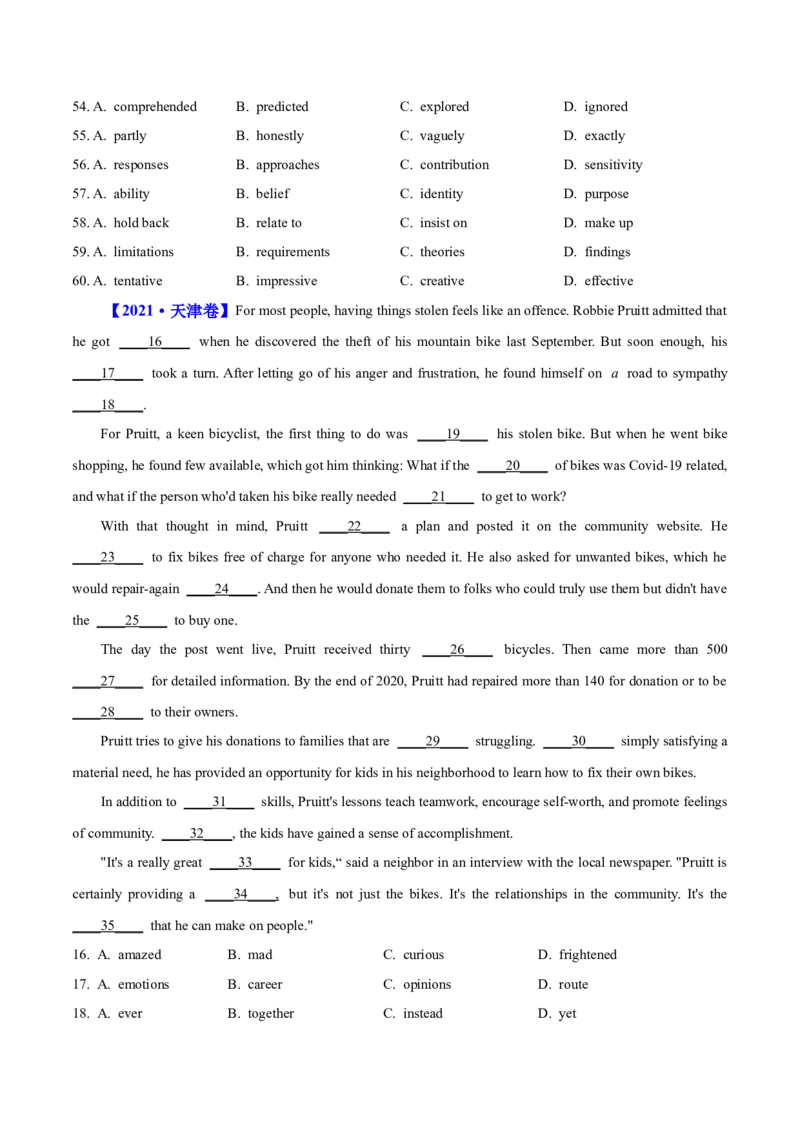
【2021·天津卷】For most people, having things stolen feels like an offence. Robbie Pruitt admitted that
he got ____16____ when he discovered the theft of his mountain bike last September. But soon enough, his
____17____ took a turn. After letting go of his anger and frustration, he found himself on a road to sympathy
____18____.
For Pruitt, a keen bicyclist, the first thing to do was ____19____ his stolen bike. But when he went bike
shopping, he found few available, which got him thinking: What if the ____20____ of bikes was Covid-19 related,
and what if the person who'd taken his bike really needed ____21____ to get to work?
With that thought in mind, Pruitt ____22____ a plan and posted it on the community website. He
____23____ to fix bikes free of charge for anyone who needed it. He also asked for unwanted bikes, which he
would repair-again ____24____. And then he would donate them to folks who could truly use them but didn't have
the ____25____ to buy one.
The day the post went live, Pruitt received thirty ____26____ bicycles. Then came more than 500
____27____ for detailed information. By the end of 2020, Pruitt had repaired more than 140 for donation or to be
____28____ to their owners.
Pruitt tries to give his donations to families that are ____29____ struggling. ____30____ simply satisfying a
material need, he has provided an opportunity for kids in his neighborhood to learn how to fix their own bikes.
In addition to ____31____ skills, Pruitt's lessons teach teamwork, encourage self-worth, and promote feelings
of community. ____32____, the kids have gained a sense of accomplishment.
"It's a really great ____33____ for kids,“ said a neighbor in an interview with the local newspaper. "Pruitt is
certainly providing a ____34____ , but it's not just the bikes. It's the relationships in the community. It's the
____35____ that he can make on people."
16. A. amazed B. mad C. curious D. frightened
17. A. emotions B. career C. opinions D. route
18. A. ever B. together C. instead D. yet19. A. ride B. lock C. repair D. replace
20. A. lack B. variety C. increase D. quality
21. A. instruction B. qualification C. transportation D. permission
22. A. came up with B. stuck to C. gave up D. broke away from
23. A. remembered B. refused C. hesitated D. offered
24. A. by accident B. in advance C. for free D. on credit
25. A. profit B. budget C. courage D. excuse
26. A. shared B. used C. expensive D. modern
27. A. enquiries B. advertisements C. notices D. announcements
28. A. exported B. sold C. lent D. returned
29. A. hardly B. slightly C. truly D. instantly
30. A. Without B. Beyond C. Upon D. Among
31. A. practical B. commercial C. mathematical D. social
32. A. Otherwise B. However C. Somehow D. Meanwhile
33. A. promise B. celebration C. comfort D. experience
34. A. competition B. service C. ceremony D. suggestion
35. A. compromise B. impression C. impact D. progress
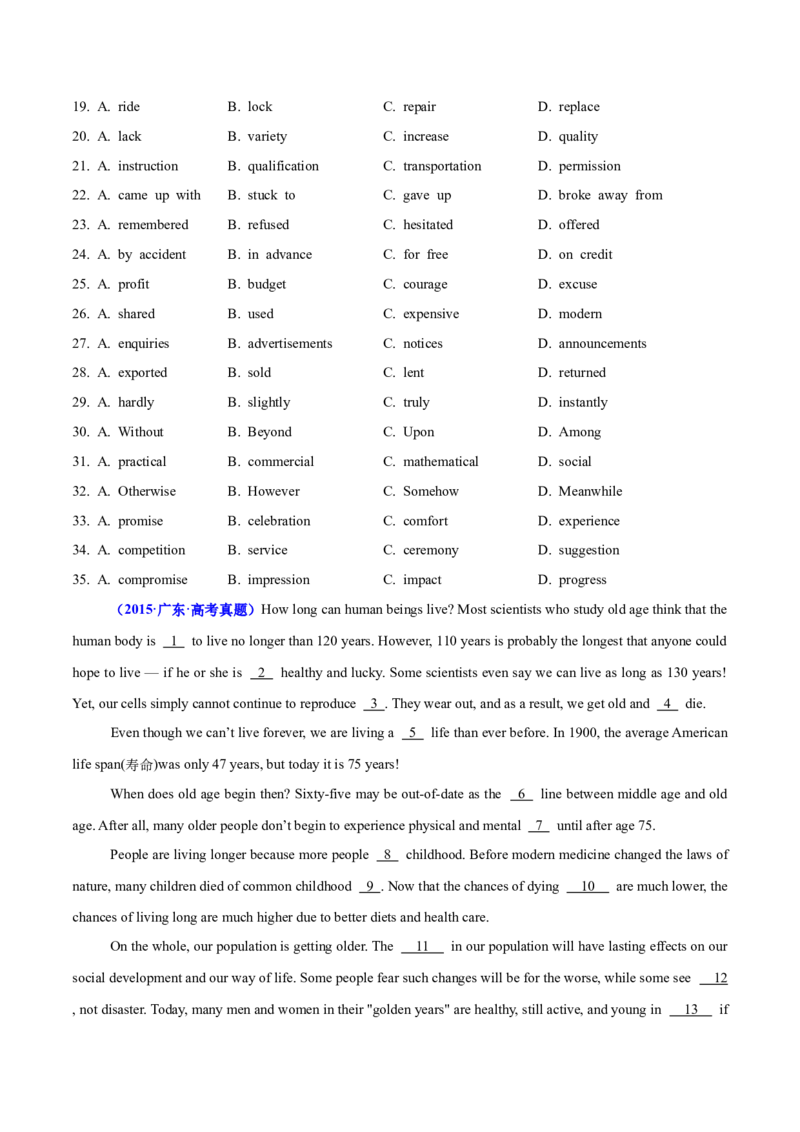
(2015·广东·高考真题)How long can human beings live? Most scientists who study old age think that the
human body is 1 to live no longer than 120 years. However, 110 years is probably the longest that anyone could
hope to live — if he or she is 2 healthy and lucky. Some scientists even say we can live as long as 130 years!
Yet, our cells simply cannot continue to reproduce 3 . They wear out, and as a result, we get old and 4 die.
Even though we can’t live forever, we are living a 5 life than ever before. In 1900, the average American
life span(寿命)was only 47 years, but today it is 75 years!
When does old age begin then? Sixty-five may be out-of-date as the 6 line between middle age and old
age. After all, many older people don’t begin to experience physical and mental 7 until after age 75.
People are living longer because more people 8 childhood. Before modern medicine changed the laws of
nature, many children died of common childhood 9 . Now that the chances of dying 10 are much lower, the
chances of living long are much higher due to better diets and health care.
On the whole, our population is getting older. The 11 in our population will have lasting effects on our
social development and our way of life. Some people fear such changes will be for the worse, while some see 12
, not disaster. Today, many men and women in their "golden years" are healthy, still active, and young in 13 ifnot in age.
As our society grows old, we need the 14 of our older citizens. With long lives ahead of them, they
need to 15 active and be devoted.
1.A.designed B.selected C.improved D.discovered
2.A.completely B.generally C.apparently D.extremely
3.A.rapidly B.harmlessly C.endlessly D.separately
4.A.eventually B.hopelessly C.automatically D.desperately
5.A.busier B.longer C.richer D.happier
6.A.finishing B.guiding C.waiting D.dividing
7.A.stress B.damage C.decline D.failure
8.A.survive B.enjoy C.remember D.value
9.A.problems B.fears C.worries D.diseases
10.A.poor B.young C.sick D.quiet
11.A.changes B.recovery C.safety D.increases
12.A.dreams B.chances C.strengths D.choices
13.A.mind B.appearance C.voice D.movement
14.A.protection B.suggestions C.contributions D.permission
15.A.sound B.appear C.turn D.stay
(2013·广东·高考真题)Number sense is not the ability to count. It is the ability to recognize a 1 ,
in number. Human beings are born with this ability. 2 , experiments show that many animals are, too. For
example, many birds have good number sense. If a nest has four eggs and you remove one, the bird will not 3
However, if you remove two, the bird 4 leaves. This means that the bird knows the 5 between two
and three.
Another interesting experiment showed a bird's 6 number sense. A man was trying to take a photo of
a crow(乌鸦)that had a nest in a tower, but the crow always left when she saw him coming. The bird did not 7
until the man left the tower. The man had an 8 . He took another man with him to the tower. One man left
and the other stayed, but they did not 9 the bird. The crow stayed away until the second man left, too. The
experiment was 10 with three men and then with four men. But the crow did not return to the nest until all
the men were 11 . It was not until five men went into the tower and only four left that they were 12
able to fool the crow.
How good is a human's number sense? It's not very good. For example, babies about fourteen months oldalmost always notice if something is taken away from a 13 group. But when the number goes beyond three
or four, the children are 14 fooled.
It seems that number sense is something we have in common with many animals in this world, and that our
human 15 is not much better than a crow's.
1.A.rise B.pattern C.change D.trend
2.A.Importantly B.Surprisingly C.Disappointedly D.Fortunately
3.A.survive B.care C.hatch D.notice
4.A.generally B.sincerely C.casually D.deliberately
5.A.distance B.range C.different D.interval
6.A.amazing B.annoying C.satisfying D.disturbing
7.A.relax B.recover C.react D.return
8.A.appointment B.excuse C.idea D.explanation
9.A.fool B.hurt C.catch D.kill
10.A.reported B.repeated C.designed D.approved
11.A.confused B.gone C.tired D.drunk
12.A.gradually B.luckily C.strangely D.finally
13.A.single B.small C.local D.new
14.A.seldom B.temporarily C.merely D.often
15.A.sight B.nature C.ability D.belief
【类型二:说明型完形填空名校模拟】
(24-25高三上·辽宁·期末)How to Avoid Raising a Spoiled Child
In the now classic scene from the movie Willy Wonka and the Chocolate Factory, a little girl stamps her foot
and 1 , “I want an Oompa Loompa now! ” as her father hurries to get her one. The more everyday version is
that the child loses 2 at the grocery checkout line, stamping and yelling to get candy. Other customers shake
their heads or 3 their eyes as they watch the 4 parent grab a candy bar off the shelf and hand it to
the child.
We can call such behavior 5 , over loved or entitled. Whatever the term, children who learn that their
tantrums (发怒) and demands can get them what they want can 6 not only running the family as teens but
also struggling in their relationships as 7 . Believing the world moves around them leaves others seeing
them as self-centered, demanding and 8 of others. They are often in 9 at work, and their home life
creates constant conflicts or leaves everyone walking on 10 .So, how do we avoid raising a spoiled child? Carrots are always better than sticks. The rule of 11
is to take action and be as non-emotional as possible when you need to set limits. And when your child doesn’t have
a tantrum at the checkout, when she is acting 12 , it’s time to get out the balloons and confetti (五彩纸屑).
The danger with always 13 and providing little reward is that the child learns to seek 14
attention, which for a child is better than no attention at all. Building in 15 quality time half an hour
before bedtime or a(n) weekend outing with a teen does the same magic.
1.A.smiles B.whispers C.speaks D.screams
2.A.money B.interest C.heart D.temper
3.A.roll B.narrow C.close D.focus
4.A.sorrowful B.exited C.annoyed D.frightening
5.A.violent B.spoiled C.serious D.panicked
6.A.rely on B.go on C.end up D.take up
7.A.children B.adults C.juniors D.seniors
8.A.inconsiderate B.thoughtful C.supportive D.ashamed
9.A.danger B.debt C.trouble D.confusion
10.A.eggshells B.grounds C.nuts D.carpets
11.A.arm B.heart C.thumb D.eye
12.A.poorly B.appropriately C.rudely D.successfully
13.A.praising B.blaming C.comforting D.distancing
14.A.objective B.immediate C.further D.negative
15.A.experimental B.accidental C.sudden D.regular
(24-25高三上·广东深圳·期末)We have been educated that we have a short life, so we’d better 1
as many things as possible by pushing, or even forcing, ourselves to a tight schedule. Then, we could lead a
fulfilling life.
However, sometimes, the more productive we are the more 2 we might be. Be 3 about a
phenomenon called the “productivity trap (陷阱)”. Believe it or not, we would do far better to 4 if we are to
make the most of our life.
Surprisingly, 5 brings anxiety. Consider a basic goal, such as improving your email response. You
might think you would be 6 with nothing in your inbox, and reply to each message the moment it comes in.
But each email you send brings further 7 and more work to complete. 8 , the messages pile up
again.Psychologists suggest trying “have done list”, the 9 of the “to do list”. Instead of starting out 10
each morning, “have done list” fills up with tasks you completed yesterday. It gives you a greater sense of 11
by recording your workload rather than stressing things you have yet to 12 .
Avoiding the productivity trap does not mean 13 tasks on purpose or working less efficiently.
Instead, it’s about finding a balance between personal efficiency and 14 . It means planning tasks carefully
and setting realistic goals, while also giving yourself enough time to 15 after working hard.
1.A.pack B.donate C.believe D.enjoy
2.A.nervous B.stressed C.happy D.successful
3.A.sorry B.cautious C.hopeful D.angry
4.A.cheer up B.go back C.break away D.slow down
5.A.capability B.flexibility C.accuracy D.efficiency
6.A.relieved B.inspired C.bored D.impressed
7.A.goals B.surprises C.replies D.improvements
8.A.Initially B.Ultimately C.Similarly D.Additionally
9.A.future B.outcome C.core D.opposite
10.A.empty B.sleepy C.delightful D.grateful
11.A.timing B.belonging C.commitment D.achievement
12.A.finish B.discover C.assess D.list
13.A.undervaluing B.delaying C.prioritizing D.tracking
14.A.task-expectation B.well-being
C.self-achievement D.time-management
15.A.create B.plan C.relax D.reflect
Trends come and go. Many goods that people buy to 1 fashion end up in the rubbish bin. Now young
American people are giving these things a second 2 .
Called “Stoopers (旧物猎人)”, they pick up idle (闲置的) goods and 3 them. They are mainly in big
cities like New York, Los Angeles and Chicago.
Anne Brown, 27, is one of them. Anne first stooped in June 2022 when many residents in a community left
their 4 on the street after they moved house. After that, she often “ 5 treasures” in her free time.
Now her small apartment holds things redesigned from the idle goods she collected, including tables, chairs and
clothing.
“Though many people say stooping is like collecting 6 , for me, it’s making the best of things,” the27-year-old digital marketer said. That’s why she wanted to 7 the trend to others. Whenever she spots goods
that are 8 used and she doesn’t need them, Anne puts a pair of eyeball-shaped stickers on them and then
posts pictures of them on her social media accounts to 9 others to pick them up.
Influenced by stoopers like Anne, 16-year-old Carmen Smith from a high school in Houston fell in love with
stooping. The 10 of “one man’s trash is another man’s treasure” is what attracts her most. She said since
her childhood, her family, who came from India, has often told stories about how past generations 11 the
period during which goods were in 12 shortage. “Frugality (节俭) has always been a traditional virtue in
India,” Carmen said. Despite this, Carmen admitted that many teenagers, including herself, are sometimes 13
consumption, leading to significant waste. This realization urged her to start stooping this year.
Carmen added that the first time she used paper from books 14 by students on campus to make
paper roses, she felt excited. “During the process of stooping, I start to observe my surroundings, which I had 15
taken for granted (想当然),” she said.
1.A.put up with B.do away with C.be familiar with D.keep pace with
2.A.goal B.deal C.life D.rule
3.A.restrict B.reserve C.reuse D.review
4.A.belongings B.pets C.fruits D.plants
5.A.displayed B.hunted C.purchased D.buried
6.A.paper B.cloth C.money D.garbage
7.A.promote B.return C.throw D.adjust
8.A.similarly B.barely C.blindly D.secretly
9.A.forbid B.force C.guide D.order
10.A.greeting B.hobby C.diary D.philosophy
11.A.survived B.valued C.wasted D.overlooked
12.A.occasional B.serious C.temporary D.slight
13.A.sensitive to B.close to C.addicted to D.equal to
14.A.treasured B.packed C.posted D.abandoned
15.A.beneficially B.previously C.dangerously D.responsibly