【好题汇编】2024 年高考英语一模试题分类汇编(新高考专用)
专题 03 阅读理解(说明文)
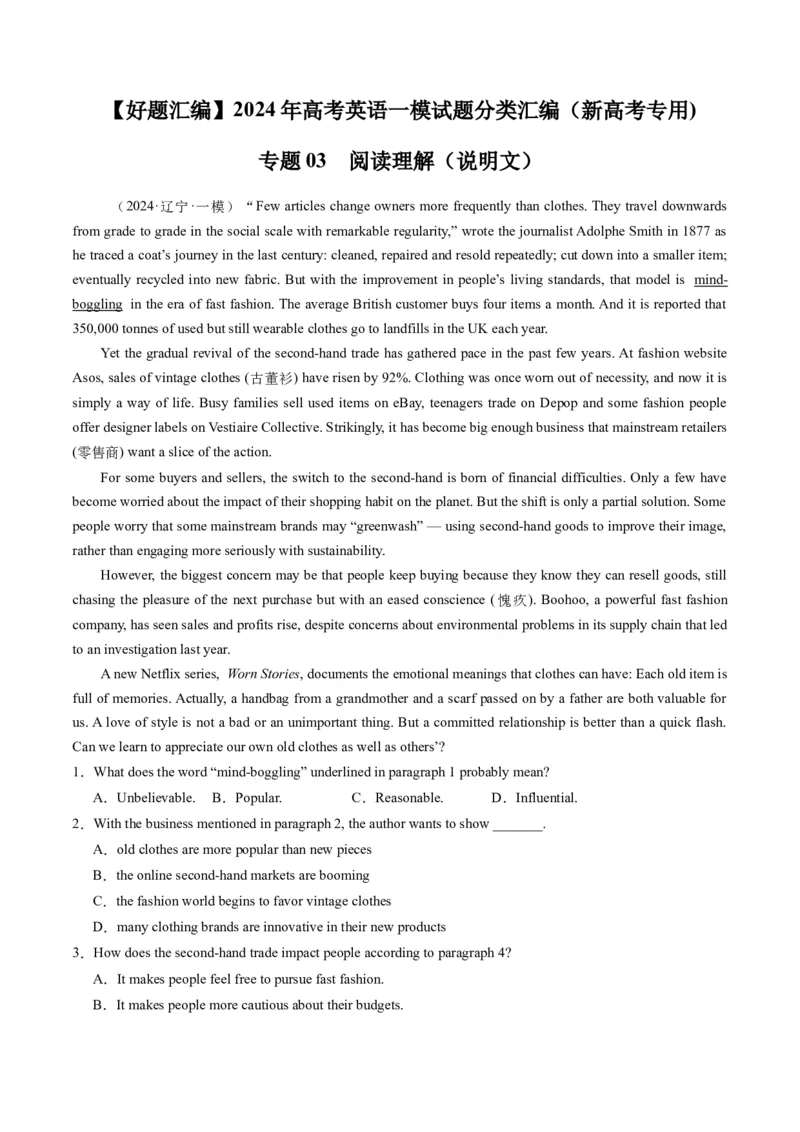
(2024·辽宁·一模)“Few articles change owners more frequently than clothes. They travel downwards
from grade to grade in the social scale with remarkable regularity,” wrote the journalist Adolphe Smith in 1877 as
he traced a coat’s journey in the last century: cleaned, repaired and resold repeatedly; cut down into a smaller item;
eventually recycled into new fabric. But with the improvement in people’s living standards, that model is mind-
boggling in the era of fast fashion. The average British customer buys four items a month. And it is reported that
350,000 tonnes of used but still wearable clothes go to landfills in the UK each year.
Yet the gradual revival of the second-hand trade has gathered pace in the past few years. At fashion website
Asos, sales of vintage clothes (古董衫) have risen by 92%. Clothing was once worn out of necessity, and now it is
simply a way of life. Busy families sell used items on eBay, teenagers trade on Depop and some fashion people
offer designer labels on Vestiaire Collective. Strikingly, it has become big enough business that mainstream retailers
(零售商) want a slice of the action.
For some buyers and sellers, the switch to the second-hand is born of financial difficulties. Only a few have
become worried about the impact of their shopping habit on the planet. But the shift is only a partial solution. Some
people worry that some mainstream brands may “greenwash” — using second-hand goods to improve their image,
rather than engaging more seriously with sustainability.
However, the biggest concern may be that people keep buying because they know they can resell goods, still
chasing the pleasure of the next purchase but with an eased conscience (愧疚). Boohoo, a powerful fast fashion
company, has seen sales and profits rise, despite concerns about environmental problems in its supply chain that led
to an investigation last year.
A new Netflix series, Worn Stories, documents the emotional meanings that clothes can have: Each old item is
full of memories. Actually, a handbag from a grandmother and a scarf passed on by a father are both valuable for
us. A love of style is not a bad or an unimportant thing. But a committed relationship is better than a quick flash.
Can we learn to appreciate our own old clothes as well as others’?
1.What does the word “mind-boggling” underlined in paragraph 1 probably mean?
A.Unbelievable. B.Popular. C.Reasonable. D.Influential.
2.With the business mentioned in paragraph 2, the author wants to show _______.
A.old clothes are more popular than new pieces
B.the online second-hand markets are booming
C.the fashion world begins to favor vintage clothes
D.many clothing brands are innovative in their new products
3.How does the second-hand trade impact people according to paragraph 4?
A.It makes people feel free to pursue fast fashion.
B.It makes people more cautious about their budgets.C.It encourages people to choose eco-friendly clothes.
D.It pushes people to be more engaged with sustainability.
4.Which of the following views does Worn Stories advocate?
A.Old items have lost favor with the public.
B.Old items are worthy of being long cherished.
C.Older generations attach great importance to old items.
D.Older generations care about the quality of their clothes.
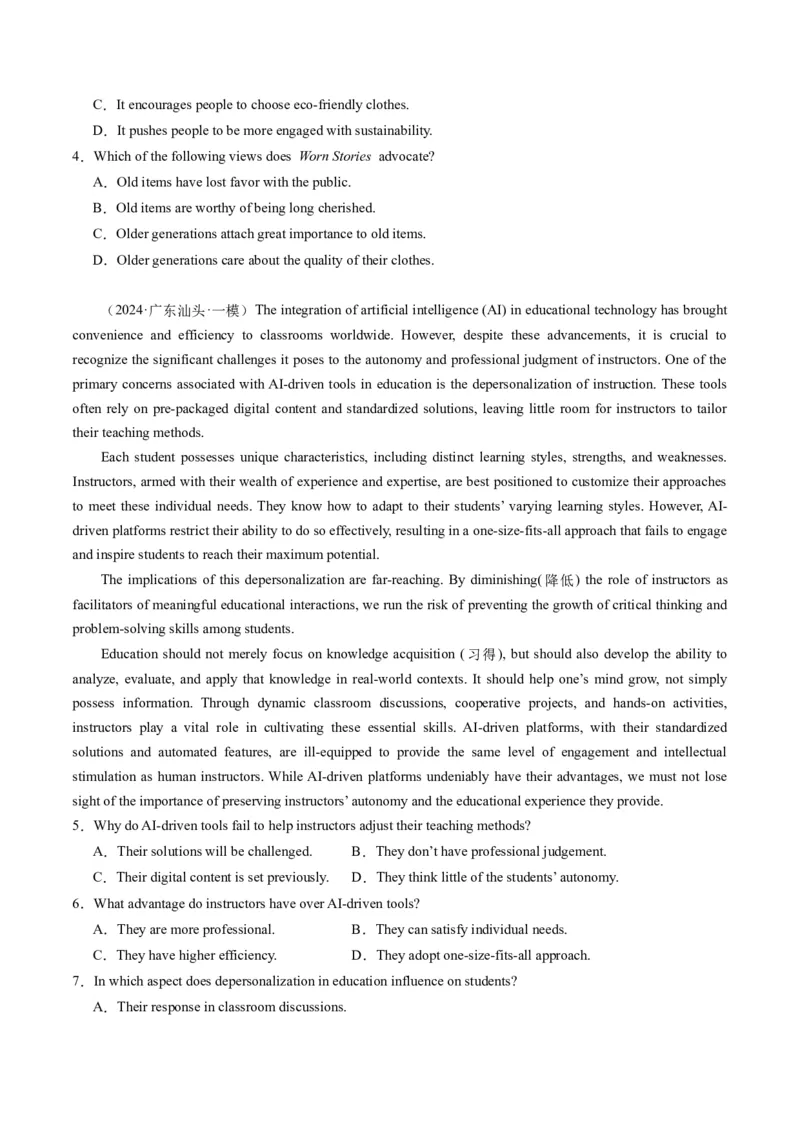
(2024·广东汕头·一模)The integration of artificial intelligence (AI) in educational technology has brought
convenience and efficiency to classrooms worldwide. However, despite these advancements, it is crucial to
recognize the significant challenges it poses to the autonomy and professional judgment of instructors. One of the
primary concerns associated with AI-driven tools in education is the depersonalization of instruction. These tools
often rely on pre-packaged digital content and standardized solutions, leaving little room for instructors to tailor
their teaching methods.
Each student possesses unique characteristics, including distinct learning styles, strengths, and weaknesses.
Instructors, armed with their wealth of experience and expertise, are best positioned to customize their approaches
to meet these individual needs. They know how to adapt to their students’ varying learning styles. However, AI-
driven platforms restrict their ability to do so effectively, resulting in a one-size-fits-all approach that fails to engage
and inspire students to reach their maximum potential.
The implications of this depersonalization are far-reaching. By diminishing(降低) the role of instructors as
facilitators of meaningful educational interactions, we run the risk of preventing the growth of critical thinking and
problem-solving skills among students.
Education should not merely focus on knowledge acquisition (习得), but should also develop the ability to
analyze, evaluate, and apply that knowledge in real-world contexts. It should help one’s mind grow, not simply
possess information. Through dynamic classroom discussions, cooperative projects, and hands-on activities,
instructors play a vital role in cultivating these essential skills. AI-driven platforms, with their standardized
solutions and automated features, are ill-equipped to provide the same level of engagement and intellectual
stimulation as human instructors. While AI-driven platforms undeniably have their advantages, we must not lose
sight of the importance of preserving instructors’ autonomy and the educational experience they provide.
5.Why do AI-driven tools fail to help instructors adjust their teaching methods?
A.Their solutions will be challenged. B.They don’t have professional judgement.
C.Their digital content is set previously. D.They think little of the students’ autonomy.
6.What advantage do instructors have over AI-driven tools?
A.They are more professional. B.They can satisfy individual needs.
C.They have higher efficiency. D.They adopt one-size-fits-all approach.
7.In which aspect does depersonalization in education influence on students?
A.Their response in classroom discussions.B.Their ability in solving real life problems.
C.Their willingness to cooperate with others.
D.Their adaptability to various learning styles.
8.What should education focus on apart from knowledge acquisition?
A.Doing cooperative projects. B.Organizing hands-on activities.
C.Developing thinking ability. D.Evaluating students’ development.
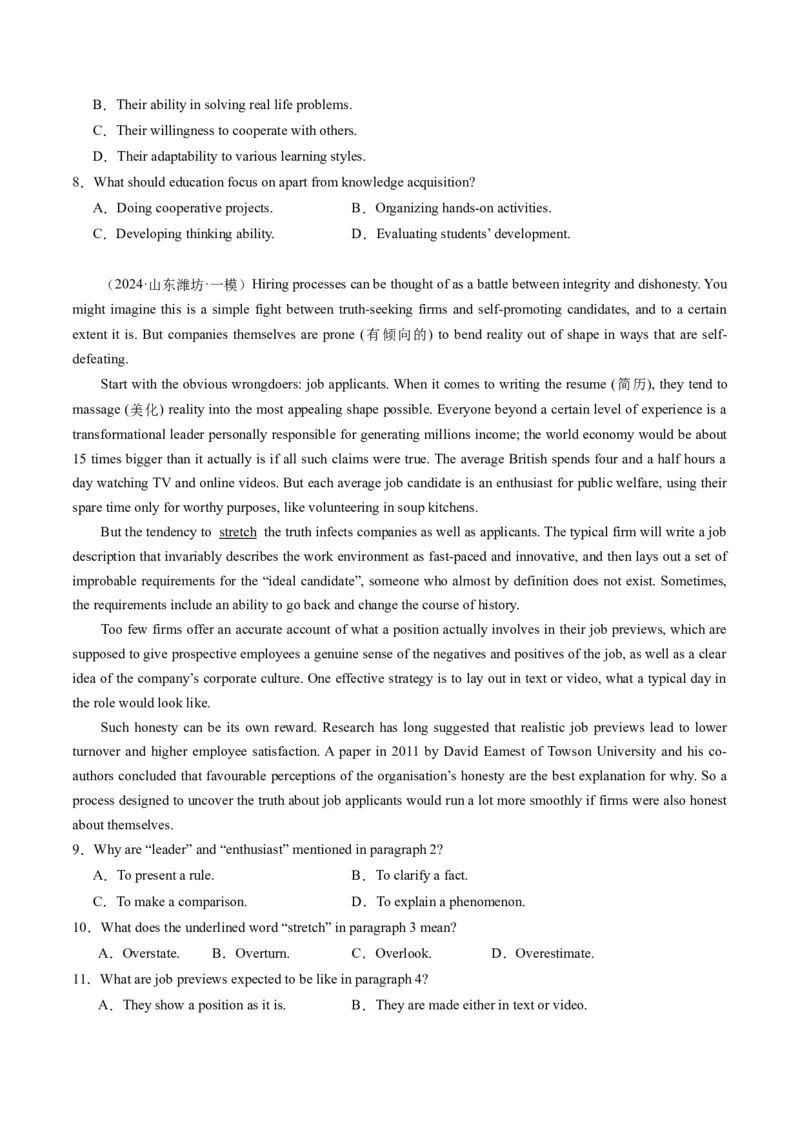
(2024·山东潍坊·一模)Hiring processes can be thought of as a battle between integrity and dishonesty. You
might imagine this is a simple fight between truth-seeking firms and self-promoting candidates, and to a certain
extent it is. But companies themselves are prone (有倾向的) to bend reality out of shape in ways that are self-
defeating.
Start with the obvious wrongdoers: job applicants. When it comes to writing the resume (简历), they tend to
massage (美化) reality into the most appealing shape possible. Everyone beyond a certain level of experience is a
transformational leader personally responsible for generating millions income; the world economy would be about
15 times bigger than it actually is if all such claims were true. The average British spends four and a half hours a
day watching TV and online videos. But each average job candidate is an enthusiast for public welfare, using their
spare time only for worthy purposes, like volunteering in soup kitchens.
But the tendency to stretch the truth infects companies as well as applicants. The typical firm will write a job
description that invariably describes the work environment as fast-paced and innovative, and then lays out a set of
improbable requirements for the “ideal candidate”, someone who almost by definition does not exist. Sometimes,
the requirements include an ability to go back and change the course of history.
Too few firms offer an accurate account of what a position actually involves in their job previews, which are
supposed to give prospective employees a genuine sense of the negatives and positives of the job, as well as a clear
idea of the company’s corporate culture. One effective strategy is to lay out in text or video, what a typical day in
the role would look like.
Such honesty can be its own reward. Research has long suggested that realistic job previews lead to lower
turnover and higher employee satisfaction. A paper in 2011 by David Eamest of Towson University and his co-
authors concluded that favourable perceptions of the organisation’s honesty are the best explanation for why. So a
process designed to uncover the truth about job applicants would run a lot more smoothly if firms were also honest
about themselves.
9.Why are “leader” and “enthusiast” mentioned in paragraph 2?
A.To present a rule. B.To clarify a fact.
C.To make a comparison. D.To explain a phenomenon.
10.What does the underlined word “stretch” in paragraph 3 mean?
A.Overstate. B.Overturn. C.Overlook. D.Overestimate.
11.What are job previews expected to be like in paragraph 4?
A.They show a position as it is. B.They are made either in text or video.C.They are favorable for bigger firms. D.They mainly contain negatives of a job.
12.What does the text mainly talk about?
A.Pains and gains of employees. B.How to get the lying out of hiring.
C.How to be more appealing in hiring. D.A wrestle between applicants and companies.
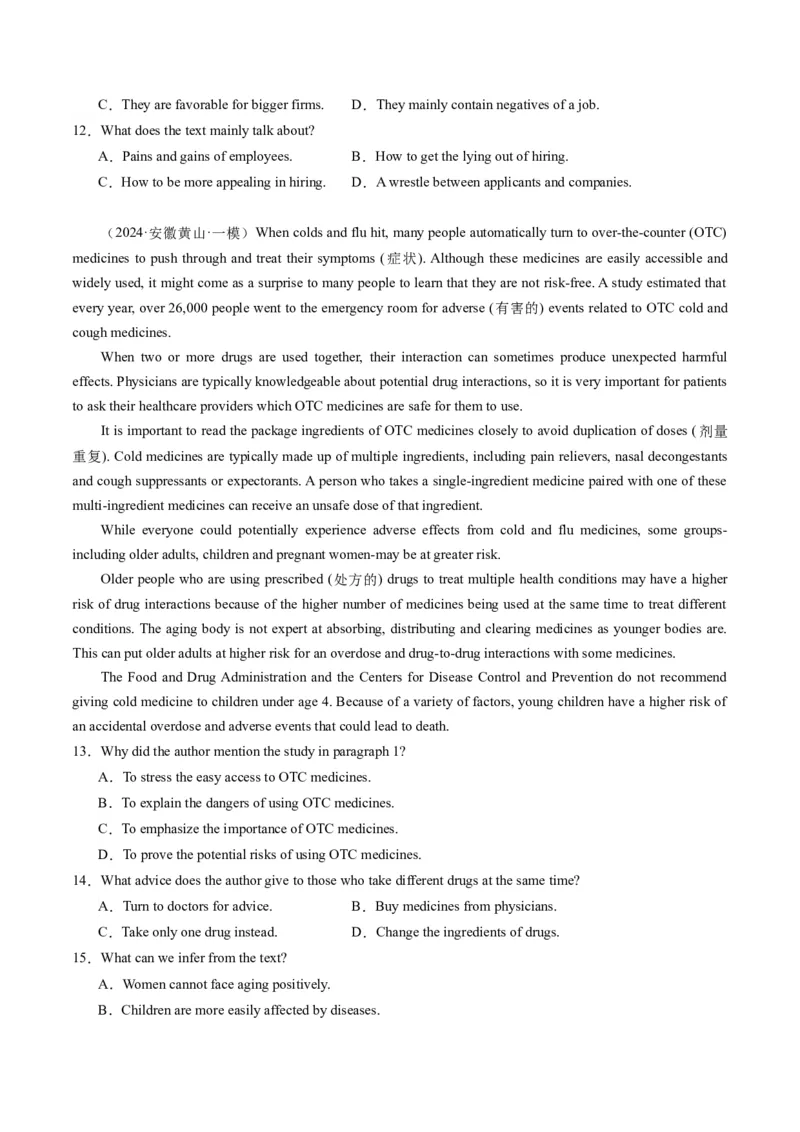
(2024·安徽黄山·一模)When colds and flu hit, many people automatically turn to over-the-counter (OTC)
medicines to push through and treat their symptoms (症状). Although these medicines are easily accessible and
widely used, it might come as a surprise to many people to learn that they are not risk-free. A study estimated that
every year, over 26,000 people went to the emergency room for adverse (有害的) events related to OTC cold and
cough medicines.
When two or more drugs are used together, their interaction can sometimes produce unexpected harmful
effects. Physicians are typically knowledgeable about potential drug interactions, so it is very important for patients
to ask their healthcare providers which OTC medicines are safe for them to use.
It is important to read the package ingredients of OTC medicines closely to avoid duplication of doses (剂量
重复). Cold medicines are typically made up of multiple ingredients, including pain relievers, nasal decongestants
and cough suppressants or expectorants. A person who takes a single-ingredient medicine paired with one of these
multi-ingredient medicines can receive an unsafe dose of that ingredient.
While everyone could potentially experience adverse effects from cold and flu medicines, some groups-
including older adults, children and pregnant women-may be at greater risk.
Older people who are using prescribed (处方的) drugs to treat multiple health conditions may have a higher
risk of drug interactions because of the higher number of medicines being used at the same time to treat different
conditions. The aging body is not expert at absorbing, distributing and clearing medicines as younger bodies are.
This can put older adults at higher risk for an overdose and drug-to-drug interactions with some medicines.
The Food and Drug Administration and the Centers for Disease Control and Prevention do not recommend
giving cold medicine to children under age 4. Because of a variety of factors, young children have a higher risk of
an accidental overdose and adverse events that could lead to death.
13.Why did the author mention the study in paragraph 1?
A.To stress the easy access to OTC medicines.
B.To explain the dangers of using OTC medicines.
C.To emphasize the importance of OTC medicines.
D.To prove the potential risks of using OTC medicines.
14.What advice does the author give to those who take different drugs at the same time?
A.Turn to doctors for advice. B.Buy medicines from physicians.
C.Take only one drug instead. D.Change the ingredients of drugs.
15.What can we infer from the text?
A.Women cannot face aging positively.
B.Children are more easily affected by diseases.C.Older people’s body cannot deal with medicines easily.
D.People’s desire for health makes them take more medicine.
16.What is a suitable title for the text?
A.OTC medicines may not be safe.
B.Tips for taking over-the-counter drugs.
C.How to deal with an OTC drug overdose?
D.Should medicines be available “over the counter”?
(2024·山西·一模)A new research from the University of Michigan stated, “People tend to have one of
three beliefs about the meaning of work and which category you fall into largely depends on your parents.”
Workers who are job-oriented (有工作倾向的) are those just trying to make a living who much prefer the activities
they pursue outside of the office. Career-oriented adults value the social status and fame that comes with
professional achievement. Calling-oriented people do work that they are passionate about because they want to
have a positive impact on the world.
In the first study into how these orientations originate, researchers found that how teenagers perceive their
parents’ work habit is central to the development of their own work attitudes. It’s not a straightforward transfer of
values. People who perceive their father to have a strong career-orientation are more likely to be career-oriented
themselves-but career-determined mothers have no effect on their kids’ work orientation. The researchers owed this
to generational gender norms. When the study’s participants were teenagers, mostly in the1980s, men were more
commonly employed outside of the home and were more likely than women to hold “career” jobs with opportunity
for advancement. Mothers do have a notable effect on whether children have a job-orientation mentality. Teenagers
who are close to their mothers are less likely to view work as just a job when they grow up, probably because
they’ve been raised to value social, rather than instrumental life experiences.
Having both parents display the same work ethic (行为准则) has a strong influence, but only in the case of
calling-oriented offspring (子女). As the society nowadays favors money and professional achievement, a child
with two calling-oriented parents is more likely to have the confidence to ignore these societal pressures and pursue
her dreams. Children can affect their parents’ work ethic, too. Allowing people to bring their children into the office
has been shown to boost efficiency and productivity and could help raise that next generation of career-oriented
workers.
17.What motivates calling-oriented people to do work they like?
A.To achieve social status and fame. B.To pursue activities outside the office.
C.To believe they can earn them much money. D.To make a positive contribution to the world.
18.What is crucial in shaping the work attitudes of teenagers?
A.Peer pressure. B.Personal preferences.
C.Educational background. D.Awareness of parents’ work habits.
19.Why are children close to mothers less likely to be job-oriented?
A.Because mothers value social life experiences.B.Because mothers focus on instrumental life experiences.
C.Because mothers tend to have a stronger career orientation.
D.Because mothers emphasize the importance of work as just a job.
20.What is the main idea of the passage?
A.The influence of societal pressures on work beliefs.
B.The preferences of workers in different occupations.
C.The impact of parental work habits on teenagers’ attitudes.
D.The relationship between money and professional achievement.
(2024·江苏泰州·一模)A satellite is an object in space that orbits around another. It has two kinds —
natural satellites and artificial satellites. The moon is a natural satellite that moves around the earth while artificial
satellites are those made by man.
Despite their widespread impact on daily life, artificial satellites mainly depend on different complicated
makeups. On the outside, they may look like a wheel, equipped with solar panels or sails. Inside, the satellites
contain mission-specific scientific instruments, which include whatever tools the satellites need to perform their
work. Among them, high-resolution cameras and communication electronics are typical ones. Besides, the part that
carries the load and holds all the parts together is called the bus.
Artificial satellites operate in a systematic way just like humans. Computers function as the satellite’s brain,
which receive information, interpret it, and send messages back to the earth. Advanced digital cameras serve as the
satellite’s eyes. Sensors are other important parts that not only recognize light, heat, and gases, but also record
changes in what is being observed. Radios on the satellite send information back to the earth. Solar panels provide
electrical power for the computers and other equipment, as well as the power to move the satellite forward.
Artificial satellites use gravity to stay in their orbits. Earth’s gravity pulls everything toward the center of the
planet. To stay in the earth’s orbit, the speed of a satellite must adjust to the tiniest changes in the pull of gravity.
The satellite’s speed works against earth’s gravity just enough so that it doesn’t go speeding into space or falling
back to the earth.
Rockets carry satellites to different types and heights of orbits, based on the tasks they need to perform.
Satellites closer to the earth are in low-earth orbit, which can be 200-500 miles high. The closer to the earth, the
stronger the gravity is. Therefore, these satellites must travel at about 17,000 miles per hour to keep from falling
back to the earth, while higher-orbiting satellites can travel more slowly.
21.What is Paragraph 2 of the text mainly about?
A.The appearance of artificial satellites. B.The components of artificial satellites.
C.The basic function of artificial satellites.D.The specific mission of artificial satellites.
22.What is the role of computers in artificial satellites?
A.Providing electrical power. B.Recording changes observed.
C.Monitoring space environment. D.Processing information received.
23.How do artificial satellites stay in their orbits?A.By relying on powerful rockets to get out of gravity.
B.By orbiting at a fixed speed regardless of gravity’s pull.
C.By changing speed constantly based on the pull of gravity.
D.By resisting the pull of gravity with advanced technologies.
24.Why do satellites in higher-earth orbit travel more slowly?
A.They are more affected by earth’s gravity.
B.They take advantage of rockets more effectively.
C.They have weaker pull of gravity in higher orbits.
D.They are equipped with more advanced instruments.
(2024·广东深圳·一模)Each year, the world loses about 10 million hectares of forest—an area about the
size of Iceland—because of cutting down trees. At that rate, some scientists predict the world’s forests could
disappear in 100 to 200 years. To handle it, now researchers at Massachusetts Institute of Technology (MIT) have
pioneered a technique to generate wood-like plant materials in a lab. This makes it possible to “grow” a wooden
product without cutting down trees.
In the lab, the researchers first take cells from the leaves of a young plant. These cells are cultured in liquid
medium for two days, then moved to another medium which contains nutrients and two different hormones. By
adjusting the hormone levels, the researchers can tune the physical and mechanical qualities of the cells. Next, the
researchers use a 3D printer to shape the cell-based material, and let the shaped material grow in the dark for three
months. Finally, the researchers dehydrate the material, and then evaluate its qualities.
They found that lower hormone levels lead to plant materials with more rounded, open cells of lower density,
while higher hormone levels contribute to the growth of plant materials with smaller but denser cell structures.
Lower or higher density of cell structures makes the plant materials softer or more rigid, helping the materials grow
with different wood-like characteristics. What’s more, it’s to be noted that the research process is about 100 times
faster than the time it takes for a tree to grow to maturity!
Research of this kind is ground-breaking. “This work demonstrates the great power of a technology,” says lead
researcher, Jeffrey Berenstain. “The real opportunity here is to be at its best with what you use and how you use it.
This technology can be tuned to meet the requirements you give about shapes, sizes, rigidity, and forms. It enables
us to ‘grow’ any wooden product in a way that traditional agricultural methods can’t achieve.”
25.Why do researchers at MIT conduct the research?
A.To grow more trees. B.To protect plant diversity.
C.To reduce tree losses. D.To predict forest disappearance.
26.What does paragraph 2 mainly tell us about the lab research?
A.Its theoretical basis. B.Its key procedures.
C.Its scientific evidence. D.Its usual difficulties.
27.What does the finding suggest about the plant materials?
A.The hormone levels affect their rigidity.B.They are better than naturally grown plants.
C.Their cells’ shapes mainly rely on their density.
D.Their growth speed determines their characteristics.
28.Why is the research ground-breaking according to Berenstain?
A.It uses new biological materials in lab experiments.
B.It revolutionizes the way to make wooden products.
C.It challenges traditional scientific theories in forestry.
D.It has a significant impact on worldwide plant growth.
(2024·云南昆明·一模)Forgetting names, faces, or events is a universal human experience; even those who
see their minds sharp struggle with memory loss from time to time. Most consider these mental mistakes to be
annoyed, and they’re seen as a potentially worrisome sign of cognitive decline. But neurologist Scott Small, who
studies and treats Alzheimer’s disease at Columbia University, thinks this view of forgetting is all wrong. In fact,
some amount of forgetfulness is critical for our minds and relationships to function at their best.
We’re developing drugs to protect against memory loss. But many psychologists have joked that what they
want is a forgetfulness drug. Too much memory poses a challenge in any long-term relationship. Anger, hatred—
they all come from not being able to let go of emotional memories. People who repeatedly think of anger or fear
suffer, often in loneliness.
Living in a noisy, ever-changing world, forgetting details is actually a perfect adaptation. Creativity isn’t
making something out of nothing. It’s making connections between already-known elements—ideas, words,
visuals, or expressions—to create something new. But to make new connections, the existing connections in your
mind have to be loose. If the connections between those elements are too tightly bound in our memory, there’s no
room for creativity.
What can we do to help our brains forget what we need to forget? One of the best ways to make sure that you
don’t have a brain that’s burning too. hot with bad memories is to stay socially engaged. Another thing to do is to
sleep, and sleep well. Many experts have concluded that we sleep in order to forget, so it makes sense that sleep has
been shown to improve creativity. If you’re short of sleep, your brain is on fire with too many memories. The brain
is like a lawn of grass—you need to keep it trimmed to make way for new memories, new connections, and new
growth.
29.What is the first paragraph mainly about?
A.The damage of cognitive decline. B.The importance of forgetting things.
C.The reasons of getting mental disease. D.The methods of preventing memory loss.
30.Why is the forgetfulness drug needed?
A.Because various pressure makes us sleepless.
B.Because some patients forget important things.
C.Because too much memory disturbs and bothers us.
D.Because many seniors suffer from Alzheimer’s disease.31.What can we learn from the last two paragraphs?
A.Too much memory blocks our creativity.B.Our brain can adapt to ever-changing world.
C.Sleeping well contributes to improved attention. D.Bad memory has terrible impact on our social life.
32.Where is the text probably from?
A.A book review. B.An advertisement. C.A science fiction. D.A news report.
(2024·山东日照·一模)Dr Paul King at Texas Christian University has been an influential scholar in the
field of communication studies for 30 years. I spoke to King about his research into “state anxiety in listening
performance”. Most of us believe that anxiety impacts only the person giving the speech or presentation. Dr King
has discovered that audience members feel anxiety, too.
King says that listening is a tiring activity because the learner is continually adding material to be
remembered-retrieved-later. This is what he means by “cognitive backlog(认知积压)”. Put simply, the longer the
task or the more information that is delivered, the greater the cognitive load. According to King, listening to a five-
minute presentation produces a relatively small amount of cognitive backlog; an 18-minute presentation produces a
little more, while a 60-minute presentation produces so much backlog that you risk seriously upsetting your
audience unless you create a very engaging presentation with “soft breaks”— stories, videos, demonstrations, or
other speakers.
The longer the presentation, the more the listener has to organize, comprehend, and remember. The burden
increases along with a listener’s anxiety. They become increasingly frustrated, even angry. King says that the
current research into memory processing suggests that it’s better to study content on two or three occasions for a
short period of time instead of spending an entire evening cramming(填鸭式学习).
King applies the results to his graduate class on research methods. If given a choice, most graduate students
would rather attend a single three-hour class than three 50-minute classes. When King taught his class once a week,
he found that the students returned for the next class having lost most of the information they had learned the prior
week. King discovered the “better practice” was to schedule the same content on three separate occasions, such as
Monday, Wednesday, and Friday. King said that despite objections, when he taught the class on three occasions his
students scored better and exhibited a better memory of the complex material.
33.What does Dr Paul King say about “cognitive backlog”?
A.It should be prevented from happening.
B.It is affected by the number of listeners.
C.It changes with the length of a presentation.
D.It produces a negative effect on mental health.
34.What is the function of “soft breaks”?
A.To ease listeners’ anxiety. B.To show the talents of speakers.
C.To add topics to the presentation. D.To make the presentation longer.
35.What does Dr Paul King’s new practice focus on?
A.Exploring complex materials. B.Completing a single task at a time.C.Breaking up the whole into parts. D.Grouping students by their levels.
36.What can we learn about Dr Paul King’s new class schedule?
A.It was welcomed by students. B.It turned out to be a success.
C.It made no difference indeed. D.It still had room for improvement.
(2024·山东日照·一模)Dr Paul King at Texas Christian University has been an influential scholar in the
field of communication studies for 30 years. I spoke to King about his research into “state anxiety in listening
performance”. Most of us believe that anxiety impacts only the person giving the speech or presentation. Dr King
has discovered that audience members feel anxiety, too.
King says that listening is a tiring activity because the learner is continually adding material to be
remembered-retrieved-later. This is what he means by “cognitive backlog(认知积压)”. Put simply, the longer the
task or the more information that is delivered, the greater the cognitive load. According to King, listening to a five-
minute presentation produces a relatively small amount of cognitive backlog; an 18-minute presentation produces a
little more, while a 60-minute presentation produces so much backlog that you risk seriously upsetting your
audience unless you create a very engaging presentation with “soft breaks”— stories, videos, demonstrations, or
other speakers.
The longer the presentation, the more the listener has to organize, comprehend, and remember. The burden
increases along with a listener’s anxiety. They become increasingly frustrated, even angry. King says that the
current research into memory processing suggests that it’s better to study content on two or three occasions for a
short period of time instead of spending an entire evening cramming(填鸭式学习).
King applies the results to his graduate class on research methods. If given a choice, most graduate students
would rather attend a single three-hour class than three 50-minute classes. When King taught his class once a week,
he found that the students returned for the next class having lost most of the information they had learned the prior
week. King discovered the “better practice” was to schedule the same content on three separate occasions, such as
Monday, Wednesday, and Friday. King said that despite objections, when he taught the class on three occasions his
students scored better and exhibited a better memory of the complex material.
37.What does Dr Paul King say about “cognitive backlog”?
A.It should be prevented from happening.
B.It is affected by the number of listeners.
C.It changes with the length of a presentation.
D.It produces a negative effect on mental health.
38.What is the function of “soft breaks”?
A.To ease listeners’ anxiety. B.To show the talents of speakers.
C.To add topics to the presentation. D.To make the presentation longer.
39.What does Dr Paul King’s new practice focus on?
A.Exploring complex materials. B.Completing a single task at a time.
C.Breaking up the whole into parts. D.Grouping students by their levels.40.What can we learn about Dr Paul King’s new class schedule?
A.It was welcomed by students. B.It turned out to be a success.
C.It made no difference indeed. D.It still had room for improvement.
(2024·湖南长沙·一模)Crows (乌鸦) are undeniably intelligent. From making tools to holding hatred,
crows have been surprising the scientific community with their skillset. In fact, a study once published in the
journal Current Biology found “the crow brain is the same relative size as the chimpanzee (大猩猩) brain”.
Now, a study published in Science Advances finds crows understand what is known as recursion (递归). Prior
to this study, recursion was believed to be unique to humans.
“We were interested in the ability to represent recursive structures—defined here as having elements be put
within other similar elements,” Diana Liao said, who is the study’s first author. Liao says it was surprising to
discover crows “were able to know the underlying recursive structure of the orders” upon first exposure. This
makes the birds similar to humans, who are able to extract patterns with little experience. “Recursion is thought to
be a key feature of human symbolic systems such as language or mathematics—and since these are thought to be
unique to humans—there’s been interest in whether non-human animals can grasp and generate recursive
structures,” says Liao.
What exactly is recursion? Liao explains: “A classic example sentence is ‘the mouse the cat caught ran’ where
the clause the cat caught’ is within the clause’ the mouse who ran’. These complex structures are found in human
languages but not in animal communication systems which suggest that recursion might be what separates them.”
The findings of this study are significant since they show recursive ability in animals that are not closely
related to chimpanzees. “This suggests that this ability is either very evolutionarily (进化) ancient or that is a
product of convergent evolution,” says Liao. “Also, it would propose that certain brain structures are not necessary
to support this ability since birds have a dramatically different neural architecture.”
Liao says scientists know crows are smart but the extent of their intelligence is really unexpected. “Everyone
has the impression that crows are super smart but I simply didn’t know just how intelligent they are.”
41.What is the finding of the new study?
A.Crows can make tools.
B.Crows understand recursion.
C.Crows can create special patterns.
D.Crows and chimpanzees are of a brain size.
42.Which structure can show Crows’ special ability?
A.I bought a book B.My book was missing.
C.The book I bought was missing. D.My book was missing and I bought one.
43.What impressed Diana Liao?
A.Crows’ intelligence level. B.Crows’ body structure.
C.The reason for Crows’s martness. D.people’s impression of crows.
44.What can be the best title for the text?A.Crows Are Humans’ close Relatives
B.Crows Are Found the cleverest Bird
C.Crows Have the Ability to Learn to speak
D.Crows Have a Human-like Grammar skill
(2024·广东湛江·一模)For the history of life on Earth, organisms have relied on the light of the sun, moon,
and stars to find their way and schedule their lives. While the beginning of electric lighting in the late 19th century
may have benefited humans, it has caused problems in the natural world. Among the impacts of artificial light at
night(ALAN), light pollution lures migrating birds to cities with shocking consequences, contributes to the
alarming decline in insect populations, and convinces sea turtle babies to amble(缓行)away from the water instead
of towards it.
Now, a new study from the University of Plymouth adds another disappointing finding about how ALAN is
affecting the creatures with whom we share the planet: Light pollution from coastal cities can trick corals(珊瑚)into
reproducing outside of the optimum times when they would normally reproduce.
Using a combination of light pollution data and spawning(产卵)observations, researchers were able to show
for the first time that corals exposed to ALAN are spawning one to three days earlier and closer to the full moon
compared to those on unlit corals. “That shift may reduce the survival and fertilization success of gametes(配
子)and genetic connectivity between nearby lit and unlit coral systems,” they explain.
“Corals are among the most biodiverse, economically important, and threatened ecosystems on the planet,”
write the authors of the study.
“Climate change has led to mass bleaching(褪色)events. Habitat destruction, fisheries, and pollution have
reduced corals substantially since the 1950s,” they write, adding, “The complete loss of corals is anticipated over
the next 100 years.”
If we want to reduce the harm ALAN is causing, we could perhaps look to delay the switching-on of night-
time lighting in coastal regions to ensure the natural dark period between sunset and moonrise when coral
reproduction remains undisturbed.
45.Why is the first paragraph written?
A.To present the topic of the text. B.To advocate energy conservation.
C.To explain a natural phenomenon. D.To provide background information.
46.What does the underlined word “optimum” in paragraph 2 mean?
A.Possible. B.Appropriate. C.Flexible. D.Sensitive.
47.What is the researchers’ major concern over corals?
A.Extinction. B.Losing value.
C.Terrible diseases. D.Exposure to moonlight.
48.What can be a suitable title for the text?
A.Creatures Rely on Natural Lights to Schedule Their Life
B.Night-time Lighting Shortens Natural Dark PeriodC.Coastal Lights Trick Corals into Early Spawning
D.Light Pollution Leads to Serious Consequences