北京 101 中学 2022-2023 学年九年级上学期月考英
语试卷
一、听后选择(每题1.5分, 共12分)
听对话或独白, 根据对话或独白的内容, 从下面各题所给的A、B、C三个选项中,选择最佳选
项。每段对话或独白你将听两遍。
听材料, 回答问题。
1. How many English classes will Linda have tomorrow?
A. Two. B. Three. C. Four.
2. What will Linda read in English classes?
A. English newspapers. B. English magazines. C. English storybooks.
听材料, 回答问题。
3. What is Peter doing?
A. He is doing his homework. B. He is calling his friend. C. He is having breakfast outside
4. What class is the poster for?
A. English class. B. Chinese class. C. History class.
听材料, 回答问题。
5. What is the girl going to do next summer holiday?
A. Travel to Australia. B. Find a job. C. Go to a summer camp.
6. What does the girl advise the boy to do?
A. Go to the swimming pool. B. Join her trip to Australia. C. Stay at home next summer holiday.
听材料, 回答问题。
7. What should we create in our mind when we remember something?
A. A story. B. A song. C. A picture.
8. How can we exercise our mind?
A. By listening to music. B. By keeping thinking. C. By doing sports.
二、听后回答(每题2分, 共10分)
听对话, 根据对话内容笔头回答问题。每段对话你将听两遍。
9. When is the English exam?
10. What club has Jack joined?
11. What does the boy want to do?
12. How long will the woman stay in Nanjing?
第1页/共10页
学科网(北京)股份有限公司13. Why didn’t Jane catch the bus?
三、听后记录并转写本大题包括两节。
第一节:听后填空。
听短文, 根据所听内容和提示信息将所缺信息填写在相应位置上。短文你将听两遍。
How to Make a Good Public Speech
•think about everything you have about the 1
Make a plan
•keep your audience(观众) in 2 put yourself in their shoes as you…
3 enough facts on your topic
•spend time on your material(材料)
Prepare well
remember to use as many examples as possible to make
your topic 4 to follow
don’t talk over their heads
Never forget your 5 don’t talk down to them
treat(对待) them politely and…
第二节:听后转写。请再听一遍短文, 根据所听到的内容和第一节中的提示信息, 写出短文的
主要内容。短文的开头已给出。请注意语法正确, 语意连贯。
I’ve got some ideas on _________________________________.
四、单项填空(每题1分, 共8分)
从下面各题所给的A、B、C、D四个选项中, 选择可以填入空白处的最佳选项。
1. Mr. Black is very kind to the students. They all like very much.
A. us B. them C. him D. her
2. I made a special card for my father __________ Father's Day this year.
A. in B. at C. on D. to
3. —Mike, ________ you write an invitation in English?
—Of course, I can.
A. can B. may C. must D. need
4. _________ the mooncakes are!
A. What delicious B. How delicious C. What a delicious D. How a delicious
5. —Where did you go during the Mid-Autumn Festival?
—I ________ to Beihai Park with my family.
A. go B. will go C. went D. was going
6. I wonder ________ everyone can enjoy the English party this Friday afternoon.
A. if B. that C. what D. when
第2页/共10页
学科网(北京)股份有限公司7. —Hey, can you read out the Chinese on the book cover?
—Sure, just a piece of cake. I ________ Chinese since I was 8 years old.
A. learn B. have learnt C. am learning D. learnt
8. —Could you tell me ________ the Chinese-English dictionary? I want a same one for myself.
—In a bookstore near my home.
A. where you buy B. where do you buy C. where you bought D. where did you buy
五、语法填空(每题1分, 共4分)
阅读下列短文,根据短文内容填空。在未给提示词的空白处仅填写1个适当的单词,在给出提示词的空白
处用括号内所给单词的正确形式填空。
Good learners think about what they ___9___(be)good at and what they need to practice more. Remember,
“Use it or lose it.” Even if you learn something well, you will forget it ___10___ you use it. “Practice ___11___
(make)perfect.” Good learners will keep practicing what they have learned, and they are not afraid of making
mistakes. Alexander Graham Bell did not invent the telephone overnight. He succeeded by ___12___(try)many
times and learning from his mistakes.
六、完形填空(每题1分, 共8分)
阅读下面的短文, 掌握其大意, 然后从短文后各题所给的A、B、C、D四个选项中, 选择最佳
选项。
There came a time in my life when my learning carve (曲线) became very deep. I learn so much in such a short
time that I was reading two grades above of my regular class. At school I was continuously bored with lectures,
because I had already done ___13___.
And as my knowledge increased, so did my arrogance(傲慢). I started getting into heated debates with my
teachers. I knew more than they did, and I was eager to show it at every ___14___ I got. That was until Mrs.T came
along, She was new to our school, and a perfect target(目标) for me. I tried one of my tricks on her in front of the
whole class. She didn’t scold(指责)me. She just ___15___.
,
At the end of the class she ___16___ me aside and said the following words, “I know that there is an unspoken
assumption(假设) that a teacher should be more knowledgeable than the student. We both know that is ___17___. I
know for a fact that you know much more than me. And I won’t insult(冒犯) you by pretending(假装) otherwise. But
remember this. Knowledge is supposed to give you ___18___, not pride.Today you are the smartest person in the
room; tomorrow you won’t be. There will always be someone much ___19___ , much more diligent than you. And when
that happens, all the pride in the world wouldn’t be enough to save you from downfall. Everything that you have
learnt will be for nothing if you don’t learn the ___20___ of humility (谦逊).”
Today, I still remember her words. I remind myself of them daily.
第3页/共10页
学科网(北京)股份有限公司13. A. everything B. nothing C. either D. none
14. A. right B. permission C. opportunity D. problem
15. A. cried B. smiled C. shouted D. worried
16. A. set B. pushed C. put D. called
17. A. correct B. wrong C. basic D. reasonable
18. A. energy B. power C. potential D. control
19. A. warmer B. stronger C. nicer D. smarter
20. A. lesson B. experience C. failure D. behavior
七、阅读理解(每题2分, 共28分)
阅读下列短文, 根据短文内容, 从短文后各题所给的A、B、C、D四个选项中, 选择最佳选项。
A
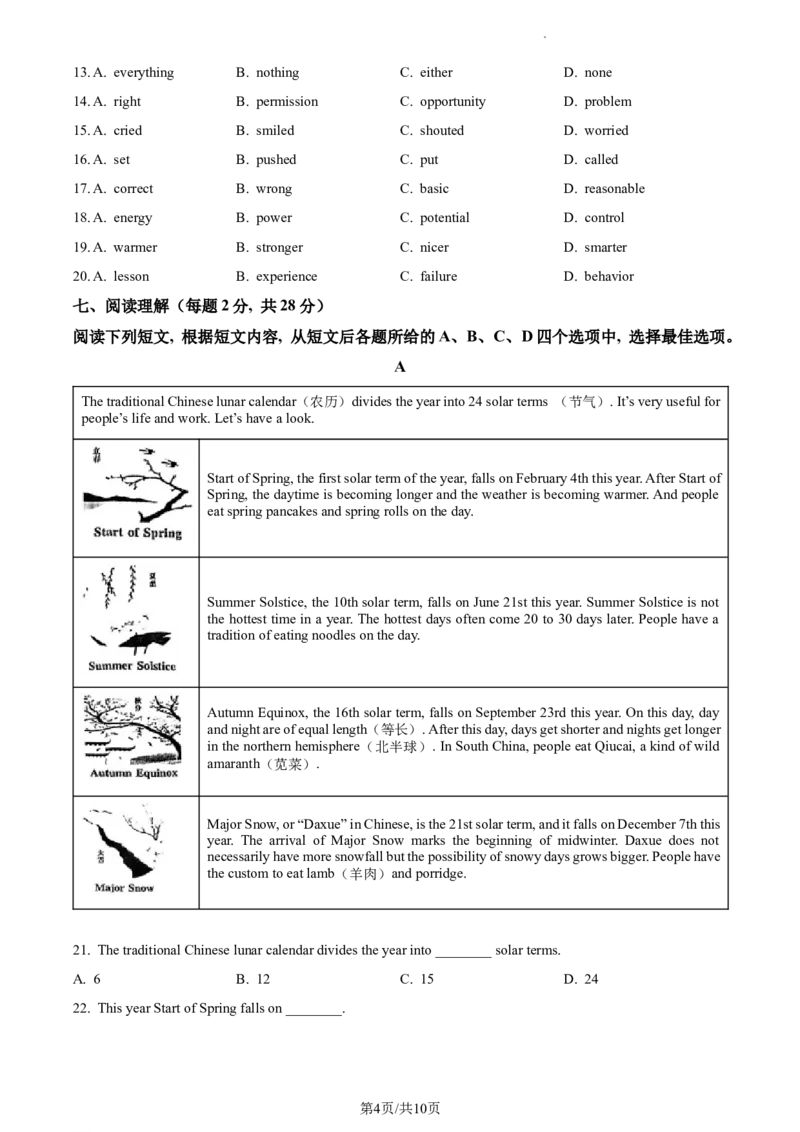
The traditional Chinese lunar calendar(农历)divides the year into 24 solar terms (节气). It’s very useful for
people’s life and work. Let’s have a look.
Start of Spring, the first solar term of the year, falls on February 4th this year. After Start of
Spring, the daytime is becoming longer and the weather is becoming warmer. And people
eat spring pancakes and spring rolls on the day.
Summer Solstice, the 10th solar term, falls on June 21st this year. Summer Solstice is not
the hottest time in a year. The hottest days often come 20 to 30 days later. People have a
tradition of eating noodles on the day.
Autumn Equinox, the 16th solar term, falls on September 23rd this year. On this day, day
and night are of equal length(等长). After this day, days get shorter and nights get longer
in the northern hemisphere(北半球). In South China, people eat Qiucai, a kind of wild
amaranth(苋菜).
Major Snow, or “Daxue” in Chinese, is the 21st solar term, and it falls on December 7th this
year. The arrival of Major Snow marks the beginning of midwinter. Daxue does not
necessarily have more snowfall but the possibility of snowy days grows bigger. People have
the custom to eat lamb(羊肉)and porridge.
21. The traditional Chinese lunar calendar divides the year into ________ solar terms.
A. 6 B. 12 C. 15 D. 24
22. This year Start of Spring falls on ________.
第4页/共10页
学科网(北京)股份有限公司A. February 4th B. June 21st C. September 23rd D. December 7th
23. Day and night are of equal length on the day of ________.
A. Start of Spring B. Summer Solstice C. Autumn Equinox D. Major Snow
24. What do people often eat on the day of Major Snow?
A. Spring pancakes. B. Noodles. C. Amaranth. D. Lamb.
B
I began to grow up that winter night when my mother said we might soon leave for America. I was crying
because I could not bear the thought of never hearing the radio program for school children every morning.
I do not remember myself crying for this reason again. In fact, I think I cried very little when I was saying
goodbye to my friends. When we were leaving. I thought about all the places I was going to see—the strange and
magical places I had known only from books and pictures.
The four years that followed taught me the importance of optimism(乐观), but the idea did not come to me
at once. For the first two years in New York I was really lost—having to study in three schools as a result of family
moves. I did not quite know what I was or what I should be. Mother remarried, and things became even more harder
for me. Some time passed before my stepfather and I got used to each other. I was often sad, and saw no end to “the
hard times.”
My responsibilities(责任) in the family increased a lot because I knew English better than everyone else at
,
home. I wrote letters filled out forms(表格), translated(翻译)at interviews with Immigration(移民)officers,
took my grandparents to the doctor and translated there, and even discussed telephone bills with company
representatives(代表).
From my experiences I have learned one important rule: almost all common troubles finally go away! Something
good is certain to happen in the end when you do not give up, and just wait a little!
I believe that my life will turn out all right, even though it will not be that easy.
25. For the first two years in New York, the writer ________.
A. often lost her way B. studied in three different schools
C. did not think about her future D. got on well with her stepfather
26. What can we learn about the writer from Paragraph 4?
.
A She worked as a translator. B. She attended a lot of job interviews.
C. She paid telephone bills for her family. D. She helped her family with her English.
27. The writer believes that ________.
A. her future will be free from troubles B. it is difficult to learn to become patient
C. good things will happen if one keeps trying D. there are more good things than bad things
第5页/共10页
学科网(北京)股份有限公司C
Many people have talked about whether or not computing machines can think. Can they or can’t they?
Almost certainly, a machine can do any work in thinking that a person can do—if the correct way for doing the
thinking work can be told exactly. Besides, many programs have been made to direct machines so that they work in
very clever ways. Machines have been taught to play chess and to learn from what happens in the games so as to
make their play better and better. Machines can beat many persons who play chess. Machines can translate from
one language to another. They can prove statements. In geometry(几何) as taught in school. Machines can notice
printed marks on paper, so that a person is no longer needed to look at the marks.
Computers can be used in many ways, such as business, science, industry, and government. Computers study
oil-field examinations made by airplanes; they keep record of oil sales; they study the working condition of the
machines; they help in planning and producing oil; and much more.
If people cannot tell exactly the correct way to do certain work in thinking, it is still a question how much of
this work a machine can do. Suppose a person is “teaching” the machine and telling the machine “yes” when the
machine is right, and “no” when the machine is wrong. Then the machine can keep on searching among possible
ways for solving a problem-until the machine can do as well as the person, and perhaps much better.
But, what is thinking? People can agree about much that is thinking, and much that is not thinking; but they
can’t reach agreement because the word “think” is not a scientific word with an exact meaning. A lot of the
discussion is wasted breath because the persons are using different meanings of the word “think”.
People, however, have only had experience with machines that appear to think since 1944. It would be too
early to say that after the next 200 years, machines will not be thinking. And to consider that machines can think
gives people a big push to give to machines more and more work in thinking.
28. The underlined part in paragraph three is about computers used in ________.
A. education B. industry C. sports D. government
29. What is the main idea of paragraph five?
A. There is much to say about thinking. B. People discuss a lot about thinking.
C. People already know what thinking is. D. There is no answer to what thinking is.
30. Which is probably the best title for the passage?
A. What Is Thinking? B. Can Machines Be Taught to Think?
C. Can Machines Think? D. Can Machines Beat All Checkers Players?
D
Being Authoritative(权威的) Parents
Phrases like “tiger mom” and “helicopter parent” have made their way into everyday language.
第6页/共10页
学科网(北京)股份有限公司Many of us find ourselves drawn to the idea that with just a bit more parental hard work and effort, we might
turn out children with bright futures. But is there anything wrong with a kind of “overparenting style”?
Parental involvement has a long history of being studied. Many of the studies, carried out by Diana Baumrind,
a famous psychologist at the University of California, Berkeley, have found that a good parent is the one who is
involved and reacts to her child in a positive way, who sets high expectations but gives her child independence.
These “authoritative parents” appear to hit the sweet spot of parental involvement and generally raise children who
do better academically, psychologically and socially than children whose parents are not strict and less involved, or
controlling and more involved.Why is this parenting style so successful?
Authoritative parents actually help improve motivation in their children Carol Daeck, a social phychologist at
Stanford University, has done research that shows why authoritative parents raise mote motivated children. In a
typical experiment, Dr. Dweck takes young children into a room and asks them to solve a simple puzzle. Most do
so with little difficulty. But then Dr Dweck tells some, but not all, of the kids how clever they are. As it turns out,
the children who are got told they’re smart are more motivated to solve increasingly difficulty puzzles. They also
show higher levels of confidence and show greater progress in puzzle-solving.
As the experiment suggests, praising children’s talents and abilities seems to shake their confidence. Dealing
with more difficult puzzles carries the risk of losing one’s status as “smart”. Dr. Dweck’s work strongly supports
that of Dr. Baumrind, who also found that reasonably supporting a child’s independence and limiting
interference(干涉) causes better academic(学术的) and emotional results.
The central task of growing up is to develop a sense of self that is independent and confident. If you treat your
young child who is just learning to walk as if she can’t walk, you reduce her confidence. Allowing children to make
mistakes is one of the greatest challenges of parenting. It is easier when they are young. The potential mistakes
carry greater risks, and part of being a parent is reducing risk for our children.
,
31. According to the passage a “tiger mom” ________.
A. helps her children realize their dreams B. pays close attention to her children’s experiences
C. places reasonable expectations on her children D. speaks her children’s everyday language
32. From the passage, we can know that controlling style of parenting may ________.
A. cause more problems in children B. develop independence in children
.
C face more challenges of children D. lead to children’s academic success
33. The example of the children doing the puzzles suggests that ________.
A. a good game plays a big role in training young minds
B. bright children usually show less confidence in difficult games
C. puzzle-solving can give children the motivation they need
第7页/共10页
学科网(北京)股份有限公司D. overpraising makes children less motivated and confident
34. The last paragraph tells us that ________.
A. children should not be given much freedom
B. parents should not increase the risk of challenging
C. children should correct mistakes with the help of their parents
D. parents should allow their children to learn from mistakes
八、阅读短文, 根据短文内容回答问题。(每题2分, 共10分)
阅读短文,根据短文内容回答问题。
All aboard! Let’s take a ride on the world’s highest railway——the Qinghai-Tibet Railway (青藏铁路). Sit
back and enjoy the journey. Get ready for the trip of a lifetime.
We’re leaving Qinghai Station. The scenery along the way is some of the wildest in all of China.
Keep your eyes open as we race through this beautiful land. You might see some Tibetan antelopes (藏羚羊)
from your window.
Before we begin our journey, let’s learn about this amazing railway. It’s truly one of the great engineering
wonders of the 21st century. When people finished building it on July 1st, 2006, the Tibet Railway set nine world
records, including the world’s highest railway at 5, 072 metres above sea level, the world’s highest tunnel (隧道) at
4, 905 meters, and the longest tunnel ever built on permafrost (冻土) .
As we travel higher, the air gets thinner and thinner. Soon there will only be 50 to 60 percent of the oxygen
which we are used to breathing. But don’t be afraid. Each rail car has two separate (独立的) oxygen systems (系
统). One system spreads oxygen throughout the train at all times. And each passenger can also get a personal
oxygen mask just like those used in planes.
Here are a few more things to think about as our train leaves the station. The designers solved three main
challenges (挑战) when building this great railway. First, the high altitude (海拔) made the task difficult because
there was no enough oxygen. Second, much of the railway runs across permafrost, a type of ground that keeps
changing as the weather warms and cools. Finally, the railway goes through some of the most sensitive ecology (敏
感的生态环境) in China. Great care was necessary to make sure of the smallest possible influence (影响) on
nature.
All three challenges were met, making our trip possible. All aboard! The train to Tibet is leaving in fifteen
minutes.
35. What animal could you see out of the window on the way?
_______________________________________
36. When did people finish building it?
第8页/共10页
学科网(北京)股份有限公司_______________________________________
37. What’s the main idea of paragraph 3?
_______________________________________
38. How many oxygen systems are there in each rail car?
_______________________________________
39. How soon the train is leaving?
_______________________________________
九、文段表达(10分)
40. 假如你是李华,你所在的北京101中学爱心社团将在10月4日重阳节组织登山及敬老院慰问活动。
请你写封英文邀请函给交换生Tom,简要介绍重阳节传统(登高、赏菊、敬老),并告知此次活动的计划,
包括时间、地点、活动内容及注意事项。
要求:根据中文和英文提示,完成一篇不少于50词的文段写作。文中已经给出内容不计入总词数。所给提
示词语仅供选用。
提示词语:climb hills, appreciate chrysanthemums(菊花),show respect,Xiangshan Mountain,small
present,best wishes
提示问题:
•How do Chinese people celebrate the festival?
• When and where are you going to meet?
• What are you going to do?
• What’s your advice for Tom?
Dear Tom,
The Double Ninth Festival is
coming.______________________________________________________________________________________
____________________________________________________________________________________________
____________________________________________________________________________________________
_______________________________________________________________________
Yours,
Li Hua
41. 初三生活紧张充实,理想成绩源自勤学苦练,英语课堂即将举行学科经验分享,假如你是李华,
请用英文写篇短文,介绍新学年第一个月为备战英语听说考试,你克服困难努力提升英语听说的经历,并
谈谈你的收获。
要求:根据中文和英文提示,成一篇不少于50词的文段写作。文中已经给出内容不计入总词数。所给提示
第9页/共10页
学科网(北京)股份有限公司词语仅供选用。
提示词语:pronunciation, enlarge vocabulary, “ETS Middle School”APP(“E听说”), a mock test(模拟考
试), ask the teacher for help, learn from mistakes
提示问题:
•What problems did you have?
• How did you improve your listening and speaking?
• What have you learned from the experience?
I’m Li Hua. I’d like to share my experience of improving English listening and speaking in the first month of
the new school
year.________________________________________________________________________________________
____________________________________________________________________________________________
____________________________________________________________________________________________
___________________________________________________________________
第10页/共10页
学科网(北京)股份有限公司