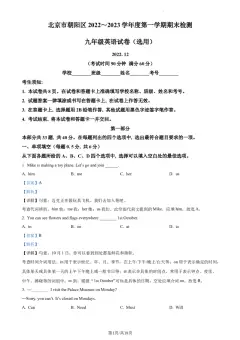
英语练习
第一部分
一、单项填空(每题0.5分,共6分)
从下面各题所给的A、B、C、D四个选项中,选择可以填入空白处的最佳选项。
1. Mr. Brown often visits the sick children in hospitals to cheer ________ up.
A. him B. them C. her D. us
2. Mike and I like basketball, and both of us are ________ our school team.
A. on B. by C. at D. to
3. —________ will the project of our city’s new library be completed?
—It won’t take long. Just in about two weeks.
A. How long B. How far C. How soon D. How often
4. He is getting heavy, ________ he decides to do some exercise after school.
A. so B. if C. for D. because
5. —Someone is knocking the door. Is it your aunt?
—It ________ be her. She has gone to Thailand for traveling.
A. needn’t B. mustn’t C. may not D. can’t
6. Stonehenge is one of ________ historical places in the world.
A. popular B. more popular C. most popular D. the most popular
7. To prevent the spread of disease, you’d better wash your hands as soon as you ________ home.
.
A got B. gets C. get D. will get
8. My family ________ a lot of changes in Beijing since we moved here in 2010.
A. experienced B. experiences C. has experienced D. will experience
9. —I called you last night, but no one answered.
—I ________ my mom cook dinner when you called.
A. was helping B. helped C. am helping D. help
10. Bob is interested in Chinese culture, and he ________ Chinese at Peking University next year.
A. studies B. will study C. studied D. has studied
11. Thousands of trees ________ along streets last year to make our city more beautiful.
A. planted B. were planted C. plant D. are planted
12. —Excuse me, could you please tell me ________?
—It will start at 8:00 p.m.
A. when did the movie startB. when the movie started C. when will the movie startD. when the movie will
第1页/共9页
学科网(北京)股份有限公司start
二、完形填空(每题1分,共8分)
阅读下面的短文,掌握其大意,然后从短文后各题所给的A、B、C、D四个选项中,选择最
佳选项。
My children went back to college after being home for the summer. I took the dogs for a walk. When I passed
the Korean Tofu House, the smell made me hungry. “Why don’t we eat here tonight?” I thought. Then I realized
that I was ____13____. My children and I had been here together just a week before and we had a great time
talking about coming back here again. Thinking about that, I couldn’t help ____14____.
When I got back home, the house was dark and quiet. It had been full of laughter and songs all summer when
the kids were at home. We cooked and ate together. We went hiking in the hills and took the dogs to the beach. It
was just like it had been in the good old days, before my kids had grown up and gone away.
The next morning, I got up and decided to make pancakes; the kids love blueberry pancakes. Then I realized
they weren’t there, so I lost my ____15____ and took the dogs for a walk without having breakfast.
When I was walking along the road, an old lady looked at my dogs, smiled warmly and asked if she could pet
my dogs. As she petted the dogs, she told her story.
“I once had a golden dog, Chunky, and he lived to 15. I had never worried about ____16____ him, because
he was never sick a day in his life till the end. He wouldn’t eat so I put gravy on my finger for him to eat. But the
doctor said to me, ‘You’ve got to let him go’.”
She looked up to the sky and back at my dogs and said, “So I did. I let him go…But I’ve never had another
dog after that.”
She put her hand over her heart and her face expressed her ____17____ as she said, “It hurts.”
Before I said anything, she gave my dogs one more loving pet. She smiled bravely and said in a ____18____
tone, “Whatever, let bygones be bygones.” Then she thanked me and walked away, relaxed.
Letting go. Yes, I know that’s what we have to do.
As I sat alone in the quiet house, I thought about the old lady and how she faced the loss of her dog through
death. I suddenly realized I was a little ____19____ crying over my loss, which is just a natural part of human
development, not life and death. In this kind of loss, we can ____20____ ourselves by celebrating the growth of
our children, feeling the satisfaction of having done our best to prepare them to face the challenges in their lives.
We can be glad that they are where they need to be, and grateful for our role in letting them go.
13. A. new B. alone C. busy D. full
14. A. arguing B. complaining C. crying D. regretting
15. A. interest B. memory C. mind D. courage
第2页/共9页
学科网(北京)股份有限公司16. A. losing B. hugging C. controlling D. forgetting
17. A. anger B. fear C. pain D. doubt
18. A. critical B. light C. curious D. cold
19. A. confused B. bored C. nervous D. silly
20. A. promise B. praise C. respect D. comfort
三、阅读理解(每题2分,共26分)
阅读下列短文,根据短文内容,从短文后各题所给的A、B、C、D四个选项中,选择最佳选
项。
A
Three must-have life skills for teens
It is necessary for you teenagers to learn a few must-have skills to benefit not only yourselves but also others.
Skill A
When people around us are sick or injured and need help, first aid is the immediate medical attention that may
save a life or stop a situation from getting worse. You can have first aid classes in your school, community or
organizations like the Chinese Red Cross.
Skill B
As you get older, you have to make decisions about money. An early start on how to manage money can help
avoid many problems. You can start from developing habits like shopping with a list and sticking to it or saving a
fixed amount of money each week.
Skill C
Do you always complain about not having enough time to do all that you want? You may practice the skill of
managing your time, which will help reduce stress, improve efficiency (效率) and better the work-life balance. The
key step is to list your daily tasks and give each task a time limit.
.
Match the situations with the skills
A. Skill A B. Skill B C. Skill C
21. If you always miss deadlines and fail to finish tasks in time, you need to develop ________.
22. If you have ________, you can help the person who is sick or injured before doctors arrive.
23. If you get much lucky money during the Spring Festival, you need ________ to manage it.
B
Henry started a business with great enthusiasm (热情), but just after few months, his business failed and went
under. After that, Henry stayed out of work for quite some time. When his teacher Roy got to know that, he invited
Henry to his home.
第3页/共9页
学科网(北京)股份有限公司Roy welcomed him and then asked, “Why don’t you try some other work?”
Henry replied, “I started a business. I worked so hard and I gave my everything to it, yet that business failed.”
Roy comforted him, saying, “But that’s life, sometimes we get success and sometimes we don’t. This doesn’t
mean we should stop working.”
“What’s the point of doing work when I can’t be sure of success?” Henry replied impatiently.
Roy took Henry to a room and showed him a dead tomato plant. Henry said, “It’s dead and useless.”
Roy replied, “When I sowed (播种) its seed, I did everything right for it. I watered it, and took great care of it
but it still died.” Roy continued, “Doing work is the same. No matter how hard you try, you cannot decide what
happens in the end. You can control only those things which are in your hands.”
Henry asked, “But if there is no guarantee (确保) of success, then what’s the use of trying doing anything?”
Roy said, “Well, if you stop trying, you’re not going to do anything big in your life.”
“But if success is only a matter of chance, then what is the use of doing so much hard work and putting in so
much money and time?” questioned Henry as he was about to leave.
Just then, Roy said, “Before you leave, I want to show you one more thing.” He took Henry to another room.
There was a pile of big red tomatoes lying there.
Henry just couldn’t get the point and asked, “Why are you showing me this?”
Roy said, “These tomatoes you see are result of not giving up on growing plants even after failing before. I
didn’t stop after seeing those dead plants. Instead, I sowed seeds again and took care of them. This time the plants
grew. Similarly, if you keep trying continuously, your chances of getting success are greatly increased. But if you
give up because of failures, then life does not give you any reward (回报).”
Henry finally learnt the lesson of success. He understood what he had to do and left with renewed energy.
24. Why did Roy show Henry a dead tomato plant at first?
A. To show he made the same mistake as Henry. B. To ask Henry to offer him some advice and help.
C. To tell Henry things don’t always go the way as planned. D. To advise Henry to predict what will happen in
the future.
25. How did Henry feel the moment Roy showed him the big red tomatoes in another room?
A. Excited. B. Confused. C. Awful. D. Hopeful.
26. What lesson did Henry learn in the end?
A. Energy and care are keys to avoiding failures. B. Failure can be a step towards success in our life.
C. We can get the expected results if we don’t give up. D. Success will be guaranteed as long as we work hard.
C
Screens are a major part of our lives. It’s common that people use more than one screen for work or play at the
第4页/共9页
学科网(北京)股份有限公司same time. For example, a teen may play games while watching TV. A new study found that multitasking between
screens might lead to problems with attention and memory.
The finding was reported by Kevin Madore and Anthony Wagner, psychologists at Stanford University. They
invited 80 young adults to answer questions about their everyday attention and media (媒体) multitasking and to
perform a memory task. The participants were required to classify (把……分类) pictures into “joyful” or
“unjoyful”. After a 10-minute break, they viewed another set of pictures, some of which had been in the first group.
Participants had to recall whether each photo had been in the first set and how they classified them the first time.
With the EEG (脑电图) device on their head, their brain activity in areas involved with attention and memory
was recorded and monitored (监测) as they paid attention to what was shown on the screen. Researchers studied the
change of the alpha waves (阿尔法脑波), which decrease when people pay close attention to something and
increase as their mind wanders (走神). The researchers also used an eye tracker to record changes in pupil dilation
(瞳孔扩张). With close attention, our pupils dilate and contract (收缩) over and over again. But when we get less
focused, our pupils become smaller.
Researchers found that people who reported more media multitasking in their daily lives were more likely to
forget pictures from the first set they’d seen. The EEG recordings showed that these people also had a harder time
paying attention during the task. The researchers also found that the participants’ pupils became smaller and alpha-
brain-waves increased right before someone wrongly classified pictures in the second part of the testing. People
who multitasked less, however, showed no such brain changes and eye changes. They also performed better on the
memory task.
It’s important to note that media multitasking and loss in attention or memory were related. “We know that
multitasking in general has costs,” the lead researcher Madore said. “That means it typically takes longer to do a
task. And we typically make more mistakes when we multitask.” Those costs don’t only happen while multitasking,
and the new study has shown we might show poorer attention and memory even when we’re no longer
multitasking. “Our attention has limits and the power of distraction (分心) can be big,” he added. That’s why we
should be mindful of how we use media and how it might affect attention and memory elsewhere in our lives.
So, if you want to improve your memory, it is worth a shot to not media multitask.
27. In the study, participants ________.
A. studied the changes of brain waves and pupil dilation B. were monitored by the EEG device and an eye tracker
C. had to explain why they classified the pictures as joyful D. were required to answer questions after the memory
task
28. The fourth paragraph is mainly about ________.
.
A how the study was performed B. why the study was carried out
第5页/共9页
学科网(北京)股份有限公司C. who took part in the study D. what the study found out
.
29 What is the writer’s main purpose in writing this passage?
A. To tell how to improve memory through media use. B. To introduce ways of multitasking between screens.
C. To explain why media harm memory and attention. D. To advise us not to multitask between screens.
D
“Regrets, I’ve had a few. But then again, too few to mention,” Frank Sinatra sang in his 1969 hit “My Way.”
The song’s idea is attractive: that anyone can just say that what’s done is done and move on. But some people take
the idea a step further and say that they have no regrets at all, insisting that life can and should be lived without
looking back at the past mistakes.
True, letting yourself be deeply affected by regret is really bad for you. But going to the other extreme (极端)
may be even worse. To remove your regrets doesn’t free you from shame or sadness; you may end up making the
same mistakes again and again. To truly get over your anxiety requires that you put regret in its proper place.
As uncomfortable as it is, regret is an amazing cognitive (心理的) action. It requires that you go back to a past
scenario (情景), imagine that you acted differently to change it, and compare the imagined result with what you are
experiencing in reality.
If left unmanaged, regret can be harmful, leading to mental problems, and even affecting your physical health.
But regret can be dealt with properly. The trick is not to banish the bad feeling; it’s to recognize it and use it for
learning and improvement. Here are three steps you can take the next time you find yourself thinking about your
past missteps.
Kill the ghost
People often say their regrets “haunt” them, as regret is like a ghost: not completely clear but always
frightening. Bring your ghost out of the darkness by making a list of your regrets.
Write down why each one still bothers you and its lasting bad effects. Be honest without overstating the fact.
____30____
Sometimes after you make a mistake, you just can’t stop kicking yourself. Perhaps you dropped out of school
decades ago, and now keep thinking of how much money you would be making, if you had made it to graduation.
In other words, you’ve chosen a life sentence for a poor decision you made in the past.
However, that doesn’t make much sense to your present life. So it is time to stop the emotional punishment.
Try saying this to yourself, “I make changes with myself and will not waste another minute of my life reliving a
decision that cannot be changed.”
Collect your diploma (毕业证书)
Regret is like a school run by human nature. If you never experienced regret, you would keep repeating the
第6页/共9页
学科网(北京)股份有限公司same behaviors that led you to miss opportunities and destroy relationships.
Your regret can teach you to become smarter and more successful—if you let it. In your list of regrets, also
note how you want to change your behavior, and outline your resolutions going forward. Next, list all the ways that
you can put in your own skills and improvement right now—and get started.
Regrets may hurt, but ignoring them or trying to live without them is a lost opportunity to grow. Life is a
journey full of pleasures and pains. To live it well and fully means learning from every bit of it, including the
mistakes, and moving forward.
30. The writer mentions the lines in the song “My Way” in Paragraph 1 to show that ________.
A. some people choose to let go of regrets B. regret is a common topic in popular songs
C. some people find it hard to get over regrets D. regret can stand in the way of people’s lives
31. The word “banish” in Paragraph 4 probably means “________”.
A. drive away B. stick to C. show off D. build up
32. Which of the following would be the best heading for Paragraph 6?
A. Relive your decision B. Try saying “No” to others
C. Value every minute of your life D. Don’t bury yourself in the past
33. The writer probably agrees that ________.
A. regret is too frightening to recall and record B. reliving past experiences is the key to making changes
C. regret can help people avoid repeating certain mistakes D. filling the life with more pleasures than pains is our
goal
第二部分
四、阅读表达(33至36题每题2分,37题4分,共10分)
阅读短文,根据短文内容回答问题。
Nowadays electronic devices are becoming wireless (无线的). We can listen to songs by using earphones
without wires. A mouse or keyboard can be run on a computer without wires. Many of them use Bluetooth.
Bluetooth is the technology that allows the exchange of data between different devices. However, have you ever
wondered why it is called Bluetooth?
Bluetooth was named after Harald Bluetooth, a 10th-century king of Denmark (丹麦). He was famous for
uniting Denmark and Norway into one kingdom. His dead tooth, which was a dark blue color earned him the
nickname Bluetooth. In 1996, Jim Kardach from Intel suggested Bluetooth as the name because King Harald
Bluetooth united two kingdoms just as people wanted to connect computers with other electronic devices. The
Bluetooth logo is a combination of Harald’s initials (首字母) ‘H(ᚼ)’ and ‘B(ᛒ)’ written in Nordic runes (古代北欧
文字).
第7页/共9页
学科网(北京)股份有限公司Developed in the late 1990s, Bluetooth has become increasingly popular. On May 20, 1999, the Bluetooth
Special Interest Group (SIG) was set up and the first Bluetooth specification (标准), Bluetooth 1.0, was published
in the same year. The Sony Ericsson T36 became the first mobile phone to include Bluetooth in 2001. The
Bluetooth SIG published the latest Bluetooth 5.3 on July 13, 2021.
Besides Bluetooth headsets, there are more things people can do with Bluetooth. Bluetooth can connect up to
seven devices to one master device at the same time and allows users to exchange voice and data transmissions (传
送) between two or more devices. For example, we can print wirelessly across the room with a Bluetooth printer.
Without Bluetooth, each device would have to be joined together by wires, meaning we could never sit more than a
few meters away from the screen.
Bluetooth offers many advantages, but there are drawbacks, too. We have to charge (充电) Bluetooth devices
more often because Bluethooth shortens battery life. Besides, Bluetooth technology easily finds nearby devices so
hackers (黑客) can see which devices are nearby and attack them, especially in public places like airports, trains
and cafes. What’s more, most Bluetooth devices must be within about 10 meters of each other and has slow data
speed.
34. Who was Harald Bluetooth?
____________________________________________
35. When was Bluetooth 1.0 published?
____________________________________________
36. Why do we have to charge Bluetooth devices more often?
____________________________________________
37. What do you think of Bluetooth? Why?
____________________________________________
五、文段表达(10分)
从下面题目中任选一题,根据所给提示,完成一篇不少于50词的英语文段写作。文中已给出
内容不计入总词数。所给提示词语仅供选用。请不要写出你的校名和姓名。
题目①
38. 我们在生活中经常会遇到各种各样的困难,但幸运的是总会有人对我们施以援手。假如你是李华,
你们学校的英语角留言板本月主题是“感恩”,请你用英文写一则留言,谈谈你最想感谢的一个人,以及
你感谢他/她的理由。
提示词语: trouble, encourage, advice, patient
提示问题:
● Who do you want to thank?
第8页/共9页
学科网(北京)股份有限公司● Why do you want to thank him/her?
I’m Li Hua, from Class 1, Grade 9.
____________________________________________________________________________________________
____________________________________________________________________________________________
____________________________________________________________________________________________
____________________________________________________________________________________________
____________________________________________________________________________________________
____________________________________________________________________________________________
____________________________________________________________________________________________
____________________________________________________________________________________________
___________________
题目②
39. 某英文网站正在开展以“青少年是否应该做家务”为主题的征文活动。假如你是李华,请你写一篇
英文短文投稿,发表对该主题的看法,并谈谈你为什么是这样认为的。
,
提示词语:independence responsibility, schoolwork, manage time
提示问题:
● Do you often do housework at home?
● Do you think teenagers should do housework at home? Why do you think so?
Housework is a necessary part to run a
home._______________________________________________________________________________________
____________________________________________________________________________________________
____________________________________________________________________________________________
____________________________________________________________________________________________
____________________________________________________________________________________________
____________________________________________________________________________________________
____________________________________________________________________________________________
____________________________________________________________________________________________
_____________________________________________________________
第9页/共9页
学科网(北京)股份有限公司