2024-2025 学年八年级下学期期末模拟卷(湖北武汉卷)
英语
(考试时间:120分钟 试卷满分:120分)
注意事项:
1.答卷前,考生务必将自己的姓名、准考证号填写在答题卡上。
2.回答第Ⅰ卷时,选出每小题答案后,用2B铅笔把答题卡上对应题目的答案标号涂黑。如需改动,
用橡皮擦干净后,再选涂其他答案标号。写在本试卷上无效。
3.回答第Ⅱ卷时,将答案写在答题卡上。写在本试卷上无效。
4.考试结束后,将本试卷和答题卡一并交回。
第Ⅰ卷(选择题,共80分)
一、听力测试(共25分)
第一节(共4小题,每小题1分,满分4分)
听下面4个问题。每个问题后有三个答语,从题中所给的A、B、C三个选项中选出最佳选项。听完
每个问题后,你都有5秒钟的时间来作答和阅读下一小题。每个问题仅读一遍。
1.
A.Journey to the West. B.In the bookstore. C.Very interesting.
2.
A.Yes, I have. B.Since two weeks ago. C.Once a week.
3.
A.It’s fantastic. B.Twice. C.Tina.
4.
A.I don’t ride it anymore. B.By bike. C.200 yuan.
第二节(共8小题,每小题1分,满分8分)
听下面8段对话。每段对话后有一个小题,从题中所给的A、B、C三个选项中选出最佳选项。听完每段
对话后,你都有10秒钟的时间来作答有关小题和阅读下一小题。每段对话仅读一遍。
5.How’s the weather in summer in Mexico?
A.Windy. B.Rainy. C.Sunny.
6.What’s the matter with the woman?
A.She has a fever. B.She has a toothache. C.She has a stomachache.7.What does Kate want to do?
A.To play chess with Bill. B.To play chess with Tom. C.To go shopping.
8.How many times has the girl been to the nature museum up to now?
A.Once. B.Twice. C.Three times.
9.When did the woman arrive?
A.At 10: 35. B.At 10: 45. C.At 10: 55.
10.What was Lucy doing when the accident happened?
A.She was driving the car.B.She was working in the park. C.She was walking near the park.
11.What does the woman mean?
A.The man should stop drinking coffee, too.
B.Smoking is better than drinking coffee.
C.The man should not stop smoking.
12.Where is Lisa from?
A. B. C.
第三节(共13小题,每小题1分,满分13分)
听下面4段对话或独白。每段对话或独白后有几个小题,从题中所给的A、B、C三个选项中选出最
佳选项。听每段对话或独白前,你将有时间阅读各个小题,每小题5秒钟;听完后,各小题将给出5秒钟
的作答时间,每段对话或独白读两遍。
听下面一段对话,回答三个小题。
13.What does the boy think of swimming?
A.Tiring. B.Useful. C.Important.
14.How often does the girl have the swimming lesson?
A.Once a week. B.Twice a week. C.Three times a week.
15.When will the two speakers go shopping?
A.On Saturday afternoon. B.On Sunday afternoon. C.On Sunday morning.
听下面一段对话,回答下列三个小题
16.Who was playing football yesterday?
A.Mike. B.Alan. C.Albert.17.How was the football game yesterday?
A.Terrible. B.Not bad. C.Fantastic.
18.What did Alan do yesterday?
A.He studied for his English test.
B.He watched the football game.
C.He did his homework at home.
听下面一段对话,回答下列四个小题。
19.Why do they collect waste things along the river?
A.To stop the river from being polluted.
B.To help them exercise every day.
C.To sell them for money.
20.How many members are there in their team?
A.12. B.16. C.28.
21.When do they do the volunteer work?
A.After lunch at noon. B.At 7: 30 every morning. C.After dinner every evening.
22.How do they collect the waste?
A.By taking a long walk along the river.
B.By helping the cleaners along the river.
C.By putting rubbish bins along the river.
听下面一段独白,回答下列三个小题。
23.What were the two brothers doing in the room?
A.Playing with sunshine. B.Playing with toys. C.Reading books.
24.How did the brothers do to make their room bright at first?
A.Clean the windows.
B.Bring some sunshine inside with a bag.
C.Open the windows.
25.What does the writer want to tell us?
A.Darkness in life.
B.How to get the sunshine into your room
C.Open your heart when darkness comes.二、选择填空(共10小题,每小题1分,满分10分)
从题中所给的A、B、C、D四个选项中,选出一个最佳答案。
26.— Mary, how about making dumplings at home this weekend?
— ____________!
A.Good luck B.You’re right C.Good idea D.You’d better not
27.—Would you like something to drink?
—____________. I’ve just drunk some tea.
A.Yes, please B.No, thanks C.Of course D.No problem
28.—It is ____________ that you visited the Yellow Crane Tower for free!
—Yes, because I spoke out three ancient poems about it.
A.amazing B.safe C.uncertain D.unfair
29.—Jack, you won the poetry competition. What is the secret?
—Hard work. It is one of the ____________ to be successful.
A.relations B.directions C.conditions D.traditions
30.—Look carefully, class! What can you find out?
—I know, Mr. Wang. The ____________ looks bent (弯曲的) when it is in water.
A.sand B.milk C.oil D.stick
31.—I read a story that a man tried to ____________ the boat to find his lost sword (剑).
—What he did is funny. Things are always changing.
A.carry B.mark C.throw D.hide
32.—What can we do in the water park?
—You can enjoy all the water sports, or ____________ lie on the beach.
A.simply B.finally C.mainly D.mostly
33.—Wang Ming and Claudia shared different opinions about Yu Gong Moves the Mountains.
—____________ of them are wrong. Different people have different opinions.
A.Either B.None C.Each D.Neither
34.The East Lake is a good place to ____________ fresh air and enjoy the natural beauty.
A.take in B.put in C.use up D.clean up
35.The famous saying “Read ten thousand books, travel ten thousand miles” tells us ____________
A.who can you travel with B.where you can read and travel
C.what’s the number of the books D.how important reading and travelling are三、完形填空(共15小题,每小题1分,满分15分)
阅读下面短文,从短文后各题所给的A、B、C、D四个选项中,选出可以填入空白处的最佳选项。
I quickly looked at my watch. It was already half past twelve. But where was that cashier (收银员)? I was worried
because I 36 had enough time to eat a sandwich and rush back to work.
I looked around the nearly empty 37 , but the cashier was nowhere in sight. A woman stood
wiping (擦) the far end of the counter. She looked at me coldly with sad and dark eyes.
I 38 , getting angry. I’d been standing there for at least three minutes!
I tried to 39 my anger as I remembered my mom’s words: When you 40 yourself in an
unpleasant situation, just think about what is missing. If someone is unkind, then kindness is missing. If someone
is hateful, then 41 is missing. If we will be what’s missing, then we’ll provide anything that the
situation needs.
And here I was in an unpleasant situation. How should I “be what’s missing”? What was missing was 42
. Maybe I should just jump behind the counter and take my own 43 .
Just then the woman walked slowly towards me. “May I help you?” she asked, still 44 . She
looked so tired. It was clear that she was overworked.
I took a deep breath. With Mom’s words 45 in my head, I gave the woman my order...and smiled.
“How are you today?”
My question seemed to 46 her. She stared at me for a second before answering. “Not too good.”
“I’m 47 ” I said. “I hope it gets better starting right now.”
She almost smiled as she looked at me. “Thanks. I hope you’re right.”
I thought to myself as I ate my sandwich. We’re all the same, really. We have problems and angers. We get
tired and we hurt. We need to be 48 to each other. 49 eating, I wiped the table cleaner than
usual and put the tray (托盘) back nicely on the stand. The woman was watching me, a big smile on her face.
“Be what’s missing.” It 50 .
36.A.sometimes B.hardly C.nearly D.often
37.A.school B.street C.restaurant D.office
38.A.waited B.finished C.agreed D.left
39.A.collect B.challenge C.consider D.control
40.A.find B.enjoy C.help D.hurt
41.A.trust B.confidence C.patience D.love
42.A.hope B.advice C.service D.money43.A.turn B.order C.bill D.place
44.A.coldly B.carefully C.nervously D.kindly
45.A.talking B.checking C.ringing D.paging
46.A.encourage B.surprise C.trouble D.fear
47.A.angry B.tired C.bad D.sorry
48.A.closer B.cooler C.nicer D.fairer
49.A.After B.Before C.While D.Until
50.A.said B.worked C.read D.ended
四、阅读理解(共15小题,每小题2分,满分30分)
阅读下面三篇材料,从每题所给的A、B、C、D四个选项中,选出最佳选项。
A
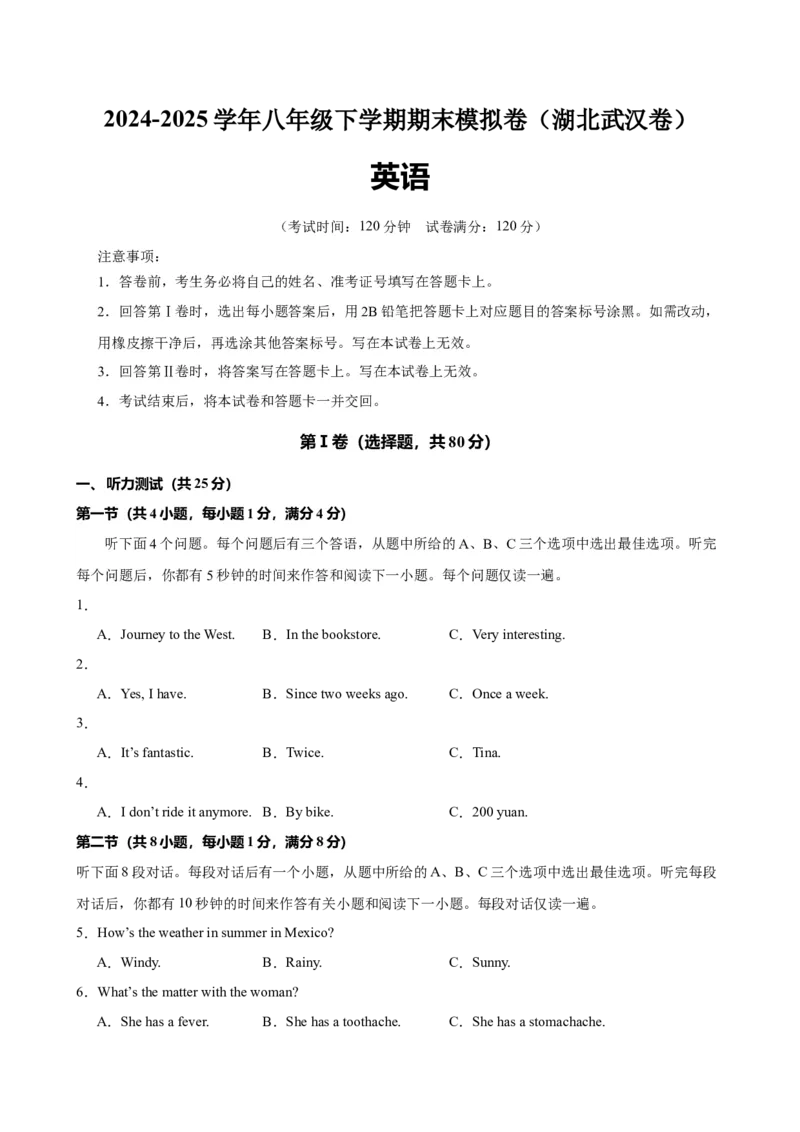
A 3D printer helped to make this house in Germany. It made the walls. They are 54 meters
long. The printer spent about 140 hours. After that, workers built the roof and doors. The house is the largest 3D
printed building in Europe. It attracts a large number of tourists.
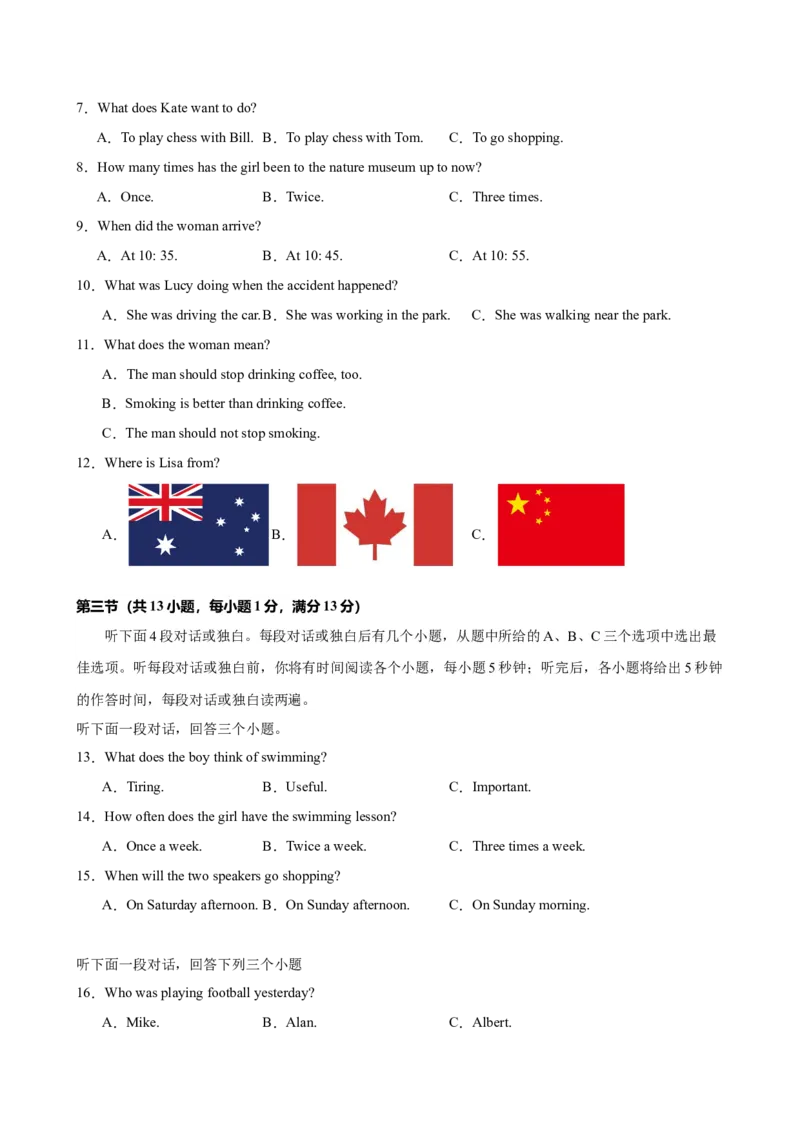
Spain’s Barcelona (巴塞罗那) is a city of amazing buildings. The designer of these buildings
was Gaudi (高迪). He lived in the 1800s. He was super creative. Gaudi’s houses don’t look like the houses we live
in. They are colorful and have amazing shapes. Some houses look like waves in the sea. Some look like castles in
fairy tales.
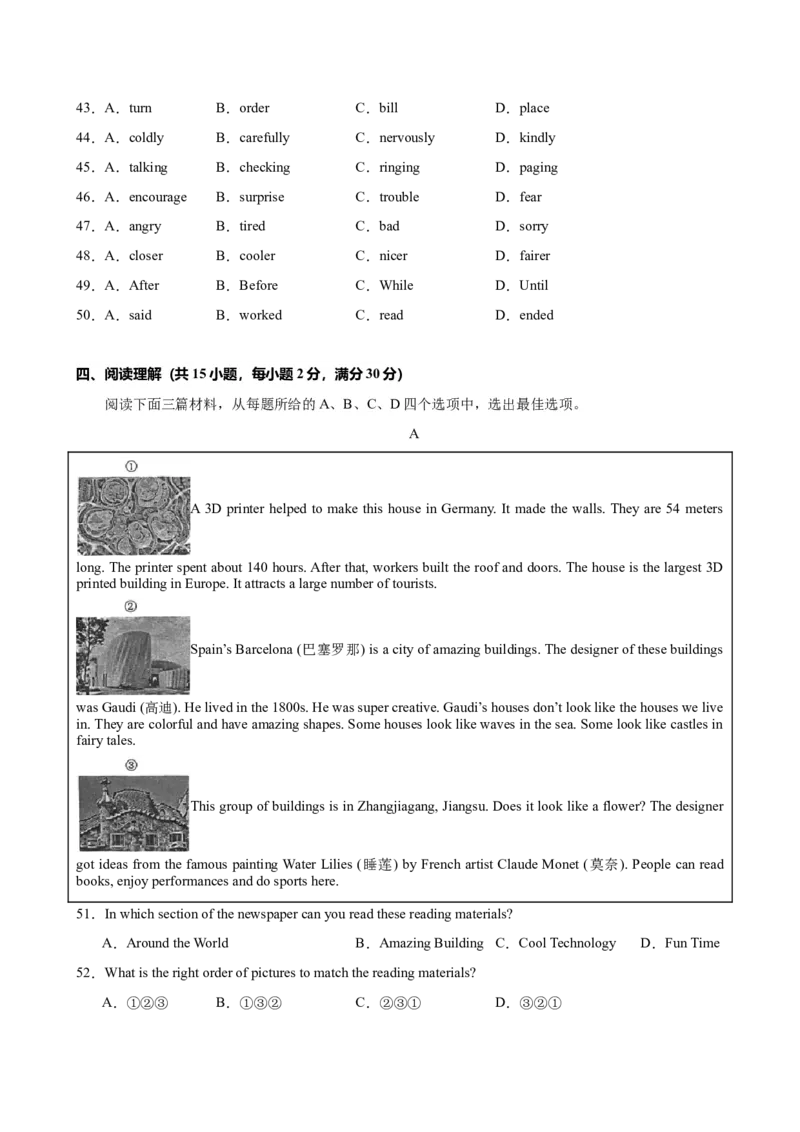
This group of buildings is in Zhangjiagang, Jiangsu. Does it look like a flower? The designer
got ideas from the famous painting Water Lilies (睡莲) by French artist Claude Monet (莫奈). People can read
books, enjoy performances and do sports here.
51.In which section of the newspaper can you read these reading materials?
A.Around the World B.Amazing Building C.Cool Technology D.Fun Time
52.What is the right order of pictures to match the reading materials?
A.①②③ B.①③② C.②③① D.③②①53.Which of the following statements is FALSE about Gaudi?
A.Gaudi was a talented designer. B.Gaudi’s houses have amazing shapes.
C.Gaudi never lived in a house he designed. D.Gaudi’s houses seem to come from fairy tales.
54.According to the reading materials, it’s clear that ________.
A.Gaudi designed all the buildings in Barcelona
B.Monet designed the group of buildings in Zhangjiagang
C.the house is the largest 3D printed building in the world
D.the 3D printer made all of the walls except the roof and doors
55.What do the three reading materials have in common?
A.The art in the buildings is special. B.The buildings are all colorful.
C.The designers are all great artists. D.The buildings all face the sea.
B
Schools in Beijing offer more break-time activities for students. Over the break times between classes,
students often rushed to the toilet and back to class with no time for anything else. This left them with little
opportunity to relax or socialize. But now that has changed. Students can have more time to rest and share
interesting things with their classmates. Starting this fall term, students at primary and middle schools in Beijing
have longer breaks between classes, changing from 10 minutes to 15 minutes. The “change” is meant to encourage
students to spend time outdoors for their physical and mental (心理的) well-being.
To make the most of this extended break time, schools have come up with creative ideas. Some schools
have mixed break time with labor education (劳动教育) by opening planting areas and animal breeding zones (饲
养区). Here, students can closely observe the life cycles of animals and plants. There are fewer students sitting at
their desks. Some play with these cute animals, while others exercise on the playground. This not only allows
them to get closer to nature but also helps them relax. Amazing, right?
Moreover, some schools have opened up activity areas both indoors and out-doors. For example, at one
school in Beijing, the ground floor of the teaching building has opened a biology lab for students to study the life
cycles of animals and plants. The second-floor corridor (走廊) is designed with spaces for free reading and chess
games. With the longer break time, safety is also a top concern. PE teachers are always on duty, carefully
watching over students playing on the ground to ensure that everyone has a safe and enjoyable break.
56.What do students often do between classes before?
A.Talk with their classmates. B.Rush to the toilet and back to class.C.Have more time to rest. D.Share interesting things with their classmates.
57.What does the word “change” in the first paragraph refer to?
A.The shorter breaks between classes. B.The longer breaks between classes.
C.Sitting in the classroom. D.Spending time outdoors.
58.What break-time activities are mentioned in the text?
a. Planting. b. Painting. c. Free reading. d. Playing chess.
A.a, c, d B.a, b, d C.b, c, d D.a, b, c
59.Which is TRUE according to the text?
A.Students can do more things if the break time between classes is longer.
B.Only middle schools in Beijing have longer break time between classes.
C.Every school has mixed break time with labor education already.
D.No one sits at their desks during the break time now.
60.Which of the following words may best describe the students’ mood (心情) for the longer break?
A.Worried. B.Sad. C.Happy. D.Upset.
C
Scientists have long known that a good night’s sleep is important for brain health. Recently a new study has
found that daytime naps (小睡) can also be good for the brain.
Researchers from University College London in the UK and the University of the Republic in Uruguay
looked at small parts of people’s DNA.There are 97 parts of DNA in humans that can tell whether a person is
likely to be a daytime napper or not. They used data from about 35,000 people in the UK between the ages of 40
and 69. They found people in the study whose DNA made them more likely to nap during the day and people
whose DNA showed they didn’t need to nap.
The results showed that those who like to nap had larger brains than those who didn’t. The brain naturally
gets smaller with age, so this means that the brains of people who like to nap age more slowly than people who
don’t nap. The people who nap have brains that are bigger than those who don’t.
Dr. Victoria Garfield said the research could help scientists understand how people could preserve the
health of their brains as they got older. She added, “I hope studies such as this one showing the health benefits of
short naps can help to change any bad impression of daytime napping.”
The researchers didn’t have information about how long the naps of people in the study lasted. Other
studies, however, have suggested that naps of about 30 minutes are the most helpful for the brain. Taking a napearlier in the day, rather than in the late afternoon, is less likely to disturb (干扰) a person’s sleep at night.
61.What is the new study about?
A.There are 97 parts of DNA in humans.
B.Taking naps in the day can be helpful for the brain.
C.People between 40 and 69 like naps much more.
D.Whether to take a nap or not is not so important.
62.What’s the difference between people who take naps and those who don’t?
A.The length of their life. B.The height of their body.
C.The size of their brains. D.The length of their sleep.
63.What does the underlined word “preserve” mean in the passage?
A.Protect. B.Influence. C.Record. D.Prevent.
64.Which of the following is true according to the last paragraph?
A.Taking a nap may disturb one’s studies. B.A 30-minute-nap is best for the brain.
C.An hour in length is necessary for napping. D.It’s better for people to take a nap later in the day.
65.What is the passage mainly about?
A.The importance of good sleep. B.The difference in people’s DNA.
C.The benefit of daytime naps. D.The size of people’s brain.
第II卷 (非选择题 共40分)
五、词与短语填空(共5小题,每小题2分,满分10分)
fed / killed / clear up / protect / falling / set up /
home
As we all know, the panda is known as the national treasure of China. However, for some reasons, too
many of them have been 66 . So the number of them is 67 quickly. Now people are trying
their best to save pandas. People want to find a 68 for them. They have 69 a nature park in
Sichuan Province. We hope that we will have enough pandas to set them free and let them live in the wild again.
Pandas are good friends of man. Man should try to 70 them and let them live in the way they
like.
六、阅读理解填词(共10小题,每小题1分,满分10分)
阅读下面材料,在空白处填入适当的内容(1个单词)或括号内单词的正确形式。It was a beautiful spring day. The students of Class 2 were looking forward to seeing the city’s 71
(wonder) scenes and experiencing its rich culture. As they got 72 the bus, Ms. Li reminded them to stay
together and follow the rules.
On the way to Suzhou, the students talked 73 (happy) about the things they were going to see and
do. When they arrived, they were amazed by the beauty of the classical 74 (garden) and the skillful silk-
making techniques.
75 they hung out around the city, a few students began to run ahead. They even 76 (climb) on
some ancient buildings and left rubbish behind. Ms. Li quickly stopped them, reminding them 77 (protect)
the culture and the environment.
The students realized that they were wrong, and they promised to do 78 (well) than before. Ms. Li
told them that being a good 79 (travel) means not only enjoying but also respecting (尊重) its cultures
and traditions.
On their way home, the students realized that they had learned 80 important lesson.
七、书面表达(共1大题,满分20分)
81.学校正在开展“好书伴成长”活动,请你以“Growing up with a good book: ________”为题,用
英文写一份倡议书。根据以下内容提示用英文从拥有该书的时间、喜欢该书的原因、该书对你的意义等
方面写份倡议书。
内容提示:
1. How long have you had this book?
2. Why do you like it?
3. What have you learned from it?
4. Something more about it.
注意:文中不得透露个人真实信息,词数 100 词左右,开头和结尾已给出,不计入总词数。
Growing up with a good book: ________
Dear friends,
As the saying goes, “Books are the ladder of human progress.” Now I am happy to share my favorite book
with you.
___________________________________________________________________________________________
___________________________________________________________________________________________
______________________________________________________________________________________________________________________________________________________________________________________
___________________________________________________________________________________________
___________________________________________________________________________________________
___________________________________________________________________________________________
___________________________________________________________________________________________
___________________________________________________________________________________________
___________________________________________________________________________________________
_______________
So let’s start reading now. Let books be our friends. Thank you!