关注公众号:陆陆高分冲刺 ~领取:最新版“小中高考-总复习”、最新试卷下载
完形填空
第一部分 真题考查分析
(2023·天津中考)
Tom had a bad toothache. His mother wanted to take him to the dentist’s(牙科诊所), but he
1 . He was afraid of the 2 when the dentist had to extract (拔出) his tooth. Tom’s mother
told him that if he did not visit the dentist, the pain would get
3 . At last, Tom had to agree.
There were not many people at the dentist’s. 4 , it was Tom’s turn. He walked nervously
into the room and sat down. The dentist looked 5 and said hello to him with a smile. He
asked Tom to 6 his mouth. And then he told Tom that he had to extract the bad tooth. The
dentist gave Tom an injection (注射) and
7 him that he would not feel any pain.
Tom really did not feel any pain. Then the dentist advised Tom to brush his teeth twice a day
and taught him the 8 way of brushing his teeth. He also told Tom not to eat too many sweet
things 9 his teeth would be healthy.
After that, Tom 10 how important it was to protect his teeth.
1. A. relaxed B. refused
C. nodded D. joked
2. A. pain B. trust
C. success D. training
3. A. nicer B. smaller
C. warmer D. worse
4. A. Sometimes B. Recently
C. Soon D. Especially
5. A. dangerous B. friendly
C. noisy D. careless
6. A. fill B. shut C. open D. cover
7. A. allowed B. asked
C. warned D. promised
8. A. right B. brave
学1科网(北京)股份有限公司关注公众号:陆陆高分冲刺 ~领取:最新版“小中高考-总复习”、最新试卷下载
C. weak D. rich
9. A. but B. so that
C. or D. whether
10. A. regretted B. hoped
C. realized D. guessed
【方法解析】
第一步:通览跳格识语境
本文是一篇记叙文。文章介绍了汤姆去看牙医的经历。通过看牙医,汤姆意识到保护牙
齿的重要性。
第二步:综合考虑初选定
1. 析语境,寻前后暗示。由but可判断,他不同意妈妈的提议“take him to the dentist’s”。
所以,他拒绝了。refuse意为“拒绝”。选B。
2. 寻信息,找关键词。由下文the pain提示句意:他害怕疼痛。选A。
3. 捕捉信息,暂时跳过。
4. 觅逻辑,找因果关系。由前句“There were not many people at the dentist’s”可判断句意:
不久就轮到汤姆了。soon意为“不久”。选 C。
5. 觅逻辑,找因果关系。由后面的“said hello to him with a smile”可判断是“这个牙医
看上去很友好”。friendly“友好的”。选B。
6. 寻信息,找关键句。结合下文“And then he told Tom that he had to extract the bad
tooth. ”可判断句意为“他叫汤姆张开嘴”。open“张开,打开”,符合句意。选C。
7. 辨词义,辨动词词义。allow“允许”;ask“要求”;warn“警告”;promise“许诺,保证”。
由后面的“he would not feel any pain”可推知句意:牙医给汤姆打了一针,并保证他不会感到
任何疼痛。选D。
8. 辨词义,辨形容词词义。由后面的“way of brushing his teeth”可推知句意为“正确的
刷牙方法”。right“正确的”,符合句意。选A。
9. 捕捉信息,暂时跳过。
10. 辨词义,辨动词词义。句意:之后,汤姆意识到保护自己的牙齿是多么重要。
regret“后悔”;hope“希望”;realise“意识到”;guess“猜测”。选C。
第三步:瞻前顾后逐突破
3. 寻信息,对比排除。由“汤姆的母亲告诉他,如果他不去看牙医……”可知,疼痛只能
会加重。get worse“变得更重”。选D。
学2科网(北京)股份有限公司关注公众号:陆陆高分冲刺 ~领取:最新版“小中高考-总复习”、最新试卷下载
9. 析语境,找因果关系。后半句“他的牙齿才会健康”是前半句“不要吃太多甜食”的
结果,so that意为“以至于,因此”,引导结果状语从句。选B。
第四步:复查验证核语境
复读全文,逐题检查、验证答案。主要考虑短文是否前后连贯一致,下文是否合乎逻辑。
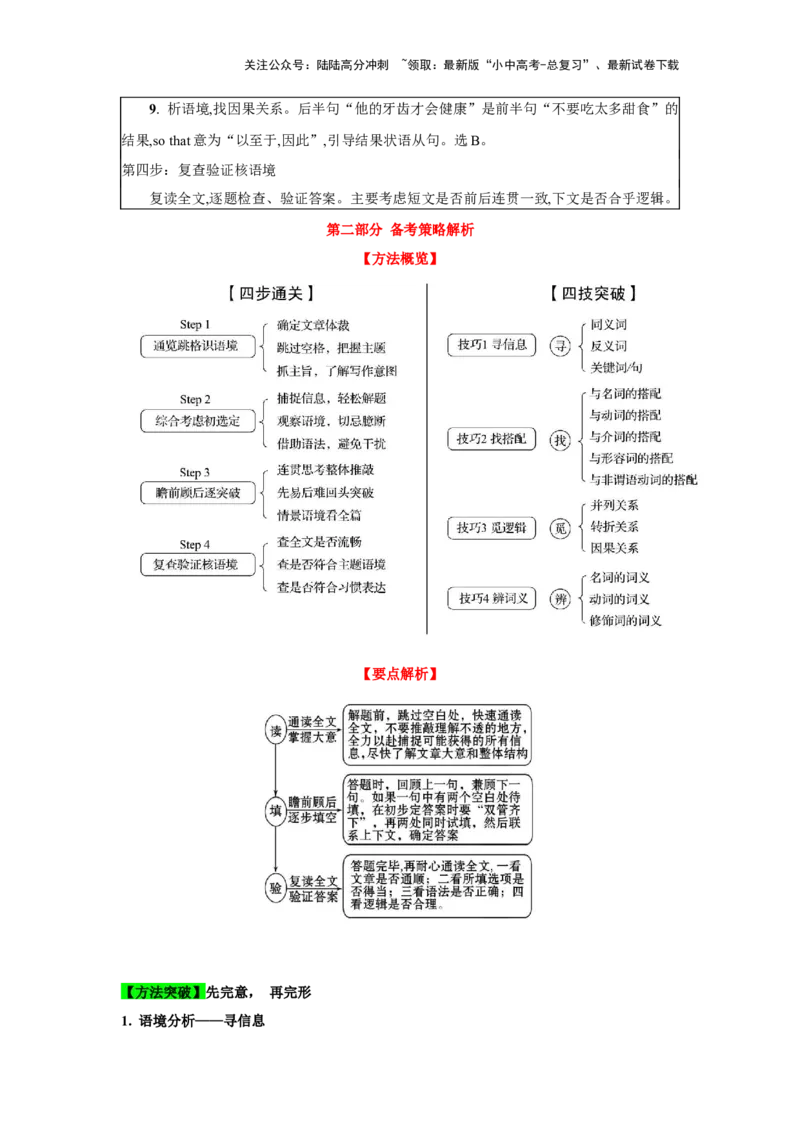
第二部分 备考策略解析
【方法概览】
【要点解析】
【方法突破】先完意, 再完形
1. 语境分析——寻信息
学3科网(北京)股份有限公司关注公众号:陆陆高分冲刺 ~领取:最新版“小中高考-总复习”、最新试卷下载
完形填空中经常会出现前面的信息为后面的空白处提供暗示, 而后面的信息有可能是
前面空白处的答案的情况。这时, 要联系上下文, 积极寻求信息以确定答案。
2. 左顾右盼——找搭配
有些单词词义相近, 而句型结构及跟其他词的搭配却截然不同, 因此不能单从词义上去
辨析, 而应审查空白处前后的名词、动词、介词或非谓语动词等, 比较与各选项的搭配关系,
然后确定答案。
3. 思前想后——觅逻辑
逻辑是作者的行文方式, 主要包括并列、转折、条件、因果、递进、让步等。它们之
间有的通过连接词来表达, 关系非常明显; 有的隐含在句与句之中, 关系比较隐晦。
4. 上下联系——辨词义
词不离句, 句不离篇。做完形填空时必须从句子的语境出发, 根据文章的中心、上下文
的意思, 确定空白处的意思, 然后选出合乎语境的词。
5. 集中精力——破难题
每篇完形填空15道题, 可能有2~4道题的难度较大, 在短时间内很难确定答案。此时,
应该在完成全文后, 集中精力, 对其进行分析、综合, 再做出决定。
【真题演练】 (2023·安徽中考)
Dear Bruce,
Thanks for your email—good to hear from you.I’m looking forward to the exchange (交
流),too!
Anyway,about the 1 and things.The school here isn’t very 2 about most things,but
there are a few things you need to know.First of all— 3 .You can wear what you want, 4
you can’t wear jeans(牛仔裤)with holes in them.You should 5 comfortable things.And it’ll be
cold when you’re here so you’d better bring some 6 clothes.
The school’s pretty strict about phones—of course you can 7 them,but you have to 8
the phones and keep them in a place as you are required before class.You can’t just put them on
silent,right?And you can bring 9 to school but you must eat it outside during the break.If it’s
raining,you can eat in the classroom.
In short,it’s a good school and the teachers are kind.You really don’t have to worry about
anything here.Hope my advice is 10 to you.Write again soon,OK?And tell me if there’s
anything else you need to know.
Yours,
学4科网(北京)股份有限公司关注公众号:陆陆高分冲刺 ~领取:最新版“小中高考-总复习”、最新试卷下载
Sarah
1.A.interviews B.hobbies C.marks D.rules
2.A.strict B.fair C.modern D.sure
3.A.questions B.reports C.clothes D.subjects
4.A.or B.so C.for D.but
5.A.borrow B.wear C.receive D.sell
6.A.clean B.dry C.warm D.new
7.A.bring B.return C.compare D.repair
8.A.hand in B.throw away C.turn off D.pick up
9.A.money B.food C.paper D.water
10.A.helpful B.similar C.secret D.free
第三部分 综合运用巩固
1
I grew up in a family of 12 (10 children and parents) and a large family of grandparents,
aunts, uncles and cousins. Neighbors were in and out of each other’s homes at 1 given
hour of any day for years! Everybody was “family”. They married 2 —that is, to people
from any country. So it was normal to hear people talking but not sure what they were 3
—there was German and French mixed with English, Eastern European accents (口音) with Asian
English.
I later learned Spanish while living in New York and married a/an 4 man who
could speak English. One day, my husband received a letter from a dear friend 5 Japan
who he hadn’t seen for many years. This friend was visiting our city and we planned to meet.
When we finally met, we 6 that his friend had been in South America for many years
and spoke only Japanese and Spanish. 7 he spoke to me in Spanish and to my husband
in Japanese; I spoke to him in Spanish and to my husband in English; and my 8 spoke
to me in English and to his friend in Japanese. We did this for about an hour! It was fun.
These experiences taught me the 9 of learning other kinds of language. I can
understand other people who speak a 10 language — language of someone whose
experience has taken them down a road very different from mine.
1. A. any B. some C. neither D. either
2. A. silently B. freely C. secretly D. wisely
学5科网(北京)股份有限公司关注公众号:陆陆高分冲刺 ~领取:最新版“小中高考-总复习”、最新试卷下载
3. A. talking B. speaking C. reading D. telling
4. A. American B. English C. Spanish D. Japanese
5. A. in B. to C. from D. with
6. A. doubted B. examined C. discovered D. explained
7. A. So B. But C. Because D. Since
8. A. mother B. husband C. sister D. brother
9. A. courage B. agreement C. manners D. importance
10. A. fascinating B. standard C. humorous D. different
2
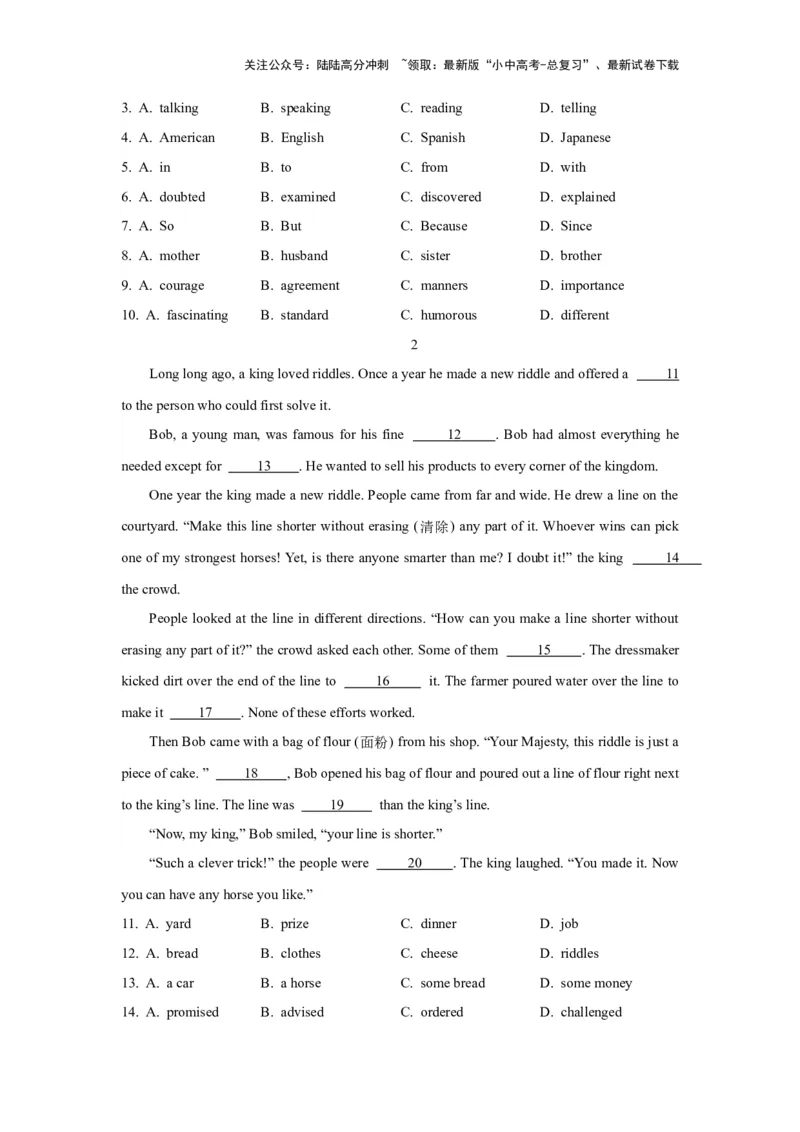
Long long ago, a king loved riddles. Once a year he made a new riddle and offered a 11
to the person who could first solve it.
Bob, a young man, was famous for his fine 12 . Bob had almost everything he
needed except for 13 . He wanted to sell his products to every corner of the kingdom.
One year the king made a new riddle. People came from far and wide. He drew a line on the
courtyard. “Make this line shorter without erasing (清除) any part of it. Whoever wins can pick
one of my strongest horses! Yet, is there anyone smarter than me? I doubt it!” the king 14
the crowd.
People looked at the line in different directions. “How can you make a line shorter without
erasing any part of it?” the crowd asked each other. Some of them 15 . The dressmaker
kicked dirt over the end of the line to 16 it. The farmer poured water over the line to
make it 17 . None of these efforts worked.
Then Bob came with a bag of flour (面粉) from his shop. “Your Majesty, this riddle is just a
piece of cake. ” 18 , Bob opened his bag of flour and poured out a line of flour right next
to the king’s line. The line was 19 than the king’s line.
“Now, my king,” Bob smiled, “your line is shorter.”
“Such a clever trick!” the people were 20 . The king laughed. “You made it. Now
you can have any horse you like.”
11. A. yard B. prize C. dinner D. job
12. A. bread B. clothes C. cheese D. riddles
13. A. a car B. a horse C. some bread D. some money
14. A. promised B. advised C. ordered D. challenged
学6科网(北京)股份有限公司关注公众号:陆陆高分冲刺 ~领取:最新版“小中高考-总复习”、最新试卷下载
15. A. tried B. explained C. succeeded D. joked
16. A. fix B. reach C. hide D. divide
17. A. pass B. connect C. float D. disappear
18. A. Politely B. Confidently C. Nervously D. Carelessly
19. A. shorter B. longer C. smaller D. bigger
20. A. annoyed B. bored C. amazed D. moved
3
阅读短文,理解其大意,从A、B、C、D四个选项中选出可以填入空白处的最佳选项。
Traditional Chinese medicine (TCM传统中医) is an important part of Chinese culture. TCM
has a long history. The 21 medical classic in China, Huangdi’s Classic on Medicine,
came out more than 2,000 years ago. The book is about the relationship between man and 22
. In Chinese culture, yin and yang are the two parts of nature. Nature keeps balanced (平衡的) if
yin and yang work 23 together. The human body needs such a 24 too. TCM
helps to do that.
Quite specially, for some health problems, a doctor of TCM does not give you medicine.
25 , he may give you just a good plan and right ways to eat. For example, it is common to 26
on the way to school, at our work desk, or in front of the TV. But TCM thinks it’s 27 . Here
are the correct ways: Sit down to eat. While eating, 28 the TV and keep away from the
work desk. Eat seasonal (季节性的) foods. Do not miss any of the three meals. Also, get your
body 29 often. Just as the saying goes, running water is never stale (流水不腐). So do
exercise more often.
Nowadays, traditional Chinese medicine is becoming more and more 30 around the
world. A government report says people in 183 countries and areas are now using TCM.
21. A. easiest B. earliest C. newest D. biggest
22. A. stars B. plants C. animals D. nature
23. A. hard B. well C. quietly D. badly
24. A. culture B. book C. balance D. promise
25. A. When B. Unless C. Instead D. If
26. A. eat B. drink C. play D. smile
27. A. wrong B. boring C. helpful D. natural
学7科网(北京)股份有限公司关注公众号:陆陆高分冲刺 ~领取:最新版“小中高考-总复习”、最新试卷下载
28. A. clean up B. show off C. look up D. turn off
29. A. staying B. relaxing C. moving D. sitting
30. A. expensive B. safe C. modern D. popular
4
请通读下面短文,掌握其大意,从每小题所给的四个选项中选出一个最佳答案,并将答题
卡上对应题目所选的选项涂黑。
There are many festivals around the world. Dads have Father’s Day. Mums have Mother’s
Day. But do our grandparents have a 31 ? Yes, they do.
The Double Ninth Festival is a 32 day for old people in China. The festival is on
lunar September 9th. On this day, people show 33 and respect (尊敬) for their
grandparents.
Respecting old people is a tradition in China. There are many ways for Chinese people to
34 their respect. When an old person enters a room, everyone should stand up. Also, people
are introduced from the 35 to the youngest. When we give something to an old person,
two hands are used. The old usually don’t have to buy tickets for buses and young people always
36 their seats to old people on a crowded subway or bus.
However, in western countries, old people have 37 lifestyles from those in China.
They don’t often live with their children—they live 38 . They don’t want to get help
from 39 . They even don’t want to be offered seats by others.
Westerners still respect old people. For holidays, families usually 40 at the
grandparents’ homes. A great smile and a warm hug are enough for grown children to show their
respect.
31. A. house B. festival C. partner D. relative
32. A. boring B. simple C. special D. surprising
33. A. love B. interest C. hope D. invitation
34. A. stop B. express C. find D. refuse
35. A. richest B. tallest C. oldest D. strongest
36. A. offer B. lend C. sell D. take
37. A. usual B. strange C. same D. different
38. A. wisely B. easily C. alone D. sadly
学8科网(北京)股份有限公司关注公众号:陆陆高分冲刺 ~领取:最新版“小中高考-总复习”、最新试卷下载
39. A. other B. the other C. others D. the others
40. A. grow up B. get off C. make up D. get together
5
With Shanghai starting to sort trash (垃圾分类), one country naturally catches our attention
— Sweden (瑞典), one of the world’s best countries in waste management, with a 41
recycling level up to 99%. 42 did Sweden make such an achievement?
Like many other countries, Sweden was once a land with much trash 43 the
government decided to clean it up. Then trash sorting took top priority (优先). The Swedish
government believed that children 44 the idea of trash sorting from an early age, so it
became a part of the national education. 45 were given the knowledge in the school, and
then taught their parents at home. After the efforts, the rules of trash sorting have 46
become part of Swedes’ daily life.
Many Swedish neighborhoods have central collection stations, from which pipelines (管道) run
through walls and into the ground, connecting different kinds of rubbish bins. The bin has a sensor
(感应器). Once the bin is 47 , it opens itself, and the rubbish, driven by strong winds,
rushes to the central collection station at a 48 of 70 km/h. Rubbish collection is done
49 a clean way.
Right now, you and your family may face the difficulty of sorting out the rubbish. 50
if we can really see the advantages—a beautiful picture like Sweden, pains are worthwhile (值得
的).
41. A. high B. low C. big D. small
42. A. Why B. What C. When D. How
43. A. after B. before C. if D. because
44. A. should tell B. should be taught C. can be told D. must ask
45. A. Children B. Girls C. Boys D. People
46. A. hardly B. never C. already D. yet
47. A. empty B. dirty C. filled D. ugly
48. A. height B. weight C. length D. speed
49. A. in B. by C. from D. to
50. A. But B. So C. Although D. Unless
学9科网(北京)股份有限公司关注公众号:陆陆高分冲刺 ~领取:最新版“小中高考-总复习”、最新试卷下载
6
阅读下面短文,掌握其大意,然后从各题所给的A、B、C、D四个选项中选出最佳选项。
It was Mary’s birthday. She got a letter from her uncle. Her uncle, a farmer would give her
some 51 as his birthday present for Mary. Mary was pleased. She liked eating eggs and
she liked eating chicken, too. “I can keep the chickens 52 their eggs or eat them,” she
thought When the chickens arrived the next day, they were in a box.
Mary was very excited 53 she saw the chickens. She took the box off the back of the
truck and began to carry it to the back of her house. However, the box of chickens was heavy and
she dropped 54 . The box fell to the ground and broke open. The chickens all ran out.
They ran everywhere —into the backyard, into neighbors’ gardens, into the road, even into
the next street. It 55 Mary hours to find them and take them back to her garden.
A few days later her uncle came to visit her
“Did the chickens arrive 56 ?” he asked Mary.
“Yes, Uncle Toby,” Mary said. “But I had a lot of 57 with them. I dropped the box. It
broke open and the chickens ran everywhere. I spent the whole morning 58 for them.”
“Have you found them all?” her uncle asked
“I hope so,” Mary answered. “I have 59 eleven of them.”
“That’s very 60 ” her uncle said with a smile, “because I only sent you six.”
51. A. cats B. dogs C. chickens D. cows
52. A. with B. by C. from D. for
53. A. when B. before C. so D. until
54. A. them B. it C. her D. him
55. A. paid B. cost C. took D. spent
56. A. quickly B. actually C. safely D. quietly
57. A. trouble B. trust C. pride D. waste
58. A. working B. caring C. preparing D. looking
59. A. killed B. caught C. cooked D. seen
60. A. boring B. fresh C. surprising D. ugly
7
学1科网(北京0)股份有限公司关注公众号:陆陆高分冲刺 ~领取:最新版“小中高考-总复习”、最新试卷下载
My father was a farmer. He worked very hard and never complained. He has never gone to
school. So, he was a common man 61 little education. But he would teach my sister and
62 lessons through stories.
One day before I was leaving for college, he sat down and took a 63 from his
pocket. And he said, “You need to know 64 things before you go out into the world.
Remember them, 65 you will be the best person you can be.”
“First, look at the pencil. We know that in order to become a(n) 66 pencil, from
time to time, it has to go through being sharpened (使锋利). If this pencil could 67 , we
could imagine how painful that would be. But that’s 68 it becomes a useful pencil. Life
is much the same. No one can live the whole life 69 all the time. Painful experiences
and difficulties come to us all. But we build our personalities and we 70 through
these chances. Second is to keep in mind that you will be able to make many of your mistakes
correct just like this eraser. If we 71 from our mistakes, they’re not mistakes. We can
use the lessons to do 72 next time. Third, just like this pencil, every place where you
are used, you leave your mark. You’re 73 your own story. Don’t be afraid and never
stop writing. And fourth, always remember the most 74 part of you is what’s inside.
A pencil is useless without it’s inner part.”
When I feel sad in my life, I’ll think about my 75 words. They give me courage
to move on.
61. A. with B. about C. under D. during
62. A. her B. him C. me D. us
63. A. pen B. pencil C. rubber D. ruler
64. A. two B. three C. four D. five
65. A. but B. or C. and D. though
66. A. careful B. useful C. awful D. colorful
67. A. feel B. shape C. insist D. cancel
68. A. what B. whom C. how D. which
69. A. quickly B. closely C. usually D. happily
70. A. guard B. guess C. grow D. greet
71. A. learn B. record C. charge D. attack
72. A. higher B. better C. farther D. earlier
学1科网(北京1)股份有限公司关注公众号:陆陆高分冲刺 ~领取:最新版“小中高考-总复习”、最新试卷下载
73. A. writing B. thinking C. reporting D. covering
74. A. difficult B. comfortable C. hard-working D. important
75. A. sister’s B. father’s C. mother’s D. brother’s
学1科网(北京2)股份有限公司