奉贤区 2014-2015 学年度第一学期期末质量抽查试卷
初三英语
(满分150分,完卷时间100分钟) 2015.01
考生注意:本卷有7大题,共94小题。试题均采用连续编号,所有答案务必按照规定在答题
卡上完成,做在试卷上不给分。
Part 1 Listening (第一部分 听力)
I. Listening comprehension (听力理解) (共30 分)
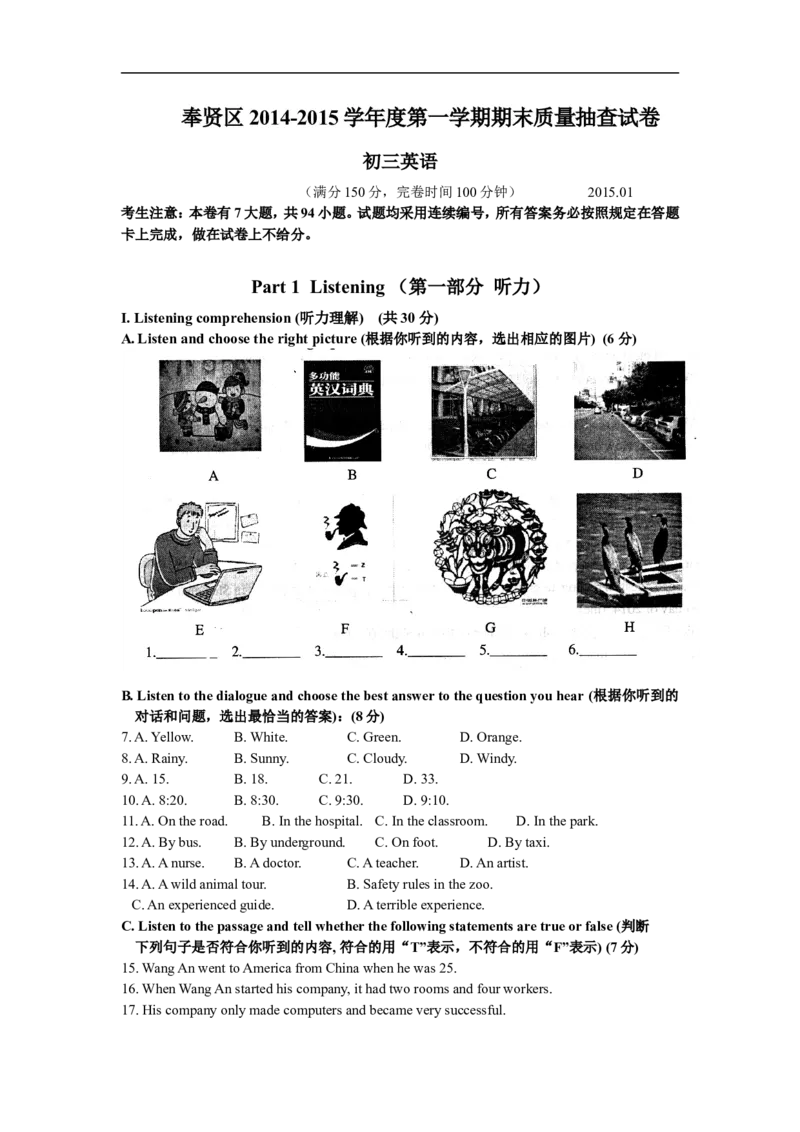
A. Listen and choose the right picture (根据你听到的内容,选出相应的图片) (6 分)
B. Listen to the dialogue and choose the best answer to the question you hear (根据你听到的
对话和问题,选出最恰当的答案):(8分)
7. A. Yellow. B. White. C. Green. D. Orange.
8. A. Rainy. B. Sunny. C. Cloudy. D. Windy.
9. A. 15. B. 18. C. 21. D. 33.
10. A. 8:20. B. 8:30. C. 9:30. D. 9:10.
11. A. On the road. B. In the hospital. C. In the classroom. D. In the park.
12. A. By bus. B. By underground. C. On foot. D. By taxi.
13. A. A nurse. B. A doctor. C. A teacher. D. An artist.
14. A. A wild animal tour. B. Safety rules in the zoo.
C. An experienced guide. D. A terrible experience.
C. Listen to the passage and tell whether the following statements are true or false (判断
下列句子是否符合你听到的内容, 符合的用“T”表示,不符合的用“F”表示) (7分)
15. Wang An went to America from China when he was 25.
16. When Wang An started his company, it had two rooms and four workers.
17. His company only made computers and became very successful.18. After Wang An got a lot of money, he moved into a big house.
19. In 1986, Wang's son, Fred became president of the company.
20. Now people can find Wang's name in some places in Boston.
D. Listen to the passage and complete the following sentences(听短文,完成下列内容。每空
格限填一词)(7分)
21. Peter was __________ __________ his work, so his boss liked him very much and gave him a
lot of work.
22. Peter always __________ __________ in his work because he couldn't sleep well at night.
23. Peter was very worried and he went to see the doctor __________ __________.
24. Ten minutes after taking the medicine, Peter went to bed and __________ __________ soon.
25. As soon as Peter came into __________ __________, he told the boss he had a good sleep.
Part 2 Phonetics, Vocabulary and Grammar
(第二部分 语音,词汇和语法)
II.Choose the best answer (选择最恰当的答案) :(共20分)
26. Let me tell you about a new case that I dealt with. Which of the following is correct for the
underlined word in the sentence?
27. Which of the following underlined parts is different in pronunciation from others?
A. What's the meaning of this word?
B. Her boyfriend's death made her very sad.
C. You can take this seat because there is no one else here.
D. My dream job is to be an astronaut.
28. Tony is so helpful that he always does me ______ favor.
A. a B. an C. the D. /
29. - Who do the books on the shelf belong to?
- They are ______.
A. we B. us C. our D. ours
30. The professor answered the questions one after ______ after the lecture.
A. the other B. another C. the others D. others
31. The Trojans fought against the Greeks to drive them away ______ their country.
A. from B. to C. with D. by
32. The writer put some colorful pictures to keep the readers ______.
A. interest B. interests C. interesting D. interested
33. This summer in Shanghai has been ______ in the past few years.
A. the coolest B. the cooler C. cooler D. cool
34. ______ notes carefully and then you can learn English better in this way.
A. To take B. Take C. Taking D. Took
35. Mum always asks her son ______ his dirty clothes everywhere.
A. not leave B. doesn't leave C. not to leave D. don't leave
36. The repairman ______ some tools to fix the tap.
A. required B. repaired C. recognized D. received
37. He still denied ______ anything though he was questioned several times.A. steal B. stole C. stealing D. to steal
38. You won't catch the last bus ______ you hurry up.
A. if B. when C. unless D. because
39. - ______ he ______ the driving test?
- No, not yet.
A. Did, pass B. Does, pass C. Have, passed D. Has, passed
40. Something necessary ______ to prevent the serious air pollution.
A. must do B. must be done C. may do D. may be done
41. We really need a new car, but ______ we'll have to continue using the old one.
A. for the time being B. for the first time
C. from time to time D. for some time
42. ______ useful information Mr. Brown gave us just now!
A. How a B. How C. What a D. What
43. After the accident, citizens are wondering ______ about the serious events.
A. will the government take action B. how will the government take action
C. how the government will take action D. if will the government take action
44. - Sorry I'm late, but my car broke down, and there were no taxis.
- ______
A. All right. B. That's all right. C. You'd better not. D. Don't say that.
45. - I'm afraid the work is too difficult for me.
- ______
A. Try it again. B. I'm sorry to hear that.
C. That's all right. D. Don't give it up. You can do it.
III. Complete the following passage with the words or phrases in the box. Each can only be
used once. (将下列单词或词组填入空格。每空限填一词,每词只能填一次) (共8分)
A. boring B. short C. took place D. at the end of E. but
Do you know what the earliest films are like? The earliest films were very 46 . They were
shown only one minute or less. People could see simple action films of trains, cars, crowd in city
streets, and other similar things. Soon theatres began to show 20-minute pictures of pieces of news
47 the stage show. Later, people used a new way to make better films. They put the beginning of
one scene upon the end of another scene to put a story together. In 1903 a film about a story was
made. Much of the action 48 at the same time---the man in prison running away, the policemen
running after them and planning to catch them. These films were simple, 49 at that time people
liked these films very much.
A. why B. effect C. afford D. either E. be able to
Mr. Hunter is very busy all the time. He drives a taxi in the daytime. He works hard to get
enough money for his family. His wife had two sons six years ago. They had no money to 50
servant. The woman had to leave the shop and began to look after the babies.
Now the two boys are six years old and they're too naughty to listen to their mother. Mr.
Hunter always feels tired when he gets home. After dinner he wants to go to bed, but he has to
teach Bruce and Bruno to write and read. The twins don't listen to him, 51 , and they often make
faces or much noise in the room. They don't like anything but playing with dogs and cats. It was
difficult for him to teach them anything and it often makes him more tired. He didn't know what to
do.
"Why not send them to school?" Mr. Hunter asked last Saturday. 'The teachers will 52teach them a lot."
Mrs. Hunter agreed. But the following day, the headmaster asked Mrs. Hunter, "Your sons are
trouble makers. How do you put up with them? Oh, sorry, I can't. That's 53 I sent them to
school."
IV. Complete the sentences with the given words in their proper forms(用括号中所给单词
的适当形式完成下列句子) (共8分)
54. The young couple decided to have the __________ baby. (two)
55. Bank __________ are reported almost every day in the newspaper. (robbery)
56. I learned a lesson on how to protect __________ from the stampede ( 踩踏事件) in Shanghai
on the last day of 2014. (me)
57. Alice felt __________ when she saw a horror film at night. (frighten)
58. He is __________ that he will win in the coming contest. (confidence)
59. It hasn't rained a lot in Yunnan __________. (recent)
60. The doctor was too tired after he __________ on the patient for a long time. (operation)
61. The poor girl is so __________ that she can look after her family. (depend)
V. Rewrite the following sentences as required(根据所给要求,改写下列句子。每空格限填一
词) (共14分)
62. He made a decision to do the project.(改为否定句)
He __________ __________ a decision to do the project.
63. The modern machine seldom goes wrong. (改为反意疑问句)
The modern machine seldom goes wrong, __________ __________?
64. Mr. Jones prefers to stay at home in order to care for his sick mother. (保持句意基本不变)
Mr. Jones prefers to stay at home __________ __________ he can care for his sick mother.
65. The journalist reported the news at once after the accident happened. (保持句意基本不变)
The journalist reported the news __________ __________ after the accident happened.
66. Our government will send some volunteers to Africa to help the people there. (改为被动语态)
Some volunteers will __________ __________ to Africa to help the people there.
67. It's about ten minutes' walk from my home to my school. (对划线部分提问)
__________ __________ is it from my home to my school?
68. stay, they, can, for, under water, two minutes (连词成句)
____________________________________________________________________________
Part 3 Reading and Writing
(第三部分 读与写)
IX. Reading Comprehension (阅读理解):(共50分)
A. Choose the best answer (根据文章内容,选择最恰当的答案):(12分)
Have you ever wanted a friend who can solve problems with magic tricks? Well, a round-
headed blue robotic cat is the friend you are looking for.
Doraemon (多啦 A梦) is a character created in the 1970s by Japanese cartoonist Fujiko E
Fujio.
Starting form Dec 1, on the birthday of Fujio, Doraemon is returning in a new comic series.
This is the first new Doraemon since it ended eight years ago.
In the story, Doraemon comes from the 22nd century. He becomes friends with a fourth-gradeboy called Nobita (大雄) who is like you and your classmates. He has arguments with his friends,
is blamed by his mother, and gets a headache from his homework. But luckily, Doraemon is
always there to help.
If you ask what makes the Doraemon series so popular, the simple answer may lie in
Doraemon's amazing pocket that's full of cool gadgets (小玩意儿). Anywhere Door helps Nobita
go anywhere to make his dreams come true. Memory Bread, once eaten, helps him remember
textbooks quickly. Xia Xue, 14, from Yangzhou, Jiangsu province, wished she could have one,
too. "With Memory Bread, I can press it on my textbook and eat it," Xia said. "This way, exams
would be a piece of cake!"
Doraemon is also like a real person. He has a nice personality. He teaches Nobita courage and
friendship. He even has a favourite food. But sometimes, he is lazy and tells small lies.
But more than that, Doraemon gives a message: the future can be likable, the present is
redeemable (可补救的), and you can be happy even if you're blue, Time magazine once
commented. This encourages children that no matter what ups and downs they have, they can
always get through them.
69. We know that Doraemon is ______.
A. Nobita's classmate B. a real person with a nice personality
C. a character from a Japanese cartoon D. a lovely cat with blue fur
70. How many cool gadgets are mentioned in paragraph 5?
A. 1 B. 2 C. 3 D. 4
71. We can infer from(推断) the story that ______.
A. Doraemon is not always honest
B. Nobita is good at studying
C. Doraemon teaches Nobita some learning methods
D. Nobita easily gets sad
72. The underlined word "blue" in the last paragraph mean "______".
A. angry B. confused C. bored D. sad
73. What can kids learn from Doraemon?
A. Be brave no matter what happens
B. With magic, you can do whatever you like
C. It is good to cry if you are not happy
D. Treasure your school days
74. The best title for the passage might be ______.
A. Nobita, a boy who's often in trouble B. Doraemon returns with cool magic
C. Doraemon's present and future D. My best friend, Doraemon
B. Choose the words or expressions and complete the passage(选择最恰当的单词或词语完
成短文)(12分)
Can we have too many friends.'?
How many friends do you have? Making a lot of friends makes you popular at school. Also,
whenever you want to find someone for help, there is always a certain friend there. Now scientists
suggest that parts of the brain in those with more friends are larger than those with 75 friends.
Scientists have studied the connection between brain 3ize and social interactions(社交互动) on
monkeys. They found that parts of the brain in more sociable monkeys were larger. They were
better 76 predicting the intentions (意图) of other monkeys.As for humans, the researchers at McGill University, Canada, studied the differences between
those with larger social groups, and those with smaller groups. The researchers studied 18 people.
In order to 77 the size of each person's social group, the people were asked how many social
interactions they'd had in the past month.
Then researchers looked at brain scans(扫描). They found that, just like monkeys, parts of the
brain in humans with larger social groups were larger.
Although scientists need long-term studies to work out 78 social interaction caused these
changes in the brain, they were sure about one thing: Some brain regions(区域) that are larger
suggests other regions might be smaller, lead scientist Mary Ann Noonan said to LiveScience.
For example, if you're spending a lot of time with friends, you won't have much free time to
learn other 79 , such as playing the piano, Noonan said. These parts of the brain stay small.
So having too many friends is not always good. 80 , it's difficult to keep a lot of meaningful
relationships. Maybe we should stick to a smaller, but closer, group of friends.
75. A. fewer B. better C. worse D. smaller
76. A. in B. on C. with D. at
77. A. take out B. find out C. put out D. look at
78. A. that B. whether C. when D. what
79. A. skills B. experiences C. technologies D. hobbies
80. A. Finally B. At least C. What's more D. Above all
C) Read the passage and fill in the blanks with proper words(在短文的空格内填入适当的词,
使其内容通顺,每空格限填一词,首字母已给):(14分)
Say hello to the world
November 21 is World Hello Day. At school, we learned that "How do you do?" and "How
are you" are standard(标准的) ways to say hello when meeting others. But do you know how to
respond to them? Nowadays, do native speakers s 81 use them today?
As we learned, "How do you do?" is for greeting someone we meet for the first time. And it can
be responded with the same "How do you do? How are you?" is often used to greet someone we
are familiar with. It usually f 82 with a response of "I'm good, and you?" or" I'm well, and
you?"
But English is a casual (随意的) language. The formal "How do you do?" is rarely said by
native speakers. It is considered old-fashioned. Yet they greet each other in m 83 other ways.
You may hear a conversation b 84 British people: "You all right? Yea, you? I'm good. Any
plans for the weekend?" or "How's it going? Yea, fine, and you?" These ways of greeting are
popular for young people to say hello to friends.
Americans like saying, "What's up" or "What's good?" to friends. Don't be confused. It doesn't
mean "what's wrong?" It is just one way of saying hello. And people usually respond "Not much"
or "Nothing". "Hey, man" is also popular. But it is only used among men. What do w 85 say?
You guessed it. They often say "Hey, girl."
If you meet an Australian, you may hear "G'day, mate". It means "Good day". You can respond
with the same "G'day".
H 86 , there is no rule to say hello to each other. If you can't remember all of the above, just
choose "How are you?". This is the most c 87 and standard way for people of all ages. You can
reply with "pretty good", "same as usual" or "I'm hanging in there."
D.Answer the questions(根据短文内容回答下列问题)(12分)Have you ever been sad because you failed in something? If so, please remember, for often,
achieving what you expect is not the most important thing. Enjoy the process. Here is a story to
tell you why.
One day a little boy decided to dig a hole behind his house after watching a science program. As
he was working, a couple of boys stopped by to watch. "what are you doing?" asked one of the
visitors. "I want to dig a deep hole all the way through the earth!" the boy answered excitedly. The
older boys began to laugh, telling him that it was impossible to do it. Then they left.
The little boy kept on digging and digging. Suddenly, a few small colorful stones caught his
eyes. He collected them and put them into a glass box patiently. Humming a song, he went on
digging. The box was full soon. Then he talked to himself quietly and proudly, "Maybe I can't
finish digging all the way through the earth, but look at what I have found in the process of
digging!"
The boy's goal was too difficult, but it did cause him to go on, in other words, to cause us to
keep working.
Not every goal will be achieved. Not every job will end up with a success. Not every dream will
come true. But when you can't achieve your goal, maybe you can say, "Yes, but look what I've
found along the way! There are so many wonderful things that have come into my life because I
tried to do something!" It is in the digging that life is lived. It is the unexpected joy on the journey
that really has a meaning.
88. Is achieving what you expect the most important thing in the passage?
__________________________________________________________________
89. When did the little boy decide to dig a hole behind his house?
__________________________________________________________________
90. Why did the older boys begin to laugh at the little boy?
__________________________________________________________________
91. What did the boy find in the process of digging?
__________________________________________________________________
92. How did the boy feel after the box was full?
__________________________________________________________________
93. Do you think it is a meaningful passage? Why or why not?
__________________________________________________________________
VII. Writing (作文): (20分)
94. Write at least 60 words according to the given situation. (根据所给情景写—篇不少于60个
词的信,标点符号不占格。)
假如你叫王芳,最近你收到了你好朋友Ann的信。她正为她的学习而烦恼。请你根据她
的信写一封回信,给她一些建议。(注意:建议不得少于两条)
Words and phrases for reference (以下短语仅供参考):
improve; I suggest that ...; useful methods; be relaxed;
(注意:短文中不得出现考生的姓名、校名及其他相关信息,否则不予评分。)Dear Ann,
Nice to hear from you. ________________________________________________________
_______________________________________________________________________________
_______________________________________________________________________________
_______________________________________________________________________________
_______________________________________________________________________________
_______________________________________________________________________________
_______________________________________________________________________________
_______________________________________________________________________________
_______________________________________________________________________________奉贤区 2014-2015 学年度第一学期期末质量抽查试卷
初三英语
听力原文和参考答案
Part 1
A.
1. Danny's father bought him a new English-Chinese dictionary as a new term gift. (B)
2. More and more young men are keen on computer games, but they are bad for their health. (E)
3. It is fun for the children to make snowmen in Winter. (A)
4. It's a school rule for the students to park their bicycles in order at school. (C)
5. Henry's ambition is to he a detective like Holmes. (F)
6. Paper-cutting is a Chinese traditional skill. (G)
B.
7. M: I like yellow and white. What about you, Miss Green?
W: My favorite color is orange.
Q: What color does the woman like best? (D)
8. M: It's going to be hot and sunny tomorrow.
W: That's great We can go swimming.
Q: What's the weather going to be like tomorrow? (B)
9. M: What a tall building! How many floors are there in it?
W: There are eighteen floors. My office is on the fifteenth floor.
Q: How many floors does the building have? (B)
10. M: The plane will take off at 9:30.
W: So we still have twenty minutes.
Q: What time is it now? (D)
11. M: You must be careful. That car nearly hit you.
W: But I want to catch the bus.
M: You mustn't cross the road now. There's much traffic. It is dangerous.
W: Sorry, I won't do it next time.
Q: Where are they talking? (A)
12. M: Shall we go to visit the Science and Technology Museum this weekend?
W: That sounds fine. How shall we go there by bus or by underground?
M: Underground Line 2 is too crowded. Since it is not so far, let's call a taxi.
Q: How will they go to the Science and Technology Museum? (D)
13. M: What's your dream job in the future, Tom?
W: My parents want me to become a doctor, but I want to be an artist.
M: Wonderful. I want to be a teacher, just like my mother.
Q: What does the boy's mother do? (C)
14. M: How was your trip to South Africa?
W: It was so cool! We drove around in a jeep and tried to get really close to the wild animals,
like lions.
M: Really? Weren't you frightened?W: No, not really. It was quite safe inside the jeep, and our guide was very experienced.
Q: What are they talking about? (A)
C.
Wang An was born in Shanghai, China in 1920. He came to America at the age of 25. He
studied at Harvard, a famous university near Boston. He was very clever and soon got a doctor's
degree from Harvard.
In 1951 Wang An started a small company. It had only one room and two workers. The
company made calculators and computers. By 1985 Wang had 30,000 workers and had made $3
billion. Wang's company was one of the most successful in the world.
Money did not change Wang An. He lived with his wife in the same house outside Boston.
He had only two suits at one time, and they were always gray. Wang An's life was his company.
He made his son, Fred, president of the company in 1986.
Wang An died in 1990. People in America will remember this great man. He was generous
and liked to give money. We find his name in places like the Wang Center for the Performing Arts
or the Wang Institute in Boston.
(15. T 16. F 17. F 18. F 19. T 20. T)
D.
Do you know the classroom customs in America? Are they the same as ours ?
In America, if the teacher asks a question, you are expected to give an answer. If you do not
understand the question, you should put up your hand and ask the teacher to repeat it. If you do
not know the answer, it is all right to tell the teacher that you do not know. Then he or she knows
what you need to learn.
There is no excuse for not doing your homework. If you are absent, you should call your
teacher or someone who is in your class and ask for the task. It is your responsibility to find out
what tasks you have missed. It is not the teacher's responsibility to remind you of missing tasks.
Be on time! It is thought rude to be late. If you come in late, be sure to do it quietly. Have your
books and papers out of your bag before you come into the classroom. Then go to your seat and sit
quietly. In the USA, it is not necessary to knock before you enter the classroom. If you must leave
during class, do it quietly. There is no need to ask the teacher's permission. Entering a teacher's
office or any other office with a closed door without knocking first is not polite. Knock first, and
then wait to be invited in;
(21. good at 22. made mistakes 23. on Friday 24. fell asleep 25. the/his office ).
Part II
26. C 27. B 28. A 29. D 30. B 31. A 32. C 33. A 34. B 35. C
36. A 37. C 38. C 39. D 40. B 41. A 42. D 43. C 44. B 45. D
46. B 47. D 48. C 49. E 50. C 51. D 52. E 53. A
54. second 55. robberies 56. myself 57.frightened
58. confident 59. recently 60. operated 61. independent
62. didn't make 63. does it 64. so that
65. right away/right now 66. be sent 67.How far
68. They can stay under water for two minutes.
(A) 69. C 70. B 71. A 72. D 73. A 74. B
(B) 75. A 76. D 77. B 78. B 79. A 80. C
(C) 81. still 82. follows 83.many 84. between85. women 86. However 87.common
(D) 88. No, it isn't./No.
89. After watching a science program. / After he watched a science program.
90. Because it was impossible to dig a (deep) hole all the way through the earth.
91. He found (small) colorful stones./Colorful stones.
92. (He felt) quiet and proud.
93. Yes. (1分)
Because I have learnt from the story that we should enjoy the process, although sometimes
our goals won't be achieved. ( 2分)
No. (1分)
Because I think achieving the goal is the most important thing. You can't get real happiness
if you can't achieve your goal.