1
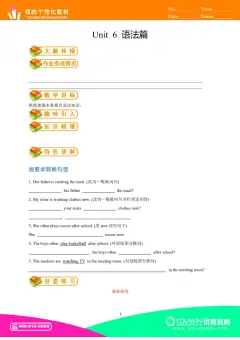
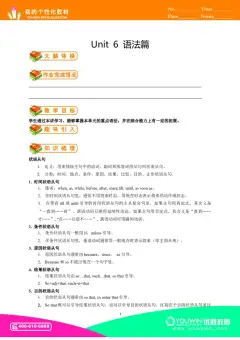
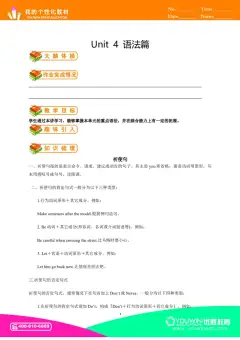
Unit 8 语法篇
__________________________________________________________________________________
__________________________________________________________________________________
理解并掌握条件状语从句的用法
条件状语从句
一、条件状语从句通常由if(如果), unless(除非),as long as(只要)引导。例如:
If it rains tomorrow, we won’t go to the park. 如果明天下雨,我们就不去公园了。
      Unless weather stops me, I go for a walk every. 我每天都会去散步,除非遇上坏天气。
      Our parents will be pleased with our performance as long as we try our best.
      只要我们竭尽全力,父母就会满意我们的表现。
二、if 引导的条件状语从句
1.“if 从句+祈使句”的句子。if 作为一个连词,主句也可以是其他形式的句子。例如:
If you want to go, please let me know.   如果你想去,请让我知道。
  If the green light isn’t on, wait for a minute.  如果绿灯没亮,请等一下。
 2.“祈使句 + and (or)+ 陈述句”在意思上相当于一个带有条件状语从句的复合句。
注意:
A.“祈使句 + and + 陈述句”可以转化为if 引导的肯定条件状语从句,而且主语是第二人称。
B.“祈使句 + or  + 陈述句”可以转化为if 引导的否定条件状语从句,而且主语是第二人称。
Study hard and you will pass the exam. =If you study hard, you will pass the exam.
努力学习你就会通过考试。
2
Hurry up, or you’ll be late. =If you don’t hurry up, you’ll be late.  快点,不然你会迟到的。
三、if 从句与主句具有以下特点:
1. if 从句中用一般现在时,表示未来的一种条件,从句中可以加时间状语。例如:
If you can’t come tomorrow, we can hold the party a little later.
明天你如果不能来,我们可迟一点举行宴会。
If it doesn’t rain tomorrow, we’ll go to the Great Wall.
明天如果不下雨,我们就去长城。
2. 当if 表示未来的条件时,主句中用一般将来时,从句用一般现在时,即“
  主将从现

 ”
  。
表示如果某种条件存在,就有可能/不可能发生什么事情。例如:
If you don’t get up early, you will be late for school.  你如果不早点起床,上学就会迟到。
If I play games on it, it will go wrong.   如果我用它玩游戏,它就会坏掉。
3. if 从句可放在主句前或主句后,从句置于主句前时,须用逗号与主句隔开,反之则不用逗
号。例如:
I f it’s fine tomorrow

 , we can go out.    如果明天天气好,我们就能出去。
She will be happy if she joins the party.  如果她参加聚会她会很开心的。
I’ll ask the teacher for help if I don’t understand.  如果我不懂我会求助老师的。
四、if 引导的条件状语从句和宾语从句的区别
if 可以用来引导条件状语从句也可以用来引导宾语从句,主要是要弄清楚if 引导从句的时态。
if  在引导宾语从句时,意为

 “
  是否

 ”
  ,
  要根据实际情况来确定时态;而if 在引导条件状语从
句时意为“如果,假设”,要用一般时代替将来时,即“主将从现”。例如:
I want to know if he will come here tomorrow.   我想知道他明天是否到这儿来。
(if 在引导的是宾语从句,从句中有很明显的表将来的时间状语tomorrow,所以if 从句要用
一般将来时。)
If it rains tomorrow, we’ll put off the sports meeting.  如果明天下雨,我们就推迟运动会。
(if 在引导的是条件状语从句,尽管从句中也有表将来时的时间状语tomorrow,从理论上讲
也应该用一般将来时,但是在if 引导的条件状语从句中要用一般现在时代替一般将来时,故
从句谓语用rains 而不用will rain. )
  【知识拓展】
     在when(当...的时候), as soon as(一...就...) 引导的时间状语从句中,也用一般现在时表示将
来,即“主将从现”。例如:
     When I finish my homework, I’ll go to the cinema with you.   我完成作业就会跟你一起去电影
院。
     A  s    soon

   as
   he comes back, he will call you.  他一到就会给你打电话的。
1. In Chongqing, you can often see many people dance outside together if it_______in the evening.
  A. rains           B. doesn’t rain
         C. will rain         D. won’t rain
3
2. ________you use your dictionary often, your spelling will improve.
  A. Whether        B. Though             C. If                D. While
3. ---I want to know if Maria _______us in the fashion show tonight.
  ---I believe if she_______her homework, she will join us.
  A. joins; finishes    B. will join; finishes     C. joins; will finish     D. will join; will finish
4. If it_____________, we will go hiking at Cool City Park.
  A. not rain         B. don’t rain           C. won’t rain
         D. doesn’t rain
5. ---Do you know when he will come back tomorrow?
---Sorry, I don’t know. When he ________back, I’ll tell you.
  A. comes         B. will come         C. come
         D. may come
6. Mum says _______I do my homework now, I can watch TV for an hour.
  A. though          B. if                 C. because            D. while
7. They will lose the game ______they try their best.
  A. unless           B. once              C. since              D. after
8. I don’t know________he will come tomorrow. _______he comes, please tell me.
  A. whether; Whether                      B. if; If
C. if; Whether                           D. /; If
解析:
1. 考查if 引导的条件句。if 引导的条件状语从句用一般现在时代替一般将来时。题意为“在重庆,
如果不下雨,你经常会看到许多人聚在一起跳舞”。故选B。
2. 考查连词用法。四个选项连词的意思分别为:whether 是否;though 尽管;if 如果;while 当…的
时候。if 更符合题意,题意为“如果你经常用字典,那么你的拼写能力会提高。”故选C。
3. 考查if 的用法。第一空if 引导宾语从句,其时态要根据实际情况来确定;第二空if 引导条件状
语从句,从句用一般现在时表示将来,故选B。
4. 考查if 引导的条件句。if 引导的条件状语从句用一般现在时代替一般将来时。故选D。
5. 考查when 引导的时间状语从句。when 引导的条件状语从句用一般现在时代替一般将来时,故选
A。
6. 考查连词用法。四个选项连词的意思分别为:though 尽管;if 如果;because 是否;while 当…的
时候。if 更符合题意,题意为“妈妈说如果我现在写作业,就能看一个小时的电视。”故选B。
7. 考查连词用法。四个选项连词的意思分别为:unless 除非;once 曾经,一旦; since 自从,因为;
 after 在…之后。Unless 更符合题意。题意为“除非他们尽最大努力,不然他们会输掉比赛。”故
选A。
8. 考查连词用法。第一空引导宾语从句;第二空引导条件状语从句,从句用一般现在时表示将来。
故选B。
答案:
1-5 BCBDA    6-8 BAB
4
基础演练
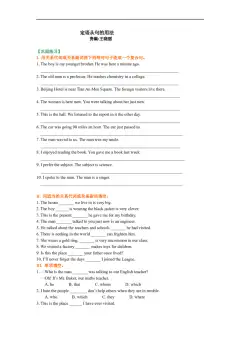
一、用所给词语的适当形式填空
1. Don’t go out tomorrow if it_________(rain).
2. I don’t know if he________(come) tomorrow.
3. If she _______(get) up late, she _______(not catch) the early bus.
4. He___________(write) a letter to his grandparents if he_______(get) his report card this week.
5. If your telephone _______(ring), answer it.
二、在正确的答案下画线
1. Daina (will go/ go/ goes) to Europe if she(will pass/ pass/ passes) the exams.
2. The graduates (will teach/ teach/ teaches) in the poor village if the Ministry of Education (will
agree/ agree/ agrees) soon.
3. If there(will be/ are/ is) a car accident, they (will call/ call/ calls) 120 for help at once.
4. If it (won’t / don’t / doesn’t / isn’t ) rainy, we (will take/ take/ take) a walk outside.
5. If a UFO (will land/ land/ lands) in front of me, I (will go/ go/ goes) in to look for the alien.
巩固提高
一、根据中文提示完成句子
1. 如果你在牛奶里加些蜂蜜,它品尝起来会非常美味。
  If you ___________some honey to the milk, it will _________very delicious.
2. 如果你现在不离开,你就会错过最后一班公共汽车。
  _________you don’t leave now, you ________________the last bus.
3. 这种机器是中国生产的。
  This kind of machine is __________________China.
4. 除非有医生的证明,否则你被要求参加体育测试。
  You’re required to take _________ in the PE test ________you have a doctor’s note.
5. 运动会因为大雨推迟了。
  The sports meeting was ___________________the heavy rain.
6. 有了抗生素,许多疾病很容易被治愈。
  With antibiotics, many disease can _______________easily.
7. 科学家们对DNA 了解得越来越多了。
  Scientists have learned_____________ about DNA.
8. 每个人都尽量成功完成生活中的每件事。
  Everyone_________________________anything in life.
9. 养植物不仅花时间而且需要耐心。
   ______________________time _________________ to grow plants.
5
10. 从那时起我下决心苦练乒乓球。
   _______________ I _________________ to practice table tennis.
二、将下列各句合并为含有if 的条件句
1. You want to record. You should press the red button.
____________________________________________________________
2. Which bus should I take? I want to go to the bank.
____________________________________________________________
3. I will do it. I can do it.
____________________________________________________________
4. I will go swimming. It won’t be cold tomorrow.
____________________________________________________________
5. Go to bed early and you will have a good rest.
____________________________________________________________
答案
基础演练
一、用所给词语的适当形式填空
1. rains    2. will come/ is coming   3. gets; won’t catch    4. will write; gets   5. rings
二、在正确的答案下画线
1. will go; passes   2. will teach; agrees    3. is; will call    4. isn’t; will take   5. lands; will
go
巩固提高
一、根据中文提示完成句子
1. put/ add; taste
2. If; will miss
3. made in
4. part; unless
5. put off because of
6. be treated
7. more and more
8. tries to succeed with
9. It takes not only; but also patience
10. From then on; made up my mind
二、将下列各句合并为含有if 的条件句
1. You should press the red button if you want to record.
2. Which bus should I take if I want to go to the bank?
3. I will do it if I can do it.
4. I will go swimming if it isn’t cold tomorrow.
5. If you go to bed early, you will have a good rest.
6
一、单项选择
1. If the soil_________dry, the plant _______to grow.
  A. is; fails        B. is; will fail      C. will be; fails      D. will be; will fail
2. They can cause problems if we_________antibiotics correctly.
  A. don’t use      B. won’t use       C. use              D. are using
3. I _______play table tennis well because I am overweight.
  A. can’t         B. didn’t           C. needn’t          D. mustn’t
4. --- ______does he feel when he sees the progresses of the plant?
  ---Excited, I think.
  A. What         B. How            C. Where           D. Which
5. If she _______come on time tomorrow, she won’t be a member of our team.
  A. don’t         B. doesn’t          C. isn’t             D. won’t
6. Your spoken English will certainly improve ________you practice it every day.
  A. though        B. before           C. if
               D. until
7. ---Tommy, do you know if Frank ______to the theatre with us this Sunday if the
weather________?
  ---Sorry, I have no idea.
  A. will go; is fine
                B. goes; is fine
  C. will go; will be fine            D. goes; will be fine
8. Robots ________more heavy work for us in the future.
  A. will do        B. have done        C. did              D. were doing
9. Talk to your teacher and you will get help ________you have a problem.
  A. unless         B. if               C. until             D. so
10. Mr. Wang has left for Guangzhou. He ________a speech there in two days.
  A. gives
      B. gave             C. will give         D. has given
二、完形填空
Last summer vacation, my brother got a set of bedroom furniture (家具) for his thirteenth birthday.
When it arrived, I helped my parents moved the    1      furniture to the garage(车库). It was still in good
condition. I thought it might be a chance for us to
  2
   someone in our community.
I started to search neighbors, anyone who    3      a bedroom set. Finally, my mom helped me call the
local elementary school. They told me about Jaila, a second – grader, the daughter of a poor single mother. I
was given an address and a telephone number, and I soon found my at Jaila’s.
The moment I went into Jaila's room, I knew I had taken on too big a
  4
  . When I pushed the old
door open,it made a long high noise. But the door was nothing compared with the rest of the room. Some
old paint was
  5

 the wall. One of the windows was broken. The bed was just a mattress (床垫)lying
7
on the old carpet (地毯).It seemed that the room needed more than furniture — it
  6
  —
for a complete makeover.
That day I spent at least an hour looking around and wondering how I could possibly
  7   the room. I
had never painted a wall, let alone recarpeted a floor. The second day, I returned with a large group of
  8
— my Girl Scout troop. We went to collect everything needed door to door in our community. We
replaced, repainted, and redecorated Jaila's room. We sweated in Jaila’ s house for more than ten hours
every day that week.
The moment we finished, we called Juila into the room. She jumped, laughed and hugged each of us.
I turned to Jailu's mother, and saw she had tears running down her face.
"Anna," Jaila called my name
  9   .
"Yes?"[来源:Zxxk.Com]
“ Welcome to my new room !”
When we saw how happy Jaila and her mother were, our    10

  disappeared into thin air. We are
really proud to make a simple donation a worthwhile experience of changing someone's life.
1. A. only
  B. old
  C. new
  D. other
2. A. thank
  B. praise
  C. help
  D. encourage
3. A. made
  B. ordered
  C. repaired
  D. needed
4. A. task
  B. mistake
  C. family
  D. game
5. A. with
  B. off
  C. in
  D. across
6. A. stood
  B. cried
  C. paid
  D. cared
7. A. fix
  B. clean
  C. empty
  D. build
8. A. watches
  B. players
  C. guides
  D. helpers
9. A. bravely
  B. nervously
  C. excitedly
  D. hopefully
10. A. happiness
  B. eagerness
  C. sadness
  D. tiredness
答案
一、单项选择 1-5 BAABB    6-10 CAABC
二、完形填空1-5 BCDAB     6-10 BADCD
_________________________________________________________________________________
_________________________________________________________________________________
一、单项选择
1. I like watching TV shows, _____ my sister doesn’t. She thinks they’re boring.
  A. and           B. but
   C. so
      D. or
8
2. --- Can you ride a horse?
---No, I ________.
  A. needn't
   B. may not
   C. mustn’t       D. can’t
3. ---Mum, _______ is my football?
  ---It’s under your bed.
  A. what           B. which
   C. when         D. where
4. When I went to say goodbye to Anna, she _________ the piano.
  A. is playing
   B. plays
   C. was playing    D. played
5. Goldilocks decided _______ for a walk in the forest.
  A. go
   B. to go          C. going         D. goes
 (附:单选1-5,  北京市怀柔区2014-2015 学年度第一学期初三年级期末英语试卷)
二、阅读理解
A
According to the US’ Office for National Statistic( 统计), women reaching the end of their
childbearing years had about 1.9 children each in 2004, compared with 3.1 for those women in 1976.
Numbers from the UK’s Office for National Statistics show a similar matter across the Atlantic: the
percentage of one-child families in Britain had risen from 18 percent in 1972 to 26 percent in 2007.
But even though only children are becoming increasingly common, the stereotype(偏见) that they’re
selfish, spoilt(宠坏的) and short of social skills holds strong. Even parents of only children are made to feel
guilty

   about having only one child. Worried that they’re being selfish and endangering their child’s future,
they rush to online trying to get advice. Soon, however, they ask themselves: is this social stereotype really
reasonable?
“There have been hundreds and hundreds of research studies that show that only children are no
different from their mates,” Susan Newman, a social psychologist(心理学家) at Rutgers University in the
US, told ABC News.
A perfect example is Natalie Portman. “I had the only attention of my parents. And you know what? If
I had had brothers or sisters I would have never become an actress,” she told Naanoo, an online magazine.
“My mother has been with me to every audition( 试听) and every acting class. With more children that
would have never been possible. They would have been jealous(妒嫉) of me.”
This raises another question: why are only children still get such suspicion(质疑)?
“There is a long-lasting belief that’s been around probably since humans first existed that to have just
one child is somehow dangerous, both for you and for the continuation of your race,” Toni Falbo, a
professor of educational psychology at Texas University’s Population Research Center, told The Guardian.
“In the past a lot of children died. You’d have had to be crazy to only have one.”
 Times, of course, have changed and baby’s death has largely disappeared. So what do only children
themselves say? Kayley Kravitz, a blogger for The Huffington Post, grew up as an only child and highly
praises the experience. “Being an only child taught me the most valuable skill of all: the ability to be
9
alone,” she said.
1. What does the writer probably think of only children?
A. They are big problems.
B. They usually have more free time.
C. They are almost the same as others.
D. They can learn more social skills from their parents.
2. What does the word “guilty ” in paragraph 2 mean probably?
A. Sorry.                 B. Happy.                    C. Disappointed.                   D. Proud.
3. What can we infer from the passage?
A. There were more only children in 2007.
B. Only children have more ability to be alone.
C. People usually have stereotypes on only children.
D. Modern medical technology makes only children more acceptable.
4. The writer mainly wants to tell us that________.
A. only children are social problems we should face directly
B. the parents were worried because of the stereotype
C. only children have more problems than others
D. there are more and more only children
B
Spam (垃圾邮件) mail is a fact of Internet life. Some of it carries bad things, but the main problem
with spam is that it is unpleasant because it fills your mail box with pointless messages.
Most email programs have built-in filters ( 过滤器) that will discover unwanted messages and put
them into a junk folder (垃圾文件夹). You can make the filter learn what you consider to be spam or block
certain senders.
Avoid letting your email address appear on websites—spammers search the Internet for email
addresses. Be careful who you give your email address to, and if you need to send out several copies of an
email, use blind copy instead to cover the other people’s addresses.
Delete (删除) spam emails without opening them. Signs of possible spam are bad spelling in email
headers, strange sender addresses, or emails sent at unusual hours. If you do open a spam mail, never reply
to it or click on any pictures it may have.
If you receive an unexpected email pretending (伪装) to come from your bank, credit card company or
other suppliers, be very careful. If the email asks you to reply, don’t do it! Instead, call up these places or
visit their websites.
Consider setting up a second email address and keep one address for your personal use and another for
your online communication.
5. What is the main problem with spam?
A. It’s everywhere.
B. It carries bad things.
C. It’s unpleasant.
D. It fills one’s mail box.
10
6. How many suggestions are there in the passage?
A. Three.
   B. Four.
C. Five.
D. Six.
7. What should you do if you receive a spam email?
A. Reply to it quickly.
    B. Delete it at once.
C. Click its pictures.
D. Visit its website.
8. Which of the following is the writer’s idea about spam emails?
A. Be careful with them.
B. Don’t be afraid of them.
C. Find interest in them.
D. Try to fight against them.
C
Although most people believe that laughter is one of the nature’s great treatments for a whole range of
mental and physical diseases, it is still a serious scientific subject that researchers are trying to figure out.
“Laughter above all else is a social thing,” says Baltimore neuroscientist, Robert Provine, who has
studied laughter for decades. “All laughter groups laugh ‘ha-ha-ha’ basically the same way. Whether you
speak Mandarin, French or English, everyone will understand laughter. There is a pattern generator(发生
器) in our brain that produces this sound.”
Laughing is our first way of communicating. Babies laugh long before they speak. No one teaches
them how to laugh. They just do. People may laugh at a trick on April Fools’ day. But surprisingly, only 10
to 15 percent of laughter is the result of someone making a joke. Laughter is mostly about social responses
rather than to a joke. Deaf people laugh without hearing and people on cell phones laugh without seeing,
showing that laughter isn’t dependent on single sense but on social interactions.
And laughter is not just a people thing. Chimps tickle each other and even laugh when another chimp
pretends to tickle them.
Jaak Panksepp, a Bowling Green University Psychology professor, studies rats that laugh when he
tickles them. It turns out rats love to be tickled—they return again and again to the hands of researchers
tickling them.
By studying rats, scientists can figure out what’s going on in the brain during laughter. Northwestern
University biomedical engineering professor, Jeffrey Burgdorf has found that laughter in rats produces a
chemical that acts as an antidepressant(抗抑郁药). He thinks the same thing probably happens in humans,
too. This would give doctors a new chemical target to develop drugs that can fight depression.
Even so, laughter itself has not been proved to be the best medicine, experts said. Margaret Stuber, a
professor at University of California, studied whether laugher helped patients. She found that distraction(分
心) and mood improvement helped, but she could not find a benefit of laughter alone.
“No study has shown that laughter produces a direct health benefit,” Provine said, largely because it’s
hard to separate laughter from just feeling good. But he thinks it doesn’t really matter: “Isn’t the fact that
laughter feels good when you do it enough?”
9. The underlined phrase “
  figure

  out
  ”  in Paragraph 6 means _________.
A. deal with         B. work out        C. look out of     D. come up with
11
10. According to the passage, scientists studied rats in order to find__________.
A. how they laugh                     B. if they like laughing
C. what laughter in rats produces         D. how rats react while being tricked
11. What is probably the best title for this passage?
A. Why rats Laugh                    B. When Laughter Happens
C. How Laughter Works                D. Why Laughter Matters
答案
一、单项选择   1-5 BDDCB
二、阅读理解   (A) 1-4 CADA
(B) 5-8 CCBA
(C) 9-11 BCD
课程顾问签字:                        教学主管签字: