1
Unit 10 语法篇
__________________________________________________________________________________
__________________________________________________________________________________
学生通过本讲学习,能够掌握本单元的重点语法,并在综合能力上有一定的拓展。
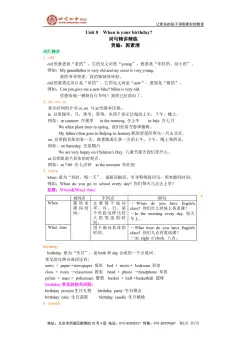
现在完成时for,since 用法
1. 表示在过去开始一直延续到现在(可能延续下去)的动作或状态时,时间状语有:for (two
years),since 1990, since (two weeks ago)和since 引导的状语从句。
如:I have been away from my hometown for thirty years.(我离开家乡有30 年了)
Uncle Wang has worked in the factory since it opened.
(自从这家工厂开张,王叔叔一直在那儿工作)
2. 口语中have got 往往表示have(有)的意思。
如:They have got thousands of books in their library.(他们图书馆有上万本书)
3. have been to 与have gone to 的区别:have gone to(“已经去了”)表示人不在这里,have been to(“去
过”)表示人在这里。
如:--Where is Mr Li? –He has gone to the UK.(李先生在哪里?他去了英国。)
 --Do you know something about Beijing? –Yes, I have been to Beijing three times.
(你知道北京的情况吗?是的,我去过那里三次。)
4. 在完成时中,一个瞬间性动词(一次性动作)不能与表示一段时间的状语连用,此时须将该瞬间动词
改为延续性动词或状态动词。具体变化见下表:
瞬间性动词的完成时
延续性动词或状态动词的完成时
have
(already)
gone to…
have
been in / at …
for (two years)
has

come to…
has
been here
since (1990)
(had)

left…
(had)
been away from…


arrived…

been in…

2


died

been dead


begun

been on


ended

been over


bought...

had…


borrowed…

kept…


joined…

been in …

或者使用下面这个句型:
It  is / has been  + (多久)+ since + 主语(人)+谓语(过去时)+……+过去时间状语
[注意] 在其它的时态中也存在类似问题,记住,关键是:瞬间动词不能和表达一段时间的状语连用。
如:How long may I keep the book?
(这本书我能借多久?)(句子中keep 取代了borrow)
1. They have been friends

    over ten years.
A.
 since
B.
 in
C.
 for
D.
 with
解析:现在完成时中和一段时间连用的介词为for,故选C。
 2. --- How long have you

    the bike?
--- For three years.
A.
 borrowed
B.
 lent
C.
 bought
D.
 had
 解析:在现在完成时中,和for,since 连用的谓语应该是延续性动词而不是为点动词,故选D。
3. He has lived here

    he was six years old.
A.
 since
B.
 for
C.
 when
D.
 from
解析:引导现在完成时的时间状语时,for+一段时间,since+时间点或句子,故选A。
 4. Rose came to Beijing in 2002. She

    here for eight years.
A.
 was living
B.
 live
C.
 will live
D.
 has lived
解析:因为是for 引导一段时间,同时根据题意可知此题为一般现在时,故选D。
 5. ---

    did your brother leave home?
--- He

    for nearly half an hour.
A.
 When; has left
B.
 When; has been away
C.
 How long; has left
D.
 How long; has been away
解析:在问句中因为leave 是点动词,因此是问你弟弟什么时候离开家,故用when,第二个句子因
为是和for 引导的一段时间,故为现在完成时,同时谓语应该为延续性动词,故选B。
3
基础演练
一、单项选择(共10 小题;共10.0 分)
 1. --- We've lived here

    2001.
--- So you've lived here

    about five years.
A.
 since; for
B.
 for; since
C.
 for; for
D.
 since; since
 2. Miss Gao has taught us English

    two years. I have been here


two years ago.
A.
 since; for
B.
 since; since
C.
 for; since
D.
 for; for
 3. Joe, my close friend, moved to Beijing years ago, and I

    him since then.
A.
 don't see
B.
 didn't see
C.
 haven't seen
D.
 won't see
 4. The train

    here for ten minutes already.
A.
 has been
B.
 has come
C.
 has stopped
D.
 has gone
 5. The Smiths came to Shanghai in 2008. They

    there for three years since then.
A.
 live
B.
 lived
C.
 have lived
D.
 will live
 6. I

    my hometown for a long time. I really miss it!
A.
 left
B.
 went away from
C.
 have left
D.
 have been away from
 7. She

    this book for nearly three weeks.
A.
 has borrowed
B.
 has lent
C.
 has bought
D.
 has kept
 8. --- How is your grandfather?
--- Oh, he

    for half a year.
--- I am sorry to hear that.
A.
 has died
B.
 died
C.
 has been dead
D.
 dies
 9. Sam

    Chinese since he came to China. He speaks Chinese well now.
A.
 learns
B.
 learned
C.
 has learned
D.
 will learn
10. Hurry up! The play

    for ten minutes.
A.
 has begun
B.
 had begun
C.
 has been on
D.
 began
二、翻译(根据中文提示完成句子)(共5 小题;共5.0 分)
11. --- 你做了多长时间的作业了?
--- 两个小时了。
4
---How long

    you

    your homework?
---

    two hours.
12. 詹姆斯自从2008 年就在北京做外教。
James


    a foreign teacher in Beijing

    2008.
13. 这本书你已经借了一个星期了。请尽快还回来。
You


    this book for a week. Please give it back as soon as possible.
14. 从2000 年开始,他就离开了家乡。
He


    away from his hometown

   2000.
15. 他奶奶生病了, 已经住院一个月了。
His grandmother


    in hospital for a month .
答案
一、单项选择
 1. A
 2. C
 3. C
 4. A
 5. C
 6. D
 7. D
 8. C
 9. C
10. C
二、翻译(根据中文提示完成句子)
11. have ; done ; For
12. has been, since
13. have kept
14. has been;since
15. has been ill


巩固提高
根据汉语意思翻译句子(每空一词)
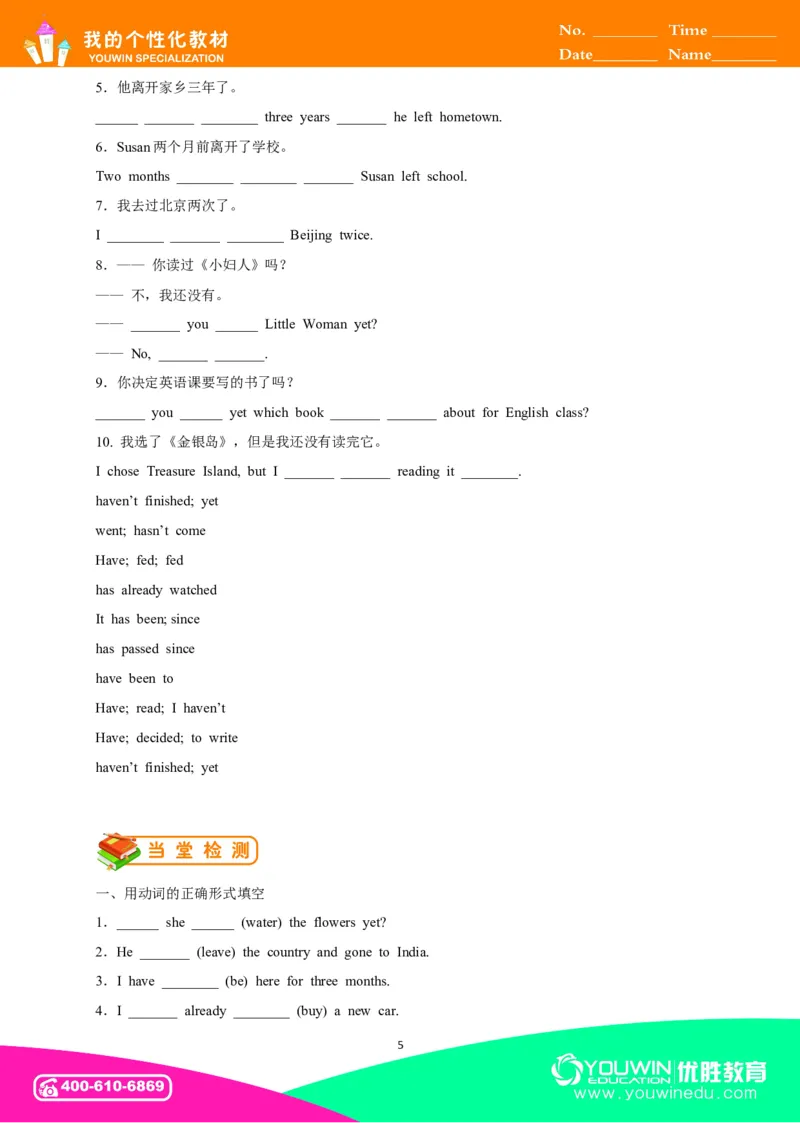
1. 我还没有完成作业。
I _______ _______ my homework _______.
2. 上周我妈妈去美国了,到现在还没有回来。
My mother ________ to America last week, and she ______ _______ back yet.
3.—— 你喂小狗了吗?
—— 喂了。我刚刚喂了它。
—— _______ you _______ the little dog?
—— Yes, I ________ it just now.
4.他已经看了两个小时的电视了。
He _____ _______ ________ TV for two hours.
5
5.他离开家乡三年了。
______ _______ ________ three years _______ he left hometown.
6.Susan 两个月前离开了学校。
Two months ________ ________ _______ Susan left school.
7.我去过北京两次了。
I ________ _______ ________ Beijing twice.
8.—— 你读过《小妇人》吗?
—— 不,我还没有。
—— _______ you ______ Little Woman yet?
—— No, _______ _______.
9.你决定英语课要写的书了吗?
_______ you ______ yet which book _______ _______ about for English class?
10. 我选了《金银岛》,但是我还没有读完它。
I chose Treasure Island, but I _______ _______ reading it ________.
haven’t finished; yet
went; hasn’t come
Have; fed; fed
has already watched
It has been; since
has passed since
have been to
Have; read; I haven’t
Have; decided; to write
haven’t finished; yet
一、用动词的正确形式填空
1.______ she ______ (water) the flowers yet?
2.He _______ (leave) the country and gone to India.
3.I have ________ (be) here for three months.
4.I _______ already ________ (buy) a new car.
6
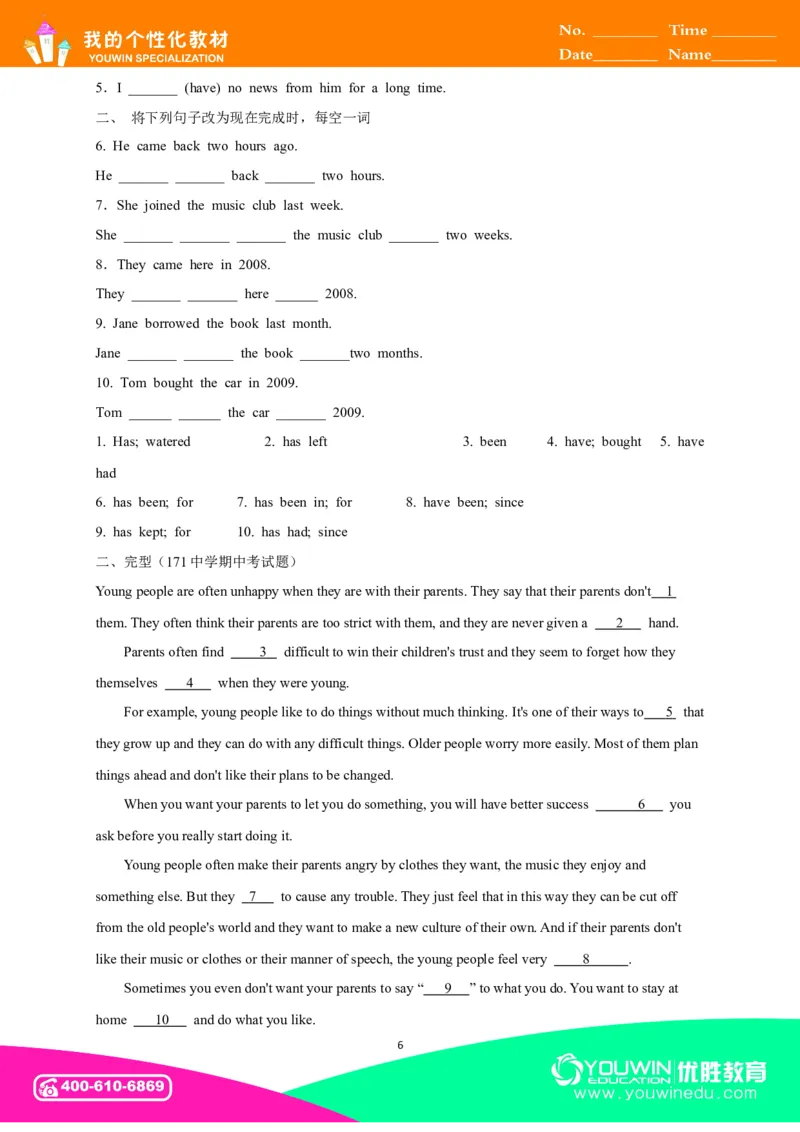
5.I _______ (have) no news from him for a long time.
二、 将下列句子改为现在完成时,每空一词
6. He came back two hours ago.
He _______ _______ back _______ two hours.
7.She joined the music club last week.
She _______ _______ _______ the music club _______ two weeks.
8.They came here in 2008.
They _______ _______ here ______ 2008.
9. Jane borrowed the book last month.
Jane _______ _______ the book _______two months.
10. Tom bought the car in 2009.
Tom ______ ______ the car _______ 2009.
1. Has; watered
2. has left
3. been
4. have; bought  5. have
had
6. has been; for
7. has been in; for       8. have been; since
9. has kept; for      10. has had; since
二、完型(171 中学期中考试题)
Young people are often unhappy when they are with their parents. They say that their parents don't    1
them. They often think their parents are too strict with them, and they are never given a

 2         hand.
    Parents often find

 3       difficult to win their children's trust and they seem to forget how they
themselves

 4         when they were young.
    For example, young people like to do things without much thinking. It's one of their ways to

 5     that
they grow up and they can do with any difficult things. Older people worry more easily. Most of them plan
things ahead and don't like their plans to be changed.
    When you want your parents to let you do something, you will have better success

 6         you
ask before you really start doing it.
    Young people often make their parents angry by clothes they want, the music they enjoy and
something else. But they   7         to cause any trouble. They just feel that in this way they can be cut off
from the old people's world and they want to make a new culture of their own. And if their parents don't
like their music or clothes or their manner of speech, the young people feel very

 8

   .
    Sometimes you even don't want your parents to say “

 9        ” to what you do. You want to stay at
home

 10
         and do what you like.
7
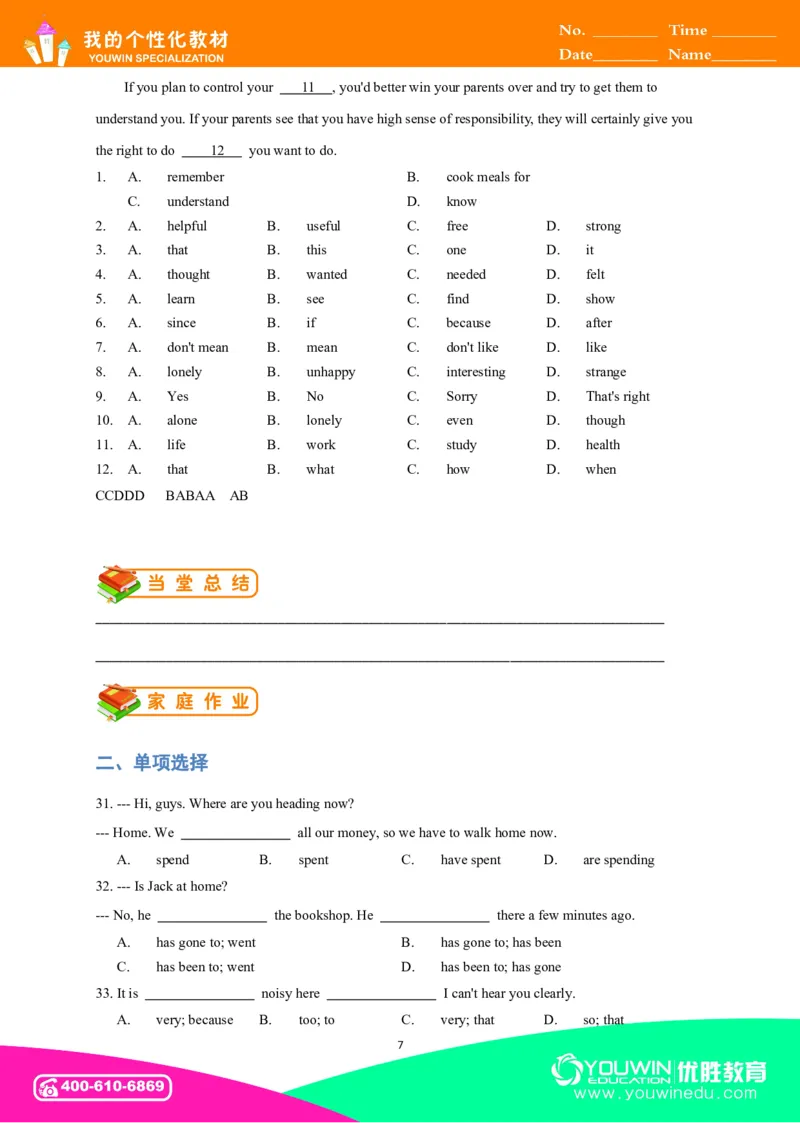
    If you plan to control your

 11
        , you'd better win your parents over and try to get them to
understand you. If your parents see that you have high sense of responsibility, they will certainly give you
the right to do

 12
         you want to do.
1.
A.
 remember
B.
 cook meals for
C.
 understand
D.
 know
2.
A.
 helpful
B.
 useful
C.
 free
D.
 strong
3.
A.
 that
B.
 this
C.
 one
D.
 it
4.
A.
 thought
B.
 wanted
C.
 needed
D.
 felt
5.
A.
 learn
B.
 see
C.
 find
D.
 show
6.
A.
 since
B.
 if
C.
 because
D.
 after
7.
A.
 don't mean
B.
 mean
C.
 don't like
D.
 like
8.
A.
 lonely
B.
 unhappy
C.
 interesting
D.
 strange
9.
A.
 Yes
B.
 No
C.
 Sorry
D.
 That's right
10.
A.
 alone
B.
 lonely
C.
 even
D.
 though
11.
A.
 life
B.
 work
C.
 study
D.
 health
12.
A.
 that
B.
 what
C.
 how
D.
 when
CCDDD   BABAA  AB
_________________________________________________________________________________
_________________________________________________________________________________
二、单项选择
31. --- Hi, guys. Where are you heading now?
--- Home. We

    all our money, so we have to walk home now.
A.
 spend
B.
 spent
C.
 have spent
D.
 are spending
32. --- Is Jack at home?
--- No, he

    the bookshop. He

    there a few minutes ago.
A.
 has gone to; went
B.
 has gone to; has been
C.
 has been to; went
D.
 has been to; has gone
33. It is

    noisy here

    I can't hear you clearly.
A.
 very; because
B.
 too; to
C.
 very; that
D.
 so; that
8
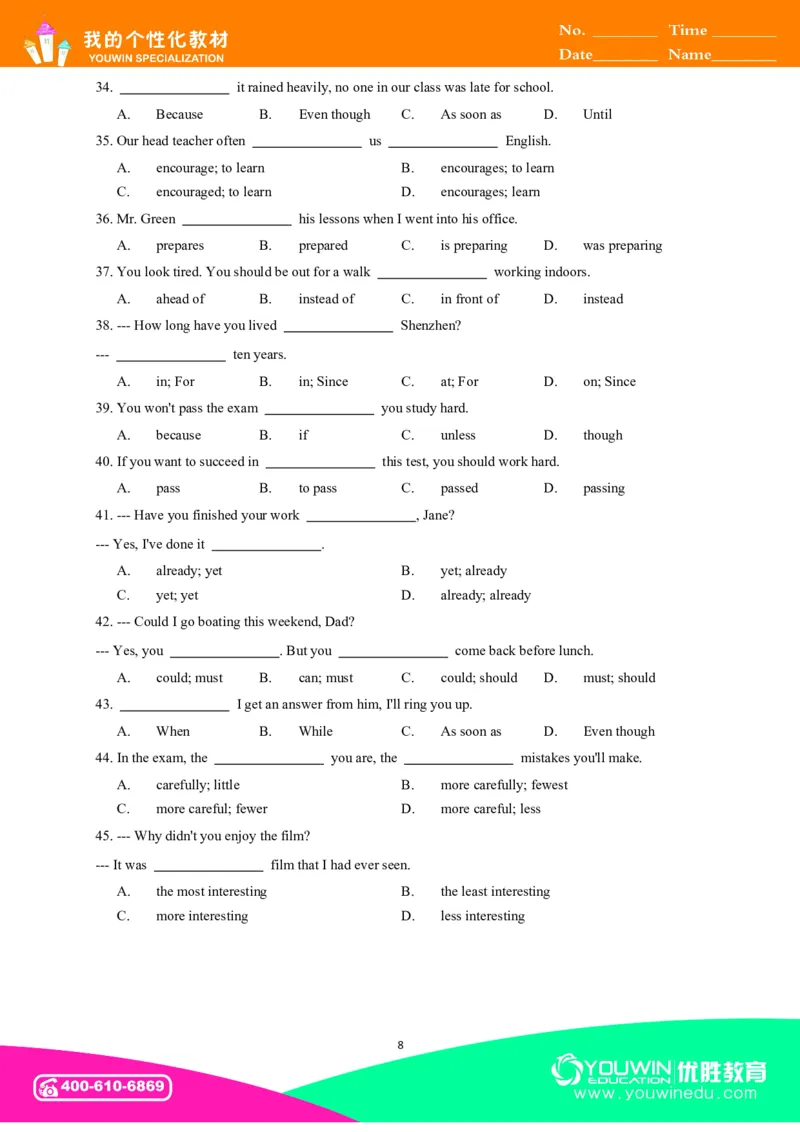
34.

    it rained heavily, no one in our class was late for school.
A.
 Because
B.
 Even though
C.
 As soon as
D.
 Until
35. Our head teacher often

    us

    English.
A.
 encourage; to learn
B.
 encourages; to learn
C.
 encouraged; to learn
D.
 encourages; learn
36. Mr. Green

    his lessons when I went into his office.
A.
 prepares
B.
 prepared
C.
 is preparing
D.
 was preparing
37. You look tired. You should be out for a walk

    working indoors.
A.
 ahead of
B.
 instead of
C.
 in front of
D.
 instead
38. --- How long have you lived

    Shenzhen?
---

    ten years.
A.
 in; For
B.
 in; Since
C.
 at; For
D.
 on; Since
39. You won't pass the exam

    you study hard.
A.
 because
B.
 if
C.
 unless
D.
 though
40. If you want to succeed in

    this test, you should work hard.
A.
 pass
B.
 to pass
C.
 passed
D.
 passing
41. --- Have you finished your work

   , Jane?
--- Yes, I've done it

   .
A.
 already; yet
B.
 yet; already
C.
 yet; yet
D.
 already; already
42. --- Could I go boating this weekend, Dad?
--- Yes, you

   . But you

    come back before lunch.
A.
 could; must
B.
 can; must
C.
 could; should
D.
 must; should
43.

    I get an answer from him, I'll ring you up.
A.
 When
B.
 While
C.
 As soon as
D.
 Even though
44. In the exam, the

    you are, the

    mistakes you'll make.
A.
 carefully; little
B.
 more carefully; fewest
C.
 more careful; fewer
D.
 more careful; less
45. --- Why didn't you enjoy the film?
--- It was

    film that I had ever seen.
A.
 the most interesting
B.
 the least interesting
C.
 more interesting
D.
 less interesting
9
三、完形填空
    Mobile phones are becoming more and more popular not only with grown-ups but also         46
students. Meanwhile, they also         47

    a problem for middle schools in the past few years.
Some children have got mobile phones as Christmas or birthday gifts, and more will         48

want them.
    Many like SMS(Short Message Service) because it is easy and         49

   . Some parents
felt happy because they could get in touch         50

    their children. Some teachers said mobile
phone use was a distraction(分心的事) to students during school hours and it also gave them much

51

    in their classrooms. Sometimes students might use phone messages to cheat(作弊) during
exams. A new study found that some teenagers who send messages in class even hurt their fingers because
they can't         52

    using SMS.
    Many teachers suggested that students should not have phones at school,         53

    if
there was a good reason, they could         54

    their phones at school office. Many people
think they understand         55

    parents would want their children to have them, but they
agree schools should let the students know when they can use their mobile phones.
46.
A.
 with
B.
 of
C.
 for
D.
 in
47.
A.
 became
B.
 had become
C.
 have become
D.
 becomes
48.
A.
 still
B.
 yet
C.
 already
D.
 just
49.
A.
 important
B.
 quick
C.
 boring
D.
 relaxing
50.
A.
 against
B.
 on
C.
 with
D.
 to
51.
A.
 business
B.
 trouble
C.
 information
D.
 problem
52.
A.
 stop
B.
 keep
C.
 continue
D.
 decide
53.
A.
 and
B.
 but
C.
 though
D.
 however
54.
A.
 miss
B.
 leave
C.
 lie
D.
 take
55.
A.
 whether
B.
 because
C.
 why
D.
 when
四、阅读理解
A
    Lots of people make it as their aim to get to the top of Mount Everest. Mark is one of them. The
difference between Mark and other climbers is that he lost both his legs when climbing New Zealand's
highest mountain, Mount Cook. He was caught in a big ice hole and he had to have his legs cut below the
10
knees after he was saved. But that couldn't make Mark lose heart, who has become the first person with
man-made legs to reach the top of Mount Everest.
    From the top of the world's highest mountain, Mark called his wife to say he made it. His wife, Anne
got the phone when she was sleeping. She couldn't hear him clearly on the phone. She was unable to say
when he reached the top but thought it was around midday. She also said his "legs" didn't work well
sometimes, so her husband was carrying a spare leg and repair tools.
    Mark used to be a mountain guide before his accident. He said it was not important that no one like
him had ever reached the 8850-meter mountain.
    "I'm not doing this to be the first. I have been climbing most of my life and I just feel Mount Everest is
really a great aim. I want to send a message that I can do anything better."
56. What was the difference between Mark and other climbers?
A.
 He went mountain-climbing with his wife.
B.
 He climbed mountains with man-made legs.
C.
 He was the first to climb Mount Everest.
D.
 He was the best guide of the world.
57. Mark's wife thought it was

    on Mount Everest when Mark reached its top.
A.
 noon
B.
 morning
C.
 midnight
D.
 evening
58. Which of the following is the correct order in Mark's story?
a. Losing both of his legs.
b. Working as a mountain guide.
c. Falling into an ice hole on Mount Cook.
d. Reaching the top of Mount Everest.
A.
 c a b d
B.
 c a d b
C.
 b c a d
D.
 b a c d
59. Mark's story makes us believe that he is a

    man.
A.
 polite
B.
 brave
C.
 kind
D.
 clever
60. Mark told us that he cared much about

   .
A.
 being the first
B.
 climbing higher
C.
 keeping healthy
D.
 being a guide
B
     Just like any relationship, best friendships depend on trust, promise, respect and interests. When any
of these elements(要素) is missing, the friendship will be hard to go on. If the trust is totally broken, you
may not be able to forgive him/her. Sometimes a friendship ends because either you or your friend gets
tired of putting the heart into it. This can happen when one of you finds a new friend or even a new hobby
11
that takes up much time. Or, perhaps you find the relationship is always going in an unhealthy way and you
want some distance. Other times, you simply change and want to leave each other. Sure, it seems sad at the
time, but it's completely normal. Not all friendships are meant to last forever. So, what should you do if
something like this happens to you? Read on for some friendly advice.
     Whatever the reason you're breaking up with your best friend, always remember that he/she was once
super important to you. Take the time to sit down privately and tell him/her what's going on and why. Don't
send him/her an unpleasant e-mail or just start ignoring(不理睬) him/her. In fact, maybe he/she has known
there's a problem and would be willing to have a heart-to-heart chat. If you're not sure about wanting an end
forever, you could suggest you two take a break from each other. If, after a while, you realize why you
became the best friends in the beginning, you can try getting back to your former behaviors. Whatever you
do, be honest about your feelings while having respect for his/hers. And if you both agree the BFF thing is
over, make sure not to be enemies.
61. What is NOT the usual cause of ending a friendship?
A.
 Getting tired of putting your heart into each other.
B.
 Finding a new hobby that takes up much time.
C.
 Realizing the relationship going in an unhealthy way.
D.
 Living too far away from each other.
62. The underlined letters BFF probably means

   .
A.
 永远的朋友
B.
 永久的隔阂
C.
 终结的友谊
D.
 暂时的误解
63. What can be the best title for this passage?
A.
 Four Basic Elements of Friendship
B.
 Friendly Advice on Reading
C.
 What to Do with Friendship in Trouble?
D.
 When to Be Friends or Enemies?
64. What should you do when breaking up with your best friends?
    1 Remember his or her once being important to you.
    2 Try to have a heart-to-heart chat with him or her.
    3 Be honest and respectful to each other.
    4 Send an unpleasant e-mail and ignore him or her.
    5 Suggest not getting along with each other for a while.
A.
 1234
B.
 2345
C.
 1345
D.
 1235
12
C
    Growing kids need sleep, as do people of all ages. Indeed, research shows that health and safety both
suffer when we try to get by with too little shuteye. So it's fortunate that our bodies do such a good job of
warning us when it's time to hit the sack.
    Like humans, other animals also take time out to rest. You've probably seen a lion dozing at the zoo,
or maybe watched our dog snooze away lying in its bed. In fact, sleep is a necessity for every animal that's
ever been studied. How long animals sleep, though, varies widely. Elephants and giraffes sleep only about
2 to 4 hours a day, while bats may nod off for up to 20 hours. Ducks sleep together, and the birds on the
edge of the group sleep with the outside eye open and half of their brain awake—probably to keep
watching while the other half of their brain snoozes. Some birds may even sleep while flying. The fact that
all animals make time for sleeping, even under very dangerous situations, suggests that sleep is very
important. And indeed, some facts suggests that sleep is important for learning and forming permanent
memories.
    But sleep may also be primarily a way for animals to save energy and stay out of harm. This may help
explain why meat-eating creatures sleep more than herbivores, which are animals that live only on plants.
Herbivores, like cows and zebras, need to spend more time searching for and grazing on food than meat
eaters do, such as lions and other big cats. So a big cat might be better off sleeping for a while after it eats,
rather than prowling around and risking injury.
    But that's just a guess. Scientists need to study other animals as well before they can fully understand
the benefits(好处) of sleep and know which benefits are most important for a particular species(物种).
    One thing is certain: enough sleep is important to health and learning. So give in when a strong wish
to sleep hits, and catch plenty of ZZZs.
65. The underlined phrase "to hit the sack" means

   .
A.
 to eat something
B.
 to drink something
C.
 to get up
D.
 to go to sleep
66. From the last paragraph, we can infer

   .
A.
 enough sleep may improve your learning in class
B.
 if you feel sleepy in class, you can fall asleep immediately
C.
 you are easy to give in if you have plenty of sleep
D.
 if you have a strong wish to sleep, you are perhaps ill
67. Which of the following is Not True according to the passage?
A.
 Different animals sleep in different ways.
13
B.
 Sleep may save energy and stay out of harm.
C.
 Scientists have studied the benefits about sleep.
D.
 Animals also need to have time to rest.
68. The main idea of the passage is about

   .
A.
 where animals find a place to sleep
B.
 how animals sleep in the open air
C.
 why animals need sleep
D.
 when animals feel sleepy
五、短文7 选5
    Jim was a bookseller(书商). He didn't like paying(付钱) for anything. One day, a big box of books fell
on his foot. "Go to see the doctor." said his wife. "No." he said.
    69.

    then I'll ask him about my foot. If I go to see him, I'll have to pay him."
    The next day, 70.

   . When Jim was getting them ready, he told the doctor about his
bad foot. The doctor checked it over. "Yes." said the doctor, 71.

   .
    "How much are the books?" said the doctor.
    "$2." answered Jim.
    "Good." said the doctor. 72.

   .
    "Why ?" asked Jim in surprise.
    "I told you about your foot." said the doctor. 73.

   . Goodbye.
A.
 you must put that foot in hot water every night
B.
 I want $2 for that
C.
 I shall not pay you anything
D.
 I'll wait until the doctor comes to the shop next time
E.
 the doctor came to the shop and bought some books
六、阅读与表达(问答式)
     Today, roller skating is easy and fun. But a long time ago, it wasn't easy at all. Before 1750, the idea
of skating didn't exist. That changed because of a man named Joseph Merlin. Merlin's work was making
musical instruments. In his spare time he liked to play the violin. Joseph Merlin was a man of ideas and
dreams. People called him a dreamer.
     One day Merlin received an invitation to attend a fancy dress ball (化妆舞会). He was very pleased
and a little excited. As the day of the party came near, Merlin began to think how to make a grand entrance
at the party. He had an idea. He thought he would get a lot of attention if he could skate into the room.
14
     Merlin tried different ways to make himself roll. Finally, he decided to put two wheels under each
shoe. These were the first roller skates. Merlin was very proud of his invention and dreamed of arriving at
the party on wheels while playing the violin.
     On the night of the party Merlin rolled into the room playing his violin. Everyone was astonished to
see him. There was just one problem. Merlin had no ways to stop his roller skates. He rolled on and on.
Suddenly, he ran into a huge mirror that was hanging on the wall. Down fell the mirror, breaking into
pieces. Nobody forgot Merlin's grand entrance for a long time!
 根据短文内容,完成下列小题。
74. What was Joseph Merlin?

75. Why did people think Merlin was a dreamer?

76. What did Merlin want to do when he put wheels under his shoes?

77. Did Merlin make a grand entrance at the party?

78. What is the passage mainly about?

七、翻译(根据中文提示完成句子)
79. 这件红色的衬衫是她的吗?


    this red blouse


    her?
80. 一方面这所房子太小,另一方面它离学校太远。
On the one hand the house is too small.


, it is too far from the school.
81. 当他看到地上的垃圾时,他立刻把它捡起来。
When he saw the rubbish on the ground, he


at once.
82. 彼得的爸爸过去常常开车去上班,但现在走着去上班。
Peter's dad


    work by car, but now he walks to work.
83. 玛丽和同学们相处得很好。
Mary


    her classmates.
15
八、作文
84.     假设你是Bob,你现在在中国旅游,你已经去过北京,你写信给David,告诉他你在北京
玩的很好,你看了京剧,吃了烤鸭,还照了很多照片,但是遗憾的是没有去爬长城,你希望有机会
可以再去,并且询问David 的假期情况。
提示:用现在完成时来写,80 词左右。开头和结尾已给出,不计入总词数。
Dear David,
    I am having a wonderful time in China. I've done so many things!

______________________________________________________________________________________
_____________________________________________________
Bye  now,
Bob.
二、单项选择
31. C
32. A
33. D
34. B
35. B
36. D
37. B
38. A
39. C
40. D
41. B
42. B
43. C
44. C
45. B
三、完形填空
46. A
47. C
48. A
49. B
50. C
51. B
52. A
53. B
54. B
55. C
四、阅读理解
56. B
57. A
58. C
59. B
60. B
61. D
62. A
63. C
64. D
65. D
66. A
67. C
68. C
五、短文7 选5
69. D
70. E
71. A
72. C
73. B
六、阅读与表达(问答式)
74. He was a worker.
75. Because he was a man of ideas and dreams.
76. He would get a lot of attention.
77. Yes,he did.
78. How the roller skating began/invented.
七、翻译(根据中文提示完成句子)
79. Does, belong to
80. On the other hand
81. picked it up
82. used to
83. gets on/along well with
八、作文
16
84. Dear David,
    I am having a wonderful time in China. I've done so many things!
    I've been to Beijing. I've enjoyed every minute of every day. And I've learnt a lot from the holiday in
China. China is very beautiful. I like China. I have seen Beijing Opera and eaten Beijing Duck. It's
delicious! I've taken photos of stone animals. They're grand!
    There's only one thing I haven't done yet: I've never climbed the Great Wall! What a pity! But I think I
will come to China again, and when I come to China , I will climb the Great Wall!
    Where did you go on holiday? Tell me about your journey.
Bye now,
BOb
课程顾问签字:                        教学主管签字: