1
Unit 1 词汇篇
__________________________________________________________________________________
__________________________________________________________________________________
学生通过本讲学习,能够掌握本单元的重点词汇句型,并在综合能力上有一定的拓展。
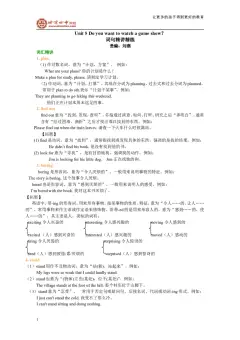
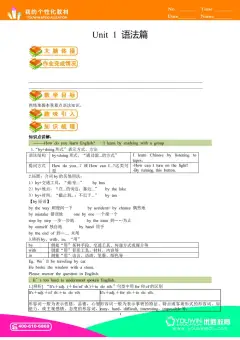
1.复合不定代词: somebody 某人 someone 某人  anybody 任何人  anyone 任何人nobody 没人  no
one 没人 ererybody 每个人  ereryone 每个人
something 某物 anything 任何事物 nothing 没有什么    ererything 一切事物
①有body 和one 的只用来指人
②有thing 的只用来指事物
③复合不定代词做主语时,谓语动词用单数形式
④ somebody, someone,something 用于肯定句,anything,anyone,anybody 用于否定句,疑问句
⑤表示请求、邀请、提建议等带有委婉的语气的疑问句,和希望得到对方肯定答复的疑问句,以及
表示反问的问句中,也用somebody, someone,something
⑥ anything 表示“任何事物,无论何事(物)”, anyone,anybody 表示“无论谁,任何人”等意
义时,他们也可以用于肯定句中。
2. something、 anything、nothing、everything+形容词,例如:something special
3.quite 和very 的区别
①  quite+a/an, a/an+very
②quite+ another,  a few , a little ,不能用very
4.few,a few, little, a little 的区别
few,可数名词复数,表否定
2
a few,可数名词复数,表肯定
little,不可数名词,表否定
a little,不可数名词,表肯定
5.what about=how about 做…怎么样 后面加动词ing 形式
6.seem 和look 的区别
Seem 暗示有一定根据的判断,look 指由视觉而得出的印象
7.bored 形容人无聊或是对。。。感到无聊  boring 形容物无聊或者是使。。。感到无聊
8.arrive at+小地方   arrive in+大地方
9.dicide to do sth=make up one′s mind to do sth 决定做某事
10.feel like 感觉像,后面接动词ing 形式
11.over 超过=more than
12.enough 足够的,enough+名词   副词+enough
13.because 和because of 的区别
Because 后面接的是一个句子,because of 后面接单词或者短语
14.below 在…下面,反义词above
15.forget to do sth 忘记去做某事(这件事还没有做)
forget  doing  sth 忘记做过某事(这件事做过了,却忘记了)
16.find out 找到,发现,强调找的结果;look for 寻找,强调找的过程
17.so…that…如此…以至于=too … to…=enough …to
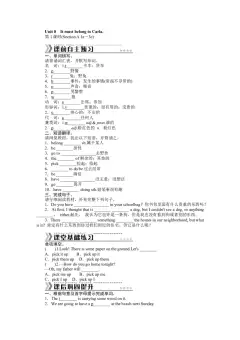
1. Why not ask

    to help you?
A.
 everyone
B.
 anyone
C.
 someone
D.
 no one
2. --- Does Tom go to school?
--- Yes, he is

    to go to school.
A.
 enough old
B.
 young enough
C.
 old enough
3. --- What are you doing now?
--- I'm watching a football match. It's really

   (excite).
4. She was

    angry

    she walked out and closed the door heavily.
A.
 so; that
B.
 too; and
C.
 very; that
D.
 such; that
5. We didn't go camping last week

   (because/because of) the rain.
3
基础演练
一、单词拼写或根据中文提示拼写单词
1.

   (大多数) of my classmates come to school by bicycles.
2. There is

   (没有什么) in the room. It's empty.
3. It's a good habit to keep a

   (日记) every day.
4. I felt

   (无聊的) when I stayed at home.
5. My sister

   (似乎) to be unhappy today.
6. I like keeping a d

    every day.
7. She bought s

    special in the store.
8. You should look after y

   .
9. I want to go s

    warm in winter.
10. We had fun there. No one s

    to be bored.
二、单项选择
1. We arrived

    Shanghai last night.
A.
 on
B.
 to
C.
 at
D.
 in
2. The two boys decided

    fishing.
A.
 go
B.
 to go
C.
 going
D.
 went
3. There

    a student and four teachers in the office.
A.
 have
B.
 has
C.
 is
D.
 are
4. Betty stayed at home and

    for the test last weekend.
A.
 study
B.
 studyed
C.
 studied
D.
 studying
5. We have worked for three hours. Now let's stop

    a rest.
A.
 had
B.
 have
C.
 to have
D.
 having
6. Our teachers told us

    homework carefully.
A.
 to do
B.
 do
C.
 does
D.
 doing
7. I enjoy

    to music at home.
A.
 listen
B.
 to listen
C.
 listening
D.
 listened
8. I had nothing

    to do yesterday.
A.
 many
B.
 much
C.
 little
D.
 few
9. Did you go out with

   ?
A.
 someone
B.
 something
C.
 anyone
D.
 anything
4
10. Mr. Black seemed

   .
A.
 to happy
B.
 happily
C.
 be happy
D.
 to be happy
11. --- Where are my books?
--- They're in your

    room.
A.
 parents
B.
 parents's
C.
 parents'
D.
 parent
12. Do you have

    to tell us?
A.
 something important
B.
 important something
C.
 anything important
D.
 important anything
巩固提高
1. 假期里我和父母去了南京。
I

    to Nanjing

    my parents


.
2. 昨天吉姆大部分时间待在家里上网。
Jim

    at home


    the time to surf the Internet
yesterday.
3. 旅游时你买了什么特别的东西吗?
Did you


    on your trip?
4. 那是我第一次去香港。


    my first time to go to Hong Kong.
5. 上周末你去哪里购物了?
Where

    you

    shopping last weekend?
6. Where did you


    (去度假)?
7. We


    (去海滩) last
Saturday.
8. My brother has


    (相当多) friends.
9. I spent


    (大多数时间)
collecting stamps.
10. I want to go


    (有趣的地方).
5
一、单项选择(共15 小题;共15.0 分)
 1. --- Morning, class. Is

    here?
--- No, sir. Tom is absent.
A.
 anybody
B.
 everybody
C.
 nobody
D.
 somebody
 2. --- Have you ever been to Jinan?
--- Yes. I

    there with my mother last year.
A.
 went
B.
 have been
C.
 have gone
D.
 will go
 3. My computer doesn't work now, there must be

    with it.
A.
 wrong something
B.
 something wrong
C.
 wrong anything
D.
 anything wrong
 4. --- Who teaches

    English?
--- Nobody, I teach

   .
A.
 your; mine
B.
 your; my
C.
 you; myself
D.
 you; me
 5. --- Who cleaned the room?
--- John

   .
A.
 cleaned
B.
 does
C.
 is
D.
 did
 6. They decide

    to the mountains this afternoon.
A.
 go
B.
 to go
C.
 went
D.
 going
 7. I helped my mother

    the room yesterday.
A.
 cleans
B.
 cleaning
C.
 cleaned
D.
 clean
 8. --- How do you feel about the CBA basketball match last night?
--- It was

   , I really enjoyed it.
A.
 boring
B.
 wonderful
C.
 strange
D.
 terrible
 9. --- Simon, I'm going to Beijing with my parents tomorrow.
---

   !
A.
 Have fun
B.
 Best wishes
C.
 Never mind
D.
 Cheer up
10.

    went hiking last weekend because of the bad weather.
A.
 Someone
B.
 No one
C.
 Everyone
D.
 Nothing
11. --- Where did you go

    vacation?
--- Qingdao.
A.
 in
B.
 on
C.
 at
D.
 to
12. --- Look! There is a talk show program on TV now.
--- Hmm. It

    exciting.
A.
 seems
B.
 looks like
C.
 feels
D.
 seems like
13. ---

    was their vacation?
--- It

    great.
A.
 What; was
B.
 How; was
C.
 How; is
D.
 Where; was
14. --- Is your friend Michael still in Australia?
6
--- I don't know. I have

    information about him because we haven't seen each other for
years.
A.
 a little; a few
B.
 little; a few
C.
 a few; a little
D.
 few; a little
15. --- I'm going to spend my summer holiday in Hawaii.
--- What a lucky boy!

    And don't forget to send me a postcard.
A.
 That sounds good.
B.
 Have a good time!
C.
 Good luck!
D.
 Can I go with you?
二、完形填空(共10 小题;共15.0 分)
    A man went to London for his holiday. He thought, "I know         16

    English. I think
people can understand         17

   ."
    One day he went to a restaurant. He wanted to         18

    a cup of tea and some eggs.
Soon the waiter asked, "        19

   " "A cup of tea and..." He could not remember the English
word for eggs. He looked about but         20

    was eating. Then he saw a book on the table.
There was a picture of         21

    on its cover. He         22

    the picture to the
waiter. "What's this?" "A cock(公鸡)." "And what do you call a cock's         23

   ?" "A hen."
"And what do you call a hen's         24

   ?" "Chicks." "And what do you call chicks
25

    they were born(出生)?" "Eggs."
   "Very well," said the man happily, "Give me two eggs and a cup of tea, please."
16.
A.
 a little
B.
 a few
C.
 a bit
D.
 little
17.
A.
 it
B.
 me
C.
 him
D.
 them
18.
A.
 have
B.
 drink
C.
 take
D.
 see
19.
A.
 What do you want?
B.
 Would you like a cup of tea?
C.
 Can I help you?
D.
 What's wrong with you?
20.
A.
 nobody
B.
 somebody
C.
 a man
D.
 a woman
21.
A.
 an egg
B.
 a cock
C.
 a cup
D.
 a hen
22.
A.
 gave
B.
 passed
C.
 showed
D.
 told
23.
A.
 wife
B.
 husband
C.
 friend
D.
 sister
24.
A.
 children
B.
 child
C.
 family
D.
 boys
25.
A.
 when
B.
 before
C.
 after
D.
 until
_________________________________________________________________________________
_________________________________________________________________________________
7
三、阅读理解(共10 小题;共20.0 分)
A
    There are several ways you can find out about the countries and places you wish to visit. You can talk
to friends who have traveled to the places, you can go and see a colour film about them, or you can read a
travel book.
    It seems that there are three kinds of travel books. The first are those that give a personal,
subjective(主观的) idea of travels which their writer has got himself. These books can be useful if the
writers share their traveling experiences with others. The second kind are those books which give
objective(客观的) information of things to be done and seen. If a cultured person has written such a book
about the facts of a place, then it is more useful. The third kind are those books which are called "a guide"
to some place or other. If they are good, they will describe and explain the place in detail. Like the first
kind , they can be interesting and exciting, but their main purpose is to help the reader plan his travel in the
most practical way.
    Whatever kind of travel book you choose, you must make sure that the book does not describe
everything as interesting, exciting or fantastic. You must also keep an open eyes on its date of
publication(出版) because travel is very practical matter and many things change quickly in the 21st
century. Finally, you should make sure that it's easy to find the useful information for you travel.
26. The passage was written to introduce

   .
A.
 travel maps
B.
 travel books
C.
 travel films
D.
 travel places
27. The writer of the first kind of travel books gave his ideas after he

   .
A.
 traveled
B.
 read books
C.
 a lot of experience
D.
 surfed the Internet
28. The underlined phrase "a cultured person" means a person with

   .
A.
 a good appearance
B.
 a good education
C.
 a lot of experience
D.
 a lot of money
29. The date of publication must be noticed because

   .
A.
 the prices of travel books may be different
B.
 the writers of travel books may be different
C.
 the information in travel books is always the same
D.
 the information in travel books is always changing
30. According to the passage, it is best to read

    before traveling to a place of interest.
A.
 the first kind of travel books
B.
 the second kind of travel books
C.
 the third kind of travel books
D.
 some travel articles in newspaper
B
    Beach vacations are fun—the shining sun, the relaxing waves, and the beach wind blowing through
your hair.
8
    But there is a lot more to beach vacations than just picking a beach with sand and packing up the car.
So you should plan and prepare it well.
    Beach vacations take place mostly outside on the beach, so you may not be too relaxed during January
beach vacations where it is too cold to swim or enjoy the beach.
    Certain times of the year, beach vacations are filled with people, such as during the week of college
spring break. During spring break, the beaches are full, there is too much traffic, and hotels are hard to
come by. Unless you want to join the party, avoid the weeks of college spring breaks.
    And if you want childfree beach vacations, avoid the summer months when children are out of
school.
    You will have the perfect beach vacations if you keep the time of year in mind when you are planning.
    To avoid overcrowding, look for beach vacations in uncommon areas. Popular beach vacations are
always overcrowded.
    People with small children may want to avoid popular beach vacations as well. A vacation with small
children is busy enough without the added stress of overcrowding.
    In general, inland(内陆) beaches can fit nicely. Not everyone who loves beach vacations likes inland
beaches. Hotels are usually cheaper at inland beaches, too.
    The most popular beach vacations are in California, Florida, Long Island, and North Carolina.
    Want to learn more about Beach Vacations? Then check out our Ebook and MP3!
31. Beach vacations mainly happen

   .
A.
 in the ships
B.
 in the sea
C.
 outside on the beach
D.
 in the hotels on the beach
32. The fourth paragraph mainly talks about

   .
A.
 beach vacation during college spring break
B.
 how to choose the beach vacation time
C.
 how to avoid the weeks of college spring breaks
D.
 the time of beach vacations
33. The underlined word "childfree" means

   .
A.
小孩自由自在
B.
小孩免费的
C
无小孩的
D.  小孩无忧无虑的
34. The writer thinks looking for

    can avoid overcrowding.
A.
 popular beach vacations
B.
 beach vacations in uncommon areas
C.
 E-book and MP3 about Beach Vacations
D.
 beach vacations filled with people
35. What is the best title of this passage?
A.
 Information About Beach Vacations
B.
 Perfect Vacations
C.
 My Beach Vacation
D.
 Beach Vacation Plans
四、阅读与表达(问答式)(共5 小题;共10.0 分)
9
    My pen friend, Susan, an American girl, is 14 years old. She is a nice girl with long brown hair. She is
interested in Chinese and can speak it very well.
    On weekdays, she is very busy. She lives far away from the school, so she gets up early in the
morning. After breakfast, she takes the school bus to school at 7:40 a.m. She always gets to school at 8:20
a.m. The first class begins at 8:30 a.m. At noon, she has lunch with her friends at the school dining hall.
And they only have one hour to have lunch. School is over at 3:00 p.m. Then Susan does some activities
with her classmates at school. She goes to the Swimming Club on Tuesday and Wednesday. On the other
days of the week, she goes to the Reading Club. At about 5:00 p.m., she goes back home. After supper, she
does her homework from 7:30 p.m. to 10:00 p.m. Then she has a chat with her parents. She usually goes to
bed at 10:45 p.m.
    Susan likes travelling(旅行) very much. Every summer she travels with her parents. She believes that
travelling is an important part of her life. She knows that China is a large country with lots of interesting
places, so she will come to visit China with her parents during the Christmas holiday. It's Susan's first time
to come to China. And they will stay here for two weeks. I will take them to visit our city, Beijing. I am
sure they will have a good time in China.
 根据短文内容,完成下列小题。
36. What does Susan look like?

37. How long does Susan need(需要) from home to school by school bus?

38. What does Susan do on Tuesday and Wednesday after school?

39. What does Susan like doing every summer?

40. How long will Susan stay in China?

五、单词拼写(单句首字母填空)(共3 小题;共3.0 分)
41. Bad luck. It's raining hard, but I didn't take an u

   .
42. Mr. Wang asked us to keep a d

    to practice our written English.
43. Shall I write my answer above or b

    the line?
六、单词拼写(根据中文提示拼写单词)(共2 小题;共2.0 分)
44. Be careful. The floor is

   (湿的).
45. His father is a

   (商人). He makes lots of money every year.
七、选词填空(句子选词填空)(共5 小题;共5.0 分)
                  different  wonder     I    build   you
46. When comparing the twins, you will find the

    between them.
47. No one helps me. I learned it by

   .
10
48. Children, help

    to some fish.
49. Look, those red

    are our department.
50. I wish you have a

    holiday.
八、按要求转换句型(共5 小题;共10.0 分)
51. Her vacation was great. (对划线部分提问)


    her vacation?
52. I helped my mother do housework yesterday. (改为一般疑问句)


    you

    your mother do housework yesterday?
53. They went to the beach last Sunday. (对划线部分提问)


    they

    last Sunday?
54. --- Was it sunny and hot yesterday? (作肯定回答)
---

   , it

   .
55. My father visited the museum last Sunday. (对划线部分提问)


    your father

    last Sunday?
九、对话7 选5(共5 小题;共10.0 分)
(On a narrow road) (A=Lucy B=Tom)
A: Hello, Tom.
B: Hello, Lucy. Wow, so many people are here. 56.
A: Yes, there are always so many people in Beijing on vacation. The weather here is so hot. I can't stand it.
B: Yes. But the weather in Kunming is so good.
A: 57.
B: Yes, I did. I went there on holiday.
A: 58.
B: Pretty good! Here is summer. 59.
A: Really!
B: It's hot here, but it's cool there.
A: 60.
B: That's right. You can also buy some flowers. Kunming is the city of flowers!
A.
 How was your vacation?
B.
 It's crowded.
C.
 Kunming is really a good place for vacation.
D.
 Did you go there?
E.
 What was the weather like?
F.
 But the weather is just like spring weather there.
G.
 Where did you go?
十、选词填空(短文选词填空)(共10 小题;共10.0 分)
用方框中所给词的适当形式完成短文,每词限用一次。
 friendly
 visit
 eat
 go
 spend
 shopping
 delicious
 cheap
 be
 fun
11
    I 61.

    to Beijing with my family on vacation last summer. The weather 62.

fine and the trip was pleasant. We 63.

    five days in Beijing. We 64.


Tian'anmen Square. We also went to the Great Wall and the Palace Museum. We 65.


some 66.

    food, too. And we went 67.

    as well. The things in the
stores were very 68.

   . We bought some gifts for our friends. The people were very 69.
. We had great 70.

    in Beijing.
**、作文(共1 小题;共25.0 分)
71.     今年暑假,李芳和家人去青岛游玩了。在她给英国的网友Gina 的邮件中,她向Gina 介绍
了此次游玩的情况。假设你是李芳,请你给Gina 写这封邮件。
要求:
    1. 使用一般过去时;
    2. 60 个词左右,开头和结尾已给出,不计入总词数。
Dear Gina,
    How was your vacation? Please write back to me.
______________________________________________________________________________________
______________________________________________________________________________________
_______________________________________
                                                       Yours,
                                                       Li Fang
课程顾问签字:                        教学主管签字: