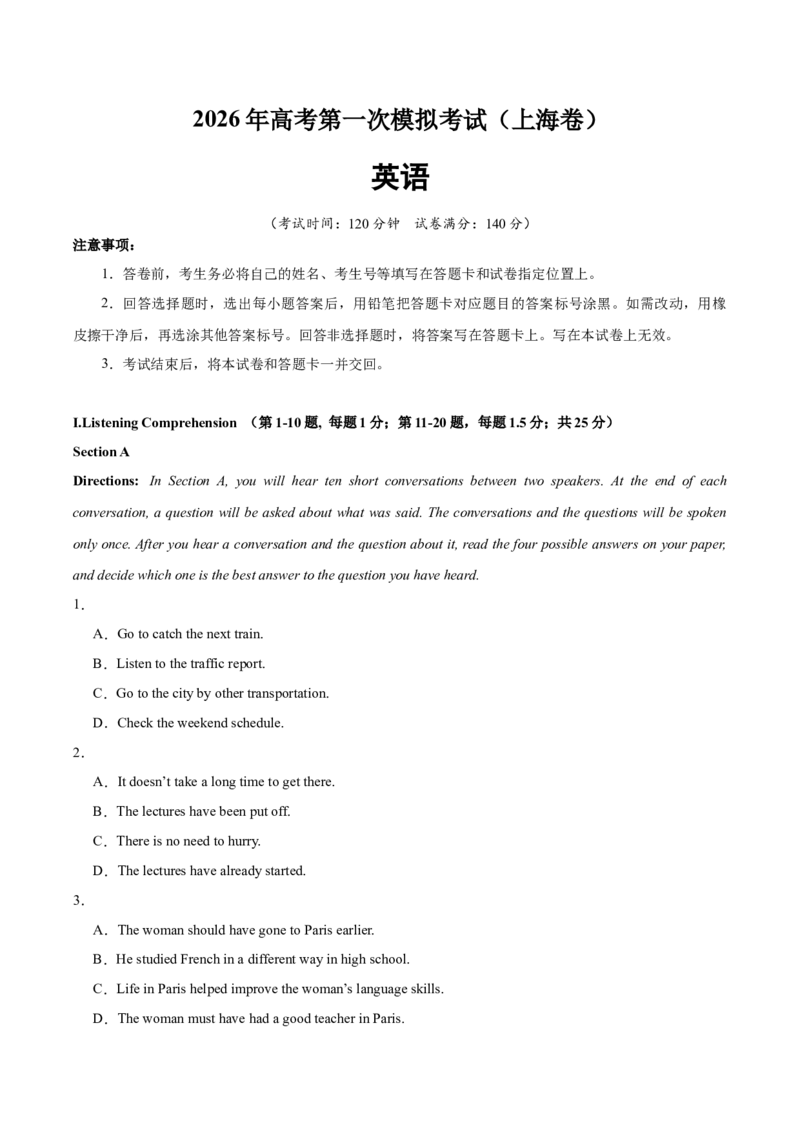
2026 年高考第一次模拟考试(上海卷)
英语
(考试时间:120 分钟  试卷满分:140 分)
注意事项:
1.答卷前,考生务必将自己的姓名、考生号等填写在答题卡和试卷指定位置上。
2.回答选择题时,选出每小题答案后,用铅笔把答题卡对应题目的答案标号涂黑。如需改动,用橡
皮擦干净后,再选涂其他答案标号。回答非选择题时,将答案写在答题卡上。写在本试卷上无效。
3.考试结束后,将本试卷和答题卡一并交回。
I.Listening Comprehension (第1-10 题, 每题1 分;第11-20 题,每题1.5 分;共25 分)
Section A
Directions: In Section A, you will hear ten short conversations between two speakers. At the end of each
conversation, a question will be asked about what was said. The conversations and the questions will be spoken
only once. After you hear a conversation and the question about it, read the four possible answers on your paper,
and decide which one is the best answer to the question you have heard.
1.
A.Go to catch the next train.
B.Listen to the traffic report.
C.Go to the city by other transportation.
D.Check the weekend schedule.
2.
A.It doesn’t take a long time to get there.
B.The lectures have been put off.
C.There is no need to hurry.
D.The lectures have already started.
3.
A.The woman should have gone to Paris earlier.
B.He studied French in a different way in high school.
C.Life in Paris helped improve the woman’s language skills.
D.The woman must have had a good teacher in Paris.
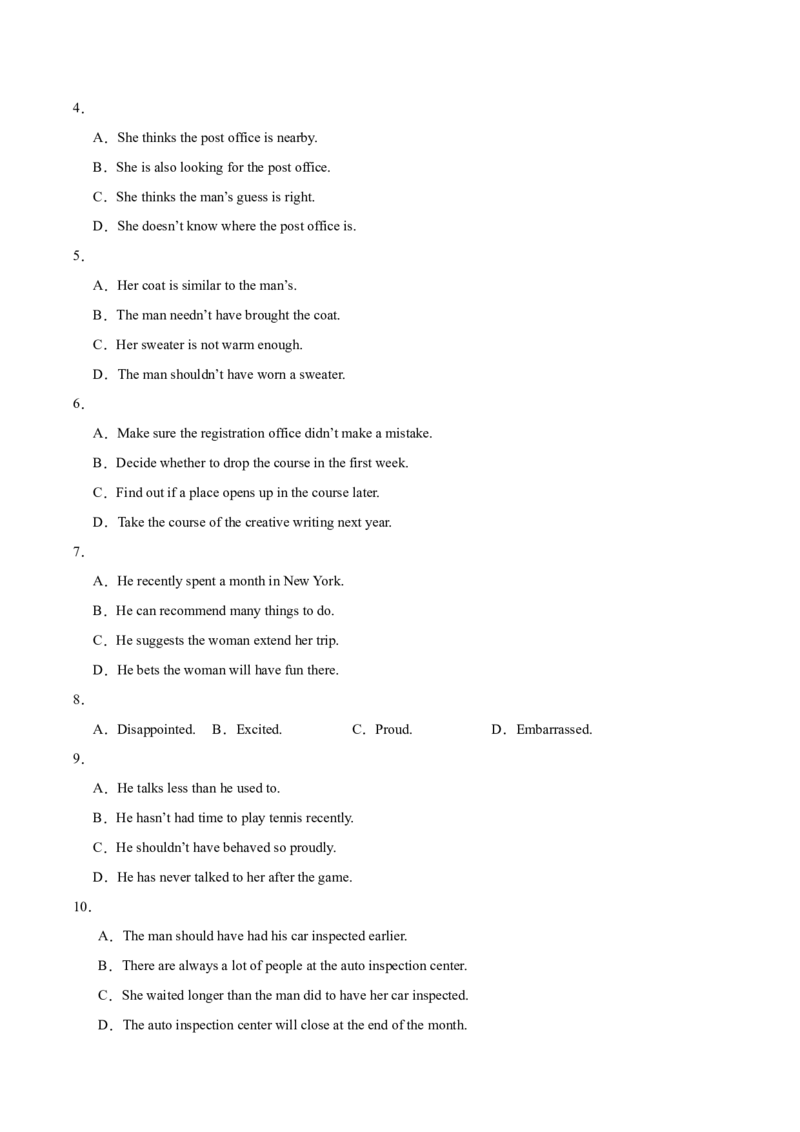
4.
A.She thinks the post office is nearby.
B.She is also looking for the post office.
C.She thinks the man’s guess is right.
D.She doesn’t know where the post office is.
5.
A.Her coat is similar to the man’s.
B.The man needn’t have brought the coat.
C.Her sweater is not warm enough.
D.The man shouldn’t have worn a sweater.
6.
A.Make sure the registration office didn’t make a mistake.
B.Decide whether to drop the course in the first week.
C.Find out if a place opens up in the course later.
D.Take the course of the creative writing next year.
7.
A.He recently spent a month in New York.
B.He can recommend many things to do.
C.He suggests the woman extend her trip.
D.He bets the woman will have fun there.
8.
A.Disappointed.
B.Excited.
C.Proud.
D.Embarrassed.
9.
A.He talks less than he used to.
B.He hasn’t had time to play tennis recently.
C.He shouldn’t have behaved so proudly.
D.He has never talked to her after the game.
10.
A.The man should have had his car inspected earlier.
B.There are always a lot of people at the auto inspection center.
C.She waited longer than the man did to have her car inspected.
D.The auto inspection center will close at the end of the month.
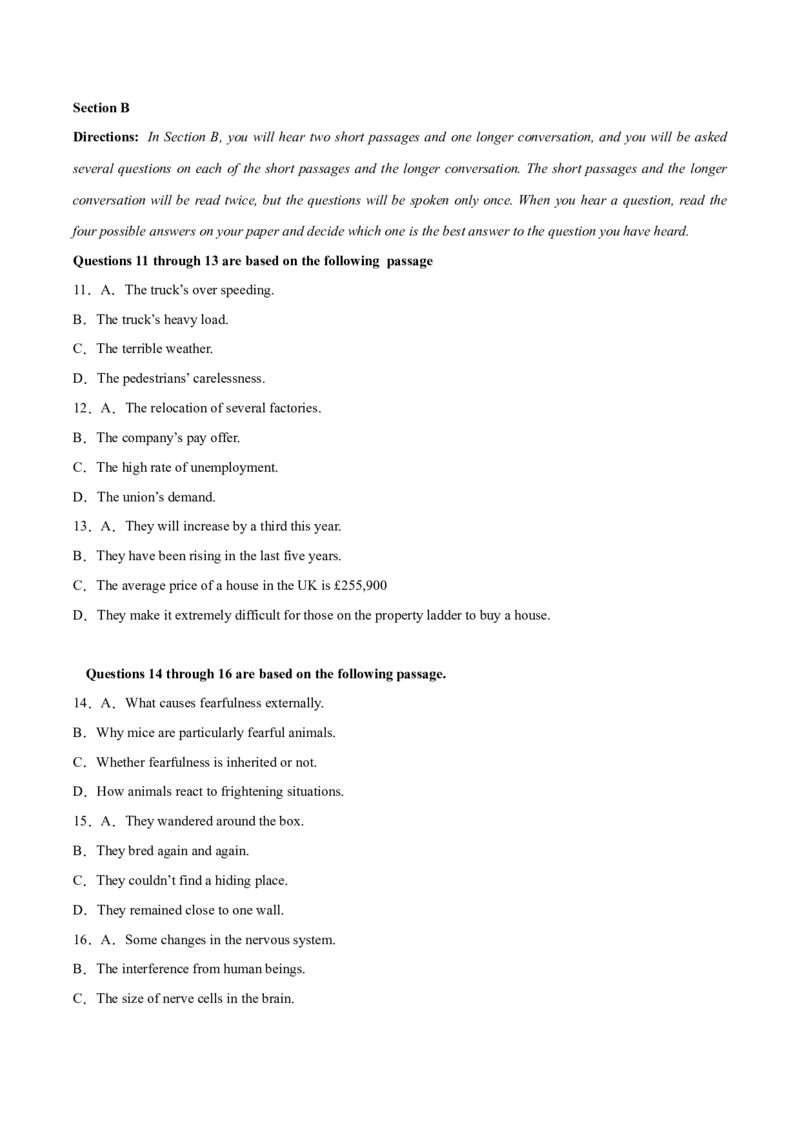
Section B
Directions: In Section B, you will hear two short passages and one longer conversation, and you will be asked
several questions on each of the short passages and the longer conversation. The short passages and the longer
conversation will be read twice, but the questions will be spoken only once. When you hear a question, read the
four possible answers on your paper and decide which one is the best answer to the question you have heard.
Questions 11 through 13 are based on the following passage
11.A.The truck’s over speeding.
B.The truck’s heavy load.
C.The terrible weather.
D.The pedestrians’ carelessness.
12.A.The relocation of several factories.
B.The company’s pay offer.
C.The high rate of unemployment.
D.The union’s demand.
13.A.They will increase by a third this year.
B.They have been rising in the last five years.
C.The average price of a house in the UK is £255,900
D.They make it extremely difficult for those on the property ladder to buy a house.
Questions 14 through 16 are based on the following passage.
14.A.What causes fearfulness externally.
B.Why mice are particularly fearful animals.
C.Whether fearfulness is inherited or not.
D.How animals react to frightening situations.
15.A.They wandered around the box.
B.They bred again and again.
C.They couldn’t find a hiding place.
D.They remained close to one wall.
16.A.Some changes in the nervous system.
B.The interference from human beings.
C.The size of nerve cells in the brain.
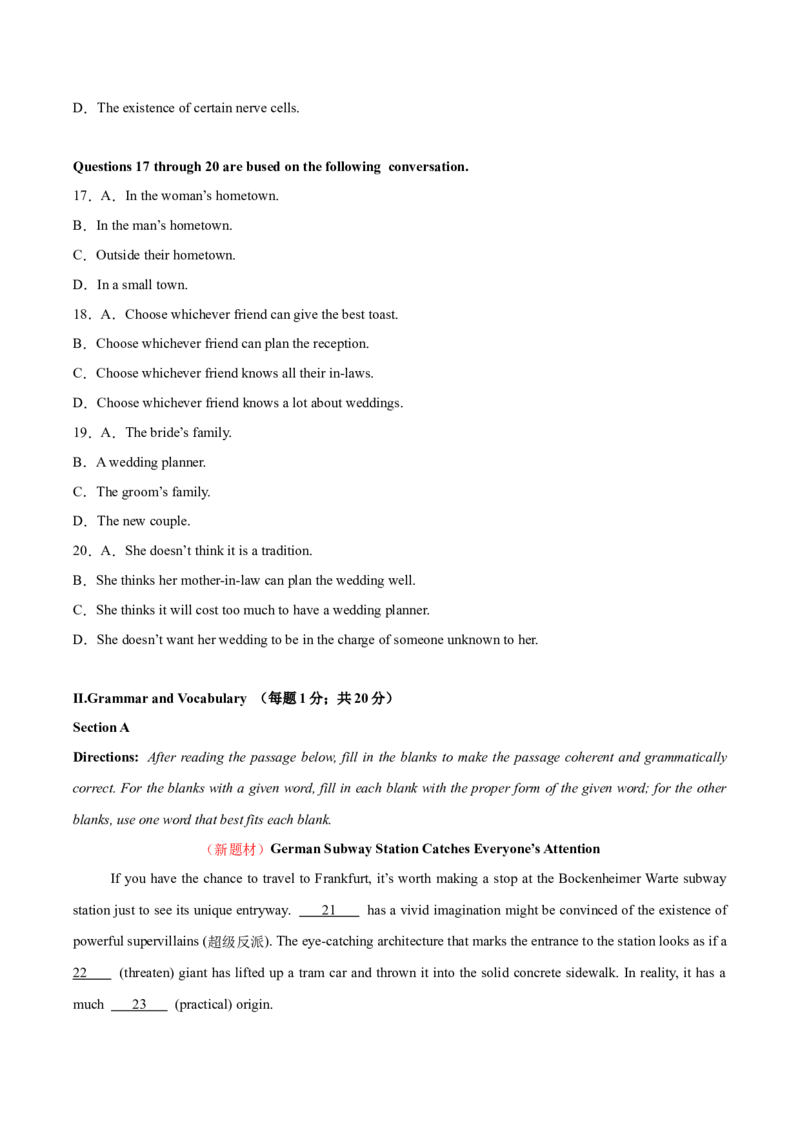
D.The existence of certain nerve cells.
Questions 17 through 20 are bused on the following conversation.
17.A.In the woman’s hometown.
B.In the man’s hometown.
C.Outside their hometown.
D.In a small town.
18.A.Choose whichever friend can give the best toast.
B.Choose whichever friend can plan the reception.
C.Choose whichever friend knows all their in-laws.
D.Choose whichever friend knows a lot about weddings.
19.A.The bride’s family.
B.A wedding planner.
C.The groom’s family.
D.The new couple.
20.A.She doesn’t think it is a tradition.
B.She thinks her mother-in-law can plan the wedding well.
C.She thinks it will cost too much to have a wedding planner.
D.She doesn’t want her wedding to be in the charge of someone unknown to her.
II.Grammar and Vocabulary (每题1 分;共20 分)
Section A
Directions: After reading the passage below, fill in the blanks to make the passage coherent and grammatically
correct. For the blanks with a given word, fill in each blank with the proper form of the given word; for the other
blanks, use one word that best fits each blank.
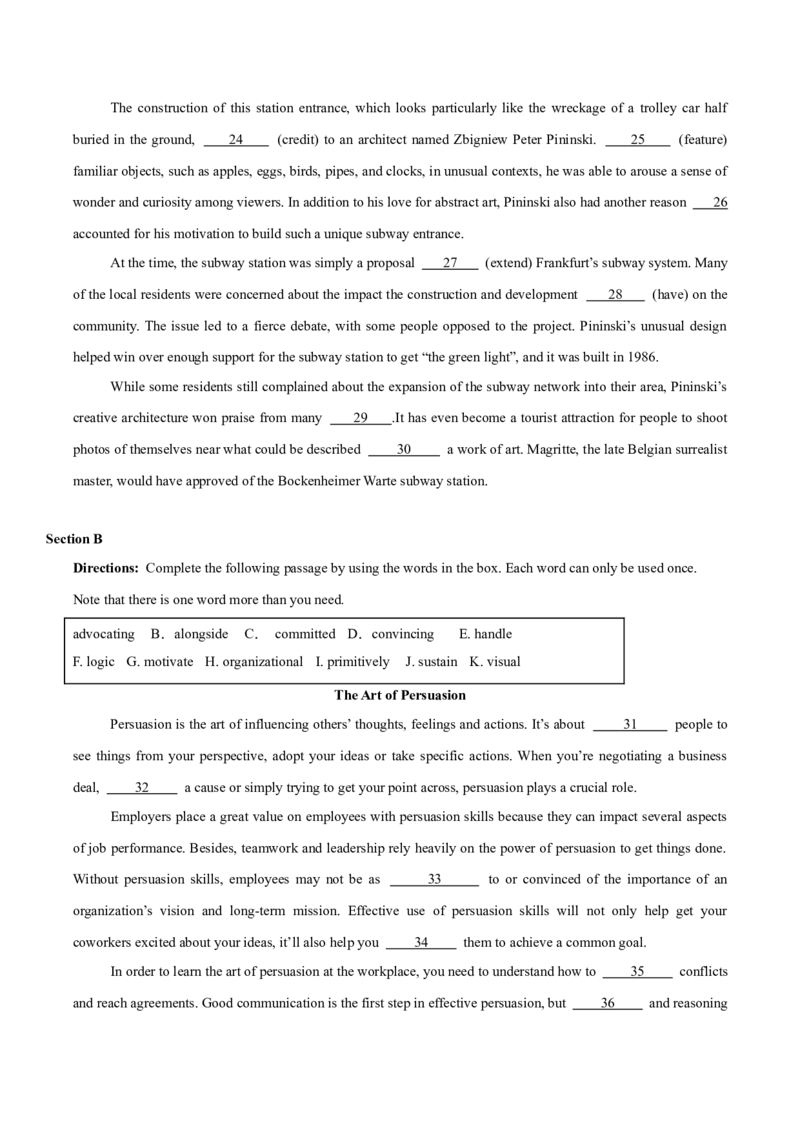
(新题材)German Subway Station Catches Everyone’s Attention
If you have the chance to travel to Frankfurt, it’s worth making a stop at the Bockenheimer Warte subway
station just to see its unique entryway.    21    has a vivid imagination might be convinced of the existence of
powerful supervillains (超级反派). The eye-catching architecture that marks the entrance to the station looks as if a
22    (threaten) giant has lifted up a tram car and thrown it into the solid concrete sidewalk. In reality, it has a
much    23    (practical) origin.
The construction of this station entrance, which looks particularly like the wreckage of a trolley car half
buried in the ground,    24    (credit) to an architect named Zbigniew Peter Pininski.    25    (feature)
familiar objects, such as apples, eggs, birds, pipes, and clocks, in unusual contexts, he was able to arouse a sense of
wonder and curiosity among viewers. In addition to his love for abstract art, Pininski also had another reason    26
accounted for his motivation to build such a unique subway entrance.
At the time, the subway station was simply a proposal    27    (extend) Frankfurt’s subway system. Many
of the local residents were concerned about the impact the construction and development    28    (have) on the
community. The issue led to a fierce debate, with some people opposed to the project. Pininski’s unusual design
helped win over enough support for the subway station to get “the green light”, and it was built in 1986.
While some residents still complained about the expansion of the subway network into their area, Pininski’s
creative architecture won praise from many    29   .It has even become a tourist attraction for people to shoot
photos of themselves near what could be described     30     a work of art. Magritte, the late Belgian surrealist
master, would have approved of the Bockenheimer Warte subway station.
Section B
Directions: Complete the following passage by using the words in the box. Each word can only be used once.
Note that there is one word more than you need.
advocating    B.alongside    C. committed   D.convincing      E. handle
F. logic   G. motivate   H. organizational   I. primitively    J. sustain   K. visual
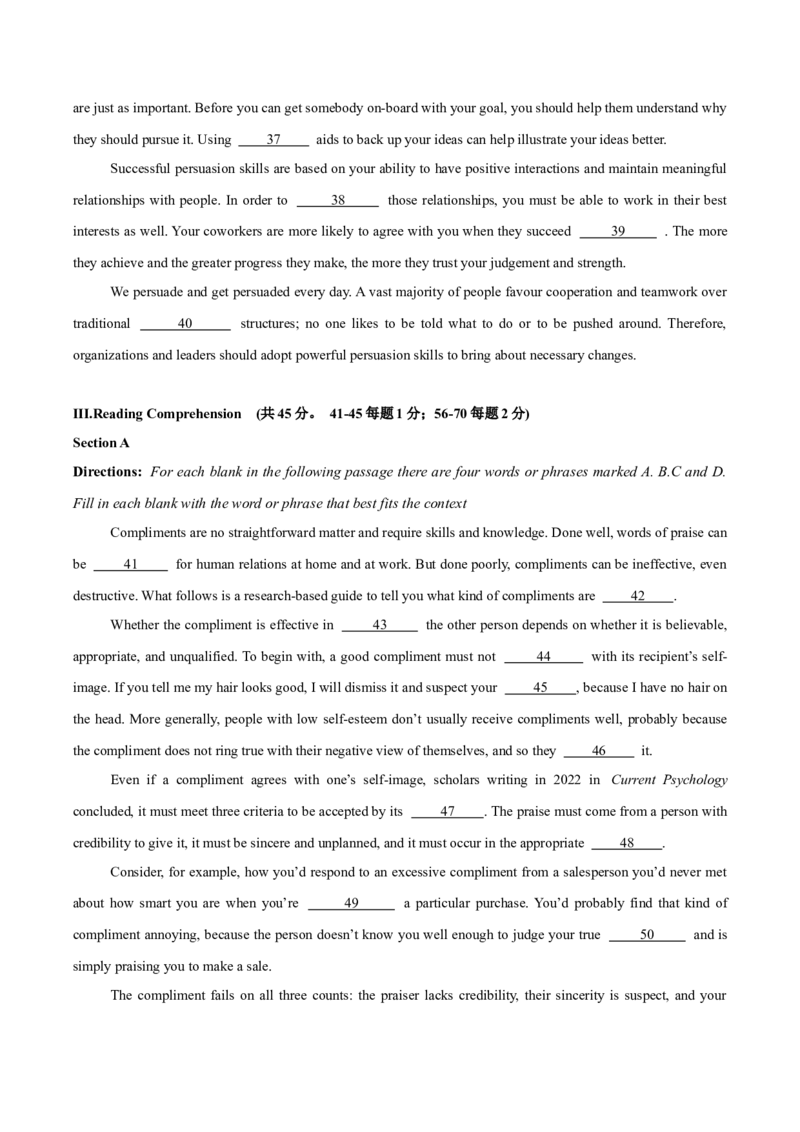
The Art of Persuasion
Persuasion is the art of influencing others’ thoughts, feelings and actions. It’s about     31     people to
see things from your perspective, adopt your ideas or take specific actions. When you’re negotiating a business
deal,     32     a cause or simply trying to get your point across, persuasion plays a crucial role.
Employers place a great value on employees with persuasion skills because they can impact several aspects
of job performance. Besides, teamwork and leadership rely heavily on the power of persuasion to get things done.
Without persuasion skills, employees may not be as     33     to or convinced of the importance of an
organization’s vision and long-term mission. Effective use of persuasion skills will not only help get your
coworkers excited about your ideas, it’ll also help you     34     them to achieve a common goal.
In order to learn the art of persuasion at the workplace, you need to understand how to     35     conflicts
and reach agreements. Good communication is the first step in effective persuasion, but     36     and reasoning
are just as important. Before you can get somebody on-board with your goal, you should help them understand why
they should pursue it. Using     37     aids to back up your ideas can help illustrate your ideas better.
Successful persuasion skills are based on your ability to have positive interactions and maintain meaningful
relationships with people. In order to     38     those relationships, you must be able to work in their best
interests as well. Your coworkers are more likely to agree with you when they succeed     39     . The more
they achieve and the greater progress they make, the more they trust your judgement and strength.
We persuade and get persuaded every day. A vast majority of people favour cooperation and teamwork over
traditional     40     structures; no one likes to be told what to do or to be pushed around. Therefore,
organizations and leaders should adopt powerful persuasion skills to bring about necessary changes.
III.Reading Comprehension  (共45 分。 41-45 每题1 分;56-70 每题2 分)
Section A
Directions: For each blank in the following passage there are four words or phrases marked A. B.C and D.
Fill in each blank with the word or phrase that best fits the context
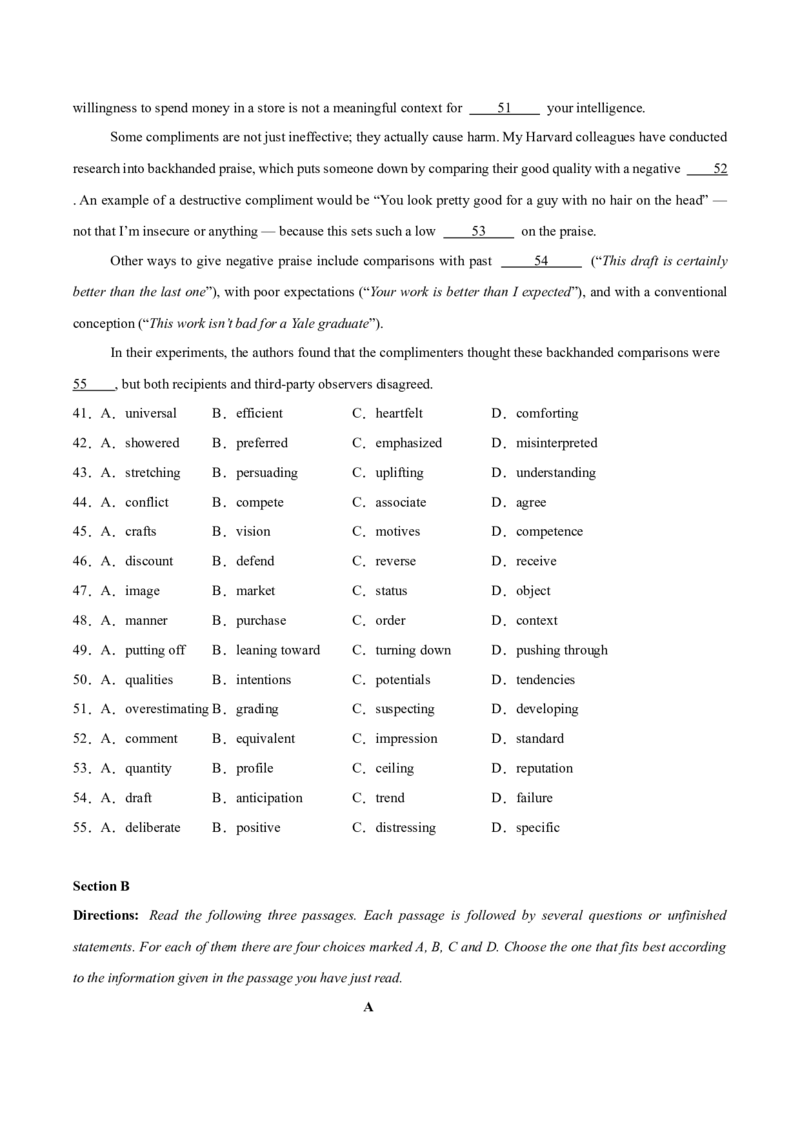
Compliments are no straightforward matter and require skills and knowledge. Done well, words of praise can
be     41     for human relations at home and at work. But done poorly, compliments can be ineffective, even
destructive. What follows is a research-based guide to tell you what kind of compliments are     42    .
Whether the compliment is effective in     43     the other person depends on whether it is believable,
appropriate, and unqualified. To begin with, a good compliment must not     44     with its recipient’s self-
image. If you tell me my hair looks good, I will dismiss it and suspect your     45    , because I have no hair on
the head. More generally, people with low self-esteem don’t usually receive compliments well, probably because
the compliment does not ring true with their negative view of themselves, and so they     46     it.
Even if a compliment agrees with one’s self-image, scholars writing in 2022 in Current Psychology
concluded, it must meet three criteria to be accepted by its     47    . The praise must come from a person with
credibility to give it, it must be sincere and unplanned, and it must occur in the appropriate     48    .
Consider, for example, how you’d respond to an excessive compliment from a salesperson you’d never met
about how smart you are when you’re     49     a particular purchase. You’d probably find that kind of
compliment annoying, because the person doesn’t know you well enough to judge your true     50     and is
simply praising you to make a sale.
The compliment fails on all three counts: the praiser lacks credibility, their sincerity is suspect, and your
willingness to spend money in a store is not a meaningful context for     51     your intelligence.
Some compliments are not just ineffective; they actually cause harm. My Harvard colleagues have conducted
research into backhanded praise, which puts someone down by comparing their good quality with a negative     52
. An example of a destructive compliment would be “You look pretty good for a guy with no hair on the head” —
not that I’m insecure or anything — because this sets such a low     53     on the praise.
Other ways to give negative praise include comparisons with past     54     (“This draft is certainly
better than the last one”), with poor expectations (“Your work is better than I expected”), and with a conventional
conception (“This work isn’t bad for a Yale graduate”).
In their experiments, the authors found that the complimenters thought these backhanded comparisons were
55    , but both recipients and third-party observers disagreed.
41.A.universal
B.efficient
C.heartfelt
D.comforting
42.A.showered
B.preferred
C.emphasized
D.misinterpreted
43.A.stretching
B.persuading
C.uplifting
D.understanding
44.A.conflict
B.compete
C.associate
D.agree
45.A.crafts
B.vision
C.motives
D.competence
46.A.discount
B.defend
C.reverse
D.receive
47.A.image
B.market
C.status
D.object
48.A.manner
B.purchase
C.order
D.context
49.A.putting off
B.leaning toward
C.turning down
D.pushing through
50.A.qualities
B.intentions
C.potentials
D.tendencies
51.A.overestimating B.grading
C.suspecting
D.developing
52.A.comment
B.equivalent
C.impression
D.standard
53.A.quantity
B.profile
C.ceiling
D.reputation
54.A.draft
B.anticipation
C.trend
D.failure
55.A.deliberate
B.positive
C.distressing
D.specific
Section B
Directions: Read the following three passages. Each passage is followed by several questions or unfinished
statements. For each of them there are four choices marked A, B, C and D. Choose the one that fits best according
to the information given in the passage you have just read.
A
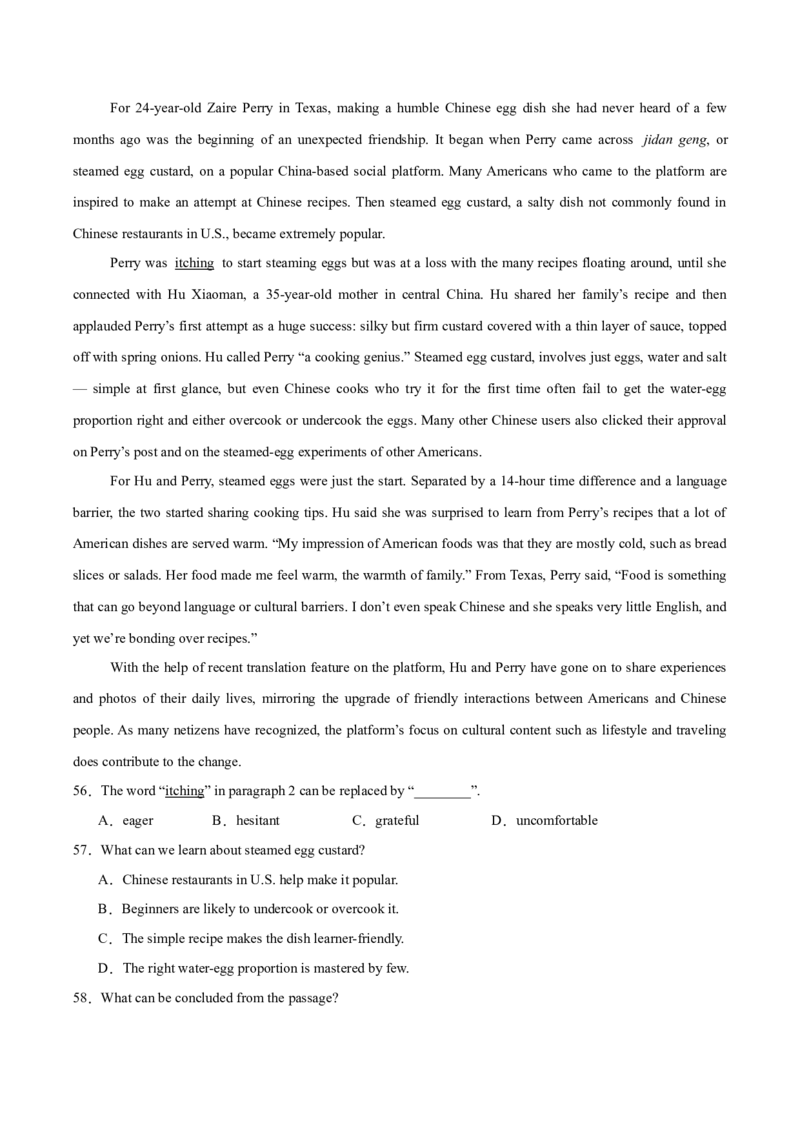
For 24-year-old Zaire Perry in Texas, making a humble Chinese egg dish she had never heard of a few
months ago was the beginning of an unexpected friendship. It began when Perry came across jidan geng, or
steamed egg custard, on a popular China-based social platform. Many Americans who came to the platform are
inspired to make an attempt at Chinese recipes. Then steamed egg custard, a salty dish not commonly found in
Chinese restaurants in U.S., became extremely popular.
Perry was itching to start steaming eggs but was at a loss with the many recipes floating around, until she
connected with Hu Xiaoman, a 35-year-old mother in central China. Hu shared her family’s recipe and then
applauded Perry’s first attempt as a huge success: silky but firm custard covered with a thin layer of sauce, topped
off with spring onions. Hu called Perry “a cooking genius.” Steamed egg custard, involves just eggs, water and salt
— simple at first glance, but even Chinese cooks who try it for the first time often fail to get the water-egg
proportion right and either overcook or undercook the eggs. Many other Chinese users also clicked their approval
on Perry’s post and on the steamed-egg experiments of other Americans.
For Hu and Perry, steamed eggs were just the start. Separated by a 14-hour time difference and a language
barrier, the two started sharing cooking tips. Hu said she was surprised to learn from Perry’s recipes that a lot of
American dishes are served warm. “My impression of American foods was that they are mostly cold, such as bread
slices or salads. Her food made me feel warm, the warmth of family.” From Texas, Perry said, “Food is something
that can go beyond language or cultural barriers. I don’t even speak Chinese and she speaks very little English, and
yet we’re bonding over recipes.”
With the help of recent translation feature on the platform, Hu and Perry have gone on to share experiences
and photos of their daily lives, mirroring the upgrade of friendly interactions between Americans and Chinese
people. As many netizens have recognized, the platform’s focus on cultural content such as lifestyle and traveling
does contribute to the change.
56.The word “itching” in paragraph 2 can be replaced by “________”.
A.eager
B.hesitant
C.grateful
D.uncomfortable
57.What can we learn about steamed egg custard?
A.Chinese restaurants in U.S. help make it popular.
B.Beginners are likely to undercook or overcook it.
C.The simple recipe makes the dish learner-friendly.
D.The right water-egg proportion is mastered by few.
58.What can be concluded from the passage?
A.Hu and Perry shared cooking tips and photographic skills.
B.Hu encouraged Perry to become a cook in a Chinese restaurant.
C.Perry helped to resolve Hu’s misunderstanding of American dishes.
D.Perry’s post of eggs aroused other Americans’ interest in Chinese dishes.
59.The passage is intended to convey the message that ______.
A.a recipe in need is a recipe indeed
B.steamed eggs can be a cultural symbol in China
C.cuisine is an entrance into friendship and cultural exchange
D.social media should be widely used to overcome language barriers
B
The MZH Alumni Executive Mentor (校友导师) Program
Program Background
The MZH Global Alumni Programs and MZH Shanghai’s Center for Career Development (CCD) launched this
program in 2014. The goal is to build up a lively alumni-student mentorship program that recognizes our alumni’s
professional achievement while helping current MZH Shanghai students get knowledge, information and
perspectives from the real world and receive guidance from mentors on their future career plans.
Highlights
●Increase specific industry knowledge and enhance professional communication skills by interacting with
director-level mentors from various industries such as financial services, legal services, technology, media and
communication.
●Broaden real-world culture perspectives and improve understanding of workplace including China,
Singapore, New York and others.
●Gain support from a growing alumni network and a community of mentors and mentees from across the
Globe.
●Empower personal journey and cultivate potential for career desires in Asian Pacific’s dynamic landscape.
Mentee Application
●Who can apply
MZH Shanghai second year students, or MZH and MZH Abu Dhabi Students currently studying away in
◇

Shanghai
Student must be in Good Academic Standing
◇
Student must be in Shanghai for the whole academic year (Fall Semester+Spring Semester)
◇
●What to prepare
One-page English Resume
◇
500-word Personal Statement & 5-min Personal Video (program motivation and career desires)
◇
Application Form including your mentor choice and reasons (link and mentor profile will be given in
◇

September)
●How to apply
Application starts in September. Applicants need to complete the online application form. Please stay tuned
to CCD emails (shanghai.carccrdevelopment@MZH.edu) and WeChat (ID: MZHShanghaiCCD). Successful
applicants will be selected for the program and introduced to their alumni mentor via email by late October.
60.Which of the following is an aim of The MZH Alumni Executive Mentor Program?
A.Building up a lively atmosphere on campus.
B.Offering alumni job opportunities at MZH Shanghai.
C.Providing students with real-world insights and career advice.
D.Relating students to alumni who performed well academically.
61.How can mentees benefit from the program?
A.They can win the chance for overseas journeys.
B.They can expand their global cultural viewpoints.
C.They can get job offers in international corporations.
D.They can enhance their communication with other mentees.
62.Applicants can know about the requirements for ________ from Mentee Application.
academic performance
age
application materials
①
②
③
channel of application
deadline of application
nationality
④
⑤
⑥
A.①③④⑤
B.②③⑤⑥
C.①②③⑤
D.①②④⑥
C
Less is More is a book with an ambitious subtitle: How Degrowth Will Save the World. That’s a big claim,
but this is by Jason Hickel, one of the leading advocates of postgrowth thinking. He has a better chance than most
at backing that up.
Degrowth is often used as a controversial word, but here it is used in a more encouraging way. Hickel looks
back to trace the origins of ‘growthism’, digging back through climate change to fossil fuels (化石燃料), to
economic growth and to capitalism. Capitalism “has a kind of totalitarian logic to it: every industry, every national
economy must grow, all the time, with no identifiable end-point.” A central principle of capitalism is to take more
than you give. Historically, that process has driven kingdoms and colonialism (殖民主义), and today it drives
climate change and ecological breakdown. Wealthier countries take from the global atmosphere in yet another form
of colonialism.
One of the most damaging things about capitalism is that it is “fundamentally ill from any concept of human
need.” It piles its rewards onto the wealthiest first. The more severe the poverty, the more invisible it is to capital,
and it takes no account of what it destroys in the process of turning things into money.
Instead, we should find ways to prioritise what matters most. More, in already wealthy countries, is not
something that matters. Hickel calculates that with better distribution and investment in public goods, the US
economy could be 65% smaller with no loss in wellbeing. Good lives are grounded in community, meaningful
work, in societies that cooperate rather than compete. People and planet are being pushed to breaking point to no
good end, says Hickel.
As the book moves into its solutions, a series of antidotes (解药) to growth are revealed. Justice is one of
them. Abundance (富足) is another—growth actually relies on people being unsatisfied. These sorts of ideas hint at
much more interesting possibilities for a post-capitalist future.
“For 500 years,” Hickel writes, “capitalist growth has been a process of enclosure and dispossession.
Degrowth represents a reversal of this process. It represents release. It represents an opportunity for recovery and
repair.”
This is an elegant evolution of degrowth ideas, expanding what the term can mean. Degrowth begins as a
process of taking less. But in the end it opens up a whole landscape of possibility, moving us from poverty to
abundance, from dominance to reciprocity, and from loneliness and separation to connection with a world that’s
full of life.
Hard to argue with that. Perhaps degrowth will save the world.
63.According to Hickel, it is _____ that causes ecological breakdown.
A.capitalism’s unceasing drive for growth
B.a lack of technological advancement
C.insufficient governmental regulation
D.overinvestment in public goods
64.It can be inferred from the passage that Hickel holds that _____.
A.capitalism to some extent meets the human need
B.colonialism is hard to avoid even in modern times
C.capitalist growth has increasingly prioritised recovery and repair
D.less wealthy countries need better distribution than wealthy ones
65.What does the word “reciprocity” (paragraph 7) most probably mean?
A.An unequal sharing of various resources.
B.A relationship based on continuous giving.
C.The possibility to compete fairly and freely.
D.The exchange of rights and mutual support.
66.According to the passage, what does “degrowth” refer to?
A.Intensifying capitalist growth in an eco-friendly way.
B.The prioritising of individual growth over community welfare.
C.Boosting economic development in order to reach a state of abundance.
D.The reduction of economic growth to focus on sustainability and well-being.
Section C
Directions: Complete the following passage by using the sentences in the box Each sentence can only be used
once. Note that there are two sentences more than you need.
On-the-go Americans are increasingly consuming their morning calories over several hours instead of sitting
down to enjoy a plate of pancakes, bacon and eggs in one sitting. The case of the morning chewing is being
initiated by the belief that it’s healthier to eat several smaller meals instead of three squares a day.
What qualifies as a snack or a meal is still a matter of perspective.     67     General Mills, Quaker Oats
and other brands are adding to their lineup of small-packaged bars and yogurts. And Jimmy Dean this summer
introduced mini-breakfast sandwiches.
It’s breakfast in stages. People will eat something at home, then stop at a convenience store for coffee and
maybe a little something.      68     The number of times Americans snack is rising faster in the morning than
during the afternoon or evening. After all, it’s easier and less time- consuming to pop a few snacks in your
backpack for later enjoyment than to sit down for a prepared meal.
Turning the snacking habit into an all-day affair would be a major growth driver for the already massive
snack food industry. Sales of all snack foods reached S16. 64 billion in the past year, up 3. 3 percent from a year
before, according to Nielsen. Of course, food companies have tried before to get people to eat outside of typical
meal times.      69     People generally feel they should eat healthy in the mornings to start the day off right.
Unfortunately, snacking is generally associated with junk food.
Therefore, food companies are trying every means to make the idea of tearing into a snack before noon
easier to swallow.     70     Products that are less than 300 calories and have more fiber or whole grains are
quickly launched on the market. The idea is that such snacks will help people stay energized or feel full longer,
making morning snacking a psychologically acceptable act.
A.Sustaining energy while on the move all day without sacrificing flavor is the overall rule.
B.Nutritional benefits of packaged goodies are repeatedly mentioned.
C.There is a commonly held idea that more frequent meals can help influence weight loss.
D.But food companies are already rolling out smaller bites that feed the growing appetite for morning treats.
E.Marketing morning snacks is trickier, though.
F.The deconstruction of breakfast is definitely happening.
IV.Summary Writing   (共10 分)
Directions: Read the following passage. Summarize the main idea and the main point( s)of the passage in no more
than 60 words. Use your own words as far as possible.
How to improve clinical trials?
Last year, a Swiss medicine company published a review of the clinical trials on drugs it had held between
2016 and 2021. It found that black people were under-represented in all but one. Surprisingly, that news represents
progress, because it shows that people are becoming more aware of a dangerous bias (偏见) that sets back the
safety of medical treatments.
Many trials leave out certain groups — children, for example, or people with physical or learning
disabilities, pregnant women and the elderly. There are good explanations for the exclusion, such as the difficulty of
getting informed permission or the potential harm to unborn children. Yet the consequences can be serious. A recent
review found that half of trials around the world testing hip-fracture (髋骨骨折) interventions excluded people
who lived in nursing homes, were old or had some sort of understanding problems. Though these groups make up
almost a third of all patients suffering hip fractures, it is unclear if the interventions will work as safely or as
effectively on them. Their doctors face a tough choice: tell their patients to take the medicine anyway, with
uncertain results; or deny them new treatments.
Obtaining informed permission for trials is not always easy, especially from people with learning disabilities.
Accounting for different groups’ risks of side-effects can complicate the analysis of the data. Even so, broadening
the range of trials’ participants can be practically useful, because it might lead to important new findings in
medicine.
Fortunately, the bias of clinical testing may be changing. The US government has recently proposed to reduce
barriers and appeal to a wider range of participants by reducing the costs and commitments required for patients to
participate. Countries like America and Britain are discussing publishing regulations that require trial organisers to
explain whom they ought to include and how they plan to include them.
____________________________________________________________________________________________
____________________________________________________________________________________________
____________________________________________________________________________________________
____________________________________________________________________________________________
________________________________
V.Translation (共15 分。第1 小题和第2 小题,每题3 分;第3 题4 分;第4 题5 分。)
Directions:Translate the following sentences into English, using the words given in the brackets
72.这部电影为推动中国文化走向世界做出了很大贡献。(contribute) (汉译英)

73.他忘了在饭盒上贴标签,有人不小心错拿了。(label) (汉译英)

74.在中国,绿色能源发展迅速,越来越多的人选择电动汽车来保护环境和减少污染。(evolve) (汉译英)

75.上周末,在春意盎然的植物园,我和我的初中英语王老师不期而遇,我们都非常激动。 (which) (汉译
英)

VI.Guided Writing  (共25 分)
76.Directions: Write an English composition in 120-150 words according to the instructions given below in
Chinese.
(社会热点)假如你是民启中学的学生,开学伊始,学校将开展“阳光体育(Sunshine Sports)”活动,项目
包括篮球、足球、羽毛球、乒乓球和踢毽子(shuttlecock)等,建议每位学生至少选择一个项目报名参加。你
作为学生会的成员,请写一篇文章对此活动进行宣传,你的文章必须包含以下内容:
·选择其中一个项目介绍其特点或优势;
·简单解释该项目的申报条件和训练安排。
(文中不得出现真实姓名和学校名称)
____________________________________________________________________________________________
____________________________________________________________________________________________
____________________________________________________________________________________________
____________________________________________________________________________________________
_______________________________________________________________________________________