2026 年高考第一次模拟考试
高三英语·全解全析
(考试时间:120 分钟  试卷满分:150 分)
本试卷特点:
题型
特点说明
听力
1-5 小题读两遍,符合新高考的要求
阅读理解
A 篇(新倾向)充分体现了“用中学”思想,实用和贴近生活是学习英语的基本任
务。C 篇 题材新颖,文章涉及了社会心理学,分析“赞美三明治”的不足,以及“明
智反馈”的有效性。D 篇  题材新颖,研究报告:常见塑料物品中的化学物质带来的
长期健康风险。
完形填空
崇尚劳动:参与植树活动后内心得到治愈、焦虑缓解的经历。
语法填空
中西方文化的交流与融合,并指出艺术在连接不同文明中的重要作用
应用文
演讲稿。 描述你自己经历的一次挫折;你克服挫折的体会和建议。经历、体会和建议
都需要学生发挥想象,没有固定答案,体现了高考的开放性。
读后续写
读后续写:读书改变生活的故事。
注意事项:
1.答卷前,考生务必将自己的姓名、准考证号等填写在答题卡和试卷指定位置上。
2.回答选择题时,选出每小题答案后,用铅笔把答题卡上对应题目的答案标号涂黑。如需改动,用
橡皮擦干净后,再选涂其他答案标号。回答非选择题时,将答案写在答题卡上。写在本试卷上无效。
3.考试结束后,将本试卷和答题卡一并交回
第一部分  听力(共两节,满分 30 分)
做题时,先将答案标在试卷上。录音内容结束后,你将有两分钟的时间将试卷上的答案转涂到答题卡
上。
第一节(共5 小题;每小题1.5 分,满分7.5 分)
听下面5 段对话。每段对话后有一个小题,从题中所给的A、B、C 三个选项中选出最佳选项。听完每段对
话后,你都有10 秒钟的时间来回答有关小题和阅读下一小题。每段对话读两遍。
1.What is the date today?
A.May 6th.
B.May 7th.
C.May 8th.
【答案】A
【原文】M: I need to get these pants shortened. Can I get them back the day after tomorrow on Wednesday, May
8th?
W: I’m not sure. We’re pretty busy this week. But we’ll try.
2.What will the man do tonight?
A.Dine with the woman.
B.Watch a show.
C.Look after his daughter.
【答案】B
【原文】W: Would you like to have dinner with us tonight?
M: I’d love to, but my daughter is going to play in a show. I can’t miss it.
3.Why is the man smiling?
A.He has got a dinner invitation.
B.He has won a large sum of money
C.He has been admitted to a university.
【答案】C
【原文】W: That’s a big smile. You look like you’ve won a lot of money.
M: Better than that. I applied to the country’s top university — and they said yes.
W: Well done. Let’s book a table at a restaurant to celebrate.
4.Where are the speakers?
A.At an airport.
B.In a hotel.
C.In a shop.
【答案】A
【原文】W: Are there any shops here? I want to buy some chocolate before taking off.
M: Over there, just next to the washing room. Please hurry up. We’ll board in 15 minutes.
5.How did the man go to his workplace before?
A.By bike.
B.By bus.
C.By car.
【答案】B
【原文】W: That’s an interesting outfit! Did you bike here?
M: Yes, I got my bike last week. Now I don’t have to worry about missing the bus anymore.
W: Sounds great! I still drive, but the traffic can be terrible.
第二节(共15 小题;每小题1.5 分,满分22.5 分)
听下面5 段对话或独白。每段对话或独白后有几个小题,从题中所给的A、B、C 三个选项中选出最佳选项。
听每段对话或独白前,你将有时间阅读各个小题,每小题5 秒钟;听完后,各小题将给出5 秒钟的作答时
间。每段对话或独白读两遍。
听下面一段对话,回答第6、7 小题。
6.What is being built at the university?
A.A cafeteria.
B.A gymnasium.
C.A computer technology center.
7.Who is the woman probably talking with?
A.Her father.
B.Her teacher.
C.Her schoolmate.
【答案】6.B    7.C
【原文】W: Our university newspaper the stone has some really interesting articles about the unfair rise in the cost
of school fees and course materials.
M: I know it’s ridiculous even the cafeteria prices have gone up. It’s probably because of the new gymnasium we’re
building.
W: Not only that but they will be putting in the newest computer technology in all the lecture halls.
M: It is nice to see all the improvements. I just wish I didn’t have to borrow from the bank and then be broke for
the next four years.
W: Looks like it’s time for us to get part time jobs.
听下面一段对话,回答第8、9 小题。
8.Where does the conversation take place?
A.In a classroom.
B.In a cafeteria.
C.In a dormitory building.
9.Who did the woman originally plan to have dinner with?
A.Her parents.
B.Her roommates.
C.Several other new students.
【答案】8.C    9.A
【原文】M: Good afternoon. Welcome to your new dormitory. I’m Jack. I’m here to receive the new students.
W: Nice to meet you. My name is Lucy Wright.
M: Okay. Lucy, you are in room 452. Both of your roommates are already there. And tonight we will have a special
dinner for all first-year students in the cafeteria.
W: Um, must I come for dinner?
M: Well, we want all new students to attend, so they can meet the other students. Most importantly, you’ll hear all
the rules for the first time.
W: Oh. Well, my parents wanted to take me out to dinner, but I guess they’ll just drive home.
M: Well, please invite them to attend our Parents’ Day next month.
W: Okay.
听下面一段对话,回答第10 至12 小题。
10.What is the boy’s homework this weekend?
A.To write a summary.
B.To review three chapters.
C.To prepare a presentation.
11.What does the woman probably teach?
A.Math.
B.Science.
C.History.
12.What does the woman want to learn from the homework?
A.What her students’ opinions are.
B.Whether her students understood the reading.
C.If her students can connect all the different ideas.
【答案】10.A    11.C    12.B
【原文】W: All right, students. Your homework for the weekend is to review Chapter 3 and to write a summary of
the most important ideas in the chapter. Next week, we’ll begin our presentations.
M: Excuse me, Ms. Diaz?
W: Yes?
M: How long should our summary be?
W: It should be one page, but no more than that. Also, remember that when you summarize a chapter, you must
leave your own opinion out.
M: Yes, ma’am, but there are many different views on the Civil War in American history. It is difficult to
summarize anything important without including my opinion at all.
W: A summary only includes the facts. You can use the author’s words directly, but you cannot include your own
ideas. For the homework, I just need to see if you understood the main ideas in the chapter.
M: Should we try to connect these ideas to other things we read this term?
W: No, you can do that next week when you give your presentation.
听下面一段对话,回答第13 至16 小题。
13.Where is the woman going this weekend?
A.To a big city in the desert.
B.To a town north of San Diego.
C.To a town southwest of Los Angeles.
14.What do people mainly do in Palm Springs during the day?
A.Go swimming.
B.Try different food.
C.Go exploring around the area.
15.What can we learn about the bar?
A.People can listen to live music at night.
B.It was opened recently.
C.It is next to a restaurant.
16.What is Joshua Tree?
A.A rock band.
B.A restaurant.
C.A national park.
【答案】13.B    14.A    15.A    16.C
【原文】M: Hey, Kelly. Do you have any plans for the weekend?
W: I sure do. I’m going to Palm Springs with my best friend Colby.
M: Where is Palm Springs and what are you going to do there?
W: Well, it’s a small town north of San Diego and southeast of Los Angeles. It’s in the middle of the desert, so it
gets pretty hot. But during the day, most people stay close to the pool. You can also relax inside the room with the
air conditioning on.
M: Do you already have your hotel reservations?
W: Yes. We’re staying at a place called Ace. It was the most famous hotel in California in the 1950s. And it still has
all its features from that time.
M: Sweet. So you’re just going to be swimming all day or what?
W: Well, there is a great bar right next to the pool. And there is a health food restaurant that serves sandwiches and
salads as well. At night, there is live music inside the bar. Many people just never leave the hotel. But we’re
planning to spend at least one day at Joshua Tree.
M: What’s that?
W: It’s a national park about half an hour away from Palm Springs. The rock band U2 named one of their early
albums after the park.
听下面一段独白,回答第17 至20 小题。
17.What are paper cuttings mainly used for now?
A.Decoration.
B.Religious events.
C.Festivals.
18.How many kinds of paper cutting are there?
A.Only one.
B.Two.
C.Six.
19.During the Lunar New Year, why are lucky patterns cut out and placed in homes?
A.To offer to gods.
B.To bring good fortune.
C.To give to ancestors.
20.What does the speaker say about the Chinese paper cutting?
A.Only expert paper cutters can do cutting work.
B.The paper cutting has a history of 6000 years.
C.The character “Shou” represents people’s wish for a long life.
【答案】17.A    18.B    19.B    20.C
【原文】The Chinese art of paper cutting has been around for centuries and was first used for religious
ceremonies. Today paper cuttings are mainly used for decoration and they have special meaning at Chinese
festivals and holidays. There are two kinds of paper cutting knife cutting and scissors cutting. Expert paper cutters
draw and cut very complex images in their work. But inexperienced artists can also enjoy the craft using relatively
simple patterns. Experts have found evidence of Chinese paper cutting existing as far back as the sixth century.
Certain kinds of paper cuttings were buried with the dead were burned at funerals and they were used as offerings
to the ancestors and gods. As times changed paper cuttings were used as special decorations during festivals. Today
paper cuttings are popular as decorations and paper cutting has become a kind of art. However special designs are
still significant at festivals and on holidays. For example, during the lunar new year lucky patterns are cut out and
placed in homes to bring good luck. During a wedding ceremony a large red paper cutting of the Chinese character
she which means Joy is displayed. When an elder is celebrating a birthday the character show will be placed
somewhere to represent long life. During almost any traditional joyful event red paper cuttings are used to decorate
tables and walls to symbolize the happiness of the occasion.
第二部分  阅读(共两节, 满分50 分)
第一节(共15 小题;每小题2.5 分, 满分37.5 分)
阅读下列短文, 从每题所给的A、B、C 和D 四个选项中选出最佳选项。
A
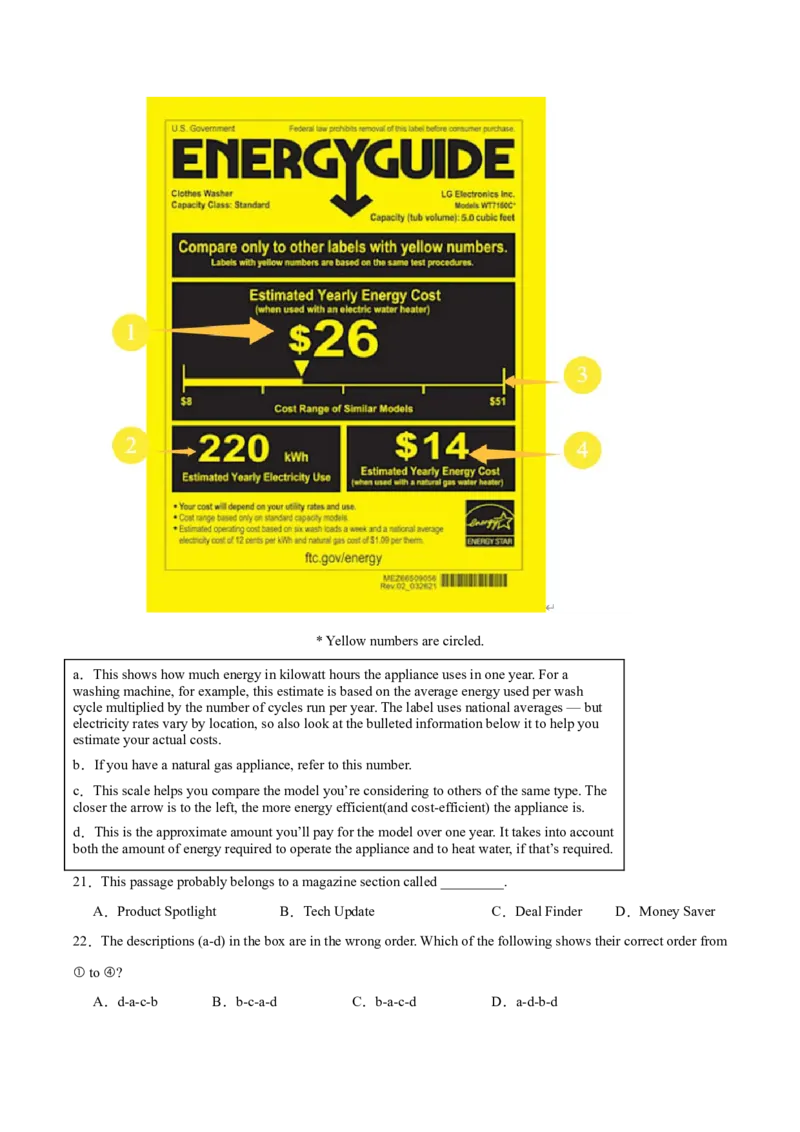
(新方向)Decoding Energy Labels
When shopping for a large appliance, it’s natural to focus on the purchase price. But another important factor
is how much the machine will add to your utility bills. Reading the EnergyGuide label closely could save you
hundreds of dollars. Here’s what to look for.
* Yellow numbers are circled.
a.This shows how much energy in kilowatt hours the appliance uses in one year. For a
washing machine, for example, this estimate is based on the average energy used per wash
cycle multiplied by the number of cycles run per year. The label uses national averages — but
electricity rates vary by location, so also look at the bulleted information below it to help you
estimate your actual costs.
b.If you have a natural gas appliance, refer to this number.
c.This scale helps you compare the model you’re considering to others of the same type. The
closer the arrow is to the left, the more energy efficient(and cost-efficient) the appliance is.
d.This is the approximate amount you’ll pay for the model over one year. It takes into account
both the amount of energy required to operate the appliance and to heat water, if that’s required.
21.This passage probably belongs to a magazine section called _________.
A.Product Spotlight         B.Tech Update
C.Deal Finder
D.Money Saver
22.The descriptions (a-d) in the box are in the wrong order. Which of the following shows their correct order from
 to
?
①
④
A.d-a-c-b
B.b-c-a-d
C.b-a-c-d
D.a-d-b-d
23.Which of the following is true about the bullet points in the label?
A.They reflect your actual usage or rates.
B.They detail what the estimates are based on.
C.LG Electronics isn’t certified with Energy Star.
D.Yellow numbers means standard washing procedures.
【答案】21.D   22.A    23.B
【解析】这是一篇应用文。文章介绍了购买大型家电时需关注的EnergyGuide 标签,解释了标签上各部分
信息的含义,帮助消费者通过阅读标签了解家电的年度能耗、使用成本及能效水平,从而节省电费开支。
21.推理判断题。根据文章开头“Reading the EnergyGuide label closely could save you hundreds of dollars.
(仔细阅读EnergyGuide 标签可以帮你节省数百美元。)”可知,文章核心是帮助消费者省钱。文章可能来自
一本名为《省钱》的杂志,故选D。
22.细节理解题。①指向“Estimated Yearly Energy Cost(年度能耗成本)”,对应d“年度花费金额”;②指向
“Estimated Yearly Electricity Use(年度用电量)”,对应a“年度能耗(千瓦时)”;③指向“Cost Range of
Similar Models(同类产品成本范围)”,对应c“能效对比刻度”;④指向“天然气热水炉的年度成本”,对应
b“天然气家电参考数值”。因此从①到④的正确顺序是d-a-c-b,对应选项A。故选A。
23.细节理解题。根据描述a 中的“the label uses national averages — but electricity rates vary by location,
also look at the bulleted information below it to help you estimate your actual costs. (标签使用全国平均值,但电
费因地区而异,也可以查看下方的项目符号信息来估算实际成本)”可知,项目符号信息解释了估算数据的
依据。故选B。
B
A small cabinet filled with teacups I’ve collected over the years just sits around the corner. There are none I
would consider priceless, except for one. It’s a light gray cup made of bone china. On the outside was a design of
an Asian-themed dragon. Inside, a woman’s lovely face peered up from the bottom.
My grandfather, whom we called Papaw, gave me the teacup when I was 9. “I thought of you when I saw
this,”he said, “so I bought it for you.” The teacup was beautiful and unique, the very opposite of how I saw myself:
just plain and shy. Yet my grandfather saw something in this teacup that reminded him of me.
My confidence grew as I entered my teens, and so did my fascination with teacups. Papaw passed away
when I was 18, and I was so grateful to have the cup to remember him by.
Papaw didn’t tell me where he got it. I guessed it was probably from one of his visits to flea markets. I’ve
visited countless antique stores searching for a similar-style teacup, but in vain. One afternoon 10 years ago, I
accidentally crashed the teacup while cleaning!
My treasure was gone. If I had broken any other cup, I would have dumped the pieces in the trash without
hesitation, but not this one, my only reminder of Papaw. Even though I didn’t know what to do with the broken
pieces, I gathered them up and put them in a small box.
A few years later, my husband made a wooden cabinet to showcase all the teacups I had collected. I arranged
them on the shelves but found my collection incomplete without the teacup that meant the most to me. I found the
box with the shattered remains of my treasure and painstakingly glued each piece until it was set. I displayed it in
the center of the top shelf. Only up close can one see the imperfections, and for me, they only add to its beauty.
They remind me that while life’s challenges have left their mark, we can emerge from them as we meant to
be, someone resilient and confident, rare and precious. Someone with unique qualities and talents to offer.
24.What makes the teacup a treasure to the writer?
A.It was a rare antique.
B.It was bought at a flea market.
C.It was from her grandfather.
D.It was designed to be one of a kind.
25.What did the writer keep the broken pieces for?
A.She plans to sell them later.
B.She expects to turn them into art.
C.She hopes to repair them someday.
D.She wants to maintain the link to Papaw.
26.Why did the writer display the repaired teacup?
A.To show her repair skills.
B.To make her collection bigger.
C.To beautify its broken parts.
D.To honor its profound influence.
27.What is the story mainly about?
A.A fascination with teacups.
B.A life-changing gift.
C.An appreciation for family.
D.A love-bonding interest.
【答案】24.C    25.D    26.D    27.B
【解析】本文是一篇记叙文。文章讲述作者珍藏祖父赠送的骨瓷茶杯,茶杯破碎后被精心修复,其承载的
回忆与意义让作者领悟人生韧性的故事。
24.细节理解题。根据第二段中的“My grandfather, whom we called Papaw, gave me the teacup when I was 9.
(我9 岁时,我们称之为“爷爷”的祖父送给了我这个茶杯)”以及第三段中的“Papaw passed away when I
was 18, and I was so grateful to have the cup to remember him by.(我18 岁时爷爷去世了,能有这个杯子用来纪
念他,我心怀感激)”可知,这个茶杯之所以成为作者的珍宝,核心原因是它来自祖父,是纪念祖父的重要
物件。故选C。
25.细节理解题。根据第五段中的“If I had broken any other cup, I would have dumped the pieces in the trash
without hesitation, but not this one, my only reminder of Papaw.(如果打碎的是其他任何一个杯子,我都会毫不
犹豫地把碎片扔进垃圾桶,但这个杯子不行——它是我能想起爷爷的唯一念想)”可知,作者保留破碎的茶
杯碎片,是因为想维系与祖父之间的情感联结。故选D。
26.推理判断题。根据第六段中的“I displayed it in the center of the top shelf. Only up close can one see the
imperfections, and for me, they only add to its beauty.(我把它放在顶层架子的正中央。只有凑近看才能发现那
些瑕疵,而对我来说,这些瑕疵反而让它更具美感)”以及第七段“They remind me that while life’s challenges
have left their mark, we can emerge from them as we meant to be, someone resilient and confident, rare and
precious. Someone with unique qualities and talents to offer.(这些瑕疵提醒着我:尽管生活的挑战会留下痕迹,
但我们依然能蜕变成本应成为的模样 —— 一个坚韧又自信、珍贵又独特的人,一个拥有独特品质与才能、
能为世界带来价值的人。)”可知,作者展示修复后的茶杯,是为了致敬它承载的回忆与带来的人生启示,
即其深远影响。故选D。
27.主旨大意题。通读全文,文章围绕祖父赠送的茶杯展开:从茶杯寄托对祖父的思念,到破碎后作者的
珍视,再到修复后带来的人生感悟,这个茶杯作为一份特殊的礼物,不仅联结着亲情,更改变了作者对自
我与人生的认知。所以短文主要关于一份改变人生的礼物。故选B。
C
(新情境)Alex is an ear, nose and throat specialist, who works wonders restoring people’s hearing. But as
the chief resident at a teaching hospital, he couldn’t make his young trainees listen. They were talented, but also
made mistakes about which he offered clear and direct feedback. These residents kept making the same errors, as
though he had never said anything to them. He couldn’t figure out why.
Alex was trapped by the mentor’s dilemma: the fact that constructive criticism, meant to push young people
to do better, can hurt their confidence and motivation. What can be done?
Many people believe in the compliment sandwich — burying criticism between two pieces of praise. But
research shows that when young people are criticized by an authority, they care less about whether the authority is a
positive person, but more about an existential question: Does this person who has power over my life think I’m
incompetent? The compliment sandwich, rather than addressing a young person’s fears of unworthiness, actually
confirms anxieties, if the praise is for something seemingly unimportant. Studies show that young people are
hungry for signs of social standing and respect, so they are especially insulted ( 冒犯) when they sense they are
being talked down to.
There is, in fact, a simple but effective solution. Young people are found willing to take even the most severe
criticism if the feedback was motivated by an appreciation for their potential. We call this “wise feedback”. It fits
the needs of mentees (被指导者) well, who neither want to be held to an impossible standard, nor want to feel
overprotected or dismissed. Studies also show that when you hold young people to high standards and make it clear
that you believe they can meet them, young people rise to the challenge because you show respect by taking them
seriously.
After knowing this, Alex sees why he couldn’t get his medical trainees to listen. He starts explaining to the
medical residents that he provides critical feedback because he thinks they can improve and he takes them and their
potential seriously. Alex’s young trainees have been more receptive and responsive, ultimately making fewer
mistakes. They are listening to him now, partly because they feel listened to.
28.What did Alex find it difficult to do with his young trainees?
A.Make them faultless.
B.Get them to take his advice.
C.Offer them clear feedback.
D.Help them to develop their talent.
29.Why is the compliment sandwich ineffective for young people?
A.They are keen on gentle criticism.
B.They are desperate for more praise.
C.They are doubtful about the authority.
D.They are fearful of being seen as incapable.
30.What can be inferred about young people from paragraph 4?
A.They tend to feel left out.
B.They want standards to be lowered.
C.They try to refuse challenges.
D.They expect their abilities to be trusted.
31.What is the basic structure of the text?
A.Problem-Solution.
B.Cause and Effect.
C.Argument-Evidence.
D.Comparison and Contrast.
【答案】28.B    29.D    30.D    31.A
【解析】本文是一篇说明文。文章主要介绍了导师Alex 面临的反馈困境,分析“赞美三明治”的不足,以
及“明智反馈”的有效性。
28.细节理解题。根据第一段中的“They were talented, but also made mistakes about which he offered clear
and direct feedback. These residents kept making the same errors, as though he had never said anything to them.(他
们很有才华,但也会犯错,对此他给出了清晰直接的反馈。这些住院医生却一直犯同样的错误,就好像他
什么都没说过一样)”可知,Alex 发现很难让年轻学员接受他的建议。故选B 项。
29.细节理解题。根据第三段中的“But research shows that when young people are criticized by an authority,
they care less about whether the authority is a positive person, but more about an existential question: Does this
person who has power over my life think I’m incompetent? The compliment sandwich, rather than addressing a
young person’s fears of unworthiness, actually confirms anxieties, if the praise is for something seemingly
unimportant. (但研究表明,当年轻人受到权威人士的批评时,他们不太在意权威人士是否积极,而更在意
一个生存问题:这个支配我生活的人觉得我无能吗?“赞美三明治”并没有解决年轻人对自身价值不足的
恐惧,如果表扬是针对一些看起来不重要的事情,反而加剧了他们的焦虑)”可知,“赞美三明治”对年轻
人无效是因为他们害怕被认为无能。故选D 项。
30.推理判断题。根据第四段中的“Young people are found willing to take even the most severe criticism if the
feedback was motivated by an appreciation for their potential.(研究发现,如果反馈的动机是认可年轻人的潜力,
他们甚至愿意接受最严厉的批评)”和“Studies also show that when you hold young people to high standards and
make it clear that you believe they can meet them, young people rise to the challenge because you show respect by
taking them seriously.(研究表明,当你对年轻人设定高标准并明确表示相信他们能达到这些标准时,他们会
迎接挑战,因为你认真对待他们是对他们的尊重)”可知,年轻人期望自己的能力被信任。故选D 项。
31.推理判断题。通读全文可知,第一段提出Alex 无法让学员接受反馈的问题,第二段点明“导师困境”,
第三段分析“赞美三明治”的无效性,第四段给出“明智反馈”的解决方案,第五段讲述Alex 应用该方案
后的效果,由此可知文章结构为“问题—解决方案”。故选A 项。
D
A recent review of numerous studies reveals that childhood exposure to chemicals in common plastic
household items poses significant and lasting health risks, extending well into adulthood. Published in The Lancet
Child & Adolescent Health, the findings highlight particular concern for three classes of chemicals: Phthalates
(making plastic flexible), bisphenols (providing rigidity), and PFAS (resisting heat and water).
The research, which analyzed data from thousands of pregnant mothers, fetuses, and children, links these
chemicals to a range of long-term health issues. These include heart disease, obesity, infertility, and asthma. Experts
explain that these substances can derange hormone function and trigger body-wide inflammation. Furthermore,
early-life exposure is associated with neuro developmental problems like autism and ADHD, as well as IQ loss.
These chemicals are widespread, found in food packaging, cosmetics, and even paper receipts. As plastics
are used, heated, or washed, microplastics and nanoparticles are released and become ingested.
The review also suggests practical solutions. Parents can reduce exposure by switching to glass or stainless-
steel containers and avoiding microwaving or dish washing plastic. Healthcare providers are encouraged to guide
families toward safer choices.
At a policy level, researchers call for stricter regulations, especially for nonessential plastics. This urgency is
supported by the ongoing negotiations for the UN Global Plastics Treaty, which aims to establish legally binding
limits on plastic production. According to Trasande, the findings in the article support the urgent need for a strong
agreement to help protect not only the environment but human health as well.
He notes that while the economic value of the plastics industry is commonly raised as a barrier to carrying
out regulations, the resulting health care costs from exposure are enormous, with his research estimates reaching
roughly $250 billion per year in the United States alone.
However, the researchers clarify that their findings do not challenge the essential, life-saving uses of plastic
in medical settings, such as in ventilators for premature infants or neutralizers for asthmatic children. The concern
lies primarily with unnecessary use outside of healthcare.
32.The underlined word “derange” in the paragraph 2 most probably means ________.
A.disturb
B.regulate
C.ignore
D.fulfill
33.According to the passage, which is NOT the measure to reduce plastic exposure?
A.Making policies to limit nonessential plastics.
B.Launching campaigns to recycle plastic bottles.
C.Avoiding microwaving and dish washing plastic.
D.Replacing plastic containers with glass or stainless steel.
34.What is Dr. Trasande’s attitude towards plastics regulation?
A.Objective.
B.Supportive.
C.Ambiguous.
D.Dismissive.
35.What is the main purpose of the passage?
A.To call for a total ban on plastic production.
B.To stress the essential role of plastics in medicine.
C.To reveal risks of plastic exposure and urge actions.
D.To assess the economic cost of plastic-related diseases.
【答案】32.A   33.B    34.B    35.C
【解析】本文是一篇说明文。文章主要讲述了一项研究揭示了童年接触常见塑料物品中的化学物质带来的
长期健康风险,并呼吁采取行动。
32.词句猜测题。根据第二段中“Experts explain that these substances can derange hormone function and
trigger body-wide inflammation.(专家解释说,这些物质会derange 激素功能,引发全身炎症)”可知,这些物
质会引发全身炎症。由此推知,这些物质会扰乱激素功能,derange 意思是“扰乱”,与disturb 意思相近。
故选A。
33.细节理解题。根据第四段“The review also suggests practical solutions. Parents can reduce exposure by
switching to glass or stainless-steel containers and avoiding microwaving or dish washing plastic. Healthcare
providers are encouraged to guide families toward safer choices.(该综述还提出了切实可行的解决方案。父母可
以通过改用玻璃或不锈钢容器,避免用微波炉加热或用洗碗机清洗塑料制品来减少接触。鼓励医疗服务提
供者指导家庭选择更安全的方式)”以及第五段中“At a policy level, researchers call for stricter regulations,
especially for nonessential plastics.(在政策层面,研究人员呼吁更严格的监管,特别是对非必要塑料制品)”可
知,减少塑料暴露的措施有制定政策限制非必要塑料制品、避免用微波炉加热和用洗碗机清洗塑料制品、
用玻璃或不锈钢容器代替塑料容器,没有提到发起回收塑料瓶的运动。故选B。
34.推理判断题。根据第五段中“According to Trasande, the findings in the article support the urgent need for a
strong agreement to help protect not only the environment but human health as well.(据Trasande 说,文章中的发
现支持了迫切需要一项强有力的协议,以帮助保护环境和人类健康)”可推知,Trasande 博士对塑料监管持
支持态度。故选B。
35.推理判断题。通读全文,尤其是根据第一段中“A recent review of numerous studies reveals that
childhood exposure to chemicals in common plastic household items poses significant and lasting health risks,
extending well into adulthood.(最近对大量研究的综述显示,童年接触常见塑料家居用品中的化学物质会带
来重大且持久的健康风险,这种风险会一直延续到成年)”以及最后一段“However, the researchers clarify
that their findings do not challenge the essential, life-saving uses of plastic in medical settings, such as in
ventilators for premature infants or neutralizers for asthmatic children. The concern lies primarily with unnecessary
use outside of healthcare.(不过研究人员也明确说明,他们的研究结论并不否定塑料在医疗领域中那些不可
或缺的救生用途,比如用于早产儿的呼吸机,或是供哮喘患儿使用的中和剂。研究的担忧主要针对医疗领
域之外那些非必要的塑料使用场景)”可知,文章主要讲述了一项研究揭示了童年接触常见塑料物品中的化
学物质带来的长期健康风险,并呼吁采取行动。由此推知,这篇文章的主要目的是揭示塑料暴露的风险并
敦促采取行动。故选C。
第二节(共5 小题;每小题2. 5 分, 满分12. 5 分)
阅读下面短文, 从短文后的选项中选出可以填入空白处的最佳选项。选项中有两项为多余选项。
In our constant pursuit of productivity and achievement, we often overlook the quality of our daily
experiences. We fill our hours with tasks, yet wonder why we so frequently feel exhausted, distracted, or
unsatisfied. What if the key to a more fulfilling life isn’t about doing more, but about doing differently? This begins
by recognizing that not all activities affect us equally.

 36


  Understanding what each category truly is helps
make better choices.
Living activities are the activities that stretch you. They might feel challenging at first, but they match with
your values and leave you with a real sense of meaning.

 27


  These types of experiences take more effort
than pleasing activities, but they often help us feel more alive.


 3  8

  You don’t need to plan them far in advance or clear out a full afternoon. It might be a walk in
nature, listening to your favorite playlist, or calling a friend just to say hello. These are simple joys that don’t
require much but offer a genuine reward. One of the biggest misconceptions about fun is that it has to be some
grand event. In truth, the most restorative moments often come from these smaller, everyday pleasures.
Yielding activities are activities that require little effort but offer little satisfaction. Think of the mindless
scanning through social media. Or visualize the repeated check of your inbox without urgency.

 39


  But
when overused, they quietly replace more meaningful experiences.
Once you’ve reflected on how you currently spend your time, try making one small shift each day. Choose a
pleasing or living activity you would like to engage in more, even something simple like a short walk or trying
something new that is consistent with your values.

 40

A.Pleasing activities are low-effort, high-reward.
B.These activities can be harmless ways to relax.
C.The results can be categorized into three primary areas.
D.Activities actually can be divided into different categories.
E.Instead, people should keep their distance from social media.
F.The aim is to trade moments of distraction for ones of full engagement.
G.It could be learning a new skill that pushes you out of your comfort zone.
【答案】36.D    37.G    38.A    39.B    40.F
【解析】本文是一篇说明文。文章介绍了追求更充实生活的关键不在于“做更多事”,而在于“以不同的
方式做事”。
36.D 由上文“This begins by recognizing that not all activities affect us equally.(这始于意识到并非所有活动
对我们的影响都是相同的。)”以及下文“Understanding what each category truly is helps make better choices.
(了解每个类别的真实含义有助于做出更好的选择。)”可知,本空要说明活动可以被划分成不同类别,D 选
项“Activities actually can be divided into different categories.(活动实际上可以被划分为不同的类别。)”能承
上启下,符合题意,该选项中的“divided into different categories”指代上文的“not all activities affect us
equally”,且该选项中的“categories”与下文的“each category”相呼应,表示对活动进行分类。故选D。
37.G 由上文“Living activities are the activities that stretch you. They might feel challenging at first, but they
match with your values and leave you with a real sense of meaning.(“成长型活动”是能让你突破自我的活动。
它们一开始可能会让人觉得有挑战性,但符合你的价值观,能给你带来真正的意义感。)”可知,本空要举
例说明成长型活动的具体形式,G 选项“It could be learning a new skill that pushes you out of your comfort
zone.(它可以是学习一项能让你走出舒适区的新技能。)”能承接上文,符合题意,该选项中的“pushes you
out of your comfort zone”与上文的“stretch you”及“challenging”相呼应,表示成长型活动的特点。故选G。
38.A 由下文“You don’t need to plan them far in advance or clear out a full afternoon. It might be a walk in
nature, listening to your favorite playlist, or calling a friend just to say hello. These are simple joys that don’t
require much but offer a genuine reward.(你不需要提前很久规划,也不用腾出一整个下午的时间。它可以是
在大自然中散步、听你最喜欢的歌单,或是给朋友打个电话问候一下。这些都是不需要付出太多却能带来
真正愉悦的简单快乐。)”可知,本空要介绍“愉悦型活动”的特点,A 选项“Pleasing activities are low-
effort, high-reward.(“愉悦型活动”是低付出、高回报的。)”能引出下文,符合题意,该选项中的“low-
effort, high-reward”与下文的“don’t need to plan”及“don’t require much but offer a genuine reward”相呼应,
表示愉悦型活动的特点。故选A。
39.B 由上文“Yielding activities are activities that require little effort but offer little satisfaction. Think of the
mindless scanning through social media. Or visualize the repeated check of your inbox without urgency.(“消耗型
活动”是付出少但满足感也少的活动。比如无意识地刷社交媒体,或是频繁检查并不紧急的收件箱。)”以
及下文“But when overused, they quietly replace more meaningful experiences.(但过度参与时,它们会悄悄取
代更有意义的体验。)”可知,本空要说明消耗型活动并非完全有害,B 选项“These activities can be
harmless ways to relax.(这些活动可以是无害的放松方式。)”能承上启下,符合题意,该选项中的“harmless
ways to relax”与下文的“when overused, they quietly replace more meaningful experiences”形成转折,说明消
耗型活动的双面性。故选B。
40.F 由上文“Once you’ve reflected on how you currently spend your time, try making one small shift each day.
Choose a pleasing or living activity you would like to engage in more, even something simple like a short walk or
trying something new that is consistent with your values.(当你反思了自己目前的时间分配后,试着每天做一个
小改变。选择一个你想多参与的愉悦型或成长型活动,哪怕是像短途散步这样简单的事,或是尝试与你价
值观相符的新事物。)”可知,本空要说明这种改变的目的,F 选项“The aim is to trade moments of
distraction for ones of full engagement.(目的是把分心的时刻换成全情投入的时刻。)”能总结上文,符合题意,
该选项中的“trade moments of distraction for ones of full engagement”与上文的“make one small shift”及
“choose a pleasing or living activity”相呼应,表示调整活动类型的目标。故选F。
第三部分 语言运用(共两节,满分30 分)
第一节(共15 小题,每小题1 分,满分15 分)
阅读下面短文, 从每题所给的A、B、C 和D 四个选项中选出可以填入空白处的最佳选项。
The weight of anxiety had been pressing down on me for months. The world seemed

 4  1

 , and I felt
powerless. Then, one day, I

 4  2

  a local environmental group organizing a tree-planting event. Something
about the idea of contributing

 4  3

  to the planet attracted me. I decided to give it a try, hoping it might
make me feel better.
On the day of the

 4  4

 , I arrived at the park, feeling nervous and excited. The group was already
very

 4  5

 . People of all ages were digging holes, placing young trees, and chatting happily. I grabbed a
shovel and joined in. The physical work was tiring, but there was a sense of

 4  6

  that I hadn’t felt in a long
time.
As I planted each tree, I felt a sense of calm

 4  7

  over me. My hands were dirty, but my mind was
4  8

 . Planting a young tree felt like a

 4  9

  step towards something bigger. I was making a difference, no
matter how small.
During the breaks, I talked to the other

 5  0

 . They shared their stories and motivations, and I
realized I wasn’t alone in my

 5  1

  to create positive change. Their enthusiasm was

 5  2

 , and I
found myself laughing and connecting with people I had never met before.
By the end of the day, I was tired but also felt full of

 5  3

 . Looking at the rows of newly planted
trees, I felt a sense of accomplishment. The anxiety didn’t disappear, but it had

 5  4

 . I had taken action,
and in doing so, I had found a way to

 5  5

  myself.
41.A.disordered
B.developed
C.dynamic
D.distant
42.A.called for
B.set up
C.came across
D.depended on
43.A.positively
B.desperately
C.permanently
D.historically
44.A.ceremony
B.activity
C.tradition
D.contest
45.A.tense
B.patient
C.busy
D.formal
46.A.direction
B.purpose
C.progress
D.humour
47.A.jump
B.knock
C.flee
D.wash
48.A.clearing
B.suffering
C.imagining
D.wandering
49.A.standard
B.challenging
C.heavy
D.genuine
50.A.conductors
B.specialists
C.volunteers
D.members
51.A.desire
B.permission
C.ability
D.courage
52.A.innocent
B.sensitive
C.precise
D.infectious
53.A.sorrow
B.relief
C.regret
D.guidance
54.A.entered
B.developed
C.lessened
D.finished
55.A.trust
B.persuade
C.trap
D.heal
【答案】
41.A    42.C    43.A    44.B    45.C    46.B    47.D    48.A    49.D    50.C

51.A    52.D    53.B    54.C    55.D
【解析】本文是一篇记叙文。文章讲述了作者因焦虑困扰,参与植树活动后内心得到治愈、焦虑缓解的经
历。
41.A 句意:这个世界看起来一片混乱,我感到无能为力。A. disordered 混乱的;B. developed 发达的;C.
dynamic 动态的,有活力的;D. distant 遥远的。根据上文“The weight of anxiety had been pressing down on
me for months.”及“I felt powerless”可知,作者被焦虑困扰,感觉世界是混乱的,自己无能为力。故选A。
42.C 句意:后来有一天,我偶然发现当地一个环保组织正在组织一场植树活动。A. called for 呼吁,要求;
B. set up 建立,设立;C. came across 偶然发现,偶遇;D. depended on 依靠,依赖。根据下文 “a local
environmental group organizing a tree-planting event”及“I decided to give it a try” 可知,作者是偶然发现这场
植树活动的。故选C。
43.A 句意:为地球做些积极贡献的想法吸引了我。A. positively 积极地;B. desperately 绝望地,迫切地;
C. permanently 永久地;D. historically 历史上地。根据下文“hoping it might make me feel better”及“I was
making a difference, no matter how small”可知,作者希望通过植树为地球做积极的贡献,从而让自己心情变
好。故选A。
44.B 句意:活动当天,我到达公园,既紧张又兴奋。A. ceremony 仪式;B. activity 活动;C. tradition 传统;
D. contest 比赛。根据上文“a local environmental group organizing a tree-planting event”可知,此处指植树活
动当天的情况。故选B。
45.C 句意:这个团队已经忙得不可开交了。A. tense 紧张的;B. patient 耐心的;C. busy 忙碌的;D.
formal 正式的。根据下文“People of all ages were digging holes, placing young trees, and chatting happily.”可
知,不同年龄段的人都在挖坑、种树、愉快聊天,说明团队成员都很忙碌。故选C。
46.B 句意:体力劳动很累人,但我有一种久违的目标感。A. direction 方向;B. purpose 目标,意义;C.
progress 进步;D. humour 幽默。根据上文作者因焦虑感到无助,以及下文“I was making a difference, no
matter how small”可知,植树的体力劳动虽累,但让作者感受到了做事的目标感。故选B。
47.D 句意:当我种下每一棵树时,一种平静的感觉涌上心头。A. jump 跳跃;B. knock 敲,撞击;C. flee
逃跑;D. wash 冲刷;涌上。根据上文“As I planted each tree, I felt a sense of calm”可知,此处指作者种树
时平静感袭来。故选D。
48.A 句意:我的手很脏,但我的头脑却清醒了。A. clearing 变清晰,清理;B. suffering 遭受;C.
imagining 想象;D. wandering 漫游,走神。根据上文“I felt a sense of calm 7 over me”及转折词but 可知,
作者手上虽脏,但内心不再焦虑,头脑变得清晰。故选A。
49.D 句意:种下一棵小树苗,感觉像是朝着更宏大的目标迈出了真实的一步。A. standard 标准的;B.
challenging 有挑战性的;C. heavy 沉重的;D. genuine 真实的,真诚的。根据下文“I was making a
difference, no matter how small”可知,作者认为自己的植树行为是实实在在为世界带来改变的一步,是真实
的。故选D。
50.C 句意:休息时,我和其他志愿者聊了起来。A. conductors 售票员,指挥;B. specialists 专家;C.
volunteers 志愿者;D. members 成员。根据上文“a local environmental group organizing a tree-planting event”
及人们自愿参与植树的背景可知,作者交谈的对象是参与活动的志愿者。故选C。
51.A 句意:他们分享了自己的故事和动机,我意识到我并不是唯一一个想要创造积极变化的人。A.
desire 渴望,愿望;B. permission 允许;C. ability 能力;D. courage 勇气。根据下文“to create positive
change”及志愿者们参与植树的行为可知,大家都有创造积极改变的愿望。故选A。
52.D 句意:他们的热情具有感染力,我发现自己在和素未谋面的人一起欢笑、交流。A. innocent 无辜的,
天真的;B. sensitive 敏感的;C. precise 精确的;D. infectious 有感染力的。根据下文“I found myself
laughing and connecting with people I had never met before”可知,志愿者们的热情感染了作者,让作者也变
得开心、愿意交流。故选D。
53.B 句意:一天结束时,我很累,但也感到如释重负。A. sorrow 悲伤;B. relief 宽慰,解脱;C. regret 后
悔;D. guidance 指导。根据上文作者焦虑缓解,以及下文“Looking at the rows of newly planted trees, I felt a
sense of accomplishment.”可知,作者虽累,但内心感到宽慰、解脱。故选B。
54.C 句意:焦虑并没有消失,但已经减轻了。A. entered 进入;B. developed 发展,形成;C. lessened 减
轻,减少;D. finished 完成。根据上文“The anxiety didn’t disappear”和表示转折的but 可知,焦虑虽未消失,
但程度有所减轻。故选C。
55.D 句意:我采取了行动,在这个过程中,我找到了治愈自己的方法。A. trust 信任;B. persuade 说服;
C. trap 困住;D. heal 治愈,疗伤。根据上文“Looking at the rows of newly planted trees, I felt a sense of
accomplishment. The anxiety didn’t disappear, but it had ________.”可知,植树活动让作者找到了治愈自己焦
虑的方式。故选D。
第二节(共10 小题;每小题1.5 分 ,满分15 分)
阅读下面短文,在空白处填入1 个适当的单词或括号内单词的正确形式。
A special English-language play, The Peony Pavilion, was put on for the first time in Asia in Fuzhou, China.
This play is a famous Chinese story     56     (pen) by Tang Xianzu, adapted by the University of Birmingham.
It was a historic moment, connecting Eastern and Western culture.
The performance was part of an event celebrating the 475th anniversary of Tang Xianzu’s birth.     57

(interesting), Tang Xianzu and William Shakespeare,     58     works talk about similar ideas like love and fate,
lived at the same time and both died in 1616, but they never met.
At the same event, parts of Shakespeare’s A Midsummer Night’s Dream and Tang’s The Dream of Nanke
59     (perform) on the same stage. This created a beautiful conversation between the two great     60

(writer) across time and space. A special television show even had actors playing Tang and Shakespeare,     61
(show) how their stories about love share much     62     (similar).
The English version of The Peony Pavilion was very successful in cross-cultural exchange. The cast
included actors from China, Ireland, and the US. They used some styles from Western theatre     63     (help)
English-speaking audiences understand and enjoy     64     Chinese classic. This was not just a translation,
65      a new creative work. As one actor said, over 400 years ago, Tang and Shakespeare looked at the same
moon while they wrote. Today, their stories continue to connect us, proving that great art has no borders.
【答案】
56.penned    57.Interestingly    58.whose    59.were performed    60.writers    61.showing
62.similarity    63.to help    64.the    65.but
【解析】本文是一篇新闻报道,讲述了英文版《牡丹亭》在亚洲首演的文化意义。文章通过汤显祖与莎士
比亚的跨时空对话,展现了中西方文化的交流与融合,并指出艺术在连接不同文明中的重要作用。
56.考查非谓语动词。句意:这部剧是由汤显祖创作的中国经典故事,经伯明翰大学改编而成。此处为非
谓语动词作后置定语,pen(撰写)与逻辑主语a famous Chinese story 之间是被动关系(故事被撰写),应
用过去分词penned。故填penned。
57.考查副词。句意:有趣的是,汤显祖与威廉·莎士比亚生活在同一时代,均于1616 年逝世,但其作品
都探讨了爱与命运等相似主题,两人却从未谋面。此处修饰整个句子,应用副词形式,interesting 的副词
为Interestingly,意为“有趣的是”,句首首字母大写。故填Interestingly。
58.考查定语从句。句意:有趣的是,汤显祖与威廉·莎士比亚生活在同一时代,均于1616 年逝世,但其
作品都探讨了爱与命运等相似主题,两人却从未谋面。此处引导非限制性定语从句,先行词为Tang Xianzu
and William Shakespeare,关系词在从句中作定语,修饰works(作品),应用关系代词whose,表“……
的”。故填whose。
59.考查动词时态、语态和主谓一致。句意:在同一活动中,莎士比亚的《仲夏夜之梦》与汤显祖的《南
柯记》片段在同一舞台上上演。根据上下文语境,此处描述过去发生的事件,应用一般过去时;主语parts
of Shakespeare’s A Midsummer Night’s Dream and Tang’s The Dream of Nanke 与perform 之间是被动关系(作
品被上演),所以用一般过去时的被动语态;主语为复数概念,故填were performed。
60.考查名词复数。句意:这促成了两位伟大作家跨越时空的美好对话。此处由two great 修饰,应用名词
writer 的复数形式writers,指代汤显祖与莎士比亚。故填writers。
61.考查非谓语动词。句意:一档特别电视节目甚至安排演员扮演汤显祖与莎士比亚,展现他们关于爱情
的故事有着诸多相似之处。此处为非谓语动词作伴随状语,show(展现)与逻辑主语a special television
show 之间是主动关系,应用现在分词showing。故填showing。
62.考查名词。句意:一档特别电视节目甚至安排演员扮演汤显祖与莎士比亚,展现他们关于爱情的故事
有着诸多相似之处。此处作share 的宾语,应用名词形式,similar 的名词为similarity,意为“相似之处”,
为不可数名词,前面有much 修饰。故填similarity。
63.考查非谓语动词。句意:他们融入了一些西方戏剧风格,以帮助英语国家观众理解并欣赏这部中国经
典。此处应用不定式作目的状语,说明“融入西方戏剧风格”的目的是“帮助观众理解”,故填to help。
64.考查冠词。句意:他们融入了一些西方戏剧风格,以帮助英语国家观众理解并欣赏这部中国经典。此
处特指前文提到的《牡丹亭》这部中国经典剧目,应用定冠词the 表特指。故填the。
65.考查连词。句意:这不仅仅是一次翻译,更是一部全新的创意作品。此处为固定搭配“not
just...but...”,意为“不仅……而且……”。故填but。
第四部分 写作(共两节, 满分40 分)
第一节(满分15 分)
假设你是晨光中学的李津。你校英语俱乐部将举办一次英语演讲比赛。请你以“Every Setback Is a Test
for Us”为题写一篇演讲稿,内容包括:
1. 描述你自己经历的一次挫折;
2. 你克服挫折的体会和建议。
注意:
(1)词数不少于100;
(2)可适当加入细节,使内容充实、行文连贯;
(3)开头已给出,不计入总词数。
参考词汇:setback 挫折
Every Setback Is a Test for Us
Hello, everyone. I’m Li Jin Today I am very glad to have the chance to speak about the topic: Every Setback
Is a Test for Us.
____________________________________________________________________________________________
____________________________________________________________________________________________
______
Thanks, for your Listening.
【参考范文】

Every Setback Is a Test for Us
Hello, everyone. I’m Li Jin Today I am very glad to have the chance to speak about the topic: Every Setback
Is a Test for Us.
As we all know, everyone will face some setbacks every now and then. I came across many setbacks in my
study and life. I failed in my physical final exam when I was in Senior One. Knowing the result, I cried hard. I
analyzed the situation and studied harder. Finally, I became good at physics. In my opinion, when setbacks happen,
we should be brave and stay optimistic. It is a good way to relieve the pain by turning to our trusted ones for
comfort, watching a funny movie, listening to music or visiting a beautiful place.
Suffering is the most powerful teacher of life and every setback is a test for us. I absolutely believe that we
need to face the setbacks bravely and learn from them. Only the one who passes the test can succeed.
Thanks, for your Listening.
【解析】本篇书面表达属于开放性作文,要求考生以“Every Setback Is a Test for Us”为题写一篇演讲稿,
内容包括:描述你自己经历的一次挫折;你克服挫折的体会和建议。
第二节(满分25 分)
阅读下面材料,根据其内容和所给段落开头语续写两段,使之构成一篇完整的短文。
Once upon a time, in a land far away, there was a small village in the heart of a big forest. Surrounded by the
majestic (壮丽的) mountains, the villagers were accustomed to their daily routines, and none of them had any
desire to learn or try something new — except for a girl named Hannah.
Hannah was an adventurous spirit with an imagination far beyond her time. She loved to explore and would
spend hours in the woods searching for new discoveries. She loved to create stories in her head and often imagined
herself as one of the characters in them.
One afternoon, while setting out on one of her adventurous quests, Hannah found a deserted cottage.
As she opened the door, she was shocked: Before her was a room filled with books! Books, shining in the
dust and basking in the warm sunlight, were just waiting to be explored. Hannah picked two books and decided to
read them at home.
On her way back, she encountered her friends and enthusiastically shared her find, but what greeted her was
roars of laughter!
Despite feeling confused and slightly hurt, she didn’t abandon her books. That evening, she immersed herself
in the adventurous tales hidden within the covers. The following day, she hurriedly finished her breakfast and made
her way back to the cottage.
Hannah devoured (如饥似渴地看) the books. They were incredibly captivating (有吸引力的), filled with
narratives about diverse creatures. Each page was just an adventure waiting to be undertaken. Hannah’s imagination
transported her to a world of talking animals, mystical creatures and adventurous nights. She read about characters
who challenged difficult times with their determination and characters who strove for good.
The little girl was so inspired by the books that the characters became her mentors (导师). She not only
learned about the power of love and friendship but also discovered that true strength lies within oneself.
注意:
1. 续写词数应为150 个左右;
2. 请按如下格式在相应位置作答。
So, Hannah decided to make a change.
____________________________________________________________________________________________
____________________________________________________________________________________________
____________________________________________________________________________________________
____________________________________________________________________________________________
____________________________________________________________________________________________
________________________________________________________________________________________
Soon, word of Hannah’s storytelling spread to other villages.
____________________________________________________________________________________________
____________________________________________________________________________________________
____________________________________________________________________________________________
____________________________________________________________________________________________
____________________________________________________________________________________________
________________________________________________________________________________________
【参考范文】
So, Hannah decided to make a change. She began to gather the village children under the old oak tree every
evening, sharing the thrilling tales she had read from the cottage books. With vivid descriptions, she brought talking
foxes and brave elves to life, making the kids’ eyes sparkle with wonder. At first, the adults laughed and shook their
heads, but soon they found themselves lingering nearby, drawn to the magical stories. Hannah also invited everyone
to visit the cottage, showing them that books were gateways to countless new worlds. Slowly, the villagers’
curiosity was sparked, and some even started asking her to read aloud for them too.
Soon, word of Hannah’s storytelling spread to other villages.People from far and wide traveled to the small
forest village, eager to listen to Hannah’s tales and explore the book-filled cottage. The once-deserted cottage was
turned into a cozy reading corner, with villagers taking turns to clean and organize the books. Over time, the
villagers who once hated new things began to embrace exploration — they started planting new crops, learning new
crafts, and even sharing stories of their own. Hannah’s little act of courage not only changed her village but also
created a bond of curiosity and friendship that stretched across the mountains.
【解析】本文以“森林小屋的藏书”为线索展开,讲述了热爱冒险的女孩汉娜发现一间堆满书籍的废弃小
屋,沉浸在书中的奇幻世界并深受启发,决心做出改变的故事。
1. 段落续写:
① 由第一段首句“所以,汉娜决定做出改变。”可知,接下来可描写汉娜的具体行动,她把从书中读到
的奇幻故事分享给村民,尤其是村里的孩子们;面对村民最初的质疑和不解,她用生动的讲述吸引大家,
慢慢改变村民不愿尝试新事物的心态。
② 由第二段首句“不久,汉娜的故事传遍了其他村庄。”可知,接下来可描写故事传播后的影响,其他
村庄的人慕名而来听汉娜讲故事,她还带着大家一起打理那间废弃小屋,将其改造成小书屋;村民们也渐
渐变得愿意探索和学习,小村庄焕发出新的活力。
2.续写线索:汉娜决定分享书中故事 —— 用生动讲述吸引村民与孩子 —— 故事名声传到邻村,众人慕
名来访 —— 改造废弃小屋为公共书屋 —— 村民观念改变,村庄焕发新活力