 夜雨聆风
夜雨聆风


俱乐部动态|在AI越来越会回答的时代,我们一起《学会提问》


在AI越来越会回答的时代
我们一起《学会提问》

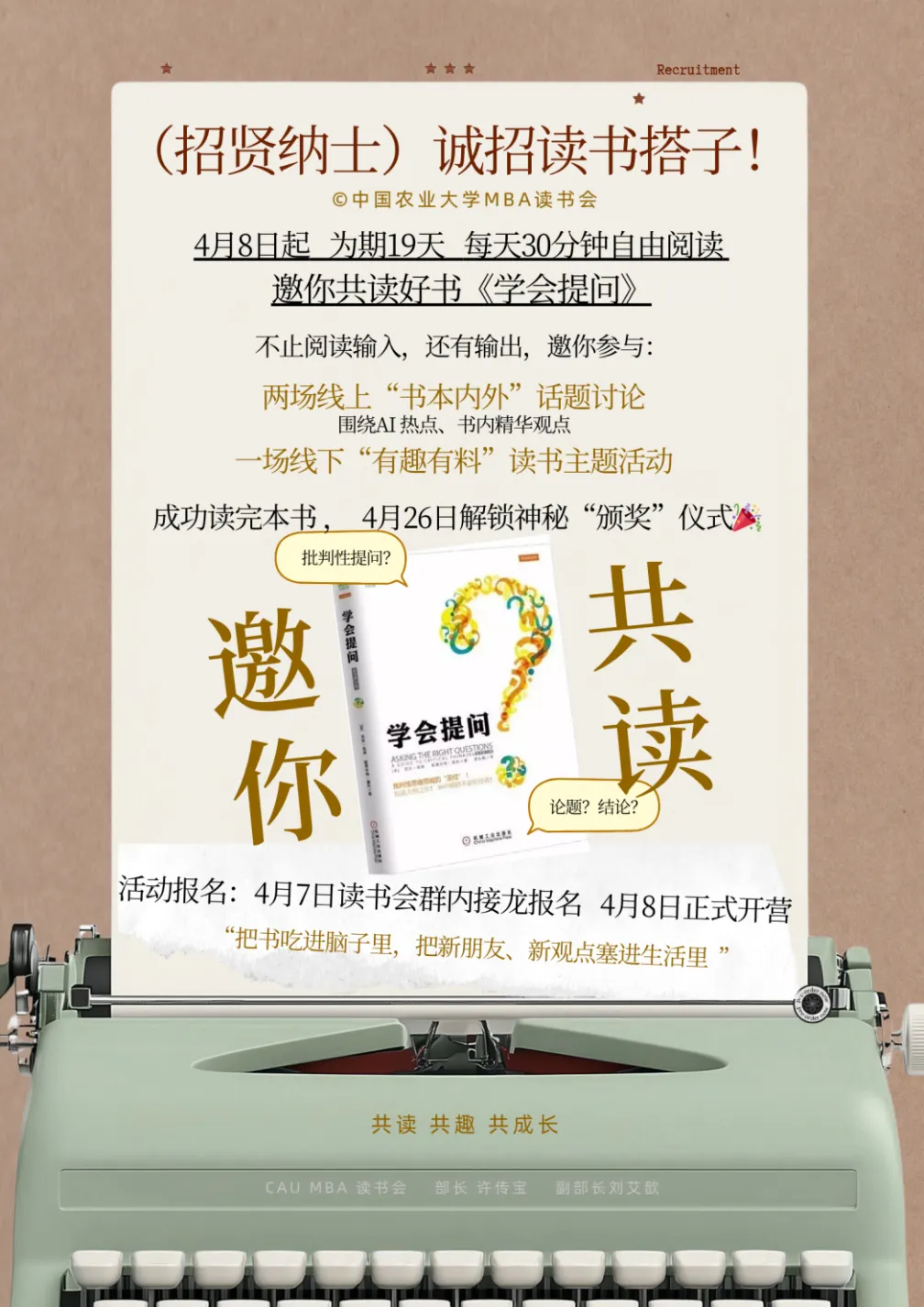
4月初,中国农大MBA读书会做了一件很“慢”的事——发起了一场为期19天的共读:《学会提问》。活动由读书会2位会长–25级综合班许传宝与刘艾歆共同发起并推进。没有复杂规则,也没有强制打卡,但仍然有30+位同学报名参与,每天抽出30分钟,持续阅读与思考。群内每天都会有一些打卡和分享,也正是在这样的阅读氛围中,一个问题逐渐浮现:当AI越来越擅长回答,我们是否还在认真提问?这个问题,没有停留在读书会内部。它成为了后来“AI时代的阅读”八校联合分享会的起点。
In early April, the China Agricultural University MBA Reading Club did something very “slow”—it launched a 19-day reading program: *Asking the Right Questions*. The activity was initiated and promoted by Xu Chuanbao, president of the 2025 cohort, and Liu Aixin, vice president. There were no complicated rules or mandatory check-ins, yet over 30 students still signed up, dedicating 30 minutes each day to continuous reading and reflection. Daily check-ins and sharing sessions took place in the group, and it was within this reading atmosphere that a question gradually emerged: As AI becomes increasingly adept at answering questions, are we still asking them seriously? This question didn’t remain within the reading club; it became the starting point for the later “Reading in the AI Era” joint sharing session with eight universities.
♥
♥
♥
01
这不是一场“读完一本书”的活动
2026
读书会
中国农大MBA
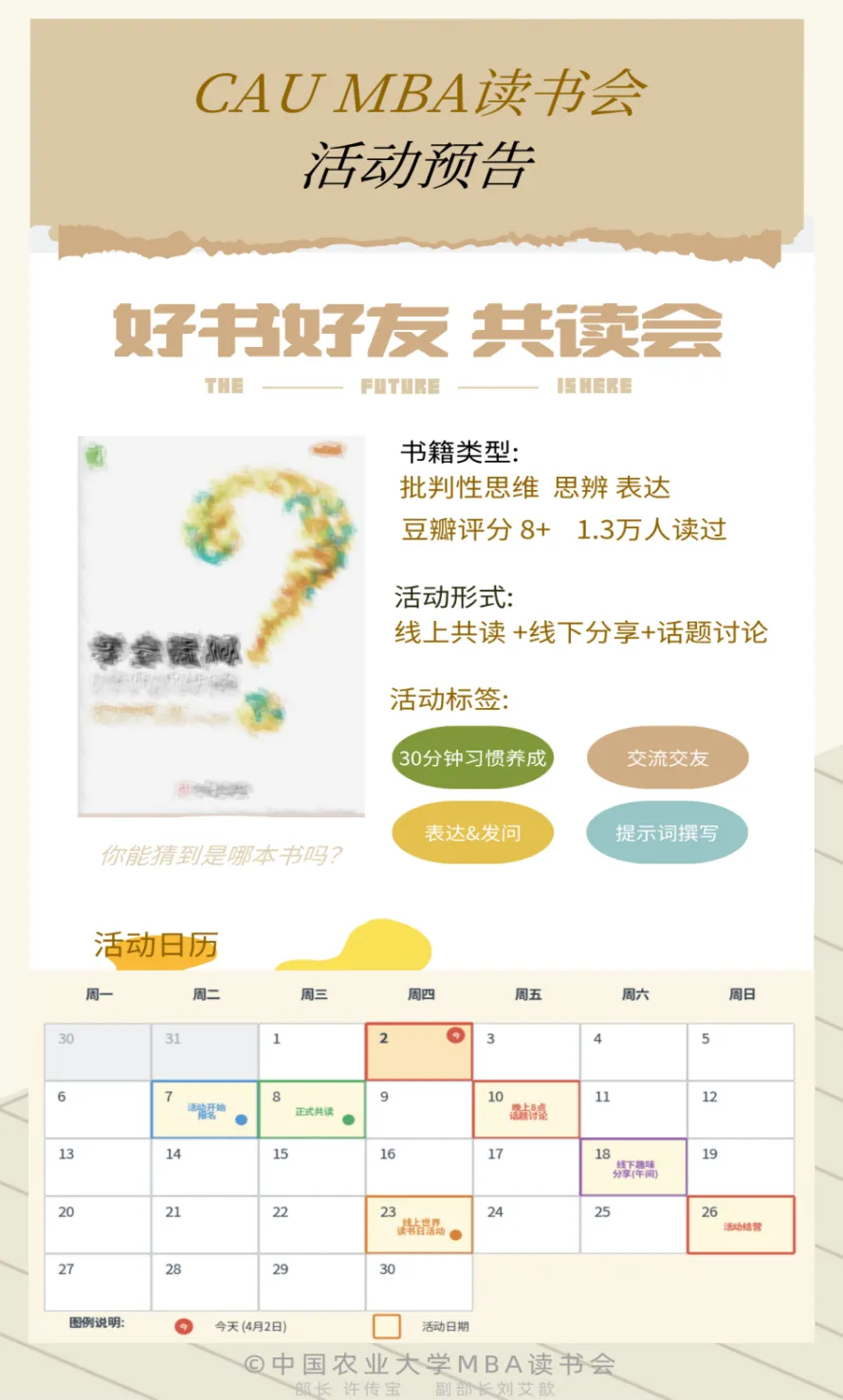
4月8日,共读正式开始。读书会并没有强调“读完”,而是更在意一件事:你是否真的在思考。于是,一些问题不断被抛出:你希望通过这本书解决什么问题?今天哪一句话,让你停下来想了一下?有没有一个你一直想问,却没有问出口的问题?
The reading program officially began on April 8th. The reading club didn’t emphasize “finishing the book,” but rather focused on one thing: whether you were truly thinking. Thus, questions were constantly raised: What problem do you hope to solve through this book? Which sentence today made you stop and think? Is there a question you’ve always wanted to ask but haven’t yet?
这不是一场“完成任务”的阅读,而是一场训练思考方式的过程。这19天里,读书会群的节奏很特别。没有人催进度,但每天都会有一句轻轻的提醒。有人在通勤路上读几页,有人深夜翻开书,也有人中途暂停,又重新回到节奏。不同节奏,但在同一件事上逐渐靠近——开始对信息,多问一句。
This wasn’t just reading to “complete a task,” but a process of training one’s thinking methods. The rhythm of the book club group was unique over these 19 days. No one pressured for progress, but there was a gentle reminder every day. Some read a few pages on their commute, some opened the book late at night, and some paused midway before resuming their pace. Different rhythms, but gradually converging on the same thing—starting to ask more questions about information.
02
我们不只是读 还在“练”
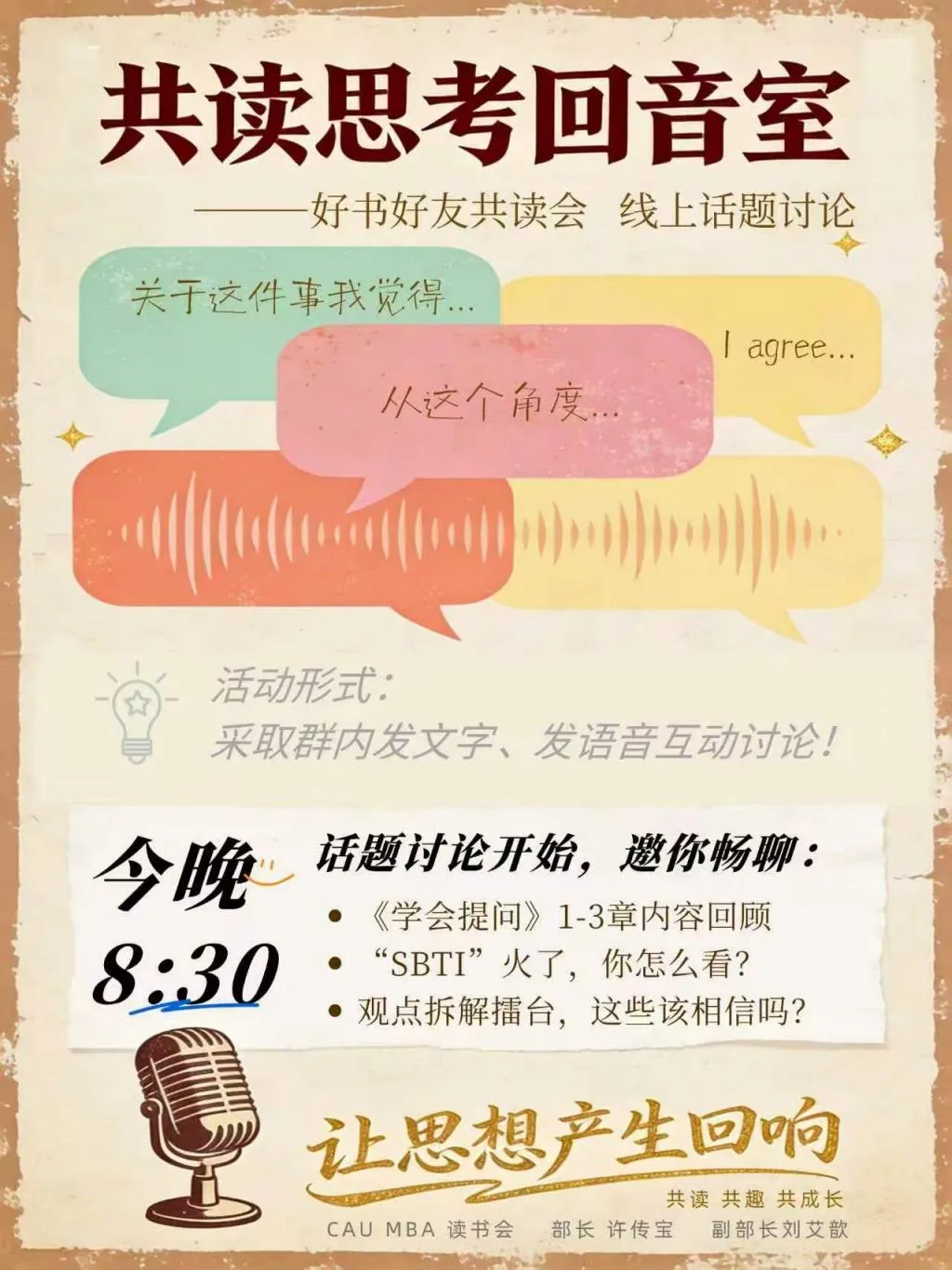
如果说阅读是输入,这次共读更重要的,是练习表达与拆解。一次晚间的群内讨论,把这种氛围推向高潮:用一句话说出自己的最大收获、围绕热点展开观点碰撞、拆解那些“看似正确”的结论。有人用文字,有人发语音,没有标准答案,但每个人都在认真表达。与此同时,不定期的问题也在群里出现:“这个结论,你真的理解了吗?”“你同意它,是因为它正确,还是因为它听起来正确?”在这样的互动中,“表达观点”变得自然,而“拆解观点”,逐渐成为一种能力。
If reading is input, this shared reading was even more important—practicing expression and deconstruction. One evening’s group discussion brought this atmosphere to a climax: summarizing one’s biggest takeaway in a single sentence, engaging in a clash of opinions around hot topics, and deconstructing seemingly correct conclusions. Some used text, some sent voice messages; there were no standard answers, but everyone was expressing themselves earnestly. At the same time, questions appeared periodically in the group: “Do you really understand this conclusion?” “Do you agree with it because it’s correct, or because it sounds correct?” In such interactions, “expressing opinions” became natural, while “deconstructing opinions” gradually became a skill.
03
从一次共读 到一种能力
这19天的共读,并没有给出一个标准答案。但它带来的变化,是具体而真实的——有人开始在面对信息时,多停一下,去想一想“这是真的吗”;有人在表达观点时,更在意理由,而不是结论本身;也有人在使用AI之前,先问清楚:我到底想解决什么问题。这些变化,或许很小,却正在慢慢累积。
This 19-day shared reading session didn’t provide a definitive answer. But the changes it brought were concrete and real—some people started pausing when faced with information to consider “Is this true?”; some focused more on reasoning than the conclusion itself when expressing opinions; and others asked themselves before using AI: What problem do I actually want to solve? These changes may be small, but they are slowly accumulating.
对一个管理者而言,这种“停下来想一想”的能力,恰恰是复杂决策中最稀缺的东西。它不会立刻让你成为更好的领导,但会让你少一些盲从、多一些判断的底气。所以,这不仅是一次读书活动,更是一次关于“如何思考”的练习。在信息越来越快、答案越来越多的时代,依然有读书会可以让人慢下来,认真读、认真想、认真交流。中国农大MBA读书会,也会继续把这样的活动做下去:不只是提供一本书,更是提供更多的学习方式。
For a manager, this ability to “stop and think” is precisely the most scarce resource in complex decision-making. It won’t immediately make you a better leader, but it will give you less blind obedience and more confidence in your judgment. Therefore, this was not just a reading activity, but also an exercise in “how to think.” In an era of ever-increasing information speed and a plethora of answers, book clubs still allow people to slow down, read carefully, think deeply, and exchange ideas meaningfully. The China Agricultural University MBA Book Club will continue to conduct such activities: not just providing a book, but providing more ways to learn.
向内,是把思考慢慢扎实;向外,是让连接一点点发生。这件事,我们会继续慢慢做下去。而每一次慢下来的思考,终将成为管理路上最稳的那一步。
Inwardly, it’s about gradually solidifying thinking; outwardly, it’s about gradually creating connections. We will continue to do this slowly. Every moment of slow reflection will ultimately become the most stable step on the road to management.

彩蛋|些许笔记和感悟
我们没有整理标准答案,但留下了一些真实的思考片段:
1.没有理由支撑的,只是观点,不是结论。
2.记住一个结论,不等于理解它。
3.多义词如果不被澄清,很容易让讨论产生偏差。
4.碎片化获取观点很快,但忽略论证,会削弱可靠性。
5.质疑不是冒犯,而是对真相的敬意。
6.批判性思维,不只是质疑别人,更是质疑自己。
We haven’t compiled standard answers, but we’ve left some genuine thoughts:
1. A viewpoint without supporting reason is merely an opinion, not a conclusion.
2. Remembering a conclusion doesn’t equate to understanding it.
3. Ambiguous terms, if not clarified, can easily lead to biased discussions.
4. Fragmented information is quick to acquire, but neglecting argumentation weakens its reliability.
5. Questioning is not offensive, but a respect for the truth.
6. Critical thinking is not just about questioning others, but also about questioning oneself.
2025级综合班 郑晓梅
批判性思维不是抬杠,而是建立环环相扣的关键问题意识。书中区分了被动吸收的“海绵式思维”与主动筛选的“淘金式思维”,并推崇敢于质疑自己立场的“强势批判性思维”。核心是掌握十大提问工具,如厘清论题、理由、歧义、假设、谬误和证据效力等。最终,学会提问,才能在信息洪流中成为理性、清醒的思考者。
Critical thinking is not about arguing for the sake of arguing, but about establishing a series of interconnected key issues. The book distinguishes between passive absorption (“sponge-like thinking”) and active selection (“gold-mining thinking”), and advocates for “strong critical thinking” that dares to question one’s own position. The core is mastering ten questioning tools, such as clarifying the topic, reasons, ambiguities, assumptions, fallacies, and the validity of evidence. Ultimately, learning to ask questions is essential to becoming a rational and clear-headed thinker amidst the deluge of information.
2025级综合班 张 营
翻开《学会提问》,是一场与自我思维的对话。作者点出“海绵式思维”让人被动吸收、迷失自我,而“淘金式思维”则是温和地与知识对话,在追问中触碰本质。书中区分了弱批判性思维(只知向外反驳)与强批判性思维(敢于向内审视),后者才是认知成熟的必经之路。真正的批判性思维不是冰冷的逻辑技巧,而是从容清醒的生活智慧——慢下来,多问一句,不被情绪裹挟。学会提问,最终不是为了争辩,而是在岁月中与自己对话,活出清醒独立的自己。
Opening “Asking the Right Questions” is a dialogue with one’s own thinking. The author points out that “sponge-like thinking” leads to passive absorption and a loss of self, while “gold-mining thinking” is a gentle dialogue with knowledge, touching the essence through questioning. The book distinguishes between weak critical thinking (only knowing how to refute externally) and strong critical thinking (daring to examine internally), the latter being the necessary path to cognitive maturity. True critical thinking is not cold logical techniques, but a calm and clear-headed wisdom of life—slowing down, asking more questions, and not being swayed by emotions. Learning to ask questions is ultimately not about arguing, but about having a dialogue with oneself over time, living a clear and independent life.
厚德|务实|专注|创新

撰稿|2025级综合班 许传宝
图片|2025级综合班 刘艾歆
排版|2025级综合班 刘博奥
审核|2025级综合班 张博浩