ARTICLE · 1103561
大学英语四级阅读真题多维拓展08
试题来源:2020年09月第1套第2篇
难度系数:5.05
维度1 真题再现(阅读理解)
Work-life balance is dead. By this, I’m not advocating that you should give up your quest to have a fulfilling career and a thriving personal life, and I am definitely not saying that you have to give up one to have the other. I also acknowledge that we have a work-life problem, but I’m arguing that the concept of balance has never been helpful, because it’s too limiting. You see, language makes a difference, and how we refer to things matters because it affects our thinking and therefore our actions.
At the minimum, most of us work because we want to be able to support ourselves, our families, and the people around us. In the ideal world, we’re all doing work that we’re proud of and that provides meaning and purpose to us. But even if your job doesn’t give you shivers of joy with each new day, working is a part of what each of us does and the contribution we make to society. When you separate work and life, it’s a little bit harder to make that connection. But when you think of work as part of a full life and a complete experience, it becomes easier to see that success in one aspect often supports another.
Losing your balance and falling isn’t pleasant. A goal to balance suggests that things could get off balance, and that causes terrible outcomes. It’s more constructive to think of solutions that continue to evolve over shifts in life and work. Rather than falling or failing, you may have good days or better days or not-so-good days. These variations are normal, and it’s more useful to think of life as something that is ever evolving and changing, rather than a high-risk enterprise where things could go wrong with one misstep.
How we talk to ourselves matters, and how we talk about issues makes a difference. Let’s bury “work-life balance” and think bigger and better about work-life fulfillment to do a little less balancing and a lot more living.
1) What does the author suggest by saying“The work-life balance is dead”?
A) The hope of achieving a thriving life is impossible to realize.
B) The pursuit of a fulfilling career involves personal sacrifice.
C) The imbalance between work and life simply doesn't exist anymore.
D) The concept of work-life balance contributes little to a fulfilling life.
2) What does the author say about our use of language?
A)It impacts how we think and behave.
B)It changes with the passage of time.
C) It reflects how we communicate.
D)It differs from person to person.
3) What does the author say we do in an ideal world?
A) We do work that betters the lives of our families and friends.
B) We do work that gives us bursts of joy each new day.
C) We do meaningful work that contributes to society
D) We do demanding work that brings our capacity into full play.
4) What does the author say about life?
A) It is cyclical.
B)It is dynamic.
C)It is fulfilling.
D)It is risky.
5) What does the author advise us to do?
A) Make life as simple as possible.
B) Talk about balance in simpler terms.
C) Balance life and work in a new way.
D)Strive for a more fulfilling life.
维度2 语块快递
1.your quest to have a fulfilling career and a thriving personal life你对拥有一份充实的事业与美满丰盈个人生活的追求
2.to make a difference有所作为;产生影响(高频写作短语)
3.at the minimum至少;最低限度(= at minimum,书面)
4.to support ourselves, our families, and the people around us养活自己、家人以及身边的人
5.to make contributions to society为社会做出贡献
6.in one aspect在某一方面;就某个层面而言
7.to get off balance失去平衡(可指心理、生活状态)
8.shifts in life and work生活与工作中的变动/变迁
9.not-so-good days不顺心的日子;难熬的时光
维度3 语法点拨
语法点:[介词with+时间名词]表示伴随
B请看段落中的句子:But even if your job doesn’t give you shivers of joy with each new day......(但即便你的工作不会让你在每一个崭新的日子里心生欣喜)。句中[介词with+时间名词each new day]表示时间背景:在…… 之时 / 伴随着(某个时间到来),相当于when each new day comes,其核心语义是:伴随each new day的到来,发生主句动作(give you shivers of joy)。再请看下面的例句:
The old man feels a surge of hope with every spring.随着每一个春天到来,老人心中都会涌起一股希望。
She gains new strength with each sunrise. 伴随着每一次日出,她获得新的力量。
The town grows quieter with every passing hour. 随着时间一分一秒流逝,小镇愈发安静。
值得注意的是,with介词词组可以挪位到句首:
With each new day, your passion may fade. 伴随着每一个新日子,你的热情或许会消退。
维度4 写译句型
句型:词组式复合形容词
英语的定语分为前位定语(主要是形容词和名词)和后位定语(如不定式、现在分词、过去分词、形容词词组、介词词组、副词等)。为了灵活表达,我们可以使用连字符号将一块使用的几个单词连接起来,构成词组式复合形容词,然后放在名词前面,由后位修饰语变成前位修饰语。请看段落中的句子,......you may have good days or better days or not-so-good days。not-so-good days的原型结构是days (that are) not so good,使用连字符号后,我们得到词组式复合形容词not-so-good。请看下面的例子:
a face-to-face talk 面对面的谈话
a hard-to-reach area 难以抵达的地区
a life-and-death struggle 殊死搏斗
a soon-to-be-married couple一对即将结婚的情侣
a well-off family 富裕的家庭
an easy-to-read article 一篇通俗易懂的文章
an up-to-date report 一份最新的报告
the around-the-clock service全天候服务
the divide-and-rule policy 分而治之的政策
the on-the-job training在职培训
the out-of-dooractivities户外活动
维度5 词汇节点
节点单词词尾:-ence
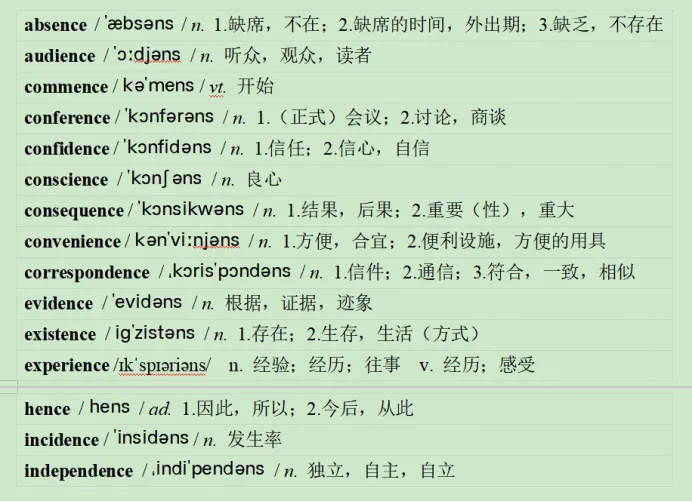
阅读段落中,difference和experience都是以字母-ence结尾的单词。大学英语教学大纲四级词汇表中,有27个单词是以字母-ence结尾,外加8个包含这些单词的词组,下面是其中的15个单词。
阅读理解参考答案
1 | 2 | 3 | 4 | 5 |
D | A | C | B | D |