ARTICLE · 1295042
2026外研社版高中英语选择性必修第四册学生AI智能体深度理解16法:第4篇|Unit 1 Looking forwards·Using language·Integrated skills
2026外研社版高中英语选择性必修第四册学生AI智能体深度理解16法:第4篇|Unit 1 Looking forwards·Using language·Integrated skills——深度理解16法之「时间距离」
外研社版高中英语选择性必修第四册 Unit 1 Looking forwards Using language·Integrated skills 完整精讲
🏫 学校:dxyc2360 👨🏫 指导教师:张元方
📖 一、深度理解16法之「时间距离」
这一板块上,时间距离从哪里看得见
时间距离讲的是理解里一条常被说反的道理:读者与文本之间隔着的那段时间,不是必须跨过去的障碍,而是理解得以发生的条件。理由不难想通:一件事刚发生的时候,动机、情绪、场面上的话全挤在一处,分不出哪一句是一时的口气、哪一句是一贯的打算;隔开一段,挤在一起的东西各自沉下去,浮在上面的与沉在底下的就分开了。伽达默尔把这个意思说成:时间距离不是一道需要填平的沟,而是一层需要辨认的厚度。读教材也一样。这一篇是 Unit 1 Looking forwards 的 Using language 之后那一块 Integrated skills(教材第8至9页,另有一页下半属跨页衔接),页上印的全是别人的选择与别人的时间:李玲在两个专业之间犹豫、六个人各说一段自己的决定、一篇讲中学生兼职的短文、四份招工广告、一段面试笔记。这些内容里时间标记极密,正好是练时间距离的地方。
第一处能看见时间距离的,是教材第7页那段对话里三个不同的时态撞在一起。李玲说 I've been recommended for admission to study physics at my dream university,这一句用现在完成时的被动,说的是推荐这件事已经办成、结果留在当下;她接着说我 had already decided to take the college entrance exam and apply to the Medical School there,这一句用过去完成时,说的是比推荐更早的一个打算;后面又说 I have always wanted to study medicine and become a dentist,这一句用现在完成时加 always,说的是一贯的愿望。三个说法各管一段时间:最短的是眼下的推荐,最长的是从小到大的愿望,中间那段是自己做过的应考打算。读的时候若把这三段时间混成一段,李玲的犹豫就像是拿不定主意;把三段时间排开看,她其实是两段长的时间在争,一段是刚刚落到手上的机会,一段是攒了很多年的志向。
第二处是她的那句 I'm really having second thoughts。进行时把犹豫压缩在此刻这一小段时间里,说的是这会儿正在动摇,不是一辈子都动摇。对面 Jenny 的回应是 Then why the indecision? Go for your preferred major.,这一句把尺度一下子拉长,问她既然志向早就定了,何必被眼前的推荐搅乱。这一段对答里,一个是短时段里的情绪,一个是长时段里的选择,时间距离要做的就是把这两样分开摆:先承认此刻确实在想不通,再看长远要的是什么。学生读到这里最容易跟着情绪走,读成「她很纠结,所以不知道怎么办」;隔着时间看,读成「她被眼前的机会摇了一下,但长期的方向没变」。
第三处时间距离在教材第8页那篇短文里,落在法规的数字上。第二段写 Many countries now have laws to regulate part-time employment for students.,紧接着给英国的例子:students aged 15 and 16 are allowed to work a maximum of 12 hours per week during term time, and 35 hours per week during school holidays. They are not allowed to work before 7 am or after 7 pm.。这里的 12 小时与 35 小时分属两段时间,一段叫 term time(学期中),一段叫 school holidays(学校假期);两个时间介词 during 各管一段,不能互相借。7 am 与 after 7 pm 又是把一天切成三段,只准中间那段用工。若把 term time 与 school holidays 混成一句「学生每周最多工作十几个小时」,数字立刻自相矛盾:12 与 35 差着近三倍,正是两段时间差出来的。
第四处时间距离在教材第9页 Richard 那段面试里,抓的全是时间词。Why did Richard do part-time jobs? 下面两条回答的起头都以 Because 引出过去的动机,中间的 What did Richard do in his previous holidays? 挂在 previous holidays 上,说的是已经过去的几个假期;有一份履历里印着 Jul 2019–present,把一段时间从现在拉到当下;笔记里还有 His 7 ________ have made him a flexible individual.,用的是现在完成时,说的是过去那些经历攒到此刻形成的结果。听力里答案的位置往往就贴着这些时间词:听到 previous holidays,后面那句就是要填的内容;听到 have made,就知道前面那一段经历已经讲完了。
第五处时间距离是对读者自己的:教材第8页第三问 Have you ever had a part-time job? Why did you do it? 与第9页末尾 Now consider if you could effectively participate in a job interview.,都不能从书上找答案。这两处要答得实,得把自己那段经历按时间排开:当时为什么去、去了做什么、现在回头看得着什么。隔开一段时间去看自己的经历,说出来的才不是当时的热乎话。时间距离用在自身上,就是把自己的过去当成一份可以回看的材料,而不是一团还在发烫的情绪。
📊 二、思维导图
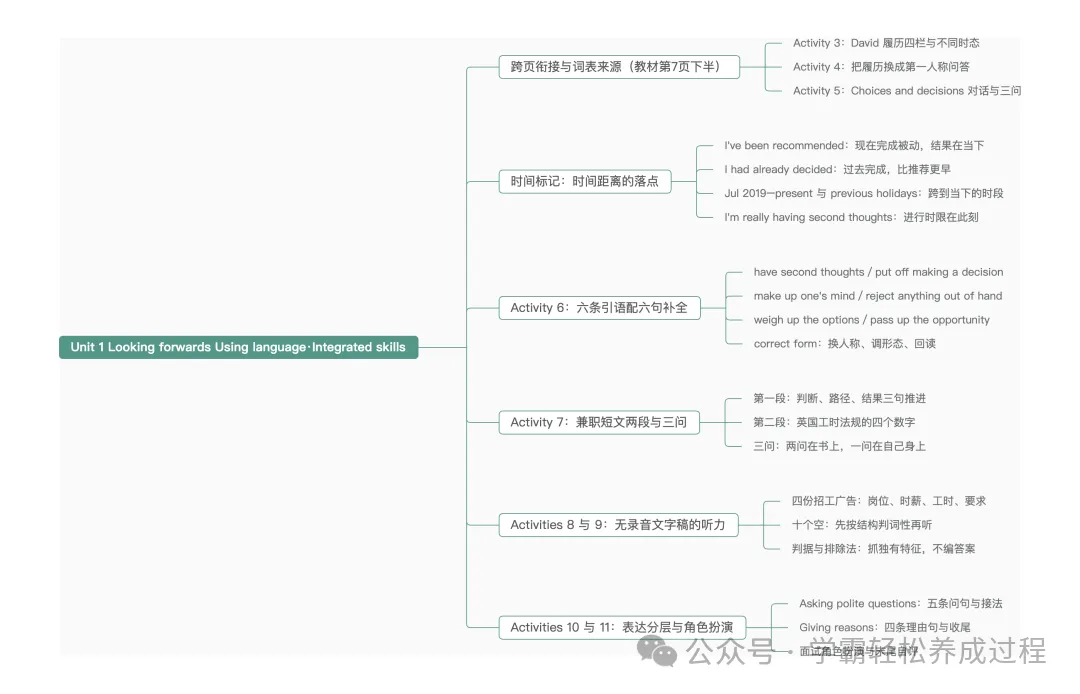
导图覆盖内容
这张导图以 Unit 1 Looking forwards Using language·Integrated skills 为中心,往外分六支:第一支是教材第7页下半那一段跨页衔接里的词表来源(Activities 3、4、5 与 Choices and decisions 这一栏),第二支是这一板块上所有的时间标记(三个时态、Jul 2019–present、previous holidays、after leaving the navy),第三支是 Activity 6 的六句补全与六个加粗表达的形态,第四支是 Activity 7 那篇兼职短文的两段要旨与三问落点,第五支是 Activities 8 与 9 的四份招工广告与十个待填空,第六支是 Activities 10 与 11 的九个表达分层与角色扮演自评。六支合起来把第8至9页上的四道编号活动、以及跨页那一页下半的词库一次收齐,照着导图回头复习,页上印过的活动一条都不会掉。
Unit 1 Looking forwards Using language·Integrated skills(思维导图)
🔑 三、重点与难点
重点
重点一:六个加粗表达的形态与时态。Activity 6 的句子要拿 Activity 5 里的表达来填,填的时候既要选对表达,也要把它改成合适的形态。这六个表达在对话里的原样是:I'm really having second thoughts(have second thoughts)、Can you put off making a decision(put off + 动名词)、I can't make up my mind(make up one's mind)、I wouldn't reject anything out of hand(reject … out of hand)、we can weigh up the options(weigh up the options)、it would be a great pity to pass up the opportunity(pass up the opportunity)。六个表达分属三种形态:进行、动词加动名词、固定词块,做题时先定形态再落笔。
重点二:Activity 6 要求的是 correct form,不只是选词。题面写 complete the sentences with the correct form of the expressions in Activity 5.。六条引语都是第一人称直述,六道待补的句子都改成第三人称,主语换成 May、Jane、Paul、Bill、Amanda、Jia Ying。人称一换,谓语跟着换:第一人称的 I'm having 到第三人称要写成 is having;I've decided 到第三人称要写成 has decided;my mind 到第三人称要写成 his mind。选对了词却没有改形态,是这一题最常见的失分处。
重点三:Activity 7 第二段的法规数字与时间介词。这一段只有两句,却压着四个数字与四个时间说法:aged 15 and 16(年龄)、a maximum of 12 hours per week during term time(学期中每小时上限)、35 hours per week during school holidays(假期中每小时上限)、before 7 am or after 7 pm(一天里的禁工时段)。四个时间说法各用各的介词:during 接一段时间,before 与 after 接时间点,per week 表频率。读这一段要能把「哪段时间、多少人、多少小时」配成一张表。
重点四:Activity 9 的十个空先判词性,再听内容。十个空前后的结构已经把答案的词性框住了:interested in 后面要名词或动名词;a 5 ________ and outgoing person 中间要形容词;His 7 ________ have made him a flexible individual. 里 have 说明主语是复数,空格要复数名词;8 ________ is relevant. 的主语是单数,空格要单数名词或不可数。先按结构判词性,听的时候只在符合词性的那类词里找,比漫无目标地等答案省力得多。
重点五:Activity 10 的九个表达按功能分两栏。页上给的九个表达分属两栏:一栏叫 Asking polite questions,一栏叫 Giving reasons。问句那一栏要的是疑问形式或请求形式,理由那一栏要的是引出原因的固定起头。九个表达里 Would you mind...?、Could you tell me...?、..., if you wouldn't mind.、May I ask why...?、Would you explain...? 五个都带疑问或请求的形式;The reason is...、It's because...、I'd say it's due to...、It's a result of... 四个都带引出原因的起头。分类的依据是形式,不是说话人的心情。
难点
难点一:哪几个表达加了粗,以教材原书为准。Activity 5 的题面写 Pay attention to the expressions in bold.,却没有逐一点名是哪几个表达。本文按 Activity 6 与 Activity 10 的复现反推:Activity 6 的六句话各要一个表达,Activity 10 又把这几个表达抄进了两栏,两处合起来正好圈出那六个与「决定」有关的词块,与对话里实际出现的 have second thoughts、put off、make up one's mind、reject … out of hand、weigh up、pass up 一一对上。正文凡说到「加粗」,都以这两处复现为据,不凭印象指派。
难点二:Activities 8 与 9 没有录音文字稿。第9页这两道活动都建立在听一段面试录音上,教材只给了四份招工广告与十个待填空,没有给对话原文。没有原文,就无从知道 Richard 应聘的是哪一份工作,也无从知道十个空里各填什么。这一篇的处理办法是:只写作答方法与判据,听什么词、按什么结构预判词性、怎么用排除法缩小范围,答案一概不给;凡涉及听力的题,文中都标「教材未给录音文字稿,此处只给判据」。
难点三:Activity 6 的六句话必须与对话里的表达逐一对应。六道待补的句子不是随便配的,每一句都能在对话里找到那句原话作依据:May 那句对 I'm really having second thoughts,Jane 那句对 Can you put off making a decision,Paul 那句对 I can't make up my mind,Bill 那句对 I wouldn't reject anything out of hand,Amanda 那句对 we can weigh up the options,Jia Ying 那句对 it would be a great pity to pass up the opportunity。对应关系一旦错位,填出来的形态一定不对,比如把 Paul 那句填成 weighing up the options,语法通、意思不通。
难点四:三道开放题没有标准答案。Activity 5 的第三问 What would you do when faced with a difficult decision?、Activity 7 的第三问 Have you ever had a part-time job? Why did you do it?、Activity 11 末尾的自评 Now consider if you could effectively participate in a job interview.,三处都要学生拿自己的经历作答,教材不给答案,也不该给。这一篇给的是作答骨架:先定点(说自己还是说书)、再给依据(举一件具体的事)、末了收一句判断。骨架给了,话还得自己说。
📝 四、易考题与易错题
易考题
易考题1:用 correct form 补全 May 那一句。题面:1 May is ___________________________________________________________.,可用的材料是 May: I thought quitting my old job to work here was the right decision to make, but now I'm not sure – the new job seems too demanding.。思路:先在引语里找与「拿不准」对应的那个表达,再看主语由 I 换成 May 之后谓语怎么变。解答:填 having second thoughts,整句为 May is having second thoughts.。理由有两条:引语里的 now I'm not sure 与 having second thoughts 同义;主语换成第三人称单数,be 动词跟着由 am 变 is。易错警示:填成 has second thoughts 是把进行时写成了一般时,读起来像「她一向如此」,与原句的「此刻动摇」不符。
易考题2:put off 后面接什么形式。题面:2 Jane is ___________________________________________________________.,材料是 Jane: Can I get back to you by the end of the week? I need to read the contract properly before making a decision.。思路:Jane 那句的核心动作是「往后拖」,对话里的 put off 后面已经带了 making a decision,照着这个搭配搬过来。解答:填 putting off making a decision,整句为 Jane is putting off making a decision.。易错警示:put off 后面接动名词,不接不定式;写成 putting off to make a decision 是把 mind 与 make 两个动词的搭配记混了。
易考题3:英国法规的具体数字。题面:Activity 7 第 2 问 What regulations are in place for students doing part-time jobs in the UK?。思路:答案全在第二段,按「年龄、学期中上限、假期中上限、禁工时段」四项取数。解答:年龄限 15 与 16 岁;学期中每周最多 12 小时;学校假期每周最多 35 小时;早上 7 点前与晚上 7 点后不许工作。作答时四项要一项不落,数字写半角阿拉伯数字。易错警示:把 12 与 35 弄反,或把 per week 记成 per day,是最常见的两处;原文用的是 a maximum of,作答时说「最多」才算忠实。
易考题4:把两个表达归栏。题面:把 Could you tell me...? 与 It's a result of... 分别归入 Asking polite questions 或 Giving reasons 两栏。思路:看形式。前者以疑问词起头、以问号收尾,是一个间接疑问句;后者以 It's 起头、后面接名词性成分,是一个说明原因的判断句。解答:Could you tell me...? 归 Asking polite questions;It's a result of... 归 Giving reasons。易错警示:见到 could 就当过去时、见到 it's 就当强调句,都会归错栏;分栏只看这句话在对话里干什么活。
易考题5:三个时态各管哪段时间。题面:把 I've been recommended for admission to study physics at my dream university.、I had already decided to take the college entrance exam and apply to the Medical School there.、I have always wanted to study medicine and become a dentist. 三句按时间先后排一排,并说出各句的时间落点。思路:现在完成时的落点在当下、动作已完成而结果还在;过去完成时的落点在过去的某个时点之前;现在完成时加 always 表从过去延续到现在的一贯状态。解答:最早起的是一贯的愿望(have always wanted),居中是自己做过的应考打算(had already decided),离此刻最近的是落到手上的推荐(have been recommended)。易错警示:把 had already decided 读成「已经决定了所以不再想」,恰恰相反,这个过去完成时说明那个决定发生在推荐之前,如今被推荐撞了一下。
易错题
易错题1:out of hand 被拆坏。错在哪:把 reject anything out of hand 写成 reject anything out of hands,或写成 reject anything out of the hand。改法:这个短语固定为 out of hand,hand 用单数、前面不加冠词,整块背下来,跟着 reject 一起记。
易错题2:pass up 后面接错成分。错在哪:把 it would be a great pity to pass up the opportunity 缩成 pass up to admit,或把 opportunity 换成动名词。改法:pass up 后面接名词性成分,教材给的是 the opportunity;opportunity 后面才用不定式 to be admitted。两个结构分层,别叠在一起。
易错题3:数字记串。错在哪:把 a maximum of 12 hours per week during term time 记成「每天 12 小时」,或把 35 hours 记成 30 hours。改法:抄写时把 per week 与 hours 一起抄,别只抄数字;两个数字并排写在纸上,旁边标上 term time 与 school holidays,一眼看出哪个大。
易错题4:婉转附加语归错栏。错在哪:把 ..., if you wouldn't mind. 归进 Giving reasons,理由是它里面有个 wouldn't 像在说原因。改法:这一条是挂在请求句尾的婉转附加语,前面要跟一个问句才成立,所以归 Asking polite questions;判断一条表达归哪栏,看它能不能单独成句回答问题。
易错题5:漏掉形式宾语 it。错在哪:3 Paul finds it easy to ___________________________________________________________ 补成 Paul finds easy to make up his mind.,把 it 丢了。改法:find、think、make、consider 一类动词后面接不定式或从句时,先用 it 占住宾语的位置,真正的宾语放到后面;这一句的 it 指的就是 to make up his mind 这件事。
🛠 五、五步学习法应用
第一步:每天锻炼一个小时。这一板块练的是听面试、说理由,正好配一段出声的功课。快走或者跳绳回来,气还顺的时候就把第7页那段对话念一遍:一个人念两个角色,Jenny 的问句往上挑,李玲的回答往下压,念够三遍算一轮。身体刚活动开,口腔松,连着念十几遍也不觉得累。念的时候把 have second thoughts、put off、weigh up 这几处咬清楚,念顺了再合上书,凭记忆把这六个表达说一遍。
第二步:扎实掌握第一个知识点。这一板块的第一个知识点是 Activity 6 那句题面里的 correct form:选词之外还要改形态。不要急着把六句话一起填掉,先拿 May 那一句把三件事做实:认出表达(have second thoughts)、换掉人称(I 到 May)、改对谓语(am 到 is)。这三步走顺了,剩下五句照着同一套动作做,只是 put off 后面要接动名词、make up one's mind 里的 my 要换成 his,都是同一套路上的变化。
第三步:能积微者速成。这一页能切出来的小份很多,一天一份就够:一天只做 Activity 6 的一句,一天只背 Activity 7 第二段的四个数字,一天只把 Activity 10 的两栏分开。每份十分钟上下,做完在旁边记一行「今天弄懂了什么」。十天下来,四道编号活动、十个待填空、九个表达全过了一遍,比考前一个晚上硬背两页要牢得多。小份的好处是每份都能收口,收口了才谈得上积。
第四步:运用对标思维突破学习困境。这一板块最容易卡住的地方是听力:没有录音文字稿,Activities 8 与 9 的答案无从核对。卡住的时候别硬猜,找一个对标的做法:把第9页那四份招工广告当成一份标准样本,逐份列出「岗位、时薪、工时、要求」四栏,再看十个空各自问的是哪一栏,比如问 why he applied 就落回岗位与兴趣,问 previous holidays 就落回经历。对标的对象不是答案,而是题与材料之间的对应关系;关系摸清了,听的时候自然知道该等哪句话。
第五步:运用杠铃法则缓解学习疲劳。这一篇的功课分两头做,中间那段省掉。一头是极轻的:把第7页那段对话当故事读一遍,只求知道两个人在争什么,五分钟。另一头是极重的:拿 Activity 11 的题目,从四份广告里挑一份,按 Activity 10 的两栏表达写一段八句的面试对答,写足二十分钟,一句一句改。中间那些抄单词、抄短语的活一律不做。轻重两头都落到实处,比在中间耗两个小时有效,也不容易烦。
📄 六、课本原文
Unit 1 Looking forwards Using language·Integrated skills(教材第8–9页)
略
知识点范围:教材第8页的 Activity 6 与 Activity 7,以及第9页的 Activities 8、9、10、11;另有一页下半的跨页衔接,即第7页 Choices and decisions 那一栏的 Activities 3、4、5,其中 Activity 5 的对话里的加粗表达正是 Activity 6 的词库。第8页 Activity 6 是六条引语配六句待补的句子,考的是六个与「做决定」有关的表达的形态;Activity 7 是一篇两段的短文加三问,短文讲中学生做兼职的好处与英国的工时法规。第9页 Activity 8 是听一段面试录音、从四份招工广告里挑出 Richard 应聘的那一份;Activity 9 是再听一遍、补全十处笔记;Activity 10 是把九个表达分进 Asking polite questions 与 Giving reasons 两栏;Activity 11 是两人挑一份广告、演一段面试。时间距离这一法在这一页上落在三处:三个时态各管一段时间、法规把学期与假期分成两段、面试笔记把过去与当下串成一条线。
例题与练习:第8页两道活动、第9页四道活动,逐题的做法与判据见第九节;把这些活动的语言点改造成六道五段式例题的,见第八节。Activities 8 与 9 附在录音上,教材未给录音文字稿,文中只给作答方法与判据,答案一概不写;凡涉及插图的题,以教材插图为唯一依据,画面里没画出来的东西一个都不补。
💡 七、知识点完整拆解
知识点1:Activity 6 的题面要的是 correct form
6 Read the statements and complete the sentences with the correct form of the expressions in Activity 5.
题面这一句里有三件事要看清。一是 read the statements(先读六条引语),二是 complete the sentences(六句待补的句子在下面),三是 with the correct form of the expressions in Activity 5(填的是上一道活动里的表达,而且要用合适的形式)。第三件事最容易漏。学生见到「complete」就只顾选词,把表达原样搬进空格,结果时态、人称、单复数全对不上。
「correct form」在这一题里至少管三层:人称(第一人称的 my 要改成 his 或 her)、时态(进行时该用的地方不能写成一般时)、以及表达内部的固定搭配(put off 后面接动名词)。三层里任何一层没改,句子就通不过。
用法与考点:做这一题的动作顺序是「找表达 → 换人称 → 调形态 → 回读一遍」。回读是最省事的一步:把填好的整句读一遍,主语与谓语对不对得上,一读就露。
知识点2:have second thoughts:此刻的动摇
May: I thought quitting my old job to work here was the right decision to make, but now I'm not sure – the new job seems too demanding.
这一句里两个时间标记夹在一起。前半截 I thought quitting my old job to work here was the right decision to make 用一般过去时,说的是当初的判断;后半截 but now I'm not sure 把时间拉回当下,说明判断动摇了。第二句 the new job seems too demanding 用一般现在时,说的是眼下这份工作给人的感觉。
下面的 but now I'm not sure 正是 have second thoughts 的意思:对已经做过的决定起了疑心。这一表达通常用进行时,说成 be having second thoughts,表示「这会儿正在动摇」,而不是「一贯动摇」。
用法与考点:have second thoughts 后面常接 about 加那件事,也可以不接。它的反义说法是 make up one's mind(拿定主意),两个表达在 Activity 5 的对话里正好一头一尾,成了这一板块的轴。
知识点3:put off:往后推,且要接动名词
Jane: Can I get back to you by the end of the week? I need to read the contract properly before making a decision.
Jane 这一句的问句 Can I get back to you by the end of the week? 先把时间点定在周末之前,再说 I need to read the contract properly before making a decision.,把「先看合同、再定」的顺序摆明。整段的意思是:这件事往后放一放。
put off 就是「推迟、往后放」,它后面接名词或动名词,不接不定式。对话里 Jenny 的原话是 Can you put off making a decision until you've spoken to your high school advisor?,put off 后面直接跟 making,这是这一板块最该背下来的搭配。
用法与考点:until 从句用现在完成时(until you've spoken)表示「等这件事做完」,是 put off 最常见的搭配之一。做题时见到 put off,先看后面是不是 -ing。
知识点4:make up one's mind:拿定主意,与形式宾语 it
Paul: The debating society or the Weiqi Club? The Weiqi Club, of course! I'm a big fan of traditional Chinese culture.
Paul 这一句先用两个名词短语把选项摆出来(The debating society or the Weiqi Club?),再用 The Weiqi Club, of course! 一句定音,末尾给理由 I'm a big fan of traditional Chinese culture.。三句话的节奏是「摆选项、定主意、说理由」。
make up one's mind 是「拿定主意」,反义正是 have second thoughts。Activity 6 第 3 句把它放进了 find it easy to 的结构里:Paul finds it easy to make up his mind.。这里的 it 是形式宾语,真正的宾语是后面那个不定式。
用法与考点:find、think、make、consider 这一类动词后面接不定式或从句时,先用 it 占住宾语的位置,这个 it 不能省。学生最容易漏的正是这个 it。
知识点5:reject … out of hand:一口回绝
Bill: Working as a clerk at my dad's insurance firm? Absolutely not! It's too boring!
Bill 这一句的语气最重:先用疑问句把选项念一遍(Working as a clerk at my dad's insurance firm?),再用 Absolutely not! 一句否掉,末了给理由 It's too boring!。三个感叹号里两个,语气全在标点上。
reject … out of hand 是「不加考虑就一口回绝」。out of hand 里的 hand 用单数、不加冠词,也不能写成 hands。这个短语的重点在「不加考虑」:不是想过了才拒绝,是压根没打算想。
用法与考点:Activity 6 第 4 句 Bill is rejecting anything out of hand. 用的是进行时,表示「他这会儿正在一口回绝」。写这个短语时把整块 out of hand 背住,别拆。
知识点6:weigh up the options:把选项掂一掂
Amanda: I need to think about the advantages and disadvantages of each option they've offered.
Amanda 这一句的关键是 the advantages and disadvantages of each option they've offered:先把每个选项的好处与坏处分开列,再作比较。they've offered 用现在完成时,说明这些选项是别人已经给到手上的。
weigh up 是「权衡、掂量」,weigh up the options 就是「把各个选项掂一掂」。它与 make up one's mind 的关系是先后:先 weigh up,才谈得上 make up one's mind。
用法与考点:weigh up 后面常接 options、advantages and disadvantages、pros and cons 一类表示「待比较项」的名词。这一句也是这一板块唯一把「比较」这个动作说透的地方,写作时可直接借用这个搭配。
知识点7:pass up:把到手的机会放掉
Jia Ying: I've decided to say no to the chance to work as a sailor after leaving the navy.
Jia Ying 这一句里有两个时间成分:I've decided 用现在完成时,说明决定已经做了;after leaving the navy 是时间状语,说明这个决定发生在离开海军之后。say no to the chance to work as a sailor 是「拒绝当水手的机会」。
pass up 是「放过、错过(机会)」,语气上带一点惋惜。对话里 Jenny 的原话是 it would be a great pity to pass up the opportunity to be admitted without taking the exam.,pass up 后面接 the opportunity,opportunity 后面才用不定式。
用法与考点:Activity 6 第 6 句 Jia Ying has decided to pass up the opportunity. 把两个结构叠在一起:decide to do 与 pass up + 名词。叠的时候各占一层,别混成一个 to。
知识点8:六句待补的句子:人称与时态的对应
1 May is ___________________________________________________________.
2 Jane is ___________________________________________________________.
3 Paul finds it easy to ___________________________________________________________.
4 Bill is ___________________________________________________________.
5 Amanda wants to ___________________________________________________________.
6 Jia Ying has decided to ___________________________________________________________.
六句待补的句子排在一起看,恰好把六条引语的第一人称全改成了第三人称:May is、Jane is、Paul finds、Bill is、Amanda wants to、Jia Ying has decided to。改人称的动作在句首就完成了,剩下要改的是表达内部的代词与谓语形态。
逐句对上去:第 1 句对 May 的 I'm not sure,填 having second thoughts,am 变 is;第 2 句对 Jane 的往后推,填 putting off making a decision;第 3 句对 Paul 的 I'm a big fan of …,填 make up his mind,my 变 his;第 4 句对 Bill 的 Absolutely not!,填 rejecting anything out of hand;第 5 句对 Amanda 的比较,填 weigh up the options;第 6 句对 Jia Ying 的 I've decided to say no,填 pass up the opportunity,I've 变 has。
用法与考点:六句里三句用进行时(is having、is putting off、is rejecting),两句用一般现在时(finds、wants),一句用现在完成时(has decided)。时态的选择不是随意的,它跟着原引语里那个动作的时间性质走。
知识点9:Activity 7 第一段:兼职的三样好处
7 Read the passage and answer the questions.
It is crucial for teenagers to develop into mature and responsible members of society. In addition to participation in school, a part-time job – such as working in a café or in an office administration role – can also be helpful in this transition. It can help them achieve new accomplishments, learn about society and become more independent.
第一段三句,结构清楚得像一张表。第一句给判断:It is crucial for teenagers to develop into mature and responsible members of society.,用 it 作形式主语,真正的主语是后面的不定式。第二句给路径:In addition to participation in school, a part-time job … can also be helpful in this transition.,破折号中间插一个 such as 举例。第三句给结果:It can help them achieve new accomplishments, learn about society and become more independent.。
三句之间是「判断、路径、结果」的推进:先说为什么重要,再说靠什么达成,末了说具体得到什么。第三句里 help 后面接了三个并列的动词原形(achieve、learn、become),一个 help 管三件事。
用法与考点:help sb do sth 里 do 不带 to;in addition to 后面接名词或动名词(这里接 participation);this transition 指的就是从少年到成年社会成员的那一段过渡。三处都是考点。
知识点10:Activity 7 第二段:法规把时间分成两段
Many countries now have laws to regulate part-time employment for students. In the UK, for example, the law states that students aged 15 and 16 are allowed to work a maximum of 12 hours per week during term time, and 35 hours per week during school holidays. They are not allowed to work before 7 am or after 7 pm.
这一段只有两句,却是一张完整的法规表。第一句给大前提:Many countries now have laws to regulate part-time employment for students.。第二句拿英国作例,四个数字分两组:年龄(15 and 16)、学期中上限(a maximum of 12 hours per week during term time)、假期中上限(35 hours per week during school holidays)、一天的禁工时段(before 7 am or after 7 pm)。
时间说法各配各的介词:during 接一段时间(during term time、during school holidays),before 与 after 接时间点(before 7 am、after 7 pm),per week 表频率。三套说法不能互换。
用法与考点:a maximum of 是「最多」,作答时要说「不超过」;regulate 是「规范、管理」,比 control 更贴法规语境。这一段的数字是本篇最容易考的事实细节,抄写时把单位与时间一起抄。
知识点11:Activity 7 的三问:两问在书上,一问在自己身上
1 What can students achieve via part-time jobs?
2 What regulations are in place for students doing part-time jobs in the UK?
3 Have you ever had a part-time job? Why did you do it?
三问的落点不一样。第一问 What can students achieve via part-time jobs? 与第二问 What regulations are in place for students doing part-time jobs in the UK? 的答案都在短文里,一问对第一段第三句,一问对第二段。第三问 Have you ever had a part-time job? Why did you do it? 换了主语,问的是读者自己。
第一问的答法是照抄三样好处:achieve new accomplishments、learn about society、become more independent。第二问的答法是四项法规一条不落。第三问没有标准答案,作答骨架是「有没有、做什么、为什么」。
用法与考点:via 是「通过」,比 through 正式;regulations are in place 是「已有规定在施行」,in place 这个短语别漏。三问的顺序也是从事实到自身,正是时间距离从书页走向读者的一条路。
知识点12:Activity 8 的四份招工广告:省略式的文体
8 Listen to the interview and choose the job Richard applied for.
Dog walker wanted!
Flexible hours
$10 / hour
Must love animals.
BUSY RESTAURANT NEEDS STAFF!
Part-time dish washer wanted at Italian restaurant.
$8.50 / hour 20 hours per week
Free meals
Part-time HOTEL RECEPTIONIST wanted!
5 hours per day
4 days per week (weekends necessary)
• Must have good people skills.
• Relevant experience preferred.
LIFEGUARDS Needed!
at public pool
30 hours per week
Uniform provided
First aid certificate essential.
四份广告的写法是同一路:先说招什么(Dog walker wanted!、LIFEGUARDS Needed!),再说条件(Flexible hours、$10 / hour、Must love animals.),条件一律用名词短语或祈使句,主语与系动词全省掉。中文广告也这么写,读起来不费力,写起来却容易把省略当随便。
四份广告各自的门槛不同:遛狗要 Must love animals.;餐馆洗碗给 $8.50 / hour 与 20 hours per week,另加 Free meals;酒店前台 5 hours per day、4 days per week (weekends necessary),要 good people skills,preferred 有相关经验;救生员 30 hours per week,Uniform provided,First aid certificate essential.。
用法与考点:wanted、needed、provided、essential、preferred 五个词撑起了整版广告的语气,前三个是被动式的省略,后两个是形容词单独成句。Activity 9 的十个空里有好几处答案就藏在这几行里,听之前先把四份广告的条件排成表,听的时候才有落点。
知识点13:Activity 9 的十个空:先判词性再听
9 Listen again and complete the notes.
Why did Richard apply for this job?
Because he has always been interested in
1 ________.
What did Richard do in his previous holidays?
• He worked in a youth hostel in Vietnam,
2 ________.
• He worked 3 ________ in Bali.
• He 4 ________ in Thailand.
Why does Richard believe he is suitable for the job?
• Because he is a 5 ________ and outgoing person, and feels happy when 6 ________.
• His 7 ________ have made him a flexible individual.
• 8 ________ is relevant.
Why did Richard do part-time jobs?
• Because he 9 ________ his holiday time.
• Because the experiences would 10 ________.
十处笔记按四个小标题分组:Why did Richard apply for this job?、What did Richard do in his previous holidays?、Why does Richard believe he is suitable for the job?、Why did Richard do part-time jobs?。四组问的是四件事:动机、经历、适任、用意。分组本身就是答题的地图。
十个空的词性可以由上下文框住:第 1 空在 interested in 后面,要名词或动名词;第 2 空跟在 in Vietnam 后面,是与地点相连的补充;第 3 空在 worked 与 in Bali 之间,要工时或岗位一类名词;第 4 空在 He 与 in Thailand 之间,缺谓语动词;第 5 空在 a 与 and outgoing person 之间,要形容词;第 6 空在 when 后面,要一个能说清「什么时候高兴」的从句成分;第 7 空在 His 与 have made 之间,have 说明要复数名词;第 8 空是 is relevant 的主语,要单数名词;第 9 空在 he 与 his holiday time 之间,缺谓语;第 10 空在 would 后面,要动词原形。
用法与考点:教材未给录音文字稿,这十个空的内容无从核对,正文只给结构与词性的判据,不给答案。做题时把判据写在空格上方,听的时候按词性筛,比空等答案稳。
知识点14:Activity 9 末尾的小组任务:判该不该给这份工作
Now work in pairs. Decide whether Richard should get the job and give your reasons.
这一条紧接十个空,把「听」转成「评」:先决定 Richard 该不该得到这份工作,再给理由。它不是听力题,是口语任务,答案开放。
作答骨架可以照四步走:一是复述他申请的那份工作与他的动机;二是举他履历里与岗位要求对得上的那一两处;三是点出他与岗位要求差着的那一处;四是给一句结论,说明这一处差距能不能靠别的条件抵掉。
用法与考点:decide whether … and give your reasons 这个句式里,whether 从句用陈述语序,reason 用复数说明要给不止一条。口语作答时把四步走完,比只说「我觉得他行」有分量。
知识点15:Activity 10 的九个表达:按形式分两栏
10 Complete the boxes with the expressions from the interview.
• Would you mind...?
• The reason is...
• Could you tell me...?
• ..., if you wouldn't mind.
• May I ask why...?
• It's because...
• I'd say it's due to...
• Would you explain...?
• It's a result of...
Asking polite questions
Giving reasons
九个表达排成一列,两栏的表头在下面:Asking polite questions 与 Giving reasons。分栏的依据是形式,不是意思:带疑问词或请求形式的进第一栏,带原因起头的进第二栏。
第一栏五个:Would you mind...?、Could you tell me...?、..., if you wouldn't mind.、May I ask why...?、Would you explain...?。第二栏四个:The reason is...、It's because...、I'd say it's due to...、It's a result of...。
用法与考点:第一栏的五个里,Would you mind 后面接动名词,Could you tell me 后面接陈述语序的从句,May I ask why 后面也接陈述语序;第二栏的四个都靠一个名词性成分收尾(the reason is 后面接从句或名词,due to 与 a result of 后面接名词)。形式一清楚,两栏就不会串。
知识点16:Activity 11 与末尾自评:把表达用出去
11 Work in pairs. Choose a part-time job advertisement in Activity 8 and act out an interview using the expressions in this section.
Now consider if you could effectively participate in a job interview.
Activity 11 把前面所有零件装成一台机器:从四份广告里挑一份,用 Activity 10 的两栏表达演一段面试。挑广告是定角色,用表达是定台词。
末尾那句 Now consider if you could effectively participate in a job interview. 是自评,要学生回头判自己能不能有效地参加一场面试。effectively 是关键词:不是「能不能说」,是「说得有没有用」。
用法与考点:act out 是「演出来」,不是「读出来」;in this section 指的就是 Activity 10 那两栏。自评要落到具体:哪一句问得得体、哪一处理由说得空,各举一例。
知识点17:跨页衔接:David 的履历与时间线
3 Work in pairs. Read the profile and talk about David's life using different tenses where appropriate.
David Mason
PERSONAL INFORMATION
Date of Birth 20 June 2001
Nationality British
EDUCATION
2007–2013 Carson Primary School
2013–2019 Wildwood High School
EXTRACURRICULAR EXPERIENCE
Sept 2017 first prize for school science project
Apr–Oct 2018 exchange programme in China
Jul 2019–present gap year in Cambodia
FUTURE PLANS
undergraduate study at Newcastle University
chemical engineer after graduation
voluntary work to help people in need
这一页下半属跨页衔接,印的是上一板块收尾处的词表来源。Activity 3 给了一份履历,四栏依次是 PERSONAL INFORMATION、EDUCATION、EXTRACURRICULAR EXPERIENCE、FUTURE PLANS,每栏都是「年份 + 事实」的写法,没有一个完整的句子。
四栏的时间落点各不相同:出生日期与国籍是静态事实;两段学历是封闭的过去区间(2007–2013、2013–2019);三段课外经历跨到当下(Sept 2017、Apr–Oct 2018、Jul 2019–present);未来计划那一栏全是尚未发生的事(undergraduate study at Newcastle University、chemical engineer after graduation、voluntary work to help people in need)。
用法与考点:题面说 talk about David's life using different tenses where appropriate.,意思就是把这四栏按时间摊开,各用各的时态:学历用一般过去时,gap year 用现在完成时或现在完成进行时,未来计划用一般将来时或 be going to。这一栏与下一篇的面试笔记是同一条路:时间标记决定时态。
知识点18:Activity 4 与栏目标题:把履历换成对话
4 Work in pairs. Interview each other about your past experience and future plans. Share them with the class using different tenses where appropriate.
Choices and decisions
Activity 4 把 Activity 3 的第三人称履历翻成第一人称问答:interview each other about your past experience and future plans,再用 different tenses where appropriate 说出来,末了 share them with the class。
上面那行 Choices and decisions 是这一栏的标题。四个词把整块内容收住了:先有选择(options),才有决定(decisions),而选择与决定之间隔着的那段时间,正是这一篇的时间距离。
用法与考点:share sth with sb 是「与某人分享」;where appropriate 是「在合适的地方」,这是个很好用的书面语,写作时可用来说明「该用的时候才用」。
知识点19:Activity 5 的对话:三个时态撞在一处
5 Read the conversation and answer the questions. Pay attention to the expressions in bold.
1 What difficult decision is Li Ling facing? Why is she feeling worried?
2 What does Jenny suggest to her?
3 What would you do when faced with a difficult decision?
Jenny: What's up, Li Ling? You look worried.
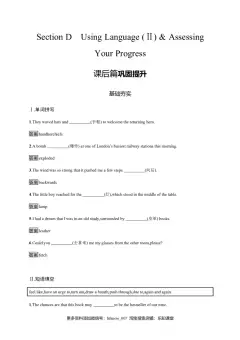
Li Ling: I'm facing a difficult decision. I've been recommended for admission to study physics at my dream university.
Jenny: Congratulations! But what do you mean by a difficult decision? I think the course is tailor-made for you!
Li Ling: Well, it sounds wonderful, but I had already decided to take the college entrance exam and apply to the Medical School there. I can't make up my mind what the right thing to do is.
Jenny: I think it would be a great pity to pass up the opportunity to be admitted without taking the exam.
Li Ling: I know, but I have always wanted to study medicine and become a dentist. Physics is interesting, but it's not my preferred major.
Jenny: Then why the indecision? Go for your preferred major.
Li Ling: But what if I don't do well enough in the exam to get into the Medical School? I'm really having second thoughts.
Jenny: Can you put off making a decision until you've spoken to your high school advisor?
Li Ling: I have already talked to her. She told me that I must decide what's right for me now, and then go for it. The problem is I don't know what is right for me.
Jenny: Well, I wouldn't reject anything out of hand. Let's go for lunch. Then we can weigh up the options and try to come to a decision. Let's put the kettle on.
这段对话十四行,两人来回。Jenny 起头问 What's up, Li Ling? You look worried.,把话头递过去;李玲交代难处;Jenny 三次给建议(Congratulations! … I think the course is tailor-made for you!、Then why the indecision? Go for your preferred major.、Can you put off making a decision until you've spoken to your high school advisor?);末了 Jenny 收在一句日常的 Let's put the kettle on.。
对话里的时间层层叠叠:I've been recommended(现在完成被动,结果在当下)、I had already decided(过去完成,比推荐更早)、I have always wanted(现在完成加 always,一贯的愿望)、I'm really having second thoughts(进行时,限在此刻)、I wouldn't reject anything out of hand(would,表假设的委婉)。五处时间标记挤在十四行里,正是练时间距离的密集区。
用法与考点:三问里前两问在对话里,第三问在读者身上。第一问要答两件事:难处是什么、为什么担心;第二问要答 Jenny 的三次建议;第三问答自己。题面说的 Pay attention to the expressions in bold. 未逐一点名,哪几个表达加了粗以教材原书为准,本文按 Activity 6 与 Activity 10 的复现反推。
📝 八、例题完整拆解
例1(教材第7页) 三个时态各管哪段时间
题目:把对话里 I've been recommended for admission to study physics at my dream university.、I had already decided to take the college entrance exam and apply to the Medical School there.、I have always wanted to study medicine and become a dentist. 三句按时间先后排一排,并说出各句的时间落点与它在对话里起的作用。
思路:先看每句的时态形式,再定时间落点:现在完成时的落点在当下、动作已完成而结果还在;过去完成时的落点在过去的某个时点之前;现在完成时加 always 表从过去延续到现在的一贯状态。落点定了,再看这三句在李玲的话里各干什么活。
解答:最早起的是一贯的愿望(I have always wanted to study medicine and become a dentist),它给整段对话定了一个长时段的底;居中是自己做过的应考打算(I had already decided to take the college entrance exam),它比推荐更早,说明路早就选过;离此刻最近的是落到手上的推荐(I've been recommended for admission),它是新出现的一个岔口。三句排开,李玲的难处就不是「没主意」,而是两段时间打在一起:一段是攒了很多年的志向,一段是刚到手的机会。
易错警示:把 had already decided 读成「已经决定了,所以不再考虑」,是把过去完成时当成了「已经完成、不必再提」。这个时态真正的意思是「在推荐这件事之前就已经定了」,它标的是先后,不是终局。
核心发现:同一段话里时态越密,越要先排时间再看意思。时间距离给的做法就是这一步:不急着判人物性格,先把时间摊开,看哪一段在跟哪一段争。
例2(教材第7页) 六个加粗表达的形态改写
题目:Activity 6 要求用 Activity 5 里表达的正确形式补全六句。请说出六个表达各自的原样、改写后该用什么形态,以及改写时改了哪几样东西。
思路:逐条把引语里的表达与待补句子的主语对起来,再问三件事:主语由谁换成谁、谓语要不要跟着变、表达内部的代词要不要换。三件事定了,形态就定了。
解答:第 1 句 May is having second thoughts.(am 变 is,其余照搬);第 2 句 Jane is putting off making a decision.(is + 动名词,put off 后面接 making);第 3 句 Paul finds it easy to make up his mind.(my 变 his,find it easy to do 的 it 不能省);第 4 句 Bill is rejecting anything out of hand.(is + 动名词,out of hand 整块照搬);第 5 句 Amanda wants to weigh up the options.(want to do 后面接 weigh up);第 6 句 Jia Ying has decided to pass up the opportunity.(I've 变 has,decide to do 后面接 pass up)。
易错警示:只选词不改形态,是最常见的失分:写成 May has second thoughts,句子成立但意思变成「她一向如此」,与原文的 now I'm not sure 不符。另一种是改过了头:把 weigh up 改成 weighing up 放进 wants to 后面,语法就垮了。
核心发现:correct form 这四个字考的是「形态跟着语境走」。同一批表达放进不同句子,形态可以全不一样;判断依据是主语、时态与固定搭配三样,不是记忆里那个原样。
例3(教材第8页) Activity 7 第二问:法规数字的复述
题目:用一句话回答 What regulations are in place for students doing part-time jobs in the UK?,要求四个数字与四个时间说法一项不落,并把「每周」「学期中」「假期」「点」四类说法各用对一次。
思路:先把第二段的两句拆成一张四行的表:年龄、学期中上限、假期中上限、一日禁工时段;每行左边写数字,右边写时间说法;再把四行串成一句或三句。
解答:英国的规定是:15 与 16 岁的学生,学期中每周最多工作 12 小时,学校假期每周最多 35 小时,早上 7 点之前与晚上 7 点之后不许工作。四行分别是 aged 15 and 16、a maximum of 12 hours per week during term time、35 hours per week during school holidays、not allowed to work before 7 am or after 7 pm。
易错警示:把 per week 说成 per day,12 与 35 就都放大成七倍;把 during term time 与 during school holidays 混成一句,12 与 35 立刻互相矛盾。另一处易错是把 a maximum of 说成 exactly,把「上限」说成「定额」。
核心发现:法规类文字的时间说法比数字更值钱。数字记错一个还能补,时间说法用错,整段意思就翻。时间距离在这里的用法是:先认清有哪几段时间,再往每段里装数字。
例4(教材第9页) Activity 8:四份广告的判据设计
题目:Activity 8 要求听一段面试录音、从四份招工广告里挑出 Richard 应聘的那一份。教材未给录音文字稿。请为这道题设计一套判据,说明听什么、怎么排除。
思路:先把四份广告拆成四栏(岗位、时薪、工时、要求),四份并排放在纸上;再想面试里会出现哪些词与这四栏对应:岗位名、工时说法、薪资说法、要求里的关键词。听的时候拿听到的词往四栏里落,落得最多的那一份就是答案。
解答:四份广告的判别特征各有一处硬指标:遛狗那份是 Must love animals.;餐馆洗碗那份是 $8.50 / hour 与 20 hours per week、Free meals;酒店前台那份是 5 hours per day 与 4 days per week (weekends necessary)、good people skills;救生员那份是 30 hours per week、Uniform provided、First aid certificate essential.。听的时候优先抓工时与要求里的关键词,这两栏最不容易撞车。
易错警示:不要凭「像不像」猜。四份广告里有三份都提到工时,只有救生员那份提到 First aid certificate,只有遛狗那份提到 love animals;若不抓这些独有特征,凭印象选一定出错。另一处易错是拿 Activity 9 的笔记去反推答案,笔记本身也是待填的,反推就成了循环论证。
核心发现:听力题在无文字稿时的正确做法是「先建判据,再听」。判据建在原文之外(广告的条件表),听的时候只做匹配,这样即便没听清整段,也能靠独有特征定案。教材未给录音文字稿,此处只给判据,答案不在本文写出。
例5(教材第9页) Activity 9:十个空的词性预判
题目:为 Activity 9 的十处空格各写一条词性判据,并说明听的时候该在哪一类词里找。教材未给录音文字稿。
思路:逐空看前后各两个词:前面是介词、冠词还是物主代词,后面是名词、形容词还是从句。把这些线索拼起来,就能定出空格该填什么词性;词性定了,听的时候只在那一类词里筛。
解答:第 1 空在 interested in 后面,要名词或动名词;第 2 空在 in Vietnam 后面,补的是与地点相连的信息;第 3 空在 worked 与 in Bali 之间,要工时或岗位一类名词;第 4 空在 He 与 in Thailand 之间,缺谓语动词,且要与上下文时态一致;第 5 空在 a 与 and outgoing person 之间,要形容词;第 6 空在 when 后面,要一个能说清时间的成分;第 7 空在 His 与 have made 之间,have 说明要复数名词;第 8 空是 is relevant 的主语,要单数名词或不可数名词;第 9 空在 he 与 his holiday time 之间,缺谓语;第 10 空在 would 后面,要动词原形。
易错警示:见到空格就等一个「听起来像答案」的词,是最费神的做法:十处一起等,注意力散在半空里。另一处易错是忽略 have made 这个提示,把第 7 空填成单数名词,主语与谓语就对不上。
核心发现:词性预判把「听」变成「核对」:本来要从整段话里捞十个答案,预判之后只需要在符合词性的词里确认。这一步做在听之前,是听力题里最划算的功课。
例6(教材第9页) Activity 10:九个表达分两栏
题目:把 Activity 10 的九个表达分进 Asking polite questions 与 Giving reasons 两栏,并说明每一条的归类依据。
思路:看形式,不看意思。问句与请求句带疑问词、问号或 if 从句;理由句带一个能接名词性成分的起头。分完之后回头检查:第一栏的每一条能不能单独用来提问,第二栏的每一条能不能单独用来回答 why。
解答:第一栏五个:Would you mind...?、Could you tell me...?、..., if you wouldn't mind.、May I ask why...?、Would you explain...?。第二栏四个:The reason is...、It's because...、I'd say it's due to...、It's a result of...。第一栏五条都靠问号或请求语气成立,第二栏四条都靠一个名词性成分收尾。
易错警示:把 ..., if you wouldn't mind. 归进第二栏,是这一题最常见的错:它里面有个 wouldn't,看着像在说条件,其实是挂在请求句尾巴上的婉转附加语,前面必须有一个问句才成立。另一处易错是把 It's a result of... 当成强调句,其实它就是给出原因的判断句。
核心发现:表达分栏只看「这句话在对话里干什么活」。同一个词形放进不同位置,活就变了;把功能摸清,比背清单管用。
📚 九、练习与习题完整拆解
这一板块共有七道编号活动:教材第8页的 Activity 6 与 Activity 7,教材第9页的 Activities 8、9、10、11,另有印在前一页下半、属跨页衔接的 Activities 3、4、5。下面按「跨页衔接」「第8页」「第9页」三段逐条拆,每一条都写出题面、作答依据与做法;听力题只给判据不编答案,开放题只给骨架不给答案。
📚 跨页衔接:教材第7页下半 Choices and decisions(Activities 3–5)
Activity 3 与 Activity 4 的题面
3 Work in pairs. Read the profile and talk about David's life using different tenses where appropriate.
4 Work in pairs. Interview each other about your past experience and future plans. Share them with the class using different tenses where appropriate.
这两条活动印在前一页,属上一板块的收尾;它们之所以要在这里过一遍,是因为 Activity 6 的词库(Activity 5 里那几个加粗表达)就长在这一页上,而这一页的全部文字与第8页的六句补全共用同一套时间标记。逐格拆 David 的履历,看的是「什么样的时间写什么样的时态」;Activity 4 把履历翻成问答,看的是同一套时间标记换到第一人称之后怎么变。
David 的履历逐格拆(Activity 3)
David Mason
PERSONAL INFORMATION
Date of Birth 20 June 2001
Nationality British
EDUCATION
2007–2013 Carson Primary School
2013–2019 Wildwood High School
EXTRACURRICULAR EXPERIENCE
Sept 2017 first prize for school science project
Apr–Oct 2018 exchange programme in China
Jul 2019–present gap year in Cambodia
FUTURE PLANS
undergraduate study at Newcastle University
chemical engineer after graduation
voluntary work to help people in need
逐格看时间性质:PERSONAL INFORMATION 那一栏的两条(Date of Birth 与 Nationality)是静态事实,说话时用一般现在时;EDUCATION 那一栏的两条是封闭的过去区间(2007–2013、2013–2019),用一般过去时;EXTRACURRICULAR EXPERIENCE 那一栏三条的落点各不相同,Sept 2017 是过去的时点、Apr–Oct 2018 是过去的区间、Jul 2019–present 一直延续到当下,末了一条要用现在完成时或现在完成进行时;FUTURE PLANS 那一栏三条全是尚未发生的事,用一般将来时或 be going to。
题面里 different tenses where appropriate 这半句是全题的钥匙:不是随便换时态,是「该换的地方才换」。判据只有一个:这件事落在哪一段时间里。落在过去的用过去时,跨到当下的用完成时,还没发生的用将来时。四栏摊开,正好是时间距离的一张示意图:过去、当下、未来各占一栏,中间那条 present 是分界。
Activity 4:把履历换成问答
Activity 4 的动作有三步:两人互问 past experience(过去的经历)与 future plans(未来的计划),用合适的时态说出来,再向全班 share。答题时的抓手是把 Activity 3 的四栏翻成第一人称的问题:What did you study at primary school?(对应 EDUCATION 栏,过去时)、What have you been doing since 2019?(对应 gap year,现在完成进行时)、What are you going to study?(对应 FUTURE PLANS,将来时)。问句的时态也要跟着时间走,不能全用一般现在时。
Activity 5:对话逐句与三问
Choices and decisions
5 Read the conversation and answer the questions. Pay attention to the expressions in bold.
Jenny: What's up, Li Ling? You look worried.
Li Ling: I'm facing a difficult decision. I've been recommended for admission to study physics at my dream university.
Jenny: Congratulations! But what do you mean by a difficult decision? I think the course is tailor-made for you!
Li Ling: Well, it sounds wonderful, but I had already decided to take the college entrance exam and apply to the Medical School there. I can't make up my mind what the right thing to do is.
Jenny: I think it would be a great pity to pass up the opportunity to be admitted without taking the exam.
Li Ling: I know, but I have always wanted to study medicine and become a dentist. Physics is interesting, but it's not my preferred major.
Jenny: Then why the indecision? Go for your preferred major.
Li Ling: But what if I don't do well enough in the exam to get into the Medical School? I'm really having second thoughts.
Jenny: Can you put off making a decision until you've spoken to your high school advisor?
Li Ling: I have already talked to her. She told me that I must decide what's right for me now, and then go for it. The problem is I don't know what is right for me.
Jenny: Well, I wouldn't reject anything out of hand. Let's go for lunch. Then we can weigh up the options and try to come to a decision. Let's put the kettle on.
三问的落点
1 What difficult decision is Li Ling facing? Why is she feeling worried?
2 What does Jenny suggest to her?
3 What would you do when faced with a difficult decision?
第一问要答两件事:难处是什么、为什么担心。难处是两条路撞在一起,一条是被推荐免试入读梦想大学的物理专业,一条是自己早就定下的应考医学专业的打算;担心的据在 I'm really having second thoughts 与 what if I don't do well enough in the exam 两处,怕的是应考失手、两头落空。第二问要答 Jenny 的三次建议:先是恭喜并说这个专业 tailor-made for you,再说 Go for your preferred major,末了提议 put off making a decision until you've spoken to your high school advisor。第三问问的是读者自己,作答骨架是「先说选择是什么、再说依据、末了给一句判断」,答案不在书上。
对话里最该记的一处,是 Jenny 收尾那句 I wouldn't reject anything out of hand. Let's go for lunch. Then we can weigh up the options and try to come to a decision.。一句话里用了两个待考表达(reject … out of hand、weigh up the options),又把「先吃饭、再权衡、后决定」的顺序排好,是这一页的时间距离最紧凑的一处。
Looking forwards 7
📚 活动逐题拆解(教材第8–9页)
Activity 6:六条引语配六句补全
6 Read the statements and complete the sentences with the correct form of the expressions in Activity 5.
May: I thought quitting my old job to work here was the right decision to make, but now I'm not sure – the new job seems too demanding.
Jane: Can I get back to you by the end of the week? I need to read the contract properly before making a decision.
Paul: The debating society or the Weiqi Club? The Weiqi Club, of course! I'm a big fan of traditional Chinese culture.
Bill: Working as a clerk at my dad's insurance firm? Absolutely not! It's too boring!
Amanda: I need to think about the advantages and disadvantages of each option they've offered.
Jia Ying: I've decided to say no to the chance to work as a sailor after leaving the navy.
1 May is ___________________________________________________________.
2 Jane is ___________________________________________________________.
3 Paul finds it easy to ___________________________________________________________.
4 Bill is ___________________________________________________________.
5 Amanda wants to ___________________________________________________________.
6 Jia Ying has decided to ___________________________________________________________.
逐句作答
第 1 题:题面 1 May is ___________________________________________________________,对应 May 的 I'm not sure;答案 having second thoughts,整句 May is having second thoughts.;依据是 now I'm not sure 与 having second thoughts 同义,主语换成第三人称单数后 be 动词由 am 变 is。
第 2 题:题面 2 Jane is ___________________________________________________________,对应 Jane 的往后推;答案 putting off making a decision,整句 Jane is putting off making a decision.;依据是 put off 后接动名词,对话里已有 Can you put off making a decision 这一原样搭配。
第 3 题:题面 3 Paul finds it easy to ___________________________________________________________,对应 Paul 的 The Weiqi Club, of course! 与 I'm a big fan of …;答案 make up his mind,整句 Paul finds it easy to make up his mind.;依据是 make up one's mind 拿定主意,主语第三人称后 my 变 his,find it easy to 里的 it 是形式宾语不能省。
第 4 题:题面 4 Bill is ___________________________________________________________,对应 Bill 的 Absolutely not!;答案 rejecting anything out of hand,整句 Bill is rejecting anything out of hand.;依据是语气上的一口回绝,out of hand 整块照搬,hand 用单数。
第 5 题:题面 5 Amanda wants to ___________________________________________________________,对应 Amanda 的比较好处与坏处;答案 weigh up the options,整句 Amanda wants to weigh up the options.;依据是 want to 后面接动词原形,the options 呼应引语里的 each option。
第 6 题:题面 6 Jia Ying has decided to ___________________________________________________________,对应 Jia Ying 的 I've decided to say no to the chance …;答案 pass up the opportunity,整句 Jia Ying has decided to pass up the opportunity.;依据是 decide to do 与 pass up 加名词两个结构各占一层,I've decided 到第三人称变成 has decided。
六题的共同动作是「换人称、调形态」:主语全由第一人称换成第三人称,三句用进行时、两句用一般现在时、一句用现在完成时。做完之后回读一遍,主语与谓语对得上,这一题就算过。
8 UNIT 1
Activity 7:短文两段与三问
7 Read the passage and answer the questions.
It is crucial for teenagers to develop into mature and responsible members of society. In addition to participation in school, a part-time job – such as working in a café or in an office administration role – can also be helpful in this transition. It can help them achieve new accomplishments, learn about society and become more independent.
Many countries now have laws to regulate part-time employment for students. In the UK, for example, the law states that students aged 15 and 16 are allowed to work a maximum of 12 hours per week during term time, and 35 hours per week during school holidays. They are not allowed to work before 7 am or after 7 pm.
第一段逐句:第一句 It is crucial for teenagers to develop into mature and responsible members of society. 是判断句,it 作形式主语,真正的主语是不定式短语;第二句 In addition to participation in school, a part-time job … can also be helpful in this transition. 是路径句,破折号里用 such as 举两例(working in a café、in an office administration role);第三句 It can help them achieve new accomplishments, learn about society and become more independent. 是结果句,一个 help 管三个动词原形。三句的推进是「为什么重要、靠什么达成、得到什么」。
第二段逐句:第一句 Many countries now have laws to regulate part-time employment for students. 给大前提,now 点明这是当下的立法状况;第二句拿英国作例,把年龄、学期中上限、假期中上限、一日禁工时段四件事一次给全。四件事对应四个数字与三类时间说法,抄写时把时间说法与数字配在一起抄,别只抄数字。
第 1 问 What can students achieve via part-time jobs? 的答案在第一段第三句,三样一句不落:achieve new accomplishments、learn about society、become more independent。
第 2 问 What regulations are in place for students doing part-time jobs in the UK? 的答案在第二段,四项:15 与 16 岁的学生可做工;学期中每周最多 12 小时;学校假期每周最多 35 小时;早上 7 点前与晚上 7 点后不许工作。
第 3 问 Have you ever had a part-time job? Why did you do it? 换到读者身上,没有标准答案。作答骨架:先答有没有(有的说是什么岗、在什么时间做的),再答为什么(为挣钱、为练胆、为看社会各说一条具体的),末了补一句现在回看怎么看那段经历。时间距离在这里的意思是:把当时的动机与现在的看法分开说,别混成一句。
Activity 8:听录音挑岗位(教材未给录音文字稿,只给判据)
8 Listen to the interview and choose the job Richard applied for.
Dog walker wanted!
Flexible hours
$10 / hour
Must love animals.
BUSY RESTAURANT NEEDS STAFF!
Part-time dish washer wanted at Italian restaurant.
$8.50 / hour 20 hours per week
Free meals
Part-time HOTEL RECEPTIONIST wanted!
5 hours per day
4 days per week (weekends necessary)
• Must have good people skills.
• Relevant experience preferred.
LIFEGUARDS Needed!
at public pool
30 hours per week
Uniform provided
First aid certificate essential.
这一题的四份广告已全部抄在这里。教材未给录音文字稿,Richard 应聘的是哪一份,本文不写答案,只给判据。做法是先把四份广告按「岗位、时薪、工时、要求」四栏排一张表,再在听的时候抓四类词:岗位名(dog walker、dish washer、receptionist、lifeguard)、工时说法(20 hours per week、5 hours per day、4 days per week、30 hours per week)、薪资说法($10 / hour、$8.50 / hour)、要求里的关键词(good people skills、Relevant experience preferred、First aid certificate essential.)。
排除法有三条:一是工时,四份广告里 30 hours per week 与 20 hours per week 最容易被混,听到 weekly 数目先记下来;二是要求,First aid certificate essential. 与 Must love animals. 是两份广告独有的门槛,听到其中一条就能定案;三是周末条件,只有酒店前台那份写明 weekends necessary,听到 weekend 这个词就要往那一份上想。三条合用,即便整段没听清,也能靠独有特征把答案缩到一份。
这一题的插图与排版以教材插图为唯一依据:四份广告在页上的框线位置与字号版面,本文按书上文字照抄,图上的排版细节不补。
Activity 9:再听一遍补全笔记
9 Listen again and complete the notes.
Why did Richard apply for this job?
Because he has always been interested in
1 ________.
What did Richard do in his previous holidays?
• He worked in a youth hostel in Vietnam,
2 ________.
• He worked 3 ________ in Bali.
• He 4 ________ in Thailand.
Why does Richard believe he is suitable for the job?
• Because he is a 5 ________ and outgoing person, and feels happy when 6 ________.
• His 7 ________ have made him a flexible individual.
• 8 ________ is relevant.
Why did Richard do part-time jobs?
• Because he 9 ________ his holiday time.
• Because the experiences would 10 ________.
教材未给录音文字稿,十处空格填什么,本文不写答案,只逐空给结构与词性判据。
第 1 空:位置在 Because he has always been interested in 之后,interested in 后面要名词或动名词,听的是「他对什么有兴趣」,与 Why did Richard apply for this job? 这一问直接对应。
第 2 空:位置在 He worked in a youth hostel in Vietnam, 之后,逗号说明后面是补充信息,听的是与越南那段经历相连的细节(时长、岗位或收获)。
第 3 空:位置在 He worked 与 in Bali 之间,缺的是工时或岗位一类名词,注意与前一条的 youth hostel 区分地点。
第 4 空:位置在 He 与 in Thailand 之间,缺谓语动词,要与前后句的时态一致(同组全用一般过去时)。
第 5 空:位置在 a 与 and outgoing person 之间,要形容词,and 说明它与 outgoing 并列,都是形容人的词。
第 6 空:位置在 feels happy when 之后,要一个能说清「什么时候高兴」的成分,通常是从句或动名词短语。
第 7 空:位置在 His 与 have made 之间,have 说明主语是复数,空格要复数名词;这一组讲的是经历攒成性格,复数名词与 flexible individual 呼应。
第 8 空:是 is relevant 的主语,要单数名词或不可数名词,与岗位要求相关,听的是「哪一样东西算得上相关」。
第 9 空:位置在 Because he 与 his holiday time 之间,缺谓语动词,讲的是他怎么用假期。
第 10 空:位置在 Because the experiences would 之后,would 后面要动词原形,讲的是这些经历会带来什么。
十条判据的用法一样:先按结构定词性,听的时候只在那一类词里筛,听到就落笔,落不下就跳过、回头再补。十个空一起等答案,注意力会散;按组来,一组一组收。
末尾的小组任务
Now work in pairs. Decide whether Richard should get the job and give your reasons.
这一条不是听力题,是口语任务,答案开放。作答四步:一是复述他申请的那份工作与他的动机;二是举他履历里与岗位要求对得上的那一两处(前几个假期做过什么、性格如何、有什么相关的东西);三是点出他与岗位要求差着的那一处;四是给一句结论,说明这一处差距能不能靠别的条件抵掉。四步走完,理由才不止一条。
Activity 10:九个表达分两栏
10 Complete the boxes with the expressions from the interview.
• Would you mind...?
• The reason is...
• Could you tell me...?
• ..., if you wouldn't mind.
• May I ask why...?
• It's because...
• I'd say it's due to...
• Would you explain...?
• It's a result of...
Asking polite questions
Giving reasons
两栏的分法是:Asking polite questions 一栏五个,Would you mind...?、Could you tell me...?、..., if you wouldn't mind.、May I ask why...?、Would you explain...?;Giving reasons 一栏四个,The reason is...、It's because...、I'd say it's due to...、It's a result of...。分栏依据是形式:带疑问词、问号或请求语气的进第一栏,带一个能接名词性成分的起头、能单独回答 why 的进第二栏。
五条问句各有各的接法:Would you mind 后面接动名词(Would you mind telling me …?);Could you tell me 后面接陈述语序的从句(Could you tell me when the interview starts?);May I ask why 后面也接陈述语序;Would you explain 后面接名词或从句;..., if you wouldn't mind. 是挂在问句尾巴上的附加语,前面必须有一个问句。
四条理由各有各的收尾:The reason is 后面接从句或名词;It's because 后面必须接从句;I'd say it's due to 后面接名词;It's a result of 后面也接名词。四条里两条接从句、两条接名词,分清这一点,写作时就不会写出 It's because the money. 这样的句子。
Activity 11 与末尾自评
11 Work in pairs. Choose a part-time job advertisement in Activity 8 and act out an interview using the expressions in this section.
Now consider if you could effectively participate in a job interview.
Activity 11 是把前面所有零件装成一台机器:从 Activity 8 的四份广告里挑一份,用 Activity 10 两栏的表达演一段面试。挑广告定角色(应聘者与面试官各认一份),用表达定台词(问句四条以上、理由三条以上)。演的时候按面试的真实顺序走:先问岗位与动机,再问经历,再问适任,末了问「你有什么要问我们的」。
末尾那句自评要落到具体:effectively 这个词问的不是「能不能开口」,是「说得有没有用」。自评时举两处实例,一处是问得得体的问句(说明为什么得体),一处是理由说得太空的回答(说明该怎么补实)。两处各写一句,自评才算做完。
Looking forwards 9
🎯 十、方法启示总结
这一板块把时间距离摆得最明白的地方,是它把「同一件事的几段时间」铺在同一页上。李玲的三个时态、David 履历的四栏、法规把学期与假期分成两段、面试笔记把 previous holidays 与 Jul 2019–present 串成一条线,四处都是同一路做法:先把时间摊开,再看意思。学法上可以直接迁移:读任何一段带时间的文字,先在旁边画一条横线,把出现的时点与时段标上去,标完再读第二遍,理解会稳得多。
第二点启示是「形态跟着语境走」。Activity 6 那句 correct form 值得记住:同一个表达放进不同句子,形态可以全变;判断依据不是记忆里那个原样,而是主语、时态与固定搭配三样。学单词时把表达连同它的搭配一起记(put off 接动名词、pass up 接名词、weigh up 接 the options),用的时候才不用现推。
第三点启示是「无原文时先建判据」。Activities 8 与 9 没有录音文字稿,硬猜答案只会猜错;把四份广告拆成四栏、把十个空按结构判出词性,听的时候只做匹配,这样即便漏听也能定案。这个做法可以搬到所有听力与阅读题上:题与材料之间的对应关系,比答案本身更值得先建。
第四点启示是「开放题要骨架,不要答案」。Activity 7 的第三问、Activity 11 的自评,教材都不给答案,因为它们问的是学生自己。答这类题的骨架是三段:定点(说自己的哪件事)、给据(举一件具体的事)、收判断(一句自己的看法)。骨架给到手,话还得自己说;这一步替换不了。
📊 十一、费曼检验
六个问题把这一板块过一遍
自问一:这一板块一共几道编号活动,各在哪一页?自答:七道。教材第8页两道(Activity 6、Activity 7),教材第9页四道(Activities 8、9、10、11),另有一道印在前一页下半、属跨页衔接(Activities 3、4、5 那一组,Activity 5 是词库的来源)。第8页两道考读写与语言点,第9页四道考听说与表达。
自问二:时间距离在这一页上能落到哪三处具体文字?自答:第一处是李玲那三句时态(I've been recommended、I had already decided、I have always wanted),三个时态各管一段时间;第二处是第8页法规那段(a maximum of 12 hours per week during term time, and 35 hours per week during school holidays),把学期与假期分成两段;第三处是第9页面试笔记(previous holidays、Jul 2019–present、have made him a flexible individual),把过去与当下串成一条线。
自问三:Activity 6 为什么不能只选词?自答:因为题面写的是 the correct form of the expressions,要求连形态一起改。六条引语都是第一人称,六句待补都是第三人称,人称一换,be 动词、助动词、物主代词全跟着换:am 变 is、I've 变 has、my 变 his。只选词不改形态,读起来要么时态不对,要么人称不对。
自问四:Activities 8 与 9 没有录音文字稿,怎么答才不算瞎猜?自答:先建判据再听。Activity 8 的判据是四份广告的四栏,抓岗位名、工时说法、薪资说法与要求里的关键词,靠独有特征(First aid certificate essential.、Must love animals.、weekends necessary)排除;Activity 9 的判据是十个空的结构,先按前后词判出词性(interested in 后接名词、His … have made 要复数名词、would 后接动词原形),听的时候只在那一类词里确认。判据建在原文之外,答案才不是猜的。
自问五:Activity 10 的九个表达怎么一分为二?自答:按形式分。带疑问词、问号或请求语气的五条进 Asking polite questions(Would you mind...?、Could you tell me...?、..., if you wouldn't mind.、May I ask why...?、Would you explain...?);带一个能接名词性成分、能单独回答 why 的起头的四条进 Giving reasons(The reason is...、It's because...、I'd say it's due to...、It's a result of...)。判断一条表达归哪栏,看它在对话里干什么活,不看它长得像什么。
自问六:这一篇的三道开放题该怎么答?自答:Activity 5 第三问、Activity 7 第三问、Activity 11 末尾自评,三处都问学生自己,教材不给答案。作答骨架是三段:定点、给据、收判断。定点说自己那件事是哪件,给据举一件具体的事(时间、地点、做了什么),收判断给一句自己的看法。三段里给据最不能省,没有具体的事,前面后面都是空话。
🚀让学生AI智能体成为你的专属AI导师
如果你觉得这篇文章有用,点个「在看」和「赞」👇转发给你身边的朋友,TA会感谢你的。