文档文本内容
更多资料关注公众号:上岸陈皮糖
语言学( linguistics) 语义学( semantics)
语音学(phonetics) 语用学(pragmatics)
音系学(phonology) 社会语言学socio-linguistics
形态学(morphology) 心理语言学psycho-linguistics
句法学(syntax) 应用语言学applied linguistics
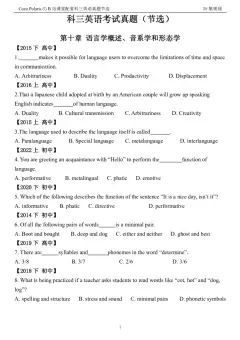
语言的本质特征
任意性Arbitrariness 移位性Displacement
二重性Duality 文化的传播Cultural transmission
能产性/创造性Productivity
语言的主要功能(functions of language)
信息功能Informative function 寒暄功能Phatic function
人际功能Interpersonal function 娱乐功能Recreational function
施为功能Performative function 元语言功能Metalingual function
情感功能Emotive function
(1)Prescriptive & Descriptive(规定性和描述性)
e.g. Don’t say X. (prescriptive) People don’t say X. (descriptive)
(2)Synchronic & Diachronic(共时性和历史性)
(3) Langue & Parole(语言和言语〉
(4) Competence & Performance(语言能力和语言表现〉
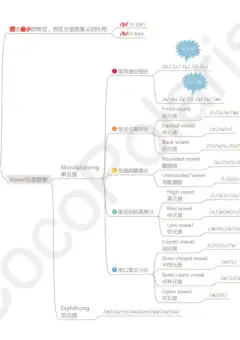
语音学(Phonetics) 单元音(Pure vowel/monophthong)
音素(phone/phoneme) 双元音( diphthong)
vowels(元音)
(1)舌头最高部分的位置 ( position of the highest part of the tongue)元音(front vowel)
元音(central vowel) 后元音(back vowel)
(2)舌头抬起的高度 ( the highest tongue rising)
高元音(high vowel) 半高/半低元音(middle vowel) 低元音(low vowel)
(3)元音的长度( length)或紧度( tenseness) 长元音(long vowel) 短元音(short vowel)
(4)嘴唇的圆展度( Roundness) 圆唇音(rounded vowel) 非圆唇音( unrounded vowel)
辅音( Consonant)分类
a. 发音方式(Manner of articulation)
b. 发音部位(Place of articulation)
c. 带声性(Voicing; vibration of the vocal cords)
清辅音(Voiceless sound)
浊辅音(Voicing sound)
语音变化(Vocal Variety)
(1)连读(Liaison) (2)失去爆破(Loss of Plosive)/不完全爆破(incomplete plosive)
(3)同化(Assimilation)
音系学 Phonology
(1) 音位(phoneme) (4) 音位变体(Allophone)
(2) 最小对立体(minimal pairs) ①互补分布(complementary distribution)
(3) 音位对立(phonemic contrast) ②自由变体(Free variation)
音系规则(phonological rules)
(1)序列规则( Sequential rule) (3)省略规则(Deletion rule)
(2)同化规则(Assimilation rule)
超音段特征(Suprasegmentals)
音节(syllable) 升调(rising tone)
重音(Stress) 降调( falling tone)
①单词重音( word stress) 降升调( falling - rising tone)
②句子重音(sentence stress) 升降调( rising - falling tone)
③语调( intonation)形态学 Morphology
词素(Morpheme) 前缀(prefix)
自由词素(free morphemes) 后缀(suffix)和中缀(infix)
粘着词素(bound morphemes) 屈折词缀(inflectional affix)
词根(root) 派生词缀(derivational affix)
词缀(affix)
词的形成( word formation)
①复合法( compounding) 向心复合词(endocentric compound)
离心复合词(exocentric compound)
②派生法( derivation)加前缀(Prefixation)加后缀(Suffixation)
词汇变化
①创新词(invention) ⑤首字母缩略/拼读(acronym)
②混成词(blending) ⑥逆构词法( back-formation)
③截断词(clipping/abbreviation) ⑦类推构词(analogical creation)
④首字母连写词(initialism) ⑧借词法( borrowing/loanword)
句法学(Syntax)
句法范畴(syntactic categories) 副词(adverb)
名词/名词短语(noun/noun phrase) 代词(pronoun)
动词/动词短语( verb/verb phrase) 助动词(auxiliary verb)
限定词( determiner) 介词短语(prepositional phrase)
形容词(adjective)
语义学(Semantics)
单词间涵义关系(sense relations between words)
(1)同义关系(synonymy)同义词(synonym)
①文体(stylistic)差别 ④情感(emotive)差别
②地域(dialectal)差别 ⑤语义(semantic)差别
③搭配(collocational)差别
(2)反义关系(Antonymy)反义词(antonym)
①等级反义(gradable antonymy) ③反向反义(converse antonymy)
②互补反义(complementary antonymy)
(3)上下位关系(Hyponymy)
①上位词( hypernym) ②下位词(hyponym)
(4)一词多义(Polysemy)
(5)Homonymy(同音/同形异义)
①同音异义(homophone) ③同形同音异义(complete homonym)
②同形异义(homograph)
语用学(Pragmatics)
言语行为(speech acts)
(1)言内行为/发话行为(locutionary act)
(2)言外行为/行事行为(Illocutionary act)
(3)言后行为/取效行为(Perlocutionary act)
(4)直接言语行为(direct speech act)
(5)间接言语行为(indirect speech act)
会话含义理论( Conversational implicature)
(1)合作原则(Cooperative principle)
合作原则准则
①数量准则(The maxim of quantity)
②质量准则(The maxim of quality)
③关系准则(The maxim of relevance)
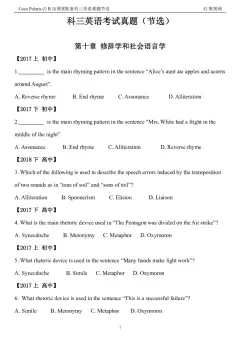
修辞学(Rhetoric)
(1)明喻( Simile) (2)暗喻(Metaphor)(3)转喻/换喻/借代(Metonymy) (7)夸张(Hyperbole)
(4)提喻( Synecdoche) (8)矛盾修饰法(Oxymoron)
(5)隐喻/典故( Allusion) (9)委婉(Euphemism)
(6)拟人(Personification) (10)移就Transferred Epithet
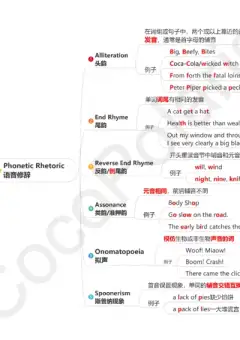
押韵(Rhyme)
①押头韵(Alliteration/ Initial rhyme/ Head rhyme)
②押尾韵(End rhyme)
③反韵(Reverse rhyme)
④准押韵(Assonance & Consonance )
⑤头尾韵(Pararhyme)
语法
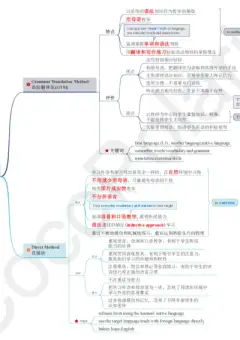
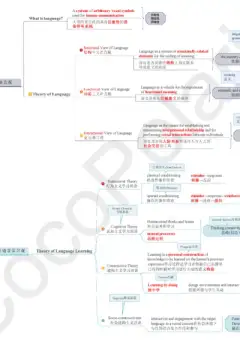
语法--翻译法( Grammar-Translation Method)
直接法(Direct Method)听说法(Audio-lingual Method)
交际法(Communicative Language Teaching Approach)又叫"功能-意念法" (The Functional-noti
onal Approach)
视听法( The Audio-Visual Method)
情境教学法(Situational Language Teaching Method)
全身反应法(Total Physical Response)
任务型教学法 (Task-based Language Teaching Approach)"在做中学" (learning by doing)
认知法(Cognitive Approach
社团语言学习法(Community Language Learning)
沉默法(The Silent Way) 暗示法( Suggestopedia)
自然法(Natural Approach)
行为主义心理学(Behaviorism)
认知心理学( Cognitivism) 代表人物:皮亚杰(Piaget)、布鲁纳(Bruner) 经典人文主义(Classical
Humanism)
重建主义(Restructionism)
"3P"模式,即: Presentation(呈现), Practice(练习), Production 〈产出〉
渐进主义(Progressivism)
语言学( Linguistical)
①强化论(又称刺激反应论)( Reinforcement)
②内在论(Innate)(又称先天论) ③相互作用论(Interaction Theory)
二语习得理论
①中介语理论(Interlanguage ) ②石化/僵化现象(Fossilization)
③输入理论( Input Theory):Krashen(克拉申)
对比分析(Contrastive analysis) 负迁移(negative transfer)
正迁移(positive transfer) 干扰(interference)
错误分析(Error Analysis)
按错误的产生时间分
①形成系统前的语言错误(Pre-systematic Errors)
②形成系统阶段的语言错误(Systematic Errors)
③形成系统后的语法错误(Post-systematic Errors)
按错误的影响因素分
①语际错误/语用错误/母语干扰性错误(Interlingual Errors)
②语内错误/目的语内部干扰性错误(Intralingual Errors)
③其它因素导致的错误
学习环境(context of learning) 文化因素(cultural factors)
交际策略communicative strategies 个人因素personal factors
按错误类型分
①省略(omission/simplification) ③互相关联( cross-association)
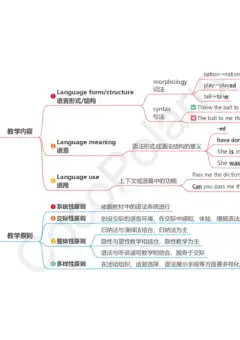
②过度概括( overgeneralization) ④顺序错误( misordering)语法教学
(1)演绎法( deductive) (3)启发式教学(heuristic teaching)
(2)归纳法( inductive)
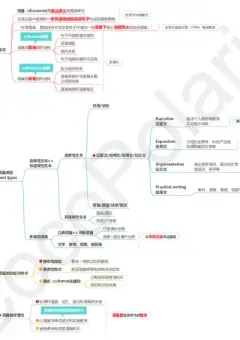
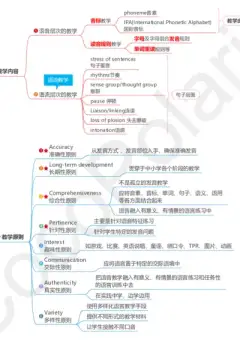
知识教学的通用原则:
系统性(systematic/integrated/combination) 趣味性(incentive)
交际性(communicative) 多样性(variety)
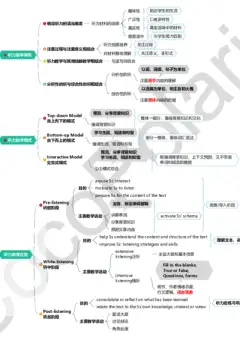
听力教学的模式:
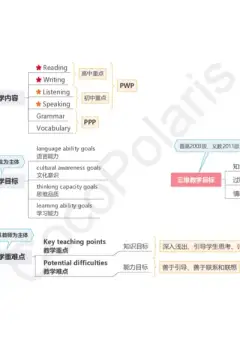
(1)自下而上的昕力教学模式(bottom-up model)
(2)自上而下的昕力教学模式( top-down model)
(3)交互式昕力教学模式(interactive model)
教学的过程:
听前阶段( Pre-listening)
听中阶段(While-listening)包括泛昕(extensive listening)和精昕(intensive listening)
听后阶段(Post-listening)
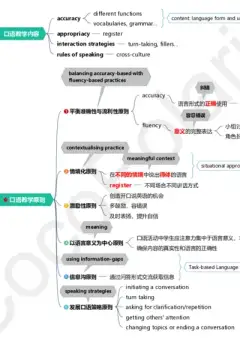
口语教学的原则:流畅性(fluency) 准确性(accuracy)
口语教学的策略:
释义( paraphrase) 小组讨论(group work)
使用近义词反义词( synonym/antonym) 配音(dubbing)
两人对话(pair work) 角色扮演(role play)
阅读教学的模式:
(1)自下而上(bottom-up model) (2)自上而下( top-down model)
(3)交互补偿(interactive-compensatory approach)
阅读教学的过程:
(1)读前阶段(Pre-reading)
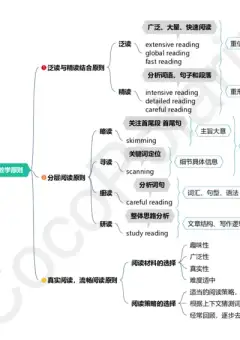
(2)读中阶段(While-reading) 包括泛读( extensive reading)和精读( intensive reading) 泛读即
了解大意,包括略读(skimming)和寻读(scanning)两个部分;精读即掌握细节。略读是为了了解
文章大意;寻读是为了快速定位特定的内容。
(3)读后阶段(Post-reading)
写作教学的模式:
(1)内容导向模式(content-oriented model)
(2)过程导向模式(process-oriented model)
(3)结果导向模式(product-oriented model)
写作教学的过程:
(2)头脑风暴(Brainstorming),思维导图(Mapping)
(3)列提纲( Outlining)
(4)写初稿(Drafting)
(5)修改。包括自改(Self-editing)和互相修改 (Peer-editing)
(6)订正(Revising)及评价(Evaluating)
写作练习的形式 :
(1)控制性写作(Controlled writing) 包括抄写(copy),填空(fill in the blanks),完成句子( comp
letion),句型转换(transformation)等。
(2)指导性写作(Guided writing)
(3)交流性写作(Expressive writing)
技能教学活动:
(1)听力教学:听主旨大意(main idea);听细节(details);练习题(exercises);讨论(discussion);角色扮
演(role-play)等。
(2)口语教学:头脑风暴(brainstorming);模仿读音 (imitating/repeating);讨论;角色扮演;配音(dub
bing)等。
(3)阅读教学:泛读(fast reading);精读(careful reading);练习题;写作;讨论等。
(4)写作教学:头脑风暴;句子仿写;练习题;讨论等。