文档文本内容
内部资料 免费交流
2024 上半年全国教师资格笔试预测报
初中英语
考点·连词分类
作用 主要连词
并
列 and,both…and,notonly…butalso,neither…nor,aswellas,
表并列关系
连 ratherthan等
词
表选择关系 or,either…or等
表转折关系 but,yet,still,however,while(而),only(只不过)等
表因果关系 for,so,then(那么)等
after,before,when,whenever,while,as,until,till,since,
从 assoonas,themoment,theminute,thesecond,theinstant,
属
引导时间状语从句 immediately,directly,instantly,once,nosooner…than,
连
词 hardly…when,everytime,eachtime,(the)nexttime,any
time,(the)lasttime,thefirsttime等
引导条件状语从句 if,unless,as/solongas,incase(万一)等
because,as,since,seeing(that),now(that),considering(that),
引导原因状语从句
inthat等
引导目的状语从句 inorderthat,sothat,incase(免得),forfearthat等
引导结果状语从句 sothat,so…that,such…that等
although,though,eventhough,evenif,while,however,
引导让步状语从句
whatever,whoever,whenever,wherever等
引导方式状语从句 as,like,asif,asthough等
引导地点状语从句 where,wherever等
引导比较状语从句 than,as…as等
引导名词性从句 that,if,whether等
1内部资料 免费交流
考点·语音知识
1. 辅音
AchartofEnglishconsonants
place Labio- Dent- Pala Vela
Voicing Bilabial Alveolar Glottal
manner dental al -tal -r
Stops or VL p t k
plosives VD b d g
VL f θ s ʃ h
Fricatives
VD v ð z ʒ
VL (tʃ) tʃ
Affricates
VD (dʒ) dʒ
Nasals VD m n ŋ
Liquids VD l,r
Glides VD w j
2.MinimalPair最小对立体
When two different forms are identical in every way except for one sound segment which
occurs in the same place in the strings, the two sound combinations are said to form a minimal
pair.Forexample, “dill” and “kill” area minimal pairbecause they differ from eachother bythe
initialsound[d]and[k].
最小对立对指除了出现在同一位置上的一个音不同之外,其余都相同的两个语音组合。
例如,dill和kill就是一组最小对立体,二者的不同在于首字母发音分别为[d]和[k]。
考点·元音
Vowel:Ifasoundisproducedwithnoobstructionofairstream,thenthesoundisavowel.
元音:在发音过程中,气流通过声道时不受任何阻碍。
Vowel sounds are differentiated by a number of factors: the position of the tongue in the
mouth,theopennessofthemouth,theshapeofthelips,andthelengthofthevowels.
Vowelscanessentiallybeviewedasbeingcombinationsofthreevariables:
元音可以看成是三种变体的组合:
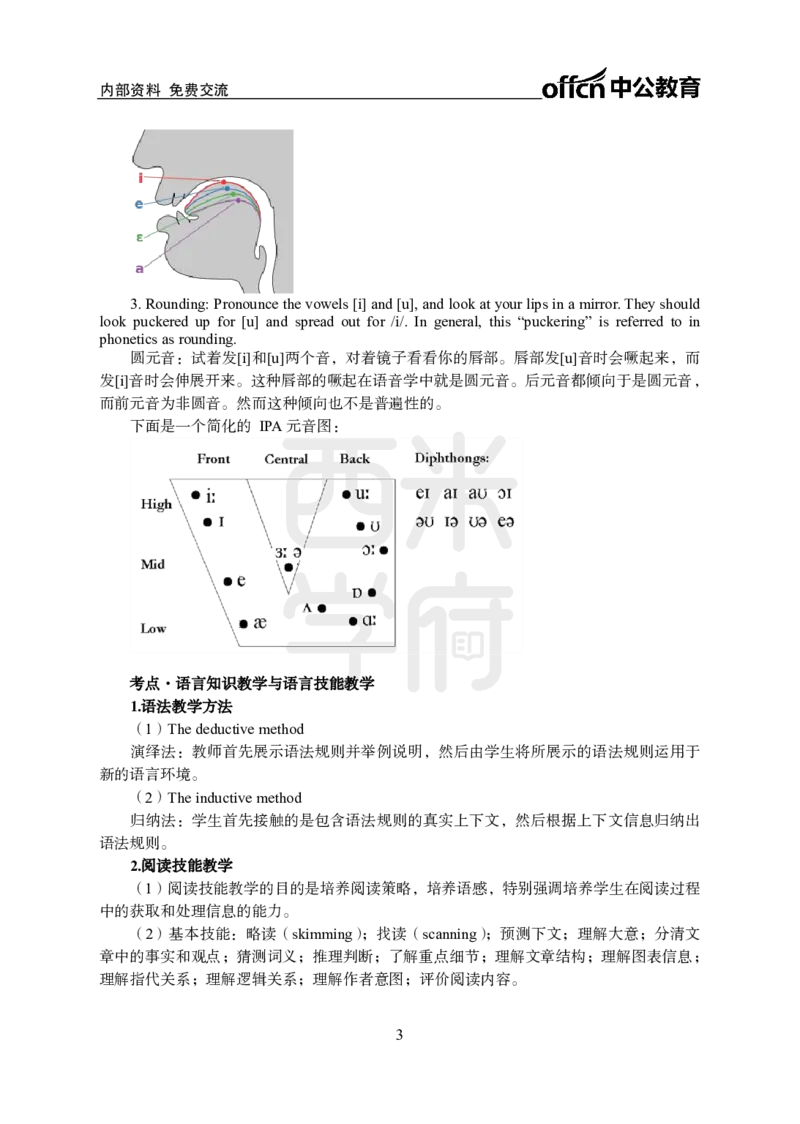
1. Height: This measures how close your tongue is to the roof of your mouth. For example,
trypronouncing[æ](asin“cat”)and[i](asin“feet”).Yourmouthshouldbemuchmoreopenfor
theformerthanthelatter.Thus[æ]iscalledeitheropenorlow,and[i]eitherclosedorhigh.
高元音:按发音时舌位高低来划分。例:在发[æ]音时,比发[i]音时嘴部张得要大一些。
因此[æ]音是开元音或低元音。而[i]音叫作闭元音或高元音。
2. Backness: This is what it sounds like. Try, for example, alternating between pronouncing
the vowels[æ](asin“cat”)and[ɒ](asin“cot”),and getafeel forthe positionofyour tonguein
your mouth.Itshouldmoveforwardfor[æ]andbackfor[ɒ],whichiswhythe former iscalleda
frontvowelandthelatterabackvowel.
后元音:试着由元音[æ]过渡到元音[ɒ],感觉一下舌位。发[æ]音的时候要前移,发[ɒ]
音的时候要后移,这就是为什么前一个叫作前元音,而后一个叫作后元音。
Thepositionofthehighestpointisusedtodeterminevowelheightandbackness.
2内部资料 免费交流
3.Rounding:Pronouncethevowels[i]and[u],andlookatyourlipsinamirror.Theyshould
look puckered up for [u] and spread out for /i/. In general, this “puckering” is referred to in
phoneticsasrounding.
圆元音:试着发[i]和[u]两个音,对着镜子看看你的唇部。唇部发[u]音时会噘起来,而
发[i]音时会伸展开来。这种唇部的噘起在语音学中就是圆元音。后元音都倾向于是圆元音,
而前元音为非圆音。然而这种倾向也不是普遍性的。
下面是一个简化的 IPA元音图:
考点·语言知识教学与语言技能教学
1.语法教学方法
(1)Thedeductivemethod
演绎法:教师首先展示语法规则并举例说明,然后由学生将所展示的语法规则运用于
新的语言环境。
(2)Theinductivemethod
归纳法:学生首先接触的是包含语法规则的真实上下文,然后根据上下文信息归纳出
语法规则。
2.阅读技能教学
(1)阅读技能教学的目的是培养阅读策略,培养语感,特别强调培养学生在阅读过程
中的获取和处理信息的能力。
(2)基本技能:略读(skimming);找读(scanning);预测下文;理解大意;分清文
章中的事实和观点;猜测词义;推理判断;了解重点细节;理解文章结构;理解图表信息;
理解指代关系;理解逻辑关系;理解作者意图;评价阅读内容。
3内部资料 免费交流
(3)相关教学活动:
略读:即选择性地进行跳跃式阅读,了解文章大意。可以采取三个步骤:①阅读文章
起始段和结尾段;②找到主题句,细读其他段落的主题句;③浏览一些与主题句相关的信
息词。
找读:要求在很短的时间内准确地找到目标,可以在利用主题词、标题或表格、板式
及印刷特点等来快速阅读教学内容后,进行回答提问的问题、解释概括文意、制作图表、
判断真伪、排序、填表、补全信息、连线等教学活动。
3.听力技能教学
(1)Pre-listening 听前
在这一环节教师可采用以下几种方式,让学生对所学材料内容有所准备。
①Introducetherelevantbackgroundinformation. 介绍相关的背景知识。
Teacher can use pictures or visual aids to attract students' attention so as to stimulate
students'abilityofobservationanddescription. 用图片或是视觉教具吸引学生对听力材料的注
意力,激发学生的观察能力和描述能力。
② Teach key words or raise relevant questions and let students predict the content of what
theyareabouttohear. 提供一些词汇或相关问题,让学生预测所要听的材料内容。
③Asksomeopeningquestionstopracticestudents’imaginativeandanalyticabilities. 提出
一些开放性问题,锻炼学生的想象能力和分析问题的能力。
(2)While-listening 听中
Cultivate students’abilities ofsummarizing and collecting the main information. 培养学生
概括和提取主要信息的能力。
Guidethestudentstorecognizethecluesaboutthelisteningcontent. 引导学生辨别所听内
容的线索和脉络。(在这一方面教师可以提供一些排序的听力练习,让学生判断情节发生的
前后顺序。)
Improvetheunderstandingofthelisteningcontent.提高学生对所听内容的理解。(教师可
采用信息转换、图文转换、行为表现等方式。)
Students should have the ability to get the main idea of the listening material.At the same
timetheyshouldknowsomedetailinformation. 学生应具有泛听主旨、精听细节的能力。(在
实施教学的过程中,要鼓励学生养成第一遍去精取粗、抓内容要点和前后线索的习惯,第
二遍可以听取一些具体的信息。一般情况下通常要让学生确定听力重点,带着六要素
——who,where,when,what,whyandhow去听。)
(3)Post-listening 听后
Group members can answer some questions according to the detail information. 让小组根
据所听信息回答就细节提出的问题。
Cultivate students' ability ofcooperative learningand expression. 培养学生合作学习和表
达能力(可开展对话,角色扮演和辩论等活动)。
Developthestudents'abilityofinferenceandimagination.(设计一些对信息进行扩展和添
加后文的任务)
4内部资料 免费交流
Improvethewritingability.(教师可根据听力记录的摘要和补充练习,设计一些相关的
写作练习)
考点·PWP活动设计
常见的PWP听力活动
听前 听中 听后
明确听的目的; 边听边操作; 口头回答问题;
激发兴趣和欲望; 边听边选择、填空、连线、 复述或转述所听内容;
熟悉话题 画图、补全信息; 总结要点;
预测大意; 边听边做笔记; 模拟或表演情景对话;
处理关键词; 判断真伪。 短剧表演;
布置任务。 小组讨论;
表达个人感受和观点。
常见的PWP阅读活动
读前活动 读中活动 读后活动
明确目的; 略读; 转述所读内容;
熟悉话题; 找读; 根据所读内容进行角色扮
预测内容,激发兴趣; 根据所读内容画图、标 演;
预测词汇; 图、连线、填表、排序、 讨论;
激活相关语言; 补全信息; 改写;
布置任务。 为课文选择或添加标题; 续尾;
根据所读内容制作图表; 写摘要。
边读边操作;
判断信息的真实性。
5