北京二中教育集团 2022-2023 学年度第一学期
初三英语期中考试试卷
命题人:________ 审核人:________
考查目标
1. 知识:①熟练掌握教材第一至第六模块的重点词汇和句型。
②熟练掌握教材第一至第六模块中相关的语法知识。
2. 能力:①能从文章中找出关键信息、猜测词义,概括文章大意,理解不同文体的行文特
点。
②选取一个题目,综合运用所学知识,完成一篇符合要求的英语短文。
学业成绩
1. 本试卷分为试题卷和答题纸,共12页;其中试题卷10页,答题纸2页。全卷共五
考
大题,39道小题。
生
2. 本试卷满分60分,考试时间90分钟。
须
3. 在试卷指定位置和答题纸的密封线内准确填写班级、姓名、考号、座位号。
知
4. 考试结束,将答题卡交回。
知识运用 (共14分)
一、单项选择。(每小题0.5分,共6分)
从下面各题所给的A、B、C、D四个选项中,选择可以填入空白处的最佳选项。
1. My mother is busy these days, so I often help _____________with housework.
A. her B. him C. me D. you
【答案】A
【解析】
【详解】句意:我妈妈最近很忙,所以我经常帮她做家务。
考查人称代词宾格。her她;him他;me我;you你,四个单词都是人称代词宾格。根据主语My mother is
busy these days可知,帮助的对象是my mother,所以用her代替。故选A。
2. There will be an English movie in our school ________ the evening of June 30.
A. at B. in C. for D. on
【答案】D
【解析】
【详解】句意:6月30日晚上我们学校将有一场英语电影。
考查介词辨析。at后跟具体的时刻;in后跟年、月、季节或泛指的上午、下午、晚上;for为了;on后跟
具体到天的时间。根据“the evening of June 30”可知,时间具体到了6月30日的晚上,所以用介词on,故
选D。3. I thought the actor was famous, _________ none of my friends has ever heard of him.
A. and B. or C. so D. but
【答案】D
【解析】
【详解】句意:我认为这个演员非常有名,但是我的朋友们一个也没有听说过他。
考查连词辨析。and和,并且;or或者,否则;so 因此;but但是。结合语境可知上下文为转折关系,故
选D。
4. —________does your mother go to the supermarket?
—Once a week.
A. How often B. How long C. How far D. How soon
【答案】A
【解析】
【详解】句意:——你妈妈多久去一次超级市场?——一周一次。
考查特殊疑问句。How often多久一次;How long多长;How far多远;How soon还有多久;根据句意理解
及回答Once a week.可知,这里是提问动作发生的频率,英语中提问频率用How often,故选A。
【点睛】英语中常用的几个特殊疑问词的用法要注意区别。How often多久一次,提问频率,本题就是提
问频率;How many多少,提问可数名词复数;How much多少,提问不可数名词;How far多远,提问距
离;How old多大,提问年龄;How long多长,提问时间持续多久或者具体物品的长度,做题时注意区分,
根据句意理解来判断。
5. — Peter, have you ever been to the English Corner?
— Oh, yes. I ________ there to practice speaking once a week last term.
A. went B. go C. have gone D. will go
【答案】A
【解析】
【详解】句意:——彼得,你去过英语角吗? ——哦,是的。上学期我每周去一次那里练习口语。
考查一般过去时。went表一般过去时;go动词原形;have gone表现在完成时;will go表一般将来时。根
据句中last term提示,空格处谓语应用一般过去时,表示过去习惯性、经常性的动作和行为,故选A。
6. Zhaozhou Bridge is one of ________ stone bridges in the world.
A. old B. older C. oldest D. the oldest
【答案】D
【解析】【详解】句意:赵州桥是世界上最古老的石桥之一。
考查形容词最高级。old古老的。old形容词原级;older形容词比较级;oldest形容词最高级;the oldest形
容词最高级前加the。根据题干中“one of ____ stone bridges in the world”可知此处是指世界上最古老的石桥
之一,用“one of the +形容词最高级+名词复数”结构。故选D。
7. David, you ________ take your umbrella. It is not raining.
A. needn’t B. can’t C. mustn’t D. might not
【答案】A
【解析】
【分析】
【详解】句意:大卫,你不必带伞。现在没有下雨。
考查情态动词辨析。needn’t不必,指没有必要;can’t 不可能,表否定推测; mustn’t不能,表禁止;
might not也许不,表推测。根据下句“It is not raining”可知,是说没必要带伞,需用needn’t,故选A。
8. ________ they are twin sisters, ________ they don’t look like each other.
A. Although; but B. Because; so C. Although; / D. Because; /
【答案】C
【解析】
【详解】句意:尽管他们是双胞胎姐妹,但是他们看起来并不相像。
考查连词的用法。although尽管,虽然,引导让步状语从句;but但是,表示转折,在英语中连词although
不与but连用,排除A;Because因为;so因此,because和so不能连用,排除B。根据句意可知,两句之
间是让步关系,所以用although放于句首,引导让步状语从句。故选C。
9. If there ________ anything I can do to help, please let me know.
A. is B. will be C. was D. has been
【答案】A
【解析】
【详解】句意:如果有什么我能帮忙的,请告诉我。
考查there be句型。is是,be动词的单数形式;will be一般将来时;was是,is的过去式;has been现在完
成时,根据if引导的条件状语从句,时态遵循“主祈从现”原则可知,空缺处应该用一般现在时,故选
A。
10. I ________ that movie several times, and I still want to see it again.
A. see B. saw C. am seeing D. have seen
【答案】D
【解析】【详解】句意:我已经看了那部电影好几次了,我仍然想去再看一次。
考查现在完成时。see“观看”,根据空后的“several times”可知,此处是指看过好几次了,应用现在完成时,
故选D。
11. Mr. Johnson met an old friend when he ________ down the street.
A. walks B. is walking C. will walk D. was walking
【答案】D
【解析】
【详解】句意:约翰逊先生在街上走的时候遇到了一位老朋友。
考查过去进行时态。walks一般现在时态的第三人称单数形式; is walking 现在进行时态的第三人称单数
形式;will walk 一般将来时态形式;was walking过去进行时态的第三人称单数形式。根据 when当 的
时候,引导时间状语从句时从句的谓语动词用进行时态。且主句动词为met,可知从句用过去进行时⋅⋅。⋅⋅⋅结⋅
合句意可知,此空应填 was walking,故选D。
12. —Could you please tell me_____?
—Yes. I bought them online.
A. where you bought the shoes B. where did you buy the shoes
C. when you bought the shoes D. how did you buy the shoes
【答案】A
【解析】
【详解】句意:——你能告诉我你在哪里买的这双鞋吗?——可以。我在网上买的。
考查宾语从句。由答语中“online”可知应询问地点,应问“在哪里买的这双鞋?”,应用where,排除C和
D;且宾语从句应用陈述句语序,即“主语+谓语+宾语”,且根据bought可知,用一般过去时bought。故选
A。
二、完形填空。(每小题1分,共8分)
Jake was sitting all alone in the classroom during the break, thinking about the “C” he had received in his
spelling test. “I knew I was getting it when I was taking the test, but I just can’t help feeling unlucky to be bad at
spellings,”thought Jake. He was good at other subjects, and he couldn’t ___13___ seeing a big “C” on his test
paper.
After the break, the spelling teacher Ms. Kaur came in and said that the Spelling Bee Contest was going to be
held. Some students were excited because they were good at spellings, but others wore ___14___ expressions. So
did Jake. He certainly was not taking part in it. He was still worrying about his test. Jake wanted to score well in
spelling tests too, but he couldn’t focus on spellings. He sat there thinking about what to do. Finally, he got a good
idea. It seemed the best thing to do was to ___15___ something in spellings. He knew it took courage to take partin something he was bad at, but it was a window of opportunity.
The next day, when he told Ms. Kaur about his decision, she was surprised. “I am proud of you, Jake. You set
a/an ___16___ for those who are bad at some subjects, but never work for them.”
From that day on, Jake started working for the contest. He was buried in the spelling books, feeling sleepy
now and then. He felt sure he would sleep with the boring spellings. But he went on working.
Soon the day for the first ___17___ of the contest came. It was his turn. He walked onto the stage. He was
nervous. Ms. Kaur nodded her head encouragingly. She asked him the word. Jake wanted to ___18___ right there.
He knew the word! “E-N-O-R-M-I-T-Y,” he answered.
Unexpectedly, Jake entered the next round and worked even harder. In the final Jake felt his heart ___19___
loudly. But when he heard his word, he was no more nervous. “C-O-U-N-C-I-L,” he answered correctly. He made it
for the subject in which he got bad grades!
Opportunities come and go. The secret of success is to be ___20___ when an opportunity comes. When it
comes, you must take it and go on, and never give up.
.
13 A. help B. mind C. stand D. remember
14. A. bored B. excited C. pleased D. confused
15. A. avoid B. achieve C. admire D. accept
16. A. goal B. instruction C. plan D. example
17. A. time B. word C. round D. scene
18. A. hide B. run C. sit D. dance
19. A. singing B. beating C. hitting D. aching
20. A. ready B. happy C. patient D. curious
【答案】13. C 14. A 15. B 16. D 17. C 18. D 19. B 20. A
【解析】
【导语】本文主要讲了主人公一开始在单词拼写方面成绩不够好,为了突破自己,他决定通过比赛,让自
己在拼写方面有所收获,终于功夫不负苦心人,他成功了。
【13题详解】
句意:他在其他科目上都很好,他不能忍受看到他的试卷上一个大大的“C”。
help帮助;mind介意;stand忍受;remember记住。根据“He was good at other subjects”可知,他无法忍受
看到他的试卷上一个大大的“C”。故选C。
【14题详解】
句意:一些学生很兴奋,因为他们擅长拼写,但其他学生则表现出厌烦的表情。
bored厌烦的;excited兴奋的;pleased满意的;confused困惑的。根据“but”可知,此句和上句是转折关系,其他学生则表现出厌烦的表情。故选A。
【15题详解】
句意:似乎最好的办法是在拼写方面有所收获。
avoid避免;achieve获得;admire羡慕;accept接受。根据“He knew it took courage to take part in something
he was bad at, but it was a window of opportunity.”可知,要想在拼写方面有所进步,就要在拼写上面有收获。
故选B。
【16题详解】
句意:你为那些在某些科目上表现不好,却从不为它们努力的人树立了榜样。
goal目标;instruction指示;plan计划;example榜样。根据上文内容和“who are bad at some subjects, but
never work for them”可知,他为其他人树立了一个好榜样。故选D。
【17题详解】
句意:不久,第一轮比赛的日子就到了。
time时间;word单词;round轮;scene场景。根据“It was his turn. He walked onto the stage. He was nervous”
和“Jake entered the next round”可知,第一轮比赛的日子来了。故选C。
【18题详解】
句意:杰克想在那里跳舞。
hide藏;run跑;sit坐;dance跳舞。根据“He knew the word! “E-N-O-R-M-I-T-Y,” he answered.”可知,因为
知道答案,所以激动地想跳舞。故选D。
【19题详解】
句意:在决赛中,杰克感到自己的心跳得很厉害。
singing唱歌;beating跳动;hitting撞;aching痛。根据“heart”可知,是心脏跳动地厉害。故选B。
【20题详解】
句意:成功的秘诀在于当机会来临时要做好准备。
ready准备;happy开心;patient耐心的;curious好奇的。根据“When it comes, you must take it and go on,
and never give up.”可知,当机会来临的时候,我们要做好准备。故选A。
阅读理解 (共26分)
三、阅读理解。(每小题2分,共26分)
从短文后各题所给的A、B、C、D四个选项中,选择最佳选项。
A
Do you know “Touching China 2018” award ceremony? The stories of people who were awarded as Chinese
role models touched the hearts of Chinese people. Here are four of them:
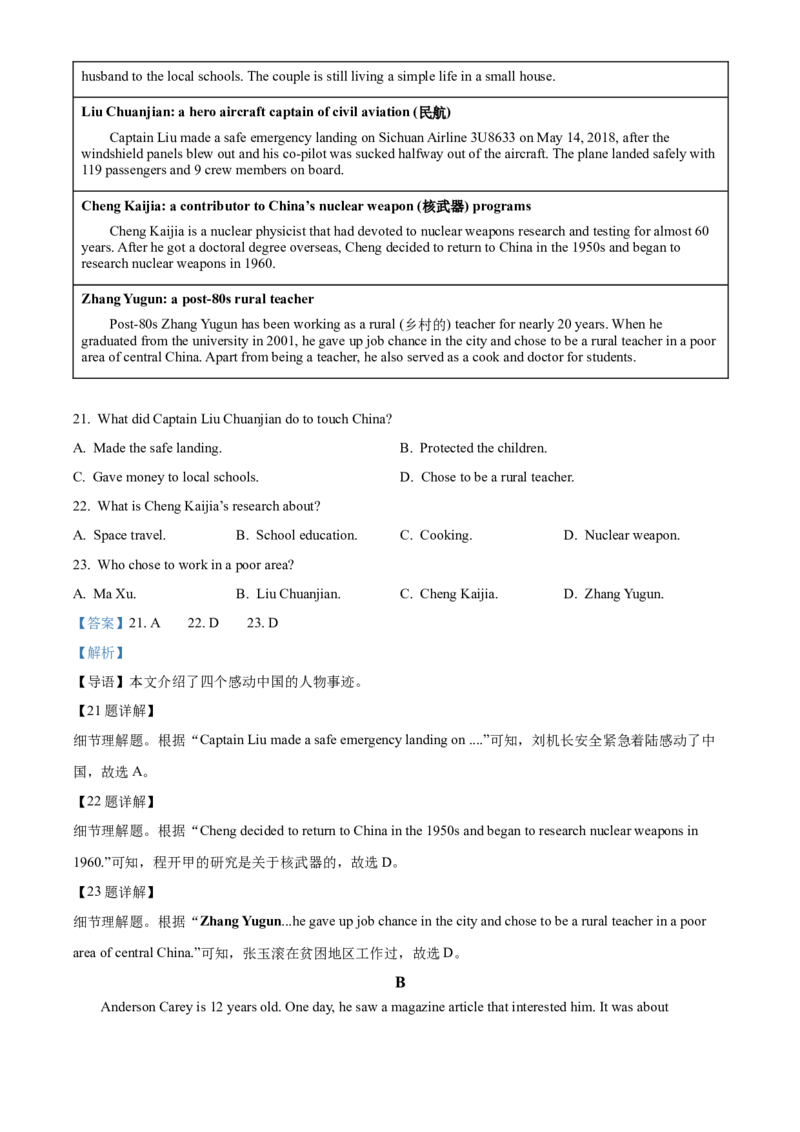
Ma Xu: a senior citizen who has given 10 million yuan
Ma Xu, a retired woman living in central China’s Hubei province, gave a total of 10 million yuan with herhusband to the local schools. The couple is still living a simple life in a small house.
Liu Chuanjian: a hero aircraft captain of civil aviation (民航)
Captain Liu made a safe emergency landing on Sichuan Airline 3U8633 on May 14, 2018, after the
windshield panels blew out and his co-pilot was sucked halfway out of the aircraft. The plane landed safely with
119 passengers and 9 crew members on board.
Cheng Kaijia: a contributor to China’s nuclear weapon (核武器) programs
Cheng Kaijia is a nuclear physicist that had devoted to nuclear weapons research and testing for almost 60
years. After he got a doctoral degree overseas, Cheng decided to return to China in the 1950s and began to
research nuclear weapons in 1960.
Zhang Yugun: a post-80s rural teacher
Post-80s Zhang Yugun has been working as a rural (乡村的) teacher for nearly 20 years. When he
graduated from the university in 2001, he gave up job chance in the city and chose to be a rural teacher in a poor
area of central China. Apart from being a teacher, he also served as a cook and doctor for students.
21. What did Captain Liu Chuanjian do to touch China?
A. Made the safe landing. B. Protected the children.
C. Gave money to local schools. D. Chose to be a rural teacher.
22. What is Cheng Kaijia’s research about?
A. Space travel. B. School education. C. Cooking. D. Nuclear weapon.
23. Who chose to work in a poor area?
A. Ma Xu. B. Liu Chuanjian. C. Cheng Kaijia. D. Zhang Yugun.
【答案】21. A 22. D 23. D
【解析】
【导语】本文介绍了四个感动中国的人物事迹。
【21题详解】
细节理解题。根据“Captain Liu made a safe emergency landing on ....”可知,刘机长安全紧急着陆感动了中
国,故选A。
【22题详解】
细节理解题。根据“Cheng decided to return to China in the 1950s and began to research nuclear weapons in
1960.”可知,程开甲的研究是关于核武器的,故选D。
【23题详解】
细节理解题。根据“Zhang Yugun...he gave up job chance in the city and chose to be a rural teacher in a poor
area of central China.”可知,张玉滚在贫困地区工作过,故选D。
B
Anderson Carey is 12 years old. One day, he saw a magazine article that interested him. It was aboutprosthetics (假肢), which can be used to replace a missing body part, like a hand, arm or leg.
The article said people are using 3-D printers to build these devices (装置). Anderson thought this was very
cool. He wanted to learn more about it. So Anderson talked to his science teacher, Dr. Holly Martin, about building
a prosthetic together. The timing was perfect. Martin had just heard about a group called Enabling the Future. This
group asks volunteers to help build robotic arms and legs. The volunteers build them for people who share their
stories on the website.
Anderson and Martin looked through the website together. They decided to help a man from the country of
Romania. His name is Comel Crismaru, who lost his leg, hand and part of his arm.
In February, Anderson and Martin got to work. Building the robotic arm was not easy. Anderson had some
problems. He had hoped to use a 3-D printer at his school. One of the pieces for the arm was bigger than the size of
the printer, though.
Soon Anderson had an idea to solve this problem. He reached out to a 3-D printing company in Woodstock,
Georgia. The company agreed to help. Anderson and Martin could use their big 3-D printers. After that, Anderson
worked on the arm for about three months.
Anderson and Martin sent the arm to Crismaru in May. In August, they received a note. It was from
Crismaru’s son. He thanked Anderson and Martin for their help.
Martin said she hopes children and grown-ups who hear about Anderson’s projects will realize that it may be
hard to change the world, but they can start with small acts. Some of these can help a person in a “huge way”.
24. The volunteers build ________ for people who share their stories online.
A. 3-D printers B. robots C. robotic arms or legs D. companies
25. How did Anderson work out the problem when helping a Romanian man?
A. By using big 3-D printers. B. By buying a 3-D printer.
C. By building a prosthetic. D. By starting a website.
26. Anderson’s story tells us that ________.
A. knowledge comes from practice B. we should have a good teacher
C. interests can help build confidence D. starting with small acts can make a difference
【答案】24. C 25. A 26. D
【解析】
【导语】本文讲述了安德森和他的科学老师霍利·马丁博士通过制作假肢帮助他人的经历,告诉我们改变世
界可能很难,但可以从小事做起去帮助别人。
【24题详解】
细节理解题。根据“This group asks volunteers to help build robotic arms and legs. The volunteers build them forpeople who share their stories on the website.”可知,该组织要求志愿者帮助制造机器人手臂和腿。志愿者们
是为那些在网站上分享自己故事的人制造它们的,所以推断,them指的是“robotic arms and legs”,故选
C。
【25题详解】
细节理解题。根据“Anderson and Martin could use their big 3-D printers. After that, Anderson worked on the
arm for about three months. Anderson and Martin sent the arm to Crismaru in May”可知,安德森通过使用大型
3-D打印机帮助了一名罗马尼亚人Crismaru。故选A。
【26题详解】
主旨大意题。根据最后一段“Martin said she hopes children and grown-ups who hear about Anderson’s projects
will realize that it may be hard to change the world, but they can start with small acts. Some of these can help a
person in a ‘huge way’.”可知,安德森的故事告诉我们改变世界也许很难,但可以从小事做起。其中一些可
以极大地帮助到一个人。故选D。
C
Fluency in another language is a dream of a newcomer to another country. Besides, understanding the culture
and learning to communicate comfortably with people of that culture are as important as learning the rules of the
language. Language learning and culture learning go together and may take a long time.
Sometimes people feel that they understand a culture after a few weeks or months. People do learn a lot when
they first begin living in another culture, but this is only the first step of learning. It usually involves things like
learning everyday activities and some basic customs.
To really understand another culture, people have to go beyond the first step. This is a challenge because it is
often difficult to know what to learn. Much of what we call"culture" is hard to see.
Culture is like an iceberg. Imagine in your mind a huge iceberg in the ocean. The only part of the iceberg that
you see is the top. You don't see the rest of the iceberg because it is hidden from sight in the water. It is easy to
forget that it is there. Most of the iceberg is deep in the ocean, just as much of a culture is deep in the ocean, just as
much of a culture is deep within its people.
When you meet someone from another culture, certain culture differences are obvious: You hear another
language or you hear your own language spoken with an accent. You see different foods, clothes and sometimes
physical characteristics of people. You watch new customs or habits, such as the use of chopsticks, and, bowing or
kissing on both cheeks as a greeting. These differences are interesting and important, but they are usually not too
difficult to understand. They can be seen easily and quickly.
The part of culture that is like the underwater part of the iceberg consists of assumptions (设想),
communication styles, values, and beliefs about what is right and wrong. The hidden part of culture influencesmuch of a person’s way of thinking and communicating. It is the meaning behind his or her verbal and nonverbal
language. Learning to communicate well with people from another culture involves understanding the hidden part
of culture.
27. To really understand another culture, people should .
A. learn the rules of language B. learn the hidden culture
C. visit some local people D. live with some local people
28. Which of the following does the writer agree?
A. Communication styles can be easily seen and learned
B. Language learning is more important than culture learning
C. Learning about culture is not easy and may take a long time
D. People usually learn a culture after a few weeks or months.
29. The passage is mainly about .
A. learning about culture. B. learning about people
C. the hidden part of the iceberg D. fluency in another language
【答案】27. B 28. C 29. A
【解析】
【分析】本文主要介绍了其它国家语言文化的学习,由于差异性,语言学习和文化学习结合在一起,可能
需要很长时间。包括文化的学习以及文化学习方面所遇见的问题。
【27题详解】
细节理解题。根据文中 To really understand another culture, people have to go beyond the first step. This is
challenge because it is often difficult to know what to learn. Much of what we call “culture” is hard to see.要真正
了解另一种文化,人们必须超越第一步。这是一个挑战,因为通常很难知道要学什么。我们称之为“文
化”的很多东西都很难看到。可知,我们要学习隐藏的文化,故选B。
【28题详解】
细节理解题。根据第一段最后一句Language learning and culture learning go together and may take a long time.
语言学习和文化学习是同时进行的,可能需要很长时间。可知作者的观点和C选项一致,故选C。
【29题详解】
主旨大意题。通读文章,全文以“culture”为主线进行。主要讲述了其它国家语言文化的学习,由于差异性,
语言学习和文化学习结合在一起,可能需要很长时间。后文具体介绍了不同国家语言文化的深刻内涵。故
选A。
D
Self-esteem is the way we feel about ourselves. It has a great influence on how we make decisions andsocialize. Normally, people with low self-esteem easily think low about themselves, so it is very important to
understand what causes low self-esteem and how we can get over it.
Because of trust, we sometimes accept the control from other people who tell us what to do. However, we
need to understand it may have serious effects, especially when that person has negative behaviors, like being cruel
(残忍的), or overly criticizing others. Remember that you cannot change a person quickly, but you must change
how you react to their words and behaviors towards you. Always remember that only you have control of your
reaction.
Do not just focus on your past unwise choices or feel guilty (内疚的) about them. Everyone makes mistakes.
But if you think more, every mistake you made in the past has caused something positive. Making mistakes will
open many doors for improvement. If you’re feeling especially guilty about a decision you made, write it down and
write beside it every possible positive result that happened to you. This will help you cherish those decisions
rather than feel upset about them.
Besides, it is not wrong to dream a big thing. However, there will be some harmful effects on your self-esteem
if it is your only goal and you fail to achieve it. Most of the time we set unrealistic goals and not being able to
achieve them makes us think that we are not good enough. Therefore, it is a good idea to set a huge goal but
remember to set up small milestones that you can achieve along the way.
Last but not least, comparing yourself to other people is so easy to become a bad habit. We think that the
picture we see on social media is their whole story, not realizing that it is just their best look. Keep in mind that
what you see is not always what it seems. Moreover remember that they worked hard to achieve what you see from
them, then learn from them to be a better you.
Hopefully, these tips help you develop your self-esteem. You will not be able to live a joyful life if you let
your low self-esteem take over.
30. What should we do if others always tell us what to do?
A. Control our own reaction.
B. Trust and take their advice.
C. Be cruel and criticize them.
D. Try to change them quickly.
31. The word “cherish” in Paragraph 4 probably means “________”.
A. make B. value C. regret D. forget
32. What can we learn from the passage?
A. We’d better try our best to make fewer mistakes.
B. Small goals will lower our self-esteem and cause failure.C. We shouldn’t believe in the stories on social media blindly.
D. The problem of low self-esteem is more serious than before.
33. The writer wrote this passage to _______.
.
A introduce some methods to study self-esteem
B. guide readers to solve the low self-esteem problem
C. lead people to make right decisions by themselves
D. encourage people to face failures bravely in real life
.
【答案】30 A 31. B 32. C 33. B
【解析】
【导语】本文主要介绍了几个解决自卑问题的方法。
【30题详解】
细节理解题。根据“we sometimes accept the control from other people who tell us what to do...Always
remember that only you have control of your reaction”可知当别人告诉我们要做什么的时候,我们要记住只有
自己才能掌控自己的反应。故选A。
【31题详解】
词义猜测题。根据“This will help you cherish those decisions rather than feel upset about them”可知在做的决
定旁边写下可能的积极结果,这不仅不会让你感到心烦意乱,还会让你珍惜所做的这些决定,故此处划线
部分意为“珍惜,珍视”,和value意义相近。故选B。
【32题详解】
推理判断题。根据“We think that the picture we see on social media is their whole story, not realizing that it is
just their best look. Keep in mind that what you see is not always what it seems”可知在网络上看到的东西可能并
不是它们原本的样子,所以不要盲目相信网络上的故事。故选C。
【33题详解】
主旨大意题。通读全文可知,本文主要介绍了几个解决自卑问题的方法。故选B。
阅读短文,根据短文内容回答问题。
When you take notes in your classes, are you confident that you’ll actually go back and look over them? Or doyou just write out your notes in class and then completely forget all of the information you wrote down? A useful
note-taking method can not only save you precious time and energy, but also help you better understand what you
learn.
This well-known note-taking method is called the Cornell Note-taking System. It was first developed in the
1940s by education professor Walter Pauk at Cornell University to help students learn. According to Cornell Notes,
each page is divided into three sections: the note-taking column, the cue column (提示栏) and summary space.
It’s very easy. You just need to draw two lines on your note page, leaving a 2.5-inch margin on the left and a 2-inch
margin on the bottom.
The note-taking column, which is the biggest space is used to write down notes while you are in class or
reading an article. The key point is that you don’t write down what you hear word by word. It requires you to be
very brief, using short phrases, symbols or keywords to replace long sentences.
To help with future review, you can write some related questions on the left. The next step is to cover the note-
taking column with a sheet of paper or your hand. Then, by only looking at the questions for key words, try to
repeat the content in your own words.
The summary space is designed to help you reflect on what you’ve learned. Questions may also be useful. For
example, what’s the significance of these facts? What principles are they based on? What’s beyond them? You can
also write down your own ideas and personal feelings. Don’t forget to review from time to time so that you will
remember the information more easily.
Practice makes perfect. After a few months of using this handy note-taking method, you are sure to become
the note-taking star of your class. And even better, you’ll finally be able to remember what you have learned.
34. Who first developed the Cornell Note-taking System?
____________________________________________________
35. What is the biggest space used to do?
____________________________________________________
36. How can you use the cue column?
____________________________________________________
37. Why is the summary space designed?
____________________________________________________
38. Would you like to use this note-taking method? Why or why not?
____________________________________________________
【答案】34. Walter Pauk./It was Walter Pauk.
35. It is used to write down notes./The biggest space is used to write down notes.36. Write down some related questions on the left column, cover the note-taking column and then repeat the content in
your own words.
37. The summary space is designed to help you reflect on what you’ve learned./To help you reflect on what you’ve
learned.
38. Yes, I would like to use it. Because this method can save my precious time and energy, help me better understand
what I’ve learned and enable me to remember what I’ve learned.
【解析】
【分析】本文讲述康奈尔笔记系统的使用方法,以及这种记笔记的方法的优势。
【34题详解】
根据第二段“This well-known note-taking method is called the Cornell Note-taking System. It was first developed
in the 1940s by education professor Walter Pauk”,可知,康奈尔笔记系统是沃尔特·波克开发的。故填Walter
Pauk./It was Walter Pauk.
【35题详解】
根据第三段“The note-taking column, which is the biggest space is used to write down notes while you are in class
or reading an article”可知最大空间被用来写笔记。故填It is used to write down notes./The biggest space is used
to write down notes.
【36题详解】
根据第四段“To help with future review, you can write some related questions on the left. The next step is to cover
the note-taking column with a sheet of paper or your hand. Then, by only looking at the questions for key words,
try to repeat the content in your own words”可知,可以写一些相关的问题在左边,用一张纸或你的手盖住笔
记栏,看关键词的问题,努力用自己的话去重复内容。故填Write down some related questions on the left
column, cover the note-taking column and then repeat the content in your own words.
【37题详解】
根据倒数第二段“The summary space is designed to help you reflect on what you’ve learned”可知,摘要空间是
为了帮助你反思你学过的内容。故填The summary space is designed to help you reflect on what you’ve
learned./To help you reflect on what you’ve learned.
【38题详解】
根据第一段“A useful note-taking method can not only save you precious time and energy, but also help you better
understand what you learn”及最后一段“And even better, you'll finally be able to remember what you have
learned”可知,康奈尔笔记系统是一种对人非常有帮助的方法,不仅可以节省你宝贵的时间和经历,还能帮
助能更好的弄懂你所学的东西,而且还能帮助你记住你学过的东西。故填Yes, I would like to use it. Because
this method can save my precious time and energy, help me better understand what I’ve learned and enable me toremember what I’ve learned.
书面表达 (共10分)
五、文段表达。(共10分)
39. 假如你是李华,你校英语社团要开展线上国际交流活动,其公众号正在进行关于中国博物馆的系
列推送。请你用英语给公众号留言,推荐一个你喜欢的中国博物馆,说明推荐理由并谈谈参观博物馆的益
处。
提示词语:exhibition, exciting, history, provide, make, learn
提示问题:1. What is your favorite museum in China?
2. Why do you like it?
3. What are the benefits of visiting museums?
Message Board:
My favorite Museum in China
__________________________________________________________________________________________
__________________________________________________________________________________________
__________________________________________________________________________________________
__________________________________________________________________________________________
__________________________________________________________________________________________
__________________________________________________________________________________________
__________________________________________________________________________________________
__________________________________________________________________________________________
________________________________________
Li Hua
【答案】例文:
My favorite Museum in China
The Science and Technology Museum is my favorite museum. It is a four-story building in the shape of a Lu
Ban lock, which shows that science is able to unlock and discover many secrets.
There are five different areas in the museum. Each of them is about a certain area of science. The most
exciting area for me is on the 4th floor. There, I can make a model rocket myself. I believe that is the special charm
of the Science and Technology Museum. Visiting museums can not only provides visitors with interesting
exhibitions but also give them useful experience. I like the Science and Technology Museum and I’m sure it’s the
best science museum in China.
【解析】
【
详解】[总体分析]
①题材:本文是一篇说明文,为材料作文;
②时态:时态为“一般现在时”;③提示:根据所给的提示问题,推荐一个你喜欢的中国博物馆,并说明推荐的理由和参观博物馆的好处,
适当添加细节,并突出写作重点。
[写作步骤]
第一步,直入主题引出自己最喜欢的博物馆;
第二步,介绍喜欢它的理由及参观博物馆的好处;
[亮点词汇]
①in the shape of呈……的形状
②provide...with...为某人提供某物
[高分句型]
①It is a four-story building in the shape of a Lu Ban lock, which shows that science is able to unlock and discover
many secrets.(which引导的定语从句)
②I’m sure it’s the best science museum in China.(省略that的宾语从句)
40. ②“世上无难事,只要肯登攀”。我们在学习和生活中都会遇到一些问题,但只要积极面对,努力
解决,就一定能克服、某英文网站正在开展以“积极面对问题”为主题的征文活动。假如你是李华,请用英
语写一篇短文投稿,谈谈你的曾经遇到过的问题是什么,你是怎么解决的,有什么收获。
提示词语:fail;ask for;practise;brave
提示问题:
● What was your problem?
● What did you do to solve it?
● What have you learned from it?
Everyone meets problems in life.
____________________________________________________________________________________________
____________________________________________________________________________________________
____________________________________________________________________________________________
____________________________________________________________________________________________
____________________________________________________________________________________________
_______________
【答案】One possible version:
Everyone meets problems in life. I’m Li Hua. I’d like to share my story with you.
When I was in Grade 7, I failed a math exam. I felt upset because most of my classmates got good marks. To
solve my learning problems, I asked my teacher for help. Mr. Wang taught me patiently and I knew that I needed to
practice more. I worked harder than before and made a great progress. When I worked out a difficult math problem,I felt really satisfied. I learned that we should face problems bravely, rather than being afraid of them. This makes
me grow as a person.
【解析】
【详解】1. 题干解读:该题目属于材料作文写作,要求按照所给的要点提示写一篇短文,介绍我曾经遇到
过的问题以及如何解决它的。注意写作时要点要齐全,同时也可进行合理而又紧扣主题的发挥。
2. 写作指导:本文应该主要用第一人称来叙述;时态采用一般过去时为主;文章开头已给出,写作时,注
意承接上文,根据要点提示具体介绍我遇到的问题是什么,我是如何解决它的以及我有什么收获;文中一
定要包含题干中列出的所有要点;可以运用一些短语和常用句型为文章增添色彩;注意单词书写的准确度,
语法运用的准确度,上下文注意连接的流畅度,以及逻辑合理。